
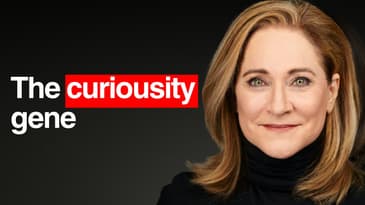
Three decades later, she had held senior leadership roles across four Fortune 50 brands (Frito-Lay, Coca-Cola, Jack Daniel's, and Humana), spent nearly 17 years building Humana's Leadership Institute, performed a one-woman off-Broadway show, and written The Curiosity Curve, a research-backed leadership book published by Fast Company Press in October 2025.
In this episode of Inspiring Women, she sits down with Laurie McGraw to unpack what tied all of it together: curiosity.
It started with a single question.
During a Humana board meeting, then-CEO Bruce Broussard leaned over and quietly asked her, "Do you think curiosity can be learned, or is it innate?" Debra promised she'd find out.
What followed was a trip to Italy where she noticed Europeans had fundamentally different conversations than Americans, a Gallup engagement report showing the lowest numbers in the firm's history, and ultimately a multi-year research project (commissioned with researchers out of MIT) that produced something no one had measured before: a direct correlation between a leader's level of curiosity and the performance of their team.
In this conversation, Debra explains:
Why curiosity is a state and not a trait (which means it can be built)The four-factor framework behind The Curiosity Curve: exploration, inspirational creativity, focused engagement, and openness to new ideasThe Coca-Cola moment that nearly cost her a job, until a former chief of staff told her, "Unless Tom asks for something three times, take no action"
She also opens up about leaving Humana to write the book, getting talked into an off-Broadway debut by her mastermind group, and what she learned about borrowing other people's belief in you until you can own it yourself.
The episode closes on what may be the most important leadership skill of the AI era.
As Debra puts it, AI levels the playing field because anyone with a phone can now get the answer. The edge belongs to the leaders who ask the boldest questions: What are we not asking? What signals are we missing?
And for women specifically, her research surfaced a striking finding. Men and women score equally on curiosity, but women don't show up as curious in the room. Her closing message is a challenge to change that.
Topics Covered:
1) From a Frito-Lay route truck to the Humana boardroom, and why starting at the bottom built her credibility
2) The boardroom moment with Bruce Broussard that sparked a multi-year research project on curiosity
3) An Italian train ride, an American joke, and the conversational habit it exposed
4) Why Gallup's worst-ever engagement report pointed to a missing ingredient in leadership
5) Commissioning MIT researchers and the direct correlation they found between curiosity and team performance
6) The four factors of The Curiosity Curve: exploration, inspirational creativity, focused engagement, and openness to new ideas
7) A Coca-Cola chief of staff lesson on knowing how your boss processes information
8) Building Humana's Leadership Institute through the company's shift from insurance company to health company
9) Leaving Humana to write the book, and getting talked into A Curious Woman off-Broadway by her mastermind group
10) Why AI raises the floor for everyone and makes question quality the real differentiatorHer message to women: ask more questions in the room, and say your point of view out loud
Debra's career arc, route driver to Fortune 50 executive to author to performer, is itself an argument for the thesis of her book.
Curiosity is what makes the pivots possible.
And in a moment when answers are cheap and questions are scarce, the leaders who keep asking what are we missing? will be the ones who actually move things forward.