
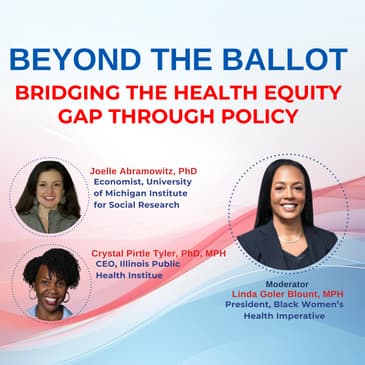

This episode is part of “Beyond the Ballot | Voting for Women's Health and Advocating for Change”, a three-part webinar series transformed into six podcast episodes. Brought to you by Beyond the Paper Gown, Black Women’s Health Imperative, G2G Consulting, and HealthyWomen, this series explores the vital link between policy and women’s health. In this episode, the panel discusses systemic disparities affecting women's health, particularly among communities of color. Topics include Medicaid expansion, maternal mortality, and the need for inclusive research, emphasizing how policy changes can foster true health equity. As you head to the polls, consider how your vote can influence policies that break down healthcare barriers and promote better outcomes for all women. Don’t miss this episode!
Please visit Beyond the Paper Gown to join our community and to learn more about achieving your optimal health.
SHOW NOTES:
Learn more about Beyond the Ballot | Voting for Women’s Health and Advocating for Change
[00:00:13] Hi, welcome to Beyond The Paper Gown. I'm Dr. Mitzi Krockover. You know, when I created this podcast, I had a vision to shine a light on many factors that shape our health and well-being. Think about it. Our physical conditions, the differences between men and women's health, the impact of research or lack thereof, and even our social and environmental circumstances. They're all interconnected and they all play a crucial role in our overall health. But there's one factor that ties all over the world.
[00:00:43] We're all of these together. Policy. It's the invisible hand that guides research priorities, healthcare access, and even our daily environments. That's why we launched a special series of webinars called Beyond the Ballot to take a look into how policy shapes women's health. This podcast is one of six that are taken from these webinars, which are a collaboration between Beyond the Paper Gown, G2G Consulting, the Black Women's Health Imperative, and Healthy Women Online Magazine.
[00:01:12] I also want to thank our gold sponsor, Procter & Gamble, and our silver sponsor, Materna Medical, for helping to make this series possible.
[00:01:30] In today's episode, we go beyond the statistics and learn about the systemic disparities that affect women's health, especially for communities of color.
[00:01:39] The expert panelists will discuss the necessary policies that can dismantle barriers to healthcare and improve outcomes for all women.
[00:01:47] Whether it's expanding Medicaid, addressing maternal mortality, or rethinking clinical research, this discussion illustrates the policies that shape our healthcare system and what needs to change to promote true health equity.
[00:02:01] In this podcast, you'll hear the White House Women's Health Research Initiative mentioned.
[00:02:06] To give you some background, the initiative is part of a broader effort by the U.S. government to address gender disparities in healthcare and to ensure that women's health research receives the necessary attention and funding.
[00:02:19] This initiative focuses on promoting research into diseases and conditions that disproportionately affect women, improving clinical trial diversity, and ensuring that sex and gender differences are considered in medical research.
[00:02:34] The moderator of the panel is Linda Goler Blount, president of the Black Women's Health Imperative.
[00:02:40] She's joined by Dr. Crystal Pertle-Tyler, CEO of the Illinois Public Health Institute, and Dr. Joelle Abramowitz, associate research scientist at the University of Michigan and co-director at the Michigan Federal Statistical Research Data Center.
[00:02:56] What we have known for years and years and years when it comes to research in women's health is we should not be treated like female versions of men, which is how we've been treated for decades.
[00:03:08] And so now we're finally understanding how important sex differences are.
[00:03:14] And we've seen that and we heard it in this conversation.
[00:03:17] And I'm just thrilled to continue from a policy perspective.
[00:03:22] We are diving into a critical conversation that goes beyond numbers and statistics, one that challenges us to really explore solutions that can transform the future of healthcare and consider the policies that determine women's health outcomes.
[00:03:41] As Ms. Nancy said, I'm Linda Goler Blount, president of the Black Women's Health Imperative, chair of the Rare Disease Diversity Coalition.
[00:03:48] Today we'll unpack some of the complex web of policy implications affecting health equity.
[00:03:55] And while many of us are familiar with the often cited statistics like, for example, Black women face a 42% higher mortality rate from breast cancer, or their maternal mortality rate is three times that of white women.
[00:04:08] And Hispanic women are 40% more likely to be diagnosed with cervical cancer and 20% more likely to, and have 20% higher rates of unintended pregnancies than white women.
[00:04:20] These numbers tell only a part of the story.
[00:04:24] The question we have to ask ourselves today is how do we move from awareness to action?
[00:04:31] What policies are needed that will not only acknowledge these disparities, but dismantle the systems and the barriers that perpetuate them?
[00:04:42] One thing we know for sure is that these disparities and many more are caused by the lack of access to the standard of care, lack of representation in clinical research, lack of available resources like insurance, workplace supports, access points, trained professionals.
[00:05:00] They are not caused by genetics or biology.
[00:05:04] Our panelists will offer insights into crucial policy actions that promote women's health.
[00:05:10] So joining me on the panel today are two esteemed experts, Dr. Joelle Abramowitz, Associate Research Scientist at the University of Michigan and Co-Director at the Michigan Federal Statistical Research Data Center, and Dr. Crystal Pertle-Tyler, CEO of the Illinois Public Health Institute.
[00:05:30] And you will find their bios and background and much more information about their incredible accomplishments in the advanced information.
[00:05:39] So, Joelle, let me begin with you.
[00:05:43] Access to quality health care before, during, and after pregnancy is crucial for the health of both mothers and infants.
[00:05:52] Medicaid plays a significant role in providing that care, especially for people of color and low-income families.
[00:05:59] But as they say, if you've seen one Medicaid program, you've seen one Medicaid program.
[00:06:04] So let's examine Medicaid's impact.
[00:06:08] Since a significant portion of the births are covered, what has been the effect on maternal and infant mortality in states that have adopted the ACA or expanded Medicaid and where Medicaid extends to full postpartum coverage?
[00:06:26] And has there been any impact on maternal and has there been any impact on maternal and infant health in those states that have not adopted the ACA or expanded Medicaid?
[00:06:37] Yeah, thanks so much for that question, Linda.
[00:06:40] So just to provide some background, that before the ACA expansions, Medicaid was available or was mandated to be available for pregnant women up to 60 days after birth.
[00:06:55] But that was the only requirement.
[00:06:58] And so by expanding Medicaid through the ACA expansions, now women were able to obtain Medicaid prior to pregnancy and to continue it after pregnancy in the states that expanded.
[00:07:17] And we've seen huge positive effects as a result of that.
[00:07:22] So certainly much better outcomes in those states that have expanded compared to those that haven't.
[00:07:27] We've seen it on a number of outcomes from having health insurance, including before, during and after pregnancy, because now women are having more avenues for getting that coverage.
[00:07:38] We've seen it in health outcomes before pregnancy, which going back to something we talked about on the last panel that, you know, it's not just about pregnancy, right?
[00:07:49] Women's health before pregnancy matters for for both when they're pregnant and for their lives overall.
[00:07:56] So we're seeing better health outcomes then, better utilization of care, even before pregnancy.
[00:08:04] During pregnancy, we're seeing better outcomes after pregnancy as well, including less maternal mortality, as well as less infant mortality, which are all really important outcomes.
[00:08:17] And is there a significant difference in states?
[00:08:25] I live in Georgia.
[00:08:27] We're special here, which has not obviously expanded Medicaid.
[00:08:35] Are you seeing is it too early to tell if there's differences?
[00:08:38] Are you seeing some differences in both preconception care, prenatal care, postpartum care and outcomes in these states where, you know, no, no ACA, no expansion of Medicaid?
[00:08:52] Absolutely.
[00:08:53] So in states that have expanded, we've seen greater use of contraception, which is enabling women to better time when they have a pregnancy, which is pregnancy is it's a really dangerous experience.
[00:09:07] So being able to have more control of that is really important.
[00:09:11] We've also seen we think about other types of care that are really important in general, better access to medications for dealing with opioid use disorder prior to pregnancy.
[00:09:24] So so that's really important as well.
[00:09:27] We're seeing more utilization of the care during pregnancy.
[00:09:35] So really across the board, just better access to health care related to pregnancy and also not related to pregnancy.
[00:09:46] So, you know, the Medicaid program is varies by state.
[00:09:50] Obviously, they're not all the same.
[00:09:53] But if you're sort of looking into your crystal ball, what more needs to be done in the Medicaid program?
[00:10:00] One, I mean, it covers almost half of all births, but also what needs to happen for commercial insurance to improve maternal health outcomes.
[00:10:11] I'm thinking, you know, policy is obviously connected to maternal mortality.
[00:10:16] We tend to use white women in this country as our standard of comparison.
[00:10:22] But the U.S. is, in fact, last among developed countries when it comes to maternal mortality.
[00:10:27] So I don't know that that's the right comparison.
[00:10:29] How how do we get that rising tide to actually lift all maternal ships?
[00:10:37] So certainly we still have 10 states that haven't expanded Medicaid.
[00:10:41] So that's a great place to start.
[00:10:44] We've seen all these great advancements in the states that have expanded.
[00:10:48] So so that would be one way.
[00:10:50] But also even within Medicaid of when we think about these state differences, some states have copays, some don't.
[00:10:57] And we know that makes a big difference in how people access care.
[00:11:00] So thinking about some of these details can make a big difference.
[00:11:05] You know, also, when we think about people being able to stay on their insurance, this was something we saw during the pandemic, that people were not disenrolled from Medicaid.
[00:11:15] And that can make a huge difference in being able to have continuous coverage to be able to seek care when you need it.
[00:11:21] So I think that's something we could should definitely be thinking about as we think about people potentially churning from Medicaid to being uninsured or being on commercial insurance.
[00:11:32] And we all know that every insurance plan that you have has different rules and different providers.
[00:11:38] And it's really a barrier to care.
[00:11:42] And, you know, but thinking more broadly, we have to think about, too, the types of policies that you have at a hospital.
[00:11:49] Right. When there's a birth and really implementing standards so that, you know, we have the best practices for addressing maternal health.
[00:12:04] And also, you know, is there a provider nearby?
[00:12:12] Can someone have transportation to get to that provider?
[00:12:16] Can they take time off work to be able to go?
[00:12:19] Do they have child care?
[00:12:19] So it's really a holistic question that's not just about, you know, what what care is available and how it's financed, but more broadly about the entire system.
[00:12:35] Yeah.
[00:12:35] And that's a really important point.
[00:12:37] We need, obviously, policies around health care, but we need policies around the way women actually live to actually make health care accessible and easy to take advantage of.
[00:12:52] And if I'm a low income and I drive two hours to maternity to my care appointment, you know, prenatal care may just be out of the question.
[00:13:02] So, Crystal, kind of keeping in that same theme, but also, you know, going back to the previous panel, we there was a discussion about the executive order and the White House initiative on women's health research by President Biden.
[00:13:18] And he was joined by First Lady Dr. Jill Biden.
[00:13:22] So I'm also in agreement.
[00:13:25] A National Institute of Women's Health would be lovely and just give that institute $12 billion and we'd be fine.
[00:13:30] So I know we're still waiting on that to be approved, but a center of excellence for women's health would be wonderful.
[00:13:35] But a lot of the conversation around that announcement talked about addressing health equity.
[00:13:43] So what are the key gaps that the initiative could address?
[00:13:49] And also, I want to I want you to talk a little bit about how these gaps, how these gaps impact sort of the everyday woman, particularly women in low income and underserved communities.
[00:14:01] And as we think about this funding, we do know that the vast majority of health disparities funding goes to big research institutions and organizations that don't have a specific strategic focus on people of color.
[00:14:17] So what is the role of policy in making sure that those resources get to places where they need where they're needed?
[00:14:25] Yeah, I appreciate the question. Thanks so much for having me.
[00:14:29] I'll say a couple of things because this panel really is focused on equity and how we ensure and advance equity.
[00:14:35] So I'll say the initiative was incredible. It was a landmark investment.
[00:14:40] It's a really big deal for women's health, for the health of birthing people.
[00:14:43] And when I say women, you know, I'm being expansive, gender nonconforming.
[00:14:48] So I don't I don't want to dismiss groups of individuals who may not identify as women, but whose bodies could benefit from the research and the funding that was given.
[00:14:57] So it was incredible. And it did a number of things that I think really advance equity.
[00:15:04] First, you know, it talks about funding not just to NIH, but across federal agencies that affect a range of diseases and conditions.
[00:15:12] And I think this is really important because women's health is not just affected by the research and funding that comes from the National Institutes of Health.
[00:15:20] It's affected by the things that come out of the FDA.
[00:15:24] It's affected by the things that come out of the Department of Defense.
[00:15:27] So really, any federal agency has an impact on the health of women and birthing people.
[00:15:33] And so this would allow for funding if funding is sent out.
[00:15:36] It would allow for funding to really center women across all of these different agencies.
[00:15:40] The other thing that I think is really important is that it thinks about women or birthing people as whole beings outside of solely their reproductive capabilities.
[00:15:49] And we know we heard from prior sessions that funding for for women's health has women's health is underfunded.
[00:15:55] And if it is funded, it tends to be centered on the fact that we can reproduce, which is a fantastic thing.
[00:16:01] We need funding for that. But we're also whole people, regardless of whether we decide to reproduce.
[00:16:07] So the fact that it allows funding for things that disproportionately or differently affect women, rheumatoid arthritis,
[00:16:14] arthritis, menopause, things that that all of us will experience, but that have significant disparities for subgroups.
[00:16:23] There's opportunities for research in those areas. But in order for that research and that funding to actually have an impact on health equity,
[00:16:30] it needs to consider the things that affect health equity.
[00:16:34] So I'm talking about those social and structural things, the conditions that people are born in,
[00:16:40] the conditions that they live in, the places that they work, the transportation that they're able to take.
[00:16:45] And those things are affected by the distribution of money and power at an individual level and at a federal level.
[00:16:52] And those things are impacted by discrimination and bias and racism.
[00:16:57] And so when we think about this huge initiative on women's health, I think it's incredible.
[00:17:02] I think it's important. But unless the funding specifically directs research and activities and interventions that address those structural racism pieces,
[00:17:12] those policies, those things that have been ingrained in our society, it will not do anything to affect disparities in those particular outcomes.
[00:17:20] So that's the big piece. The other part that I'll add, I know, the other part that I'll add is that the federal government,
[00:17:28] I think, is moving in the right direction, not just because of this research, but because of the way that they're funding other pieces.
[00:17:35] Kudos to the federal government and to Medicaid, who are saying, you know, we recognize that where a person lives and their transportation
[00:17:41] and the availability of childcare, the availability of healthy food all impacts health.
[00:17:46] So they are now starting to fund work around health related social needs.
[00:17:50] I don't know that that was clearly articulated in a way that makes people go out and do research differently.
[00:17:57] And that initiative. So my hope is that when research is happening, they're considering the whole person,
[00:18:02] not just the reproductive capabilities, but where they live, where they work, where they play, what they eat,
[00:18:07] their transportation, their childcare needs, and how that affects their health outcomes as well.
[00:18:12] Well, you said something that was, among many things, quite remarkable.
[00:18:16] And it certainly ties into what Joella said in the previous panel.
[00:18:22] But it's this notion of power.
[00:18:25] So as we look at the role of policymakers and healthcare providers and research institutions,
[00:18:30] and everybody's talking about health equity, and I would just as an aside say that we don't all have the same definition
[00:18:37] of health equity and the same measures of success.
[00:18:42] But how do we incorporate power into our research and our policy research and the implementation
[00:18:52] or adherence to policies?
[00:18:54] Because I understand what you're saying.
[00:18:57] We're not going to get there if we don't deal with these fundamental imbalances.
[00:19:03] I love that question. And I will say, a lot of folks say, well, power can be given, power can be taken away.
[00:19:10] But I would, and that is true in a lot of ways, I would argue that, you know, community, when I think about power,
[00:19:16] I think of community voices. I think of individuals who have been most affected,
[00:19:20] who have sort of been pushed to the margins when it comes to their health, but when it comes to other areas.
[00:19:25] I mean, this is a policy discussion.
[00:19:27] We're talking about civic power and engagement, economic power and engagement, racial justice and power and engagement.
[00:19:33] All of these things are related to our health.
[00:19:35] So I think it's a matter of community members who are most affected, who have been pushed to the margins,
[00:19:41] coming back and saying, we're not doing that.
[00:19:43] This is what we demand.
[00:19:44] And these are the things that we think should happen.
[00:19:47] So I think it is on us as professionals in this space to really make sure that we're elevating and centering the voices
[00:19:56] and perspectives of folks who have been marginalized and pushed to the side.
[00:19:59] And when we take our privilege and do that, that means that folks have power and voice and say to make sure
[00:20:07] that the outcomes that they want to have for themselves, that those things are able to happen.
[00:20:13] There's also some power we have at the ballot box as well.
[00:20:21] Joelle, sort of along those same lines, you know, we think of policy happening among lawmakers at the federal level or the state level,
[00:20:30] but policy happens in a number of different places.
[00:20:33] And so we often underestimate the impact of external forces on health.
[00:20:38] For example, the USPSTF, the United States Preventive Services Task Force,
[00:20:43] sets guidelines that determine insurance coverage for cancer screenings, as an example.
[00:20:50] So there are threats to contraceptive access, preventive care, clinical trial participation from a variety of sources.
[00:20:58] From a policy perspective, what is it that we need to know or do to make sure that women receive the standard of care?
[00:21:09] I think, you know, building on everything we've been talking about, that it's really,
[00:21:15] if only there were one way that we could, you know, just, you know, solve these issues, it would be wonderful.
[00:21:21] But it's really at so many different levels that we need to address this.
[00:21:25] And certainly voting, right?
[00:21:28] And, you know, showing up at the ballot box to advocate and vote for initiatives that promote women's health is one way to do that.
[00:21:41] But it's more than that.
[00:21:43] And it's at both on the policy level, on the legislative level, in terms of who we elect and the initiatives that we vote for.
[00:21:54] But also, you know, in our workplaces, right?
[00:21:57] The kinds of policies that we have, you know, in our state regulations, right, that aren't part of the legislative system,
[00:22:07] but can have a big impact on, you know, what's covered and these sorts of things.
[00:22:15] So, really, all of these things work together.
[00:22:18] You know, when we think about the last panel about new technologies, right, that are being developed, which is, you know, so exciting.
[00:22:28] And then we think about, but how can we actually get those two people, right, in a way that is accessible and is affordable?
[00:22:36] What does that mean, you know, with the intersections with the insurance system and laws there?
[00:22:41] And then, you know, in actually enabling, right, these different areas that we talked about, like, you know,
[00:22:52] maybe it's paid family leave and paid sick leave and other, you know, structural disparities that we see to really have to think about this in a holistic way.
[00:23:06] Yeah.
[00:23:08] Crystal, you know, when we think about innovation and therapeutic development or med tech, effective interventions are always disparities producing because people with resources get access to them first.
[00:23:24] So, as you think about recent changes, policy changes in women's health that have been significant, that have had an impact,
[00:23:31] think about kind of where we're going in this area of sort of innovation and what the policy implications could be.
[00:23:39] Well, you know, how should policymakers, how should industry even respond as we, you know, we don't want to innovate just for the sake of innovation,
[00:23:48] but what is the role of policy to make sure that innovation actually does reach everyone?
[00:23:54] Yeah, it's such an important question.
[00:23:56] And I think the point that you made before asking the question is an important one that I don't hear enough.
[00:24:01] And that's that just because you create an innovation that improves the health of individuals,
[00:24:08] if you don't actively target and seek out and ensure that that innovation goes to those who are most harmed,
[00:24:14] then you're actively causing harm and increasing more disparities.
[00:24:19] And that's a really, really important thing to understand.
[00:24:22] So, from a policy perspective, I think policymakers and innovators in the space and funders in the space need to understand that piece,
[00:24:31] that if you aren't with your funding requiring that that new innovation, that new product, that new service line,
[00:24:39] that super awesome technology that saves everybody's life,
[00:24:42] if you aren't requiring that that technology, that product, that service goes to those who are most harmed,
[00:24:48] then you're making things worse.
[00:24:50] So, I think that's one piece.
[00:24:53] Actually, that's the most important thing, I would say.
[00:24:55] Actually, it's not.
[00:24:56] The second piece that I'll say is when innovators are creating these products and services and technologies,
[00:25:06] they need to include not just one or two or 10,
[00:25:09] they need to include a sizable number of individuals who experience inequities in that particular outcome
[00:25:16] to ensure that that innovation, that technology, that service line actually works for those individuals.
[00:25:22] Because if they don't do that, they are actively causing harm.
[00:25:27] And the third thing, the third thing I'll say is because women's health tends to be funded off over here in a separate area,
[00:25:34] it's assumed that if you're funding women's health, you're addressing disparities and inequities.
[00:25:40] And that's not necessarily true because women are not a monolith.
[00:25:45] There are subgroups within women.
[00:25:47] And women's health by itself, funding, does not address disparities.
[00:25:51] You need to specifically target individuals who are experiencing disparities within that women's health category in order to target disparities.
[00:26:00] Very important point is we tend to conflate women with that underserved group and that women are underserved.
[00:26:08] From both of you, and Joelle, we'll start with you and then end with you, Crystal.
[00:26:12] What is the one, and this is probably unfair, but the one key takeaway for this group to know about policy and women's health?
[00:26:20] I would say one key takeaway is that we need to make our voices heard.
[00:26:32] We need to, you know, and it's across a number of areas, but, you know, we know that there are structures and policies that historically have not been set up to, you know, address these needs.
[00:26:52] And amplify these voices.
[00:26:54] And so I think that would be the main, my main takeaway.
[00:26:59] Crystal?
[00:27:00] My main point would be that women don't live their lives in these silos that our funding dictates that women and birthing people are whole beings that live in communities that require all sorts of needs in order to be healthy.
[00:27:19] And the funding and the funding and the policies that we are pushing for, that we're voting for, should consider us within the context of reality.
[00:27:30] So consider our housing, consider our food, consider our health care as well.
[00:27:35] That's what's going to push towards equity and health for all.
[00:27:39] Thank you both so much.
[00:27:41] I agree.
[00:27:42] Reality-based policy.
[00:27:43] Thank you so much for joining me today.
[00:27:51] And that wraps our episode up on women's health policy and health equity.
[00:27:55] We've covered a lot of ground today from the importance of Medicaid expansion to the need for inclusive research and innovation.
[00:28:02] As Dr. Crystal Pertl Tyler pointed out, women don't live their lives in silos and our policies shouldn't treat them as if they do.
[00:28:11] We need holistic approaches that consider all aspects of women's lives.
[00:28:16] If you want to see the webinar series in its entirety and learn more about our panelists, I invite you to visit beyondthepapergown.com.
[00:28:24] You'll also find resources you can use to learn more about these issues.
[00:28:28] And while you're there, please sign up for our newsletter so you'll get information on our upcoming podcast and webinars as well as news and events.
[00:28:36] Thank you as always for tuning in.
[00:28:38] If you've been inspired by today's discussion, here's your call to action.
[00:28:42] Make a plan to vote in our upcoming elections and invite a friend or family member to do the same.
[00:28:49] All voices matter in shaping the policies that affect the health of women.
[00:28:54] Take good care.
[00:29:01] Our podcast is produced by Patrick Shambayati and me, and our assistant producer is Kyla McMillian.