
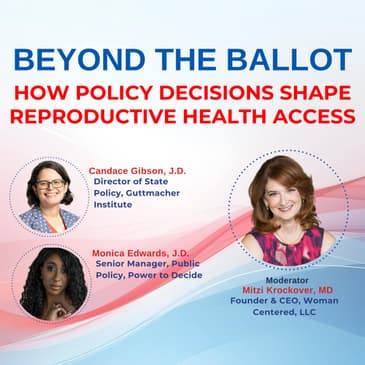

This episode is part of Beyond the Ballot | Voting for Women's Health and Advocating for Change, a three-part webinar series transformed into six podcast episodes. Presented by Beyond the Paper Gown, Black Women’s Health Imperative, G2G Consulting, and HealthyWomen, this series examines how policy shapes women’s health. In this episode, the expert panel discusses the wide-reaching impact of reproductive health policies in the wake of the Dobbs decision, exploring issues from abortion restrictions to maternal care deserts and rising maternal mortality rates. Our experts delve into how access to contraception, comprehensive sex education, and protective measures for survivors of domestic violence intersect with reproductive rights, shedding light on the far-reaching consequences of current policies. Don’t miss this episode!
Please visit Beyond the Paper Gown to join our community and to learn more about achieving your optimal health.
SHOW NOTES:
Learn more about Beyond the Ballot | Voting for Women’s Health and Advocating for Change
[00:00:22] Welcome to Beyond The Paper Gown. I'm your host, Dr. Mitzi Krockover. You know, when I created this podcast, I had a vision to shine a light on the many factors that shape our health and well-being. Think about it. Our physical conditions, the differences between men and women's health, the impact of research or lack thereof, and even our social and environmental circumstances. They're all interconnected and they all play a crucial role in the world.
[00:00:52] And our overall health. But there's one factor that ties all of these together. Policy. It's the invisible hand that guides research priorities, health care access, and even our daily environments. That's why we launched a special series of webinars called Beyond The Ballot to take a look into how policy shapes women's health. This podcast and others that will follow are taken from those webinars, which are a collaboration between Beyond The Paper Gown,
[00:01:21] G2G Consulting, the Black Women's Health Imperative and Healthy Women, and Healthy Women. And I also want to thank our gold sponsor, Procter & Gamble and our silver sponsor, Materna Health for helping to make this series possible.
[00:01:35] In this episode, we're diving into a topic that's at the heart of today's social and political debates. The ripple effects of the Dobbs decision that reversed Roe v. Wade's federal right to abortion and the state of reproductive health in America. Since this landmark ruling, women's reproductive rights and access to essential health services have changed dramatically, affecting millions across the country. But there's more to this story than what you might see in the headlines.
[00:02:02] In this episode, we'll explore not only the impact on abortion rights, but also the broader issues around access to contraceptives and even the unforeseen challenges facing in vitro fertilization.
[00:02:14] We'll also uncover the links between reproductive policy and issues like intimate partner violence and maternal health deserts, showing how interconnected these policies are with everyday lives.
[00:02:26] I'm joined by two incredible experts, Monica Edwards, who's senior manager of public policy at Power to Decide, and Candace Gibson, director of state policy at the Guttmacher Institute.
[00:02:38] Both bring a wealth of knowledge to help us understand the data, the real world impacts, and what's at stake for women's health in this new landscape.
[00:02:46] Thank you for joining us as we delve into these pressing topics and break down complex policies into the realities affecting women daily.
[00:03:10] It's no secret that the Dobbs decision and legislative actions in nearly half the states have upended reproductive freedoms and access to reproductive health care.
[00:03:22] Our first panel will explore some of the ramifications of current policy changes.
[00:03:28] This panel will be moderated by Dr. Mitzi Krakover.
[00:03:31] Dr. Krakover is a dedicated women's health advocate, serving as the founder and CEO of Women's Centered LLC,
[00:03:38] and host of Beyond the Paper Gown.
[00:03:42] She is also a managing director at Golden Seeds, an angel investment organization, and co-leads its health sector committee.
[00:03:51] She has held notable roles in healthcare management and women's health, including as the founding meadow director of the Iris Care,
[00:03:59] UCLA Women's Health Center, and as VP of Women's Health at Humana.
[00:04:05] Dr. Krakover, we welcome you, and the screen is yours.
[00:04:10] Thank you so much, Linda.
[00:04:12] As Linda spoke about, this panel is focusing on reproductive rights, and certainly we can't discuss that topic
[00:04:19] without exploring the profound changes and challenges in the wake of the Dobbs decision.
[00:04:24] In fact, this is what probably first comes to mind when we talk about the effect of policy on women's health.
[00:04:31] Obviously, it's a topic that engenders strong feelings.
[00:04:34] We are going to focus our discussion on data and facts.
[00:04:38] In that vein, let me set the stage.
[00:04:41] The Dobbs decision in June 2022 overturned Roe v. Wade, eliminating the federal constitutional right to abortion.
[00:04:49] This has allowed states to enact more restrictive laws.
[00:04:52] As of October 2024, 14 states have near-total abortion bans in effect, and an additional nine states have laws that significantly restrict abortion access.
[00:05:04] Over 60 million women of reproductive age, or one in three, now live in states where abortion is banned or significantly restricted.
[00:05:14] Our discussion today will touch on the results, some intended, unintended, I should say, but not unexpected, of this decision.
[00:05:23] And so with all these facts in mind, let's get started.
[00:05:26] I want to welcome our esteemed panelists, Monica Edwards and Candace Gibson.
[00:05:31] Monica and Candace, please take a moment and introduce yourselves.
[00:05:35] And why don't we start with you, Monica?
[00:05:39] Thank you, Dr. Krockover.
[00:05:40] Hi, everyone.
[00:05:41] My name is Monica Edwards.
[00:05:43] I use she, her pronouns.
[00:05:44] I'm the senior manager of public policy at Power to Decide.
[00:05:48] Thank you.
[00:05:49] Candace?
[00:05:50] Thank you.
[00:05:51] Thank you, Dr. Krockover and to Black Women's Health Imperative and to your sponsors for having this, you know, for having this conversation.
[00:05:58] I'm Candace Gibson.
[00:06:00] I'm the director of state policy of the Guttmacher Institute, and pronouns are she, her.
[00:06:05] Thank you both.
[00:06:06] And please call me Mitzi.
[00:06:07] We are all peers and colleagues, and I really appreciate your being here.
[00:06:12] So, Candace, I'll start with you.
[00:06:14] I mentioned in my introduction that the states have made their own choices when it comes to enacting abortion laws.
[00:06:21] How does the state-level policies on abortion access impact women's health outcomes, particularly in relationship to maternal mortality rates, as well as the creation of maternal care deserts?
[00:06:34] Yeah, no, thanks Mitzi for that question.
[00:06:36] So, I think at the moment, we are still trying to understand how abortion bans and restrictions affect maternal health.
[00:06:45] I think, you know, leading up to the Dobbs decision and even afterwards, there's been a number of analyses that have been produced that, you know, shows that states where abortion is more restricted or banned have fewer maternal health care providers, more maternity care deserts, and higher rates of both maternal and infant deaths than states where abortion is available.
[00:07:07] And, you know, really highlights how you can't silo abortion care from the full range of sexual and reproductive health care and maternal health care that people need.
[00:07:17] I'll also note, too, quickly, that researchers have provided preliminary estimates regarding the risk of maternal mortality for individuals if there was a national ban on abortion to be enacted.
[00:07:31] And assuming that abortions were banned in all states, at the highest end, maternal mortality would increase by 24%.
[00:07:40] You know, we've seen or perhaps heard a lot in the news between this connection between abortions and maternal mortality.
[00:07:48] And I think that many of us think about abortion as elective abortions for an unwanted pregnancy.
[00:07:56] But can you just define or explain that specific relationship between restriction of abortion and maternal mortality in women that are pregnant and trying to carry their babies to term?
[00:08:11] So I think, Mitzi, I think they're still trying to draw out that connection between, you know, the impact of abortion bans and restrictions on and on maternal health, right?
[00:08:21] I think, you know, what we have been seeing with, you know, abortion bans and restrictions is that the exceptions that often are part of these bans are often unworkable, right?
[00:08:33] And so you have seen the rise of, right, of, of, not rise, but I should say, but this confusion around, you know, what providers can provide care when individuals are showing up to emergency rooms, right?
[00:08:47] We most recently saw the reporting about the deaths of Amber Thurman and Candy Miller, you know, where these deaths were preventable, right?
[00:08:55] But because of Georgia's six-week abortion ban in place, they were unable to get the care that they need.
[00:09:03] Because I, not to put words in your mouth, but that the physicians' providers felt like their hands were tied because they weren't sure at what point they could intervene.
[00:09:12] Right, exactly.
[00:09:13] I think in the case of, you know, Amber Thurman, right, they didn't, you know, they delayed lifesaving care.
[00:09:19] And then in, you know, the case of Candy Miller, right, I think there was just so much fear and concern about whether they can go to the providers, right?
[00:09:28] Because there is now sort of a hostile environment in the states when it comes to abortion care, right?
[00:09:35] And so for many individuals, they are concerned about being criminalized, right?
[00:09:39] Or that their family members and member and, you know, friends who would support them could also be criminalized.
[00:09:45] Thank you.
[00:09:47] So, Monica, obviously, when we're talking about abortion with respect to unwanted pregnancies or what we call elective abortions,
[00:09:58] the idea would be to reduce those numbers of unwanted pregnancies.
[00:10:02] And when you and I and Candace spoke, you connected this issue with the current policies that affect access to sex education and contraception, especially for young people.
[00:10:17] Can you tell us a little bit about that?
[00:10:19] Sure, of course.
[00:10:20] I think this all goes down to, comes back to reproductive justice or RJ.
[00:10:25] And to just be clear, power to decide it's not a reproductive justice organization, nor does it do RJ work.
[00:10:30] But I am able to talk a little bit about that intersection just because of my previous role at RJ organizations.
[00:10:36] So for people who don't know, reproductive justice is a critical framework and movement officially coined and started by Black women in the 90s.
[00:10:43] But it has been a framework that has been fought for by trans and gender expansive folks and women of color even before it was officially coined.
[00:10:51] Sister Song, one of the many pivotal RJ organizations, defines RJ as the human right to maintain personal bodily autonomy,
[00:10:57] to have children, to not have children, and to parent the children we have in safe and sustainable communities.
[00:11:03] And that is why things like access to contraception, and specifically the contraceptive method of your choice,
[00:11:10] and or access to sex education is so important.
[00:11:13] And it's one of the many issues that fall under reproductive justice because it reaffirms the principles of self-determination and bodily autonomy.
[00:11:21] For example, having not only contraception, but access to the contraceptive method of your choice is an important part of supporting one's ability to make decisions about their health,
[00:11:31] how to plan or prevent pregnancy, et cetera.
[00:11:34] Additionally, with comprehensive sex education, evidence-based and unbiased sex education gives young people,
[00:11:40] and frankly all people, information that helps inform them about their bodies, their relationships, about sex, about sexual health.
[00:11:48] But unfortunately, in many places across the country, policies in place negatively impact both contraceptive access,
[00:11:55] as well as access to comprehensive sex education.
[00:11:59] So for example, more than 19 million women of reproductive age living in the U.S.
[00:12:03] are in need of publicly funded contraception, and they live in contraceptive deserts,
[00:12:08] which means they don't have access to a county health center that provides the full range of methods.
[00:12:14] And similarly, with comprehensive sex education, because there is no federal bill that really dictates how comprehensive sex ed is laid out in states.
[00:12:23] It really is a state-level and, frankly, district-level issue.
[00:12:27] That means we have a patchwork of young people who are receiving sex ed, who are not receiving sex ed,
[00:12:32] or maybe they're receiving sex ed, but it's very shamey, abstinence-based, not affirming if you're LGBTQ.
[00:12:38] And I think without that access to information and access to health services, that really impacts the ability for someone to self-determine their own lives.
[00:12:49] Do you see, and I apologize if this is a pop-up question, but do you see a connection between the Dobbs decision impacting on contraception availability?
[00:13:02] Yeah, of course. Even post-ops, actually Power to Decide recently just did a Your Health survey where we surveyed young people across the country,
[00:13:12] and we found that a lot of those young people were unable to get access to contraceptive,
[00:13:18] or they had delays and barriers getting access to that contraceptive, right?
[00:13:22] And so when you are in the landscape where we're in, where it really is a patchwork of you may have abortion access,
[00:13:28] you might have abortion access with restrictions, you may have the travel for that care, right?
[00:13:32] This is not just impacting an abortion. A lot of those states with abortion bands on the books or restrictions on abortion,
[00:13:40] restrictions on contraception are also some of the same states that have sex education where it's not affirming for young people.
[00:13:46] It's not affirming if you are a person of color or if you're LGBTQ+, if you're trans or gender expansive, right?
[00:13:53] It's really not affirming. And so to continue to see laws that impact people's bodily autonomy, their reproductive health, right?
[00:14:01] It's not new, and it really is a playbook from anti-abortion advocates and policymakers.
[00:14:08] Okay. Thank you.
[00:14:09] So Candice, moving to another adjacent issue is this whole concept of IVF and the effect of the Dobbs decision with in vitro fertilization.
[00:14:28] Can you explain just so we can level set what the connection is and what the ramifications are?
[00:14:36] Yeah, no, thanks so much, Mitzi, for that question.
[00:14:38] So I think what the connection is between the Dobbs decision, right, and the Alabama Supreme Court decision that we saw earlier this year, right,
[00:14:48] is that Dobbs really upended this idea that, you know, sexual reproductive health care policy had long been settled, right?
[00:14:57] And I think it really opened the door to various policy and legal ideas and decisions that could significantly alter the health care landscape.
[00:15:09] So in February, in terms of the Alabama Supreme Court, as some of your audience members may know,
[00:15:16] So the Supreme Court in Alabama ruled that embryos created through in vitro fertilization are considered children under the state's wrongful death of a minor law.
[00:15:30] You know, I think the backlash of this decision was, you know, pretty immediate.
[00:15:34] Some providers halted treatment entirely because they were concerned about their own legal risk and liability.
[00:15:42] And therefore, you know, patients can access the care that they need.
[00:15:46] You know, some providers in the state also just terminated their services completely because they just didn't know how they would be able to operate in the future, right?
[00:15:54] And I think as part of this, you know, backlash, we saw that 12, you know, we saw 12 states introduce legislation to provide protections to providers,
[00:16:05] to really clarify their laws about fertilized embryos and the IVF processes.
[00:16:13] But this, I think this decision really, you know, sort of continues to concern people, right?
[00:16:22] Because it was so unprecedented.
[00:16:25] And, you know, this type of legal thinking analysis that was in the decision could threaten other forms of health care, like Monica just mentioned, right?
[00:16:33] Contraception, right?
[00:16:35] Also, you know, down the line, also abortion care and maybe other areas of health care that we're just not thinking about right now.
[00:16:42] Sure. And just to explain, probably everybody understands this, but the whole idea about the relationship with IVF to abortion is that you're looking at the embryo as a person.
[00:16:55] Is that?
[00:16:56] Yeah, that's correct, right?
[00:16:57] So there is this concept of fetal personhood, right, where, you know, the idea is that, you know, embryos and also fetuses have legal rights under this concept of fetal personhood.
[00:17:11] And so, you know, in this decision, right, by the court, they were equating that, you know, embryos had the same legal rights as a child.
[00:17:20] And so this type of concept, fetal personhood, we've seen in, we've seen really advanced in other state laws as well.
[00:17:29] This is not a new idea, but I think more and more of the public is understanding, you know, what are the ramifications of these types of policies.
[00:17:38] Sure. Thank you.
[00:17:42] Monica, shifting a bit from Dobbs right now, one of the most concerning consequences of the pandemic was that many women were locked in with their abusive partners, literally.
[00:17:53] Can you elaborate on the connection between reproductive rights policies and violence against women?
[00:18:02] And how do certain laws like the Violence Against Women Act factor into that larger picture?
[00:18:09] Of course, I think that's a really important question and really important to make, seeing that it is Domestic Violence Awareness Month.
[00:18:17] So just really want to name that.
[00:18:18] Yeah. So when discussing the landmark turn away study that I'm sure many folks know about, led by Dr. Vayan Green Foster, one of the quotes that I remember that she stated was that the abortion debate really focuses on what happens to the pregnant person.
[00:18:34] And so with that study, the turn away study, which followed folks who were able to get abortion care and also folks who were not and kind of documented what happened after they were denied abortion care.
[00:18:45] And we learned that a myriad of ways in which being denied access to abortion intersects with other issues.
[00:18:51] And we found out, of course, with that study, that it also intersected with domestic and intimate partner violence.
[00:18:58] And so unfortunately, that statistic that came from the study was that a person being denied an abortion, among other things, is more likely to stay in contact with an abusive partner.
[00:19:08] Right. And I think the other the larger way in which we can look at the intersection between domestic violence and intimate partner violence and reproductive health is goes back to the ability to self-determine our lives,
[00:19:19] to bodily autonomy and to live and thrive in safe and sustainable communities.
[00:19:24] Right. But our communities are not safe and they're not sustainable if we are in a situation where we're experiencing violence, whether that be domestic or intimate partner violence or state violence.
[00:19:35] And so we already know just statistically that for those experiencing violence, they're statistically more likely to escalate that situation.
[00:19:43] And for those experiencing violence, it's more likely to result in a homicide during pregnancy or after the recent birth of a child.
[00:19:51] But we also learned shortly after the decision in Dobbs in a May 2024 study, it revealed that trap laws, which are targeted regulation of abortion providers,
[00:20:02] was associated with a three point four percent increase of intimate partner violence.
[00:20:06] And so further, we know that homicide, often by an abusive partner, is the leading cause of death for pregnant women.
[00:20:13] So to kind of zoom out a little bit, when you couple the alarming rates of domestic and intimate partner violence,
[00:20:19] especially for indigenous, black and Latinas, with the current chaotic landscape of you might be able to access abortion or you might not,
[00:20:28] or you might be able to access, but you have to go through hurdles to get that care.
[00:20:32] However, it results in the sad reality that you are more likely to experience violence.
[00:20:38] And if you are experiencing violence, that violence is more likely to escalate.
[00:20:42] And so I think it really just goes back to the ability to live and thrive in a safe, sustainable communities.
[00:20:47] And unfortunately, bans on abortion and the Dobbs decision have only exacerbated the violence that survivors are experiencing.
[00:20:55] Talk a little bit also, if you would, about the impact of the Violence Against Women Act.
[00:21:01] Of course. Yeah. So the Violence Against Women Act, or VAWA, was first enacted in 1994.
[00:21:07] And it's most recently been reauthorized in 2022.
[00:21:10] So how VAWA works, it was actually signed in law by now President Joseph Biden.
[00:21:16] But it is reauthorized every five years and usually is tacked onto the annual appropriations bills that come out of Congress to fund the government.
[00:21:24] And so over time, what has been really nice about VAWA is that it has been built upon since 1994.
[00:21:31] It has taken years of lobbying and storytelling by survivors and organizations to get VAWA where it is today.
[00:21:38] So, for example, in the early 90s, when VAWA was first enacted, culturally, domestic violence and intimate partner violence wasn't seen as really something that impacted young people.
[00:21:47] It wasn't really talked about in the context of those who weren't married.
[00:21:51] It didn't center women of color really at all.
[00:21:54] And it certainly didn't really center people in non-heterosexual relationships.
[00:21:58] So it took years of work by earlier advocates and organizations such as the National Network to End Domestic Violence, Survived and Punished, National Miss Law Center,
[00:22:08] and just to name a few, to really push that narrative so that when VAWA is reauthorized every five years, it includes protections for not only getting legal support.
[00:22:18] It funds organizations that do domestic violence work.
[00:22:21] It also works to incorporate survivors who are experiencing homelessness.
[00:22:26] Right. And so what I think is nice about VAWA is that it has been built upon.
[00:22:30] But I do think as we continue to see the fallout of DOBS and really the impacts on survivors, it's going to take a coalition of organizations working across movements to make sure not only VAWA,
[00:22:42] but any proactive policy that supports survivors really gets at the intersection of domestic violence, intimate partner violence and reproductive health.
[00:22:51] Yeah. And wasn't there a delay in getting that reinstated so that even though it seems like it should be automatic, it really wasn't?
[00:23:01] Yeah. Unfortunately, the nice part about VAWA being reauthorized every five years is that luckily it has been built upon,
[00:23:08] but it has been a struggle for advocates and I won't pretend to be like an expert on VAWA.
[00:23:13] That's certainly not my work.
[00:23:14] But as a survivor and someone working in the reproductive freedom movement, I've been able to sort of witness from the sidelines the fight that advocates have had to have,
[00:23:23] not only to just reauthorize VAWA, but to build on VAWA, right?
[00:23:26] To make sure that there are protections for people experiencing homelessness through HUD,
[00:23:31] to make sure that LGBTQ folks are included in statutory language when it's reauthorized.
[00:23:37] It has really been a fight for those folks, unfortunately.
[00:23:40] And that really was kind of the center of the delays for reauthorization.
[00:23:45] It's like, unfortunately, lawmakers fighting what should not be something that we're fighting about.
[00:23:51] It should be, we want to make sure that laws that center survivors, center all survivors.
[00:23:56] But unfortunately, that's not what happened.
[00:23:59] Right. Well, I think we're going to have to leave it at that.
[00:24:02] We could talk about this issue and more.
[00:24:04] Again, I hope that the audience understands all the connections that maybe they hadn't thought about before.
[00:24:12] Thank you, Monica Edwards and Candice Gibson.
[00:24:17] As we wrap up today's episode, we've covered some critical and interconnected issues in reproductive health following the Dobbs decision.
[00:24:24] For example, we examined how new restrictions and changing policies affect not only abortion access,
[00:24:31] but also ripple into other areas of health like maternal mortality, contraceptive access, and even the availability of sex education.
[00:24:40] We also explored the potential implications for those seeking fertility treatments,
[00:24:45] the complexities around intimate partner violence, and the patchwork of support systems impacted by these decisions.
[00:24:52] I hope this discussion has shed light on the importance of understanding these broader impacts and staying informed as we move forward.
[00:25:00] To listen to the entire webinar series, please visit beyondthepapergown.com.
[00:25:04] And while you're there, subscribe to our newsletter so you can keep up to date with our podcast, events,
[00:25:09] and even ways to take action to advocate for your health.
[00:25:12] And please subscribe to our podcast on your favorite platform and leave us a rating.
[00:25:17] It helps us get noticed.
[00:25:18] Thank you for joining me, and I encourage you to stay informed, stay engaged,
[00:25:23] and continue advocating for health policies that truly support women's well-being.
[00:25:29] Take good care.
[00:25:36] This podcast was produced by Patrick Shambayati and me, and our associate producer is Kyla McMillian.