
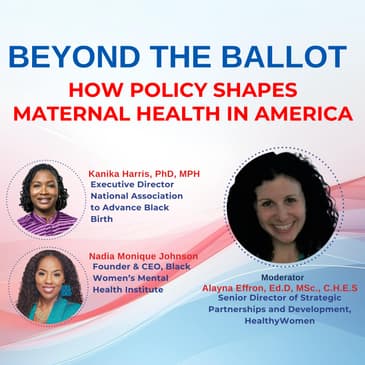

This episode is part of Beyond the Ballot | Voting for Women’s Health and Advocating for Change, a three-part webinar series transformed into six podcast episodes. Presented by Beyond the Paper Gown, Black Women’s Health Imperative, G2G Consulting, and HealthyWomen, this series dives into the essential intersections of policy and maternal health. In this episode, expert panelists explore how policies like Medicaid expansion and the Momnibus Act can positively impact maternal and perinatal mental health. The discussion uncovers critical links between health outcomes, access to care, and structural racism, shedding light on challenges faced by birthing individuals nationwide and emphasizing the importance of inclusive, community-based care models. Learn how advocates, healthcare professionals, and policymakers can collaborate to drive change and ensure equitable maternal health for all. Don't miss this compelling episode!
Please visit Beyond the Paper Gown to join our community and to learn more about achieving your optimal health.
SHOW NOTES:
Learn more about Beyond the Ballot | Voting for Women’s Health and Advocating for Change
[00:00:22] Welcome to Beyond The Paper Gown. I'm your host, Dr. Mitzi Krockover. You know, when I created this podcast, I had a vision to shine a light on the many factors that shape our health and well-being. Think about it. Our physical conditions, the differences between men and women's health, the impact of research or lack thereof, and even our social and environmental circumstances. They're all interconnected and they all play a crucial role in the world.
[00:00:52] And our overall health. But there's one factor that ties all of these together. Policy. It's the invisible hand that guides research priorities, healthcare access, and even our daily environments. That's why we launched a special series of webinars called Beyond The Ballot to take a look into how policy shapes women's health. This podcast and others that will follow are taken from those webinars, which are a collaboration between Beyond The Paper Gown and Beyond The Paper Gown and Beyond The Paper Gown.
[00:01:22] G2G Consulting, the Black Women's Health Imperative, and Healthy Women. And I also want to thank our gold sponsor, Procter & Gamble, and our silver sponsor, Materna Health, for helping to make this series possible.
[00:01:35] In this episode, we'll dive deep into a topic that's essential to the well-being of our communities, maternal health.
[00:01:42] And maternal health goes beyond just physical well-being. It encompasses mental health and the unique challenges that mothers face before, during, and after pregnancy.
[00:01:52] You may be surprised to know, though, that the U.S. maternal mortality rate, meaning the death rate of pregnant mothers, is at the bottom of the developed nations.
[00:02:01] We rank 24th overall, and the numbers are getting worse, not better.
[00:02:06] And Black women are three times more likely to die than white women.
[00:02:11] Today's discussion brings together leaders who work every day to improve those maternal health outcomes, advocate for health equity, and support mental health resources for mothers nationwide.
[00:02:22] Our panel moderator, Dr. Elena Efron, joins us from Healthy Women, an online magazine and leading nonprofit dedicated to women's health.
[00:02:31] She serves as the Director of Development and Strategic Partnerships.
[00:02:35] She'll be joined by Dr. Nadja Monique Johnson, CEO of the Black Women's Mental Health Institute, and Dr. Kanika Harris, Executive Director of the National Association to Advance Black Birth.
[00:02:47] Together, they'll be addressing critical challenges such as peripartum mental health, systemic health disparities, and the policies needed to create a more equitable landscape for maternal health.
[00:02:58] In this episode, you'll hear inspiring insights on breaking down silos in maternal health, the power of community-based care models, and the essential advocacy needed to move maternal health forward.
[00:03:28] I'm your moderator, lively moderator, Dr. Elena Efron, and Healthy Women is a leading nonprofit organization really focusing on the health and wellness of women ages 35 to 64, spanning that intergenerational health span.
[00:03:41] And I am joined by my illustrious panelists, Dr. Nadja Monique Johnson and Dr. Kanika Harris.
[00:03:48] And I will lovingly give them a moment to introduce themselves.
[00:03:51] After introductions, we'll engage in some thoughtful discussion about the pressing issues in maternal health.
[00:03:56] For those tuning in, please feel free to drop your questions into the Q&A, as Linda mentioned earlier, and we'll do our best to answer them in real time.
[00:04:03] So handing it over to you, I'll start with Dr. Johnson to start introductions, and then please feel free to popcorn it over to Dr. Harris.
[00:04:10] Sure, absolutely.
[00:04:11] First of all, thank you so much for the invitation to be here.
[00:04:14] I love participating in these kinds of discussions.
[00:04:17] And quite frankly, all of the women here that are speaking, I'm kind of girl fanning.
[00:04:22] I love the amazing policy and community work that you're involved in.
[00:04:25] So, and a special thank you to our sponsors.
[00:04:29] Again, my name is Dr. Nadia Johnson.
[00:04:31] My pronouns are she, her.
[00:04:32] I'm the founder and CEO of the Black Women's Mental Health Institute.
[00:04:36] And now I'll pass it to Dr. Harris.
[00:04:40] Hi, good afternoon, good morning, depending on where you're coming from, or maybe afternoon everywhere.
[00:04:46] I am Dr. Kanika Harris.
[00:04:48] I'm really excited to be on this panel and see all the intersections here.
[00:04:54] I'm really grateful to the support here, especially the Black Women's Health Imperative, who has influenced and spearheaded my career since I was a young girl.
[00:05:06] I am now the new executive director of the National Association to Advance Black Birth, where we support and grow midwives and focus on really improving the perinatal workforce to improve Black maternal health and Black maternal mental health as well.
[00:05:25] Thank you.
[00:05:27] Thank you.
[00:05:28] Thank you so much for your introductions, and thank you so much for being here.
[00:05:32] As mentioned, today's discussion will focus on maternal health, and we'll also focus and lean into health equity and maternal health.
[00:05:38] So, in the United States, there are significant disparities in maternal health and those disparities in access to care that impact health and health outcomes.
[00:05:47] So, for example, states without Medicaid expansion, we see higher rates of maternal mortality in those states.
[00:05:52] We see the impacts of policy and policy changes, as we have just heard and discussed, structural racism, implicit bias, those social determinants of health, and their impacts on the health of maternal health, on mental health, on health outcomes, health equity, and access to safe and quality care.
[00:06:09] And so it's really important that we address a lot of these intersections so health can be a right for all and not just a privilege for some.
[00:06:16] And we need that in order to advance the health and well-being of women nationwide.
[00:06:19] So, I'd love to dive in, and I'll start with you, Dr. Harris.
[00:06:23] So, given your breadth and depth of experience in health equity and maternal health and women's health, might you shed some light, perhaps, on the progress we've seen in maternal health?
[00:06:34] And as we look back at that progress, maybe what we need to know in order to move forward, especially at this election season?
[00:06:41] Sure, absolutely.
[00:06:42] Absolutely.
[00:06:43] I remember when Vice President Kamala Harris first came on, and her first mode of action was to focus on maternal health and really illuminating the issues in Black maternal health.
[00:07:00] And I feel like that is just one huge example of how we've seen things kind of a movement happen over the last year in Black, over the last four years in the Black maternal health.
[00:07:14] One thing we have to realize about policy and how policy works is we're either normalizing health behaviors that need to change, normalizing the things that are happening in our community.
[00:07:27] And one thing that's happened over the last four years is that we've started to really normalize and hear words like racism, structural violence, normalized understanding, and really working on what Black maternal health really means and how it affects the country, not only for Black women, but for all women.
[00:07:51] And so I feel like we've seen a huge amount of legislative progress in terms of the Black maternal health mom and the bus act that was introduced in 2020.
[00:08:07] And then we've introduced it a few times again in 2023.
[00:08:13] We've seen Medicaid expansion for postpartum coverage from 60 days to 12 months.
[00:08:18] That has been really critical for knowing that most of the deaths are happening in the postpartum period.
[00:08:25] We've also seen state-level initiatives and policy changes in terms of supporting midwives and doulas,
[00:08:32] and really starting to do Medicaid reimbursement for doulas.
[00:08:41] And I feel like we're getting to a point where we're normalizing and understanding what doulas do, what they are,
[00:08:48] and how important they are to really supporting this crisis we're seeing right now.
[00:08:53] And I feel like we've also seen a lot of progress in the establishment of maternal mortality review committees,
[00:09:01] and really illuminating and highlighting and examining cases of maternal deaths,
[00:09:08] these severe complications and the racism that are affecting these deaths.
[00:09:13] And lastly, I would just say just increasing awareness and advocacy.
[00:09:18] We've been able to do the Black Maternal Health Week, which has been huge around the country.
[00:09:23] We've been able to also have awareness about Black midwifery and the importance of Black midwives birth centers.
[00:09:33] So I feel like we've made a lot of progress in that area.
[00:09:36] And where we need to go, we need to get the Monimbus Bill passed.
[00:09:41] You know, Congresswoman Lauren Underwood, Congresswoman Alma Adams, Senator Cory Booker,
[00:09:50] really leading this charge and have done amazing research.
[00:09:54] And where we're getting stuck is really in that help committee and getting this bill passed
[00:10:00] and getting that bipartisan support to make sure this bill is passed.
[00:10:04] The bill will not only increase money for federal money, community-based organizations,
[00:10:13] historically Black colleges and universities that can lead in their communities to make these changes,
[00:10:18] but also really change the landscape of maternal health overall.
[00:10:23] So I would say, please, you know, our senators and our Congress, they work for us.
[00:10:32] And they really work and are in this work based on their lived experience.
[00:10:37] And we all have lived experience.
[00:10:39] So talk to them.
[00:10:41] We need bipartisan report.
[00:10:43] We need some Republicans to really sign on to this and to pass it through that help committee.
[00:10:50] And to follow up on all those great points, how do you feel as a field, as a community,
[00:10:55] as a collective, we can work together to be in lockstep to support the advocacy, the voice, the work?
[00:11:03] Yes.
[00:11:04] To be in lockstep, I feel there's been a lot of divisiveness between doctors and midwives and doulas
[00:11:15] and the perinatal workforce and understanding that we all comprehensively play a part in this.
[00:11:25] And if you look at just global leadership around maternal health, the countries that are doing really well,
[00:11:32] midwives and doctors are working together.
[00:11:34] They're not in competition with each other.
[00:11:37] Doulas and support with nurses and at-home care is the norm.
[00:11:45] I also feel like we have to realize that maternal health is not a siloed issue.
[00:11:52] Transportation, housing, food justice, all these things affect maternal health.
[00:12:01] As we heard from the previous panel as well, when you're thinking about sex education,
[00:12:07] when you're thinking about menopause, when you're thinking about our lives across our life course,
[00:12:13] there is no aspect of this issue that is not affected by maternal health.
[00:12:20] Maternal health, remember maternal health, how we measure maternal health is how we measure the health of this nation.
[00:12:26] That is simply so everyone has a part to play.
[00:12:30] And I think we have to realize that midwives and doulas will help to bolster and support and change the direction of where we are going.
[00:12:42] They are here to support doctors.
[00:12:44] They're not here to be against doctors.
[00:12:46] And that everyone has a role to play from environmental health, climate change, our social workers, lawyers, transportation,
[00:12:59] especially digital health as well and AI.
[00:13:02] All of that is playing a role here.
[00:13:04] And so we need to all get on the same bus together to move this train forward.
[00:13:10] Couldn't agree more.
[00:13:12] Women's health is national health, public health for sure.
[00:13:15] Sure.
[00:13:17] Thank you.
[00:13:19] Dr. Nadia Monique Johnson, as the founder and CEO of the amazing, incredible, impactful Black Women's Mental Health Institute,
[00:13:27] what do you see as the most important and necessary changes needed in maternal mental health?
[00:13:33] Well, it's really going to piggyback on a lot of what Dr. Harris said, but also what was said in some of the other panels.
[00:13:39] What we need is a community-based integrative care model that focuses on collaboration and coordination.
[00:13:46] So it really is kind of piggybacking on the idea that doctors and nurses should be working with midwives, should be working with doulas.
[00:13:53] But here's something that I think we often leave out of the conversation.
[00:13:57] I have the opportunity to teach at university levels.
[00:14:00] So I teach pre-med medical students and residents.
[00:14:04] And the medical school curriculum and really university curriculum across the board is being threatened by this anti-DEI legislation.
[00:14:11] And I know sometimes when we're thinking about that, we're thinking about, oh, well, you know, we're talking about health and health outcomes and how to treat patients and how to diagnose and identify symptoms.
[00:14:21] However, when you're thinking about maternal mortality rates, it's severe bleeding, it's high blood pressure, it's infection, it's a lot of different things, but it's also heavily embedded with systemic racism.
[00:14:33] And systemic racism is not going to be eliminated by focusing solely on the medical model.
[00:14:38] And what we are finding, and this is data that has come from the American Medical Association, the NIH, the CDC, is that racism is a threat when you're thinking about maternal mortality and, of course, maternal medical health.
[00:14:52] And so we have to really think about what does it look like to ensure that that curriculum is in our medical schools?
[00:14:58] Because it is being threatened.
[00:14:59] It's already being eliminated in the undergraduate level.
[00:15:01] But if you don't get in the undergraduate level and now you're trying to teach individuals in graduate school or in medical programs, they're starting from scratch and they have no idea how to understand their own implicit bias.
[00:15:13] They have no idea how to incorporate strategies for cultural responsiveness and cultural competency and cultural humility.
[00:15:20] They have no idea how to engage patients who are different than them.
[00:15:24] This means that if they are from a historically marginalized population that they do not identify with, that they are limited in their ability to provide them care.
[00:15:33] If they have stereotypes that have not been addressed for LGBTQIA plus populations, that needs to be addressed.
[00:15:40] So that's one of the issues I think that we often don't address is just how is the healthcare workforce being trained?
[00:15:47] And then how are they being encouraged to create work environments that are going to support community-based integrative care models where a doctor is not going to dismiss the contributions of a midwife or the value of a doula.
[00:16:03] They're going to understand that they are needed in a holistic model to provide the best possible care to every individual that they have the opportunity to serve.
[00:16:14] Absolutely.
[00:16:15] So similar question posed to Dr. Harris also.
[00:16:19] So how, as we, as ambassadors of public health, advocates for women's health and maternal health equity, how do we work together?
[00:16:27] What is needed in our step process to ensure that that curriculum is expanded, to ensure that there are these entry and access points for all women across the nation?
[00:16:39] And again, starting with really the health education and the training of our clinical bedrock.
[00:16:45] I, you know, honestly, I, I'm a cold call queen and I will absolutely, I do it all the time.
[00:16:53] When I'm traveling to a city, I will call a university.
[00:16:55] I will call a medical school.
[00:16:57] I will reach out to the federally qualified health clinics in whatever area I'm in.
[00:17:01] And I'll encourage conversations.
[00:17:03] And sometimes it's just a coffee, coffee talk conversation with individuals in the community.
[00:17:08] Or maybe it's an opportunity to speak at a university to share these insights because I see how it impacts the way students think, but also how communities come together.
[00:17:18] I also see this a lot, that sometimes when there are rooms full of decision makers, all of those decision makers are credentialed in very traditional ways of knowing.
[00:17:29] But you don't have individuals from the community who are directly impacted by these issues.
[00:17:35] So, for example, the Black Women's Mental Health Institute, even though we're national and our reach is, you know, all over the place, we're founded and headquartered in Alabama, specifically Birmingham, Alabama.
[00:17:45] And when you think about Alabama and the high rates of maternal mortality, we have the third highest maternal mortality rate in the country.
[00:17:55] And there's the Black Belt specifically is a case study of what it looks like to provide care.
[00:18:01] If we go down there, you know, in the most culturally inclusive manner, as I can state this, I'm not Dr. Johnson.
[00:18:10] I'm Nadia.
[00:18:11] Better yet, I'm Nikki.
[00:18:12] And I need to go down there and let go of these ideas of who I am as a credentialed individual and know that the grandmother who has lived there and raised two or three generations is the expert.
[00:18:22] And she can teach me what not one, two, three PhDs can teach me about the needs of her community.
[00:18:29] And so now it is my job as someone who's interested in providing the culturally responsive care that is going to really make strides in their community to invite her into the rooms that we're having these discussions, that she's a part of this decision making process, that we're partnering with churches, that we're partnering with clinics, that we're partnering with schools, that we're partnering with all sorts of individuals, barbershops, what have you.
[00:18:54] We have to get on the ground level.
[00:18:56] And sometimes that's hard when you're operating with all sorts of different spaces, but it gets better if you put it into practice.
[00:19:03] That's the way these silos are maintained is because we don't step out of it.
[00:19:09] We can be researchers, but then don't step out to see who this research is impacting.
[00:19:14] We can be educators, but don't step outside.
[00:19:16] We can even be community organizers and don't learn the lingo and the language and the theory that the doctors are using.
[00:19:25] And you have it.
[00:19:26] So you have to learn both ways so that you can translate your language in a way that's going to really bring everyone together.
[00:19:33] So I really do believe that, again, community-based integrative care models.
[00:19:39] I believe in, of course, social determinants of health was already mentioned, but political determinants of health.
[00:19:45] You know, shout out Daniel Dawes, who coined that term.
[00:19:48] And what are the policies and the politics that influence health outcomes?
[00:19:52] How can we address that?
[00:19:53] So, for example, we talked about the high rates of maternal mortality rates in the Black Belt.
[00:19:59] Does that have to do with lack of insurance?
[00:20:01] Yes.
[00:20:02] Does that have to do with Medicare expansion?
[00:20:04] Yes.
[00:20:05] But it also has to do with food deserts.
[00:20:07] And guess what also it has to do with?
[00:20:09] Wastewater management.
[00:20:11] If infections are a contributing factor to that high rate, wastewater management, having access to clean water,
[00:20:19] having access to sanitation, having access to those things are also going to create an environment where women can thrive.
[00:20:26] And that's not happening parts of the Black Belt.
[00:20:29] When the World Health Organization came here, they deemed parts of the Black Belt as having third world conditions.
[00:20:35] So that is right here in the United States.
[00:20:38] And we can change that through policy.
[00:20:40] And before I pass the mic to Dr. Harris, I am going to say another quick thing.
[00:20:46] Bipartisan is possible.
[00:20:47] I think Liz Powell has proven that in the work that she's doing with G2G and the Women's Health PAC.
[00:20:55] But I will also say within our organization, we are a Black women-led nonprofit organization in Alabama that has received bipartisan support to be written into the state budget.
[00:21:07] How does that happen?
[00:21:08] Health is about everyone.
[00:21:10] And when you frame it in a way that says it's going to impact this population this way, this population this way, and these policies are being pushed forward, are divisive and are actually creating environments that are causing the disparities that you say you want to solve.
[00:21:28] So it really is a lot of relationship building.
[00:21:30] It's hard work.
[00:21:31] It is putting energy and efforts into the ones that you know are listening and not so much as the ones that you know aren't.
[00:21:39] But that's also a part of the work, too.
[00:21:41] That's a part of the community work.
[00:21:42] And making sure that when you're having those meetings, it's not just codes and credentials that are in the room.
[00:21:51] A hundred percent.
[00:21:52] A hundred percent.
[00:21:54] Totally, wholeheartedly agree.
[00:21:56] And really, this is a question for both of you.
[00:21:59] So knowing this, how do we activate, right?
[00:22:03] How, I mean, I think many of us here feel that activation and we're here, how do we activate those that aren't, right?
[00:22:10] How do we rock that boat?
[00:22:11] How do we make that change possible?
[00:22:14] And this is really an open-ended question.
[00:22:15] I'd love to hear both of your perspectives.
[00:22:17] And thank you so much, Dr. Johnson, for sharing some of the initiatives that the Institute's working on.
[00:22:21] I invite Dr. Harris to do the same as well, if there's any that you'd like to eliminate here with our time together as well.
[00:22:28] Sure.
[00:22:29] So how do we activate this bipartisan change?
[00:22:32] I totally agree with Dr. Johnson.
[00:22:35] It is possible.
[00:22:38] It is absolutely possible.
[00:22:40] And I would say that everyone has a story.
[00:22:44] So when Dr. Johnson was talking about that relationship building, you know, whatever side you're on, if you're a Republican or a Democrat, we are humans.
[00:22:54] We have stories.
[00:22:55] Something has brought us to this work.
[00:22:57] So the way you get that bipartisan support is you figure out what their stories are.
[00:23:04] For example, I may, you know, go to the Hill and look for Republicans, read their stories and find, oh my goodness, this Republican had a stillbirth experience.
[00:23:16] I've had a stillbirth experience.
[00:23:18] Let me talk to him about that experience and why supporting the momnibus and supporting this bill will help us not have these experiences again, will give us more research to address this issue.
[00:23:32] You know, there may be a Republican that's really focused on climate change.
[00:23:38] Well, like Dr. Johnson spoke about, okay, I'm in D.C.
[00:23:43] We've also experienced huge water issues with lead.
[00:23:47] They're just now changing the lead pipes in D.C.
[00:23:50] But for years that has also impacted our maternal health.
[00:23:54] It has also impacted our rates of high blood pressure, which is one of the leading causes of maternal health.
[00:23:59] So let's talk about that together.
[00:24:02] So you have to do your research.
[00:24:04] You have to figure out what the what the senator in Congress, what their stories are, what are their personal stories and use those stories to galvanize this bipartisan change.
[00:24:16] Thank you.
[00:24:17] And the only thing I would add is let's keep doing this.
[00:24:21] You know, we get energy from each other.
[00:24:23] This is exhausting work, but it's important work.
[00:24:27] It's community work.
[00:24:28] It's valuable work.
[00:24:29] It's necessary work.
[00:24:30] We should celebrate our wins and give each other energy and support when this gets exhausting.
[00:24:37] But also keep building, keep building relationships, empower individuals to do the same.
[00:24:43] I know that this election season and really any election season, sometimes individuals don't know how to remain informed, how to remain engaged.
[00:24:53] I'll even say in some of my community and even some of my family, there's this disillusionment.
[00:24:58] It's not going to make it different.
[00:24:59] What does my vote matter?
[00:25:01] What does my voice matter?
[00:25:02] These things are never going to get better.
[00:25:04] But we know that they can and we know that they do.
[00:25:06] And we know that there are things in the works that are going to change the trajectory of women's health.
[00:25:12] We already see what's being done in the White House right now.
[00:25:15] And I see that growing and I see that continuing to work.
[00:25:18] So really to speak life and energy, not to dismiss when someone has a negative thought or, you know, are discouraged, but to also provide another perspective that says, no, we can do this.
[00:25:32] We have a long history of women making this kind of change in the country.
[00:25:36] And we'll continue to do this.
[00:25:39] Again, our organization, we have this whole campaign and it's year round, but we really ramp it up during a presidential election that says voting matters to our mental health.
[00:25:49] On one hand, it matters because, you know, it can push policy and it can form and it really can engage elected officials.
[00:25:55] On another hand, it's a way of putting yourself to action and putting yourself to action and putting your voice to action and putting your thoughts to action actually will combat feelings of hopelessness and helplessness.
[00:26:10] Like there's nothing I can do and there's no reason and there's no purpose.
[00:26:14] No, there's always something you can do.
[00:26:16] You can be involved.
[00:26:17] You can be engaged.
[00:26:18] You can get to work in your community.
[00:26:21] And you can join calls like this and learn and get connected.
[00:26:24] One of the things I loved as soon as we started is how a bunch of participants were dropping their LinkedIn.
[00:26:30] I'll be doing the same, dropping their LinkedIn and talking about the work that they do.
[00:26:35] I regularly go to places and conferences where I see that and it's like, oh, OK, you did the wrong thing.
[00:26:40] I'm about to call you.
[00:26:41] I'm going to send you an email.
[00:26:43] We're going to get to work.
[00:26:44] We're going to get to know each other.
[00:26:45] We're going to support each other.
[00:26:46] So I love that this it's already happening.
[00:26:48] We just have to keep doing this and build momentum around it.
[00:26:52] Yes.
[00:26:52] One last thing I'll share in terms of our organization is we do have a Black Birthing Bill of Rights,
[00:26:59] and I will put it in the chat as well to make sure that, you know, there's the big P policy that we're talking about in terms of, you know, federal and legislative change.
[00:27:10] And then there's also how we normalize policy in our communities and our everyday lives and just understanding our rights around the perinatal process,
[00:27:21] around giving birth and normalizing these rights within the government, within hospitals,
[00:27:27] so that you know that if you're at a teaching hospital and you don't want a whole bunch of residents looking at you or checking you,
[00:27:36] do you have the right to say no?
[00:27:38] And so what are your everyday rights, like Dr. Johnson is talking about, that you can enact, that you can feel power around?
[00:27:46] And once you start with those everyday rights, it really starts to galvanize you, change the norms in your community,
[00:27:53] where you start to go up the chain and recognize that empowerment.
[00:28:01] Yes. Yes. Yes. Thank you. And thank you so much, Dr. Harris, Dr. Johnson.
[00:28:06] Thank you so much for your insight, for being here, for all you do as professionals, as individuals,
[00:28:11] as part of our collective to really advance the health and well-being of women and maternal health nationwide.
[00:28:16] It's been an honor today. So thank you so much. I'll hand it back to you, Linda.
[00:28:21] Thank you.
[00:28:41] Dr. Johnson, I'll be here to share with you, Linda.
[00:28:43] Thank you, Linda.
[00:28:46] Thank you.
[00:28:47] Thank you.
[00:28:48] Thank you.
[00:28:58] Thank you.
[00:29:01] Thank you.
[00:29:29] Thank you, Linda.
[00:29:32] encourage them to create and support thoughtful legislation that makes a real impact on maternal
[00:29:37] health. This is a great way to advocate for meaningful change. You can view the rest of
[00:29:43] the webinars on our website at beyondthepapergown.com. And while you're there, subscribe to our newsletter
[00:29:48] for news events and podcast updates. You'll also find resources regarding the policy information
[00:29:54] and organizations you heard about today. Thank you for listening and take good care.
[00:30:00] This episode was produced by Patrick Shambayati and me, and our associate producer is Kyla McMillian.