
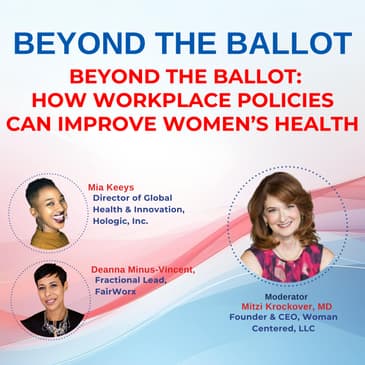

This episode is part of Beyond the Ballot | Voting for Women's Health and Advocating for Change, a three-part webinar series transformed into six podcast episodes. Presented by Beyond the Paper Gown, Black Women’s Health Imperative, G2G Consulting, and HealthyWomen, this series delves into how policy affects women’s health. In this episode, the panel explores the intersection of workplace policies and women's health, revealing how factors like stress and caregiving roles impact health outcomes. Listen to insights from the Hologic Global Women’s Health Index highlighting how workplace stress, especially during the COVID-19 pandemic, disproportionately affects women, leading to higher rates of cardiovascular disease and chronic conditions.
Hear from experts about innovative policies that support healthier workplace environments, including flexible benefits, fair work policies, and anti-harassment procedures. As we approach election season, remember the impact of policy on health and workplace equity, and consider how your vote can influence these vital issues. Don’t miss this episode!
Please visit Beyond the Paper Gown to join our community and to learn more about achieving your optimal health.
SHOW NOTES:
Learn more about Beyond the Ballot | Voting for Women’s Health and Advocating for Change
[00:00:22] Welcome to Beyond The Paper Gown. I'm your host, Dr. Mitzi Krockover. You know, when I created this podcast, I had a vision to shine a light on the many factors that shape our health and well-being. Think about it. Our physical conditions, the differences between men and women's health, the impact of research or lack thereof, and even our social and environmental circumstances. They're all interconnected and they all play a crucial role in our health.
[00:00:52] And our overall health. But there's one factor that ties all of these together. Policy. It's the invisible hand that guides research priorities, healthcare access, and even our daily environments. That's why we launched a special series of webinars called Beyond The Ballot to take a look into how policy shapes women's health. This podcast and others that will follow are taken from those webinars, which are a collaboration between Beyond The Paper Gown and the
[00:01:22] G2G Consulting, the Black Women's Health Imperative and Healthy Women. And I also want to thank our gold sponsor, Procter & Gamble and our silver sponsor, Materna Health for helping to make this series possible.
[00:01:34] The intersection of workplace policies and women's health represents one of our most pressing yet under addressed public health challenges. While women make up nearly half of the United States workforce, our health outcomes continue to be significantly impacted by workplace environments and policies.
[00:01:55] Today, you'll hear about recent data from Hologic's Global Women's Health Index, which reveals that women are 20% more likely than men to report workplace-related stress, worry, and sadness. Factors that directly contribute to increased rates of cardiovascular disease and other chronic conditions.
[00:02:14] The economic implications are clear. Studies show that comprehensive workplace health benefits and supportive policies can reduce healthcare costs by up to 20%.
[00:02:25] You know, this became particularly evident during the COVID-19 pandemic, which highlighted how women, especially women of color and those in frontline roles, face unique challenges balancing work with caregiving responsibilities.
[00:02:40] The, quote, sandwich generation phenomenon, where women simultaneously care for children and aging parents while maintaining employment, underscores the critical need for flexible work arrangements and comprehensive support policies.
[00:02:55] As we'll explore today, creating workplace environments that support women's health isn't just about compliance.
[00:03:02] It's about developing solutions that benefit organizations, individuals, and communities as a whole.
[00:03:08] Well, we're going to jump right in because we've got a lot to talk about and really making the connection between the workplace and health as well as policies that impact on both of those.
[00:03:40] So, Deanna, I'm going to start with you because, as I said, you had the program Fair Work.
[00:03:46] And so tell us a little bit about that program, why it's called Fair Work,
[00:03:50] and what are some of those policies that you're focusing on that you think are important with respect to the health of women?
[00:04:00] Sure, definitely.
[00:04:02] So Fair Work is a for-profit subsidiary that was started by the Black Women's Health Imperative.
[00:04:07] And it was started because they had conversations with over 4,500 Black women beginning, but then also additional stakeholders to really understand their experiences at work.
[00:04:20] And what we learned is really what we've known is that there's disparities in the workplace.
[00:04:27] And as a result, they built an index.
[00:04:32] So Fair Work uses data, technology, and AI to de-risk documents, so policies, practices, procedures, public-facing media,
[00:04:45] to ensure that what we're delivering in the workplace is fair, from looking at gender, race, ethnicity, age, and ability.
[00:04:56] It provides corporate and institutional leaders with actionable data to lower employee recruitment, retention,
[00:05:04] and employee health care costs by up to 20%, which is huge for them,
[00:05:11] and measurably improve productivity and employee engagement.
[00:05:16] And this is huge for organizations when we know that 67% of all employees are disengaged.
[00:05:24] They are quiet quitting, especially with remote work policies.
[00:05:28] So by providing them with Fair Works, we are able to help them engage more fully into the work process.
[00:05:37] Thank you.
[00:05:38] And when you and I were speaking yesterday, there were a couple of specific policies that you pointed out
[00:05:43] that are especially salient to this conversation.
[00:05:46] Would you mind speaking about those?
[00:05:48] Definitely.
[00:05:49] So we look at first health insurance.
[00:05:51] What does your health insurance policies look like?
[00:05:54] A lot of things that the first panel spoke about.
[00:05:58] So what does your, does it include contraception?
[00:06:01] Well women exams.
[00:06:03] Does it cover, does it have affordable premiums?
[00:06:06] So things such as that.
[00:06:08] Flexible work arrangements.
[00:06:09] A lot of us are in the sandwich generation, have small children as well as aging parents,
[00:06:15] and we need flexible work schedules.
[00:06:19] Breastfeeding and lactation policies.
[00:06:22] What does that look like?
[00:06:23] Everything from, do I have to pump in a restroom or is there a private area that I can pump with
[00:06:29] storage for my breast milk?
[00:06:32] Paid leave, anti-harassment policies, fertility benefits.
[00:06:36] So all of those things we look at and we have conversations.
[00:06:40] And what the tool allows us to do is for corporations to upload those policies, benchmark it against best practices,
[00:06:48] and see if they have fair tools.
[00:06:50] And those are some of the policies that we look at.
[00:06:54] Thank you.
[00:06:55] And Mia, Deanna is talking about a number of things where non-work issues kind of come into the workplace to a certain extent.
[00:07:08] And so you and I talked and you shared with me a study from the UK that talks about the impact of that external life,
[00:07:18] bringing it into the workplace.
[00:07:19] So talk a little bit about that as well as the importance to women's health specifically.
[00:07:27] For sure.
[00:07:28] Thank you for that, Mitzi.
[00:07:30] And I appreciate Deanna's comments because they flow directly into the question that you're asking.
[00:07:35] So foremost, for all of us, wherever we enter, there we are, right?
[00:07:40] So we bring our embodiment into our work, into our spaces, into what we speak about in our lived experiences, as well as in our silences, right?
[00:07:50] In my capacity at Hologic, I work from a global perspective.
[00:07:55] And so across the world, you have constructs of our being, social constructs of our being that take on real reified information and meaning, right?
[00:08:06] So the social construct of race, social construct of gender, all of these bear upon the ways in which we can work, and as well as the way in which we live, we play, where we worship, all of those elements that make up what we now call social determinants of health.
[00:08:23] And so some years ago, Sir Michael Marmot, he's an epidemiologist, he looked specifically at differences in workers and persons within the workplace across a relatively homogenous, racially homogenous and gender homogenous workspace.
[00:08:43] Where basically he was looking at, well, why are people who are paid more experiencing better health outcomes?
[00:08:50] Why are people who are paid less experiencing health outcomes that are very different, qualitatively so, from their richer counterparts?
[00:09:02] And essentially came up with a theory of the health gap, which now we talk about it in terms of health inequities, right?
[00:09:09] So, of course, that was in the UK context because it took place in the UK.
[00:09:13] But health outcomes between those who are rich and those who are poor is not just a matter of healthcare access, right?
[00:09:21] And so when we talk about in the US context and in a more global context, when we talk about the idea of health equity, a lot of people are much more practiced or aware, only aware of, or probably for, you know, for the sake of being frank,
[00:09:37] much more comfortable with talking about the idea of health inequity from a matter of access to healthcare.
[00:09:45] But it is not sufficient to discuss healthcare inequities solely in the context of healthcare access, nor is it sufficient to talk about it solely in the context of socioeconomic status.
[00:09:57] You have other research.
[00:09:58] I'm a sociologist and public health researcher by training.
[00:10:03] And so most of my studies are at those intersections.
[00:10:07] And you have researchers who, for time and time again, who've been saying, yes, socioeconomic status is a fundamental cause of disease, right?
[00:10:14] Because it affects multiple disease outcomes.
[00:10:16] You can look this up.
[00:10:17] Lincoln Phelan are the main researchers there.
[00:10:21] And it impacts access to resources that can mitigate disease consequences and extrapolates one's state of health over time.
[00:10:30] But in the context of women's health, you have to have, and really in the context of just in the US in general, one has to have the intersectional conversation, even in the workplace.
[00:10:39] Meaning that health issues, which are unique to women, you have to have a conversation, not just about socioeconomic status or where they are in terms of leadership within the workplace, the gender parity gap.
[00:10:51] You have to have those conversations.
[00:10:52] And a lot of people are very, again, comfortable with having those conversations, but are not as practiced and are less comfortable.
[00:10:58] We saw this during COVID, having a conversation about, to Claire's earlier point, the intersectional conversation.
[00:11:05] What role does race play in the workplace in terms of how a woman's ability to lead and to rise up in the ranks, but also to make decisions for her health and that of her family?
[00:11:17] What does that matter?
[00:11:18] And again, inextricably linked to the socially constructed, but very real senses of being.
[00:11:26] And it plays out in the workplace as it pertains to women's health has to be the place where employers, and perhaps we can talk about this a little later, can tackle those harder decisions that are, quote unquote, outside of the workplace.
[00:11:41] Thank you for that.
[00:11:42] And, you know, as you talked about intersectionality, Indiana, in our conversation, you brought this issue up.
[00:11:51] And it was something that I hadn't really thought about until having a conversation during COVID about the number of, for example, frontline workers, many of them people of color.
[00:12:03] Obviously, many of them in a lower socioeconomic status.
[00:12:07] So, again, that intersectionality, Mia, that you're talking about.
[00:12:10] And now being faced with the fact that they may be employed, but also be eligible for government assistance, but that the system isn't really set up to make that easily available.
[00:12:27] And there seems to be a disconnect.
[00:12:31] So, talk a little bit about that and the role that both the workplace as well as the government plays in getting those resources to the right people.
[00:12:42] Definitely.
[00:12:44] So, we call that frontline staff, we call them ALICE.
[00:12:48] So, asset limited, income constrained, yet employed.
[00:12:51] So, the ALICE population, we used to call them working poor, but we now call them ALICE.
[00:12:58] And it is, I think, as employers, and we need to make sure that we are offering a full suite of benefits, inclusive of public benefits.
[00:13:11] We need to make sure our employees who may be ALICE or may be frontline, that they're aware of all of the services and supports that are available to them.
[00:13:23] Because although we may not want to admit that, you know, we have employees that we are funding and we may even be giving them a living wage, they can't make ends meet and they may qualify for public benefits.
[00:13:36] So, you know, especially if we're healthcare providers or we are in other places and spaces, we know that if someone's on Medicaid, they're highly likely eligible for SNAP and heat and prescription assistance.
[00:13:51] So, how do we make sure that those data points match together and we're making it easier for them as opposed to making them jump through hoops?
[00:13:59] And those are easy policy, well, not easy, I say easy, sitting on the outside.
[00:14:03] But those are policy things that we can change and really create administrative savings for government at both the local levels and at the federal level.
[00:14:13] So, if we can figure out what those data sharing agreements look like and really think about what the requirements look like so that we can make those things work.
[00:14:25] So, for instance, if a child is getting free and reduced price lunch at school, shouldn't they be able to eat at home?
[00:14:31] Shouldn't those applications look the same?
[00:14:34] Shouldn't we be able to marry the two so that we have all those spaces and places covered so that we are making sure that our employees can eat?
[00:14:45] Because we know we can see healthcare savings in that space.
[00:14:49] I know you had a slide at the beginning of the webinar that showed that we see $1,600 in healthcare savings when people can eat.
[00:14:57] And so, when they get snapped.
[00:14:59] But we also see that amplified exponentially when people have heart disease or diabetes up to $4,000 or over $4,000 when they have heart disease and diabetes.
[00:15:11] We see that as healthcare savings.
[00:15:13] So, it's critical that we look at those government benefits.
[00:15:17] And people may say, well, I don't qualify.
[00:15:20] Well, childcare savings, you can make up to almost $70,000 and get childcare subsidies.
[00:15:25] So, I think we need to look at what those look like and make sure that we're informed in our own states.
[00:15:33] And then make sure that our employees are informed and are aware and are enrolled and stay enrolled because also the churn rate is so high.
[00:15:45] You know, really, we talk a lot about, you know, kind of negatives and what should be happening or, you know, what isn't happening.
[00:15:52] And it just, this one just for me underlines that if it were to work the way that you suggested, it would be a win-win for everyone.
[00:16:03] It would be a win-win.
[00:16:05] And I think also it would stimulate local economies too because we know for prescription assistance and for SNAP, it also increases employment on the front end.
[00:16:15] Grocers can hire more people.
[00:16:17] And we know, you know, Moody says that for every dollar in SNAP, it stimulates the economy by $1.79, I believe the current statistic is.
[00:16:26] I might be off by a couple pennies, but so, you know, it creates workforce.
[00:16:31] It creates local economy.
[00:16:33] So, I think we need to think about all of that and think about policies and technology to make sure that that happens.
[00:16:40] Sure.
[00:16:41] And Mia, you and I, again, talked yesterday and you shared with me that Hologic did a survey called the Global State of Women and Girls.
[00:16:49] And you have now an international focus.
[00:16:52] You probably always did, but now your work is mirroring that.
[00:16:56] What were the key takeaways, especially as they related to stress, mental health, and health outcomes?
[00:17:03] And how does it help us understand the state of women's health worldwide and insights that we might be able to extrapolate, if you will, here in the United States?
[00:17:15] For sure.
[00:17:16] So, for several years now, Hologic has been collecting these data across several key indicators of women's health across the globe, as you mentioned, the Global Women's Health Index.
[00:17:28] And one of the major areas of concern for Hologic has to do with levels of burnout, has to do with the emotional toil that women bear disproportionately across the world, right?
[00:17:44] And so, levels of burnout globally, mental, emotional, spiritual health is on the decline, right?
[00:17:52] And I think we can feel that intuitively amongst us.
[00:17:56] We see tensions.
[00:17:58] We certainly saw tensions raging high during COVID, but before and after, right?
[00:18:02] And so, what does this mean?
[00:18:04] We're discussing issues that Deanna has mentioned in terms of ability to work and receive supports that are necessary.
[00:18:14] It matters, right?
[00:18:15] So, what our data, what the data show, we've been working with Gallup to collect these data, where women are sadder, angrier, women are more worried than they've been since, you know, the height of COVID-19.
[00:18:28] And women are 20% more likely to feel these feelings, to have this experience compared to men, right?
[00:18:35] And we know the reasons why.
[00:18:37] Data show us, but then also we live the reasons why, right?
[00:18:42] And so, some of the, I think a number of the insights that come out of that is when we're talking about wellness and specifically at Hologic, we, you know, we're a women's health and innovation company.
[00:18:55] So, women's health, we worry about issues around breast health, issues pertaining to cervical health, but we are worried about issues that disproportionately impact women, right?
[00:19:05] And so, that matters when we're having conversations that pertain to health outside traditional clinical walls, like violence against women.
[00:19:16] And the role that stress plays out, not just in a woman's life, but in the lives of the men who are around her, lives of aggressors, they could be men or women.
[00:19:27] And even the rise of a global patriarchal narrative.
[00:19:32] And I'm using that terminology not necessarily to incite any sort of partisan conversation, but patriarchal meaning systems that are associated with the power of men, right?
[00:19:42] And what does that mean in terms of bearing out on social institutions?
[00:19:45] What does that mean in terms of leadership and representation, right?
[00:19:49] We're seeing, especially in this political environment, hearkening back to traditional values that challenge a woman's autonomy.
[00:19:58] Not just her bodily autonomy, but her ability to make decisions on behalf of her family.
[00:20:03] And then there's this pervasive toxic narrative because we're, you know, we're talking about socioeconomic status.
[00:20:09] There's this narrative that what a woman earns, it's not a critical contribution to her household expenditures or even to the sustainability of her family and community.
[00:20:20] And that feeds into an even more consequential and ongoing gender pay equity gap conversation, right?
[00:20:27] And so then we, you know, so now women are, you know, running like hamsters, you know, and it is an emotional toll.
[00:20:34] It contributes to burnout and certainly the stress associated with, again, an intersectional conversation, which by the way, I didn't mention this earlier.
[00:20:45] Intersectional meaning or coming from the work of Kimberley Crenshaw, it's important to call the people out who've come up with these terms.
[00:20:53] You know, promotions of stress associated with discrimination, in terms of race, in terms of gender, all of that matters.
[00:21:06] We're having conversations about emotional health.
[00:21:09] And it really especially matters in terms of employers asking themselves, how can we be supportive to our major base, especially because in the U.S., almost half of American workers, U.S. workers are women.
[00:21:23] And certainly the biggest consumers are women.
[00:21:28] Yeah, so true.
[00:21:29] And, you know, again, the physician in me is thinking about the stress and not only the impact on mental health, but the increased cortisol of stress, you know, that elicits and then that effect on so many conditions such as diabetes and hypertension and heart disease.
[00:21:45] And anything having to do with inflammation, yes.
[00:21:47] Exactly, exactly.
[00:21:50] Good point.
[00:21:51] Good point.
[00:21:52] So, Deanna, in July of 2021, and I remember reading this, the Washington Post published an article with the headline,
[00:22:00] Many Black Women Felt Relieved to Work from Home During COVID, Free from Microaggressions.
[00:22:07] And so to build on what Mia is saying, talk a little bit about what those microaggressions are
[00:22:17] and how workplace contributes to them or can alleviate them.
[00:22:23] And, you know, we, you and I had spoken with respect to the Crown Act as a, an example of policy that at least addressed a piece of that.
[00:22:35] So I'll let you talk a little bit more.
[00:22:39] Sure.
[00:22:39] So I think microaggressions can be exactly what they say, micro, or they can be macro, right?
[00:22:47] Prior to starting my own business, I worked in healthcare, so in large healthcare systems.
[00:22:53] And in just describing some of the microaggressions and what I heard, you know, because I interviewed,
[00:22:58] part of my job was in systemic racism for a large healthcare system.
[00:23:02] So I interviewed a lot of our staff and you heard everything from, you know, getting in elevators
[00:23:10] and people grabbing their pocketbooks to not being spoken to in the hallway to patients throwing urine on them and saying,
[00:23:17] I don't want this Black so-and-so in my room or speak English.
[00:23:22] We speak English here.
[00:23:23] So microaggressions ran the gamut.
[00:23:27] And exactly as Mia said, you know, it's about the weathering, the cortisol levels and the health outcomes that, that result.
[00:23:38] And so that's why so many Black women felt, or women or women of color in general felt relieved not having to go into the workplace.
[00:23:49] And because I think if we were to have done a study, we would see that health outcomes improved.
[00:23:58] And because it's weathering, right?
[00:24:01] It's the continued fight or flight and the toll it takes on our body that leads to all of the things we talked about in the earlier panel.
[00:24:12] Heart disease and so many things.
[00:24:15] I think as far as policies, you have to think about anti-harassment policies that are put in place and how effective those are.
[00:24:23] But beyond a policy, what are the procedures for following the policy?
[00:24:28] I mean, policies are just policies until they are enacted and whether they are followed every time.
[00:24:36] And what's the process for reporting them?
[00:24:39] Can you report them anonymously?
[00:24:41] What's the sanctions that come out of them?
[00:24:45] So all of that you have to think about in a workplace.
[00:24:50] And so at Fair Works and when I'm working with other clients, we really think about what is the policy?
[00:24:58] What are the procedures that are followed?
[00:25:00] Is it followed every time?
[00:25:02] Because, you know, sometimes bias seeps in and it may be followed on the front lines, but maybe not followed in the C-suite.
[00:25:09] So it's all of that.
[00:25:12] So those are some of the policies that we really think about.
[00:25:16] Feedback loops, procedures, other HR procedures such as, you know, 360 evaluations with management, management training, bias trainings.
[00:25:27] But what is a piece of an ongoing continuum and not just a bias training today and then doing nothing else?
[00:25:35] Because actually that's been found to be ineffective and actually increases bias when you have mandatory bias trainings and nothing else surrounding them.
[00:25:46] So it's all of those things, making sure you have a comprehensive strategy to eradicate.
[00:25:54] Thank you.
[00:25:55] Thank you.
[00:25:55] Yeah, it really needs a systemic answer as opposed to band-aids.
[00:25:59] I see that we only have a couple of minutes.
[00:26:02] And, Mia, I want to at least get this question in because I thought it was so fascinating.
[00:26:07] When a few years ago after the Dobbs decision came down in June of 2022, I hosted a webinar about the unintended consequences.
[00:26:19] We called it aftershocks of that decision.
[00:26:24] Yet, I thought we had explored all of them, but the one that you brought up was really fascinating to me.
[00:26:32] We know that a lot of employers, the minute that happened, announced that they were going to either pay for transportation or somehow support individuals if they were in states that did not allow abortion.
[00:26:46] And then, and they got it really into the fray, if you will.
[00:26:52] And I know that we talked about it in our webinar a little bit, but it was still kind of new.
[00:26:57] What were those unintended consequences once those state decisions were made and they really, and it became reality for those employers?
[00:27:08] Yeah.
[00:27:09] Well, I think, I think the bottom line for many employers, you know, is it can't just be the bottom line, right?
[00:27:19] Especially when you're talking about private, private companies.
[00:27:24] Having to really take care in a new state.
[00:27:29] And by state, I don't mean, I mean, boundless, a boundless political state.
[00:27:36] Having to take care of one's employees is paramount, right?
[00:27:41] Because it has everything to do with, with whether or not the company will thrive.
[00:27:46] And by thrive, I don't, I don't mean just, again, not just the bottom line, but thrive in terms of leadership, thrive in terms of reputability and so forth.
[00:27:56] And being on the cutting edge, being innovative.
[00:28:00] And so I think especially, and not even just after Dobbs, but even during COVID, we saw a lot of, we saw a lot of companies coming out and speaking about, speaking out against racial violence, speaking out against police brutality in ways that I think were unprecedented in the 21st century.
[00:28:16] And centuries before then, where civil rights was activated.
[00:28:22] But now I think with Dobbs in particular, you have this phenomena of employers reacting to judicial decisions and to legislative policies at the intersection of women's health.
[00:28:39] And perhaps to your point, there are companies that didn't make public statements similar to what they may have done in 2020 against other really very hard conversations that were impacting their employees, right?
[00:28:53] They didn't say openly where they stood, but perhaps they made very swift determinations, internal determinations associated with company retention and recruitment.
[00:29:03] To harken back to some of the things that Deanna mentioned, perhaps there were supplemental benefits provided for family planning services sought across state lines, right?
[00:29:15] Packages for extended caregiver benefits for, again, that sandwich generation that she mentioned, you know, parents parenting their children and parents parenting their parents, you know.
[00:29:30] But not only just for new and burgeoning families, you know, families who were giving birth, you know, to children, but perhaps you saw employers who were extending packages for employees who were looking to parent children who are already on this earth.
[00:29:48] Or for families experiencing transitions, again, related to intergenerational supports.
[00:29:54] I recently saw this video on, it was probably on Instagram, about a community in Oregon, which is unique, but I know that there are others that are like this, that focus on elderly care, right?
[00:30:09] So it's an independent living space that is intergenerational on purpose.
[00:30:15] And where they bring in persons who are widowed, persons who maybe they are Medicaid or Medicare beneficiaries.
[00:30:22] And a part of living there is also living amongst families who foster children or who recently adopted children.
[00:30:29] And I thought to myself, this is such an innovative and necessary and frankly, really not a new concept globally, but certainly in the United States as novel.
[00:30:40] Perhaps employers could invest in something like this or, you know, health associations or institutions can really look into novel ways to attend to the needs that are new for our nation because our needs are changing.
[00:30:57] Our demographics are shifting.
[00:30:59] You know, we're becoming a browner society.
[00:31:02] We're becoming an older society.
[00:31:04] And we're becoming a society where, again, most of the, almost half and half the workers are men to women.
[00:31:12] So what does that mean in terms of, to use your terminology earlier, Mitzi, unintended consequences?
[00:31:17] We have yet to really see, but I know that our needs for this century will completely look different.
[00:31:23] And the innovations necessary are going to be along social lines, not just technological lines.
[00:31:28] They're going to be along employee lines and not just with respect to workforce management as we know it.
[00:31:36] So we have, we've come so far and yet we have not.
[00:31:41] And we've got to continue moving forward by, by innovatively addressing the issues that women need in the workforce and beyond.
[00:31:49] Well, we're going to have to leave it at that.
[00:31:51] And that was a great way to sum things up.
[00:31:54] Thank you, Mia Keyes and Deanna Minus Vincent for joining us on this panel.
[00:31:59] Lots of great information.
[00:32:05] Today's discussion highlighted the crucial connection between workplace policies and women's health outcomes.
[00:32:12] Our experts have shown that creating equitable, healthy workplaces requires addressing multiple dimensions,
[00:32:18] from comprehensive health benefits and flexible work arrangements to tackling workplace stress and microaggressions.
[00:32:25] The Fair Works program demonstrates that organizations can take concrete steps toward positive change,
[00:32:31] while Hologic's global research reminds us that these challenges transcend borders,
[00:32:37] with women worldwide experiencing increasing levels of stress and burnout.
[00:32:41] To address these challenges, organizations can evaluate policies through an equity lens,
[00:32:47] implement comprehensive health benefits,
[00:32:50] create flexible work arrangements that acknowledge caregiving responsibilities,
[00:32:55] develop clear procedures for addressing workplace harassment,
[00:32:58] and ensure eligible employees can access public benefits.
[00:33:02] For those ready to act, you can start by reviewing your own current policies,
[00:33:07] engaging with employees to understand their needs,
[00:33:10] and connecting with organizations like the Black Women's Health Imperative
[00:33:14] and their Fair Works program to improve workplace practices.
[00:33:18] Thank you to Mia Keyes and Deanna Minus Vincent,
[00:33:22] and to all of you for joining this important conversation.
[00:33:25] The resources mentioned today are available on our website,
[00:33:30] along with many others,
[00:33:31] including the full webinar series and the podcast as well.
[00:33:37] You can also sign up for our newsletter while you're there,
[00:33:39] and do subscribe to our podcast on your favorite podcast platform,
[00:33:44] and leave us a rating.
[00:33:46] Remember, supporting women's health in the workplace isn't just the right thing to do.
[00:33:50] it's essential for creating stronger, more resilient organizations and communities.
[00:33:57] Thanks as always for listening and take good care. This podcast was produced by Patrick
[00:34:10] Shalvayati and me and our associate producer is Kyla McMillian.