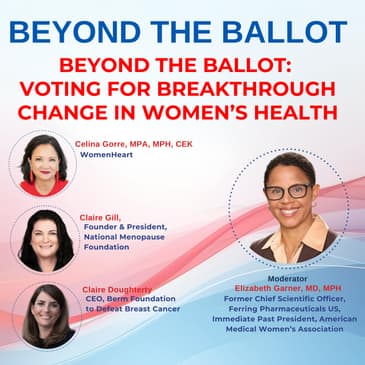

This episode is part of Beyond the Ballot | Voting for Women's Health and Advocating for Change, a three-part webinar series transformed into six podcast episodes. Presented by Beyond the Paper Gown, Black Women’s Health Imperative, G2G Consulting, and HealthyWomen, this series examines how policy shapes women’s health. In this episode, the panel addresses gaps in chronic disease care for women, including heart disease, breast cancer, osteoporosis, and menopause management and the policies that could close those gaps. From advocating for expanded insurance coverage and advancing medical education on women’s health to fostering equity in early diagnosis and chronic care, our panelists discuss how policies can better address the needs of women. Learn more about critical legislation like the HEART Act and the Find It Early Act and the power of your vote in supporting policies that could transform healthcare for all women. Don’t miss this episode!
Please visit Beyond the Paper Gown to join our community and to learn more about achieving your optimal health.
SHOW NOTES:
Learn more about Beyond the Ballot | Voting for Women’s Health and Advocating for Change
[00:00:22] Welcome to Beyond The Paper Gown. I'm your host, Dr. Mitzi Krockover. You know, when I created this podcast, I had a vision to shine a light on the many factors that shape our health and well-being. Think about it. Our physical conditions, the differences between men and women's health, the impact of research or lack thereof, and even our social and environmental circumstances. They're all interconnected and they all play a crucial role in the world.
[00:00:52] And our overall health. But there's one factor that ties all of these together. Policy. It's the invisible hand that guides research priorities, health care access, and even our daily environments. That's why we launched a special series of webinars called Beyond The Ballot to take a look into how policy shapes women's health. This podcast and others that will follow are taken from those webinars, which are a collaboration between Beyond The Paper Gown and the
[00:01:22] G2G Consulting, the Black Women's Health Imperative and Healthy Women. And I also want to thank our gold sponsor, Procter & Gamble and our silver sponsor, Materna Health for helping to make this series possible.
[00:01:34] When we talk about women's health, we often think first about reproductive care. But the story is much bigger than that. Women face unique challenges across a spectrum of chronic conditions, from heart disease, where we're twice as likely as men to die in the year following a heart attack, to osteoporosis, where we represent 80% of cases. These aren't just medical issues. They're policy challenges that demand our attention. In this episode, we'll hear from advocates fighting to change how these conditions are
[00:02:06] are diagnosed, treated, and even covered by insurance. From improving early detection of breast cancer, to addressing gaps in medical education about women and heart disease, our experts share concrete ways that policy shapes women's health outcomes, and how we can work to improve them.
[00:02:23] Our moderator is Dr. Elizabeth Garner, strategic advisor to the research collaborative of women's health access matters, also known as WAM. And she is the former chief scientific officer at Faring Pharmaceuticals and the immediate past president of the American Medical Women's Association.
[00:02:41] The panelists are Claire Doherty, CEO of the Brehm Foundation, Selena Gore, CEO of WomenHeart, and Claire Gill, CEO of the Bone Health and Osteoporosis Foundation, and founder and CEO of the Menopause Foundation.
[00:03:14] So thank you to everyone for joining. Really excited about today's panel. So just for a little bit of background, according to the CDC, chronic diseases are defined broadly as conditions that last at least one year,
[00:03:27] and require ongoing medical attention or limit daily activities. Today we have experts and advocates in cardiovascular disease, menopause, osteoporosis, and cancer. And these are chronic diseases that impact women every day.
[00:03:43] Chronic diseases are the leading cause of illness, disability, and death in the U.S.
[00:03:48] So as we come up to a very significant election, it's important to focus on policy on these diseases.
[00:03:56] For many chronic diseases, women are predominantly or differently affected versus men. Relevant to today's discussion, cardiovascular disease is the number one killer of women.
[00:04:07] Women are twice as likely than men to die in the year following a heart attack, and that's often due to misdiagnosis.
[00:04:13] Yet only one third of participants in cardiovascular clinical trials are female.
[00:04:19] 80% of people with osteoporosis are women.
[00:04:24] Although significant advancements have been made in breast cancer, we need to do much better with early detection.
[00:04:31] Importantly, according to work by the nonprofit Women's Health Access Matters that you just heard about,
[00:04:36] the potential economic impact as well of addressing these disparities is enormous.
[00:04:42] So our panelists today are experts and advocates for a number of chronic diseases that affect women every day.
[00:04:48] They fight every day to improve the lives of patients and their families by advocating for better education,
[00:04:54] encouraging patients to advocate for better solutions for prevention and treatment.
[00:04:59] So with that in mind, I'll now ask our panelists to turn on their cameras and briefly introduce themselves.
[00:05:06] So let's start with Selena, then Claire Gill, and then Claire Dougherty.
[00:05:15] Well, hello, everybody. I'm so pleased to be with you all.
[00:05:17] I'm Selena Gorey. I am the CEO of Women Heart, and we are an organization that is 25 years strong,
[00:05:25] educating and advocating and making sure that women are supported through their heart journeys.
[00:05:32] Thank you.
[00:05:35] Claire Gill?
[00:05:35] I'm Claire Gill. I'm the CEO of the Bone Health and Osteoporosis Foundation and the founder and president of the National Menopause Foundation.
[00:05:45] And our role is to advocate on behalf of patients and consumers.
[00:05:50] So women journeying to and through the menopause journey and the transition.
[00:05:55] And then obviously covering bone health across the lifespan, but it has a much greater impact as we reach menopause and beyond.
[00:06:04] Thank you. Claire Dougherty.
[00:06:06] Hi, thanks. I'm Claire Dougherty. I'm CEO of Brehm Foundation to Defeat Breast Cancer.
[00:06:12] We are entirely focused on early detection of breast cancer.
[00:06:17] We do this through education, access programs and advocacy.
[00:06:21] And we fight for every woman to get the screening and diagnostics she deserves, regardless of her ability to pay.
[00:06:28] So thanks for having me.
[00:06:30] Thank you so much.
[00:06:32] So we're going to have an opening question that I'd like each of the panelists to address.
[00:06:40] So each of you represents and advocates for change in very important diseases that affect women, as we've just heard.
[00:06:47] So for you and your organizations, what are the key, say, one, two or three priorities that your organizations are focused on right now, especially as it relates to policy?
[00:07:00] Claire Dougherty, why don't you start?
[00:07:01] Sure. I'm happy to go first.
[00:07:03] Thanks for the question.
[00:07:04] So at Brehm Foundation, one of our sort of core pillars is to empower women to take control of their own breast health.
[00:07:13] And what that means to us is, first of all, women need to understand their family history and their risk factors, such as dense breast tissue,
[00:07:21] and then take that into their provider, their doctor conversations to figure out what screening profile works best for them and what age they should start screening.
[00:07:33] And we also advocate for pushing back on your provider if you don't feel like you're being heard.
[00:07:38] On the policy front, last week, many of you might have heard that a dense breast notification rule became law.
[00:07:48] So every woman who gets a mammogram must now be notified that she has dense tissue, which is fantastic.
[00:07:53] We believe that knowledge is power in early detection of breast cancer.
[00:07:57] That said, insurance does not cover the out-of-pocket costs for screening beyond mammography, which is an access barrier.
[00:08:05] So that is really how we focus.
[00:08:08] That is a priority for us as we advocate for breast health.
[00:08:13] Thank you so much.
[00:08:14] I was so happy to hear about the dense breast notification.
[00:08:18] That's critical.
[00:08:19] And we know so well, right, that women with dense breasts are less likely to be identified as a breast cancer patient.
[00:08:28] So that's great news.
[00:08:29] And thank you for all of that.
[00:08:31] Selena?
[00:08:34] Yeah.
[00:08:35] One other thing to add to that.
[00:08:37] Oh, sure.
[00:08:37] Of course.
[00:08:37] As I said, I was at a medical conference recently, and I also heard that there's a shortage of MRIs to be able to get that screening.
[00:08:46] So, again, we have a lot of work to do to really advance all of these things.
[00:08:50] So the priorities for menopause and bone, I'll address both.
[00:08:56] It's very similar across many of these states.
[00:08:59] It's access.
[00:09:00] First of all, it's patient education or consumer education, clinical education, because clinicians don't know enough about how to treat women for the menopausal journey.
[00:09:10] They don't get much training up for it during medical school.
[00:09:12] And patients don't know enough about what's happening to them and women, understanding that the symptoms that we're experiencing are actually menopause.
[00:09:20] And then access to the treatments that we need for menopause.
[00:09:26] It's for the treatment of the symptoms of menopause, because menopause is a natural stage of life.
[00:09:33] But the symptoms that we experience can be very debilitating.
[00:09:36] And so those symptoms can be treated.
[00:09:38] And so making sure that all women have access to, first of all, clinicians who know how to care for them and then to the treatments for their symptoms.
[00:09:46] And in bone, we often think that, you know, falling and breaking a bone is a natural part of aging, but it isn't.
[00:09:55] We should be able to fall and not break a bone.
[00:09:59] If you fall and break a bone over the age of 50, you need to get a bone density test to see if osteoporosis is the underlining cause of that fracture.
[00:10:08] And so we're pushing hard within the Medicare community with the Bone Health and Osteoporosis Foundation to ensure that all people who do break a bone, which is the first sentinel event and can lead to repeated fractures, that they all get the standard of care that they need.
[00:10:27] The same way we get the standard of care for diabetes education and for cardiac, you know, we'll hear more about that.
[00:10:34] But once women have had an infraction, being able to have the proper care, that's what we're working for in bone.
[00:10:42] And unfortunately, we are not at the standard of care by a long shot.
[00:10:48] Thank you so much.
[00:10:49] That's just amazing work.
[00:10:50] I can tell you as a physician who was trained years ago, even the OBGYN trainees are not really taught much about menopause.
[00:11:00] And we don't know much about menopause in many ways, too, right?
[00:11:03] So thank you so much, Claire.
[00:11:05] Selena.
[00:11:06] Yeah.
[00:11:07] So from a policy perspective, I would say the number one issue that WomenHeart is really prioritizing is everything having to do with what you mentioned earlier, Beth, missed, delayed and misdiagnosis of heart disease in women.
[00:11:19] And we hear stories every day, all day long about how this informs the experience of women with heart disease and the long journeys they often go through to eventually get a diagnosis.
[00:11:32] But in terms of specific policies, a few that we support and that we advocate for, one example is Troa, and that is about improving access to obesity management medication.
[00:11:45] And we do that because it also happens to improve cardiovascular health.
[00:11:51] So really, you know, it's a bill that's going through Congress now.
[00:11:57] We also are very supportive and excited about a newer bill that's being introduced called the Heart Act that would require continuing medical education specifically on the unique needs of women with heart disease.
[00:12:11] And this is critical because close to 45% of clinicians and practitioners are not confident in their ability to address the needs of women with heart disease.
[00:12:24] So fundamental and sort of what you've learned in medical school, heart disease and the needs of women with heart disease are not highlighted and are not taught systematically through medical education.
[00:12:41] So it's something that we're very passionate about at WomenHeart.
[00:12:44] Fantastic and such great work considering this is the killer of women, right?
[00:12:50] The first number one.
[00:12:52] Thank you for that.
[00:12:54] And I can certainly speak to as well, you know, even emergency physicians, right?
[00:12:58] Who should be those first, who are the first folks oftentimes when a heart attack is happening, right?
[00:13:04] To see that patient.
[00:13:05] And they don't understand the differences between men and women as to how they present with, you know, with a heart attack.
[00:13:11] And so often women get sent home, right?
[00:13:14] As you said, so such important work.
[00:13:16] So Selena, let's stay on you for a minute because I'd like to hear a little bit more about how you're teaching women to advocate and push for policy.
[00:13:27] Yeah.
[00:13:28] So we are very excited about our signature program, which has been, you know, a staple at WomenHeart, which is our WomenHeart Champions.
[00:13:37] We take women living with heart disease and we bring them to the Mayo Clinic and we train them on the ins and outs of heart disease.
[00:13:45] We train them on how to tell their story in a meaningful way.
[00:13:49] And we train them how to use their stories in the advocacy journey.
[00:13:54] We bring them to Capitol Hill in D.C.
[00:13:56] And they use their stories to highlight all of the challenges that they face in the heart disease journey.
[00:14:03] That includes all of the policies that we just talked about, but especially and importantly, their specific experience of delays and misdiagnosis.
[00:14:13] Thank you.
[00:14:14] That's great.
[00:14:14] And we know the importance of having congressional leaders listen directly to patients.
[00:14:21] Right.
[00:14:21] Those are always, I think, the most impactful ways to advocate.
[00:14:25] So thanks for that.
[00:14:27] Let's go back to Claire Gill.
[00:14:30] So you talked about your work.
[00:14:33] I'd like to hear maybe one specific gap, right, that sort of keeps you up at night.
[00:14:39] Like, you know, what is it?
[00:14:40] You talked about all the policies that you're working towards and so on.
[00:14:43] So what's getting you sort of like, oh, you know, this is the one thing we really need to get done.
[00:14:48] And then also, I believe you're having, I think, a congressional briefing next week on the connections between osteoporosis and obesity, which I found very important.
[00:14:57] Yeah, absolutely.
[00:14:58] It's much like all chronic diseases, you know, as we're talking about.
[00:15:02] There are comorbidities that impact our health.
[00:15:06] And I think, again, many of the providers, the clinicians that we see are really focused on one area, right?
[00:15:13] They're there if you're seeing a cardiologist that they're going to help you with your heart.
[00:15:16] And it's not necessarily looking across the whole spectrum holistically about health.
[00:15:21] And so it really is important that we as women advocate for ourselves and do think about our health holistically.
[00:15:32] And part of that, obviously, is thinking about what the impact of menopause is on us.
[00:15:38] So both menopause and bone, obesity plays a big part in our health.
[00:15:45] Women find that it is much harder after the loss of estrogen to lose weight.
[00:15:52] And what's also surprising for many women, even those who are in great shape and have done, you know, stayed physically active their whole lives, there's actually a transfer of where fat in our bodies collects.
[00:16:03] And it often moves from our hips to our middle.
[00:16:06] And so that obviously impacts our heart health then when it, you know, moved to the front.
[00:16:10] But many women, I've had a lot of women say, you know, oh, I've got nothing has changed except my blouse isn't buttoning the same way or my pants aren't fitting the same way.
[00:16:20] And they haven't changed at all in their weight.
[00:16:22] It is literally the shifting of where fat collects in the body.
[00:16:26] And then for bone, I think there's this misconception that, you know, big bone people, people who have a lot of potential bone density, have better bone health.
[00:16:37] But that's not necessarily true because being obese can actually impact the quality of the bone.
[00:16:43] So it is really important that we address all of these potential comorbid conditions when we're looking at women's health and particularly women's midlife health.
[00:16:53] So that's kind of what keeps me up at night is how to make all of these connections for both women and clinicians when we're all so incredibly busy and trying to take care of so many different aspects of the family.
[00:17:07] We really need to try to focus on our own health.
[00:17:09] And again, make sure that you're taking stock of your entire health, whether that be your heart health, your brain health, your diabetes risk, all of those things, your osteoporosis risk.
[00:17:21] We really need to be able to talk with our health care providers about our overall health and not just one area.
[00:17:28] Thank you very, very much.
[00:17:31] Let's go to Claire Doherty.
[00:17:33] So Brehm has focused a lot on early detection as we talked about and we heard about the wonderful information around notification.
[00:17:44] Can you tell us, and you said that, you know, the issues around coverage.
[00:17:47] I'd like to hear a little bit more about what you're doing around that coverage piece and where you think it's going.
[00:17:54] Absolutely.
[00:17:54] Thanks, Beth.
[00:17:55] And first of all, it's just, it's so great to hear from all the advocates on this call about sort of all the confusion and lack of knowledge that's out there.
[00:18:03] Because I really feel like it's only through platforms like this that we can really try and drive that understanding for better, better women's health.
[00:18:12] Um, Brum Foundation was really honored to join with a group of other breast health advocates, as well as Katie Couric, who after her breast cancer diagnosis became very active on this issue.
[00:18:25] We worked with Congresswoman Rosa DeLauro and Brian Fitzpatrick.
[00:18:29] It's a bipartisan bill called the Find It Early Act.
[00:18:32] And really what this bill does is remove the out-of-pocket costs for screening beyond mammography.
[00:18:38] Unfortunately, and I know many of us have experienced this, I myself have experienced it, out-of-pocket costs for tests to diagnose or rule out a breast cancer can range from, say, $250 to $3,000 out-of-pocket, depending on where you go and what your insurance plan is and what your deductible is.
[00:18:58] So this is an issue that impacts not just uninsured, but insured women as well.
[00:19:04] And really, we feel very strongly at Brum Foundation that costs should not be a barrier to whether women are able to diagnose their breast cancer early.
[00:19:13] The earlier you diagnose your breast cancer, the better the health outcomes.
[00:19:18] In fact, if you diagnose your cancer very early, 90-plus women have great health outcomes.
[00:19:25] But, of course, if you wait, and we hear regularly that people, women, come to clinics, and if they hear that there's going to be a large out-of-pocket costs, they go home.
[00:19:35] And then, unfortunately, they come back and they have a stage four diagnosis.
[00:19:39] So we also work to educate women.
[00:19:43] We have a digital risk assessment tool called Checkmate.
[00:19:47] You can find it on the Brum Foundation website.
[00:19:49] It's something you can take in two minutes on your phone or a laptop, and it provides you with a very specific list of your risk factors that you can take to your next doctor's appointment so that you can be more informed as you sit with your provider.
[00:20:04] I understand you go to your primary care doctor, and there's so many things to discuss.
[00:20:09] So we're trying to make it simpler for women to have the information at their fingertips.
[00:20:14] The last thing I will say is, as a woman who's worked in women's health advocacy for over 25 years, I'm shocked at how low the knowledge is, whether it's on breast health, menopause, or heart health, the big three we're talking about today.
[00:20:29] So I just commend everyone for the work we're doing on education because I really think that's the way that we're going to move the needle.
[00:20:37] Couldn't agree more.
[00:20:38] All about education and getting women in particular to fight for themselves.
[00:20:42] We also obviously need the men as allies to help us as well.
[00:20:46] Thank you so, so much.
[00:20:48] All right.
[00:20:48] So we are close to the end here because I'd like to get a little bit of Q&A as well.
[00:20:53] I do have one more question for each of you, and I'm going to quickly run through the questions, and then you can pick one that you want to address.
[00:21:00] So I think we've sort of talked a little bit sort of indirectly about the intersectionality across all of this, right, as it relates to educational needs, clinical care delivery, and access, right?
[00:21:14] Especially as it relates to women of color.
[00:21:15] We haven't really talked about that much today.
[00:21:16] And, of course, other underserved communities.
[00:21:19] So we need to work together.
[00:21:21] There's no doubt about it, right?
[00:21:22] So I'd love to hear how you have worked together with your organization across other organizations to solving some of these intersectional problems.
[00:21:30] So that's the first one.
[00:21:31] First question.
[00:21:32] The second one, how can we help women, in particular women of color, women from other underserved communities, to advocate for themselves?
[00:21:39] I think maybe we've heard about that today, but if you'd like to say more on that.
[00:21:42] Or if you'd want to choose the last question, which is, what would you want every woman to know when it comes to advocating for better policies that affect women's health?
[00:21:51] So I'll let Selena go first here.
[00:21:55] Thanks, Beth.
[00:21:56] So I'm going to share with you a goal that I had when I came into the role.
[00:22:01] And that goal was that WomenHeart accurately reflects the makeup of women's cardiovascular risk in this country.
[00:22:09] Because I'll be frank with you, it doesn't currently do that.
[00:22:13] So what does that mean?
[00:22:14] That means we need to go down and deep into our communities.
[00:22:18] And we are very blessed to have WomenHeart champions across this country who have themselves started community-based organizations so that they can do the outreach to their communities.
[00:22:30] Because frankly, I'm not the best messenger to communicate to African-American women in Atlanta.
[00:22:36] It's going to be a woman for that community who's going to be able to reach those women the best.
[00:22:41] So what we are doing at WomenHeart is supporting those smaller, sometimes micro-nonprofit organizations to do that deep dive so that WomenHeart can look like the beautiful, diverse communities that we have across this country.
[00:22:58] And it's the work that I would love to be my legacy at WomenHeart.
[00:23:04] Incredible.
[00:23:04] Thank you so much.
[00:23:06] Claire, Gil.
[00:23:09] Thank you.
[00:23:10] So there's a lot of opportunities for collaboration across all of these intersectionalities, as you said, and being able to take this information into the communities.
[00:23:18] So on the bone health side, under the National Bone Health Policy Institute, we have a coalition to strengthen bone health where we bring together right now,
[00:23:27] where it's over 25 organizations that are focused on patient outreach and consumer outreach across all disease states that are impacted by bone and across all communities that are impacted by bone.
[00:23:41] And, you know, when I took over as CEO of BHO in 2020, one of my, you know, charges was to how do we get this information out into the hands of people who need it?
[00:23:53] And just as Selena said, you know, we're not always the best delivery, deliverers of that message.
[00:23:59] And so my messaging within bone is I have all the best information about bone health that you could possibly need.
[00:24:06] And if you need it to get it to your community, whether that's your heart community, your diabetes community, your breast community, your BCD community, on it, please reach out to us.
[00:24:17] And we will happily give you that information so you can get it to your audiences.
[00:24:21] And we certainly welcome organizations like Claire's and Selena's to be part of our coalition because we do have a stronger voice together.
[00:24:30] On the menopause side, similarly, I found that we're all trying to address the same things in midlife women's health.
[00:24:40] And so we created the Midlife Women's Health Policy Institute, where, again, we're trying to bring people together around midlife and look at all of these comorbid conditions and say, let's be able to work on this together.
[00:24:55] And so, again, I encourage anybody in organizations or women who want to volunteer to reach out to all of us and get involved.
[00:25:03] Thank you, Claire. That's wonderful.
[00:25:06] And Claire Doherty.
[00:25:07] Yes, thank you.
[00:25:08] I could comment on all three, but I think I will comment really on the issue of intersectionality really through talking a little bit quickly about Brem Foundation really is focused on working in partnership with organizations in our community.
[00:25:25] For example, here in D.C., we partner very closely with organizations such as Married Center and Breast Care for Washington.
[00:25:35] And they help us administer our access programs.
[00:25:39] We have a unique partnership with Lyft called Wheels for Women that provides free rides to screening appointments for women in need.
[00:25:46] That said, it's really the patient navigators at Married Center, Breast Care for Washington, and our other partners that help us identify the women in need.
[00:25:55] So, as everybody else here has mentioned, you know, I don't pretend to be able to identify the women in need of these services to break down access barriers.
[00:26:04] But we truly welcome partnering with those in our communities who do.
[00:26:10] Finally, I would be remiss if I didn't say that every woman on this should get a mammogram every year on this call.
[00:26:16] If you are at average risk for breast cancer and if you are at higher risk, please see your doctor to find out about additional screening because truly early detection can save lives.
[00:26:28] Thank you so, so much.
[00:26:30] I'm wondering, Mitzi, if we have a minute for a question, and if not, no problem.
[00:26:36] You have one minute.
[00:26:38] One minute to ask the question.
[00:26:40] Thank you for being so conscious.
[00:26:41] Thank you.
[00:26:42] I did see one thing that I think that Claire Doherty can answer pretty quickly.
[00:26:50] It was, actually, no, it was to Selena.
[00:26:52] Selena.
[00:26:53] Love to hear more.
[00:26:54] The main points that Selena teaches patients in order to be effective advocates.
[00:27:00] What are the main things you tell them?
[00:27:02] Let me give you one tip.
[00:27:04] So, if you are showing up to the ER with chest pain, right, it's a very common experience.
[00:27:09] And many women are sent away from the ER and told you're having a panic attack.
[00:27:13] You're just anxious.
[00:27:14] You just need rest.
[00:27:15] The one question you can ask them is, please note on my medical record that I have requested testing for heart attack and I was denied that test.
[00:27:29] And nine times out of ten, you will get that test.
[00:27:34] That was an incredible, incredible piece of information.
[00:27:37] Thank you so much.
[00:27:38] So, thank you so much to these amazing panelists.
[00:27:41] And, Mitzi, I'll turn it back to you.
[00:27:43] I want to thank Dr. Beth Gardner for her expert moderation.
[00:27:51] And our extraordinary panelist, Selena Gore from WomenHeart.
[00:27:55] Claire Gill from the Bone Health and Osteoporosis Foundation and the National Menopause Foundation.
[00:28:00] And Claire Doherty from the Brem Foundation.
[00:28:03] As you can see from today's episode, policy change is crucial for addressing chronic diseases that disproportionately affect women.
[00:28:10] And as we approach this significant election year, the key policy priorities highlighted today deserve our attention.
[00:28:18] The Heart Act, which would mandate continuing medical education on women's unique cardiovascular needs.
[00:28:24] The Find It Early Act, addressing the critical coverage gaps for advanced breast cancer screening.
[00:28:30] Medicare policy changes to ensure proper bone density testing and care after fractures.
[00:28:36] And better insurance coverage for menopause treatment and management.
[00:28:40] These challenges require coordinated policy solutions.
[00:28:44] And through coalitions like the National Bone Health Policy Institute and the Midlife Women's Health Policy Institute,
[00:28:50] organizations like the Brem Foundation and WomenHeart,
[00:28:54] these organizations are working together to amplify their impact and reach underserved communities.
[00:29:00] As we look toward future policy decisions, remember that your voice matters.
[00:29:05] Not only in the most recent election, but it's also after the election.
[00:29:10] Sharing your story with Congress, supporting these organizations, or even advocating for yourself in a doctor's office.
[00:29:17] Together, we can create meaningful change in women's health policy.
[00:29:21] I invite you to visit our website at Beyond the Paper Gown to link to these organizations,
[00:29:26] to learn more, and to access our webinars and podcasts devoted to policy and women's health.
[00:29:31] While you're there, please subscribe to our newsletter so you'll be up to date with the latest news and events.
[00:29:37] Also, I invite you to subscribe to our podcast on your favorite platform and leave us a rating while you're there.
[00:29:43] Thanks for joining me and take good care.
[00:29:45] This podcast was produced by Patrick Shabayati and me, and our associate producer is Kyla McMillian.