
This episode is part of Beyond the Ballot | Voting for Women's Health and Advocating for Change, a three-part webinar series turned into six podcast episodes. Brought to you by Beyond the Paper Gown, Black Women's Health Imperative, G2G Consulting, and HealthyWomen, this series dives deep into the essential connection between policy and women's health.
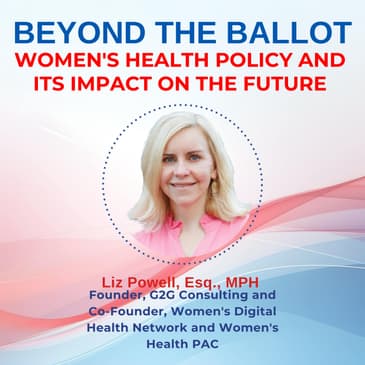
In this closing episode, we are joined by Liz Powell, founder of G2G Consulting and co-founder of the Women’s Health PAC, who brings over 25 years of experience in shaping policy and championing advocacy on Capitol Hill. Liz offers insights into recent milestones in women's health policy, from the White House Initiative on Women’s Health Research to the groundbreaking Momnibus Act, and even new policies at the Department of Defense. Highlighting the powerful role of advocacy, she reminds us that meaningful change is happening—and that we must keep up the momentum. Liz outlines the actions each of us can take, including voting, advocating, and sharing our stories, to build a healthier, more equitable future.
Stay tuned to learn how policy, innovation, and grassroots advocacy are converging to advance women's health. Don't miss this episode!
Please visit Beyond the Paper Gown to join our community and to learn more about achieving your optimal health.
SHOW NOTES:
Learn more about Beyond the Ballot | Voting for Women’s Health and Advocating for Change
[00:00:22] Hi, welcome to Beyond The Paper Gown. I'm your host, Dr. Mitzi Krockover. Today, we're closing out our series of podcasts based on our three-part webinar, Beyond the Ballot, which explores how policy impacts women's health. This empowering session features Liz Powell, founder of G2G Consulting, an industry powerhouse with over 25 years of experience shaping policy and leading advocacy efforts on Capitol Hill and beyond. As an attorney,
[00:00:52] lobbyist and leader in government relations, Liz has worn many hats, including legislative director on Capitol Hill, and she currently serves on the steering committee for the Innovation Equity Forum. Liz also co-founded the Women's Health Pack, which supports candidates prioritizing women's health and also helps to educate them as well. In this session, Liz ties together the powerful themes we've explored throughout the series, from research funding and sex-based data to workplace policies, reproductive health, and beyond.
[00:01:22] Lizzie brings a call to action, urging us to transform awareness into impact. As she walks us through the changes taking place in women's health policy and advocacy, her insights highlight the momentum we have today. With milestones like the recent White House initiative on women's health research, the passing of the Momnibus Bill, and even transformative changes within the Department of Defense and the NIH, it's clear that real progress is underway.
[00:01:51] But her message is clear. We must keep the momentum going.
[00:01:55] I just wanted to close out with some thoughts on policy and advocacy, so that we're all in a place of action after hearing all these amazing panelists. So we've had these three webinars throughout this series. We've talked about research funding, sex-based data utilization, disparities and inequities, chronic disease, workplace policies, reproductive health barriers, maternal health deserts,
[00:02:38] So many issues that span the holistic life of women, impact women and men. These are important issues that have surfaced and finally are getting attention. And what we're seeing right now is a movement for change. And no matter what happens on election day, we cannot stop.
[00:02:59] So I want to close out with some hope. So yes, things are still very challenging. And I encourage folks to use that anger to do something to take action. And so some areas of hope and progress, you see this White House initiative on women's health research,
[00:03:15] that was this culminating force that has brought us to this place where we can't go back, where now we're seeing much more discussion around investing in women's health innovation, addressing health inequities, addressing access, addressing sex-based data.
[00:03:31] So we're seeing policy change. We had that executive order with 20 different directives for agencies. We had ARPA-H and the new $100 million sprint for women's health research.
[00:03:41] We've seen congressional action. Over 2,000 bills are addressing women's issues. About 250 are on women's health. There's the highest number of women members in the House and Senate that we've ever had before.
[00:03:54] And we're seeing legislation we've never had before. For the first time ever, we have language in the annual appropriations bill talking about SBA, the Small Business Administration, putting more investment into those SBR grants that are focused on women's health research and development.
[00:04:12] That has never, ever before been included in legislation, although folks like me have been trying for years.
[00:04:17] We've got $200 million pending in this appropriations bill for the NIH-wide effort to coordinate around women's health and to end all those silos that are happening too often and ensure that women's health is being addressed holistically.
[00:04:34] From menopause, endometriosis, gynecological conditions, cancers, all kinds of conditions are being coordinated and addressed in our research.
[00:04:41] We've got menopause having its day. You had Halle Berry, you had bipartisan senators come together to introduce menopause legislation.
[00:04:51] And then again, we saw funding in this appropriations bill, $5 million for the first ever research action network on menopause.
[00:04:58] Even within labor, we've got the Women's Bureau at the Department of Labor focusing on identifying models of workplace practices that are supporting women going through menopause.
[00:05:08] So things are changing. When we talked about Congressman Lauren Underwood, our champion, 80% of her mom and bus bill is the law of the land because she did that legislation in a bipartisan broad effort and she would not stop.
[00:05:24] She was very persistent. She built up a community of support across the aisle. And that's what makes a huge difference.
[00:05:30] We're also seeing Medicaid coverage across the states for doulas, for postpartum care that whole, that entire first year.
[00:05:37] So huge changes are happening. Even within Department of Defense, which you might not think is a place to target.
[00:05:43] However, women are the fastest growing demographic within the military.
[00:05:47] And for the first time ever, this came out this summer, any research grant funded by Department of Defense has to include women.
[00:05:55] 2024, that was not a requirement, but it is now. And if women are not included, you have to explain it.
[00:06:01] For example, if it's a study on prostate cancer, then that would make sense.
[00:06:04] So we are seeing huge movement. There's billions of dollars that come out of the Department of Defense research program.
[00:06:11] So that is a huge impact. And then elections. Vice President Harris.
[00:06:16] It's the first time ever we've had a candidate so active in women's health.
[00:06:19] She was the champion of the mom and bus bill in the Senate.
[00:06:22] She wrote legislation on fibroids, on domestic workers' rights, on STEM education for girls, on numerous pieces of legislation that are impacting women's health.
[00:06:31] So there is this momentum now that we have to capitalize on. And what does that mean?
[00:06:38] Well, with Election Day, about 20 days away, that means we need to make sure we're registered to vote.
[00:06:42] Our friends are registered to vote. And then when we go to vote, we are voting on women's health.
[00:06:46] That is what is motivating us to vote. And then we need to talk to candidates.
[00:06:50] They're all out and about. They're in parades. They're doing town halls.
[00:06:54] They are very available right now because they need you. They need all of us to vote for them.
[00:06:59] So go up and talk to them. If your issue is breast cancer, you know, Senator, I wanted to know what you think about breast cancer and the fact that there is no insurance coverage for supplemental screening for women with dense breasts, which is half of all women.
[00:07:11] What do you know about this issue? Can we work together on it? Or if your topic is research funding, do you know that NIH only spends 11% on women's health?
[00:07:19] Can I work with you to address that, to increase that funding? Whatever your issue is, you can very politely start to educate and build a relationship with your member of Congress or the state level, any level of government,
[00:07:31] to start to educate them on women's health gaps and opportunities to address them.
[00:07:34] And something Dr. Harris said, I just want to reiterate, share your story. Your story is so compelling.
[00:07:40] And every single one of us has one, whether we've lost someone to a woman's health condition or we've struggled ourselves in just trying to get a diagnosis, for example,
[00:07:49] or been gaslit or whatever systemic changes, systemic impact we've faced.
[00:07:54] You've got to share that because that will make a difference.
[00:07:58] And then finally, after Election Day, you want to shift to advocacy.
[00:08:01] You want to make sure you continue to talk to your lawmakers, share your story, share your requests for policy change, funding increases, whatever that is.
[00:08:12] And remember to use social media. I think we're all very good at that.
[00:08:14] But that has a huge impact, like with the Black Maternal Health Week and other things.
[00:08:18] So those are my final tips. Sorry I went off a little long on that, but very excited.
[00:08:26] Thank you for joining us for this empowering conversation with Liz Powell.
[00:08:36] Thank you for joining us.
[00:08:39] Thank you for joining us.
[00:08:41] We all have a role to play.
[00:08:45] You can view the entire webinar series on our website, beyondthepapergown.com, as well as find resources covering these issues and more.
[00:08:53] and while you're there I invite you to sign up for our newsletter to stay up to date regarding
[00:08:58] podcast news and events and if you subscribe to our podcast on your favorite platform you won't
[00:09:04] miss any future episodes and please rate us to let us know how we're doing so let's harness this
[00:09:11] momentum keep the conversation going and work together to make a lasting impact and a healthier
[00:09:18] more equitable future for all I thank you for listening and take good care
[00:09:30] our episode was produced by Patrick Shambayati and me and our associate producer is Kyla McMillian