
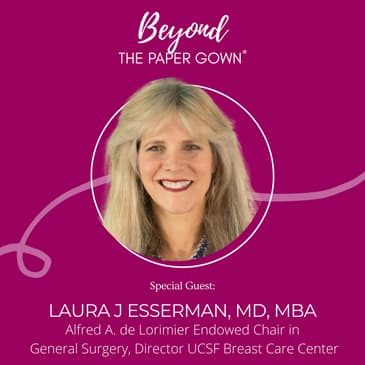

In this podcast episode, Mitzi Krockover, MD, engages in an eye-opening conversation with the dynamic Laura Esserman, MD, MBA, Endowed Chair in General Surgery, Director of the UCSF Breast Care Center, shedding light on the revolutionary Wisdom Study. Dr. Esserman passionately advocates for a paradigm shift in breast cancer screening, challenging the one-size-fits-all approach. The Wisdom Study, with its audacious goal of enrolling 100,000 diverse women, promises to transform screening methods tailored to individual risk profiles. Dr. Esserman's fervor for prevention strategies that consider personal history, genetics, and more sparks excitement for a proactive approach to stop breast cancer in its tracks. Don't miss this compelling discussion and seize the opportunity to be part of the groundbreaking Wisdom Study – a game-changer in women's health.
Please visit Beyond the Paper Gown to join our community and to learn more about achieving your optimal health.
Show Notes:
Breast Cancer Surveillance Consortium
[00:00:00] If you enjoy podcasts like this, you should check out our other shows on Health Podcasts Network. For example, Hopeful Hits, hosted by Dr. Tara, guides and supports those on the often challenging and isolating journey of women's health concerns and infertility.
[00:00:16] There's a particularly powerful episode that you should check out called All Things Endometriosis, which dives deep into understanding the condition to help the many women who suffer from endometriosis and have no idea they have it, and healthcare providers who are uneducated about it, making
[00:00:33] the diagnosis process so difficult. Check out Hopeful Hits on your favorite podcast platform or visit healthpodcastnetwork.com. Hi, I'm Dr. Mitzi Krockover. Welcome to Beyond The Paper Gown, where we focus on uncovering issues that impact
[00:01:06] our health as well as the actions we can take to be healthy and well. We do this through candid conversations with scientists, clinicians, policymakers and innovators. Today, we're delving into a topic that touches lives across the globe, breast cancer.
[00:01:22] Many of us will be affected either directly or indirectly because one out of eight women will be diagnosed during their lifetime, women who are mothers, daughters, friends and partners. And that's why we're sitting down with a true superstar in the field, Dr. Laura Esserman.
[00:01:39] She's a breast surgeon and breast cancer expert, as well as a research scientist and advocate. In this episode, we're focusing on the latest information about screening for breast cancer as well as new ways to prevent it based on personal factors such as genetics and even breast density.
[00:01:57] Dr. Esserman also tells us about a groundbreaking study enlisting 100,000 women in the quest for personalizing breast cancer screening. Stay tuned to hear how you can play a part in scientific breakthroughs and contribute to a future where breast cancer is no longer a common fear.
[00:02:15] This was an enlightening conversation from me and I know you'll be glad you stopped by to take a listen. And just a reminder that the information we provide is for educational purposes only and should not be considered medical advice.
[00:02:28] If you have a specific health concern, please consult your personal healthcare provider. I am so happy and excited to introduce our guest today. Dr. Laura Esserman is the director of the University of California, San Francisco Breast Care Center.
[00:02:51] She is the Alfred A. DeLormier endowed chair in general surgery. She is a practicing breast surgeon and breast cancer oncology specialist. She's also the founder of the University of California-wide Athena Breast Health Network, which is a model learning system to integrate clinical care and research.
[00:03:11] She also leads the innovative iSPY trials, which are designed to accelerate the identification and approval of novel agents for women with high-risk cancers. And she is the principal investigator of the Wisdom Study, which is bringing together
[00:03:25] 100,000 diverse women from across the United States to find the safest and most effective way to detect breast cancer for every woman. And we're going to talk a lot about that later on in the show. Welcome, Dr. Esserman. Thank you so much for having me. My pleasure.
[00:03:41] Well, let's start the stage just so that everybody is on the same page. Tell us a little bit about how common breast cancer is currently and who's at most risk. So over 267,000 women were diagnosed with a new breast cancer.
[00:03:58] 50 to 60,000 women a year are told they have stage zero breast cancer. So about one in eight women. So it's very common. And there are many risk factors that have to do with family history, sometimes exposures, and your genetic makeup, how dense your breast tissue is.
[00:04:20] So many factors that are involved. And there's a number of people who have put together models for predicting risk. And it is our goal to try and work to improve those, and not just to predict whether or not you're at risk for cancer, but what type of cancer.
[00:04:40] Let's stop for a moment. Dr. Esserman just made a really interesting point. Not only can we assess overall risk, but also what type of cancer someone's at risk for. She goes on to explain that breast cancer is not one disease, but a spectrum of different conditions.
[00:04:58] Each type has unique characteristics and requires specific treatment approaches. For example, a key characteristic that's a factor in categorizing breast cancer is the hormone receptor status. Some cancers are what's called hormone receptor positive, meaning they grow in response to hormones like estrogen or progesterone.
[00:05:20] Orders may have what's called a HER2 receptor, which can also influence the growth of cancer cells. Knowing these characteristics of the cancer can help provide a more personalized approach to treatment. And because risk factors for breast cancer vary among individuals, a uniform screening
[00:05:37] approach might not be the most effective. So understanding these risks can guide the frequency and the method of screening, especially for fast growing versus slow growing types of cancer. Dr. Esserman goes on to explain.
[00:05:52] And we know that women have very different risk factors, so it really doesn't make much sense for us to be doing a one size fits all for screening. So we know we can't look for every specific type of breast cancer, but we can generally
[00:06:06] separate things out into fast growing and slow growing. So probably about 25% of cancers are of the faster growing type and about 75% really are of the slower growing type. And we think that if you are at risk for a fast growing tumor, you probably need to be
[00:06:24] screening differently and probably more frequently. And if you have very dense breast tissue, you probably need a contrast based exam. We sort of do a little bit of that personalized screening. If someone has a known mutation and has inherited a BRCA1 or a BRCA2 mutation, we
[00:06:45] do say to people, screen every six months, get a mammogram alternating with an MRI. We have shown now that contrast based imaging is better for people at high risk than mammograms alone or even the 3D mammograms. It's not sufficient that you need that vascular way of imaging.
[00:07:08] An exciting change that's coming up is contrast based mammography or contrast enhanced mammography. So you get a little bit of dye, it's lye dye dye, same thing that you get with a CT scan.
[00:07:20] You get the same amount of radiation you would with a mammogram, but it's kind of like the poor man's MRI. I'm very excited about that. I would say that for a high risk woman, alternating a contrast based imaging study every six
[00:07:34] months would probably be the way in which we could reduce the chance that we would find cancers at a high stage. That's important. Are there any risks to that dye doing it so often? I don't think there's a risk to the dye doing it so often.
[00:07:52] Obviously, if you have an eye dyneology, you can't do it. Sure. And so you might find that. But we don't think so, but I think we also know that you're at risk. If you're at risk for one of these bad cancers, you'd be wanting to find them early.
[00:08:10] Now, on the other side of screening are all of the advances in treatment. I'm really excited about using some combination of PARP inhibitors for mutation carriers up front, not out back, but up front to try and avoid chemotherapy. Before we continue on, here's a little bit of explanation.
[00:08:33] PARP inhibitors are a class of drugs used to treat cancers with specific genetic mutations, such as ovarian cancer, for example. This approach could be a game changer in cancer treatment, especially for those with genetic predispositions to breast cancer.
[00:08:49] That's because right now, if you have a mutation, such as the BRCA1 mutation or BRCA mutation you may have heard about, for example, which increases the risk of both breast cancer and ovarian cancer, only preventive action you can take
[00:09:04] is removing the breast and ovaries to minimize the chance of developing cancer. Dr. Esermann is saying that these cancers could be treatable with these PARP inhibitors in patients with specific mutations, and thus give another option to them. I think it's promising.
[00:09:20] We're actually trying to get one of these combinations into the I-SPY trials. And in fact, if we find that these cancers can be incredibly well treated and be made to go away with pretty tolerable therapies, that may be a complete
[00:09:37] game changer and may completely change how women with mutations think about whether or not they need prophylactic surgery or not. So I think that's incredibly exciting. And if we can really identify everybody who's at risk, that's how you start. It's not that big a group.
[00:09:57] That's how you can start doing real prevention studies. I think part of my issue with screening is that we should really be rethinking it. Screening isn't prevention. Right. But if you start with risk assessment, you can build screening and prevention
[00:10:14] together in ways that really are not just about looking for cancer, but trying to prevent cancer because you have a better idea of what people are going to get and really start moving down the road. Let's take a moment to review what we've heard and learned thus far.
[00:10:30] Breast cancers can have specific characteristics such as their rate of growth and presence of certain receptors, such as hormone or HER2 receptors. Not everyone is at the same risk and it's dependent on certain factors, including genetic factors.
[00:10:46] Breast cancers can be a result of one mutation on a single gene, such as a BRCA1 or 2 mutation, or develop in response to the combined effect of mutations on multiple genes. So knowing the genetic profile of someone and understanding the meaning
[00:11:01] of the profile and its risks, particularly in hormone positive cancers, can lead to more effective prevention strategies. You know, when you inherit your genes, you can have an error in an important proofreader gene, right? Like BRCA1 or BRCA2. That's really about making sure you don't have errors
[00:11:24] in the DNA replication. But you also inherit thousands of other genes, poly, many, genetic risk, poly, genetic risk, poly. So all these genes, when we started this study, there were maybe 76 of these that we thought were associated with breast cancer. Now there's 330 and I'm sure that will change.
[00:11:45] And we're starting to look for again the polygenic risk scores that are associated with fast growing tumors and slow growing tumors. Now not surprisingly, the polygenic risk that we identified now that's pretty standard predicts hormone positive cancer. And what's the importance of that?
[00:12:08] Well it's not surprising since the majority of cancers are hormone positive. But the importance of it is that if you know you're at high risk for developing a hormone positive cancer, you could drop that risk in half by taking tamoxifen.
[00:12:22] And now we know that you can take baby tamoxifen. Instead of 20 milligrams, you can take 5 milligrams and it's so much more tolerable. Right the side effects are a lot less. The side effects are much less and prevention beats screening every time.
[00:12:36] I mean what if we can make that 276,000 down to 130? Wouldn't that be amazing? And that's what we want. We want to find better, more tolerable agents that reduce risk. So if we can identify people at risk, we can start reducing risk. Think cardiology. I have cardiology envy, right?
[00:12:59] And you know that's really think about it. People take statins and they don't think about it if they have a family history of heart disease or stroke and they have high cholesterol. And we have tools to say are they working?
[00:13:12] We need to do the same thing in breast cancer, right? And we can. What you're talking about is just very exciting. And when you talk about being at risk, what are some of the groups that are at risk or at higher risk?
[00:13:28] For example black women are more likely to perhaps get cancer earlier. Is that because of the dense breast or is there a genetic component? We don't know for sure and all black women are not at higher risk. That's part of the point.
[00:13:47] So just because people say well there's a higher risk of genetic mutations and Jewish women, all women who are Jewish or black shouldn't be screening every six months because again there's a smaller proportion of people who are at risk.
[00:14:04] Now it's true any woman who gets cancer in their 30s has a much higher risk of getting an aggressive cancer or a triple negative cancer. That's one of the reasons why we want to start the genetic testing early
[00:14:19] so that we can try and figure out that small part of the population who really is at risk. And part of the reason why I think we've had trouble trying to identify some of this is because we haven't had sufficient representation in trials.
[00:14:33] It's super important for Latino women, African American women, Asian women to participate in the trial as well as white women because that way we can start to understand. And there are SNPs or these polygenic risk scores that are appropriate
[00:14:49] for Latino women, Asian women and now African American women. What is a SNP? So when you look at the whole genome you inherit many, many, many genes and there's little bits of variation in every gene. So these single nucleotide polymorphism small changes
[00:15:05] most of which are irrelevant don't matter but taken together certain ones start to begin to tell us, you know, we can explain maybe a third of breast cancer risk with these polygenic risk scores. So that's actually pretty important. So yeah, what does that mean then for genetic testing?
[00:15:26] Because not everybody has access to genetic testing but it sounds like we're getting to a point where that's going to be very important. Well I think so and we have decided that what we want to do for the study is test everyone.
[00:15:42] So we're making it basically, you know, a population based test. We're going to take a quick break and when we get back we'll talk about the wisdom study, a landmark study of 100,000 women whose goal is to personalize breast cancer screening. Hi Dr. Mitzi Krak over here.
[00:16:02] It's holiday time and I want to invite you to check out our holiday guide on BeyondThePaperGound.com. We have a number of women's health products designed and produced by innovative entrepreneurs, many with special discounts for our BTPG listeners. Also check out our new Make an Impact page
[00:16:22] with profiles on nonprofit organizations focused on improving the health of women. You know donations also make great gifts. Welcome back. We're talking with Dr. Laura Esserman, director of the UCSF Breast Care Center and the principal investigator of the Wisdom Study,
[00:16:41] a landmark study that could change the way we screen for breast cancer. So the Wisdom Study is women informed to screen depending on measures of risk. So we want to bring more wisdom into the field or we want to bring in a modern era study
[00:16:55] where we are looking at not just the generalized risk factors but the genetic factors, actual mutations. So for the first seven years we randomized people to annual screening versus personalized screening. And we found that 60% of the people who had mutations, actual mutations
[00:17:16] and like BRCA1, BRCA2, PALB2, those did not have a first degree family history. So it's either because families are small, there's a lot of men in them, people may not talk about them. But there's a test now that's cheaper than a mammogram
[00:17:32] that allows you to answer that question. And we feel that that now should be standard and that's part of what the study is trying to show. And this next phase of the Wisdom Study, we're actually trying to improve the way we predict cancers
[00:17:48] and start to look for slow growing and fast growing because if you're risk for a fast growing cancer, you should be screened more frequently and you probably need contrast based imaging, especially if you have very dense breast tissue.
[00:17:59] If you're slow growing cancer, you're a good candidate for prevention and risk reduction and we can do counseling for that and lifestyle interventions. So those are things that we can work on for people
[00:18:12] and we can try and right size the screen more for the people that need it and less for the people that don't. And there's probably a group in the population, 20%, that don't even ever get to the average risk of a 50 year old woman.
[00:18:27] They may not need to be screened at all, but we certainly could screen them every three years like they do in the UK. And the analogy I would make there is that when people screen her colonoscopy, we do basically a personalized screening.
[00:18:42] If you have Lynch syndrome or you have familial polyposis, you're screening every six months. If you have lots of polyps, you'd come back in a year. If you have a couple of polyps, you come back in five years. If you have no polyps, you come back in 10 years
[00:18:57] and as I said, who's screening about wanting to come back in a year for their colonoscopy? Nobody. Right, or they can have the DNA test if they're at low risk. That's right. That's right if they hate taking all of the prepping and prepping with the ball prep.
[00:19:15] So I think it's just so important that we are thinking about this in a way that allows us to profile people and try and think about their risk. And we want screening to be better. We have in the process of screening,
[00:19:34] we've sort of pulled in a bunch of cancers that are probably in that low risk and are unknown risk for developing cancer, probably higher risk. DCIS is one of those, Dr. Carcinoma and Cytu. I've called for not calling it cancer, just get the word out of it.
[00:19:51] You know they did that for cervical cancer screening. They used to call it cervical carcinoma and Cytu. And they stopped that because people were getting hysterectomies at young ages that didn't need it. So now they call it cervical neoplasia.
[00:20:07] They're trying to change and make it seem less scary for people. And there's a lot more washable waiting. So we're trying to take a page from that book and start that with trying to think about how we can do active surveillance for DCIS.
[00:20:26] And not only that, maybe develop better more tolerable prevention agents. I think DCIS is a window to prevention. Wow, that is exciting. Are you still recruiting for the wisdom study? We are. We are starting the recruitment of our next 50,000 women
[00:20:45] and this is all gonna be focused on trying to find or predict if you are at risk for high or fast growing cancers, slow growing cancers, moderate risk or really very low risk. And to give people prevention guidelines and screening guidelines that are appropriate
[00:21:04] for what we think you're at risk for. So they'll actually get that if they're part of that study? They will. Oh wow, that's exciting. All online, all you have to do is go to wisdomstudy.org. Super simple. And it's a great way to contribute to science.
[00:21:24] I would say that this is hopefully gonna be a paradigm shift, right? It's so easy to do. You don't have to get your care at any particular facility. The only thing we need you to do is follow up with us. You go online, wisdomstudy.org,
[00:21:40] sign up, fill out some surveys. If you're in the personalized arm, if you choose to be in the personalized arm, we'll send you a box that has your genetic test. You spit in a little tube, put it back in the box, send it back out.
[00:21:52] Month later you get the results and you get information about, and if you are at high risk, we have counselors that will talk to you and we're now doing more of a warm handoff and connecting with the primary care physicians because we know that we need
[00:22:07] to sort of get everybody involved. And we may put together sort of a high risk clinic, counseling clinic to help people know who are at high risk because or connect with people who can do that because I think it's, you have to close the loop
[00:22:25] to get people to be interested in and willing to participate. And how are you reaching out to underrepresented groups? So that's a great question. We actually have a webinar where we, every month, we have more people to participate. We really have dedicated centers in areas
[00:22:49] where people have different rates of Latino women or African American women or Asian women so we're really trying to go into the communities and identify leaders who are, who look like the populations we want to recruit. We have partnered with the VA.
[00:23:11] The VA has a really diverse population, especially women who are very service oriented and want to participate and who are actually very interested in chemical exposures because they've had a number of chemical exposures. That's really interesting. And it is actually, turns out through Lexis,
[00:23:32] you can actually get a history of where people have lived and you can start to think about exposures that people have had. And so we're starting to work on that because I think women are extremely interested in exposures. It's very interesting.
[00:23:49] We haven't really been able to find the right link to environmental toxins and breast cancer but I think it's partly because that there's heterogeneity, there's lots of different cancers. And so I think it may be that certain exposures may increase the risk of hormone-driven cancers
[00:24:11] and certain other cancers may drive the risk for fast growing cancers. And I think if you are predisposed because you have high genetic or polygenic risk, you might be much more at risk for exposures and because it's only 10% of the population that probably has that,
[00:24:33] it's hard to find. Wow, so many variables. But now once we have that, that may give us a chance to really sort that out. And so what do you see as the culmination of the study? Well, I hope that our results from the randomized portion of the trial
[00:24:53] where we are looking at annual screening versus personalized screening, we needed to show that it's just as safe. I think that that will be true. Because we have a data safety monitoring board and so far they've said it's safe to continue
[00:25:09] and so we have one more year of follow-up and we'll be able to report. We wanna know if it's less morbid. So the people who are screening less often, do they have less biopsies, less things? That's probably going to be true.
[00:25:21] We wanted to find out whether this is more accepted by women, the personalized arm. A lot of people had said, oh, you can't do that. No one's gonna ever do anything other than annual screening. But that turns out to be completely not true.
[00:25:36] 60% of the population were willing to be randomized and the people who chose, no matter where they lived, no matter what age, over 80% of them prefer the personalized arm. So I mean, again, that's why we asked. So we said, if you don't wanna be randomized,
[00:25:51] then be in the observational arm and let us understand what you want so that we can, because you have to generate the evidence and that's why I said that everybody should want themselves to be represented in this study. Every color, every race, every ethnicity,
[00:26:09] so that we can ask what are these features? And some people are more at risk for fast growing cancers after American women have a persistent risk of triple negative breast cancers. But probably the thing that puts them most at risk is hormone positive cancer.
[00:26:26] Still, the most people die of hormone positive breast cancer. So we want to do a better job of preventing that and understanding it. And the last thing I'd say is that, we're starting a new conference called Rise Up for Breast Cancer where we really wanna upend prognosis
[00:26:41] for breast cancer because by really understanding the different types of cancers, the kinds of things that are working in targeted ways to treat them in the upfront setting. And the idea that over a woman's lifetime, there are probably five different places where we are already manipulating their hormones,
[00:27:02] cyclical control, birth control, in vitro fertilization, postpartum weaning and postmenopausal hormone management and menopausal symptoms. Why aren't we thinking about organizing treatments that are tolerable and risk reducing for breast cancer? We got lucky with birth control pills, they reduced the risk of ovarian cancer. That was luck.
[00:27:27] But now we can think about it, putting an anti-progestin in. There's lots of things that we could do. Could you imagine? Yeah, and nobody really has talked about this on previous days. No one has talked about it and I think it's high time that we do this.
[00:27:41] So October 2024, we're gonna have our first conference, Rise Up for Breast Cancer. Terrific, where is it gonna be? San Francisco. Oh, excellent. And are you gonna follow up with these women? Oh yeah, definitely. So after they've been on Wisdom One for five years,
[00:27:58] we're gonna invite them to be part of Wisdom 2.0 and then we are hoping to keep, because I mean, one of the great things we have is, we have surveys so people can follow up with us. That's the most important thing about being part of the study.
[00:28:13] You gotta keep in touch with us. So once it's easy to sign up, it's easy to participate but if you get a cancer or if anything happens to you, you get a vibe so you gotta tell us and you gotta follow up with us.
[00:28:24] So this can be a study about women for women, by women and men of course. But it's so important and we ourselves can be the evidence generators. That it's like, it's time. It's time for us to take a stand and really, really get involved and make a difference.
[00:28:47] I think it's a wonderful opportunity because again, I think so many of us as women feel like there's not a lot we can do and this is one way to take action. I wanna just go back a little bit and say, okay, that's terrific for the future
[00:29:07] and hopefully not too far away future. What about now? Because the recommendations have been all over the place. I think women are confused. I think physicians are confused. The American Cancer Society said one thing, the US preventive task force said something else.
[00:29:24] I think there's a little bit more convergence. So just for our listeners, can you help make sense of what the current recommendations are? I can and I would say if you're in the US and you haven't had breast cancer, I would encourage you to go to wisdomstudy.org
[00:29:39] and join the study. Absolutely. But we are increasingly putting information on the site to try and explain why there's such controversy. And there isn't, if you really, I mean, and you can just go online and do one of the online tools that the Cancer Surveillance Consortium tool.
[00:29:56] If you're at average risk, there isn't a reason for you to start screening before 50 and screening every other year. That's the standard way. If you had radiation as a child to your chest or your thyroid or you had family history, young people in your family getting cancer,
[00:30:15] you should go in and start screening probably 10 years before the first onset of cancer in a family member, but even better to get actually a genetic test so you know what you're dealing with. Sometimes we can explain the risk in the family and sometimes we can't.
[00:30:32] But I think that's really important. If you have extremely dense breast tissue and you have high risk, you probably need a contrast enhanced tool like MRI if there's contrast and enhanced mammography in your area. There's a big study going on.
[00:30:52] I think that's gonna be a very important tool. So I think those are the things for you to think about. But again, this is one of the reasons why we started the wisdom study to try and give people a rational way
[00:31:04] to start working on this and thinking about it. So super important I think for everybody. Let's talk about dense breast for a moment because the FDA just mandated that if you have a mammogram, then you need to be informed if you have dense breast.
[00:31:25] And then they say follow up. And from what I've heard, the follow up has been inconsistent at best. And there's also a barrier in terms of for many women if they have insurance, insurance may not always cover the follow up
[00:31:42] or a diagnostic if there's something that was found. So dense breast density does contribute to risk. It's not the only factor, but it's one of the factors. So there's two things that I think that we need to really work on. So what should we be doing for people
[00:32:00] with dense breast tissue? A lot of people say, okay, we should be doing ultrasound and ultrasound does increase the breast cancer detection rate a little bit, but it also really increases the false positives. So 90% of the biopsies are negative. So I think it's also pretty stressful.
[00:32:16] If you really are at high risk, you should be getting a contrast based exam, ultrasound and mammogram that they're there. You know, it's hard for the sound waves or the ionizing radiation to get through all that density and you need something that's vascular and approach.
[00:32:30] That's where I think that contrast enhance mammography or either contrast enhancement or MRI is really much more important and finding these early cancers. Now, one of the things that we can do is we can reverse breast density and we can reverse all that enhancement.
[00:32:47] That's what some of these endocrine reducing like to moxibon will reduce your density. It'll reduce the background enhancement on an MRI. And I think in order for prevention to really take hold, we need something that, you know, women don't wanna just take something.
[00:33:02] They wanna know if it's working. Just like, you know, if you take an antihypertensive, you look to see if your blood pressure comes down or you're taking something for cholesterol, your cholesterol will come down. People want some feedback. So we need to be working on these tools
[00:33:16] and it's possible to do that. You know, AI and mammography is coming and going to change things for the better. But, you know, we have to do this in studies. So it's a big part of Wisdom 2.0. We're looking at how to incorporate the tools
[00:33:33] for AI and mammography, you know, how to incorporate advances in polygenic risk for fast and slow growing risk. Same thing in that AI for mammography. And then to do some modeling to make sure that we're not, that we're setting our thresholds
[00:33:48] in a way that we're not sweeping people in and making the biopsy rate skyrocket or the cost skyrocket. You know, if you were to follow the recommendations of the American College of Radiology and you've got 70% of women screening, you'd be upwards of $40 billion for screening.
[00:34:09] And ACS is about $20 billion. But a personalized screening is more like $8 billion in aggregate. I don't think people don't realize first of all how much it costs because it seems simple, but it's a lot. And I think we also have to have a commitment.
[00:34:24] If we're gonna recommend ultrasound biopsy or MRI or any of these things in the screening setting, that has to be covered and no co-pays because those co-pays can be $1,000, which a lot of people just can't afford. And no one's even told about it.
[00:34:44] So we really have to work on the policy aspects of this all the way through. And that's where we have to, in order to get what we need for the highest risk people, we can't just sweep everybody in. In order we want to.
[00:34:55] I mean, who wants to go through all that if it's not gonna help them? So that's one of the reasons why I think we have to really work on right sizing the screening. And when you talked about the cost, it's not just the cost of the study itself,
[00:35:08] but as you said, it could lead to needing for biopsies or other modalities and that increases the cost as well as the inconvenience and perhaps even sometimes harm. Well, and pain or maybe you'd find eutipia or DCIS, 25% of women with DCIS opt for bilateral mastectomy. It's terrible, right?
[00:35:29] And it's like a lot of those people probably don't need it. That's one of the reasons why we're starting the active surveillance study. We think over half of women don't even need surgery. And so, you know, it's not an emergency and you have time to sort it out.
[00:35:43] And so I think it's really important for these studies, you know, to go forward. And you know, breast cancer is never an emergency. DCIS, eutipia, definitely not an emergency. You know, you have time to figure it out, think about trials, you know, options.
[00:36:01] And nothing's gonna happen if you take a few weeks or even a couple months to sort things out. That's important I think for people to hear. What did I not ask you that you think is important for our listeners to know?
[00:36:14] Well, you know again, I think it's important to know that the majority of fast growing tumors actually present as masses. They present symptomatically. We're not good at finding those through screening yet. And so I think a lot of people don't realize
[00:36:31] if they say, oh, I have a mass but I had a normal mammogram five months ago so I'm sure I'm fine. That's not true. If you have a new mass, you need to get it checked out. I think most women should be familiar
[00:36:42] with what their breasts feel like. Some people are lumpy-bumpy, some people are not. But have a good sense of what you feel like and if there is a change, it doesn't matter if you had a normal mammogram or not.
[00:36:54] Make sure you bring that to the attention of your physician. So I think that's super important for people to realize that it takes all kinds of, that everyone has to pay attention. Women have to be more aware, physicians have to be more aware.
[00:37:11] The research has to work to getting us more towards screening, more towards prevention, more thinking about how do we stop this scourge of breast cancer. What do you tell younger women? Because anecdotally, there's a lot of stories out there of younger women feeling a lump or whatever
[00:37:35] going to their physician and being told, don't worry about it. And for the most part, because of the risk in terms of age, that's probably true, but there are a number of people who don't get diagnosed early. Absolutely. And you know on the ice biotrial as I said,
[00:37:58] half of the women are under the age of 45, half. So a lot of women in their 30s, this is one of the reasons why I'm so intent on trying to figure out how to start the genetic testing portion at age 30. Because if so many people don't know
[00:38:12] their mutation carrier and a third of your risk is in your 30s, we need to be finding those people early. And even though it's not a big group of people, at least we can do more for the people who have an 80% lifetime risk,
[00:38:26] a third of which is in their 30s. That just makes sense. Let's do the low hanging fruit. And I would say if you feel something that is rock hard that is different and is growing, you must go in and you must insist on a biopsy.
[00:38:43] Yes, if most things are assist or things like that, they're not there, but young women can get breast cancer. And they're usually aggressive and they usually change. Don't take no for an answer. If your OBGYN doesn't take you seriously,
[00:38:59] go to a breast center or go find a breast surgeon and have them examine you. We know that young women can get breast cancer. And that's a really important point. Even though it's not very common, it can happen. That's why I say know your body.
[00:39:15] I think the UK has a very good strategy. Be breast aware. And honestly, it takes, don't do an hour exam, do a one minute exam. Up and down every month in the shower, just be aware. And if something is new, you'll know it if you know yourself
[00:39:34] and you'll bring it to your physician's attention. That's great advice. Well, I'm looking very forward to continuing to be a participant in the wisdom study. And I hope all of our listeners will sign up as well. We'll have information on our podcast notes.
[00:39:49] But Dr. Laura Eserman, thank you so much for being with us and for all the work that you are doing. It is so important and you offered to come back and I'm going to take you up on that. Okay, fantastic. I look forward to coming back.
[00:40:03] Thank you so much for having me. Thank you. Let's take a moment to reflect on what we've heard today from Dr. Laura Eserman, the director of the UCSF Breast Care Center. As you recall, one in eight women will be diagnosed with breast cancer.
[00:40:24] We now know that family history, genetics and even breast density can all be risk factors. The takeaway from that knowledge is that recommendations for breast cancer screening should not be a one size fits all. And that's what the wisdom study is all about.
[00:40:40] The study's goal is to revolutionize breast cancer screening by enrolling 100,000 diverse women to determine the most effective screening methods tailored to their individual risk profiles. Dr. Eserman's passion really shown through when she spoke about prevention, how it's about more than just finding cancer.
[00:41:00] The key is to stop it before it starts by tailoring prevention options that are also based on personal history, genetics and other factors. If you'd like to contribute to the science that will help to form these recommendations, I encourage you to sign up for the wisdom study.
[00:41:17] It's a great opportunity to find out about your own risk as well as be a part of a landmark study that will have a big impact on women's health. And how often do we get a chance to do that? It's a gift to the next generation.
[00:41:31] And just a reminder, do check your breast on a regular basis and if you feel any changes, have it checked out by a healthcare provider. We'll have information on the wisdom study and the other resources that were mentioned in our podcast notes. If you get our newsletter,
[00:41:46] there's also a link to the study. And if you don't get our newsletter, please visit us at beyondthepapergown.com and sign up. You can also follow us on Facebook, LinkedIn, Instagram and YouTube. And you can find our podcast on your favorite platform.
[00:42:02] Please do take a moment to subscribe and rate us. It helps us get noticed. Thank you for listening and take good care. Our podcast is produced by Patrick Shambayati and me and our associate producer is Kyla McMillian. If you enjoyed podcasts like this,
[00:42:40] you should check out our other shows on Health Podcast Network. For example, Hopeful Hits, hosted by Dr. Tara, guides and supports those on the often challenging and isolating journey of women's health concerns and infertility. There's a particularly powerful episode that you should check out called All Things Endometriosis,
[00:43:01] which dives deep into understanding the condition to help the many women who suffer from endometriosis and have no idea they have it and healthcare providers who are uneducated about it, making the diagnosis process so difficult. Check out Hopeful Hits on your favorite podcast platform or visit healthpodcastnetwork.com.