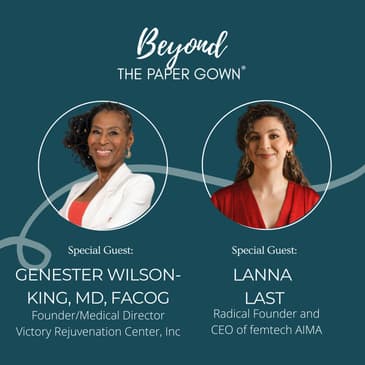

Tune in to the latest episode of Beyond the Paper Gown featuring Genester Wilson-King, MD FACOG, a board certified ob/gyn, cannabis expert and medical advisor to AIMA, and Lanna Last, Founder and CEO of AIMA, a company creating cannabis-based therapeutics for pelvic pain as well as symptoms of menopause. Together they share insights into the therapeutic potential of cannabis, dispelling myths and highlighting its use for women’s health and delve into the “gender pain gap”. Discover their journey, from scientific research to advocacy, as they empower women to take control of their health and well-being. Don't miss this enlightening conversation on cannabis, women's health, and the need for more solutions to successfully address pain in women.
Please visit Beyond the Paper Gown to join our community and to learn more about achieving your optimal health.
[00:00:00] Welcome to Beyond The Paper Gown, I'm Dr. Mitzi Krockover. Let me ask you a question. Have
[00:00:16] you ever found yourself searching for alternatives to traditional pain management, for conditions
[00:00:21] like pelvic pains such as severe menstrual cramps, pain from intimitriosis, or chronic abdominal
[00:00:27] conditions such as irritable bowel syndrome, or inflammatory bowel disease? Maybe you've tried
[00:00:33] many options without finding relief. Well, you're not alone and in fact some women have turned
[00:00:39] to cannabis for their pain relief. I wanted to learn more and thought you might too. So today we're
[00:00:46] speaking with Dr. Janester Wilson King, a board certified OBGYN and an expert on cannabis use in
[00:00:54] women's health. She's a leader in the society of cannabis clinicians and serves on the special
[00:00:59] advisory board for the association for cannabis health equity and medicine. Joining her is Lana
[00:01:06] last, CEO and founder of Emma, a company creating cannabis based therapeutics for pelvic pain as well
[00:01:14] as symptoms of menopause among other conditions. Whether you're here out of curiosity, seeking alternatives
[00:01:21] or just to learn, I know you'll find this conversation both interesting and useful. I know I did.
[00:01:28] Please remember, our podcast provides education and information but should not be considered medical
[00:01:34] advice. I encourage you to consult with your healthcare provider to discuss your own personal
[00:01:40] healthcare needs. I couldn't be more delighted today than to have two powerful women professionals who
[00:01:55] are going to really, I think, open our eyes to a new area of women's health treatment that I'm
[00:02:01] very curious about and I'm sure you will be as well. So I'm going to let them go ahead and introduce
[00:02:06] themselves and then we'll get into a really great conversation. So Dr. Wilson King, please say
[00:02:11] introduce yourself. Sure, glad to. First of all, I'm honored to be here and thank you for the invitation.
[00:02:19] I'm a board certified OBGYN who had a conventional OBGYN practice for many, many, many years. Don't
[00:02:26] want to necessarily tell you how many because then you'll know that I'm almost an antique but
[00:02:32] it's been years and through the years I actually started doing biodegradable hormone therapy back
[00:02:41] in the 90s. And through the years, my practice is just transitioned from full service OBGYN to then
[00:02:50] office GYN and surgery and then come out of the hospital completely and do just office GYN but then
[00:03:01] I realized you really can't take care of women and their hormones in a seven to nine minute
[00:03:09] office visit. So I started a second practice or a second office to keep it separate for women
[00:03:17] who, women and those assigned female at birth who need hormone therapy. And so that's really how
[00:03:25] my practice transitioned to the integrative GYN practice that it is today. And what we do essentially
[00:03:32] is assess where mostly women and those assigned female at birth some men where they are on the
[00:03:41] health and wellness spectrum then try to get them where they want to be through nutritional changes,
[00:03:50] lifestyle modification, whether or not to take supplements, gut microbiome assessments,
[00:03:57] and hormone balancing and cannabis if needed. So we've got a good tool chest of things to help
[00:04:03] individualize our treatment plan for our patients. That's terrific and there's so much there that
[00:04:11] I would love to spend a couple of hours with you but because we have limited time hopefully you
[00:04:16] may be come back. We're going to focus on the last part of what you said and that is cannabis
[00:04:22] which is a relatively new option that I don't think a lot of us know about. And so Lana,
[00:04:28] that's where you come in. Lana LAST who is the CEO of Emma did I say it right?
[00:04:33] Yeah you did thanks Nancy. Okay great so I'll let you go ahead and introduce yourself and your
[00:04:39] company as well and then we'll start on some specific questions. Sure I'm Lana LAST and I'm the
[00:04:44] co-founder and CEO of Emma. I'm a queer female founder and I started this company back in 2019
[00:04:52] because I had like everyone else most of their life have had debilitating period and pelvic pain
[00:04:59] and so being able to manage my pain since I was 10 with my first period to now in my 30s was
[00:05:06] really difficult. I had to take a lot of NSAIDs like Advil and Neproxon to manage that pain plus
[00:05:12] I get ovulation pain and PMS so I was taking a lot of medicine. But I ended up in this hospital
[00:05:20] during my master's with really bad stomach ulcers which were a result from taking so many NSAIDs
[00:05:27] every month. And then I went back to my GP looking for another solution to manage that pain and she
[00:05:32] put me on hormonal birth control but that gave me TIA or tiny strokes so I had to come off of that
[00:05:40] go back to my GP who then tried to prescribe me opioids and that just for me was something I wasn't
[00:05:45] comfortable taking because I have a family history of addiction. So I really had to find something
[00:05:51] that I could use so that I could have some type of quality of life throughout my cycle
[00:05:57] and so I turned to cannabis and that's kind of where the journey of Emma started. I was lucky enough
[00:06:04] during my master's to meet my two co-founders and then last year meet Dr. Wilson King because we have
[00:06:10] this shared understanding and love for knowing that cannabis has a lot of attributes to help women
[00:06:17] in pain. Wow that is quite a journey and thank you for sharing your story with us and just
[00:06:25] for our listeners purposes. Dr. Wilson King is part of your team at Emma is that correct?
[00:06:34] Correct she is our medical advisor. I forgot to say that so thank you.
[00:06:43] No worries no worries you can only wear so many hats and remember you know where you put them
[00:06:49] welcome to my life. So let's dial back a little bit and talk a little bit about cannabis
[00:06:59] so tell us a little bit about what cannabis is in terms of treatment. We're not talking about
[00:07:06] getting high we're talking about therapy and then I'd like to also slide into what specifically
[00:07:15] we know about cannabis and its effect on any women's health conditions so I'll let
[00:07:20] Janessa Dr. Wilson King take that one right now or actually those two questions.
[00:07:25] That's actually yes those are power packed questions for sure but what is cannabis cannabis is a plant
[00:07:33] it's of the cannabis species and it's been used for thousands of years medicinal in all sorts
[00:07:42] of ways. You can use the okay you'll hear the terms hemp and you'll hear the terms marijuana
[00:07:50] and you'll hear the terms cannabis they're all in all three the only difference between cannabis
[00:07:57] or cannabis with THC or hemp hemp is primarily CBD and other phyto cannabinoids but there
[00:08:05] is virtually no or very minimal THC such that there's no impairment so hemp products
[00:08:14] minimal THC don't even have effect a patient and then cannabis is full the full spectrum of
[00:08:23] phyto cannabinoids, terpenes, flavonoids etc. And you have the terpenes and the flavonoids in
[00:08:29] the hemp products you just do not have the THC and I don't want to demonize THC. THC is
[00:08:36] medicinal effective very effective in fact it doesn't really it to how you should have the full
[00:08:44] complement of phyto cannabinoids for to help many conditions but there are people who just can't
[00:08:51] handle THC so there are products without THC and they're and contain the rest of the
[00:08:59] cannabinoids and terpenes and parts of the plant that we all know and love. So now to address
[00:09:05] the second question in terms of women I have a saying that I that I use very often and that is
[00:09:15] the health of women and of course those assigned female at birth. The health has multi-factorial
[00:09:24] components including mood, pain, poor sleep and or hormonal dysfunction so the capacity of cannabis
[00:09:32] and this is why cannabis is so great to act as an anti-inflammatory agent, muscle relaxer,
[00:09:39] mood enhancer, sleep remedy and pain relief at the same time make it potentially ideal for those
[00:09:49] facing these types of health conditions. So what that all means is cannabis can help a wide
[00:09:56] variety of symptoms and women and those assigned female at birth tend to have a variety of
[00:10:03] symptoms with their conditions that's what makes cannabis so helpful. Does it matter how it's taken?
[00:10:14] In terms of the how women how you need the effects, smoking or vaping you get one set of action
[00:10:25] quickly. So if you're having acute pain you don't want to swallow or eat a gummy and then have
[00:10:32] to wait an hour and a half for effect for the relief to come, you'll smoke it or vapet inhale it
[00:10:42] addibles will topicals rather and tinctures rather I should say tinctures
[00:10:47] take about 20 to 45 minutes for onset of duration. Tinctures are put in the mouth and sit in the
[00:10:55] mouth for up to three minutes and then you swallow because you're getting some of it absorbed through
[00:11:01] the mucus membranes in the mouth and so you get a little faster onset of action and then oral just
[00:11:08] taking capsules or eating a brownie or a cookie or something like that. On set of action maybe up to
[00:11:16] two hours to a half hours so it just depends on your need at that time. Despite the fact that
[00:11:24] it is faster and I can understand in certain situations why you'd want to but I'm also,
[00:11:30] again, want to point out that vaping and smoking still has an effect on your lungs just like
[00:11:37] smoking tobacco. There was a great paper written by Donald Teskins from UCLA he looked at
[00:11:46] compared smokers and cannabis and nicotine smokers and found that the a lot of the side effects
[00:11:56] are the same you do get the bronchitis, the COPD things like that from smoking cannabis as
[00:12:03] you would from smoking cigarettes. The only difference or the biggest difference was that the
[00:12:09] cannabis users did not have an increased risk of lung cancer so smoking cannabis seemed to be
[00:12:16] more of a protective factor when it comes to cannabis smoking but you get all the other side effects
[00:12:24] so yes that is so true that smoking and vaping we don't know how safe vaping is because we don't
[00:12:33] know what those filaments are doing to the cannabis oil that's in there. We don't know if the heat,
[00:12:41] we were not testing the temperature of the heat so we don't know what's happening inside what
[00:12:46] are there some other products that are being made or is something burning we don't know all of that.
[00:12:53] We think vaping is better than smoking but we really don't know that so yes I don't necessarily
[00:13:01] recommend patients smoke or vape cannabis but in some instances it's the only thing that works and
[00:13:09] for many patients, unfortunately it's the only way they'll medicate. I just wanted to clarify
[00:13:15] because at the beginning of our conversation you talked about the difference between cannabis
[00:13:19] and hemp and if I remember correctly or I understood it correctly cannabis has more THC
[00:13:28] but I'm assuming that a lot of what is used for pain and again this is where I want Lana to
[00:13:34] jump in and talk a little bit more is really the CBD part without the THC and I just wanted
[00:13:41] to clarify it my correct in saying that. Well that's what people can easily bottle you can't easily
[00:13:49] buy cannabis that has the full complement of THC. That comes from a specialized or all-begin
[00:13:57] sensory and you have to go through where like each state has their own medical cannabis program
[00:14:05] or adult use program or both and so that involves doing some different things like in the state
[00:14:13] of Florida if you want to get medical cannabis you can see a physician be referred for a
[00:14:23] recommendation then for an order and then the physician puts the order into the health center.
[00:14:30] The patient has to get an ID card and then you can go to the dispensary and get what you want.
[00:14:38] Some patients find that inconvenient and annoying so they would rather just go get CBD.
[00:14:45] You can buy CBD or maybe some of the other phytocanabinoids that don't impair you by itself over
[00:14:51] the counter that's why it's so widely used but really the full complement of cannabis should be
[00:14:58] used for pain. So there are there are ways that people don't have to be impaired if they don't
[00:15:04] want to be but THC is very medicinal-ly effective. Lana you've been so patient thank you
[00:15:12] and talk a little bit about how did you come to use cannabis or discover it
[00:15:18] and how do you use it? So I'm someone who when I was experimenting with cannabis did not like
[00:15:29] being high but I understood as Dr. Wilson King having the medicinal benefit for when I was
[00:15:36] having my period pain or experiencing ovulation pain or PMS but again I didn't want that like
[00:15:42] imperative effect from THC so together my co-founders and I looked at CBD and CBG and CBD is
[00:15:50] the non-emparing cannabinoid that allows people to have that great anti-inflammation effect
[00:15:57] and same thing with CBG. So when we were building our formulation we looked at preclinical studies
[00:16:03] done by say Dr. Ethan Russo, Dr. Mike Armer out of Australia to see what type of research had been
[00:16:11] done and what they found was really interesting so they a few different people found that in terms
[00:16:17] of managing endometriosis we found that other clinicians found that there was this out of balance
[00:16:27] endocannabinoid system in the vagina and reproductive organs and that introducing cannabis into
[00:16:34] the vagina and the reproductive organs balanced that ECS system which then reduced the flares
[00:16:40] that occurred for endometriosis which was really interesting and so what we built was a vaginal
[00:16:47] and rectal suppository using CBD and CBG isolate for period and pelvic pain. We wanted something
[00:16:55] that was a localized or like right at the source delivery for that type of pain and so that's what
[00:17:02] we started with was this great spository called OV relief. Dr. Wilson King had talked a little bit about
[00:17:09] how long the effect started when you took it in a different ways because the vagina and the
[00:17:16] rectum armukus membranes does that mean that you get a quick relief or even immediate relief?
[00:17:23] Our vagina is very similar to the mouth at the same type of membrane so although it's not
[00:17:28] it's not instantaneous it's not going to be immediate we've owned in our observational trials
[00:17:33] and with my own experience taking the product multiple times a month like during my menstruation
[00:17:39] and not that it takes around 30 to 45 minutes to work to feel that full benefit but everyone's
[00:17:45] body is different right and the type of pain that they're experiencing is different so we've had
[00:17:50] some people in our observational trials who it worked for after 10 minutes. For myself personally
[00:17:56] I hit that average of about 30 to 45 minutes but it's a great time to be able to lay down and
[00:18:03] relax with a heating pad to just let your vagina absorb the CBD and CBG in our base to be
[00:18:11] able to do its job and get through the vaginal epithelium. Remind me are you FDA approved or cleared?
[00:18:19] No so we are considered an FDA cosmetic so again that can be the same as this reduces the
[00:18:28] appearance of wrinkles rather than saying like this will get rid of your wrinkles it's that type
[00:18:33] of wordplay but that's fine because it allows us as a company to take into accountability our own
[00:18:42] scientific rigor and so that's how we actually stand out from our competitors. If you're a
[00:18:47] cosmetic you don't need to do any of the scientific research that you should do especially for
[00:18:53] women's health but we decided to go above and beyond that and do that. And what specifically have
[00:18:59] you done in terms of research has it been a you know on a clinical trial or observational trial
[00:19:07] what have you done? So we've done in vitro studies so we looked at ourselves in a test tube
[00:19:16] setting with a vaginal epithelium cells in our lab and competitors self-sour competitors
[00:19:22] and so what we found was pretty interesting. We found that one we preserve the vaginal pH at a 3.8
[00:19:30] which is super important for keeping the flora normal in your vagina. We found that our competitors
[00:19:37] actually pushed that pH to a seven which is huge because that can cause BV yeast infections
[00:19:44] and UTIs. BV meaning bacterial vaginosis. Exactly yes thank you. And then we also did our drug
[00:19:52] release profile and so we found that we have this really great burst of all of our active ingredients
[00:19:59] like CBD and CBG that lasted over 50 hours in vitro whereas our competitors had this tiny burst
[00:20:05] and then it died out really quickly. We're also water soluble, we're not oil-based so people who
[00:20:13] use our product don't need to refrigerate it they can use condoms to without them worrying
[00:20:19] that they're going to break and get pregnant whereas our competitors all use oil and this factors
[00:20:23] into that condoms can break if you use oil which again is that fear of getting pregnant if that's
[00:20:29] not something that you want. So we've done that as well as our stability studies so we know how
[00:20:35] long we're good for on the shelf and then we did two observational trials. The first was on primary
[00:20:40] dysmineria or normal period pain and then found that there was 80% total relief as well as relief
[00:20:47] from nausea, migraines and also helping some sleep which is really important when you're in pain
[00:20:54] and then we did a second observational trial looking at endometriosis which is called secondary
[00:21:02] dysmineria. An endometriosis we found that there was an 80% relief in the like
[00:21:10] knocking down three points on the one to 10 scale so if a one is I have no pain, a 10 is like I'm in
[00:21:16] the most excruciating pain. If someone in our observational trial was an eight they ended up using
[00:21:22] our product and lining out a six which is massive for endo because it's such a difficult disease
[00:21:29] to manage. And so that's what we've started off doing and then we're we're slowly moving to do
[00:21:37] more science. We're just trying to fundraise for that now and what about safety?
[00:21:46] So there's only been one ever cannabis product to go through the FDA and it's called epa-dilex
[00:21:54] an epa-dilex is a drug that's given to children who have epilepsy and so they are given it
[00:22:00] orally through their mouths around seven grams a day with castor oil which is massive that's
[00:22:05] a huge dose. And so they were very rigorous because it's used for children they've done three
[00:22:10] different animal trials human trials there's been a lot of science behind that and so we took a
[00:22:16] look at that study that drug and worked our way backwards in terms of safety. So we only have 50
[00:22:23] milligrams of CBD and CBG isolate in our product that's way less than seven grams taken orally a day.
[00:22:32] We also looked at preclinical studies done on cannabis and endometriosis and pelvic pain
[00:22:38] and looked at the dosages there and came up with where we land. So we actually have no side effects
[00:22:45] whatsoever in any of our products which is pretty amazing. That's speaking to the cannabis but
[00:22:52] what about any of the other inactive ingredients is there any risk of sensitivity or irritation
[00:23:02] or anything like that? No so the base formulation that we use has gone through the FDA and is
[00:23:08] approved. So there's nothing there at all for sensitivity or anything like that. It's if anything
[00:23:16] our product is better for sensitivity because again we don't use oil everything is water based.
[00:23:24] Talk a little bit about what you would use the rectal suppository for versus the vaginal.
[00:23:31] Yeah that's a good question so a lot of people who have bowel endometriosis will use it
[00:23:38] rectally and vaginally but because the membrane between the vagina and the rectum is very thin
[00:23:44] it really doesn't matter if it's used vaginally or rectally for that. However people who have
[00:23:50] colon cancer and are undergoing chemo have been buying our products to use it rectally just to
[00:23:56] manage that really brutal pain as well as IBS and IBD so that's been really interesting
[00:24:01] that we're getting different groups of people who have different chronic problems and pain
[00:24:07] using our product. We also had people undergoing IVF or egg freezing who have had pelvic pain who
[00:24:13] have been buying our product to manage chronic flares like endo or specific types of pelvic pain
[00:24:20] while undergoing this treatment. This is such an under looked kind of part of the body when managing
[00:24:27] pain with cannabis that I think we've just been so lucky and grateful to have so many people use our
[00:24:33] product for different things but it runs the gamut. For sure and when Lana said IBD and IBS
[00:24:43] IBD is inflammatory bowel disease like Crohn's ulcerative colitis, IBS is irritable bowel syndrome two
[00:24:52] different conditions. We're working with Dr. Wilson King and our team to provide educational webinars
[00:25:00] and series for cannabis and women's health so we really want people to understand you know how to
[00:25:07] read a cannabis label like what's the difference between hemp extract versus isolite right to have
[00:25:13] that type of information so you as a woman who's managing a pain can go and feel empowered
[00:25:19] as a buyer is so important so we're going to be coming out with that series as part of our
[00:25:24] subscription program so that people can feel educated. And what my my favorite thing is that now
[00:25:30] guided cologists and clinicians are reaching out to us asking us like hey my patients are asking
[00:25:36] about cannabis what can you tell me about that. Patients are the ones who encourage doctors to learn
[00:25:42] about cannabis. Are you talking about a cannabis specialist and where does one find one?
[00:25:50] We're getting more physicians involved in cannabis and learning about the endocannabinoid system
[00:25:57] and helping patients. Now in the state of Florida you can find a cannabis clinician by going to
[00:26:05] the Department of Health website there's a list of the doctors you have to take and they
[00:26:10] are certifying a certification exam in order to recommend cannabis in the state of Florida.
[00:26:16] And you'll see a list of those who have passed the exam and are certified to recommend cannabis
[00:26:22] in the state they're listed by name and county and you can find you can find a doctor somewhere
[00:26:31] sure you for sure. And I was just going to say very briefly that on our website too my dash
[00:26:40] Emma aiamay.com we're going to be uploading a resource with clinicians we know who prescribe or
[00:26:47] recommend cannabis and it runs the gamut from gynecologist to integrative specialists to pelvic
[00:26:52] floor therapists and acupuncturists because those are people that we work with and so we know
[00:26:58] recommend products and understand cannabis education. So we're also going to be uploading that resource
[00:27:04] for people across the US. Talk a little bit about the use of cannabis with parimenopausal symptoms.
[00:27:11] So using cannabis to address some of the issues. Now what happens in parimenopause and menopause
[00:27:19] is your hormone levels decline and progesterone being the first hormone to decline you lose about
[00:27:27] 75% of your hormones before age 50 whereas estrogen only falls by 30% by age 50 so you see how
[00:27:35] your estrogen dominant for a number of years and that leads to bloating midsection weight gain
[00:27:41] moodiness irritability cravings for sweets and chocolates breast tenderness headaches and
[00:27:47] some anxiety all of those things and that's in parimenopause and post can happen in post menopause.
[00:27:54] Cannabis can it's a great sleep medicine so cannabis can help to address the sleep issue
[00:28:00] if you don't want to take hormones or if hormones aren't working for you. Cannabis can address
[00:28:06] anxiety can help with the fatigue. You can take some cannabis products that will help stimulate you
[00:28:14] help get you going. Our repositories too if I can hop in here in Genester have been used by
[00:28:21] women who are menopausal for painful sex actually which was really interesting so we were just
[00:28:28] considering like pelvic and period pain yeah and now we have people who are like hey not only
[00:28:34] am I going through menopause and having pelvic pain but I'm having dysperunia painful sex and
[00:28:39] have been using the repositories for that which is great because we have such a long dissolution time
[00:28:45] so we are seeing this adoption for sex which is really really interesting. Besides the
[00:28:51] suppositories do you have any other products? Yes yes so we are coming out with an oral capsule
[00:28:58] that has the exact same formulation as our suppository except we've also added a new cannibinoid
[00:29:05] CBDA which is showing really great results for managing extreme pain that's associated with cancer
[00:29:12] so we're going to be adding that into our oral capsule which is coming out this spring and then
[00:29:18] Dr. Wilson King and my co-founder Dr. Mally Maybode she's our chief scientific officer
[00:29:24] they're creating a vaginal suppository for menopause specifically just so that we can offer
[00:29:33] something that's a bit more focused for that age group so we do have more products coming out into
[00:29:38] the market. How will that one be different than the one for the original one? We've done a lot of
[00:29:46] research over the past two, three years working with different gynecologists and formulation experts
[00:29:52] in the menopause world to really come up with a better more suitable formulation that adds
[00:29:59] more say moisture to the vagina so that there's less tearing or thinning of the walls
[00:30:06] in combination with cannabis because we all deserve that personalized healthcare so yes right now
[00:30:13] you can use our suppository if your menopause will have this issue but our next product specifically
[00:30:21] for menopause is going to be better in addressing these specific issues. And how can people obtain your
[00:30:30] products? Yeah so right now you can go onto our website my-ema-am-am-a-a-m-a-e.com and purchase our
[00:30:40] product there or we're on the sexual wellness store its rhythm as well as a period tracking app
[00:30:47] called ORCID. We're going into more retailers online but it's honestly best just to order from us
[00:30:53] because if you have any questions I'm the person that answers along with my co-founders and I just
[00:30:59] to give a shout out to my co-founders as well they're both really amazing human beings who
[00:31:06] between the three of us we suffer from what they call the evil triplets so period pain pelvic pain
[00:31:12] and IC or like very extreme bladder pain. And so Melanie, her borg she's a cellular biologist
[00:31:20] she's our COO and she suffers from IC pretty brutally and so she uses our product for that
[00:31:27] and then Dr. Mally Maybawd who hails from Iran and came to Canada in 2015 and got her PhD
[00:31:34] in drug discovery and delivery she has multiple patents under her belt with drug discovery
[00:31:41] and she suffers from the same as me chronic period and pelvic pain so together we all know what it's
[00:31:47] like to like suffer and not have any options. You mentioned the gender pain gap for our listeners
[00:31:54] explain what that is. Yeah so the gender pain gap is where women or people who identify as women
[00:32:02] receive less care based on their gender essentially so for example there was a study done
[00:32:10] in the UK that looked at men and women who went to the emergency room for the exact same problem
[00:32:15] abdominal pain. And what they found was that women had to wait over 60 minutes to see a physician
[00:32:23] or a doctor while men only had to wait 45 minutes. Women were given anti-psychotics,
[00:32:30] men were given pain medication. So that is an example one example of the gender pain gap
[00:32:39] where we're not heard or understood or trusted. What did I not ask you that you thought was
[00:32:46] important for us to address? You will not die from cannabis, you will not die from cannabis,
[00:32:54] you can overdose on cannabis but all you do then is lay down and go to sleep and when you wake up
[00:33:01] you'll feel much better so it won't kill you like opioids do. That's one thing that's very important
[00:33:08] to know. Along that line what about the addiction potential? Very very low it's about
[00:33:16] 9 to 10 percent of people will become addicted. It's more a psychological addiction rather than
[00:33:26] physical. You could stop if you use cannabis every day, you could stop using it. You'd be a little
[00:33:31] irritable for a few days, few weeks and that's it and it's not like with alcohol addiction and withdrawal
[00:33:38] you can actually die from it and you can't die from cannabis. If you're just using it maybe
[00:33:48] topically or pure CBD is that even a risk? Topically no because there's no systemic absorption
[00:34:00] and CBD or the non-impairing phytoconabinoids you can still overdose on those but you won't die
[00:34:13] from them. By the way low doses of CBD are not impairing but you can take a high dose and
[00:34:22] who knows what that amount is for each individual but high doses of CBD can cause some
[00:34:29] impairment? I think there's this balancing act of yes I want us to be successful in business but
[00:34:38] I also and want to make an impact on women's lives but it's really important for us to also do
[00:34:43] the advocacy work. To really walk the walk and talk the talk is really important to us so advocacy
[00:34:50] for our company is a big thing. We again not just want to make an important product that helps but we
[00:34:56] really want to change the way that women's health has talked about and research. I will ask my final
[00:35:04] question and that is if you have one or two tips for our listeners in terms of what they can do
[00:35:11] directly to improve their health? Absolutely actually I love questions like that. The first thing I would
[00:35:20] say is that number one you should try to get sleep. You make sleep a priority in your life.
[00:35:32] It's another area where you may not necessarily think about it being a part of wellness but lack of
[00:35:40] sleep causes weight gain, causes irritability, causes all sorts of problems in your life and sleep is
[00:35:51] definitely important. The next recommendation I have is embrace healthy eating. Don't mean you have
[00:36:02] to be a vegan or a vegetarian. Just make healthy choices, make better choices, healthier choices
[00:36:12] maybe cut down on your fat intake, maybe use less dressing on your salad, maybe eat red meat
[00:36:22] once a week instead of five nights a week. Use other types of proteins to get your protein. Protein is
[00:36:32] real important especially for women over 40 but you don't want to necessarily eat all red meat. That's not
[00:36:39] the healthiest thing to do either. So just make healthy choices. The third thing is set up
[00:36:47] establish an exercise routine. I don't recommend anybody go to a gym at least not early on.
[00:36:57] Just maybe go outside and go for a walk. It's actually been proven that regular exercise has
[00:37:05] a lot of benefits. You get a 30% lower risk of depression, dementia and early death.
[00:37:15] Just go for a walk in your neighborhood. Walk out your door for 15 minutes turn around and come back.
[00:37:23] Make exercise a part of your routine before you start spending money on it. So that's the third
[00:37:31] third recommendation is that. But the fourth one is self care. We got to learn how to de-stress so we
[00:37:41] got to learn to take care of ourselves. It is important that chronic stress has a strong
[00:37:50] link to the six leading causes of death, heart disease, cancer, lung ailments, accidents and
[00:37:57] liver cirrhosis and suicide. So there needs to be a wellness plant that includes
[00:38:05] de-stressing, take time to meditate, get a massage, get a facial, do something for you,
[00:38:13] show kindness and value to yourself and that will help you to help others. And lastly,
[00:38:22] pay attention to your mental health. Do not hesitate to see a therapist. If you know things trigger
[00:38:31] you, avoid them. It's okay to say no. I can't, I don't want to do that. It's okay. If they're really
[00:38:38] your friends, they'll still be your friends. If they aren't your friends after that, they never were.
[00:38:45] That's all. But yeah, you want to make sure that you address your mental health. However you do
[00:38:53] that, quiet time, finding something that relaxes you. Laughing. Laughing is a huge remedy for a lot
[00:39:02] of things that bother people. It's a great stress reliever. Find a good comedy or find something
[00:39:12] that makes you laugh. And I'm going to date myself, but it never fails. If I turn on an episode
[00:39:20] of the Golden Girls, I will laugh. I will laugh my head off. I think they're having a renaissance.
[00:39:29] They are. They seem to be for sure. So it's really laughing is there's nothing better than laughing.
[00:39:41] And those are my five things that I would recommend. Talk to each other. Educate yourselves and
[00:39:48] educate each other on the information that's out there. Keep your eyes open in your ears to
[00:39:54] the ground about women's health because it is important. Even if you're a healthy woman and you
[00:39:59] don't have any problems, there's most likely a woman in your life who does and who could use
[00:40:05] anything that you learn or hear about to help them in their journey. This is how women for
[00:40:10] like millennia have learned about our own bodies is by talking with each other and learning from
[00:40:15] each other. So we're really big on teaching women and people born with a uterus to understand cannabis,
[00:40:23] buyer product, or don't, but at least be able to read a label and understand the ingredients so
[00:40:29] you know what you're putting in your body and that you can feel empowered by that. So please share
[00:40:38] the knowledge that you have of yourself and other people and brands like us who are doing the
[00:40:43] hard work to really spread the information, help us spread the information basically.
[00:40:50] And then of course self-compassion is a big one. And that's something that as somebody who
[00:40:56] is a millennial okay I have no kids and I don't know how other people do it with kids but
[00:41:02] I own a business that's like my baby and it is a struggle in this day and age to be a woman. It
[00:41:08] is really hard. There were supposed to be super women non-stop and it is an impossibility
[00:41:16] to do that so please have some self-compassion and pat yourselves on the back because it is not
[00:41:22] easy to be where we're at and remind yourselves that this will affect your health and so it's okay
[00:41:28] to take a step back and love yourself that way and show yourself some kindness and ease.
[00:41:36] Beautifully said and monolass thank you so much for coming on and also informing us about
[00:41:44] a really important issue. Dr. Janester Wilson King thank you so much for being with us today.
[00:41:51] Thank you so much it was an honor to be here with you. I love the work that you're doing.
[00:41:57] Thanks so much.
[00:42:03] As we close today's episode we've covered a lot of ground and I want to thank Dr. Janester Wilson
[00:42:09] King and Lana last for a great conversation. For those of you seeking more information or considering
[00:42:16] cannabis for health reasons I hope this episode offers a starting point for your own research
[00:42:22] and discussion with your healthcare providers. We've added some resources in our podcast notes so
[00:42:28] please check them out. Also I invite you to check out our website at BeyondThePaperGown.com
[00:42:35] and subscribe to our newsletter for the latest updates on the podcast as well as women's health
[00:42:40] news activities events and more. And before you leave us today please take a moment to subscribe
[00:42:46] to our podcast and read us it helps us get noticed as always thank you for joining me and take good care.
[00:42:54] Our podcast is produced by Patrick Shambayati and myself and our associate producer is Kaila McMillion.