
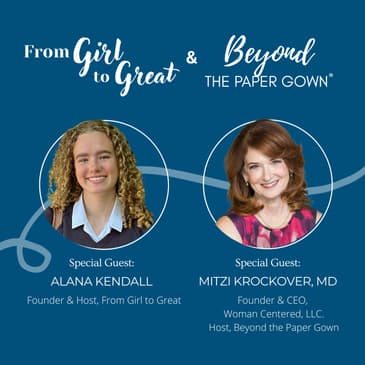

Curiosity can spark groundbreaking change—especially in women's health. In this special episode, we’re sharing an inspiring conversation from the Girl to Great podcast, where host Alana Kendall—a high school student passionate about empowering young women to lead in healthcare, policy, and health economics—interviews Dr. Mitzi Krockover, host of Beyond the Paper Gown. From leading the first UCLA Women’s Health Center to investing in femtech, Dr. Krockover shares how embracing change and lived experiences can drive meaningful advancements. Tune in for insights on healthcare, leadership, and carving your own path forward!
Please visit Beyond the Paper Gown to join our community and to learn more about achieving your optimal health.
SHOW NOTES:
- Mitzi Krockover, Founder and CEO, Woman Centered, LLC and Host of Beyond the Paper Gown
- From Girl to Great, Hosted by Alana Kendall
[00:00:14] Welcome to Beyond The Paper Gown. I'm your host, Dr. Mitzi Krockover. Today, I'm sharing a conversation I had on another podcast, From Girl to Great, hosted and produced by Alana Kendall. Alana is a remarkable high school student from the UK living with type 1 diabetes who has created a platform dedicated to empowering young women in healthcare and leadership through mentorship and real-world insights, as well as her incredible
[00:00:44] podcast. I was honored to join her to discuss my experiences as a physician and my work in women's health and women's health innovation. Alana and I explored how curiosity and lived experiences can spark groundbreaking innovations in women's health. We discussed the challenges facing women's healthcare, the promising frontier of femtech, and I offered guidance for young women looking to make their mark in this evolving field. In this episode, I also
[00:01:14] emphasized the importance of staying curious, creating solutions from personal experiences and recognizing the many ways to make a difference in healthcare, regardless of your chosen path. I hope you enjoy this conversation, From Girl to Great, now featured here on Beyond The Paper Gown. I thank Alana for allowing me to share this episode with you. Welcome to the podcast, From Girl to Great. I'm your host, Alana Kendall.
[00:01:42] In this episode, I spoke with Dr. Mitzi Krokova, an internist and a leader in women's healthcare innovation. Mitzi shared her incredible journey from studying psychology to being the founding medical director of the Iris Cantor UCLA Women's Health Centre. I really connected with her passion for advancing women's healthcare and her belief in the power of innovation, especially in areas like femtech. Her advice about carving out your own
[00:02:12] path in a field in a field you're passionate about was so inspiring and I loved hearing about the challenges she's faced and overcome as a trailblazer. Mitzi also hosts the podcast called Beyond The Paper Gown, which is an amazing resource for anyone looking to learn more about women's healthcare. I've linked the podcast in the show notes. Let's jump right into the conversation with Dr. Mitzi Krokova.
[00:02:38] Hello everyone, welcome back to From Girl to Great. I'm really excited to introduce my guest today, Dr. Mitzi Krokova. Mitzi, would you introduce yourself please? Sure. So glad to be here. I'm Mitzi Krokova. I am an internist by training in previous practice and my area of focus is women's health. I have a history of starting as the founding medical director of the Iris Cantor UCLA Women's Health Centre.
[00:03:06] They went on to Humana Insurance Company as vice president of women's health and now and currently in the women's health innovation space. We can talk more about why that is. And I'm also host of the podcast Beyond The Paper Gown, which focuses on women's health and not just our medical conditions, but all the factors that impact on us. Would you mind briefly explaining what an internist is?
[00:03:31] Oh, good question. So it's really an adult medicine primary care provider. We do three years of residency and in all the different organs and organ diseases like diabetes and high blood pressure and heart disease and kidney disease and that kind of thing. And then some people go on to subspecialize in those different areas as cardiologists, nephrologists and so on. Thanks for the explanation. Sure.
[00:04:01] Could you tell our listeners a bit about your education journey, please? Oh, so long and so long ago. Actually, this might be useful for your listeners because I didn't have a typical pathway to what I do. And the moral of that story I'll start out with is you don't have to have a typical pathway. I went to college and I was going to be a psychologist. I did some work during breaks and things like that.
[00:04:30] And professionals said, you know what? You should really think about being a physician. And so I said, OK, I never really thought about that. And I was already in my sophomore year and I got some bad advice from my advisor to start taking certain courses and then trying to catch up from the courses I didn't take at the same time. So that was pretty much a recipe for disaster. So I decided, OK, maybe this isn't for me. And I went back to psychology. But it was still nibbling at me.
[00:04:58] So by the end of my senior year, I went ahead and graduated. And I said, you know what? I really do want to be a doctor. And so I went home to Texas. And I took all of my pre-med courses from one summer and a whole year and then another summer. And I think because I was really focused and really wanted to do that, I did really well. Luckily, I got into medical school.
[00:05:25] So then I had four years of medical school and then I decided that I wanted to be an internist. So I did three more years of internal medicine residency. Fantastic. How did you get into women's health care? That's a really good question. When I finished my residency, I actually wanted to talk about health care reform. And so I wanted to do that on TV.
[00:05:51] So I took some media classes and did a little bit. But then I didn't feel like a doctor. I really wanted to practice. UCLA had an opening. And they asked me, what's your special area of focus? And I literally said, without even thinking about it, women's health. Do not know where that came from. It wasn't as ubiquitous as it is now. But that was it. And I was very lucky. There was a group of our physicians who were very focused on women's health.
[00:06:20] And as internists, we don't do a lot of GYN usually. But we actually expanded our practice to do that. And so what we wanted to do is start a center. And we were very lucky that a benefactor, Iris Cantor, decided that she wanted to help us with that. So she funded the Iris Cantor UCLA Women's Health Center, which was a primary care. It still is. A primary care women's health center.
[00:06:48] So someone can come in for the regular general care. And then we obviously have a network of subspecialists to refer them to. And we became a center of excellence in women's health through the Department of Health and Human Services. That's the start of my foray, if you will, in women's health. Amazing. What are some of the challenges in women's health that you're trying to fix? Sure. You and I are here at Health, the conference.
[00:07:13] And we just heard Jill Biden and a number of folks talking about the challenges with women's health. You know, I said that I was I said women's health, you know, kind of out of the clouds. At that time, right before that, women were not included in research because we're complicated. We've got these hormonal changes. And they thought it's easier for us to extrapolate from the research on men. But obviously, we are not the same. And we needed that research.
[00:07:42] So there's a lot of gaps in research. So even for the things that we have, like men, like cardiovascular disease, it's different. We have different symptoms and so forth. So there's all those kinds of things that we need to catch up on. Because in 1994 or 93, they started allowing women to be in clinical studies. And it's only been since 2016 that they've asked to look at sex as a biological variable.
[00:08:11] And that means does sex make a difference even at the cellular level? And most of the time it does. And so we need more research. So that's a big gap. And then because that research hasn't been done and very little money has been, relatively speaking, provided for research funding, there's a lot of gaps on things that are just women's stuff. And you heard about endometriosis, polycystic ovarian disease, and even menopause. Every woman goes through menopause. We know so little.
[00:08:39] And as a physician, I was taught so little. Because if it's not studied, if it doesn't get into the textbooks, it doesn't get into clinical practice. And so I think that's what a lot of women are feeling frustrated about because they go to their doctors and their doctors really don't know. That's changing. But it's, again, changing very slowly. So there's a myriad of opportunities, if you will, in terms of improving women's health. Yes.
[00:09:06] And I'm sure there's lots of young women listening that want to drive innovation and change in these fields. So what skills or experiences do you think are most valuable for young women? I would say curiosity. If you're not curious, you're not going to look at different things and different opportunities. First of all, the things that I've done, most of the jobs I've had, there wasn't one before that. And especially now, things are changing. So I would say don't pigeonhole yourself.
[00:09:36] Figure out what you're interested in because you don't know what the jobs and opportunities are five years from now because things are changing. The second piece is that we know that women's health has improved and more research has been done because there's more women. There's more women in research. There's more women clinicians. There's more female venture capitalists and more women in government. So if you're interested in STEM, there's lots of opportunities in research and tech.
[00:10:06] And if you're interested from a business standpoint, there's lots of opportunities to take that discovery and make it into an innovation. I would say figure out what it is you love and then try to find ways to do those things. And a lot of entrepreneurs especially really draw upon their own lived experience.
[00:10:29] The reason I became so interested in women's health innovation is because women were coming to me for my medical expertise because they were creating companies to answer questions and solve problems for them that they couldn't find either in the healthcare system or on the shelves for their own healthcare problems. And so they were creating the solutions. And that's what you're seeing over and over again.
[00:10:55] And lived experience really informs a lot of what a lot of these women are doing and making changes not only for themselves but for others. Great advice. I know you're starting to do some investment in femtech companies. Is that correct? Yes, I've been doing that for a while. What femtech company are you most excited about? Okay, well, let's go back. So femtech was a coined word for digital health applications to women's health, but I think it's now become much more broad.
[00:11:24] It's kind of women's health innovation, if you will. And when we talk about women's health, we're talking about those issues that uniquely manifest in women like reproductive cancers and menopause and hormonal changes and pregnancy and that kind of thing. But there are also diseases or conditions that manifest disproportionately. So more women may suffer from autoimmune disease.
[00:11:48] You heard in the conference today Alzheimer's and osteoporosis, for example, and then those that manifest differently, like we talked about heart disease. So what am I most excited about? I think I'm excited about the fact that while there's such a need and continued innovation in the maternal health space, we're seeing more innovation to some of those other buckets, if you will, for osteoporosis, for Alzheimer's, for menopause.
[00:12:17] And also seeing the interconnections between maybe the hormonal changes that we experience and some of those other conditions that we have that maybe we share with men, but we experience them differently. There's all sorts of medical devices. There are medical services. There are therapeutics. There are diagnostics.
[00:12:40] Two of the most interesting things to me in terms of categories are AI and AI-informed innovation that, again, will be based on data on women. And then the second one is putting more responsibility and opportunity in women's hands. So we know about the pregnancy test, but now you can test for all sorts of things. You can test for your different levels of hormones in your body.
[00:13:08] You can test for so many things that you can do at home. And at this conference, we even saw kits that were provided for patients to do some of that on their own. If you could go back in time, what advice would you give to your 17-year-old self? The theme of this conference is be bold. And I like that because for me and I think a lot of girls and women,
[00:13:32] we are hesitant to either blow our own horn or take risks or have enough confidence in ourselves. And I know this sounds cliche, but there's only one you. And there's only one you that has a whole set of characteristics and experiences that are put together in a very unique way to build on that.
[00:13:56] Get as much experience as you can and also just be very true to yourself and advocate for yourself. What are the biggest challenges women face in healthcare, both as patients and professionals? As patients, I think that it goes back to feeling like they're not listened to or being dismissed. And that's where we get into the advocating.
[00:14:19] So if something isn't right, doesn't feel right, you have to be able to advocate understanding maybe that there are gaps in knowledge. And I think that is frustrating that there are those gaps. And I think good physicians will recognize those and be honest. Some don't know enough to know that they don't know. And then they put that on the patient. So I think that is the hardest thing about being a female patient, if you will.
[00:14:47] But I do think most doctors want to help. And if you're not getting what you need, you need to move on. As a physician, as a female physician, I think it really depends on where you are and where you've trained. And everybody has had different experiences. I know that some women have felt that they didn't get ahead because they were a female. I don't remember having that challenge. And I guess I was lucky.
[00:15:13] I do think that if you look at how the workforce is set up, even in medical school, it's hard to be a mom. You do hear stories about women trying to lactate in like closets because there's no lactation room in a hospital, that kind of thing. When I was running the Women's Health Center, we always joked one of us was always pregnant. So we figured out a way to share when somebody was on maternity leave.
[00:15:40] We would take their patients and we would try to make it seamless for our patients and let them know ahead of time. And we would share records. And I did start a lactation program at Humana for my employees. Amazing. So that was a lesson learned. But just in terms of flexibility, understanding that most women are caregivers as well. So they're really juggling a lot. We saw that certainly during the pandemic.
[00:16:06] So I think that that's the big challenge for female physicians. It's putting a round peg in a square hole sometimes because the system really wasn't made for women. It was really made for men who had women at home, if you will. So hopefully those things are changing as we get more women in leadership. And I think also men are much more open to making changes.
[00:16:31] What is the area of women's health care that you would like to see the most effort devoted to in coming years? That's a hard one because there's so much that needs to be addressed. I will say that I think that in the United States, you've probably heard this, that we have one of the worst maternal mortality. And as someone said, women are literally dying in childbirth. And it's getting worse when you think that shouldn't be the case.
[00:17:01] And we know that black women are three times more liable to die during childbirth. I think that we need to figure out how to take better care of our pregnant women and figure out why this is happening. Peripartum depression is a huge issue. And it not only affects the woman, it obviously affects the baby and the care of the baby. And it also affects the family. So that's one area that I think has to be a priority.
[00:17:31] But again, I think there's so many other areas. Heart disease is the number one killer in women. And we have worse outcomes when we come to the hospital. Some of that is misdiagnosis and not understanding that. Some of it is, is it a different kind of disease? So that kind of thing. Osteoporosis? We don't have a good therapeutic for osteoporosis. 80% of people with osteoporosis are women.
[00:18:00] And you have a much higher risk of a hip fracture. Hip fractures can not only immobilize people, but it also can kill them. Just because they get pneumonia, because they're in bed and all of that. We need more therapies for those kinds of issues. And I think mental health in general for women. And I think it's so multifactorial that it's not just you treat depression in women, you've treated depression in women.
[00:18:26] You really have to figure out what the biology is and what the external factors are. So those are some of the big buckets. The others that we've heard about are endometriosis. One in 10 women have basically it's uterine-like tissue outside the uterus. And it's extremely painful, can reduce fertility. We don't have a good way to diagnose it. We don't have a good way of treating it. And all of those things. Again, I don't have one. I've got many because we are so far behind.
[00:18:55] But I'm also optimistic because we have so many people. Again, we heard that there were 1,700 submissions just for these grants on women's health. And so hopefully in the next few years, we'll have more funding and we'll have more solutions. Yeah, I hope so. Because even I have a friend that has endometriosis. And I know it's really annoying because it's pain every month nonstop. Yes. Yeah.
[00:19:21] And I think it's quite fortunate that she's diagnosed because lots of women, it takes years to get diagnosed, right? Exactly. Yeah. It says five to seven doctors before you get the right diagnosis. And there can be scarring. There's real ramifications. It's not just painful periods. It really is debilitating in a number of ways. Is there anything else you'd like to express to young women that are interested in health care and being a leader in this field? Sure. You can't go wrong.
[00:19:51] It is such a privilege to be a physician. It's a very intimate relationship with your patients. And I wouldn't give that experience up at all. But if you don't want to be a doctor, there's so many other ways to contribute and to make a difference. We've seen that policies like the White House Women's Health Research Initiative that increased funding. That's a policy issue. So I joined a PAC.
[00:20:15] It's called the Women's Health Political Action Committee that is focused on educating and supporting candidates who put women's health first or make it a priority. And one way that you do that is to support them financially and vote. So that's a piece that we haven't talked about that I think is so important. And just really advocating.
[00:20:37] If there's something in your family and you want a policy change, going to your representative is absolutely appropriate. A lot of times having a story is more powerful than data. I would like to say that data is also important and it is. But having that story that connects someone is really important. So I don't want to forget that piece of it. We've seen it with abortion rights.
[00:21:04] And that's one of the most extreme examples right now that you can point to. But again, there's so much more such as the research funding or expanding Medicaid, which is our insurance for low income. Most of those are women and children. And they expanded the coverage to a year after pregnancy so that those women have those postnatal checkups and have other services to help them be healthy and to be able to take care of their children.
[00:21:34] There's all sorts of ways that policy impacts on our health and our health care. You can be an advocate. You can be a practitioner. You can be a scientist. You can be a coder and help bring a lot of these innovations to fruition through technology. If you're interested in business, become an entrepreneur. Or if you're interested in finance, helping to finance some of these.
[00:21:59] Whatever your interest is, I'm sure you can contribute to improving women's health in some way. Thank you so much, Mitzi, for being on this show and sharing what you're doing. It's really impactful and I'm sure will inspire many. Thank you so much. Thank you so much for listening to this episode of From Girl to Great with my guest, Dr. Mitzi Krokova.
[00:22:23] Don't forget you can find links to everything we discussed in our show notes, including links to Dr. Krokova's podcast called Beyond the Paper Gown. And remember to follow this show wherever you get your podcasts and check out fromgirltogreat.com for more episodes and information. Goodbye. I highly encourage you to follow Alana Kendall and her excellent podcast, From Girl to Great.
[00:22:49] She is doing incredible work, amplifying women's voices in healthcare and providing inspiration for the next generation of leaders. You can find her podcast on Apple and Spotify and follow her journey as she continues to empower young women. And learn more about her work at fromgirltogreat.com.
[00:23:08] I also invite you to visit our website, beyondthepapergown.com, where you can sign up for our newsletter full of updates, events, and ways you can improve your health and support organizations dedicated to doing the same. Please subscribe to our podcast on whatever platform you get your podcast on. Thanks for listening and take good care and stay curious.