
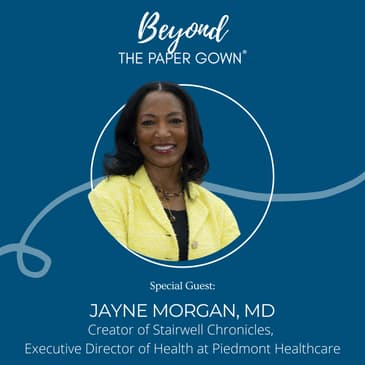

Join us on this compelling episode of "Beyond the Paper Gown" with host Dr. Mitzi Krockover, as we welcome the trailblazing Dr. Jayne Morgan, a distinguished cardiologist and Executive Director of Health and Community Education at Piedmont Healthcare. Dr. Morgan, leveraging her profound experience as a Black female physician, explores the systemic issues affecting women's healthcare, particularly in underrepresented communities. She discusses the critical need for diversity in medical research and training, and the impact of biases in AI and healthcare delivery. Discover how changing medical education and embracing inclusive research can lead to better health outcomes for all. Don't miss Dr. Morgan's powerful insights on transforming healthcare—tune in now to learn how we can all contribute to a more equitable health system.
Please visit Beyond the Paper Gown to join our community and to learn more about achieving your optimal health.
[00:00:00] If you enjoy podcasts like this, you should check out our other shows on Health Podcasts Network.
[00:00:06] For example, Hopeful Hits, hosted by Dr. Tara, guides and supports those on the often challenging
[00:00:12] and isolating journey of women's health concerns and infertility.
[00:00:16] There's a particularly powerful episode that you should check out called All Things Endometriosis,
[00:00:23] which dives deep into understanding the condition to help the many women who suffer from endometriosis
[00:00:28] and have no idea they have it, and healthcare providers who are uneducated about it, making
[00:00:33] the diagnosis process so difficult.
[00:00:37] Check out Hopeful Hits on your favorite podcast platform or visit healthpodcastnetwork.com
[00:00:58] Welcome to Beyond The Paper Gown.
[00:01:00] I'm your host, Dr. Mitzi Krockover.
[00:01:03] You know, here at Beyond The Paper Gown, we dive deep into women's health and the
[00:01:07] many factors that can impact it.
[00:01:10] Did you know, though, that some of those factors might be things that we don't typically consider?
[00:01:15] Things like who our doctors are and what kind of training they've received.
[00:01:19] And that training is based on research.
[00:01:21] And if the research doesn't include women or other underrepresented groups, it might
[00:01:26] not be accurate for those populations.
[00:01:29] And doctors, just like any human, come with biases that can also impact on how they
[00:01:34] care for their patients.
[00:01:36] Do you know what also can come with bias?
[00:01:38] AI.
[00:01:39] And finally, factors outside the healthcare system can greatly impact on our health in
[00:01:45] ways that are not always so evident.
[00:01:47] Today, we're going to address all of those issues and what we can do to receive better
[00:01:52] healthcare and achieve better health.
[00:01:55] We'll be talking to a true trailblazer in medicine research and advocacy who uses
[00:02:00] her experience as a black female cardiologist to inform her perspective on what is needed
[00:02:06] for better health for women, especially black women.
[00:02:09] Dr. Jane Morgan is a cardiologist and executive director of health and community
[00:02:14] education and led the COVID Task Force at Piedmont Health Care Corporation in Atlanta,
[00:02:19] Georgia.
[00:02:20] Piedmont is the largest healthcare system in the state of Georgia.
[00:02:24] Dr. Morgan also led groundbreaking projects at Piedmont, enhancing the success
[00:02:29] rates of healthcare innovations and expanding cardiovascular research in structural
[00:02:34] and valvular heart therapy.
[00:02:36] She's held many other influential roles, including CEO of 40 million Beats and
[00:02:41] worldwide director at Salve Pharmaceutical.
[00:02:44] And she also actively contributes to several national and regional boards
[00:02:48] focusing on health equity and technology.
[00:02:52] She's also the creator of the stairwell Chronicles, providing 60 seconds of
[00:02:56] information on specific health questions.
[00:02:59] And just a reminder, this podcast is for informational purposes only and
[00:03:04] should not be construed as medical advice.
[00:03:07] We encourage you to consult your healthcare provider to discuss your personal health
[00:03:12] issues.
[00:03:21] Dr. Jane Morgan, thank you for joining me today.
[00:03:24] Hi, Mitzi.
[00:03:25] I'm really pleased to be here today with you.
[00:03:27] You're a cardiologist and if I can, you are a black cardiologist,
[00:03:31] which is a rare breed.
[00:03:33] Right, a black female cardiologist.
[00:03:35] I'm sorry, a black female cardiologist, please.
[00:03:37] And so I'm really interested in about your journey about how you got there.
[00:03:44] So a not such a fascinating story.
[00:03:47] I grew up in a neighborhood of other physicians.
[00:03:53] And so I always had exposure to doctors.
[00:03:56] They were always, they're all men.
[00:03:59] And I think in the back of my mind, I really thought men were doctors and
[00:04:04] women were nurses when I was growing up in my neighborhood because the only
[00:04:08] physicians that I saw were the ones in my neighborhood.
[00:04:11] As I got older and I was in high school, probably even as latest high school,
[00:04:15] believe it or not, and started to give it some thought, I realized,
[00:04:17] oh wait, I can be a doctor too.
[00:04:19] Women can be doctors.
[00:04:21] So I went to college with the thought that I would major in science and
[00:04:25] go to medical school.
[00:04:26] And that's exactly what I did.
[00:04:28] In medical school, I actually wasn't sure what I wanted to do.
[00:04:33] In my neighborhood, we had two orthopedic surgeons.
[00:04:36] So I thought when I went to medical school, I would be an orthopedic surgeon for
[00:04:40] no reason other than those were the doctors that I knew, my neighbors were
[00:04:44] orthopedic surgeons.
[00:04:46] We also had a dermatologist and a family practitioner in the neighborhood.
[00:04:50] And so I went through different iterations.
[00:04:54] And so really I was doing my internal medicine residency.
[00:04:57] I was a doctor.
[00:04:58] I was at George Washington University rotating during my internal medicine
[00:05:02] residency, had an elective in the critical care unit, which really was pulmonary
[00:05:09] anesthesia, critical care.
[00:05:11] And then later to cardiology and really started to like it.
[00:05:15] And so then I volunteered to go through more electives of cardiology and
[00:05:20] then decided, you know what?
[00:05:21] I'd like to do a subspecialty in that.
[00:05:23] But I was far along.
[00:05:25] I was in my internal medicine residency.
[00:05:27] And so I think the lesson in that is to always be a student,
[00:05:30] always be willing to learn and expand and to grow.
[00:05:33] And you don't know in what direction life will take you.
[00:05:38] Sure.
[00:05:38] And when you were talking about, you saw, or you knew an orthopedic surgeon,
[00:05:43] or you knew I believe a dermatologist or whomever.
[00:05:46] So it's really, it's who you see.
[00:05:50] That's right.
[00:05:51] And I think that's true for so many women.
[00:05:53] And I can't help but think that now when women see you,
[00:05:58] that they start thinking, especially black women,
[00:06:00] that this is a possibility.
[00:06:02] Has that been your experience?
[00:06:04] You know, it's something that I've been thinking about more recently.
[00:06:07] And you really make a good point about your environment.
[00:06:10] And people don't have any control over the environments in which they're
[00:06:15] born into.
[00:06:16] And we start off and the child absorbs and becomes a sponge and learns
[00:06:21] all the things around them and then emulates that without even knowing it.
[00:06:24] I went to medical school to become an orthopedic surgeon
[00:06:27] without actually giving thought to why I wanted to be an orthopedic surgeon.
[00:06:31] That's because I had grown up my whole life with neighbors who are orthopedic
[00:06:34] surgeons, but I didn't connect the two.
[00:06:38] And then you meet someone and they see you as someone they'd like to emulate.
[00:06:43] So this is new for me to really just say, you know,
[00:06:47] am I someone that people want to emulate?
[00:06:50] I think about my life in many ways has been a challenge.
[00:06:54] Being a woman and being black and have had so many doors that have been close to me,
[00:06:59] have had to knock on doors much longer than I should have had to knock on them.
[00:07:04] I have gotten only a part of what I know I should have gotten.
[00:07:07] They've had to make lemonade out of lemons, have had to smile when I felt
[00:07:11] like crying, you know, and then suddenly for someone to say,
[00:07:15] oh, I'd like to be just like you.
[00:07:17] You're thinking like me? What?
[00:07:20] Do you know what you're talking about?
[00:07:22] And so, you know, the outside often doesn't relay what the struggle really has been.
[00:07:29] And so in that, I would like to say that hopefully in my struggle,
[00:07:33] I have made the path a little bit smoother for those coming behind me.
[00:07:38] And maybe, maybe I don't really look like what I've been through.
[00:07:44] And so perhaps that's a compliment to me.
[00:07:49] Well, you know,
[00:07:52] it again as you're speaking and I think about those women who, again,
[00:07:58] having been able to see someone like yourself and say, hey,
[00:08:02] I might be able to do that.
[00:08:04] I also wonder and you talk about the struggle about women.
[00:08:08] And again, I think black women, especially,
[00:08:12] but I think all women fall into this having a really difficult time
[00:08:16] in the health care system. Right.
[00:08:18] And so my guess is that you've also bridged that gap in a lot of ways.
[00:08:23] Right, you know, I would say I've walked in the gap.
[00:08:26] I can't say that I've actually bridged it because the chasm is so large.
[00:08:32] And I think it was very eye opening for me when I went to medical school
[00:08:36] and the way medicine was taught
[00:08:40] and the way medicine was not taught was very apparent.
[00:08:44] I think to both a woman and a black woman going through medical school.
[00:08:50] And I learned I asked a couple of questions that were culturally based.
[00:08:55] How would I recognize, you know, X, Y and Z on black skin?
[00:08:59] Or what if someone said X, Y and Z to you?
[00:09:02] And I got no responses to it.
[00:09:04] And, you know, I got the message early that that's not important.
[00:09:10] Or we don't know and we're not going to pursue it.
[00:09:14] And I realized there was a whole section of medicine with, you know, people,
[00:09:19] human beings where we just weren't really learning.
[00:09:24] We really didn't have a lot of information.
[00:09:26] And then later in my career on a guide involved in research
[00:09:29] and clinical trials, I was working at Solvay Pharmaceuticals and Abbott
[00:09:32] and in research and development and medical affairs and business development.
[00:09:36] I realized, started to learn even how drugs and devices are developed.
[00:09:41] And so that pervasive thinking even carried through from the very beginning
[00:09:46] of how we actually get the drugs to market, how we're developing them.
[00:09:50] Who's in our clinical trial?
[00:09:52] And most importantly, who's not in our clinical trials?
[00:09:56] And what this means?
[00:09:58] And it just, you know, you start to peel back the onion
[00:10:00] and it's just layer after layer after layer.
[00:10:04] I'm going to ask a really basic question and I'm going to apologize for it beforehand.
[00:10:09] But I just for our listeners, why is it important to have black men and women
[00:10:17] or other underrepresented populations?
[00:10:22] Why is it important to have them represented in medicine?
[00:10:27] When we look at where we've been and where we're going,
[00:10:32] there is a trust issue.
[00:10:34] That's number one.
[00:10:36] And people of every race, every demographic, every hue.
[00:10:42] For the most part, tend to see doctors with whom they have a trust.
[00:10:49] Trust is the major factor in this country.
[00:10:52] 80 percent of black Americans are actually seen by African American
[00:10:57] physicians for that very reason.
[00:11:00] Where can we go where we can trust first that there will be no harm
[00:11:05] that will come to us?
[00:11:07] Imagine we're the only demographic that actually picks their doctor
[00:11:11] based on where they first will not be harmed.
[00:11:15] Whereas other people go to the doctor to be healed.
[00:11:19] That's not our primary objective in going.
[00:11:22] We need to go first where we won't be harmed.
[00:11:25] And then you start to look at what is the representation in clinical trials?
[00:11:29] The leaders, the physician leaders of clinical trial to call principal
[00:11:33] investigators, we almost have no black people who are principal investigators
[00:11:37] because the drug companies don't reach out to them.
[00:11:40] They don't train them.
[00:11:41] They don't include them as leaders.
[00:11:43] If you don't have leaders and people who look like you in a system
[00:11:46] where there's not a lot of trust, then you still are not going to gain
[00:11:50] entry into people, into these clinical trials.
[00:11:53] And we'll continue to develop drugs that are not relevant for all parts
[00:11:58] of the population, which therefore then puts minority patients at further risk.
[00:12:04] You know, there's some untoward effect because it wasn't captured
[00:12:08] within a clinical trial because you and people like you were not included.
[00:12:12] People like you are not leaders in those clinical trials.
[00:12:16] And so it's just kind of one thing that gets the next,
[00:12:19] but gets the next, but gets the next.
[00:12:22] What is the antidote to that?
[00:12:27] So we've had a lot of reversals of things.
[00:12:31] You know, we had the Flexner report back in 1904 and 1905.
[00:12:36] And I think his name is Abraham Flexner.
[00:12:41] I have to remember was commissioned by the American Medical Association,
[00:12:45] actually, to do a report of all the medical schools here in the United States.
[00:12:49] At the time, we had about seven or eight HBCU medical schools,
[00:12:53] majority black medical schools.
[00:12:55] And at the end of that report, you recommended that certain medical schools
[00:12:59] be closed and, of course, the majority of the black institutions were closed.
[00:13:04] It left us with just two institutions, Howard and Mahary.
[00:13:09] We went along with two institutions for a long period of time until 1980s
[00:13:14] till 1980s when the Morehouse School of Medicine came about.
[00:13:17] And we're now moving to add more institutions, but 100 years later,
[00:13:22] more than 100 years later, that damage has been done.
[00:13:25] And we now look as a country at the shortage of physicians
[00:13:31] that we are facing as we move forward and our population ages.
[00:13:35] And we're facing a shortage of physicians.
[00:13:38] If those medical schools had just been allowed to stay open,
[00:13:42] there would have been another 35 to 45,000 physicians trained in this country.
[00:13:47] And that's an example of how racism initially hurts the targeted population,
[00:13:53] but ultimately it impacts negatively all of society.
[00:13:58] You mentioned in an article three factors that every black woman should ask her doctor.
[00:14:06] Would you go over those for us?
[00:14:08] Or three questions, three questions.
[00:14:12] So a couple of things I always want to talk about
[00:14:16] is the connection of OB obstetrics pregnancy to cardiology.
[00:14:21] And so I think you always need to ask,
[00:14:25] is my obstetrical history relevant?
[00:14:28] Meaning would you like to know something about my pregnancy?
[00:14:32] And here's what the answer to that question should be.
[00:14:35] Yes, please. Please tell me about your obstetrical history.
[00:14:40] Or better yet, they should have asked.
[00:14:42] Right.
[00:14:44] The reason for that is your history of pregnancy complications.
[00:14:50] If you had complications is relevant to your mortality,
[00:14:55] meaning how long you will live because it is relevant to your heart history.
[00:15:00] If you had complications in pregnancy, if you've ever heard these terms,
[00:15:04] preeclampsia, eclampsia, pregnancy induced hypertension,
[00:15:08] gestational hypertension, gestational diabetes.
[00:15:12] If you've heard any of those terms, you know, you may not exactly know what they are.
[00:15:15] But if you've heard them, you're like, oh, I think I think I had that.
[00:15:19] Then your risk of heart disease is now twice that of a woman who had a
[00:15:24] pregnancy who did not have those types of complications.
[00:15:28] And what should have happened after your baby was delivered safely,
[00:15:33] then you should have been referred to a cardiologist for long term
[00:15:36] management and prevention because we know
[00:15:40] that you have just failed your first stress test.
[00:15:44] A pregnancy is a volume overload.
[00:15:48] And your volume overload then stresses your heart.
[00:15:52] If you developed any of these complications, that's a fail stress test.
[00:15:56] So here's why it's important for all the specialties to come together.
[00:16:00] Another great example of why diversity works.
[00:16:03] We have specialties coming together with different perspectives.
[00:16:07] The obstetrician describes you as a pregnant female with preeclampsia.
[00:16:15] A cardiologist looking at the same patient would describe you as
[00:16:20] a volume overloaded female with a fail stress test.
[00:16:25] Do you see how those the focus of those is different?
[00:16:29] Both are important.
[00:16:31] One is focused on the baby, others focused on the mom.
[00:16:35] They both are important.
[00:16:37] They're looking at the same person with the same set of symptoms
[00:16:42] and diagnoses, but with different lens on that.
[00:16:45] And that's why it's really incredibly important. Absolutely.
[00:16:50] Do you remember the other two questions?
[00:16:53] If you are a woman in sort of your late 30s or early 50s,
[00:16:57] we want to absolutely talk about paraminopause and menopause symptoms.
[00:17:03] And you want to be able to talk with your physician about whether
[00:17:06] menopausal hormone therapy or estrogen therapy or some
[00:17:10] some combination of estrogen and progesterone is right for you.
[00:17:15] From a cardiologist's perspective, estrogen protects the heart.
[00:17:19] Estrogen has cardioprotective properties.
[00:17:21] It has anti-inflammatory properties.
[00:17:23] We know that chronic inflammatory processes
[00:17:27] increase the risk of heart disease, accelerate the development
[00:17:30] of heart disease, but not just heart disease, bone disease,
[00:17:34] cancer, rheumatoid arthritis, all types of diabetes,
[00:17:38] all types of chronic medical conditions.
[00:17:42] So we want to absolutely have a conversation
[00:17:46] about whether hormone therapy is an option for you.
[00:17:50] It's not an option for all women, but it is an option for most women.
[00:17:56] And we should have these conversations and don't settle for
[00:17:59] you're talking with your doctor about symptoms of menopause
[00:18:03] that you may or may not be aware.
[00:18:05] You may feel agitated.
[00:18:07] I do something called the stairwell chronicles where I sit on my stairs
[00:18:10] and I answer a question in 60 seconds or less.
[00:18:15] And one of the symptoms I say is, are you sick and tired of everybody?
[00:18:21] If you're sick and tired of everybody,
[00:18:24] then that's one of the symptoms of menopause, if that's in your age.
[00:18:27] And you've got to begin to think about that.
[00:18:29] And don't accept from your physician the prescription of an anti-depressant
[00:18:35] or take a vacation.
[00:18:37] You know, the the prescriptions of anti-depressants
[00:18:42] in the perimenopausal years, late 30s to early 50s in women actually doubles.
[00:18:49] We're not all depressed.
[00:18:51] We can't all be depressed.
[00:18:53] So maybe what we need to do is actually address
[00:18:56] what's causing the symptoms of menopause, which are these dropping estrogen levels.
[00:19:01] So we have a lot of different options.
[00:19:03] I want you to have this conversation.
[00:19:05] There are a multitude of symptoms.
[00:19:07] So I'm going to go over some of the bigger ones you've heard of,
[00:19:09] hot flashes, which we now call hot flushes or restlessness, feeling sweaty.
[00:19:16] We also see an increase in your cholesterol levels and increase in your blood pressure.
[00:19:22] You can feel brain fog, somewhat out of sorts.
[00:19:25] But then there's some others that I talk about in my stairwell chronicles
[00:19:28] that you may not have heard of, like your ears could start itching
[00:19:32] because your skin is drying out and that includes the skin inside of your ear.
[00:19:36] You could get a frozen shoulder where you now have pain
[00:19:39] with rotation and limited movement of that shoulder.
[00:19:44] So these are all things you can have a change in your taste buds.
[00:19:47] You could now have a drawer full of deodorants and antiperspirants
[00:19:50] and none of them work.
[00:19:52] And you just have this whole drawer.
[00:19:54] Nothing works anymore.
[00:19:56] These are all symptoms of going through paraminopausin, menopausin.
[00:19:59] Listen to me, we do not have to suffer.
[00:20:02] We've got to get this lexicon out of our conscious.
[00:20:07] It's not just us.
[00:20:08] It's society.
[00:20:09] Women are expected to suffer, suffer through it.
[00:20:15] Right?
[00:20:16] So many times that we said that to others, people have said it to us.
[00:20:19] Listen, we deserve to be able to present our best face forward,
[00:20:24] put our best foot forward, bring our best selves forward.
[00:20:28] If you are diminishing a large part of your population that is suffering
[00:20:35] with these paraminopausal symptoms, including memory lapses and brain fog
[00:20:39] and fatigue and irritability and you just dismiss it
[00:20:43] and these people step away from being productive citizens,
[00:20:47] then you're ultimately hurting yourself as well.
[00:20:50] I met Dr. Morgan this past January at the J.P. Morgan Health Care Conference
[00:20:55] where she was a featured panelist.
[00:20:57] She spoke about the fact that too often women are not taken seriously
[00:21:01] in the doctor's office and their concerns are dismissed with a there there.
[00:21:06] The there there, right?
[00:21:08] The physician generally a male, patch you on the shoulder.
[00:21:11] There, there, there.
[00:21:12] You'll be better.
[00:21:13] The hysterical woman in his office complaining about all kinds of things
[00:21:18] and all the tests are negative.
[00:21:21] You're just hysterical.
[00:21:23] You're just depressed.
[00:21:24] They're there, go home.
[00:21:25] It'll all be better.
[00:21:26] Have some coffee.
[00:21:27] Have a wine.
[00:21:29] This sort of thing.
[00:21:30] No, you know what I need?
[00:21:32] I need for you to have an educated conversation with me
[00:21:35] about menopausal hormone therapy.
[00:21:37] And if you can't do that, I'll be changing doctors.
[00:21:40] I'm not angry with you.
[00:21:42] And I appreciate all that you've done for me up until this point.
[00:21:45] But now I don't think we can continue this journey together
[00:21:48] because I need something else now at this point in my life.
[00:21:52] Thank you very much for all that you've done.
[00:21:54] Goodbye.
[00:21:55] And they're there.
[00:21:57] They're there.
[00:21:59] I wanted the other questions that you suggested,
[00:22:01] which I thought was really interesting,
[00:22:03] is are there any clinical trials I can get into?
[00:22:07] Right.
[00:22:08] And you know, that is such a great question
[00:22:12] that we have to take into account.
[00:22:14] Great question that we don't ask why,
[00:22:16] because we just don't know to ask it.
[00:22:19] Who goes to the doctor to say, hey,
[00:22:21] by the way, we didn't discuss clinical trials.
[00:22:24] Right. Nobody does that.
[00:22:26] But we should.
[00:22:29] And if your doctor doesn't know,
[00:22:31] we should push the doctor to find one,
[00:22:33] especially if you've got chronic medical conditions.
[00:22:36] If you've got chronic, I can say chronic medical condition.
[00:22:39] You've got chronic liver disease.
[00:22:41] I mean, when I say chronic medical conditions,
[00:22:42] things that can't be cured,
[00:22:44] that you've got to manage now for the rest of your life.
[00:22:47] High blood pressure,
[00:22:48] heart disease, diabetes, lung disease,
[00:22:52] liver disease, kidney disease.
[00:22:54] Generally, once you're diagnosed with these,
[00:22:56] they don't just disappear.
[00:22:57] They don't go away.
[00:22:58] You've got to manage this.
[00:23:00] These are chronic medical.
[00:23:01] Autoimmune, for example.
[00:23:02] If you've got something chronic or arthritis,
[00:23:05] then you're a great candidate to go into a clinical trial.
[00:23:09] And it's not to say you're the only demographic,
[00:23:12] but I'm just saying especially if you've got chronic medical conditions.
[00:23:15] And then obviously all other people always ask about clinical trials.
[00:23:19] And if your physician doesn't know,
[00:23:21] push that physician to get that information and get it back to you.
[00:23:24] You can always look on websites of your local universities
[00:23:28] and major medical centers in your area as well.
[00:23:31] So, you know,
[00:23:33] clinical trials are the bridge
[00:23:38] to health equity for women and for all populations
[00:23:43] that they have sort of been left out of medical advancements.
[00:23:48] Right?
[00:23:49] We we benefit from medical advancements sort of
[00:23:56] because the data wasn't gotten on us.
[00:23:59] Our doctors are smart enough
[00:24:02] to realize there has to be some extrapolation.
[00:24:05] So we may decrease the dose a little bit for a woman or that type of thing.
[00:24:09] But we really don't have the information specifically on women.
[00:24:13] And that's why menopause is still a mystery.
[00:24:16] Nobody studies menopause.
[00:24:17] Why I said earlier that most of the principal investigators were men.
[00:24:21] And so another reason why there needs to be representation and listen,
[00:24:26] health is wealth if once the industry recognizes how much money
[00:24:32] is on the table, women are the primary
[00:24:36] health care decision makers in the family for themselves
[00:24:40] and for everyone else to ignore this demographic seems really suicidal.
[00:24:45] But OK, as my mother used to say, OK, I guess you're going to find out.
[00:24:54] In November, the president announced the White House Research Initiative
[00:24:58] on women's health, promising more funding to women's health research
[00:25:02] and support for women's health.
[00:25:03] I asked Dr. Morgan about her thoughts on this new initiative.
[00:25:07] Love it, love it.
[00:25:09] I wish it had come sooner, but I love it.
[00:25:11] I think it's bringing awareness.
[00:25:13] I don't see enough actually for me.
[00:25:15] I don't see enough publicity on it.
[00:25:18] But I know the money is there.
[00:25:20] The dollars are there will start to move the needle.
[00:25:23] But it's it's really a fraction of what we need.
[00:25:27] But I'll take it because it's more than we have.
[00:25:30] But let's be honest, it's a fraction.
[00:25:32] We need money in the billions.
[00:25:35] So this was, you know, I don't want to say a drop in the bucket.
[00:25:39] I would say a start.
[00:25:40] It's a small start and it has big,
[00:25:47] you know, a big platform, the first lady of the White House.
[00:25:50] That's a huge platform.
[00:25:51] And so let's keep the ball rolling.
[00:25:54] Yeah, absolutely.
[00:25:56] What else needs to happen?
[00:25:59] Oh, my goodness. So, you know, when we talk about what needs to happen,
[00:26:03] the information that you and I are talking about today
[00:26:07] needs to be not only socialized amongst the population,
[00:26:10] but we've got to go back and start to retrain our physicians.
[00:26:14] When I say retrain our physicians all the way back in medical school,
[00:26:18] we've got to reintegrate into the medical school curricula.
[00:26:24] What this is, why it's important,
[00:26:27] how to manage all people's not just one
[00:26:32] and to make certain that when you leave medical school,
[00:26:35] your vision is broader than when you came in.
[00:26:41] And that has to start in medical school in your training.
[00:26:45] And then it's got to be reinforced during your residency
[00:26:49] and your practical application years and your fellowship.
[00:26:52] And because what we're trying to do now
[00:26:55] with all the doctors who are in their forties and fifties and sixties
[00:26:58] and seventies is unlearn something and then reteach it.
[00:27:05] That's harder because this is the way it's always been.
[00:27:08] So why don't we just teach it the right way from the beginning?
[00:27:10] I couldn't agree more.
[00:27:11] And, you know, I really look forward to a day where
[00:27:17] all students go, well, what are the gender differences?
[00:27:21] What are the sex differences?
[00:27:22] What are any ethnic or racial differences
[00:27:25] and not just be sponges of what is there?
[00:27:29] And I think that is so important.
[00:27:32] And that goes to the types of teachers,
[00:27:34] that the types of instructors and professors that you're hiring.
[00:27:39] And it doesn't mean it has to be any one type or another type,
[00:27:42] but that they also understand the breath and the scope
[00:27:48] of a global society
[00:27:51] and that we've got to train physicians that can go out
[00:27:54] and be leaders in the world and not just for a narrow demographic
[00:27:59] or else you're going to be obsolete.
[00:28:00] We've got to be able to ultimately be who we are,
[00:28:03] which was supposed to be public servants.
[00:28:07] We're supposed to be serving humanity.
[00:28:10] That is ultimately our charge.
[00:28:12] And we've got to broaden that definition of humanity
[00:28:17] and what that means.
[00:28:19] So the I was just at the Vive conference,
[00:28:23] which is which is focused on digital health and the key word was
[00:28:29] or key phrase was generative AI.
[00:28:32] And I can't help but think in terms of clinical decision support
[00:28:39] that that is a double edged sword because just as we want to have
[00:28:44] physicians who ask the question and are comfortable with,
[00:28:48] well, we don't know rather than it doesn't matter.
[00:28:51] And then we figure out what those gaps are and we can, you know,
[00:28:53] hopefully address them.
[00:28:56] Generative AI is going to go into the data that we have
[00:29:00] as flawed as it is.
[00:29:03] And it's going my concern is that it's going to provide
[00:29:07] flawed responses.
[00:29:09] Have you thought about that?
[00:29:10] And what are your thoughts?
[00:29:11] I think about it all the time.
[00:29:12] I think about even, you know, the algorithms and formulas
[00:29:15] that we have now that are flawed and have racial bias in them.
[00:29:19] Artificial intelligence so far is only as good as the person
[00:29:23] who's programming the software.
[00:29:26] And so here we go round and round and round and round.
[00:29:29] Who are the voices at the table?
[00:29:31] What is happening?
[00:29:32] How are these things being developed?
[00:29:34] Are there considerations for it?
[00:29:36] The first time a company hears about it,
[00:29:38] shouldn't be when they roll it out at a conference
[00:29:40] and someone raises their hand and asks a question and says,
[00:29:42] Hey, but the data that you're mining is incorrect.
[00:29:46] How does that work?
[00:29:47] And then that's the first time they've heard about it
[00:29:49] because they haven't had enough people at the table
[00:29:52] to make certain that they can develop a product
[00:29:53] that's actually relevant to everybody.
[00:30:01] You have really been vocal about obviously
[00:30:04] a number of health care topics.
[00:30:06] And maybe we've already talked about it.
[00:30:08] But what do you believe is currently the most pressing
[00:30:10] issue in our health care system?
[00:30:13] Oh boy, so many things.
[00:30:15] Maybe, maybe it's probably coming up top on my list
[00:30:20] is maternal mortality because it really encompasses
[00:30:28] the obstetrical history, the cardiovascular history,
[00:30:31] the menopause history.
[00:30:32] I can roll that in.
[00:30:34] And it's going to also wrap in a lot of black women
[00:30:38] because maternal mortality has the greatest negative impact
[00:30:44] in the black community as well.
[00:30:46] And so I think when we talk about maternal mortality,
[00:30:49] I can hit so many targets along the way that are important
[00:30:54] and that I talk about often
[00:30:56] and a lot of them roll into this topic.
[00:31:00] And I think it's important just to remind our audience
[00:31:03] that we are number, we, the United States
[00:31:05] are number 24th in the world
[00:31:09] in terms of our maternal mortality,
[00:31:12] meaning that we have some of the worst outcomes
[00:31:15] of any developed country,
[00:31:17] let alone some of the underdeveloped country.
[00:31:19] Why do you think that is?
[00:31:22] So for a number of reasons,
[00:31:26] one of them is just racism in the country
[00:31:30] and how populations are segregated
[00:31:35] and the segregation generally
[00:31:37] is also along financial lines.
[00:31:39] And so there's not economic advantage
[00:31:42] and health equals wealth
[00:31:45] and money can determine how many years you live
[00:31:49] in this country.
[00:31:50] I give lectures about who's going to live the longest.
[00:31:53] You don't even have to know anything
[00:31:54] about your medical background.
[00:31:55] If you know, you don't have to know their medical history.
[00:31:58] If you know something about their financial history,
[00:32:00] you can have an idea of who's going to live longer
[00:32:03] than someone else.
[00:32:04] And we call this the redlining of the zip codes
[00:32:06] and those types of things.
[00:32:07] So what foods are available?
[00:32:10] Money determines the choices that you make in life
[00:32:16] and those choices will determine your quality of health
[00:32:22] in this country.
[00:32:23] It is more expensive to be healthy.
[00:32:26] It's more expensive to eat fresh fruits
[00:32:29] and fresh vegetables and organic foods.
[00:32:32] That is very, very expensive.
[00:32:35] You can fit it within your budget.
[00:32:38] If you're only making $22,000 a year
[00:32:41] and you're a family of four,
[00:32:42] you're going to have a lot of processed foods
[00:32:44] because they're cheap and it's abundant
[00:32:46] and you can keep your family afloat.
[00:32:49] That's really just the bottom line.
[00:32:52] And I show a slide that always bothers me
[00:32:56] where we show what is the earnings gap
[00:33:02] between whites and blacks,
[00:33:03] depending on your educational level.
[00:33:06] Even with your most advanced degrees,
[00:33:10] a black person on average earns the same
[00:33:14] that a white person who has a high school diploma makes.
[00:33:17] That's the average.
[00:33:18] That's how hard it is to have melanin in your skin
[00:33:23] in this country.
[00:33:24] That's how hard it is.
[00:33:26] Then we have all the redlining.
[00:33:28] We know people in zip codes live
[00:33:30] have different opportunities.
[00:33:32] The amount of income that you make
[00:33:35] will determine the opportunities
[00:33:37] that you can provide for yourself and your children.
[00:33:40] What schools you go to, what neighborhoods you live in,
[00:33:42] if you have access to parks,
[00:33:44] are you able to learn other languages?
[00:33:46] Do you have fresh water?
[00:33:49] All of those kinds of things will be determined.
[00:33:51] Even the type of insurance you can have for your family.
[00:33:55] And don't forget,
[00:33:56] many people have the insurance
[00:33:59] insurance.
[00:34:00] Insurance is different levels.
[00:34:02] There's some insurance that's better
[00:34:03] than other insurance carriers,
[00:34:06] other insurance types.
[00:34:07] The type of insurance that you can afford
[00:34:10] will be determined by your earning potential.
[00:34:13] And if you can never earn,
[00:34:17] if you can never equalize your earning potential
[00:34:20] even with the most advanced degrees,
[00:34:24] it becomes such a heavy burden and a challenge.
[00:34:28] And this is how it all develops.
[00:34:31] And so what do you have?
[00:34:32] All the processed foods, then you've got obesity
[00:34:35] and then you've got diabetes.
[00:34:36] Then you have hypertension and people can't exercise.
[00:34:40] There's no access to parks.
[00:34:41] The neighborhoods aren't safe.
[00:34:43] Unemployment is high.
[00:34:44] But it just goes on and on and on.
[00:34:49] You know, thank you for those comments.
[00:34:53] When you started out saying,
[00:34:56] it's a racism.
[00:34:57] I think a lot of people and even including me,
[00:35:02] perhaps before thought,
[00:35:03] oh, it's just the doctor being racist against the patient.
[00:35:06] And we know that that's part of it too,
[00:35:09] that a lot of times black women,
[00:35:11] women in general, but black women may not be
[00:35:14] or maybe ignored even when they start talking about
[00:35:16] something that is bothering them.
[00:35:18] But this whole constellation
[00:35:21] of kind of the domino effect
[00:35:23] that you just talked about,
[00:35:25] that racism elicits is really just really mind blowing.
[00:35:31] So thank you for that kind of detail
[00:35:34] because it really does put things
[00:35:36] in a different perspective.
[00:35:37] And you can see where the problem isn't easily fixed.
[00:35:41] But hopefully that we can.
[00:35:48] So you've been a researcher, you've been a clinician
[00:35:51] and you also ran the COVID task force at Piedmont.
[00:35:55] And what was the most challenging part
[00:35:58] of combating that disease
[00:36:00] in the population that you served?
[00:36:02] Yeah, I think the most challenging thing was
[00:36:09] trying to understand, not even trying,
[00:36:11] clearly I did understand them,
[00:36:13] but maybe balancing the needs of our physicians,
[00:36:16] our nurses with trying to educate the public.
[00:36:22] So really it was too prong
[00:36:24] with regard to education,
[00:36:26] which was a large part of my role,
[00:36:28] making certain that doctors were educated
[00:36:30] because the landscape of COVID was moving quickly
[00:36:33] and making certain that people always had
[00:36:35] the latest up-to-date information.
[00:36:37] Trying to have conversations with the community
[00:36:41] who were often confused.
[00:36:43] And it was not so much that the information was confusing.
[00:36:49] It was that oftentimes the information was given
[00:36:51] in a way that was not generalizable
[00:36:55] to the entire population.
[00:36:57] And then compounding that,
[00:36:59] you had people who were intentionally confusing messages
[00:37:03] on social media.
[00:37:04] So it started to just become a big thing, if you will.
[00:37:09] And so outside of the hospital,
[00:37:11] I had the challenge of trying to sort through the noise
[00:37:15] and create a calm spot
[00:37:17] to actually explain what's actually happening
[00:37:22] from a medical and a scientific perspective.
[00:37:25] So I started these stairwell chronicles
[00:37:28] just to explain and talk to the public.
[00:37:32] I think none of us really knew what to expect from COVID.
[00:37:34] We didn't know there would be multiple variants,
[00:37:36] the alpha and the beta and then the delta
[00:37:38] and the Omicron was just kept going and kept going.
[00:37:40] And so we kept going and kept going.
[00:37:43] Why did you pick the stairwell?
[00:37:45] You know, that is...
[00:37:47] So here's the answer that remember,
[00:37:49] I'm not putting a lot of thought into it.
[00:37:52] I'm not putting any thought at all
[00:37:54] into that this will be a series.
[00:37:56] I was just trying to find someplace
[00:37:58] that could sit down and talk.
[00:37:59] And so originally, I had on my coat,
[00:38:02] it was winter, it was January
[00:38:04] and I really sat outside on my front steps.
[00:38:06] And I said, I'm just gonna sit out here
[00:38:08] on the front steps.
[00:38:09] It's just gonna talk to you like a friend
[00:38:12] and say, hey, here's what's going on with COVID,
[00:38:15] blah, blah, blah.
[00:38:16] But you know, it wasn't gonna do,
[00:38:17] I was just gonna film a few of these, that's it.
[00:38:19] And I got outside and it was overcast
[00:38:23] and I was filming on my iPhone,
[00:38:25] it was hard to see
[00:38:26] and I didn't have that much skill with filming.
[00:38:28] And so eventually I went indoors where I had lights
[00:38:31] and sat on the stairs inside.
[00:38:34] I was just sitting on the steps
[00:38:35] to have a casual conversation.
[00:38:38] And after I started it,
[00:38:40] I named it the stairwell Chronicles.
[00:38:42] Again, it was a temporary name
[00:38:44] and I named it that only because
[00:38:47] I couldn't come up with something catchy.
[00:38:49] So that's how it started by not starting,
[00:38:53] by doing something that you didn't know
[00:38:55] what you were doing,
[00:38:56] that you were starting something right.
[00:38:59] I just wanted to wrap up to ask you two questions.
[00:39:03] First of all, what did I not ask you
[00:39:05] that you thought was important for our audience to know?
[00:39:10] You know, I think it's important
[00:39:12] to know that being a physician is not easy.
[00:39:18] And I think COVID really showed us that it's not easy.
[00:39:22] It doesn't mean that you shouldn't do it.
[00:39:24] And I know I've had so many people
[00:39:26] who want to emulate me,
[00:39:28] but just know that what you see
[00:39:32] doesn't belay what it really takes sometimes
[00:39:38] to really advocate for your patients.
[00:39:41] That requires a lot of energy
[00:39:43] and it requires a lot of effort.
[00:39:46] And you've got to be willing to do that,
[00:39:49] to live up to your, your Hippocratic oath.
[00:39:53] And so I do encourage people to become physicians.
[00:39:56] I encourage minority populations and blacks
[00:39:59] to become physicians.
[00:40:00] I encourage women to be physicians
[00:40:02] because the more and more and more there are of us,
[00:40:05] the less and less and less advocacy
[00:40:08] people like me will have to do.
[00:40:11] If we can normalize just being present
[00:40:15] and being available,
[00:40:16] and it doesn't mean that black people only see black patients
[00:40:19] and Indian people only see Indian patients.
[00:40:22] We all are trained
[00:40:23] and we should all be able to see everyone
[00:40:25] and treat everyone respectfully
[00:40:26] but also understand that different people
[00:40:29] may require different things
[00:40:31] and come from different backgrounds.
[00:40:32] And some people have more advantages
[00:40:34] than other people have had through no fault of their own.
[00:40:38] And here all of humanity lands in your office.
[00:40:44] And I used to think about that when I was in Miami,
[00:40:49] I worked in Miami and there were migrant workers
[00:40:52] that sometimes would come in to the office
[00:40:55] and sometimes I would have executives that would come in
[00:40:57] and their pilots would be waiting for them in the lobby.
[00:41:01] I've got to be able to treat everybody
[00:41:04] to my best ability and make certain
[00:41:07] that the executive whose pilot is waiting for him
[00:41:11] and the migrant worker who's covered in dirt
[00:41:13] from head to toe and is also sick,
[00:41:16] both get my equal attention because they're both humans
[00:41:20] and we've got to remember
[00:41:21] that we're here to serve humanity
[00:41:23] and not make judgment calls on people.
[00:41:27] Well, you answered my second question,
[00:41:28] which is what can we do?
[00:41:29] So Dr. Jane Morgan, thank you so much
[00:41:33] for sharing your experience, your expertise.
[00:41:36] That was a great conversation.
[00:41:38] Loved it.
[00:41:44] As we conclude today's episode,
[00:41:46] I want to thank Dr. Jane Morgan for her profound insights
[00:41:49] and her commitment to inclusivity
[00:41:51] and equity in healthcare.
[00:41:53] Her journey as a black female cardiologist
[00:41:56] is not just inspiring.
[00:41:58] It's also a reminder of the work still needed
[00:42:01] to ensure diversity in all facets
[00:42:03] of medicine and healthcare,
[00:42:04] including research, professional education
[00:42:07] and patient care.
[00:42:09] Let's review some of the highlights of her recommendations
[00:42:12] on how to take charge of your health.
[00:42:14] First, discuss your full medical and family history
[00:42:17] with your healthcare providers,
[00:42:19] including and especially any pregnancy related complications
[00:42:24] even if you're not asked.
[00:42:25] This information is crucial for identifying risk factors
[00:42:29] that can lead to other health conditions.
[00:42:31] And if you're having symptoms of perimenopause
[00:42:34] or even think you are,
[00:42:35] have a conversation with your physician
[00:42:37] about hormones and other treatments.
[00:42:40] Understanding your options
[00:42:41] can significantly impact your long-term health.
[00:42:44] And if you have a chronic condition,
[00:42:47] ask your doctor about available clinical trials.
[00:42:50] Your participation can help ensure
[00:42:52] that medical advancements are effective for everyone.
[00:42:56] By embracing these actions,
[00:42:58] you can improve not only your health
[00:43:00] but also contribute to creating a healthcare environment
[00:43:03] that is equitable and representative of all populations.
[00:43:08] You can follow us for more health news
[00:43:09] and information on our social media
[00:43:11] and sign up for our newsletter
[00:43:13] at beyondthepapergown.com.
[00:43:15] We love to get your comments as well.
[00:43:18] Thanks for joining us and take good care.
[00:43:34] Our episode was produced by Patrick Shambayati and me
[00:43:37] and our associate producer, Iskyle McNoyan.
[00:43:49] If you enjoyed podcasts like this,
[00:43:51] you should check out our other shows
[00:43:53] on HealthPodcast Network.
[00:43:55] For example, Hopeful Hits, hosted by Dr. Tara,
[00:43:58] guides and supports those on the often challenging
[00:44:01] and isolating journey
[00:44:03] of women's health concerns and infertility.
[00:44:05] There's a particularly powerful episode
[00:44:08] that you should check out called
[00:44:10] All Things Endometriosis,
[00:44:12] which dives deep into understanding the condition
[00:44:14] to help the many women who suffer from endometriosis
[00:44:17] and have no idea they have it
[00:44:19] and healthcare providers who are uneducated about it,
[00:44:22] making the diagnosis process so difficult.
[00:44:26] Check out Hopeful Hits on your favorite podcast platform
[00:44:30] or visit healthpodcastnetwork.com.