
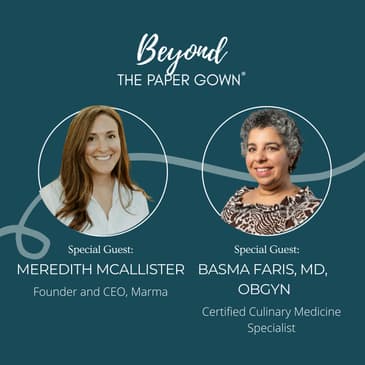

In this discussion which goes beyond the basics of "just take your prenatal vitamins", Dr. Mitzi Krockover welcomes two insightful experts in pregnancy nutrition: Meredith McAllister, CEO and co-founder of Marma, an app designed to guide women through the complexities of pregnancy nutrition, and Dr. Basma Faris, a board-certified OB/GYN and culinary medicine specialist who leads Marma's medical advisory team. Together, they discuss common challenges like managing morning sickness, handling food aversions, understanding cravings, and postpartum nutrition needs, while also discussing the innovative field of culinary medicine. Whether you're expecting, planning, or supporting a loved one, this episode provides practical insights and solutions for navigating nutrition throughout pregnancy and postpartum.
Please visit Beyond the Paper Gown to join our community and to learn more about achieving your optimal health.
SHOW NOTES:
Meredith McAllister, Founder and CEO, Marma
Basma Faris, MD, OBGYN and Certified Culinary Medicine Specialist
Mitzi Krockover, Founder and CEO, Woman Centered, LLC and Host of Beyond the Paper Gown
[00:00:22] Welcome to Beyond The Paper Gown. I'm your host, Dr. Mitzi Krockover. If you've ever been pregnant or known someone who has, you know that the typical nutritional guidance often begins and ends with, take your prenatal vitamins. But there's so much more to consider. Today, we're exploring what nutrients a pregnant person needs during and after pregnancy. Joining me today are two experts who are innovating pregnancy nutrition support. Meredith McAllister, who's CEO and co-founder of Vibra.
[00:00:52] Marma, an app helping women navigate pregnancy nutrition. And Dr. Basma Farris, a board-certified OBGYN and culinary medical specialist who serves as Marma's lead medical advisor. We're going to talk about managing morning sickness, what to do when certain foods are no longer appetizing, as well as those odd cravings we sometimes get. We'll also explore practical solutions for the many nutritional challenges women face during pregnancy and postpartum. We'll also talk about
[00:01:22] the specialty of culinary medicine, an innovative approach to food and medicine. So whether you're currently expecting, planning to become pregnant, or want to support a loved one through this time, I know you'll learn something useful and new. Hi, welcome to Beyond The Paper Gown. I'm Dr. Mitzi Krockover. And today we have a really wonderful topic that we're going to discuss, and that's nutrition and pregnancy, which I so wish I had a resource for when I was pregnant with my two daughters.
[00:02:08] So to talk to talk to us about that is Meredith McAllister, who is the CEO and co-founder of Marma. We also have Dr. Basma Farris, who is a OBGYN, a board-certified OBGYN, and a culinary medicine specialist. We'll find out what that means. And she is the lead medical advisor for Marma. So welcome to both of you.
[00:02:33] Thank you. Thanks for having us.
[00:02:35] Oh, I'm so excited. As I said, Meredith, I really wish, you know, many moons ago that there was a resource like Marma. And so just to kind of start us off, actually, I'm going to ask this to Dr. Farris, and then I'm going to turn it over to you if that's okay. What are some of the largest or biggest nutritional challenges that women face during pregnancy?
[00:03:00] There are many.
[00:03:02] There are many that even if we're talking about a low-risk routine pregnancy, there are changes in appetite, increases, decreases.
[00:03:11] There are cravings. There are symptoms that can impact your nutritional intake, whether it be morning sickness, whether it be heartburn, constipation.
[00:03:23] There are increased protein needs, increased calorie needs. Some people, you know, have nutritional deficiencies.
[00:03:34] People can develop complications of pregnancy that impact their nutrition, like gestational diabetes and the hypertensive disorders of pregnancy.
[00:03:45] And so there's so much actually that can be said about the importance of nutrition in pregnancy from both, you know, just normal, healthy, low-risk pregnancies to some of the more complicated ones.
[00:03:58] Terrific. And to add to that, you know, I don't remember my OBGYN having an extensive conversation.
[00:04:07] I think that the conversation was you really need to take prenatal vitamins.
[00:04:11] So what should a woman expect from the OBGYN?
[00:04:17] And I know that, again, there's limited time and, you know, it's hard to put in everything you need to talk to a pregnant patient about.
[00:04:28] You are correct. Historically, the sort of the guidance that has been provided to pregnant people by their obstetricians throughout their pregnancy is limited.
[00:04:40] And that is in part due to time, as you mentioned, right?
[00:04:45] There's so many different things that we need to cover.
[00:04:48] Obstetricians and midwives also have, you know, a burden of seeing many patients.
[00:04:53] And, you know, those are sort of larger issues in the health care system about how providers are reimbursed for those services.
[00:05:02] But also there's a knowledge gap, right?
[00:05:05] Most physicians don't receive much nutrition education or training during medical school or residency.
[00:05:14] So enter Marma.
[00:05:17] Meredith, what was your impetus for starting this company?
[00:05:23] So exactly the reasons that we've all mentioned.
[00:05:26] I was pregnant with my second child.
[00:05:29] Marma is actually my second company.
[00:05:31] I am a doer and a problem solver from the start.
[00:05:34] And it was halfway through my second pregnancy that I had that light bulb moment that the only information around nutrition that my OBGYN told me was to take a prenatal supplement.
[00:05:46] And of which, you know, it's a spectrum of quality.
[00:05:49] But there was nothing else around it.
[00:05:53] And the knowledge seeker in me wanted to know more.
[00:05:58] And so that led me to Google and blogs, you know, from 2014 and hearing, you know, other people say their experiences.
[00:06:07] But there was really nothing credible out there.
[00:06:11] And you're growing a human.
[00:06:12] You're growing their organs.
[00:06:14] You know, this is impacting not only you and your body, but this child, this baby.
[00:06:20] And so that's really when I just wanted to know.
[00:06:23] I wanted to know more.
[00:06:24] I wanted to do more.
[00:06:24] And I hired my now co-founder, who is a holistic health coach.
[00:06:29] And she studied specifically pregnancy and postpartum.
[00:06:32] And she, you know, guided me along.
[00:06:34] And here are some meals to make.
[00:06:36] Here are some changes that you can make within your diet to get the nutrients that you need at this point.
[00:06:42] And it was a pretty incredible difference.
[00:06:47] I had, I was lucky to have two healthy, quote unquote, normal pregnancies with no complications.
[00:06:54] But I still had the standard, the standard issue.
[00:06:57] You know, I felt nauseous.
[00:06:58] I was tired.
[00:06:59] I didn't, you know, all the things.
[00:07:01] I just like, blah.
[00:07:02] And our society has said, well, that's just, that's just pregnancy for you.
[00:07:07] And it's, and it doesn't have to be that way.
[00:07:10] You know, you can, there are, you can change your diet.
[00:07:13] You can add things in that can help support your pregnancy.
[00:07:18] And so I hired my co-founder, felt better, realized that there was something to this.
[00:07:24] And so I approached her.
[00:07:25] I'm like, well, you're working, you know, you've worked with hundreds of women in a specific time of life.
[00:07:31] What do you like?
[00:07:32] Do you think that there's something to this?
[00:07:34] And she's like, yes, absolutely.
[00:07:35] You know, she's getting questions all the time on what should I eat when I'm pregnant and how can I best support myself in the postpartum phase?
[00:07:42] And what should I be stocking my freezer with?
[00:07:45] And so that was really the start of Marmot.
[00:07:48] We wanted to create a company that was easy to access, a credible resource.
[00:07:53] And so what it does is it, you know, guides you along.
[00:07:56] Here's what's happening with you and with baby.
[00:07:58] And here are the nutrients and the foods and recipes to support that for this specific period of time.
[00:08:04] So talk a little bit about the app.
[00:08:08] It's an app, correct?
[00:08:09] And how it and the patient's journey or the pregnant woman's journey.
[00:08:14] Yep.
[00:08:15] So as soon as so the app as it is today is for pregnancy and postpartum.
[00:08:20] So they will go in and say, here is my due date.
[00:08:23] Or if they are if they've already had the baby, here is baby's birthday.
[00:08:28] And it will give them week by week information.
[00:08:31] So great.
[00:08:32] You're in week 27.
[00:08:33] Here's what's happening with you.
[00:08:35] Here's what's happening with baby.
[00:08:37] And then a list of nutrients that can support you specifically in that week.
[00:08:41] So if it's choline or vitamin D, they can look in and understand a little bit more about those nutrients.
[00:08:48] And then foods that have that are high in those nutrients.
[00:08:51] On top of that, it's another layer of recipes.
[00:08:54] So here are some recipes that you can make right now that are going to support you in this week.
[00:08:59] Additionally, we have information on symptoms and cravings.
[00:09:03] So let's say you're craving chocolate.
[00:09:05] Maybe there's a deficiency of magnesium.
[00:09:08] So here are some foods that are high in magnesium to support you throughout that craving or whatever that symptom might be.
[00:09:14] So everything is food-based.
[00:09:17] And we try to also keep it relatively simple.
[00:09:21] The recipes can go from as simple as a nut butter and apple to a really gourmet meal.
[00:09:31] And you have kind of two tiers.
[00:09:34] And the second tier, if you will, or the paid tier includes a coach.
[00:09:39] And so how does that work?
[00:09:44] Yep.
[00:09:44] So that's within the app.
[00:09:46] We have our in-app chat.
[00:09:47] And they can be connected to a holistic health coach right away.
[00:09:52] And that is usually it takes about 30 seconds before they get a response.
[00:09:57] And so if somebody is at the grocery store and they're looking like, what's the difference between hemp seeds and chia seeds?
[00:10:04] Or, you know, I want to know, should I be eating eggs?
[00:10:09] Like, what's a high choline food?
[00:10:12] We can give them recommendations right away.
[00:10:15] It really helps support them.
[00:10:17] Or, you know, I'm struggling to get to have a meal right when I wake up.
[00:10:21] I've, you know, read that I need to, in order to be less nauseous, I should be eating right away.
[00:10:26] Well, what do you recommend?
[00:10:27] What are some snacks I can keep at my bedside that are going to support me right now?
[00:10:32] And our health coaches can guide them along.
[00:10:34] Do you have other or specialized programs?
[00:10:38] Dr. Ferris talked a little bit about diabetes and hypertension.
[00:10:43] Do you address those issues?
[00:10:46] We take a blanketed approach.
[00:10:48] So this is actually where Dr. Ferris has been invaluable in helping us.
[00:10:52] But we don't provide one-on-one consultations.
[00:10:55] So if somebody does have gestational diabetes, we have a one-pager that we can help, you know, hear some tips and suggestions to guide them through.
[00:11:03] But we don't, because we're utilizing health coaches, we don't offer that, like, specific guidance.
[00:11:10] And Bisma, talk a little bit about some of the special needs of someone with either of those two issues briefly.
[00:11:17] And then if they were to use MARMA, how they might adjust that or any other kind of diets that they're looking for?
[00:11:26] Sure.
[00:11:27] So, you know, if we're talking about gestational diabetes, which is common and really requires a, you know, an approach that is a multidisciplinary approach with your obstetrician or midwife and maternal fetal medicine specialists and usually dieticians,
[00:11:45] once you have a medical plan, MARMA still can be there to support people to execute that plan.
[00:11:56] And so that's where a coach really can help with how do you apply those recommendations that have been made to you by others.
[00:12:05] And that's really important because it's just translating that into real-world situations.
[00:12:12] Sure. So I'm going to take advantage of the fact that we've got an expert here and kind of talk a little bit about some of the issues with respect to pregnancy that you and Meredith just spoke about earlier.
[00:12:26] And that is, you know, kind of let's go through the trimester.
[00:12:29] So the first trimester I think everybody thinks about are the nausea and or vomiting.
[00:12:35] And so sorry, everybody who's having their morning coffee.
[00:12:39] So in any case, talk a little bit about how some nutritional options are that might make that better or other kinds of options even.
[00:12:50] Yeah. I think there are things sometimes that people don't think about, right?
[00:12:54] We always think of having, you know, the crackers by the bedside, but that doesn't work for everybody.
[00:12:59] There certainly are different flavors or aromas that can be helpful or can worsen feelings of nausea.
[00:13:09] And so steering people towards those flavor profiles and aromas that may actually improve somebody's nausea.
[00:13:18] Utilizing small, frequent meals.
[00:13:21] Utilizing strategies of not having too much liquid at the same time as your meals.
[00:13:25] So trying to separate the majority of your fluid intake actually separate from solid food is another strategy.
[00:13:34] Something that people often don't think about is the temperature of foods.
[00:13:37] And so hotter foods, right, may actually have more smell.
[00:13:43] So it can worsen nausea.
[00:13:45] So a strategy can be how can you have some foods that you can eat ready out of the refrigerator?
[00:13:50] Something that's cold or that's room temperature that's still going to be safe, right?
[00:13:55] Because we always worry about food safety and thinking about reheating foods and food safety.
[00:13:59] So how can you do that safely where you're eating something that is going to be nutritious,
[00:14:03] but actually, you know, not piping hot and making you actually feel worse?
[00:14:08] So I think that's an overlooked strategy as well.
[00:14:11] And then utilizing, you know, timing of your supplements.
[00:14:15] Sometimes the timing of your prenatal vitamin can worsen your nausea.
[00:14:19] So how can you, you know, change things up so that you can minimize your symptoms, you know, the best that you can?
[00:14:26] So these are all some of the creative think-outside-the-box things that I know our, you know,
[00:14:32] our content and our coaching can help people with.
[00:14:35] And we know that there is a situation called hyperemesis gravidum,
[00:14:39] which is basically, it's just severe nausea and vomiting that really jeopardizes someone's health status.
[00:14:47] Besma, talk a little bit about some of the signs of hyperemesis
[00:14:51] and when someone might want to, you know, go ahead and call their physician or healthcare provider.
[00:14:58] If somebody really has an inability to tolerate food or drink to the point that they are getting inadequate nutrition.
[00:15:08] So if they're losing weight, and so that's something that you, you know,
[00:15:12] every time somebody goes to the obstetrician, they're being weighed.
[00:15:16] But in the first trimester, it may be, you know, four weeks before you see them again.
[00:15:20] So if you have a scale at home and you notice that you've actually lost a few pounds
[00:15:24] when you should be, you know, either staying neutral or a slight increase, that would be one sign.
[00:15:30] And then just noticing signs of dehydration.
[00:15:32] So if you are making less urine, right, you're peeing less.
[00:15:37] Usually in pregnancy, you start, you're actually, your urine output increases.
[00:15:41] And so if that is falling off, if it's very concentrated,
[00:15:45] you're noticing that your mouth is excessively dry.
[00:15:48] These are all signs that you are dehydrated, which is, and may have some electrolyte abnormalities.
[00:15:56] And so that is serious and that warrants a call to your doctor and potentially an emergency room visit are those things.
[00:16:06] So Meredith, Besma has talked a little bit about supplements or mentioned that.
[00:16:11] That could honestly be a part of the problem, if you will, in terms of nausea.
[00:16:16] And then earlier you talked about the fact that there's many types of supplements and not all are created equal.
[00:16:24] Do you want to talk a little bit about that?
[00:16:27] There are supplements that are, you know, really high quality.
[00:16:31] There's actually a company, Parallel Vitamins, and their first, they have a, their supplement, their prenatal goes by trimester.
[00:16:40] And we're seeing that more and more that there are some that are phase specific.
[00:16:44] But what's really neat about their first trimester, they have the capsules, but they also have a powder,
[00:16:49] which is really for those who are not able to take a pill, which is pretty common in that for in those early days.
[00:16:57] They're big pills.
[00:16:58] They are big pills.
[00:17:00] It's a lot.
[00:17:02] So yeah, varying qualities.
[00:17:04] And there are some, you know, they're just kind of, they're filled with dyes and they don't meet the nutrient requirements.
[00:17:10] Besma, do you want to add anything to that?
[00:17:13] Sure.
[00:17:14] Consumer Reports is a, is a great resource.
[00:17:17] They have actually reviewed supplements because, and for many, many different issues, right?
[00:17:23] You want to make sure that your supplement has what they say is in it.
[00:17:26] And unfortunately, regulation around supplements is really poor in this country.
[00:17:31] And so, you know, Consumer Reports did do a deep dive looking at different supplements at different price points,
[00:17:37] which is also important because that can vary dramatically.
[00:17:42] And so, you know, it may be the one that your insurance covers.
[00:17:47] And if that's what you can afford, you want to make sure you're getting the best prenatal vitamin that you can afford.
[00:17:53] And so there are, I think that's a good resource.
[00:17:56] And again, they're different, you know, you really can spend a lot on your supplements.
[00:18:01] And so making sure that you actually, if you are somebody that really is interested in doing that,
[00:18:07] that you're actually getting value for what you're spending your money on.
[00:18:11] And so I think that's important as well.
[00:18:15] And that's really all I will.
[00:18:17] There's, you know, there's a lot of controversy around folic acid versus, you know, food-based folates.
[00:18:23] There's a lot of controversy around, you know, many, many different nutrients in pregnancy.
[00:18:29] But we do know, you know, we know folic acid is important.
[00:18:32] And there are many different ways of getting what you need, depending on your particular circumstances.
[00:18:39] Talk more about that because folic acid is such an important issue with respect to the baby's development.
[00:18:47] So folic acid is a B vitamin.
[00:18:50] It's a water-soluble B vitamin that we know is important in, especially in the first trimester of pregnancy.
[00:18:55] And that deficiencies in folic acid can result in some really devastating birth defects called neural tube defects.
[00:19:03] And that can, that's a broad spectrum of defects that involves the neurologic system.
[00:19:09] And that can range from a very small defect at the base of the spine to some really profound defects that can alter the structure of the spine, even to things of having some defects in the brain.
[00:19:23] And so it was discovered back, I think it was, now it's been the 50s, by the March of Dimes, that folic acid supplementation dramatically reduced the occurrence of these birth defects.
[00:19:37] And then for individuals that may or may not have different abilities to metabolize folic acid, some people prefer a food form of folate because it's more natural.
[00:19:48] It's coming from food sources.
[00:19:51] It doesn't require as much metabolism or being modified.
[00:19:58] But at the same time, it's less digestible and more expensive.
[00:20:02] And so requires special processing to be put into a supplement and maintain its stability.
[00:20:09] So the issue is if you're purchasing, because you think you're doing the right thing and you're purchasing a supplement that has a food form of folate, you don't know how stable that is.
[00:20:20] And by the time that you're taking it, depending on how it's been stored and shipped and when it was produced, that you're getting an adequate amount.
[00:20:30] So that's where a lot of the sort of criticism of folate-based supplements comes from because the studies were done with folic acid, not with folate.
[00:20:40] They're probably, if you have a good quality folate supplement and a folic acid supplement, they probably both are almost equally effective.
[00:20:49] But these are some of the pros and cons that we have to think about with both of them.
[00:20:55] Oh, interesting.
[00:20:55] And it dawns on me that one of the perhaps largest public health activities, if you will, or initiatives is that folic acid, folic acid, right?
[00:21:07] Not folic, has been imbued, if you will, across bread products and so forth so that everyone is getting that regardless.
[00:21:19] Yes.
[00:21:20] As long as people are eating foods that are fortified.
[00:21:23] So if you're eating breakfast cereals or commercially produced bread products, then you are getting folic acid in that form as well.
[00:21:35] So yes, a very important point that it's a public health measure, the fortification of our grain supply with folic acid.
[00:21:44] Sure.
[00:21:44] So I'm going to ask Meredith, and then I'd like you to also chime in, Besma.
[00:21:50] What do you suggest to your members that are asking about cravings?
[00:21:58] And I'm just going to put in, again, this is like TMI, but I didn't really have cravings.
[00:22:03] I had aversions.
[00:22:04] Like I stopped eating fish, you know, and I loved fish before.
[00:22:08] So how do you counsel your patients or your clients?
[00:22:13] We have a lot of people who also have aversions.
[00:22:16] And my approach is do the best you can with what you have.
[00:22:21] And you're on your own.
[00:22:22] You know, this is, there's a, you know, I think that it's such a, it's such a vulnerable period of life.
[00:22:31] And it's also one where I think, I know personally, and a lot of our users, they really want to do the best that they can.
[00:22:42] And they will beat themselves up if they aren't following, you know, checking all of the boxes.
[00:22:47] And so we, you know, our aim with Marma is to really, here's the information.
[00:22:53] Um, we want to empower you.
[00:22:55] And also there's a lot of grace to be given in this period.
[00:22:59] Um, you might like, yeah, you might not have the most quote unquote ideal day and that is okay.
[00:23:06] Um, but if there are, you know, ways that we can help you get the nutrients and with food, great.
[00:23:14] That is, that is our goal.
[00:23:15] Um, so specifically with cravings, if they have that craving, they can go into the app and see, you know, what craving it is.
[00:23:22] And we will provide some, um, food-based recommendations.
[00:23:26] And if they need more information, they can chat with the coach on here's how to implement, you know, here's the recipe.
[00:23:31] Well, that doesn't sound good.
[00:23:32] Okay.
[00:23:32] Well, here's another one.
[00:23:33] What does sound good and how can we make that work?
[00:23:36] Sure.
[00:23:37] And Bessma, what is the physiological reason for cravings?
[00:23:43] I mean, you hear about the classic pickles and ice cream and some really, you know, again, odd ones.
[00:23:50] Yeah.
[00:23:50] Um, I think some of it does, as Meredith has already mentioned, reflects actually your body's needs, your nutritional needs.
[00:23:58] Um, and some of them probably are some evolutionary behaviors that we don't quite understand.
[00:24:04] Um, and, um, you know, I think the aversions is, is very, I was very averse to coffee, to coffee, which is like, I love coffee.
[00:24:11] And as soon as I was pregnant, it's just smelled so awful to me.
[00:24:15] That wasn't so hard because it's not like coffee is a, you know, essential nutrient that I needed to replace.
[00:24:21] But if somebody has an aversion to something that's providing them a lot of nutrition, what, what we have to do is then provide those alternatives.
[00:24:30] So what are other protein sources that we can introduce?
[00:24:33] So that's really important.
[00:24:35] And then there are some more extreme.
[00:24:37] There are some cravings that really do represent deficiencies.
[00:24:40] So people can have something called pica was where they're actually eating non-food items like ice, um, paint chips and things.
[00:24:49] And these actually can reflect iron deficiency or some other mineral deficiencies.
[00:24:54] So that's important for people to know and to, you know, not be ashamed of it and that they should tell their doctor.
[00:25:01] So we can, you know, give some, you know, content and, and, and guidance around, you know, somebody does have pica that they really need to pay attention to it and reach out to their doctor or their midwife.
[00:25:12] And we have that within the app that, you know, if you're craving ice, um, that, that, that might be a sign of pica.
[00:25:18] So talk to your doctor, um, and here are some foods to implement in that time.
[00:25:23] Sure.
[00:25:24] It, I remember also having to be on iron, which is very constipating.
[00:25:29] And so Meredith, what kinds of suggestions do you make for that problem?
[00:25:37] Um, so if somebody, uh, well, actually, I mean, throughout pregnancy, we suggest iron rich foods and, um, cooking in a cast iron pan is an easy way as well to increase the iron.
[00:25:48] Um, in your diet.
[00:25:50] So just simple things, but just, we promote high iron foods throughout, um, so that hopefully they don't need to be on a supplement, but if they do, then, you know, making sure that they're taking vitamin C to absorb it.
[00:26:02] Um, and if they, if somebody comes to us and said, yeah, I, you know, my iron levels are low, then again, we'll, we'll be sending them recipes or foods that are high.
[00:26:12] So our whole premise is food first, um, and then supplements are secondary.
[00:26:19] Okay.
[00:26:19] Bisma, do you want to talk a little bit about that as well?
[00:26:22] Yeah, I would agree always, um, with the food first recommendation.
[00:26:25] Um, and I think many people don't know that, right?
[00:26:28] That vitamin C helps in iron absorption.
[00:26:31] And so that's an important food-based recommendation to make.
[00:26:35] Um, the constipation is real people, even without iron supplementation suffer with constipation.
[00:26:40] And so add iron to that.
[00:26:42] Um, so how can that be mitigated?
[00:26:44] So including adequate fiber, most people don't get enough fiber in their diet, um, in this country.
[00:26:50] So, um, that's an, you know, food with, you know, food-based sources of fiber, adequate hydration.
[00:26:57] Um, and then maybe change the dosing schedule.
[00:27:00] It's been, um, demonstrated now that actually, if you don't take your iron every day, if you take it every other day, it may actually improve the absorption of it.
[00:27:11] And so you may be able to have the same impact on your, uh, anemia as if you were taking it every day.
[00:27:19] It used to be, we'd give it to somebody once a day.
[00:27:21] And if their hemoglobin didn't improve, their anemia didn't improve, we'd increase it to twice a day.
[00:27:26] Right.
[00:27:26] And if that wasn't good enough, we'd increase it to three times a day.
[00:27:29] Like how horrible is that?
[00:27:31] So, um, but actually now the thinking is, um, is a little bit different as, uh, as the science has, has changed, you know, as we, you know, not the science has changed, but that we've,
[00:27:41] learn more about it.
[00:27:42] And so I, that's a really important thing, um, as well.
[00:27:46] Sure.
[00:27:47] I'm assuming that you do ask folks about their either preferences, allergies, or what kinds of diets that they're on.
[00:27:57] For example, vegetarian or vegan.
[00:27:59] We do.
[00:28:00] So we, um, I would say right now it's a little bit more, um, minimal than we would prefer.
[00:28:06] It's, it's in the recipes you're able to filter out by diet types.
[00:28:10] So pescatarian, vegetarian, gluten-free.
[00:28:13] Um, and so then you'll see only recipes that support that diet.
[00:28:19] In Bessma, what do you suggest to your, uh, pregnant vegetarian patients?
[00:28:27] I know that I, you know, just, uh, in general, when you're not pregnant, it's hard to get a lot of protein, for example.
[00:28:34] So, yeah, so those, that's, uh, you know, the, one of the concerns is getting adequate protein intake and you can, it can be achieved.
[00:28:43] Um, it's certainly more challenging if you are, uh, following a vegan or a whole foods plant-based diet where you consume no animal products.
[00:28:51] Then having, um, you know, getting adequate protein can be more challenging and can, that really can sort of limit the variety of things that you eat.
[00:29:01] Some people will sort of in, like, broaden their, um, their, their restrictions or their limitations during pregnancy because they find that they cannot really get the adequate nutrition, um, by their current dietary practice.
[00:29:19] And that's an individual, you know, decision that people have to make for themselves based on their own beliefs and, and what they're comfortable with.
[00:29:27] But that's sort of, that's not uncommon actually, where somebody who's vegan may decide that they're actually going to introduce either some seafood that gives them protein and omega-3s,
[00:29:37] or that they're going to add some eggs or add some dairy so that they're getting adequate protein, um, and plus the other micronutrients, vitamin B12 and getting adequate calcium and adequate iron,
[00:29:49] which can be challenging if you're following a vegan or whole foods plant-based diet.
[00:29:55] And so if they're not willing to do so, it's just a matter of being very mindful and bumping up the food intake?
[00:30:04] Yes. So then it's really just making sure that that's a focus, um, especially on the protein.
[00:30:11] So that just really, it ends up being a lot of legumes.
[00:30:14] So how can you introduce variety, um, into, um, and then the, the grains that compliment the legumes, um, so that they're getting all of their essential amino acids.
[00:30:24] Um, and that takes, you know, it takes planning and it takes preparation.
[00:30:28] It can be done, but it, you know, it certainly, it takes paying attention to it and, and being willing to cook and prep things in advance.
[00:30:37] And, you know, you can't really rely on, um, um, sort of convenience foods and such.
[00:30:42] So it can be done.
[00:30:44] Sure. And Meredith, what's the difference between the postpartum nutrient needs and diet as opposed to when one's pregnant?
[00:30:57] Um, so from our, I'll actually let Bosma take the specifics on what you would need.
[00:31:02] Um, but from our, from the app's perspective, when somebody enters the postpartum phase, we're really promoting really nourishing foods.
[00:31:12] So really warming stews, bone broth soups, um, that are really nutrient dense.
[00:31:19] Um, something like kitchari, which is, uh, a rice and vegetable dish, things that are going to have protein.
[00:31:28] Um, and I'm really protein throughout all of pregnancy and postpartum is so, so important.
[00:31:34] Um, but we, we just kind of transitioned to a little bit, actually less fresh foods and more cooked and, um, easy to digest in those early postpartum days that are very nutrient dense.
[00:31:48] Sure. And Bosma, I'm assuming that one, if one's lactating, they really need to bump up their nutrients.
[00:31:57] Yes. So you actually need more energy.
[00:32:00] So more calories, um, when you're lactating than even when you were pregnant and growing this human, because you have to convert all of that energy now into a food source for somebody else.
[00:32:10] So, um, so yes, it has to be energy dense. It has to be nutrient dense. You need adequate protein. You need adequate hydration, adequate calcium.
[00:32:20] At the same time, you're healing your body from your birth, whether that be a vaginal birth or a C-section, your body needs to heal.
[00:32:27] So you need enough, um, protein and vitamins to allow for tissue repair. Um, and then you also want to not be spending all of your time preparing food.
[00:32:36] So having, um, recipes and suggestions for things that you can make ahead so that when you come home from the hospital, you have things that are ready or things that are easy or things that you can prepare in batches that are going to be nourishing.
[00:32:49] Um, and then you want to think about, um, are there foods that maybe promote lactation, right? So there are some natural galactagogues, things like oats and certain, um, certain herbs.
[00:33:01] And then there are many different, um, food traditions, right? So like traditional food practices around healing in many different cultures.
[00:33:09] So trying to incorporate some of that as well, um, so that people really do feel, um, you know, that they are getting the best from a, uh, you know, just from a nutrient standpoint, but just also from that soul nourishing, you know, standpoint.
[00:33:26] Speaking to Bosma's point, I was so much hungrier after I could not eat throughout, you know, when I was pregnant, I could barely eat at all.
[00:33:36] And I was so conscious of what I was trying to get as many nutrients in.
[00:33:40] And as soon as I delivered that both children, it's like, I cannot eat or drink enough.
[00:33:45] Um, and so what foods could I have near me at all times are going to be really nourishing.
[00:33:52] And it's so challenging when you go back to work, you know, it's one thing to be at home and have those things available and be in more control.
[00:34:05] Yes. It's actually really interesting.
[00:34:07] Something that we have focused more on, um, just as a brand in the last few months is snack prep.
[00:34:13] So we all know about meal prep and prepping for your week and making sure your fridge is stocked with whatever you need.
[00:34:19] Like we get that, but I think something that's also really important to snack prep, because especially when you're pregnant and you don't want to have a huge meal, um, you don't want to spend energy on making this big meal.
[00:34:30] And then you only eat three bites.
[00:34:33] Um, and for me, I'm a working mom.
[00:34:36] I want to have snacks.
[00:34:37] I want to be able to run downstairs, grab something really quick and have it be healthy.
[00:34:42] You know, so hard boiled eggs is something that I always have on hand.
[00:34:46] Um, some grilled chicken, just things that I can grab quickly.
[00:34:49] And that's what we're, we're also teaching.
[00:34:51] Like do snack prep at the beginning of the week, do your meal prep.
[00:34:54] Think about what you want to have definitely, but also think about what snacks you want to have so that you're not reaching for something that, you know, lacks the nutrients.
[00:35:03] Um, and you can really get the most thing for your butt.
[00:35:06] That's a really great idea.
[00:35:09] So I have kept you here, both of you here very long.
[00:35:12] So I want to try to wrap up, but I can't wrap up without talking to Besma about what is culinary medicine.
[00:35:21] Uh, so culinary medicine is a relatively new specialty.
[00:35:25] And the American college of culinary medicine is celebrating its 10th anniversary.
[00:35:30] Um, so relatively new, but not so new.
[00:35:33] Um, so 10 years I think is a great milestone.
[00:35:36] And really I think of culinary medicine as applied nutrition.
[00:35:41] It's not just saying you should eat this neat nutrient or you should eat that nutrient.
[00:35:46] It's actually using the culinary arts to help people reach their health goals.
[00:35:53] And so it's getting physicians, dieticians, nurses, and chefs together in the same place and learning together and teaching each other.
[00:36:03] And that's really what culinary medicine is all about.
[00:36:06] It's so fun.
[00:36:08] Honestly, it really brings a lot of joy to me as a physician.
[00:36:11] It's brought a lot of joy, uh, sort of back into the practice of medicine for me.
[00:36:17] Um, and just because I can connect with like-minded individuals and do something that I love, which is I love to cook and I love to teach cooking.
[00:36:26] And so if I can do it to, you know, help people improve their health, um, I think there's nothing more impactful than that.
[00:36:35] And so I know that you have a telehealth, uh, practice that focuses on polycystic ovarian syndrome, which, or PCOS.
[00:36:45] Do you integrate that knowledge with your patients?
[00:36:50] Absolutely.
[00:36:51] So a big part of what I do in my PCOS practice is food first.
[00:36:55] I spend, you know, the first visit, uh, you know, we spend a whole hour and it's not just going through history.
[00:37:01] It's really going through, um, what people eat and what are some of the barriers that they face, um, to make good changes and, and, you know, using shared decision-making to create nutrition goals.
[00:37:13] And it's often me providing recipes and shopping lists, um, you know, in addition to medications and supplements and other recommendations.
[00:37:23] So, um, it really is a whole body approach.
[00:37:27] And I try to take that same knowledge and my same approach, um, when I am advising, um, Meredith and Victoria and Marma, um, really just using food first and trying to, um, meet people where they are.
[00:37:43] Right.
[00:37:43] Because people can say, yeah, yeah, I'm going to do it.
[00:37:45] But if you really are not giving them the tools to do it, they're, they're not going to.
[00:37:49] Which is basically what Marma is doing in terms of, uh, translating that kind of thing.
[00:37:54] I'm sure people are listening that people who are listening are wondering, where can I find a culinary medicine specialist?
[00:38:03] You can go to the culinarymedicine.org website and there is a directory.
[00:38:07] So you can find somebody near you.
[00:38:10] And as I said, it's physicians, it's dieticians.
[00:38:13] So there are many people that are certified now in culinary medicine.
[00:38:16] And now there is a track for, um, for food professionals.
[00:38:21] So now there are the first crop of chefs that are getting this training as well.
[00:38:26] Um, and so that they can work in these different systems.
[00:38:28] So they can work with companies like Marma.
[00:38:30] So they can work in food service.
[00:38:32] So they can work in, in hospitality, um, to help people improve their nutrition as well.
[00:38:37] So that's really exciting.
[00:38:38] That is terrific.
[00:38:40] Well, before we wrap up, I want to make sure that we covered everything that you all wanted to make sure our audience knows.
[00:38:47] So I'll go to you, Meredith.
[00:38:49] What did I not ask you that you wanted to, again, make sure that, uh, we understand.
[00:38:55] I think that there is something that's really magical that happens when somebody feels empowered.
[00:39:01] And, uh, that's, you know, feeling empowered with any decision that they're making in their life.
[00:39:07] And that's something that we, when we give them the tools to make that, those decisions in the kitchen and at home, there's something special that happens there.
[00:39:15] And they're like, I know that I can do this.
[00:39:17] And I know that I'm doing something that's really good for my body.
[00:39:20] Um, and that's, that I think is the best.
[00:39:24] Um, we had a call, we were doing user interviews for Marma.
[00:39:28] And, um, it was just, you know, how, I think one of the questions was how can we improve?
[00:39:33] And this person takes a moment, starts getting teary and says, honestly, you've, you've empowered me.
[00:39:39] You've taught me that I can go into the kitchen and I can cook something that is nutritious for me and my family and my baby.
[00:39:46] It's like, that is all.
[00:39:48] And those are the moments where like, oh, you know, that's why we're doing what we're doing is it's something that seems, you know, if, if you cook, if you are familiar with food, it seems so simple.
[00:39:59] Like, well, of course.
[00:40:01] Um, but if some of this is new or you're feeling confused or you're again in this kind of weird vulnerable state, um, having just a little bit of information and some, a little guidance on what to do, what to, you know, here's something that you can eat.
[00:40:14] Here's what you can make.
[00:40:15] Like that's, that's pretty incredible.
[00:40:18] Um, and that is change that, that I feel, I feel very honored to be on this ride of Marma, um, and to see some of the change that's happening.
[00:40:27] And how do people find the app?
[00:40:30] They can find it in the app store, the Apple app store or Google play.
[00:40:35] Okay, perfect.
[00:40:37] And Besma, what did I not ask you that you thought was important?
[00:40:43] I want to say that Meredith is so humble, but, um, you know, everybody wants to do the right thing.
[00:40:49] Expecting moms want to do the right thing for their families.
[00:40:52] Um, healthcare professionals want to do the right thing.
[00:40:55] Um, I know that at least the way I feel is that Marma is also doing a service for those people who care for these moms.
[00:41:04] Right.
[00:41:05] And, and, and so that I think is so important.
[00:41:08] I know that people, uh, like myself, obstetricians, midwives are grateful that finally there is an option in this area that really hasn't existed.
[00:41:18] And so, um, you know, Meredith is, is, is, is very humble, but they really are doing a service for patients and really for, uh, healthcare professionals who care for women and pregnant people.
[00:41:31] And so I think that's really important.
[00:41:33] And then also I think this really, uh, you know, we can't under, um, state the importance of reliable vetted information in this day and age where there is so much misinformation.
[00:41:48] Um, and that, that is an incredible service, right?
[00:41:52] So people can go to a place that they trust and obtain good, solid, reliable information.
[00:42:01] Um, that's, that's huge today.
[00:42:05] Sure.
[00:42:06] And such a great reminder that there is so much misinformation out there and that it's really important to find a trusted source of information.
[00:42:16] Well, Meredith McAllister and Dr. Besma Ferris, thank you so much.
[00:42:21] I learned a lot and, uh, no, my audience, uh, well, and it's a great resource that you just told us about Marma.
[00:42:29] So thank you so much for being with us.
[00:42:32] Thank you.
[00:42:32] Thank you for having us.
[00:42:33] Thanks.
[00:42:34] Yeah.
[00:42:35] Our pleasure.
[00:42:40] This was an eyeopening conversation about pregnancy nutrition with Meredith McAllister and Dr. Basma Ferris.
[00:42:47] You know, we've all heard that eating well during pregnancy is important, but our guests really broke down exactly what that means.
[00:42:55] In practical everyday terms, whether you're dealing with morning sickness, trying to figure out what cravings mean, or just wanting to make sure you're getting the right nutrients.
[00:43:04] They've shared some incredibly helpful insights that go way beyond just take your prenatal vitamins.
[00:43:10] As we learned today, pregnancy nutrition does not have to be overwhelming.
[00:43:15] With resources like the Marma app, we now have evidence-based practical guidance right at our fingertips.
[00:43:21] For more information, please visit us at beyondthepapergown.com where you can sign up for our newsletter so you're up to date about events, ways to take action, and of course, our latest podcast.
[00:43:32] Please subscribe to our podcast on your favorite platform and leave us a rating.
[00:43:37] Thanks as always for listening and take good care.
[00:43:52] This episode was produced by Patrick Shambayati and me and our associate producer is Kyla McMillian.
[00:43:59] Thank you.