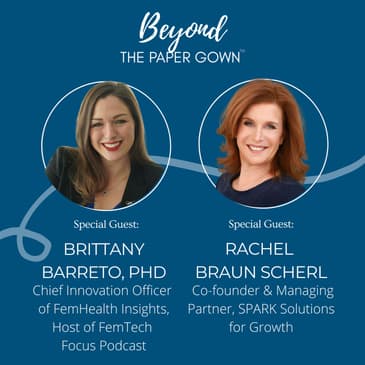

In this enlightening episode of 'The Business of Women's Health,' host Dr. Mitzi Krockover is joined by Rachel Braun Scherl, Co-founder & Managing Partner, SPARK Solutions for Growth, and Brittany Barreto, PhD, Chief Innovation Officer of FemHealth Insights, Host of FemTech Focus Podcast. The discussion revolves around the impactful world of FEMtech and innovation in women's health.
Throughout the episode, the conversation delves into various aspects of women's health, ranging from menopause and workplace issues to the evolution of medical devices and the importance of proper female representation in clinical trials. The speakers highlight the challenges and taboos surrounding women's health and emphasize the need for more inclusive and comprehensive healthcare solutions.
This podcast is an invaluable resource for understanding the current landscape and future potential of women's health and innovation. It provides a comprehensive overview of the challenges, opportunities, and groundbreaking advancements shaping the future of FEM tech and women's health. This episode is a must-listen for anyone interested in the intersection of health, technology, and female empowerment.
Please visit Beyond the Paper Gown to join our community and to learn more about achieving your optimal health.
[00:00:00] Hi, welcome to Beyond The Paper Gown, I'm Dr. Mitzi Krockover. If you're a regular
[00:00:13] listener then you know that my goal is to bring you the thought leaders in the areas
[00:00:17] that affect our health, whether it be healthcare, research or policy. One of the exciting factors
[00:00:23] that's having a significant impact on our health is a growing area of femtek or innovation
[00:00:29] in women's health. And today I am thrilled to host two dynamic and insightful women, each
[00:00:35] of whom is deeply embedded in advancing women's health through supporting innovators and advocating
[00:00:41] for removing barriers to innovation. Joining us is Rachel Braun-Scherl, co-founder
[00:00:47] of Spark which is a consultancy specializing in business development and strategy. Rachel's
[00:00:52] impressive client roster includes Johnson & Johnson, Allergan, Pfizer, Merck, Bear and
[00:00:58] many more. Beyond her consultancy role she often speaks out on challenges and opportunities
[00:01:04] in the field. Rachel brings a unique perspective and calls herself a vagina pernora which is
[00:01:09] a term we'll explore shortly. Additionally she co-hosts the Business of the V Podcast. We also
[00:01:16] have with us Dr. Brittany Burretto who holds a PhD in Molecular and Human Genetics and
[00:01:22] is also a serial entrepreneur. Brittany's innovative spirit led her to create Pharamore, the
[00:01:28] world's first DNA-based dating app. She's a prominent figure in the femtek community hosting
[00:01:34] the femtek focus podcast and contributing to femtek Forbes. Brittany founded FEM Health Insights
[00:01:41] which is a boutique consulting firm equipped with market research software dedicated to women's
[00:01:46] health innovation. As you can see we are set for a vibrant and enlightening conversation that
[00:01:52] I believe will not only educate you but certainly will also inspire.
[00:02:08] Good morning or good afternoon to you ladies it's still my morning.
[00:02:12] Hi, Mitzi. Hi. So Rachel I'm just going to start with you. What's a vagin pernora?
[00:02:20] A vagin pernora is a person who is in the business of Women's Sexual Reproductive Health. The name
[00:02:27] was created by this brilliant journalist Abby Ellen who was the first person we ever spoke to
[00:02:34] before our story. A period of the New York Times and she said oh I get it. Fajin is in business
[00:02:39] you're a vagin pernora and it's just become a shorthand to describe the kinds of things I focus on.
[00:02:46] The part to the one part of the body that I focus on and the fact that I come at it from a very
[00:02:51] much a business perspective. Terrific thanks. And Brittany I'll ask you how does a DNA dating app work?
[00:03:01] Well scientists have actually shown that people are attracted to one another through pheromones.
[00:03:06] So pheromones are hormones that affect somebody else. That's actually the definition what a pheromone is.
[00:03:11] And we release pheromones through hair follicle pores typically in places like our underarms
[00:03:18] and the tops of our heads. And so when we go on first dates we're actually picking up signals from
[00:03:24] other people through their pheromones which is changing our biochemistry. And people are actually
[00:03:30] attracted to one another when their immune system genes are very different. So you can think about it
[00:03:35] like you want an organ transplant from your sister but you do not want to marry your sister right.
[00:03:42] And so when you get an organ transplant it's about similar immune system genes. When it's about
[00:03:47] physical chemistry and attraction it's actually about opposite immune system genes. So that's
[00:03:52] kind of the quick 4-1-1 on what is a DNA based dating app. It's tapping into the biology of attraction
[00:04:01] and putting that into the technical world. So if our listers haven't figured out already these
[00:04:07] are two very creative smart and innovative women. And so it doesn't you know it shouldn't surprise anybody
[00:04:18] that they're also very outspoken in terms of being advocates for women's health and I've really
[00:04:23] enjoyed getting to know you guys over the last couple of years but you know in many societies
[00:04:30] including ours women's health issues are still considered to boo and we in the United States
[00:04:35] still find resistance to talking about certain issues. Though I think things are changing because
[00:04:40] I just read that the vagina museum in London is opening up again so there is some hope but why can
[00:04:47] we all collectively work towards normalizing that conversation right. It's all like you get started.
[00:04:53] There's so many factors but like the way we think about women's health is a good model for how
[00:04:58] we think about moving the category along. It really is about the intersection of physical
[00:05:06] conditions, emotional situations, hormonal social behavioral contextual aging and we're really
[00:05:15] starting to talk much more about how complex so many of these issues are that women face. They
[00:05:23] either face them uniquely because they have they were born with the organs, they face them differently
[00:05:28] because men and women respond differently or they face them primarily in terms of they affect
[00:05:33] women a lot more than men. And when we look at the progress that we've made it really is
[00:05:39] a combination of all those factors. We have lots of entrepreneurs who are building companies
[00:05:45] who invest in companies. There are a lot more women who have excess capital to invest. We have
[00:05:53] creative sources of capital. We have celebrities aging which makes a big difference when Oprah talks
[00:05:59] about menopause versus you know Joan at the corner talking about menopause. We have organizations
[00:06:06] who now have part of their mandate investing in and supporting female entrepreneurs. And we have
[00:06:13] the media who's now come along with the conversation. Everyone has noted that The New York Times has
[00:06:20] done quite a number of articles on menopause and the last piece. And this has been discovered 25
[00:06:25] years ago for fertility and reproduction and only more recently with menopause. We know that if we're
[00:06:31] not dealing with women's health conditions situations experiences, we are at risk of losing
[00:06:39] a lot of talent. So when Apple and Google came out with fertility and reproductive and egg freezing
[00:06:45] benefits, you know is it because it was nice to do? Yes but didn't also make sense from a business
[00:06:53] perspective. Yes people left less frequently. We reduced turnover. We increased productivity and
[00:07:01] we're seeing the exact same thing in menopause right now because at any one point 20% of the workforce
[00:07:07] is in menopause. So it's a long answer but it is so many factors coming together at the same time.
[00:07:15] You know I joke, I have a talk that I give that's called in a hot flash women's health and overnight
[00:07:20] sensation centuries in the making. And these factors have come together at this moment or the last two
[00:07:27] years of moments because of all these factors coming together and coalescing at the same time.
[00:07:34] You know I really resonate with that I've been doing women's health. They are practicing women's
[00:07:39] health for very long time and I was going back through some of my papers and things like that. A lot
[00:07:46] of the topics that we are talking about now, we were talking about back then but we didn't have
[00:07:51] this confluence of kind of the perfect storm of women in leadership, women in science, more
[00:07:58] women in clinical and business as well as the technology. So it's all about the timing and so I'm
[00:08:05] so glad to go to be seeing that. And just to underline what you were just talking about with respect
[00:08:11] to menopause, Mayo Clinic study came out that showed that businesses lose an estimated one billion
[00:08:18] dollars in lost work time per year and 26.6 billion annually when medical expenses are added due
[00:08:26] to menopause and parimenopausal symptoms that are experienced by their workers in the workplace.
[00:08:31] So you know that should give us pause.
[00:08:36] Having numbers from the Mayo Clinic or having numbers from you know the menopause foundation,
[00:08:42] that speaks volumes and one of the other factors that is the result of all these this confluence
[00:08:49] is a vocabulary. You can have a conversation unless you have the words to speak about it
[00:08:55] and whether that's body parts, whether it's human conditions, whether it's emotional experiences,
[00:09:01] you need the vocabulary which also has been being built and developed and used most importantly
[00:09:07] alongside all the other changes. Brittany what comes to my mind is that recently you were at a large
[00:09:13] conference and saw a need and dealt with that in a very public way so that you did a service
[00:09:21] and you also then called attention to the issue. Talk a little bit about that.
[00:09:26] Yeah sure so there's a conference called Health Spelt HLTH and it's to date like the largest
[00:09:32] health tech conference in the world and I attended it last year and it was on the Las Vegas trip
[00:09:37] and several women approached me knowing who I am and what I do saying I just got my period
[00:09:43] and I have to leave because there's no menstrual products in the bathroom. There wasn't even coin
[00:09:49] operated ones and so not only did these women have to interrupt their day, not attend a meeting,
[00:09:54] not attend a talk but they could have just even go down the hallway. They had to walk and I looked
[00:09:59] it up .7 miles to the closest pharmacy to get menstrual products for themselves and you know these
[00:10:06] are women who may have only needed two tampons or a pad to get them through the day maybe they had
[00:10:11] some in their hotel room but instead we're asking them to spend $20 on a box of 20 tampons and then
[00:10:17] they have to keep in their purse or throw away right because what are you carrying at the conference
[00:10:22] and just seem to be so logistically nonsensical and to something that you know we're providing water
[00:10:28] and toilet paper. We should probably provide menstrual products and looking at that being 10,000
[00:10:34] people there let's assume 40% of the attendees were female let's assume even 10% of that 4,000
[00:10:42] women were actively menstruating that's 400 menstruators right 400 menstruators that
[00:10:48] regardless of breakthrough bleeding let's just say on on their period they knew it they ran
[00:10:53] out of product or forgot it in the hotel had to do something about it and so yeah I bought I purchased
[00:10:58] a thousand menstrual products brought it to the conference put them in little baskets in the
[00:11:04] restrooms put up little signs that said when all you think about is women's health you see opportunity
[00:11:08] where others don't had a little QR code for my podcast and my consulting firm and it was the best
[00:11:13] $120 I've ever spent because we've gotten a ton of business out of it and next year hopefully
[00:11:19] we'll have a whole femtek booth with lots of products available for everybody not just in the
[00:11:23] women's health bathrooms people forget that menstruators are part of the workforce menstruators are
[00:11:29] part of your attendees at your conference and you know it's kind of fun women's health it is a
[00:11:35] lot of low hanging fruit which makes it a great business opportunity right now. Sure you know it's
[00:11:40] interesting my daughter attended a lot of hackathons when she was in high school and the first time
[00:11:46] I went to one in the in the girls bathroom was some products and I think it might have been
[00:11:51] sponsored by ant flow and it was like I'd never seen that before I never really thought about it
[00:11:58] because we're so used to trying to find that quarter if you need it or or stuffing you know toilet
[00:12:04] paper or whatever it is I just want to kind of expand that a little bit just to make the point
[00:12:09] that not only again do we maybe not think about that it's expensive and there's even taxes on it
[00:12:16] in certain municipalities so we call it the luxury tax and so what we know for example is that
[00:12:23] there are girls that don't go to school in the United States because they can't afford period
[00:12:28] products and they don't go to school so you know we think about this as kind of a minor issue but
[00:12:36] it's really not and for all the reasons that you stated in terms of again being inconvenient
[00:12:42] and all of that but even more than that expensive and having to miss opportunities you know
[00:12:49] all the way to just not even being able to go and do what you need to do to graduate high school
[00:12:55] so I'll get off my my soap box but I wanted to make that point. But it speaks to the rise of
[00:13:00] women's health right we're finally acknowledging that there are administrators at school in the work
[00:13:05] place at your conference right and so we're also not only admitting to there being administrators but
[00:13:11] the administrators are standing up saying I deserve service. I deserve to be accommodated this is a
[00:13:18] biological process that is not in not weird not taboo shouldn't even begin community this should
[00:13:23] be a natural human process that you should acknowledge and respect and so speaking to kind of your
[00:13:28] first question mitsy about this rise of women's health we're finally starting to call things what
[00:13:33] they are it's your vagina this is your vulva right there's a cervix we're starting to get rid of
[00:13:39] you know myths like breaking your hymen right we're starting to actually talk about the facts
[00:13:46] the biology and we're learning about the biology of menstruation right we're learning about the
[00:13:53] windows of fertility and the more that we learn about these things we're more able to talk about
[00:13:58] it as Rachel was mentioning right we can't raise awareness for something if we don't even know
[00:14:01] the words that we're supposed to use for it and the thing that excites me the most of what we
[00:14:06] see in our research is that there's a rise of women in STEM science technology engineering
[00:14:11] and medicine and the more women we have in STEM we're seeing the more solutions coming out
[00:14:16] specifically for women's health and so it's a really exciting time Gen Z gives me a lot of hope
[00:14:22] they're just questioning every paradigm that's ever been built and we we're truly starting to
[00:14:27] make women's health mainstream so we're talking earlier about the fact that we have more
[00:14:35] women in life sciences and research and business and investment and clinical practice obviously
[00:14:43] can always use more but the burden the responsibility is on women where are the men in all this what do
[00:14:50] you think Rachel? We can't do it without the men it affects everybody and I'll just go back to
[00:14:58] to Brittany's example with walking point seven miles to the bathroom if you are working with a woman
[00:15:04] who has to walk one point four miles to go to the bathroom and she was meeting with you that
[00:15:09] affects your productivity so it has a lot of implications really practical day-to-day implications
[00:15:14] in the workplace women make 80% of the healthcare decisions and in their family they're the chief medical
[00:15:20] officers often of their family if there is a woman in the family so her understanding her knowledge
[00:15:27] her ability to put together pieces of information affects everybody they should not be a women's
[00:15:33] health issue healthier women lead to healthier more productive societies so we have a lot of
[00:15:41] advocates and men supporting it should not be and us versus them we must do this together
[00:15:47] to make the change and to build the companies that we want to see that can change the world
[00:15:52] you're here Brittany do you have anything dad? The tagline of our podcast is women's health is
[00:15:58] everyone's health you know we are 51% of the population and responsible for the other 49
[00:16:04] even if that's just burling them and so when you improve a woman's health you truly improve
[00:16:09] the health of her partners her childrens her families her community her business
[00:16:14] and unfortunately we haven't seen capitalism care too much about women's health but now that we're
[00:16:21] more than 50% of the workforce our health does matter to your bottom line. Going back to your
[00:16:28] point Rachel in terms of the challenging parts of sex and issues the DOBS decision focused
[00:16:38] attention on women's reproductive rights and that was the overturning of Roe v Wade it also
[00:16:43] with obviously highlighted how politics and policies can impact on our health so talk a little bit
[00:16:52] about your view on the key takeaways from this decision and others like it and its impact on women's
[00:16:59] health well after the overturning of Roe v Wade we saw a deep self reflection I think by individuals
[00:17:07] governments and companies to ask themselves where do I stand on this issue we've had companies
[00:17:13] ask themselves where do they stand on it we've had investors ask themselves where do they stand
[00:17:17] on it are they going to put money into reproductive health we've seen what we call row rounds which is
[00:17:22] startups and venture funds having a very significant uptick in the amount of funding they were able to
[00:17:28] raise because investors were self-reflecting on themselves and where they stood on the issue and
[00:17:33] you know the ones that said I wanted to put my money where my heart is and they invested in
[00:17:37] these reproductive health companies something I'm really excited about is I actually just got back
[00:17:42] from the national contraception meeting last week ironically took place in Texas where abortion
[00:17:49] is illegal um they saw a significant increase in male interest in birth control so I actually called
[00:17:57] my mother um yesterday and was telling her about the conference and and I was telling her oh mom
[00:18:03] and there's like oh there's a three three drugs in phase one clinical trials right now for a male
[00:18:08] contraception of male birth control and she said oh well it's too bad that men won't take it you know
[00:18:13] she's like men would never do it they won't even get the sector means and I said ma that's your
[00:18:17] generation I said you know and she what is she she's almost 60 right and so for her she had this
[00:18:23] paradigm that men would refuse to take birth control and I said ma the men and my the males if I
[00:18:28] if I am more correct the males in my generation and younger are absolutely open to taking on
[00:18:35] the responsibility of reproductive rights and they want to participate in that and she was like
[00:18:40] are you serious that's incredible that's huge right and so I wouldn't and that was a specifically
[00:18:47] in the research they showed it was they redid the surveys after Roe v Wade was overturned
[00:18:51] and that's when the jump took place right and so although it's like a horrible in my opinion horrible
[00:18:57] thing that happened to women's rights I also think it kind of made us dust off some you know
[00:19:02] cobwebs and say damn we need to make some decisions we need to step up and do something about this
[00:19:07] whether that be policies in your company investment decisions or even personal choices about
[00:19:13] the drugs that you or your partner are taking and you know I'm cheering uh if we could be cheering
[00:19:20] during a webinar you know I agree wholeheartedly with everything Brit says I'll take it in a slightly
[00:19:26] different direction you know the expression necessity as the mother of invention we luckily
[00:19:32] seen more innovative solutions COVID trained us just in time to understand telehealth which has made
[00:19:39] medication abortion a much bigger option one of the things that's really challenging for companies
[00:19:45] is this is a this is an issue that is never easy there's never consensus it makes lots of people
[00:19:53] uncomfortable and I was on a panel with a person who is in the benefits area and I heard the
[00:19:59] most fascinating thing that I want to share because I hadn't heard it before since if you want to
[00:20:05] enable employees to travel across state lines for miscarriage management for abortion
[00:20:13] why should they have to go to their boss to their HR department and say raise their hand and say
[00:20:19] I'm going to terminate a pregnancy so what this company has decided to do is we now pay for people
[00:20:25] to cross state lines to get to the best care they can get for whatever it is that else them
[00:20:31] so if you need a double-hyper placement and you're in a state uh that's next door to where the
[00:20:36] greatest orthopedic surgeon on the planet is they are paying for you to go there so and that's
[00:20:41] a really important concept that we don't want to make women's health or my personal health I
[00:20:49] certainly don't I want to be the one who gets to share what people know about my health and so
[00:20:53] putting the onus on women to say you know here I am here I am I'm doing this thing which you
[00:20:59] may or may not approve of there you can create policies that make it so everybody can get the best
[00:21:05] health that they need while moving on to the other end of the spectrum and we talked a little bit
[00:21:11] about menopause but specifically menopause in the workplace and again we talked about the bottom line
[00:21:19] what are you seeing in terms of actual programs initiatives that you think are not just
[00:21:28] superficial but really meaningful and Rachel you're nodding your heads I'll let you start
[00:21:35] okay so uh and I'm it's more personal for me than Brit given our respective ages
[00:21:43] so we're seeing that one of the biggest things we hear over and over again with the menopausal
[00:21:49] community is that they feel so alone they don't expect it you know your trained as a physician
[00:21:54] you might not have been expecting it there are dozens and dozens of symptoms you know
[00:21:59] high flashes might get center stage but there are many many others that are quite problematic like
[00:22:04] brain fog like increased anxiety like the impact on sleep some of which is caused by hot flashes but
[00:22:10] not all increased anxiety and depression lethargy so these are huge issues every single one of
[00:22:18] which affects productivity in a workplace so we are seeing many startups going in and educating
[00:22:26] you know providing the language helping them understand the signs helping them do what they can to
[00:22:31] manage any of the symptoms giving them access to collect data your lot of amazing devices in
[00:22:36] menopause that are collecting data that will help you make more informed decisions so the first
[00:22:41] piece is education and awareness and the second we're not quite there yet but we're making a lot
[00:22:47] of progress is products and services that offer solutions or relief of some of these symptoms that
[00:22:54] are so intrusive. Brittany how about yourself? Well there was a survey in 2022 that said
[00:23:03] four out of every ten women so 40% of women have experienced menopausal symptoms that interfere
[00:23:09] directly with their work performance or productivity on a weekly basis so 40% weekly basis symptoms
[00:23:16] are interfering with their work and 17 so 1 7% have quit their job or considered quitting due to
[00:23:24] menopausal symptoms this is actually a recent revelation for me I you know obviously this is all
[00:23:30] like eat breath sleep roll around in is women's health and I have been hearing more and more
[00:23:38] and more about women in dropping out of the workforce because of their menopausal symptoms as a female
[00:23:44] founder as a female scientist as a feminist in general I've been fighting the DEI fight we need
[00:23:50] women at the table we need women on boards we need women leadership and I can't help but think
[00:23:56] have we missed a major talking point or by talking I mean hopefully actionable point that menopause
[00:24:05] may actually be part of the leaky pipeline that people been saying I think there's been a giant
[00:24:10] gaping leak in our pipe which is even if women did make it to leadership their brain fog or fatigue
[00:24:18] or hot sweats at night that leads them to not be well rested and they're they're just pure like
[00:24:26] dissociation from their body may actually be causing one of the biggest fit pitfalls
[00:24:33] and having females in leadership we've worked so hard to get females in leadership how do we keep
[00:24:38] them there and keep them there in a healthy way and I think that is so important because of the way
[00:24:44] we talked earlier about keeping young childbearing women in the workplace by offering benefits and
[00:24:52] enable them to build families in the way that they want how they want when they want we are now seeing
[00:24:58] the response to that for the first time companies offering menopause support and that takes many
[00:25:04] different forms it could be a telehealth visit with the doctor it could be education it could be
[00:25:10] access to products but we are now seeing why would we want okay there'll be oldest and say maybe
[00:25:18] the wisest also why would we want to lose people who will be but they're not that old I mean
[00:25:26] but I'm talking you could start 40 years old so and we have executives that are in their 70s
[00:25:33] and so male executives for the most part so I think that's another piece of it it's it's not just a
[00:25:40] disease of old people it's not even a disease let's put it that way it's not a disease but there
[00:25:45] is a jizum you know if I never I would never want to be in a room where I would want to raise my
[00:25:51] hand and say excuse me my brain synapses aren't connecting right now can we take a 20 minute break
[00:25:58] while I have an unbearable high-flash and go to the ladies room that's not what the goal is
[00:26:05] but could we have a high-flash standing in front of a room which I have and many many people I know
[00:26:10] have and say excuse me I need to step out for five minutes that's different we're not you know
[00:26:17] I think one of the things we have to be clear about is I don't think most women want to be sharing
[00:26:24] their personal details of their health in the workplace what I think they want is an ability to work
[00:26:31] with them in the context you know of the workplace and again I'm a broken record because I go back
[00:26:38] to the economic argument we'll assume that people who are entering Manipause have more work
[00:26:45] experience than people who are 20 years younger why would we want to lose the people who are
[00:26:50] elevating or making decisions who are giving us a seat at the table our listeners out here are
[00:26:56] probably saying okay that's great but I don't want to be the person that brings this issue up so
[00:27:02] how would you suggest that they could successfully advocate and what are they advocating specifically for
[00:27:09] I would say a workplace that supports women in general right so I think work has been
[00:27:15] it's only recently that women have had a major stake holder place in the workplace right that this
[00:27:21] is a recent thing in the in the long generations of working but to answer your question and like
[00:27:28] instead of you know your listeners going to HR and being like you need to rethink how workplaces
[00:27:33] are philosophically here's actual something they can do they can go to their HR department and say hey
[00:27:39] can you bring in a speaker to educate the workplace about ovulation in the office or
[00:27:44] menstruation or metapause in the office HR departments bring in DEI speakers all the time put it
[00:27:50] under that budget put in a women's health talk right and then you as they employee don't have to bear
[00:27:55] that burden of educating your bro or male leadership about what's going on in your body you can
[00:28:03] bring in an external person like Rachel or myself or you know if you want to list I'm sure we
[00:28:08] have a list of experts I would love to come in and talk to your business about this we'll do the heavy
[00:28:13] lifting for you in the meantime I would say that you can also advocate for little signs that the
[00:28:19] company is pro women so you can advocate for going to HR and saying hey can we get free menstrual
[00:28:25] products in the bathroom so I think it's about for me as of right now it's an H it's a talk about
[00:28:31] with leadership in HR's about you know putting it under DEI is typically what I find to be most
[00:28:37] successful and by the way going back to men and women and if you're experiencing hot flashes from
[00:28:44] your prostate cancer treatment we care about that also very good the other piece that I would
[00:28:49] mention is COVID as horrible as it was had a few silver linings one of them was we understood
[00:28:57] the complexity in the full range of people's lives and I could say as someone who has been working
[00:29:02] since the day my children were born 25 years ago I would never say I have to go and leave for
[00:29:10] my daughter's squash match but now a kid is running behind you a baby is crying the dog jumps on
[00:29:16] you someone poops on the desk it became a reality when everybody's on zoom that people had to
[00:29:23] understand a broader view of someone's life the same thing when schools were closed then we saw
[00:29:29] literally and still have a crisis in child care you know I don't know anybody male or female
[00:29:36] anymore who has a nine to five job that you know that is like a vacation compared to how most
[00:29:41] people are asked to work overtime becomes just something that's expected so we need to be supporting
[00:29:49] our workforce in a way that doesn't require you know all the blocks to be put together and the
[00:29:55] puzzle to be fitting together perfectly this isn't new people have been struggling with child care
[00:30:00] and figuring out how to take care of their children and work this is going to be a challenge forever
[00:30:06] because you cannot be in two places at the same time so I think really we're seeing when we talk
[00:30:13] about these cataclysmic changes changes some of them we are catalyzing and some of them we need to
[00:30:20] be responding to you know I entered investment in women's health because the light bulb went off
[00:30:26] for me when I was being consulted for my clinical expertise by these women who could not find
[00:30:32] solutions for their medical issues in the marketplace or in the healthcare system and so for me
[00:30:37] I literally wanted to be invested to support these innovations and these innovators so talk to
[00:30:43] me a little bit about what you see as the way that these innovations can play a pivotal role in
[00:30:50] women's health Brittany what do you say sometimes I think innovation could be seen as an improvement
[00:30:58] on solutions and so often I find that in women's health it's the first ever right like we're making
[00:31:04] the first ever diagnostic for endometriosis which affects one in 10 women not a better test
[00:31:10] not a faster test on a more specific one a first ever right or if we are innovating on something
[00:31:16] that exists it we're innovating on something that's been around for 300 years right like it was
[00:31:22] invented 300 years ago and we really haven't touched the product design of it and so some of the
[00:31:27] things that I'm really excited about are um I'll give you an example of one of those like dramatic
[00:31:33] improvements the 300 year timeline one um to get an IUD in place into the uterus you have to
[00:31:40] bypass the cervix I like to think of the uterus as like a balloon and the cervix is the not on the
[00:31:46] bottom of the balloon holding holding the air in right now that's not actually how the cervix works
[00:31:51] but just go with me here in terms of the analogy you have to bypass that nut and it's actually very
[00:31:58] painful to do so it's actually very painful to do so but most of that pain actually does not come
[00:32:03] from the crossing of the cervix the pain comes from the stabilization of the cervix and what I
[00:32:08] mean by that is the holding it steady and currently the way that gynecologist hold your cervix steady
[00:32:15] in order to put an IUD into your uterus or do things like implant an embryo into your uterus if you're
[00:32:22] doing fertility you know treatments or get a um a uterine biopsy if you're getting a test on any
[00:32:28] of those things that need to cross that cervix cross that knot what they're currently using is a
[00:32:32] thing called a uh tenaculum a tenaculum is like these little pincher things and it's actually the
[00:32:39] same tool that they use to take a bullet out of a hole right I think we've all seen enough action
[00:32:44] movies like they're they're in the war zone or whatever and they need to take the bullet out
[00:32:49] and there's this these like kind of um metal clampy looking things are going in there and they're
[00:32:54] taking the bullet out that is what they are using the clamp down onto the cervix and that's what
[00:33:00] they're using to stabilize it okay for those who can't see me I'm quote-unquoteing it stabilizing it
[00:33:05] right the most of the pain is coming from that pinch there is now a new medical device by the
[00:33:10] company called a spivix and a spivix created a suction based the device that essentially it's like
[00:33:18] a little smiley face a little half circle and it goes to the bottom of the cervix and it you pull
[00:33:23] on the bottom and it sucks and it sucks a little bit of the cervix skin into this little med
[00:33:29] device and that's what's actually holding it and in their clinical trials they showed a 70%
[00:33:34] decrease in pain now what gets me just really riled up is that pain is considered normal in
[00:33:40] women's health if your symptom is pain it's not considered a symptom because pain is just part
[00:33:45] of the female experience supposedly and so what they are innovating on is not that the tenaculum
[00:33:52] isn't good at stabilizing the cervix but it is incredibly painful and when you're trying to get
[00:33:58] women to do things like be diagnosed for disease or have an IUD place you would like it to not be
[00:34:04] a traumatic injury and so I'm really excited about innovations like spivix which are dramatically
[00:34:10] decreasing the pain of that experience so that hopefully we can dramatically increase the conversion
[00:34:16] of female patients saying okay yeah I'll have an IUD placed none of my friends said it was that
[00:34:22] bad and we're talking about Roe v Wade we're living in a world where 21 states abortion is illegal
[00:34:27] when you have a procedure that could potentially guarantee your you know contraception through not
[00:34:33] having to take a pill every day through an IUD you want that that procedure to be attractive
[00:34:39] you want that to be something that women say yeah I'll participate in this and so those are
[00:34:44] the types of things I am excited about and you know femtic is so often the lowest hanging fruit
[00:34:50] literally the lowest hanging fruit we're we're the innovation is we're no longer using a
[00:34:55] bullet remover to clamp on your internal organs one last example as to how bad this is
[00:35:02] I saw a spivix at a conference and I did a demo follow me on tiktok to see the demo dr.
[00:35:08] Brittany burrito and I did a demo they had little cervix and the little the section cup thing
[00:35:12] and I'm doing it and I asked the founder I said oh do you have a tenaculum on you let me show them
[00:35:17] what that one looks like and she said oh it's on the TSA's band list I'm not allowed to fly with it
[00:35:23] I said well dear god if that's not the epitome of women's health that you you were not allowed
[00:35:29] to fly with the medical device because you might actually kill someone on the plane with it
[00:35:33] it's that dangerous that I mean if you're not allowed to bring it on TSA we probably shouldn't be
[00:35:38] clamping your organs with it so I'll end with that I'm really excited about what is becoming
[00:35:44] sort of a deafening roar around women's health and you know even 12 months ago we were hearing
[00:35:50] conversations where VCs would say oh I looked at a menopause company I'm good I'm covered
[00:35:56] which if you know about menopause or you know about women's health is a very narrow relatively
[00:36:01] uneducated view of the implications and the impact of menopause so I like that there are companies
[00:36:08] where I spend my time is as the connective tissue between venture back startups and larger companies
[00:36:13] whether they're sources of capital whether they're distribution partners whether they're access points
[00:36:19] whether they're mouthpieces and you and you uh they're the wind beneath your wings so to speak
[00:36:26] I'm really excited that there are more people who are interested in this it's been very clear
[00:36:32] one of the things that concerns me which wasn't part of your question but I'll just
[00:36:35] throw that in anyway is we have lots of effort in patches and we still have big gaps on the
[00:36:42] plane field where no one isn't starting no leadership so we're going to see a lot of consolidation
[00:36:48] a lot of collaboration in areas where you know quite frankly there might be more companies than we
[00:36:54] need and we still have to really work at what are these huge gaps like endometriosis like PCOS
[00:37:02] diseases that take seven to ten years to diagnose that often come or not a person is not even aware
[00:37:09] that there's anything wrong until they start getting trying to get pregnant and then they've
[00:37:14] potentially had a seven to ten year impact on their fertility window so I want to make sure we're
[00:37:20] coming up with solutions for the big big big stuff because there's still a lot of big stuff
[00:37:26] and to do that what we're learning is you have to break down the problems into pieces
[00:37:30] there's no warmins health condition where there's you know how many times you hear in this space we
[00:37:36] need the female viagra the female sexual response system does not work that way so there is no
[00:37:43] one hit wonder for women's sexual response or desire or satisfaction or orgasm so we really have
[00:37:49] to be breaking down an understanding of women's health and figuring out places where we can make a
[00:37:54] difference in a very complex process and to that and I know that you know we you and I and Brittany
[00:38:01] talked about this and that is different from the viagra where my kids knew what ED was before they
[00:38:08] knew what a vagina was because they saw it on TV at five p.m. on channel CBS during the Super Bowl
[00:38:15] absolutely you know there are companies that aren't even in the sexual health space but certainly
[00:38:22] including it those that can even get their products advertised talk a little bit about that
[00:38:29] how much time do you have 30 seconds you can this is this is an old story as long as I've been
[00:38:36] in the space which is over 15 years at this point there have been limitations on channels media
[00:38:44] channels where women's health businesses can get their ads and big things like now meta but they
[00:38:51] were doing it when they were still Facebook some TikTok every every website every cable station
[00:38:58] every network what you are approaching them when I was running my first business in the space we
[00:39:03] went to a hundred media outlets and that was radio website TV cable and network 95 said no
[00:39:10] what was your product at that point it was a product that improved a ralphal desire and satisfaction
[00:39:15] for women so if you can't get your product out there to educate people how to Brit's point do
[00:39:21] actually know about a solution so we do still face despite huge efforts and huge progress big headwinds
[00:39:27] because someone some algorithm some company decides that breastfeeding is too sexual in nature
[00:39:34] you know my favorite story ever in this space is company called pulse that I've had the pleasure
[00:39:39] of working with they have a device and consumable for lubrication and massage oil for intimate wellness
[00:39:47] and their ad got rejected because vaginal dryness was considered too sexual in nature so you know
[00:39:55] I always put it out to people name a hundred things that sound sexual or sexually appealing or
[00:40:01] sexually motivating I don't think vaginal dryness would make even the longest list so there's education
[00:40:09] that is sometimes being stymied by the actual places where we want to put the education
[00:40:15] it goes back I think to what you had said earlier we really need to be upstream talking to kids
[00:40:20] about body part language and making the body you know neutral as opposed to normal safe something
[00:40:28] we talk about something we're comfortable with not something that if I never hear the taboo taboo
[00:40:33] again for the rest of my life you know that would be great absolutely and Brittany talk a little bit
[00:40:40] because I don't think that you know the I know I didn't until I got involved the process of getting
[00:40:47] a product developed into market especially if it's a medical device or need some kind of regulatory
[00:40:55] approval well we have a lot of you know well essentially we have a lot of struggles and creating
[00:41:05] really fantastic diagnostics and medical devices because of the lack of history of work being done
[00:41:12] so our backdrop to scientific discovery has been based on a male paradigm and so we have to
[00:41:18] actually rewrite the books in terms of you know sometimes I wonder what basic scientific things have
[00:41:24] I learned about that are literally based on a male that we've never actually studied a female
[00:41:28] cell or a female animal model and then you jump into human clinical trials and you have issues like
[00:41:35] well women were not allowed to participate in clinical trials until 1993 and that was just
[00:41:42] the permission to participate not even the requirement to participate was the it was just the
[00:41:47] permission to it wasn't until 2016 2016 y'all that we actually had a bill pass that said you have
[00:41:57] to consider sex in your data so before that if you even included females in your clinical trial
[00:42:04] you are allowed to summarize that data with the male participant data and say here's how it's
[00:42:09] working well here's an example as to why that is terrible science well the drug called ambian
[00:42:16] ambian is a drug for helping you sleep the female metabolism metabolizes it dramatically slower
[00:42:22] than males do and so for 20 years women were getting into car accidents in the mornings because they
[00:42:27] were still high on ambian they were still half asleep and so it was the first and only drug to be
[00:42:33] removed from the market and then re-approved with sex specific dosages I cannot imagine how many
[00:42:39] women out there are being overdosed because the dosage is based on a male's body type right and so
[00:42:45] when you actually require clinical trials to say well here's the results for the male participants
[00:42:51] and here's the results for the female participants now we can actually start to say huh this drug does
[00:42:56] work in both but actually needs to be higher in females or get this what if we considered her menstrual
[00:43:02] cycle so you know we're technically able to give women a 28 day hormone regimen for her birth
[00:43:08] control pill why are we not doing that for her prozac why are we not doing that for her Crohn's disease
[00:43:14] medication her Parkinson's disease medication we have so many women patient advocacy groups now coming
[00:43:21] out saying we know our symptoms are worth when worse when we menstruate and we want pharma to kind of
[00:43:27] consider that can you please figure out why my symptoms are worse do I need a higher dosage of
[00:43:32] my drug when I'm menstruating what about if I'm post metapause does it change how my metabolism
[00:43:37] works with these pharmaceutical drugs do we need to consider that the the it is required for female
[00:43:44] participants in clinical trials to be on birth control to date you do now have drugs that have been
[00:43:50] approved that have been on a woman not on hormones every woman in clinical trials in order to prevent her
[00:43:55] from getting pregnant during the trial she has to be on birth control and so this I've even lost
[00:44:01] track of what your original question oh the track how do you get the medical device the product at
[00:44:05] market essentially essentially the first thing we do is ask how sex and gender is being considered
[00:44:13] throughout that product development through the safety protocols through the evaluations of its
[00:44:18] efficacy i.e. how well it works and then don't even get me started on actually getting it
[00:44:23] reimbursed by insurance or getting it approved by the FDA and what what I think the conversation
[00:44:30] really demonstrates is some of the just basic fundamental things are wrong you know the average drug
[00:44:35] was determined and dose done a hundred sixty pound white man 40 percent of america is overweight or
[00:44:41] obese so we're doing we're making a lot of mistakes because our clinical study population
[00:44:48] is not reflecting our population in terms of you know how people show up and you know what
[00:44:56] what they bring with them what what is their genetic history what is their familial history so
[00:45:02] again in women's health i mean if there's one theme you know it's complicated but making a little
[00:45:08] bit of progress in any of these things has a huge implication for you name it you know I just
[00:45:16] wanted to add one more thing about the other silver lining of covid you know we had conversations
[00:45:22] about the impact of vaccines on menstrual cycles because millions of people were getting vaccines at
[00:45:28] the same time and they were seeing changes that wasn't studied but that mistake or whatever you
[00:45:35] want to call it gave rise to a conversation and awareness that hadn't existed before
[00:45:41] let's talk about the consumer itself because we all had a conversation about
[00:45:47] the fact that women's health can also be a place where women can be exploited and so
[00:45:55] Brittany talk a little bit about how consumers can really evaluate some of the
[00:46:05] products that we're seeing in services yeah well unfortunately a lot of marketing has been
[00:46:11] going into women's health to try to tell us to have our vagina smell like flowers and we've lost
[00:46:17] track of what our vagina is really supposed to smell like and unfortunately I think that these types
[00:46:24] of marketing things have played on societal expectations of women that are outside of our natural
[00:46:30] biology and so one thing to do is to you know you can listen to podcasts like this one or femtic
[00:46:37] focus or business of the V if you're if you're inclined to kind of listen while you do the dishes
[00:46:43] or take the dog for a walk and learn about products and learn about your own biology and you're
[00:46:48] the bacteria in your vulva and what it's actually supposed to smell like and start to question
[00:46:53] what products am I using and why am I using them another way to do research is simply by going
[00:46:58] on the company's website and asking if they have research behind the products that they are doing
[00:47:05] if you do not have the time or desire to do so and I can totally appreciate as a consumer myself
[00:47:10] I don't necessarily always have the time or desire to do my own research you can go to marketplaces
[00:47:15] that have already done the research for you so actually just this morning how to call with the
[00:47:19] founder of a company called unfaibled unfaibled and they actually do the research for you and it's
[00:47:27] a marketplace e-commerce website that has all these women's health brands and companies that
[00:47:32] they've already did the research they did it for you to make sure that this was you know good
[00:47:37] for your health based from a good company that actually cares about your you know health and not
[00:47:43] just how your vagina smells Rachel what are your thoughts it is very hard for the average consumer
[00:47:50] to understand how to read or interpret clinical studies but it is to a certain extent you know
[00:47:58] caveat answer let the buyer be where your responsibility to find a way to get the information
[00:48:04] of just as we know just because it's on the internet doesn't mean it's true and just because
[00:48:09] someone has doctor in front of their name with all due respect to two doctors on the phone who
[00:48:14] I'm sure minister's back for doesn't mean they've looked at the science so you really have to be
[00:48:21] an advocate you have to read the science or figure out how to help someone understand the science
[00:48:26] before used to these claims from you know from skincare and hair care and is it actually saying
[00:48:34] improves X by 10% or doesn't say in a trial 90% of women reported X that's what's called a marketing
[00:48:43] study which just means which doesn't mean it's not valid but it doesn't also mean it doesn't
[00:48:50] necessarily mean it's scientific so like we don't have enough to do there's there's one more
[00:48:55] thing but to me before you're putting something in your body that has the or on your body that
[00:49:00] has the ability to have you know implications for a lot of systems and quality of life you need
[00:49:06] to get educated so as we're wrapping up my questions are what excites you about the next five
[00:49:14] years with respect to women's health how about yourself Brittany I am excited to see red liquid
[00:49:21] in menstruation commercials which essentially is for in bigger terms a normalization of women's
[00:49:29] health and media it's what I'm really excited about it's almost kind of like the blue is as normal
[00:49:36] I mean if you have a smart liquid coming out of your vagina I recommend you see a doctor
[00:49:45] there I'm some really excited to see the normalization of women's health and media I'm excited
[00:49:50] for people to say these words like vagina or vulva not only correctly you know I'm wearing
[00:49:58] uterus earrings for those who can't see these are female reproductive organs I have ovaries
[00:50:03] fallopian tube butyurus cervix vagina and people will literally say like oh you have vaginas
[00:50:09] on your earrings and like oh here's a teaching moment that's the vagina right like there's so
[00:50:13] many other words so just learning about the basic anatomy of the female reproductive track in
[00:50:20] our bodies and how things are supposed to work because the more we learn and normalize it
[00:50:25] the less stigmatized or unique will feel so I think like there's women who are so hard on
[00:50:30] themselves for quote unquote not being able to breastfeed and yet if they knew the actual statistics
[00:50:36] of breastfeeding success they would say oh wow I'm actually in the norm or miscarriage you know there's
[00:50:42] this thing that's like don't tell anyone you're pregnant till the second trimester and it's like well
[00:50:46] who's on whose behalf are we telling these women not to talk about that I would love for them to
[00:50:51] tell me and then therefore if they did lose the pregnancy I could support them in that right
[00:50:56] but we continue to tell women to keep their health to themselves keep their bodies to themselves
[00:51:00] and only tell us when it's going great um and so I think that uh I'm really excited for the normalization
[00:51:07] of the regular female health experience and I'm excited to see some big exits and some big money
[00:51:13] come in from women's health you know and by exits I mean acquisitions where bigger companies
[00:51:19] buy other companies or even IPOs the more big successes will get the less questions will get about
[00:51:25] this being a big enough market to make money in and uh I'm also really excited because the people
[00:51:30] who are gonna make the money I know where their their next round of funding is going to go it's
[00:51:34] gonna go back into women's health they knew it was a good investment decision they made their
[00:51:39] money from it and I'm excited for them to further engage in in funding our industry great Rachel
[00:51:46] I'm excited for the changes to actually really change the conversation so that more money goes in
[00:51:53] I'm excited for the day when um a women's health unicorn isn't a unicorn isn't so unusual when it
[00:52:01] just becomes um par for the chorus I'm excited for when you no longer see all male panels which
[00:52:09] they call mammals which I think is very funny talking about uh women's health I'm excited to see
[00:52:15] collaboration between small companies and large companies I'm excited to see consolidation
[00:52:21] and I'm excited to sort of wake up one day and have this not be so much work to even get this
[00:52:30] on the table you know a lot of the hard work has been done but lots of people and I also want to
[00:52:37] make sure that we're celebrating the wins and it just strikes me when Brittany was talking about
[00:52:43] you know actually showing the color of menstrual fluid that did we spend enough time talking about
[00:52:49] the fact that Wimbledon changed the all-white dress code partially in response to the fact that
[00:52:56] women it's not the most comfortable thing to wear white certainly not on TV certainly while you're
[00:53:00] playing tennis when you're menstruating I mean that in the world of women's health that's a sea change
[00:53:08] you know that's unbelievable and we really have to celebrate so that we can keep up our energy
[00:53:14] because this is a long haul absolutely and what would you say to the listeners who want to get
[00:53:21] involved or want to make a difference Rachel you're smiling solid. I'm the answer is so different now
[00:53:29] than it was before there are podcasts there are communities like Femtec focus like Femtec inside
[00:53:35] or like women of wearables there's a lot of information so I'm sure and I know this Femtec I've
[00:53:40] talked about this week at calls every week I'm interested in women's health that's a hard
[00:53:45] conversation to have because that is so broad and so big so really start using the resources
[00:53:52] that are available and the information that's available in the case studies that are available
[00:53:56] to figure out what your focus is you can't just do women's health there's no such thing there's
[00:54:03] there's too many pieces of it so I encourage people who are interested in the space find people
[00:54:09] you like in any other business find people you admire see if you could talk to them read about
[00:54:13] interesting companies read about big failures talk to people who have been successful in other
[00:54:19] spaces and find out what it would take you know from a P&L standpoint to be successful there's so
[00:54:25] many sources of education now then when I started it was like you know you felt a little bit
[00:54:32] years ago like you were shouting into the void now you're shouting and a lot of people are shouting
[00:54:37] back and I think that in a productive way there's a lot of conversation there are thousands and
[00:54:43] thousands of not billions of people who are talking about it building companies raising money
[00:54:49] investing money great how about you Brittany building on that because that was my first
[00:54:55] first suggestion get involved educate through podcasts newsletters articles you know linked in post
[00:55:00] etc but also start to participate there are crowdfunding platforms like WeFunder or Kickstarter
[00:55:06] that you can put a hundred dollars in start to put your money into the products that you want to
[00:55:11] see come to market and so that one you don't have to be a very rich person to put your money where
[00:55:17] your desire is in terms of products coming to market and then also it's just talk about women's
[00:55:23] health normalize the conversation and I'm not just talking about but yes in addition to your
[00:55:29] girlfriends your female family members your female co-workers but men as well Metsi I don't know
[00:55:35] that your gender sex demographics of your listeners but if there anything like my show it mine is
[00:55:40] 96% female listeners right and I'm talking about women's health innovation it's not just for women
[00:55:45] but that's just my listener base we need to include men in this conversation and the more that I think
[00:55:51] that we can educate men on it they have questions they have a lot of questions and if you could be
[00:55:56] someone that they know they can ask answer questions to you're actually empowering the women in their
[00:56:01] workforce and their jobs and their other circles because they may not feel comfortable to ask them.
[00:56:08] You know it's funny that you say that because I have a cadre of men who do listen to the podcast
[00:56:13] yeah Dr. Brittany Barreto and Rachel Braunchirl thank you so much my friends for coming on this was
[00:56:20] really great thank you great to be with you and great to see you Brittany
[00:56:25] same here
[00:56:32] thank you for joining me as we discuss the challenges and opportunities in the field of
[00:56:36] innovation in women's health I really hope this discussion opened your eyes to some of the
[00:56:41] challenges as well as the opportunities that women and women's health innovators face.
[00:56:47] In fact if you're looking to make an impact investing starting a business in women's health or
[00:56:51] working for one can provide many opportunities and as you heard while there are still challenges
[00:56:58] such as obtaining funding and barriers to marketing one can really make a difference
[00:57:03] and as consumers and advocates we all need to be aware of the science behind health products
[00:57:09] in order to make better choices and to support credible companies.
[00:57:14] If you enjoyed the program do rate us on your favorite platform and subscribe so you won't miss
[00:57:20] an episode I also invite you to follow us on Instagram YouTube and Facebook and go to our website
[00:57:26] at beyondthepapergown.com there you'll find articles podcast a marketplace as well as information
[00:57:33] on nonprofits focused on women's health and while you're there you can also subscribe to our newsletter
[00:57:39] so you can keep up to date on our podcast women's health news and ways to participate in advocacy
[00:57:45] and studies. Thanks again for joining us and take good care
[00:58:01] our podcast was produced by Patrick Shambayati and me and our associate producer is Kyla McMillan