
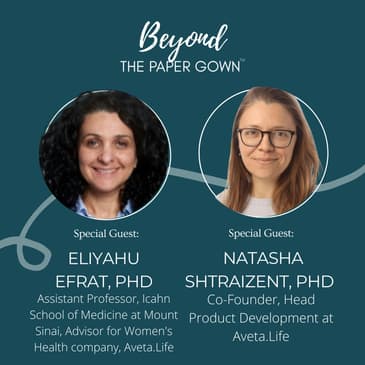

Join us while Mitzi Krockover, MD, leads a discussion with Eliyahu Efrat, PhD, Assistant Professor, Icahn School of Medicine at Mount Sinai, Advisor for Women's Health company, Aveta.Life, and Natasha Shtraizent, PhD, Co-Founder, Head Product Development at Aveta.Life, on the future of women's health. Together they highlight the pressing need for research surrounding hormone monitoring, from IVF treatment to menopause, and explore the challenges of developing accurate at-home hormone tests.
They discuss their vision of personalized hormone therapy, backed by science and integrated with clinical practice, providing women with more convenience and more appropriate dosing. It’s a peek into the future of hormonal treatment that goes beyond the “one size fits all” approach.
Please visit Beyond the Paper Gown to join our community and to learn more about achieving your optimal health.
[00:00:00] Hi, welcome to Beyond The Paper Gown, where we explore the factors that impact on women's
[00:00:13] self and how we can use that knowledge to be our healthiest self.
[00:00:17] I'm Dr. Mitzi Krockover.
[00:00:20] You know if you've gone through IVF or in vitro fertilization, then you know how rigorous
[00:00:25] and time consuming it can be.
[00:00:28] You probably also know then that hormone monitoring plays a crucial role.
[00:00:33] Today, we're going to talk about the process of hormone monitoring.
[00:00:37] We'll learn how new technology may be able to make the IV process more convenient and
[00:00:42] efficient.
[00:00:43] We'll also talk about the other end of the spectrum menopause, and how such monitoring
[00:00:47] may help us personalize hormone treatment in the future.
[00:00:51] And stay tuned until the end when we discuss the current over-the-counter hormone measurement
[00:00:56] diagnostics and how accurate they are.
[00:00:59] Just a reminder, this podcast is for educational purposes only and should not be taken as
[00:01:04] medical advice.
[00:01:06] Please do speak with your healthcare provider for any specific questions related to
[00:01:10] your personal situation.
[00:01:15] I am very excited about this conversation that we're about to have because it talks
[00:01:29] about hormones and some really interesting new science and innovation.
[00:01:36] We have Dr. Effert Eliyahu, who's an assistant professor of genetics and genomic sciences
[00:01:42] at the Icon Institute in New York.
[00:01:44] She specializes in embryology and reproductive research, and she is an advisor to a Vita
[00:01:52] life, which is a women's health diagnostic company.
[00:01:55] And we're going to welcome later another member of the team of a Vita health, Dr. Natasha
[00:02:01] Streisand, who is a process architect at a Vita life.
[00:02:06] And we'll also find out what a process architect is.
[00:02:09] So if I can call you Effy, Effy, it is great to see you today.
[00:02:14] Thank you.
[00:02:15] Yes.
[00:02:16] Thank you.
[00:02:17] Great.
[00:02:18] First of all, let's talk a little bit about your work and what you focus on.
[00:02:25] So my work is actually focusing on how to improve in general women's health, focusing
[00:02:37] on trying to promote safe and effective hormonal therapy, and also to try to improve the IVF
[00:02:51] and vitro fertilization protocol that is heavily using hormonal therapy.
[00:02:59] Let's take a moment to talk about IVF, so we're all on the same page.
[00:03:03] In IVF, eggs are combined with sperm outside the body in a lab setting.
[00:03:09] This process includes several steps, starting with medications to control a menstrual cycle,
[00:03:15] followed by stimulating the ovaries to produce multiple eggs.
[00:03:19] These eggs are then retrieved, fertilized with sperm, and the resulting embryos are transferred
[00:03:25] back into the uterus, hoping for a successful implantation and pregnancy.
[00:03:31] Hormone monitoring is pivotal in this process.
[00:03:34] Hormones regulate everything from the growth and release of eggs to preparing the uterus
[00:03:38] for embryo implantation.
[00:03:41] In IVF, precise hormone control is critical.
[00:03:45] It helps in effectively stimulating the ovaries to produce viable eggs, ensuring they're retrieved
[00:03:50] at the right time and preparing the uterus to receive the embryo.
[00:03:55] Any imbalance can affect the chances of success which makes hormone monitoring so important
[00:04:01] in this process.
[00:04:03] Dr. Aileahu's work focuses on enhancing the way eggs and embryos are cultured during IVF.
[00:04:10] The goal is to improve the conditions in which these cells develop, aiming to extend their
[00:04:14] viability and increase fertilization success rates, and potentially reduce the need for more
[00:04:20] intense hormonal treatments that are often part and parcel of IVF today.
[00:04:26] Dr. Aileahu's approach is particularly relevant in today's diverse IVF landscape.
[00:04:31] It's no longer just couples struggling with fertility for years who seek IVF.
[00:04:36] The patient base now includes a wider spectrum, older individuals, same-sex couples, and
[00:04:41] single people eager to start families.
[00:04:44] Dr. Aileahu advocates for personalized treatment protocols that cater to the unique needs of
[00:04:49] each of these groups.
[00:04:52] As a scientist, the way that we have in order to try to improve the clinical protocol is
[00:05:03] by first I was trying to improve the culture conditions, for example, in the IVF, in
[00:05:13] order to prolong the life of eggs and embryos in culture, to bring into higher successful
[00:05:23] rate, fertilization rate.
[00:05:25] So there will be no needs of aggressive super-ovalation and aggressive hormonal therapy in order
[00:05:36] to achieve a successful cycle, IVF cycle.
[00:05:43] For those who have not experienced IVF, tell us a little bit about that process and why
[00:05:51] what you're focusing on is so important.
[00:05:55] So I would like to start with explaining why I believe the protocol in the IVF is as
[00:06:06] it is today and why I believe it's need to be addressed.
[00:06:13] So decades ago when the IVF clinic was helping couples that were challenged to get pregnant,
[00:06:26] in most of the cases, couples were trying for several years to get pregnant and when
[00:06:33] they reached the point that they were desperate, they went to the IVF clinic in order to get
[00:06:41] a solution.
[00:06:43] And back then the protocol was just based on the population that was coming to the clinic.
[00:06:53] This protocol was based on hormonal therapy in order to increase the number of outside
[00:07:01] that can actually survive in the in vitro environment to receive embryos.
[00:07:11] These days most of the patients that are coming to the IVF clinic have different challenges
[00:07:18] than what it was years ago.
[00:07:22] There are a lot of patients that they have advanced age, not that it wasn't in the past
[00:07:30] but mainly today's much more one of the most examples of the needs to IVF clinic help.
[00:07:40] And also different couples or same sex couples or just patients that do not have the other partner
[00:07:52] to concede.
[00:07:54] And all of those new patients so-called are going through the same exact protocol.
[00:08:01] It's like one size fits all.
[00:08:04] Yes, and one protocol fits all mainly.
[00:08:08] And of course we know that there are different clinics and different I don't want to say that
[00:08:13] everyone is like that but this is the mainstream phenotype that we are seeing.
[00:08:21] So aside of trying to improve the IVF media and culture and conditions, I thought that
[00:08:30] in order to enable physician to do hormonal monitoring and not just one dose fits all
[00:08:39] in order to reduce the side effect that patients, especially patients that are going through
[00:08:44] IVF is to enable the physicians and the providers to do hormonal monitoring.
[00:08:55] So my second push was to try to see if there is any way to give those patients, not only
[00:09:06] the IVF patient and we can touch later on which population actually can benefit from that
[00:09:13] to be able to monitor the fluctuations and changes in hormones in order to bring better
[00:09:22] efficiency of the treatment that they are going through.
[00:09:26] And also safety.
[00:09:29] And I would also assume convenience because right now they are having to come in every
[00:09:35] few days, get their blood drawn and also an ultrasound.
[00:09:40] And so if I'm understanding you correctly what you're saying is that if you could do this
[00:09:45] at home then that would cut down on the number of visits as well.
[00:09:53] But how would you deal with the need for ultrasound?
[00:09:56] So there's no question about the convenience home test, allowing the individuals to monitor
[00:10:03] their hormone wherever they want if it's in the office or at home and they don't have
[00:10:08] to necessarily rush into the clinic.
[00:10:11] So in most of the clinic, the protocol today you need to come to the clinic for a period
[00:10:19] of time between 7-12 days, almost every day for blood drawing and not always also a vaginal
[00:10:29] ultrasound to validate the size and the amount of follicles in the ovaries.
[00:10:36] In order to better predict when to do the outside retrieval and the other procedure that
[00:10:42] need to be done, the ultrasound is not necessarily done every visit.
[00:10:49] Sometimes they ask because the patient is already there.
[00:10:53] But if we could just reduce the amount of visits in the clinic during every cycle and
[00:11:04] the quality of life of those patients will dramatically improve.
[00:11:10] Let's back up a little bit and just kind of start from the beginning so that everybody,
[00:11:16] our listeners are all on the same page.
[00:11:20] Let's talk about what are the sex hormones that are important in women's health if you
[00:11:26] will.
[00:11:28] Okay, so sex hormones actually have effect on almost every aspect of our body.
[00:11:39] So there are physical traits, there are physiological traits, there are mental health and emotional
[00:11:46] well-being influence.
[00:11:50] And of course, our sexuality function and also about our reproductive health.
[00:12:01] So and also I would like to mention that some hormones have also influence and are involved
[00:12:09] in some of the oncology field like in breast cancer, some tumor are depend on a story,
[00:12:19] hormone and so on.
[00:12:21] So really sex hormone has a very wide effect on our body.
[00:12:32] Unlike an IVF where hormone levels are monitored frequently, in menopause Dr. Eliah who notes
[00:12:37] that hormone replacement therapy or HRT is often a one protocol fits all approach where
[00:12:43] adjustments are made based on symptom relief.
[00:12:46] However, she emphasizes the potential risks and benefits of HRT highlighting that without
[00:12:52] monitoring hormone levels it's challenging to determine the therapies impact on conditions
[00:12:57] like cancer or cardiovascular disease.
[00:13:01] Dr. Eliah who also points out the variability in how individuals process hormones especially
[00:13:06] as they age and how this affects hormone therapy.
[00:13:10] We got into the conclusion that if you are not monitoring the level of hormones during
[00:13:21] time, if you are not monitoring you cannot say for sure if the hormonal therapy is actually
[00:13:29] causing damage or increase the risk for ABC or D if you cannot even correlate it to the
[00:13:37] level of the hormones in the blood.
[00:13:41] And it doesn't matter for me if you are saying okay for taking one year, two years and
[00:13:45] four years because what we see in actually animal model that we perform is study that we
[00:13:50] performed.
[00:13:51] What we can see is that there for example there is a very important enzyme in the liver that
[00:13:57] responsible for the processing and breaking down clearance of the estrogen in the blood.
[00:14:03] But during aging and I want to remind you that when you are starting the menopause or
[00:14:10] where you are deep in menopause, eposmenopause condition, those conditions, those enzyme levels
[00:14:18] is going down.
[00:14:20] So if you are taking today 1 milligram of estrogen or you are taking it in three years deep
[00:14:27] in menopause, the level in your blood will be totally different.
[00:14:35] And then it can switch between helping to damaging and everything can be controlled easier
[00:14:43] if you can just monitoring.
[00:14:45] So answering your question I think even at the beginning, physician are not monitoring
[00:14:53] the hormones because it's not important and that what we are trying to fight.
[00:14:59] You don't know that it's important because you are not measuring each the egg or the chicken.
[00:15:05] Sure.
[00:15:06] But just to be clear, at this point in time even if a clinician was monitoring it, there's
[00:15:14] no guidelines about what to do with respect to those different levels.
[00:15:21] Absolutely and this is how we can get into resolution.
[00:15:25] If we will have the hormonal monitoring at home device to do hormonal drug monitoring,
[00:15:35] the clearance of the drop from the body, the absorption of the blood which is totally
[00:15:41] different from one person to another if we want to personalize hormonal therapy, we
[00:15:48] will, if we will do it, we'll be able to do a wide clinical trials to validate and finally
[00:15:59] to solve those questions where and who should take the hormonal therapy.
[00:16:06] How much should be a have if there is any disposition for a lung disease in that patient, do
[00:16:14] not advise to take hormones or and so on.
[00:16:18] But in order to raise the flag, yes no, we have to have those devices in order to prove
[00:16:29] that monitoring can dramatically change the quality of life of patients.
[00:16:36] You know what you're really highlighting is that we don't have information and it's
[00:16:43] really amazing given that every woman will go through menopause, should they live that
[00:16:49] long and yet we have such little information about it because really research has lagged
[00:16:56] behind.
[00:16:58] So what you're really talking about in a lot of ways is needing to progress that research
[00:17:06] very quickly.
[00:17:08] Yes, and you know one of the efforts that I would say for a vital life was okay.
[00:17:16] You are saying that we need a device in order to actually answer those questions in order
[00:17:21] to create a real time, a clinical studies.
[00:17:25] And for example, you know, I'm sure you know with your background, for progesterone for
[00:17:31] example, used to be tested during pregnancy and it stopped.
[00:17:37] And you're asking physician and I can ask you why do you think it stopped?
[00:17:43] Is it meaningful?
[00:17:45] But we know that progesterone is so important for the support of the embryos in the uterus.
[00:17:52] The embryo can be perfectly fine and still you will go into miscarriages.
[00:18:00] And because of the wall of the uterus that was not supportive enough with progesterone to
[00:18:04] hold the embryo.
[00:18:07] So I'm asking myself why it stopped?
[00:18:10] Because it's not convenient.
[00:18:12] It's impossible to monitor the progesterone during pregnancy, but we strongly believe,
[00:18:18] I strongly believe that bringing back the hormonal monitoring or hormonal testing will
[00:18:29] help us to light the knowledge of what going on.
[00:18:35] And also, the fact that hormones are changing during the day.
[00:18:40] So some physician said it's not important because I will test it in the morning and
[00:18:44] will test it in the evening.
[00:18:45] It will be different.
[00:18:46] What does that mean to me?
[00:18:48] But if you're doing monitoring during time or more frequently only at home, you can
[00:18:56] do it.
[00:18:57] And then you can get the whole picture of what's going on in this particular body.
[00:19:05] Well you alluded to or you actually mentioned Avitra.
[00:19:08] So let's bring on Dr. Natasha Streisand, who is the, as I said, process architect of
[00:19:16] Avitra life to talk about the company a little bit and what you're trying to achieve.
[00:19:22] Natasha is so great to see you.
[00:19:25] So tell us what a process architect is.
[00:19:28] Thank you for having me.
[00:19:31] Process architect is a person who synchronizes efforts of multiple teams.
[00:19:37] So if we were talking about, if he was talking about analyzing patient data and Avitra trying
[00:19:45] to build the device for monitoring, hormonal monitoring, and have a clinical piece where
[00:19:51] the doctors can explain how we can better integrate something that Avitra is developing
[00:19:59] into the healthcare.
[00:20:01] And then of course as a business, business faster where we want to make it affordable and
[00:20:10] profitable at the same time for the company.
[00:20:13] So I'm trying to synchronize all the efforts that all is going to lead to the same result
[00:20:19] where we can produce something that can improve women's health.
[00:20:24] Thank you.
[00:20:27] And so talk a little bit, either one of you about what you are creating and what's the
[00:20:36] hope for the next few years.
[00:20:39] Natasha?
[00:20:40] I can take it.
[00:20:41] Great.
[00:20:42] So I think we talked about lack of misinformation, about lack of knowledge.
[00:20:51] And I want to echo that and say that healthcare providers and technologies or reproductive
[00:20:57] medicine specialists, it is impossible for them to deduce how to optimize treatment
[00:21:05] because they are lacking the tools that are needed.
[00:21:09] And also they don't have the capacity to do this kind of evaluation in real time.
[00:21:16] So we want to, our first goal is to gain knowledge and share knowledge about what are
[00:21:24] the specific variables for each woman that either in the hormonal baseline levels or the
[00:21:35] outcomes of the treatments or the side effects that are long-term side effects in a large
[00:21:42] scale.
[00:21:43] So once we have the knowledge and we have the tool that we're developing, we want to help
[00:21:49] bring this into healthcare practice, help the doctors optimize the timing and the dose
[00:21:56] of treatment, prevent long-term health risks and of course improve, achieve better clinical
[00:22:03] outcomes, better health and better, a whole more balanced women.
[00:22:10] Either they need hormonal treatment or they don't but you want to help them achieve
[00:22:14] both.
[00:22:17] And Fee are you planning to do any large clinical trials with respect to getting some of
[00:22:24] that data that you need in order to help physicians know what to do with this information?
[00:22:31] Absolutely.
[00:22:32] I'm dreaming for that day.
[00:22:36] Literally, I dedicated my career in order to get to the point that we can do the change with
[00:22:45] my scientific break from my education, I could just go and be the head of IVF clinic and make
[00:22:53] a lot of money.
[00:22:54] Other than staying in the academic and doing this change.
[00:22:57] I do want to get into this point of having a and the number of clinical trials that can
[00:23:03] be done are huge.
[00:23:07] Most of them won't be done by us, right?
[00:23:09] Because it will be in any field that hormones take in place but I would like to add one more
[00:23:16] point about and it's actually touching a little life but I think there is a big issue that
[00:23:26] I mean let's do the point that we do not have good diagnostic tests for hormones.
[00:23:31] It's because steroids hormones are a tiny molecule that are in such low concentration
[00:23:42] in the blood in a picogram levels.
[00:23:46] You don't need much of estrogen in order to cause a chaos.
[00:23:53] And we know that tiny level of picogram level of estrogen will do the change.
[00:23:58] And that's also why the reason that there have a lot of severe side effect when you're
[00:24:02] overdosing because they are tiny molecules that do a lot of chaos.
[00:24:11] And so the reason that they are very small and in very low concentration making the diagnostic
[00:24:19] test super challenging.
[00:24:23] Even in the blood role, in the regular labs, the clinical labs it's challenging.
[00:24:30] So to have it in the home device, from fingerprint for example is really challenging or from saliva
[00:24:38] or urine and so on.
[00:24:41] So what I liked at the Vita was to help them and you know, to develop a unique tool,
[00:24:53] new tool for the diagnostic that will enable us to test not only steroids and hormones.
[00:24:59] You know it's also can be applicable for any pharmaceutical drug.
[00:25:03] How nice it will be that the patient can take them and you know their lattice to home
[00:25:10] and see if they are in the toxicity level or not.
[00:25:15] And so what the Vita life is doing and actually my lab is collaborating just to validate their
[00:25:22] you know test, they put together a very healthy brains I want to say that from the field
[00:25:29] of a molecular biology biochemistry chemistry diagnostic and so on in order to put together
[00:25:38] a new molecule that will enable this precise accurate diagnostic test.
[00:25:47] That I strongly believe and hope that they will succeed, that we will succeed all together
[00:25:54] to have this key and to have this option of the diagnostic.
[00:26:03] And because most of the tests also limited with the range, estrogen can go from one
[00:26:09] picogram up to thousands. So having a test that can be very accurate and by the way a lot
[00:26:17] of physicians unfortunately don't even trust the test results that they are setting into
[00:26:21] the lab. And so if indeed a Vita will be able to deliver such a test I will be very happy.
[00:26:33] Any company that will do that, I will be very happy.
[00:26:37] Yes. You know right now there's a number of tests on the market both primarily focused
[00:26:44] on menopause or are you going into menopause or are you fertile and there's saliva test
[00:26:54] there's blood test and there's urine test. So briefly tell me about the state of our diagnostic
[00:27:04] testing or at home diagnostic testing at this point in time.
[00:27:10] Yes, so as I mentioned we have to keep in our mind that home tests in general are not
[00:27:16] so accurate. As the let's say the laboratory test that are offered and also provider usually
[00:27:25] won't trust any home test at an end of the laboratory. So it's true there are a lot
[00:27:31] of different kits and tests that are offered at home. And there is the ovulation predictor
[00:27:40] kit that different companies are selling over the counter for a large levels and so on.
[00:27:51] There is as we mentioned before pregnancy test over the counter pregnancy test that measuring
[00:27:58] mainly the beta HCG hormones and most of them are urine tests. There is also saliva hormonal
[00:28:09] testing, some of them are offering even estrogen and progesterone I know that some company
[00:28:17] are working in order to bring it to the market. Everybody is telling me why do you want
[00:28:23] to do the blood test? Why not go to non-invasive glucose test and I'm so precise, I'm
[00:28:31] saying no with that you cannot go to the saliva test. Simply because for example there's
[00:28:38] a lot of type of food that have stories in them that can really change the sensitivity
[00:28:46] the accuracy of the hormonal level. There are home blood fingerprint blood tests, but
[00:28:58] there are most of it are blood spot test that you are putting one drop of the blood on a paper.
[00:29:04] But for that you need to send it in the mail and waiting for the results and so on.
[00:29:12] The urine hormone tests are more reliable, but from my experience which I try to help a
[00:29:19] lot of friends and different couples to find the right timing for a ovulation and so on.
[00:29:27] There are not reliable too. It's really the first urine no no no actually let's go
[00:29:34] to the second one and how much did you drink? It's weird how come the dialysis now lower during
[00:29:40] the day comparing to the morning and so on. It's really frustrating in order to change
[00:29:46] the clinical protocol we have to measure the hormones in the blood that is the most reliable
[00:29:54] and stable fluid in order to really validate and change the concept in order to do an accurate
[00:30:02] clinical trial that when we will publish the paper it will be reliable. Thank you.
[00:30:09] So before we wrap up what did I not ask you Natasha that you wanted to make sure that our listeners knew?
[00:30:21] Yeah, thank you. I can just quickly maybe describe our
[00:30:27] roadmap to improving women's health and
[00:30:31] say you know what women can expect to hear from us about
[00:30:35] and so in the next year we hope to launch and
[00:30:41] accurate at home after general progesterone test which can be used to collect additional missing data
[00:30:48] point. So we'll probably involve women and
[00:30:53] collect these data points and help us better understand the result of different hormone
[00:30:58] treatment and then with that with this information in the following year we will improve
[00:31:07] AI guided prediction model that will help
[00:31:12] first understand how to optimize treatments. This will be it will have to be done in clinical
[00:31:18] trials so first we understand how and then we tested in clinical trial whether our
[00:31:25] AI guided algorithm will indeed result in improved clinical outcomes. And then final piece
[00:31:32] within three years or so we hope to integrate our technology in healthcare practice
[00:31:38] so that the doctors can recommend using our technology so they can give a better healthcare.
[00:31:47] My guess is that when you do that clinical trial you're going to be
[00:31:52] wanting and recruiting women to participate so hopefully you'll let me know so that we can
[00:32:00] let our audience know as well that this is something that they can do to contribute to the science
[00:32:07] that will help with. That's amazing, we'll be happy to keep you updated and you know touch base.
[00:32:13] So every what is it that you would like to leave our listeners with?
[00:32:18] So my call is we it's hormones are good in a level at a sense as long as there are
[00:32:32] monitored and the right levels and I want everyone to know they have two rights to go
[00:32:38] and to support in the future the personalized therapy for each patient with his own history
[00:32:48] his own genetics. And we are trying even to predict today by your DNA what are the risk for
[00:32:57] how you are going to react to this and that's therapy this and that dose so how come in such a world
[00:33:07] that I'm actually coming from such a simple blood monitoring for drugs and for stories is not there
[00:33:15] so yeah that may wish. That's really profound. Well thank you both for spending time with us
[00:33:23] I learned a lot and also thank you for your work. Thank you for having us. Thank you, thank you for
[00:33:29] having us. My pleasure.
[00:33:37] As we come to the close of today's episode of Beyond the Paper Gown I'd like to take a moment
[00:33:43] to reflect on the rich and insightful conversation we've had with both Dr. Effret Eliahu
[00:33:48] and Dr. Nishasha Streisand. It's clear that the fields of hormone monitoring especially in areas
[00:33:55] like IVF and menopause is on the brink of significant change. And one of the most compelling takeaways
[00:34:01] from today's discussion is the need to move away from the one size fits all approach that has long
[00:34:07] dominated hormone therapy you know it's evident that personalization and treatment is really not just
[00:34:13] a luxury but a necessity. The uniqueness of each individual's hormonal makeup demands a more nuanced
[00:34:20] and tailored approach to treatment. This is particularly critical when we consider the future
[00:34:26] of IVF and menopause management. The potential for at home precise hormone monitoring tools to
[00:34:33] revolutionize these treatments is enormous. Imagine a world where the IV process is less burdensome
[00:34:40] and success rates soar and menopause is managed more effectively all because we have a deeper
[00:34:47] data-driven understanding of each person's hormonal needs. Companies like Avita are working on
[00:34:53] exactly this area and it will be exciting to watch their progress so as we sign off from today's
[00:34:59] episode let's look forward to a future where hormone treatments are as unique as the individuals who
[00:35:04] need them. I thank you for joining me on Beyond the Paper Gown and I invite you to subscribe to
[00:35:10] our newsletter at BeyondThePaperGown.com and follow us on Instagram, LinkedIn, Facebook and
[00:35:16] YouTube. And don't miss out on any episodes by subscribing to our podcast on your favorite platform
[00:35:23] and I have just one request today. Please comment and rate us it helps us get noticed.
[00:35:29] Until next time take good care.
[00:35:38] Our podcast is produced by Patrick Shambhiyati and me and our associate producer is Kyla McMillion.