
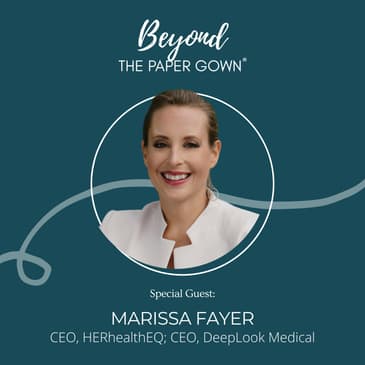

AI is revolutionizing healthcare, and this episode features a compelling conversation with Marissa Fayer, a trailblazer in the field of medical technology. As CEO of Deep Look Medical, CEO of the non-profit HerHealthEQ ,and with over 20 years in the medical device industry, Marissa talks about how artificial intelligence is transforming the way we detect breast cancer and other tumors. She highlights the importance of having diverse representation in medical research, and how medical equipment can save women's lives in places with limited resources. We also learn about Marissa's inspiring journey from aspiring aerospace engineer to leading innovations in women's health, her role in developing 3D mammography, and her passionate work toward global health equity. Join us for an inspiring discussion that bridges technology, healthcare, and women's empowerment. We even touch upon how corporate culture can support the advancement of women's health. Join us to be more informed about AI and women’s health; you’ll also be inspired by Marissa’ s important impact towards making healthcare more accessible and equitable.
Please visit Beyond the Paper Gown to join our community and to learn more about achieving your optimal health.
Podcast Notes:
[00:00:00] If you enjoy podcasts like this, you should check out our other shows on Health Podcast Network. For example, Highway to Health Podcast, hosted by Jeremy Quinby, provides guidance, quality resources and inspiration for anyone seeking wellness in mind, body, and spirit.
[00:00:18] There's an episode that you should check out called The Value of Our Emotions, where Jeremy helps listeners understand the role emotions serve and what we can learn about our present state by staying attuned to them.
[00:00:31] Check out Highway to Health Podcast on your favorite podcast platform or visit healthpodcastnetwork.com. Welcome to Beyond The Paper Gown, I'm Dr. Mitzi Krockover. Now, I created this podcast to share with you stories behind the latest medical breakthroughs,
[00:01:00] the factors that affect your health, and the future of healthcare for women. My goal is to inspire you with the most up-to-date information and insights so you can take charge of your well-being and live your healthiest life.
[00:01:14] Well, I'm sure you've heard a lot about AI in these past months. Of course, I'm speaking about artificial intelligence. AI is affecting so much of our lives, including and increasingly so in medicine and healthcare.
[00:01:29] In today's episode, I have the pleasure of chatting with an amazing woman who is not only a leader in the field of medical technology, but she's also a passionate advocate for women's health and empowerment.
[00:01:42] Marissa Fair is the CEO of Deep Look Medical, a company that uses artificial intelligence to enhance radiological imaging. Marissa is also the CEO and founder of HerHealthEQ, which is a nonprofit organization that provides medical equipment and training aimed at improving healthcare for women in low-resource settings.
[00:02:03] Marissa has over 20 years of experience in the medical device industry, and she's here to tell us how AI is transforming the detection of breast cancer, how diversity and inclusion are essential for medical research and innovation, how medical equipment can save lives and
[00:02:19] create opportunities for women in developing countries, and how corporate culture can support the advancement of women's health. As you can see, we cover a lot of ground. It's a great conversation, and I'm so glad you're here with us.
[00:02:44] It is my pleasure to welcome my good friend and our guest today. Marissa, it is so good to see you. It's so good to see you. You are. Every time I see you, it's like, where's Waldo?
[00:02:57] In terms of all the traveling that you do all over the world, I just want to live vicariously, so that's what I do. It looks far more prestigious than it is most of the time.
[00:03:08] I started taking some pictures of what it really looks like behind the scenes as I'm eating crackers and peanut butter and almond butter, things like that. Running through an airport, everyone's like, it's so glamorous. It is with a six-hour time delay. Sure. Yeah.
[00:03:26] Well, you look wonderful, so you obviously aren't having jet lag right now. That's terrific. There's so much I'm going to want to talk to you about today. First of all, though, let's just talk about your background because you really bring to
[00:03:41] what you're doing both in the nonprofit and for-profit sectors, your skills and expertise. Talk a little bit about that. I'm an engineer by background. I have an engineering degree. I also have an MBA. I merged the technical and the business side together.
[00:04:00] I thought I was going into aerospace engineering quite honestly. And then that's my love and my passion. It was a downturn in the economy when I was graduating and I was recruited into a healthcare company 20 plus years later, here we are, still here.
[00:04:17] Everyone says once you're in healthcare, you never leave. And it's true because you realize that you're improving people's lives. It's always exciting and innovative and there's always new products. There's always new things to do. That's how it happened.
[00:04:33] I was an engineering corporate for 15 years with several different companies, the largest one being Hologic. And I spent nine years there. I developed the 3D mammography system with the team. I handled about nine years. Okay, stay or stop right there. You helped develop the 3D mammography system.
[00:04:49] That is so important. Thank you. So thank you. No, thanks. I actually rolled the first 10 off the production line because I'm manufacturing and operations and that's what we do. So we work- Did you try it out too? I did actually.
[00:05:04] There was very new women back there and had to do some of the imaging. I mean, like I've had hundreds of mammograms just because not on the production floor, thank God, in the test lab. But you know, like they unfortunately back then there weren't that many women.
[00:05:19] So they're like, hi, we need some women. And I was like, what? So yeah, back in the test lab, that's where I was most of the time. Oh my goodness. So thank you for your service. Well thanks, yeah. Thankfully it didn't hurt so bad.
[00:05:32] So yes, I did that. I also did about nine murders and acquisitions and I had the blessing to be able to move out of country for many years. So I lived in Costa Rica for three years in Toronto for a year and did a lot of moving
[00:05:46] around with the company and with some other companies. I was in the Dominican Republic and Mexico and California. So it was just great to have that experience and that led me to starting my own consulting firm and leaving corporate before burnout was a thing.
[00:06:04] And that path took me to consulting and advising a lot of growth companies and really focusing on women's health. I've been in women's health before. It was a topic to talk about and it just was.
[00:06:16] I've been in it for 20 years and so I helped advise women's health companies how to grow because that was my passion. And in the same time, I formed her healthy queue because of some need that I saw
[00:06:27] when I was living in Costa Rica and as a result of actually the launch of the 3D mammography systems. So everything kind of came together or maybe I just saw it come together and kind of connected
[00:06:40] the dots and engineers are here to solve problems and that's what I do. That's what I do on a daily basis. It's what I do as a CEO of two companies. It's what I do as an investor. It's what I do as a philanthropist. That's what we do.
[00:06:51] We solve problems. You know, when I advise companies or I take executive positions, I'm typically there to solve problems. So let's talk about deep look medical and what that company is and how it's different from other companies in that space.
[00:07:09] What we are, we are a software technology company that's developing several different technologies for oncology and radiology. Our first product is FDA cleared across all imaging modalities and across all health conditions, but we've made the decision to go first and foremost and almost double down
[00:07:28] into breast cancer and breast cancer mammography imaging. And the reason why is because it's the largest consistent imaging market in the world and it's the only area where imaging happens on an annual basis. And there's legislation and coverage and insurance coverage for it and things like that.
[00:07:51] And unfortunately, the stats are one in eight women will develop breast cancer. It's actually trending now towards one in seven women and it's trending towards younger and younger women. And so making sure that mammography has the best tools is really important.
[00:08:07] And that's one of the reasons why we decided to go straight into that first and foremost, because once you get the largest and hardest market, the other ones are a little bit easier to follow in. And so what is the software enable mammography to do without it?
[00:08:23] What would happen? Yes. So currently, the way that this is done is the radiologists manually draw a circle and then take the measurements and draw the lesion. It's very manual intensive. They are really true, true only competitors are a mouse that we use on our
[00:08:41] computer or a touchpad and digital calibers. And so that's really the big advantage. It's like everyone got really excited about really high tech and almost forgot about this segment of the market. And we can do it because we're using our patent to technology based on shape recognition.
[00:08:59] So it's like we're reading the math and the pixels, which is exciting. And so for us, that was the most basic of what to do because it's a very manual process and it's right now. Deal precise, our first product is it's a workflow tool.
[00:09:14] It's really helps radiologists save some time, save some effort so they can focus on the hard problems. We're also really applicable in dense tissue and 40 to 45 percent of all women have dense breasts and it's not based on your body composition.
[00:09:33] It's just a genetic factor actually that affects black women, Asian women and Jewish women disproportionately. And when you have dense tissue, not excuse me for interrupting, but also as you were talking about, you know, you're seeing a trend toward younger women
[00:09:49] and younger women tend to have denser breast as well. Yeah. Yeah. Density tends to go away over time just because of again, tissue makeup. And the issue is when you when you're looking through a cloud, can you see what's inside that cloud? You can't.
[00:10:05] And that's what it really dense breast looks like. And, you know, if you're a mass, if there's a mass somewhere in the cloud, how are you supposed to see that? We can see through that because we're looking at different gradients in each individual pixel.
[00:10:21] And so that's how we can draw the outside shape, which is not just a circle, it's literally the outside shape of the mass. It can be moved by radiologists if they want it, if they want to.
[00:10:33] And once you have the outside drawing, you can just have the measurements, which is really important when you're working to see if something's changed over time. And we can go back into previous scans from years because this is a tool
[00:10:47] for radiologists to be able to say, no, everything's OK. It's just, you know, it's just a benign mass. It's going to stay there. It's no big deal. It's in there. Or this has grown. We need to have a secondary screening or you need to have a biopsy.
[00:11:02] And so that's what the technology does. We have also, because we're reading the pixels, we can colorize that and digitize it to make it to show what the inside of the structure looks like. If you, you know, for example, if it's a round cyst,
[00:11:18] it would be consistent density. Cancer grows with a dense core and gets less dense as you go. And so we can colorize that to just show the different shades of density, which is a tool for visualization for the radiologists. We're not decision support, not yet.
[00:11:36] And we hope to be in the future. But for right now, we're just giving them some visual tools to share. And this takes the variability out of it, which is really important. And I assume that you've done tests and evaluations of this technology.
[00:11:55] What are some of the outcomes and does this actually improve diagnosis? Yes. So we're doing those. Well, we're getting ready to publish those studies. So I can't tell you right this minute because unfortunately the people who are publishing them want the first notification to go out,
[00:12:12] which is fair in medical imaging. But what we're seeing is, you know, there's improved rates and accuracy on the lesion segment, which is the outside drawing mark and the measurement. It's a lot more consistent time over time.
[00:12:31] And it doesn't depend on the radiologist and in this time of radiologists being overworked and exhausted. And sometimes it happens remotely. This happens automated, you know, with a click of a button one time. It's the same every time. There's not there's no variable variability, which is really exciting.
[00:12:51] So that's what we're seeing. We're working on some studies right now where we're working to prove we can reduce biopsy rates because shoving a very large needle inside a woman's breast is not comfortable or any other part of their body. So just because we're playing a guessing game
[00:13:08] and unfortunately, 90 percent of all biopsies are not needed. And so I was going to ask that question because sometimes when the technology gets really good, you see lots of things that you're not sure what it is and that sometimes leads to more procedures.
[00:13:26] And it sounds like that's not what you're seeing. You're seeing perhaps the opposite. Yeah. So what we're seeing and hopefully what we will prove in this final result of the study is that we will be able to reduce some of those biopsies,
[00:13:41] those biopsies, which could be really exciting. Listen, even if we reduce it three, four or five percent, that's three or four or five percent of women that don't need a very large gigantic needle being stabbed inside of them. They need to take a core of a tissue.
[00:13:56] You know, so it's not just like getting your flu shot every year. You know, it's quite uncomfortable in the recovery time for many women is very excruciating. And so and so is the anxiety right about not knowing what it is
[00:14:10] and waiting for the results and all of that. Yeah, and what we're waiting for the appointment to get the biopsies. That's the other part. You know, we're hoping in the future that we can continue to prove that,
[00:14:21] you know what, no, we don't see something because a lot of these secondary screens are as a result of not being able to see. So just imagine being like, sure if there's something here, but we're going to send you for another screen.
[00:14:35] So now for the entire two weeks, three weeks, four weeks, one day, whatever, that you're waiting to get your next screen. You're fresh, you know, we're women. We know how this goes. We know generally we have cancer like we're going to die, you know.
[00:14:50] And unfortunately, this happens to all women who have dense breasts. And so imagine every single year not knowing if there's something there. That's for 45 percent of the entire population. That's disastrous. And that's loss of work productivity.
[00:15:05] That's where, you know, loss of, you know, just like your increase in general anxiety or emotional state. We're hoping to just help be one of the tools that helps to reduce that anxiety. Well, and it dawns on me that a lot of times women will be notified.
[00:15:24] You have dense breasts and they'll get that and then going like, and you should follow up. And then sometimes these let's just say that the follow up is usually inconsistent, not everybody follows up, not everybody follows up with the right, you know, technology.
[00:15:40] So are you saying that what you're seeing also is that it's kind of one stop shopping? You're not going to need that second look. That's the hope. That's the hope. Or if there is a potential that something's there, then you know what? Then you're actually getting the screen.
[00:15:56] I mean, listen, I don't think that we're ever going to remove the secondary screen of ultrasound for, you know, for dense breasts. I don't think so. But I think that you, you know, we hope in the future that we can reduce the anxiety
[00:16:10] or maybe there's less women who are called back. I mean, that's the hope. That's the hope in the future. We're not there yet. That's a, you know, we're still at commercial launch in two weeks, you know, T minus two weeks right now.
[00:16:20] So so we're going to get there in the future, but not yet. And so if someone's listening and they want to have this technology added to their mammogram, how would they do that? Or what do you see as the launch in terms of distribution?
[00:16:37] First and foremost, ask your doctor and have your doctor requested. If you're in mammography, you know, we've partnered with Barco, which is the largest monitor of medical and medical imaging. And they are 90 percent of the entire U.S. market as far as mammography.
[00:16:56] And so they're working with their partners to roll this out. So we're commercial launching with breast with them in two weeks. So again, ask your doctor so that they can ask their sales teams. We're going out with other oncology solutions for other areas
[00:17:11] with three of our partners, Tempus, which is a large AI company, Blackford, which is owned by Bayer Healthcare for other oncology solutions and Radical Imaging, which has created a special viewer as well, which is used in a lot of hospitals.
[00:17:26] And so we've partnered with all three of those and launching all at one time. We know because why would I ever do something easy? And you know, you know me, I'll never do another podcast for that. Yeah, for sure.
[00:17:41] It's a, you know, if I'm not to do it all at one time, then what am I doing? But, you know, that's where we're going, because we also want this tool to be applicable and available for for other areas besides breast.
[00:17:54] We're really excited about this with the other oncology solutions. So really what patients can do, ask their doctors, ask their doctors for deep look, ask their doctors, contact us and we can put them together with the right partner.
[00:18:08] And can you tell us a little bit about some of the other areas in oncology that you're looking to launch in? For sure. Lung, liver, prostate, thyroid. These are all areas. And honestly, we're approved across all 35 areas of soft tumor masses.
[00:18:27] But we're looking specifically at lung because there's new legislation around that and a lot of focus for dedicated screening in lung. We're also being used in brain, which is quite exciting to segment the lesions. You know, breast and lung is very specific because there's very big
[00:18:45] focus on legislation around those. Talk a little bit about this because, as you know, I'm very focused on how policy impacts especially women's health. Yes. And so what you're really doing as well is connecting that policy to actual technology being available.
[00:19:04] So talk a little bit about that and why that's so important. Yeah. So there's a lot of legislation around just general breast cancer screening and it's great that it's actually annualized for all patients. 40 and above. And there was news just last week about Canada actually dropping it from 50,
[00:19:22] which is exciting news. There's additional legislation related to dense breast screenings. And so women with dense breasts again, as it affects 45% of the whole population, it's not a niche. It's quite a large population. There's dense breast legislation on the table and right now state by
[00:19:38] state is adopting legislation for reporting and also for coverage. Insurance coverage is also really important when we talk about the legislation because ultrasounds, which are the secondary screen after a mammogram sometimes are not covered by insurance and there needs to be
[00:19:57] universal coverage for breast, dense breast patients that need an ultrasound for the secondary screen. You know, they shouldn't be penalized because that's how their body is made up. And so that's very much, you know, we're not, you know, we're not
[00:20:11] tagging onto that, but it really helps because when you have annualized screenings, it is repeatable and there's a lot of need for it. And that's now also what's happening with lung cancer. Finally, there's legislation on the table and I think that's actually
[00:20:28] just been passed recently that smokers, which is a massive market, need to get annualized screenings. It's the first time in history that this is happening. As a pre-screen, not as a result of something happening and you not
[00:20:44] feeling well or you feel something or, you know, a reason there needs to be more of these annualized screenings. And so that's kind of some of the work that we're, we're tagging onto as a benefit. It's not that we're doing it because of it, but it helps because
[00:21:00] there's a lot of attention. There's a lot of people talking about it. It really helps when your state and hopefully you're the entire countries are following those, those legislations and insurance coverage is happening right after. One of the potential problems with AI is basically being biased
[00:21:27] inadvertently because you can only really do machine learning on things that you've seen and AI the same way. So how did you or did you have to determine differences, whether it be gender or ethnicity or race or any of those variables?
[00:21:48] So we didn't have to because again, it's a, it's pretty fixed code. So we didn't have to in our secondary product, which is a morphology matching database. We do. But what we've done is we've gone to Emory University and
[00:22:04] who has the most diverse and largest data set of mammographies collected from their network and around the United States. And we specifically wrote our study that we want 50% of African American women, black women, 10% of Asian women and the rest
[00:22:23] everybody else so that we made sure we trained the next version of our technology, our next product. It was loaded with images from a diverse set. We actually don't see any patient information, but we know, you know, if it's 50%, one and two are going to be, we're not
[00:22:44] screening out, but we have, we know that we know the mechanisms behind the scenes and we can tell. And so because we've written our study appropriately to include all types of people and we will do this continuously when we load it with lung and we load it with
[00:23:00] thyroid and we load it with all these other things, we will do the same thing. This is our standard protocol and is required per me quite honestly. I won't leave this company unless we have a diverse set of technology.
[00:23:15] And so what we've done is we very specifically have mandated that. But for the first product out, it's actually not necessary because a line of code is a line of code and it doesn't discriminate. So what's the difference between this first product and
[00:23:32] the morphology product that you just referenced? Yeah, so this is the first FDA cleared product, DL precise, which is the one click measurement segmentation and visualization tool to lay on top of that is to say, is a morphology matching is to say, hmm, okay, this is
[00:23:47] what the inside of the tumor looks like or the mass looks like not necessarily tumor. This is what the mass looks like when we have it loaded from a massive library of 60, 600,000 images. Hey, this is, you know, let's make it basic.
[00:24:03] This is an orange cat with white stripes. Here's an orange cat with white stripes in the same place. Here's another orange cat with white stripes in the same place. Here's another cat with orange stripe, you know, an orange cat with white stripes, all of these
[00:24:16] orange cats with white stripes, they all look the same and they're all malignant. They have been tested in biopsied to be cancer. Chances are, so is yours, but you physician make the decision. We're just giving you a visual library to say these are other ones that are known.
[00:24:37] Ground truth, biopsied look the same or it could be the opposite. Hey, you have this round cyst, you know, this is what it looks like. Here are your same matching visuals with the same image. Yep, no problem. Those were all verified to be round cysts or just
[00:24:56] malignant masses. It's a visual tool to show them again visual matching to say here's what is known and is loaded. And then we're going down the pathway of decision support so that we don't have to say we're just, you know, like, you know, listen,
[00:25:13] decision support means we're supporting the decision. We're not making decisions. And I think that's really important when we talk about AI. We still as humans, as patients, we still have a ton of trust in our physicians as we should. They are trained, they have information, but they
[00:25:31] need help. And so let's make their job a little easier. That's what the gift of AI is. That's a, you know, that's the dream, right? Yeah, it is. And so as you're in this area, what do you, you know, again, there's, as you said, there's a
[00:25:47] lot of hype and a lot of hope as well. What do you see in the next five years AI being able to do? And what are some of the challenges or cautions you might want to highlight? So what I think is we're not ready for AI to be
[00:26:04] the sole decision maker. And I don't even think in five years we will be, to be honest. I think we will have a lot more confidence that AI tools have been developed to help radiologists and help just general physicians and oncologists, you know, make decisions.
[00:26:20] It is a tool to help them better decide what to do and to give them more information and to pull from everywhere and be able to have a better patient outcome. That's what I see it as. I think if we're talking about in 20 years,
[00:26:35] that's like a different story because then I think there could be, you know, the insight for making full decisions and relying specifically only on AI. Radiology is the first area that's really adopted AI and potentially machine learning in the entire healthcare area with the exception of
[00:26:54] modernizing and automating, you know, electronic health records and things like that. So the first, you know, medical area has been radiology. I think all the focus on radiology that's happening now will start to spread to the rest of the healthcare area. And that's really my hope.
[00:27:12] That's what I see. The downside is when they're not trained on diverse populations, when they're, you know, we're just going to continue a pattern of how our healthcare system has been developed, you know, up to now. And so the downside is we continue down
[00:27:30] that pathway and we're not including diverse sets, we're not testing it on a global market. We're not testing it for other areas on other people on other genetics. We need to look for the rest of the world as the world gets smaller and also as, you know,
[00:27:44] there's a lot of continuous immigration happening. I mean why is there no testing happening or not as much testing happening, especially in the United States for populations in Latin America? Which is making up more and more of our population, you know, same thing with Asia.
[00:27:59] Like it needs to be tested on everywhere. And so if we do not do that, we're going to be where we are. And that's really the big downside. I don't think that AI tools are going to take over our brains in the next five years.
[00:28:16] I mean, I would hope not because then I'm probably out of a job. But you know, I don't think they're going to take over our brains. I don't think they're going to take over, you know, the brains of our doctors. I think these are tools to make them
[00:28:26] more efficient and hopefully lead them to less burnout and to better outcomes for their patients. I think precision medicine, AI has a massive opportunity to make sure when there is something wrong that, you know, everything is precise to the actual patient, not like a general population.
[00:28:45] That's where the benefit of AI comes in to make it more personal for the patient. We're going to take a break and when we return, we'll talk with Marissa Fair about the organization she founded to bring medical equipment to women in developing countries as well as why we
[00:29:07] need more investment in women's health and more. Hi, Dr. Mitzi Krak over here. It's holiday time and I want to invite you to check out our holiday guide on BeyondThePaperGound.com. We have a number of women's health products designed and produced by innovative entrepreneurs, many with
[00:29:28] special discounts for our BTPG listeners. Also, check out our new Make an Impact page with profiles on nonprofit organizations focused on improving the health of women. You know, donations also make great gifts. Welcome back to my discussion with Marissa Fair, CEO of Deep Look Medical and
[00:29:52] Her Health EQ. Well, let's some change direction just a bit and talk about her health EQ. And you mentioned that you early on did a lot of traveling in Costa Rica and the Dominican Republic and so my guess is that that really opened your eyes to
[00:30:11] a number of things that probably impacted on your founding that. So talk a little bit about that and what her health EQ is. Sure, so her health EQ is a global nonprofit focused really on health equity for women and we make sure that there's
[00:30:27] equity, hence the EQ, through equipment and we want medical equipment to be accessible for the prevention, screening and diagnosis and treatment of non-communicable diseases which specifically the ones that affect women are maternal health, heart disease and cancers specifically for women. The problem is medical equipment is
[00:30:51] expensive but as we know every two years there's a brand new generation of something that comes out and the reason I founded this was back to the original. I developed a 3D, you know I helped develop the 3D mammography system which means the 2D
[00:31:06] system started coming back and trying to get retrofitted or scavenged for parts or sold in a lower cost market. Immediately following that launch I moved down to Costa Rica to integrate a company back into our larger company and women were dying of breast cancer
[00:31:23] in Costa Rica one of the most developed of the developing countries where there is socialized medicine but they were away from the capital and their mammography system broke down ten years before that and I knew against our warehouse wall there was a ton of pieces of equipment
[00:31:39] that were sitting there so I was grateful to be able to facilitate the donation of a mammography system. It's still working ten years later we still get metrics from it so it was kind of the Genesis story of her healthy Q. I didn't form it
[00:31:53] immediately then because I was working in a company, I was you know I was in my 30s, I didn't you know I didn't know what all of that meant and when I left corporate I realized there was something bigger
[00:32:04] than me that I had to do because I started thinking about all this excess equipment every two years in medical device you know in the medical device world there's a new generation that comes out and whether it's because of a marketing change because you change a logo color
[00:32:18] or maybe it's hey this surface gets a little bit more rounded or maybe there's a true massive new generation with new technology that comes out but when we're talking about hard durable pieces of equipment like an ultrasound machine or a mammography or a colpuscope these things have
[00:32:36] a durable life between 10 and 25 years not two so in order to say you know handle the sustainability problem of not throwing all of this in the garbage for no reason when there's people around the world that need it and don't care if there's a scratch on it
[00:32:50] you know to make sure it gets to women and you know I'm in healthcare like I again I can't solve education I can solve healthcare I can work on that and I was blessed to be able to start doing that and to see it with my own eyes
[00:33:08] to visually be in another country living there for three years and seeing it I went through the healthcare system there like I understand how hard it was and I had private health insurance just imagine if you don't and so you know these almost all developing countries
[00:33:24] have universal healthcare or a lot of them are going towards that the problem is you can have universal healthcare if you don't have the equipment to diagnose, screen or treat these problems which if you catch them early there's not over 90 to 95 percent you know life
[00:33:42] expectancy rates like you're going to survive but you got to find it early you got to treat it early and even let's talk about maternal health which is not going in the right direction in this country but it certainly it's been improving everywhere else which is wonderful
[00:34:00] but you're still there's still hundreds of thousands of women who are dying of maternal health issues every single year they're unnecessary most of them so that's what we're working to do is to make sure that the equipment gets to where it needs and we're doing that we're excited
[00:34:24] what countries are you in right now? currently we're in nine different countries two repeats so Costa Rica for obvious reasons as I've worked there we're in Tanzania twice we are in Jamaica we've sent supplies also to the Ukraine and we're in Southeast Asia we're in the US actually
[00:34:50] so yeah we're in a lot of different countries we're doing a massive expansion right now especially with the cervical cancer screening program so this year towards the end of this year and beginning of next year we'll be going into Ghana, into Mexico into Sierra Leone
[00:35:06] a few other countries as well we're looking at Panama as well and a few other Latin American countries yeah so we're doing a really big expansion because there's need and there's equipment available and why not? why not exactly aren't you also in India?
[00:35:26] yeah sorry we are in India yes I just remember being talked about you asked me to list all nine and I sometimes I really just can't I'm lucky that I can't remember it's okay and do you partner diagnosis obviously or screening is step one
[00:35:46] but obviously then you need to have resources in order to treat and follow up so how are you doing that? yeah so we do it a few different ways sometimes we provide the equipment because we're not specific just on screening we sometimes it's dependent on what they need
[00:36:04] sometimes they have screening already but they need a treatment device so we kind of wait and everybody tells us what they need if we are doing screening we make sure that there's a referral network available and in place so that for the cancers that are found
[00:36:20] or for the maternal health issues that are found or the heart disease issues that are found there is somewhere for those physicians to refer their patients to the next level and we work with local we work with all of the local communities that are already there
[00:36:36] the clinics, the other non-profits we partner with other non-profits to be able to do that I'm sure you have dozens if not hundreds of great stories but is there one that stands out for you? yeah I mean every single one as you said every single one is special
[00:36:52] and that's the only reason that I continue to do it when I was in Jamaica it was really wonderful we were there and a woman just gave birth she was one of the first five women to be able to use the ultrasound right before
[00:37:08] to make sure nothing was wrong and to really show her and be able to show her the heartbeat and things like that and the fact of the matter was she was a little bit higher risk but because of the ultrasound
[00:37:22] she was actually able to go home and rest before the baby was born instead of having to stay for three weeks at the hospital because of an ultrasound it's as simple as that it's one of my favorite stories it happened several years ago
[00:37:36] and it's still one of my favorites who doesn't love seeing a beautiful baby and hearing the mother's story so that I loved but it's every single woman who is able to know that either she doesn't have cervical cancer or she had stage zero, stage one lesion
[00:37:56] and immediately they were able to find it immediately when she was there and we had to do the equipment we had or other equipment that was at the clinic previously we want more women to have access
[00:38:08] and that's what we do, we make sure that they have the equipment and their clinicians their clinics, their doctors, their nurses have access to the equipment for them to do their jobs the jobs that they want to do Sure Do you also train the clinicians?
[00:38:24] We do, so we provide the training either locally, there's somebody who do a lot of online manuals, thank God we make sure that's included we also provide service for multiple years so we all know that Wow, maintenance basically Yeah, it's maintenance and again
[00:38:40] we partner with the local organization or we contract directly with the manufacturer and we will make sure if a circuit board breaks you know what, the entire piece of equipment could be down, like that's not helpful we're not moving our trash to somebody else's location, like that's not
[00:38:56] it doesn't make me feel good you know, but that's unfortunately a lot of times what happens and if there's no service and support that's what happens and then they're afraid to use it because they don't want it to break because they want to use it
[00:39:12] so it's a vicious cycle I said to one of our clinics they said, well so like what happens if we we use it up and I said, you know what you use it so much when it's not operable, we'll get you another one please, please use it
[00:39:28] as much as you humanly can because you've done your job you've done exactly what this equipment is meant to do and we want you to use it and we'll make sure that if that's your problem and you're concerned it's fine, we'll make sure that you get another one
[00:39:44] so if someone wants to learn more or get more involved in this how would they do that and foremost go to our website herhealtheq.org reach out to me put it on LinkedIn we are always looking for partners and so in-country partners
[00:40:06] but also corporate partners who want to support our work this you know we fit into the ESG DEI, philanthropy et cetera buckets we do the work, you guys get the credit so that's always exciting you don't need to be in medical devices you need to be in healthcare
[00:40:22] so we always look for people to support our work and we always look for new partners new locations, in-country assistants and great people to be on our advisor or board members join our team so yeah, we're always open terrific so as we're kind of rolling into the end
[00:40:48] what did I not ask you what did you think was important to tell our listeners why we should focus on women's health which is something near and dear to both of us absolutely so you and I talk about this a lot and I think we're very
[00:41:07] lined on how we feel but women's health isn't a niche and it's 51% of the population we disproportionately are affected by so many conditions we're differently affected by similar conditions and there's not enough research there's not enough investment and you know for those
[00:41:29] that are listening that are maybe not involved in an investment in entrepreneurship and all that what I think the message is is that we're missing out we're missing out on innovations, on technologies because as you said even those entrepreneurs are having a hard time getting funding
[00:41:47] and bringing it to market also in a corporate environment you know you don't have to be in women's health but you understand how your health or your partner's health or your mother's health or your friend's health or any of those why it's important
[00:42:03] can you give an example of how someone in a corporation might be able to make a difference internally yeah so make sure that you have equality on women in your teams in your teams, your work groups and making sure again not just white women too
[00:42:21] and you're talking to men and women men and women, yeah men and women need to advocate it's not just women advocating it's men advocating for equality you can't have equality without equity you need to start having women and and it's again not women
[00:42:39] only advocating everybody needs to advocate and so that's the first part whether women and men are equally on your team making sure that there's diverse voices from different areas on your team so that's first and foremost going to your HR team
[00:42:55] and saying you know what I noticed that we don't have coverage for my paternal leave or paternal leave, how about that make it equitable paternal leave is just as important as maternal leave as we know so make that equitable I mean there's little steps join a women's group
[00:43:15] join a conversation about diversity inclusion join a group that wants to talk about equity and equality those are very easy first steps to do, start a conversation nobody's willing to have one, start it there might be two people, there might be 50 it doesn't matter, start the conversation absolutely
[00:43:39] Marissa Fayer, CEO of Deep Look Medical and CEO and founder of HerHealth EQ thank you my friend for coming on today and for your great insights thank you for having me I love Marissa's message as she said she sees problems and looks for solutions she's a great example
[00:44:05] of the numerous scientists entrepreneurs and leaders such as herself who are working to close the gaps in women's health both here in the United States and globally if you want to learn more about Deep Look or HerHealth EQ check out our podcast notes for links to both
[00:44:21] I'd also like to invite you to check out our website at beyondthepapergown.com and subscribe to our newsletter we're adding new sections on health news as well as ways to get involved in the growing number of women's health activities, research and events you can also follow us
[00:44:35] on Facebook, Instagram and YouTube and you can also follow us on Instagram and YouTube and you can subscribe to our podcast on your favorite platform and do rate us it helps us get noticed so that we can bring you even more great discussions thanks for listening
[00:44:53] and take good care our podcast is produced by Patrick Shambayati and myself and our associate producer is Kyla McMillian if you enjoy podcasts like this you should check out our other shows on Health Podcast Network Highway to Health Podcast hosted by Jeremy Quinby provides guidance, quality resources
[00:45:35] and inspiration for anyone seeking wellness in mind, body and spirit there's an episode that you should check out called the value of our emotions where Jeremy helps listeners understand the role emotions serve and what we can learn about our present state by staying attuned to them
[00:45:53] check out Highway to Health Podcast on your favorite podcast platform or visit Health Podcast Network.com