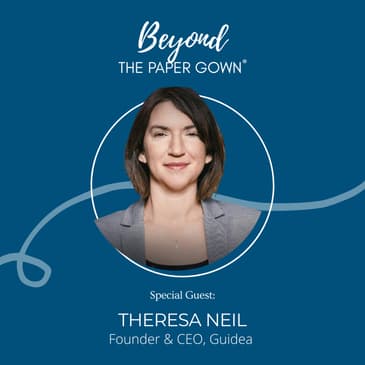

In this episode of Beyond the Paper Gown, Dr. Mitzi Krockover ventures into the world of women's health tech with Theresa Neil, Founder & CEO of Guidea, an award-winning UX design consultancy specializing in healthcare. Theresa, also recognized by Business Insider as a top designer in technology, shares insights on product design, innovation, and the unique challenges in creating technology specifically for women's health needs. Discover how femtech startups are revolutionizing women’s healthcare. You’ll also hear about Femovate, a program Theresa created to support early-stage founders focused on women’s health technology. If you are an early stage entrepreneur in the femtech space, Teresa provides invaluable insight and advice. Listen now for an inside look at the future of health innovation!
Please visit Beyond the Paper Gown to join our community and to learn more about achieving your optimal health.
[00:00:00] If you enjoy podcasts like this, you should check out our other shows on Health Podcasts Network. For example, Hopeful Hits, hosted by Dr. Tara, guides and supports those on the often challenging and isolating journey of women's health concerns and infertility.
[00:00:16] There's a particularly powerful episode that you should check out called All Things Endometriosis, which dives deep into understanding the condition to help the many women who suffer from endometriosis and have no idea they have it, and healthcare providers who are uneducated about it making
[00:00:33] the diagnosis process so difficult. Check out Hopeful Hits on your favorite podcast platform or visit healthpodcastnetwork.com. Hi, welcome to Beyond The Paper Gown, where we explore the challenges in women's health as well as the latest science and innovations.
[00:01:06] Our goal is to empower you with the knowledge you need for your full wellness potential. I'm your host, Dr. Mitzi Krockover. HealthTech has become a part of our everyday life, from period infertility trackers to apps that pair with devices like biometric trackers or even breast pumps.
[00:01:26] We rarely think about how these devices and apps are designed for ease and accessibility, until of course something doesn't work or it's hard to understand. Today, we'll get an inside peek into the world of product design and innovation
[00:01:39] in women's health tech from Teresa Neal, the founder of Gadiah, an award-winning UX design consultancy specializing in healthcare. Teresa has also written three books for the tech publisher O'Reilly and she's recognized as a top designer in technology by Business Insider.
[00:01:58] Teresa will show us how products and technologies are created and launched and discuss the unique challenges and considerations when designing products specifically for women's health needs. She's also the driving force behind FAMOVATE, an initiative that provides support and design services to early-stage FAMTAC startups.
[00:02:18] We'll hear about some of the inspiring companies she's collaborating with and the groundbreaking innovations they're introducing. Teresa's insights will open your eyes to the incredible thought and effort that goes into creating the products and technologies we use every day.
[00:02:34] And just a reminder that this podcast is for your information only and should not be taken as medical advice. I'm really excited to welcome you, Teresa, and also learn about all the great things that you're doing. Thank you so much for having me.
[00:02:58] I'm excited to speak with you. So tell us a little bit about what is product design? Yeah, design is about more than just the aesthetics of a product or the brand on the box or the icon for the app.
[00:03:13] It's really about looking at the opportunity space where people may have challenges or struggles or there's ways to make their lives better with the product. And then we come in and look at the overall customer journey or patient journey or even provider journey if we're designing for physicians.
[00:03:31] And understand what do we need to create for them so that they understand the value of the product that we want them to use? And I would assume you talked about providers. You're really looking at how can you design something that fits into their workflow easily, for example?
[00:03:49] Or if it's a consumer, it's really something that they can easily access and don't have to go a different place or take a different step to get it? Absolutely. So healthcare providers are so busy.
[00:04:03] And we know this because when we go into the doctors, we're like, oh, we have a 30-minute appointment, but we really only get to see them for maybe 15 minutes. Their stretch so thin adding technology to an already busy day is kind of a big ask.
[00:04:17] And we have to make sure that if we're creating a digital product or software for them that it integrates in the tools and processes that they already have, or it's just it's too much of a burden to adopt.
[00:04:29] Now for us as consumers, we might be willing to make a little bit of a change if we're going to get a better outcome. Right? So there's a little more freedom in bringing women's health innovation directly
[00:04:43] to consumers because all of us as women have a bunch of needs that aren't being met by healthcare, traditional healthcare. And so we're willing to put a little bit more time and effort into it and see how we can adopt something into our life versus making sure
[00:04:57] if it's seamlessly into a healthcare provider's existing workflow. Sure. And you mentioned software or technology. And so I just wanted you to kind of talk a little bit about that because, again, I think of products as something that you can hold or use.
[00:05:14] And you're saying that really any kind of innovation, whether it be tangible or virtual, or not I shouldn't say virtual for software, but technological or digital is fair game for product design. I think so. Many years ago, I think when I got started in my career,
[00:05:38] just like 25 years ago, there was a really clear delineation between physical product design and digital product design. But things are converging now. And a lot of times you have a physical product like the LV trainer or the LV breast pump that has a digital component
[00:05:58] that goes with it. And it's not just an add on, right? It's not just like a nice to have. It's actually providing the instructions for how to use the device. It's capturing data from the device. It's the digital experiences coaching us and providing us education,
[00:06:15] tips, sometimes even therapy, digital therapy to get the best out of the device or kit that we've purchased. So I think they've really converged, especially in FemTech. We see a lot of digital and physical combination, and they shouldn't be designed separately.
[00:06:36] We want to make sure that they work really well together and feel cohesive. Sure. And just for those who have not heard the term FemTech, that is pretty much our umbrella term for women's health innovation. And so give an example, if you would,
[00:06:54] about how you approach a product for women or women's health condition that might be different than what you might do for, quote, the general population or even for men. So when we're thinking about designing for women, let's say, let's think about like an app.
[00:07:19] Let's say an app that's going to help someone really understand their cycles and their fertility. When we will conduct user research the same way that we would if we were going to speak to the general population, however, we know that there are specific challenges
[00:07:38] that women face that perhaps not all men or if we're looking at such a broad population, like general population, we may not really be focusing on some of these challenges. So when we start looking at designing for women, we want to be cognizant that many women are fulfilling
[00:07:57] caregiver roles. So they may have a family that they're caregiving for. They may have young kids. They may have older kids. They may be caring for their spouse or partner. They also may be caring for the older generation. And so when we think about that, you'll
[00:08:16] start to realize that when we create, like if we need to design an app to support them, their own women, I don't want to say they, because I'm a woman too, but our own self-care and health takes a backseat to other obligations most of the time.
[00:08:31] And so where a company may want to bring this amazing new innovation to women, we have to recognize that women's time is limited. And there's all these other pressing demands. So how might we design something that a woman will actually have time to use and realize
[00:08:53] the importance and make it a priority to incorporate into her life? Now, that's a great example. With respect to some more of those tangible products that you can hold in your hand or use, have you created anything with the idea that it has to be different in women?
[00:09:19] And I guess what I'm thinking about right now is maybe some tools that physicians use in surgery, for example. Or one of the best designed products I've seen lately are a couple of different speculum that have been used. And we didn't have anything different for decades,
[00:09:44] if not centuries. And so all of a sudden there's these really beautifully designed tools for the doctors to use. Have you had that experience? And if so, what are some of the things that you think about when you're doing that? Women's health is ripe for innovation.
[00:10:05] When we look at these tools, some of them haven't changed in 100 years or in the case of, in some things they haven't changed in 1,000 years. So we're working with a team who is creating a new tool to measure effacement and dilation during labor. So a couple of definitions.
[00:10:29] In the first stage of labor, the cervix prepares for the delivery of the baby in two ways. Ephasement is the stretching and thinning of the cervix. And dilation is the gradual opening of the cervix. Healthcare providers monitor effacement and dilation to assess how labor is progressing.
[00:10:47] And so as far as forever back, as we can remember, exams during labor have involved the provider, the midwife, the birthing attendant, measuring dilation with their hand, which is very intrusive. And some women find it very uncomfortable as well.
[00:11:10] And so this new company, Syconia, has created or is creating a device that will actually accurately measure the effacement and dilation of the cervix with a device. And so it's going to be an accurate measurement and reading every time.
[00:11:29] Because you can imagine if you have different people measuring that there is a difference in people's hand sizes and finger sizes. And that's what's being used for measurement. I believe will be one of the first times we'll have this accurate measurement. So that's one example.
[00:11:46] The other one is for a company out of Canada called Hy-Ivy. The founder of... Are you familiar with Hy-Ivy? OK. Do you want me to talk a little bit about it? Go ahead, of course. So the founder of Rachel has created this amazing new device for pelvic pain.
[00:12:08] And so it's another area. There hasn't been any innovation in 100 years from the original dilator used to treat pelvic pain. And she's created this brand new physical product that has heat associated with the dilator. The dilator can actually change and adjust size.
[00:12:30] And so this means that women who are experiencing pelvic health pain, when they go to their pelvic PT and receive a diagnosis and a therapy, that they'd actually be able to take this new device home with them and use it for their own regimen of pelvic health
[00:12:53] care and hopefully get better results because it's a much nicer product than the old plastic dilators that come in all of these different sizes. And this device paired with the digital app will help women understand what the doctor has prescribed
[00:13:12] as the therapy, how often to do the sessions. It'll offer some breathing techniques to help with the actual therapy because sometimes it's a little painful. And despite the great device, there's still some pain associated with it. And really help women stay on track with that therapy
[00:13:30] and get a better health outcome because it's a better product. So it'll be used more often and they can hopefully complete the therapy to get that better outcome. Did you work with her on that design? We're working on the digital design.
[00:13:46] So for the patient app as well as the provider app, so the physical therapist would be able to set up the therapy, assign it to the patient, and then the patient would be able to do this at home. But we didn't design the physical device itself.
[00:14:02] That's Rachel and her team. Now, do you design physical devices? No, we just work with the industrial engineering teams who do that, but we collaborate with them so that the digital experience works well with the physical experience.
[00:14:18] I've just had a phone call with a team a few minutes ago talking about this and thinking about if you have the physical device and the color green on the device, give a green light, mean something on the device, and you try to have it mean something different
[00:14:32] in the digital interface, that's going to be very confusing to the person who's trying to use it. So we need to work, our team works really closely with the industrial designers on the physical product design while we're in parallel working on the digital product design.
[00:14:49] So that really brings up great information that when you look at a tech-enabled or digitally-enabled device, you have lots of teams working on it and having to inform each other. Absolutely, and this is a big challenge that we see startup founders run into
[00:15:11] if they're coming from the world of technology and they've only done digital, or they're coming from the world of medical devices and they haven't done digital, they've only done physical. It's a different world, but again, we have to pull them together or the overall experience will be suboptimal.
[00:15:31] It could be confusing, it could introduce errors, it could be inefficient, it could just feel clunky. And so bringing all of those teams together and coming up with this holistic, cohesive experience for our customer or for the provider is really key.
[00:15:48] Now, there's a lot that goes on in developing these innovations that I don't know that we all appreciate fully. You have a lot of BioFarma and bigger health companies as your customer, but you also have started this program called FEMOv8 to help those startups.
[00:16:11] Talk a little bit about that. So I've had an idea for almost 20 years and two years ago, I realized, you know what? We've helped a lot of startups launch their companies. And we'd like to think with good design has really helped them be successful in the market.
[00:16:31] And I was thinking, how can we give back to women? And then what if we gave back to FEMTEC founders? So not all FEMTEC founders are women, but quite a few of them are. And so we thought, what if we create a program
[00:16:47] where we support early stage FEMTEC founders? That way we'll be helping women entrepreneurs who are then in turn helping women's health innovation so we can increase women's health equity. So in 30 days we designed and launched this little program. We hadn't even named it FEMOv8 yet.
[00:17:07] It was just our FEMTEC startup program. We did a call for applications to see if there were any teams that would want pro bono design services. We got 100 applications from around the world and we started meeting with each and every one
[00:17:22] of these founders to learn more about their company. And we realized right away, we weren't gonna be able to pick two or three teams which is what we thought we were gonna do. We thought we'd help one or two, three companies maybe put in 50K worth of services.
[00:17:37] And as we met these founders, we were probably like 20 or 25 interviews and we realized women's health is profoundly broken. Profoundly broken. And I mean, just absolutely ripe for innovation and the caliber of applicants we had was really amazing, kind of astonishing.
[00:17:59] And they weren't necessarily getting as much traction as one would have hoped. And so we ended up picking 30 startups to support and expanded our program to be $500,000 worth of services. Total. And we're up to 55 companies in the program now and we've put in $1.5 million in services.
[00:18:25] And what that means is for each of the founders that works with us, we create a bespoke project plan for the design and research services they need. And it varies widely. Some of them need help with their go-to-market strategy. Who are we going to bring this to?
[00:18:43] Are we gonna bring it direct to consumer? Are we gonna take it to payers like human or are we gonna take it direct to providers or is it gonna be a combination? Some of them need research, UX research, right? So go out and be like,
[00:18:57] oh okay, if we are going to have a hormone testing kit that you can buy on the shelf in Walgreens, what are women's expectations for something like that? How do we need to design that experience? And then some of the teams need actual like screen design work,
[00:19:14] user testing, validation, getting their products ready for research trials or clinical trials. Some of them need help farther down in the process where they're prepping everything and getting it ready for regulatory reviews. So like to go through FDA clearance.
[00:19:33] And so we created a bespoke project plan for each company and then we work with them to deliver on what we can within the within, it's like a $25,000 sponsorship per team. And yeah, it's been an absolutely amazing experience that we just didn't know. Speaking of naivety,
[00:19:54] we didn't know what we were getting into when we started but it's really changed the trajectory of Gaidia and really my life, this is absolutely my mission now is to help early stage from tech companies. That's terrific. And do you have any specific stories
[00:20:14] that you can share about the program? So one of my favorite startups, no, I love them all. Of course, they're all your babies. Absolutely. So one of my favorite teams that we're working with is Armor Medical. Kelsey Mayo is one of the founders
[00:20:33] and when we met her in 22, she told us about this invention that they were creating which is a wearable to proactively detect postpartum hemorrhage. I had actually experienced it myself with my second child. So that's a team that we're absolutely really enjoying working with
[00:20:55] and we're so proud of their success. They've won a number, they've been awarded a number of grants through RADX and CDC to bring their products to market. So fantastic team doing fantastic work. And what part of the product did you design with them?
[00:21:15] So we had to work on the monitoring interface that'll be used by the nurses and the anesthesiologist. So it's connected. It basically, a little more detail on that is the device on the woman itself is you can't look at the woman's arm and the wearable
[00:21:35] and be like, oh, what's happening? You actually have to look at a screen. And so ideally the monitoring would be integrated into devices that are already being used in the OR and bedside with the patient. Where are they in the process in terms of time to market?
[00:21:59] I believe that they're looking at 2025 for a commercial product. Terrific. What is your role once the product goes to market and do you also iterate when it goes to pilot before that? So there's lots of iteration in products. Once the first concepts are designed
[00:22:32] so it could be sketches of the physical product, it could be sketches or early prototypes of the digital product, then we wanna take that into what we call validation or testing with our target users. So you had asked early on
[00:22:48] what's the difference between designing for men and women? You know, in this point, if we've created these concepts, we actually want to go test them with women. And we wanna test it with a very diverse group of women. We wanna make sure that we have people
[00:23:06] from all different geographic locations, all different educational backgrounds, all different socioeconomic backgrounds to make sure that this is going to work well for everybody whose hands we're gonna put it into. I would assume that you're also looking at race and ethnicity? Race and ethnicity and also physical abilities.
[00:23:27] We're working with a team who's doing screening for cervical cancer. So to identify the presence of the HPV virus, which can then potentially turn into cervical cancer. So they created these wonderful at home kits so it can just be shipped directly to your home.
[00:23:46] It has a almost, I'm gonna say kind of like a Q-tip. It's got like a swab so you can do your own test, send it back and it'll detect the presence of HPV. Thus eliminating the need to go in for the annual and get that type of screening.
[00:24:05] So we're thinking, oh, this is amazing. This is gonna be a real game changer for women who may not have access to transportation or be able to take a couple hours off of work and go in for that appointment.
[00:24:20] And once we were looking at how do we deliver the results of this test, we were talking about, oh, it's gonna be delivered on a digital device. That's where you'll get the results, right? So on your mobile phone.
[00:24:36] And when we did the testing for other kits like this we spoke to a bunch of women of all different abilities and we spoke to a woman with cerebral palsy and she explained that she'd easily be able to use the kit
[00:24:54] but she's not able to use a phone to access her results. She can't use a mobile phone to access it because of the dexterity needed to navigate an app on a phone. And so she would really like the option to be able to call to get her results
[00:25:12] or to have the results mailed to her. And it was this huge light bulb moment for me because I've been designing software for 20 years. Why wouldn't we have the results in an app? And the reason why is because that's not inclusive.
[00:25:25] We need to make sure that we still offer paper-based results that we offer a way to dial in and get results. And then we don't limit things to only delivering the information over an app because some people don't, they may have a phone
[00:25:40] but they don't have a great data plan or they have a phone but they don't have a lot of storage so they can't download an app for a one-time use like checking on results. So that's a great example. So as you know, the FemTech market is growing.
[00:25:58] Thank goodness. And is I think expected to reach maybe $1 trillion by 2027 is one estimate. And you're right there. You're seeing the companies that will be starting to sell their products, if you will, in 2027. What other innovations or trends do you see happening in that time span?
[00:26:26] I'm so glad you asked. We're seeing a lot of innovation in this space for early screening. So not just screening for HPV but early screening for endometriosis or PCOS. So endometriosis has historically taken eight to 10 years on average to diagnose. Imagine being able to order a kit
[00:26:54] and have an answer in a couple of weeks. So early screening I think is gonna be huge. Collaborative care. So imagine you think you have PCOS or endometriosis or uterine fibroids and you seek out a solution that you have shipped
[00:27:15] to your house or a screening, let's say a screening product that you have shipped to your house. You start logging your symptoms, you capture this information. Well now we've gotta take it into our physician and talk with them about it.
[00:27:28] So I think we're gonna see a lot more of this collaborative care of women bringing in information. And they're like, hey, I've meticulously tracked all of my symptoms for the past two to three months. I have a series of very specific questions and concerns.
[00:27:44] Oh, and I also have these kits with this information that has been brought back specific to my body. Can we have a conversation on this? And I think that's gonna change the way we speak with our physicians about perimenopause and menopause and potentially using hormone replacement therapy
[00:28:05] or birth control. I think it's going to speed up diagnosis of some of these conditions that just take so long for women to get help with. I think it's going to also reduce unnecessary testing where we're trying to figure out, well, what is happening with our bodies?
[00:28:25] Because these products, these apps, these kits are going to start giving us more information so we can have really good collaborative conversations with our providers. Just amazing, right? One of the things I get a little bit concerned about is that a lot of these kits right now
[00:28:46] are not covered by insurance and they're out of pocket so it really does limit the amount of people that can access it. What has been the approach with some of the startups that you're working with or other companies in this space? I also have concerns about that.
[00:29:08] I think in order to really reach women who are economically disadvantaged or just don't have the extra income at the moment to do this investigative testing through these kits, I think things are going to have to change in regards to what payers will include
[00:29:32] in preventative care and also probably a legislative changes are going to be needed. For example, dense breast tissue impacts 40% of women. I don't know if you've personally experienced this but I have and that means I go for a mammogram and they say, yeah we did your mammogram
[00:29:56] but you have a dense breast tissue therefore you need to go for an ultrasound but it's not covered. You'll have to pay for it out of pocket and so I always go and have that but why isn't that covered? And so I had the opportunity to speak
[00:30:10] with a lobbyist the other day and they're like, we're working on it. And we really- There's legislation that's been introduced so hopefully. We really need that legislation in place. Do you ever consider part of the product design
[00:30:26] also figuring out how to get it paid for in some ways or make it enticing if you will to insurance companies or to providers who are getting what we call value-based care payments that their outcomes are better? Yes, that's absolutely part of design
[00:30:49] and it's in the upfront go to market strategy of who are we going to market this to? What is the value? How do we articulate that value and how do we prove and provide evidence that the solution we're proposing is actually gonna deliver on that value.
[00:31:08] And so looking to see are we gonna go direct to providers or are we gonna go direct to payers or are we gonna go direct to consumers? And each of those paths has its pros and cons. It's very challenging for an early stage startup
[00:31:23] to do a direct to consumer play. You need millions of dollars in marketing budget to get in front of all the women who may be good customers for your product. But it's equally challenging going to payers because they are being approached by tons and tons of companies.
[00:31:42] They don't necessarily know which product or solution is going to really improve their member population's health. And then going direct to providers is tricky because like I mentioned, many of our healthcare providers are stretched really thin. And so asking them to take on another technology
[00:32:04] or another product when they're already overburdened is really tricky. What's next for Femmavate? Well, we are in the thick of it right now. We've just wrapped up 39 projects as of last week. And I say wrapped up meaning for software.
[00:32:27] That means that we have gotten to a good point in which products may go into development or they may go into clinical trials or maybe they're live in the app store now, but there's gonna be many more iterations until we get them optimized and refined.
[00:32:42] But we're looking ahead to this fall and seeing about how we're gonna run our program. Are we gonna run it exactly the same and pick 30 new startups or are we gonna start partnering with accelerators and incubators and social impact funds
[00:33:01] to amplify and fuel their initiatives with our services? So that's kind of top of mind for me right now. So if there is a budding entrepreneur or an entrepreneur already working on a product, what would be your advice to them and how might they connect with the program?
[00:33:26] Oh yeah, well anybody can sign up on the Femmavate waitlist. Just go to Femmavate.com. You'll see the wait list, sign up and we'll make sure that you're notified when we do the open call for applications. But for anybody who's thinking about,
[00:33:40] I've really dealt with terrible period pain or I have a great idea for how to solve this. I'd encourage you first to do a lightweight competitive analysis. So go out and take a look at what's already out there to make sure that you're not replicating
[00:33:58] something that already exists. And a little trick that I found for this is actually looking at the Facebook or Meta ad library. So anybody can go and type in Meta ad library and it'll take you to a site where all of the ads are aggregated from Meta.
[00:34:20] LinkedIn also has one, I think all social network sites are required to have one. If you go into the ad library, you can go into keywords and type in whatever your topic is if you're thinking about solving period pain or innovation for menopause,
[00:34:39] you can type in those keywords and it'll bring up all the other companies that are advertising in this space. And you'll start to get an idea of like, ooh, these are complimentary companies. Ooh, these are competitor companies. Oh wait, nothing's going on in this space?
[00:34:53] Maybe there is an opportunity for me to create a product. And so I always recommend that competitive analysis upfront because if you find that your idea is unique, you're gonna wanna lean in and articulate your differentiators or if you find out that your idea isn't unique,
[00:35:12] it's okay, you don't have to abandon it but really have a good idea of what other people are already doing in this space and start thinking about well, how can I differentiate? What could I bring that's different than other companies who are already in this space? Great advice.
[00:35:28] And any advice for consumers as they're trying to also make their decisions with a lot of products out there? Oh, absolutely. So when we're looking at products to use for ourselves, I think it's very important to really stringently read what the package or what the brand is saying
[00:35:51] in terms of clinically validated evidence-based and the value that it's providing to you. So I've noticed that quite a few companies in the health space or in the supplement space speak to clinical validation or evidence-based and they're not actually talking about their specific product.
[00:36:17] They're talking about an element of their product. So I would just encourage everybody to really drill in and make sure that if you're buying a product that is saying it's clinically validated or organic or any of the things that we generally wanna look for in our products,
[00:36:40] that they're actually referring to the product that's being advertised has gone through that validation. It has been tested. It's actually been certified versus just a component of it or something that it's built on. You'll see a lot of like digital health apps that say they're clinically validated
[00:36:58] but they're referring to the fact that they're using cognitive behavior therapy which is clinically validated but that doesn't mean the product itself is clinically validated. So anyway, just drill in a little bit and make sure you have a good understanding of what they're saying.
[00:37:14] Theresa, what did I not ask you that you wanted to make sure our audience learned about today? I think one hot topic for us in the Femtex space as well as me personally as a consumer is around data security and safety.
[00:37:34] So again, when we're looking at different products or apps I think it's really important to understand how our data is gonna be used and really look to see and make sure the brand that we're entrusting our data with is going to be responsible with it
[00:37:54] and they have good data security, HIPAA compliance in place so that any information that we're sharing with them is secure and safe. It could be from cycle tracking to sharing biomarkers through kits even an example is sex toys are in a non-regulated space.
[00:38:24] And so I don't know if you're aware but if you have a connected toy it doesn't actually have security built into it. And so basically your neighbor would be able to access your toys. Whereas if it was in a regulated space then of course it wouldn't,
[00:38:47] it would never be okay and everything would be locked down securely so that nobody else's app could potentially control like say a pacemaker device, right? But sex toys are unregulated so they don't necessarily have the level of security around them that you would expect with other devices
[00:39:05] but just take a look at anything that you're purchasing before you're sending in any of your information, how that company is saying they're going to handle the anonymity of your data. That is so important especially unfortunately in this day and age of all of the different legislative
[00:39:29] challenges that we have with reproductive rights. And it's interesting I was at another conference when we were talking about this and I think it's also really important now that you've brought this up that not all apps have to be HIPAA compliant
[00:39:44] and HIPAA is the Health Information Portability Act that basically says that your healthcare information or your health information has to be private. So some of the wellness apps don't really fall under that and I'm assuming that you're also working with your companies on finding the best ways
[00:40:03] to protect patients or consumers data? We are, that's not our area of specialty but we do bring it up with each of the startups to make sure that they're aware of all of the regulation around HIPAA compliance and it's more than just
[00:40:24] you know, just assuring patients or consumers that their data is secure. You actually have to make sure all the software that you're using for storing that data is secure and you have to have policies in place for what happens if there's a data breach
[00:40:38] and there's just so many different layers to it that again, not everybody knows when they're getting into creating a FemTech startup and so you know, we cover that at a high level and emphasize how important that is and what a huge risk it is to a company
[00:40:55] to not set that up correctly. So that we do pair up startups with companies that are experts in that space and can set up the security for them. Terrific. Well, Teresa Neal, thank you so much for being with us and opening up this area
[00:41:18] so that we can kind of peek behind the curtain and I think hopefully even more fully appreciate all of the work that you and the startups and the entrepreneurs that you're working with are doing to bring these products to market. Thank you so much for having me.
[00:41:37] It was really exciting to share what we're working on. What an insightful conversation. Thank you so much to Teresa Neal. You know, it's so interesting to learn just how much thought and effort goes into creating the products and technologies we use every day,
[00:41:58] especially those focused on women's health needs. During our conversation, Teresa shared valuable tips and insights for both consumers and entrepreneurs. This inspired me to realize that we all have a role to play in improving women's health products. As consumers, we can provide feedback on what works
[00:42:16] and what doesn't through social media comments or taking the time to fill out those company surveys. This crucial input can improve FemTech innovation, ultimately benefiting all of us. Thanks so much for joining me. If you enjoyed this episode, please rate us on your favorite podcast platform
[00:42:35] and while you're there, subscribe so you won't miss any of our future episodes. And to keep up to date with news, events and ways to get involved in women's health, please subscribe to our newsletter at BeyondThePaperGown.com. Take good care.
[00:43:04] Our episode was produced by Patrick Shambayati and myself and our associate producer is Kailah McMillian. If you enjoyed podcasts like this, you should check out our other shows on Health Podcast Network. For example, Hopeful Hints, hosted by Dr. Tara, guides and supports those
[00:43:30] on the often challenging and isolating journey of women's health concerns and infertility. There's a particularly powerful episode that you should check out called All Things Endometriosis, which dives deep into understanding the condition to help the many women who suffer from endometriosis and have no idea they have it
[00:43:49] and healthcare providers who are uneducated about it, making the diagnosis process so difficult. Check out Hopeful Hints on your favorite podcast platform or visit healthpodcastnetwork.com.