
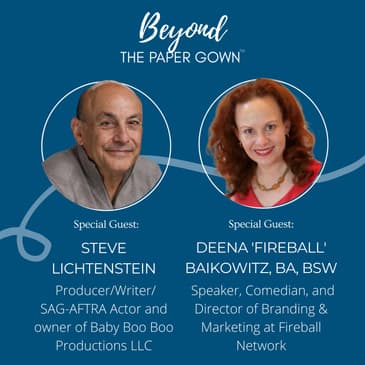

In our latest episode, we bring you a candid conversation with Steve Lichtenstein and Deena Baikowitz, where humor meets heart in a journey through life's transitions. Join us as they open up about their unconventional paths into filmmaking and comedy, sharing hilarious anecdotes and profound insights along the way. Discover how they've turned laughter and storytelling into a powerful tool for advocacy. From practical communication tips on how to communicate effectively with healthcare providers, to the healing power of humor, this episode explores the intersection of health, humor, and humanity, promising laughter, learning, and a fresh perspective on living life to the fullest. Tune in now and let their contagious energy uplift and move you.
Click here to get more of Deena 'Fireball' Baikowitz
Please visit Beyond the Paper Gown to join our community and to learn more about achieving your optimal health.
[00:00:00] Hi, welcome to Beyond The Paper Gown. I'm Dr. Mitzi Krockover. Today's episode is part of our
[00:00:20] candid conversation series where we delve into health and healthcare topics with guests from both
[00:00:26] within and outside the healthcare field. Today we're focusing on the interplay between
[00:00:31] humor, health and the connections that bring vibrancy to our lives as well as the challenges
[00:00:37] and opportunities presented by professional transitions later in life. You know our global
[00:00:42] population is aging over 700 million people are currently over 65 a figure expected to double
[00:00:50] by 2050. At the same time we're in a loneliness epidemic with more than 40% of adults over 65
[00:00:58] feeling isolated. All this points to the importance of making meaningful connections,
[00:01:04] navigating lives transitions including career changes as well as advocating for our health.
[00:01:11] We're also going to talk about the benefits of humor. Laughter reduces stress hormones,
[00:01:15] alleviates pain and even boosts the immune system. And it also helps us connect with others
[00:01:21] and hear messages we might not have been open to. I'm excited today to welcome Steve Lichtenstein,
[00:01:28] an actor and award-winning filmmaker and Dina Bakerwoods, a performer, strategist and advocate for
[00:01:34] women's empowerment. We'll hear how they use storytelling and humor to bridge gaps and strengthen
[00:01:39] individual bonds. They'll also share their personal stories about what it takes to make transitions
[00:01:45] at later stages in life. And we'll get some practical tips on how to advocate for yourself during
[00:01:50] medical appointments. Considering that the average doctor's visit lasts less than 20 minutes,
[00:01:55] it's crucial that we master effective and efficient communication with our healthcare providers.
[00:02:01] And of course we'll also share some healthy laughs throughout.
[00:02:15] This is a real special edition of our podcast. It is what we're calling a candid conversation and we
[00:02:25] have two of the most candid people I know. Steve Lichtenstein is an actor and he's going to tell you
[00:02:32] a little bit more about himself in just a moment. And Dina Bakerwoods is so much and she is,
[00:02:40] she is a performer, she is a strategist and she is a network per-aux-aux-aux-exilants. So with that
[00:02:52] introduction I'm going to actually let them talk a little bit more about themselves. So Steve and Dina,
[00:02:59] thank you so much for being with us. Dina, let's start with you. Can you give us a little bit of
[00:03:04] bio and tell us a little bit about yourself? Well I think you said it best when you said I'm a lot.
[00:03:10] I've been told that before. And there is an expression I love in a good way. There's an
[00:03:17] expression I love it says you'll never be too much for someone who can't get enough of you.
[00:03:23] Right, and I think that applies you know personally in my case as a single woman
[00:03:28] and professionally to all of us. Right, so finding that fit and to your point about healthcare
[00:03:34] and the arts and business those are my three of my main careers. I've had many different career
[00:03:42] iterations and my healthcare background was and is as a social worker I created programs for
[00:03:51] patients and families and healthcare workers around communication, therapeutic, humor therapy
[00:03:59] programs, conferences, and then in the arts both as a performer and as a producer and an arts
[00:04:07] marketer. And in the business world in marketing and branding and business development.
[00:04:13] And through all of it my throughline is people like I my passion for people is what gets me up
[00:04:19] in the morning and as you know in social work we say those who are the most isolated are the
[00:04:25] most at risk. And in business we say your network is your net worth which is still a little crass but
[00:04:32] you know surrounding yourself having social support systems and now with the loneliness epidemic
[00:04:40] helping people connect better is really what I do through comedy, through business,
[00:04:45] through healthcare community and through dating. We'll talk about all of those in just a moment.
[00:04:54] Steve, welcome also tell us a little bit more about you. Thanks for having me. Of course.
[00:05:02] A little more about me. Well there's a lot about me too. I am also a slash but more in the entertainment
[00:05:12] sector as far as a producer, writer, actor. I started filmmaking about five years ago and I produced
[00:05:21] short prior to this called Aaron with two A's and now my new one but it also deals with a lot of
[00:05:28] the things you're talking about with just human connection, health and so forth within the
[00:05:34] environmental crisis in the near future and also technology all that. I have been
[00:05:42] acting. My mother would tell you since I was a kid acting out in some cases before I knew I was
[00:05:51] a creative person but I have been for years theater, film, so many other things. There's a film
[00:06:03] coming up in fidelity that I would love to push because I was very excited to be in it with
[00:06:10] Carabono and Chris Parnell and also Willow Shields but I am multifaceted because I had a prior
[00:06:21] life which was also my day job as a project manager for a number of years. We won't go into that age
[00:06:30] thing but yeah we won't just do that but go ahead. No I love acting, I love the arts, I love
[00:06:40] storytelling and I know we'll get to that but storytelling, I can't even it is who I am
[00:06:49] it's my heartbeat, it's my life, it's saved me several times in my life and you better love it
[00:07:00] if you're going to do this. Okay and that's about it I guess. Okay well let's talk a little bit
[00:07:12] alluded to the film Aaron with two A's which has garnered a number of awards as it's been viewed in
[00:07:22] a number of film festivals and of course I love it and it tells a story about a man who decides to
[00:07:31] pursue his dream of acting at a relatively late age or later stage of life and despite the odds
[00:07:38] of success and the pushback from friends and family what were you hoping to do with this film
[00:07:45] in addition to entertaining? I'm sorry I know I'm laughing at the word entertaining it's it's it is
[00:07:54] entertaining. No no it is but everything you don't set out to necessarily writing a script to
[00:08:03] entertain somebody you you started out with something that comes through you trying to impact
[00:08:11] an audience okay in in a certain way and it it is entertainment but it's also but doing it brings up
[00:08:21] a lot of angst and experience from your own life and so forth so yeah what did I intend I intended
[00:08:29] to impact somebody's life hopefully to change something which is what you're doing as an actor
[00:08:35] as a storyteller is trying to have somebody change or at least be moved in some way by what you do
[00:08:45] and so I it's an experience when you're sitting in a Q&A and somebody stands up in the back and
[00:08:52] is a younger person and they lock eyes with you and they tell you that this changed their life
[00:09:02] this inspired there's nothing like that and if I don't it's sort of like an Oscar winning film
[00:09:12] nobody sets out to make an Oscar winning film because you can't so it's like you tell a story
[00:09:18] and that's what you're trying to do no then it sounds obviously that it was successful in that it
[00:09:25] did impact folks and Dina since I've known you it's been a relatively short period of time but I
[00:09:33] every moment is great um and again you bring laughter to all of your interactions
[00:09:40] and as you've noted before you were a performer have been a performer I've seen you perform
[00:09:47] how do you find that comedy breaks down barriers well comedy definitely connects us it normalizes
[00:09:54] and validates human experience comedy is proven to be stress relief and you know reducing stress helps
[00:10:03] women avoid preventing my risk of heart attacks and heart disease for example we all know mental
[00:10:10] health emotional health um for me comedy originally I only started doing stand-up in 2018
[00:10:17] and it was by accident it was I was leaving a single party you know if anything happens on the
[00:10:25] way from a single party and there's a comedy show going on and I'm leaving with food on each
[00:10:30] arm so wow you know type A accomplishment we have a goal let's go after it but right like as I'm
[00:10:42] saying this to you in a funny way at the heart right we're all emotional beings and what Steve said
[00:10:49] about we want to touch people appropriately um and we want to move them and we want to
[00:10:55] will vote a response whether that responses fear laughter uh action so I can honestly tell you that
[00:11:05] I never really um strategically thought about comedy but it was always a part of my life and my
[00:11:12] background and my family my uh Angelou how was I believe credited with saying people will forget
[00:11:20] what you told them but they won't forget how you make them feel I want to talk a little bit about
[00:11:26] adjacent to that is that using humor to diffuse situations or to maybe talk about things that you
[00:11:34] wouldn't want to talk about otherwise and the program that you alluded to before was that you and I
[00:11:41] enjoy reos who was a um podcaster and also started a company called like a girl media we
[00:11:49] she wanted to build community and talk about a health issue so we talked about hard health
[00:11:56] but we didn't want to do just your same old webinar you did a great job doing a great set
[00:12:03] that was around the issue and um again to make it and to make it even funnier we were all on mute
[00:12:12] so everybody was laughing but she couldn't hear it did it couldn't hear it so she got to know
[00:12:17] and I was also like in the moment the nervousness of the technical things I was not totally technically
[00:12:25] not prepared it's a uni had this wonderful uh foil because you're coming in with the science
[00:12:31] and i'm coming in with the humor and as I said I I will make up jokes I will not make up science
[00:12:38] and and it is that palatable way you know you can catch more flies with honey than with vinegar
[00:12:44] and in the history of the world yelling at someone never got them to do anything the lecturing
[00:12:50] and the anger and the angst and the anxiety and all the things that we are fighting against
[00:12:56] the inequality and the inequity of the systems right let's get serious for a moment
[00:13:01] but when we deliver them with a shot of humor and a funny story and when we touch the emotion
[00:13:08] and we get real about it so it's not me against you it's me and you against the problem
[00:13:15] and I I don't know that i when I started doing comedy or even just growing up I was always funny
[00:13:23] but i didn't analyze it as much now that humor there in so many ways emotionally,
[00:13:28] psychologically and on a practical level truly does help people learn better there's an app in
[00:13:36] fact called endeavor for people with children and adults with ADHD and I was just diagnosed a few
[00:13:43] years ago so i'm playing catch up on all the learning but my first reaction was my first reaction
[00:13:47] was like well that makes sense my second reaction was yay 10 million new friends I get to join
[00:13:53] another club but this I have it in their research and it's brain training and game of
[00:13:59] fighting habits and learning so like neuroscience to me fascinating they found with the women
[00:14:06] adult women and i'm assuming for the most part over 30 40 humor that the feedback they got was
[00:14:14] that the humor was the most attractive thing the most attractive part of the game like that's
[00:14:20] what helped them learn the best and I know that when we're having fun we learn something quicker
[00:14:26] and stronger and better than if it's just we're being lecture two and then once we can break down
[00:14:32] the stigma and we can talk about it in a way that isn't killing our self esteem or like oh my god
[00:14:39] that's shameful shame is a big issue with women in health care and life in general
[00:14:45] that's my long-winded serious way to deliver a punchline that's how you know again we were talking
[00:14:51] about that that's a way to approach serious or sensitive topics but you also have to be sensitive
[00:14:56] in the humor so Steve how do you approach sensitive topics with respect to when you're writing or
[00:15:05] creating something that is gonna again go out to the public i'd love to say that I do
[00:15:14] yeah i also think there's this other side that humor used well can serve people
[00:15:26] humor used in a bad way to put people down or do whatever can also put people off
[00:15:34] um i think that drama although it's drama you're told to find humor in everything
[00:15:44] even if you're doing a drama you need humor it's part of life and so as part of life there's
[00:15:52] a thin line between humor and hate or anger or whatever you want to say it's there's a line
[00:15:59] that butts up against a story told truly honestly you want to make people feel a little on edge
[00:16:07] a little bit thinking in a little insecure but then you come in with a humor of something
[00:16:14] and it changes um kind of to make the point but i don't think you shy away from
[00:16:22] something that is necessarily deep people are gonna know when they go see some film
[00:16:29] they're probably looking at something it's gonna be similar to that um
[00:16:34] it does move is again as long as it brings out emotion and moves people and are remembered for that
[00:16:43] uh you know it could it could do anything it could it could solve issues
[00:16:47] spotlight certainly wasn't humorous per se certainly move people and got some changes made
[00:16:56] as time goes by yeah movie spotlight yeah movie spotlight sorry um and i'm just
[00:17:02] saying there it's i think it's there's a simplicity and a complexity about the whole thing
[00:17:11] we started telling stories in the caveman days in the cave they would draw little things
[00:17:16] every archaeological dig as watching it the documentary other jay goes back to reenact a story
[00:17:23] and to share it with somebody they use humor back then too it's just it's human nature
[00:17:32] to want to laugh it's human nature you know they used humor
[00:17:38] because if you look at the little drawings actually a certain way you can see what are you
[00:17:41] me i can't i can some of it i can't go into so that i can't go into in this podcast but there were
[00:17:49] so there no i just say it's there there are ways to tell what they were trying to say
[00:17:55] i mean i'm not an expert obviously but you're right but your point about you know communicating is
[00:18:01] so important rather than going eye to eye sometimes people seem to be on parallel paths
[00:18:07] but dina you were going to say something what were you wanting to say i like what you said about
[00:18:11] the parallel paths um and i work with words right love words you can get me to stop using words
[00:18:20] you never thought of this humor and human hum what is the root latin greek caveman i'd love
[00:18:29] to look that up and i speak four and a half languages you think i would know this by now um but
[00:18:35] i like as you're talking steven as mitsis you're talking and i'm thinking back i never
[00:18:42] strategically or scientifically analyzed humor we talk about it we see the effects i connect with
[00:18:48] people i mean just going to uh comedy classes is a way to like you get to know a lot about people and
[00:18:55] i i not even jokingly my very first class i did my first open mic and then totally unprepared
[00:19:03] i just did it without knowing really how to stride i mean i talked for five minutes
[00:19:07] everyone got off on stage and revealed something really raw and personal
[00:19:13] whether or not it was funny wasn't even the issue we each had our five minutes
[00:19:17] one man just broke down crying his eyes out so we're all incredibly uncomfortable and then he said oh
[00:19:22] no i'm an actor i wanted to show my range and he's just like don't do that and stand up but you know
[00:19:28] maybe he's an amazing actor but i looked around as like no one's signed an NDA there's no confidential
[00:19:35] agreements we don't even know each other's last names we are getting up on a stage in front of a class
[00:19:42] okay new yorkers we share a lot we're an open people but we were sharing things that like i said
[00:19:47] things that my best friends might not have known at that point and there was a certain amount of trust
[00:19:52] um humor is a delivery mechanism it's a tool there's an expression i like i don't know who said
[00:19:59] it but i use it we're not writing for the laugh we're writing for the truth right what's the
[00:20:05] underlying message and you can deliver it in multiple ways right you know and it's interesting
[00:20:14] what you just talked about because when you were talking about the class obviously it felt safe
[00:20:23] and i have to connect the dots to perhaps like for me obviously that's what i'm thinking about
[00:20:30] is how do we as healthcare professionals or therapists or you know how do we create safe spaces
[00:20:40] so people can tell their story and i look at the healthcare system and right or wrong
[00:20:50] there isn't enough time a lot of times to tell the story so it's frustrating for the physician
[00:20:56] perhaps the physician just wants the you know the fax maim so we can tell you what the answer is
[00:21:03] but yet it's so valuable to hear someone's story in the context of what's important to them
[00:21:11] maybe what their home life is about what it is that they think is wrong you know what is it
[00:21:17] that's most troubling to them we may think it's you know one thing but it might be the fact that
[00:21:24] you know it's not about the pain it's about the fact they can't dance anymore and so
[00:21:28] I just kind of want to throw that out and because i don't have the answer i can't tell people
[00:21:34] that are listening you know have a five minute story in your pocket but i would say to the extent
[00:21:41] that you can interject that or say hey i need to tell you why that's something that i would suggest
[00:21:48] because again giving fax it is going to have some impact the real impact is how you really
[00:21:57] packaged that for that individual steve you want to say something please oh yeah no
[00:22:05] with it uh one of the master classes that i take uh they they bring in people who aren't just
[00:22:12] actors they bring in people who are either teachers or even in the medical field or whatever
[00:22:21] mostly those who give speeches but it's interesting because there's two sides to the story that
[00:22:27] you're just talking about is the medical professional who has to listen to hear
[00:22:34] and the person telling the story and what they're getting across doing something oddly enough
[00:22:41] like an acting class or some kind of thing get somebody attuned to the other people and their
[00:22:46] vulnerabilities and how they talk candidly and so forth and how to listen which can help in
[00:22:53] their profession but the person coming in when they tell a story and i'll give you an example
[00:23:00] someone that we both know and i won't mention the name will have an issue with her physical
[00:23:08] me and sort of like yeah it's not that important so when she goes to the doctor she'll tell say
[00:23:15] something about it but it's in such a way the doctor goes okay it's not a big deal whereas so if
[00:23:20] she came in and said no you have to listen this is really coming out i got it i got to know what
[00:23:26] the answer is that evokes a different emotion from the person on the other side
[00:23:32] so it's really about how you tell it but also the emotion that comes through with it
[00:23:37] you know that's really interesting because women again gross over generalized stereotype but it's
[00:23:46] through i think more often than not is that we just want to minimize things or we're so used to
[00:23:53] perhaps being told you know it's fine or whatever it is we have for anybody who's listen or gets
[00:24:02] our newsletter i hyperlinked a video of Elizabeth Banks who did a great program on heart someone
[00:24:13] having a heart attack for the American Heart Association and in the middle of all this stuff
[00:24:19] you know and she's calling 911 to I'm sorry to bother you but you know and here she is she has
[00:24:24] a life threatening issue and it wasn't so far fetched i mean again i think a lot of us are ourselves
[00:24:31] in her as she's minimizing things and so your point about giving yourself permission to
[00:24:39] be more assertive and to say what's really going on is i think a real a really important point
[00:24:49] do you know want to also go back a little bit because we i don't want to leave the humor piece
[00:24:54] you have used humor in therapeutic settings talk to us a little bit about that
[00:24:58] as a social worker right i've worked in oncology palliative care transplant floor
[00:25:05] all timers was geriatric was my specialty and the the humor there there's a couple of different
[00:25:14] facilities i worked at in the therapeutic setting especially because and in the situations i
[00:25:20] was working in where patients and families are in crisis they're in trauma they may or may not have
[00:25:27] support systems it you know having family and support systems certainly helps but it can also
[00:25:32] exacerbate the problems right when you have family conflict in the drama so being able to bring
[00:25:38] everyone together in a way that isn't conflictual that isn't me against you and release that tension
[00:25:45] and then just you're in a hospital you're recovering from illness you've had an amputation you're
[00:25:50] dealing with dementia your loved one has had a stroke and will not regain the same functions they
[00:25:56] used to this is all incredibly serious stuff just sometimes to get through the day to push yourself
[00:26:04] to do an exercise to normalize what you're gonna have to deal with in a way that isn't constantly
[00:26:10] crying and screaming and grieving um you know even my grandmother's eulogy we had jokes in there
[00:26:20] because it just relieved the tension and she was the kind of woman and this is how they ended it
[00:26:24] but she had a good sense of humor and she was an extrovert also tiny little women and I see
[00:26:29] she would have said what are you all doing here go back to work
[00:26:36] Steve you're nodding as well did you want to add something?
[00:26:40] i hope i'm not saying something offensive i don't mean to it's not that way
[00:26:45] it's just you know acting what you you you pay attention to is other people
[00:26:50] and in some females always feel as if they have to apologize in their voice
[00:26:58] so there's this question mark it's not like a something definite even if you know that black
[00:27:04] is black and white is white it's like black white and it takes so much to overcome that
[00:27:17] and experience what it's like to not do that sure my girls will roll their eyes because when we are
[00:27:27] going out to dinner and they say could i have the salmon? like of course you can have this
[00:27:34] salmon let's talk about i would like the salmon and um you know and it is i they i can see them
[00:27:43] struggle with you know changing that and i'm sure i do the same thing
[00:27:47] and again trying to not trying to but wanting to connect this to
[00:27:53] patient empowerment we don't always think about practicing to go to the doctor
[00:27:58] but i think we should practice to go to the doctor especially when you've got 15 minutes
[00:28:03] and the doctors you know busy and the doctor wants to know what's going on so he or she can
[00:28:08] help you with that issue i think we could all really benefit from saying okay i'm not going to
[00:28:16] apologize just little things i'm not going to apologize i'm going to speak my truth if you will
[00:28:24] i'm going to be as succinct as i can but i'm gonna get out what i need to get out and if i
[00:28:31] can't get it out then perhaps we can make another appointment or i can find a way to to finish up
[00:28:38] the conversation but i i think this is something that we don't talk about enough and that we need to
[00:28:46] and the other piece that you brought up Steve was i think as physicians healthcare providers
[00:28:51] we need to tune in faster you know there's a lot to be said by looking at body language listening to
[00:28:59] different syntax as well as giving that person the safe space and the permission
[00:29:07] to to speak i worked a lot with survivors of domestic violence and sometimes all you needed to say was
[00:29:18] that was really terrible because a lot of times no one says that and just to be able to validate
[00:29:26] someone's experience so again i think there's work that can be done on both um you know in both
[00:29:32] arenas but if you're going to get what you need you do need to come in prepared now dina please
[00:29:42] what were you going to say so mitsy you're coming from the point of view as a practitioner who's
[00:29:48] listening to patient stories and you mentioned that patients need to be able to tell the story
[00:29:53] in a concise way the facts this way scribble bellies notes plus the tone right if i'm like oh
[00:29:59] i have this issue but it's not a problem or i have this issue and it's a problem that's affecting
[00:30:03] my whole life you get a different it can be the same fact with a different tone the delivery
[00:30:09] and then how it's received and as a doctor like i'm not criticizing anyone now we can all use
[00:30:15] that training and here's where i think the business idea comes in and i'm sure AI can come into play
[00:30:20] of helping patients crack those stories with the fact and then the delivery of women not like oh
[00:30:28] i think it's a problem like you know made my name is leesa and we learn this in theater and this
[00:30:35] is something i coach clients and presentations so we're not reinventing the wheel but we're taking
[00:30:40] something that we're already learning in the business world of how did i mean i teach this i've
[00:30:44] learned it i consult on it how to create a presentation whether it's you know your slides your story
[00:30:49] what are the facts the executive summary taking 18 pages and synthesizing it and then how you
[00:30:54] deliver it right and then who's listening what is there will know your audience so for you as a
[00:31:01] clinician who's listening you want your your motivation is to not even jazzo do no harm but to help
[00:31:09] so you want to get that information in in all of those ways and you're like doctors aren't necessarily
[00:31:15] coached or trained in an LP or reading body language and something i've noticed a lot recently
[00:31:22] with just my own doctors and in general they're type type this is me and a doctor's office type
[00:31:27] type type type she's clickety clacky clickety clacky therapist are doing it they're missing all of the
[00:31:32] nuances i had an idea as well but i was more going into workshop in symposiums or something where people
[00:31:41] get together where the doctor gets together with patients and they work these scenarios out and they
[00:31:46] get to play act these things out and i also think it's today's society where we're less
[00:31:53] we don't have the time we don't have what a focus we don't have whatever so it's really like you
[00:31:59] don't really listen and you don't your bedside manner kind of went to the side it's all about the
[00:32:05] data you know right and turn over what's also interesting to me and i've told this story so many times
[00:32:13] but there is a linguist Deborah Tannen and she wrote you just don't understand among other
[00:32:20] books that talks about the difference between the genders and how we communicate she has one
[00:32:27] about business and this one wasn't even about health care but when i read it i had this aha moment
[00:32:33] because she talks about again gross generalization women look for context they need eye contact to be
[00:32:41] heard to your point dina and so when we tell husband john and he's watching the super bowl
[00:32:50] you know i need you to go out afterwards and get these three things and he's still looking at
[00:32:55] the super bowl goes you haven't heard me it goes yeah i heard you you need one two and three
[00:33:01] he did here because he doesn't need that context but she does so what i did is i translated that
[00:33:07] into the doctor's office and so i realized that what exactly what you said dina even though it was
[00:33:15] going to take me longer and whatever as i put down my at the time my my notes and i made sure
[00:33:24] i was looking at my female patient because that i knew was important
[00:33:36] well i want to shift a little bit because not only are you guys great storytellers and performers
[00:33:43] but you also shared that you've had a number of professional transitions
[00:33:49] and i think that that's probably more the norm and i'll include myself as well
[00:33:56] than it is the exception but it does take courage and it does take a willingness to
[00:34:06] you know learn something new so and especially as we get older
[00:34:12] steve talked to that a little bit in terms of your experience
[00:34:17] i think fear is a great motivator too
[00:34:21] okay so what were you afraid of oh god obviously you were more afraid of not doing it than doing it
[00:34:28] so i'm insecure i think somewhere along the way i got some female gene or something
[00:34:35] sorry i'm going to take offense at that i'm going to take accept that steve because that's the old
[00:34:40] school i was going to say it's because you're an actor
[00:34:44] well it either i i didn't mean it in that sense i didn't mean that it wasn't all i mean is
[00:34:51] because i tend to think everybody has certain parts of this whether they acknowledge it or they
[00:34:55] don't it's just that the sensitivity and the understanding that i have is more online with what i'm
[00:35:02] hearing from kinds of those things you're saying then then necessarily where i would identify with
[00:35:10] some football player who you know but there are people too so i can't even say that but
[00:35:16] i'm just i'm just trying to say that's you know i it's okay you can stop digging i want
[00:35:23] sorry i'm trying to save myself i really am okay good guy
[00:35:29] there's a point in this right that like that the more evolved person has a little bit of both right
[00:35:35] yeah no i agree with that i do you know whether it's been kept down in some cases or whether
[00:35:43] it's been told you can't do it from the other end it life certain things have altered it i
[00:35:50] guess for me the the reason i said fear when i was a kid particularly i was a depressed individual
[00:36:00] who probably was somewhat suicidal and you know going in first of all finding that my
[00:36:10] uniqueness in my acting pulled me out and showed me i was something more than just this alone
[00:36:22] person who you know whatever and it's sort of like you're walking around at the age of 28
[00:36:30] New York City and you're doing just odd jobs getting temp jobs and trying to exist and you've never had
[00:36:42] money you've never had a wife you've never had a relationship you've never been with anybody
[00:36:48] and at that point that's where fear came in because i had to do something
[00:36:55] and i happened to get into computers and then project management with that experience and
[00:37:06] i can tell you working in project management the guys i had are computers
[00:37:12] many stories like mine where you didn't intend to do that but you got there to make money or
[00:37:19] to do the work and it was fun it was good it wasn't it wasn't terrible but it was not something you
[00:37:24] loved and i saw other people around me and they just accepted where they were and they really had
[00:37:35] other things but they just made peace with making them hobbies or not doing anything with them
[00:37:43] because they were in the 40s and 50s and scared about what it would affect or not do
[00:37:49] i think i got lucky seriously because i met my wife which gave me opportunities i might not have had
[00:37:58] i don't know but at some point as i was doing more and more work in the 2000s and when i first started
[00:38:07] back with with some small theater i did seven plays in one year and i was a project manager
[00:38:16] and i had to go from Columbia, Maryland to Washington DC which is about an hour and a half or so
[00:38:21] even though it's 20 miles but an hour and a half to get the work i get into eight i'd leave it five
[00:38:28] hop in the car go up the baltomorge is another hour and then i'd rehearse until like
[00:38:35] eleven or whatever midnight wake up again at about four or five and start it all over again
[00:38:40] and i don't know how i did it i can't tell you today i couldn't do that to save my life
[00:38:45] but it would but back then i just loved it and i needed to my spring opened up when i got back into
[00:38:53] it and it's it's that drive it's that passion it's that love of something that there's a love
[00:39:04] hate thing going on but it basically you know that transition taught me a lot and when you do
[00:39:14] finally believe in something in yourself a little things can sprout from that and you start
[00:39:22] discovering in your sixties that all of a sudden hey i can write i can produce i can do some
[00:39:32] other things this is really cool in my life that's great you know and those transitions
[00:39:41] everything about what you do ends up in stories somewhere they're golden nuggets bad or good
[00:39:49] they're gold sure thank you for sharing that dina how about you you really have also gone through
[00:39:58] a number of transitions and i think you're starting to get back into performing and and come
[00:40:03] i mean i'm listening to steve story and there's so many messages and universal human themes and also
[00:40:11] that's your life steve that you're sharing with people there's a lot i relate to as well um i
[00:40:17] did not know what i wanted to be when i grow up you know back then or even now i was like oh
[00:40:22] trying something new i still have that figure right out defying grown up also right again you
[00:40:30] you were like you know maybe getting older but i've never grown up um we're getting any taller
[00:40:36] with your story steve so for me because i was so tight still i mean i was like i was really short
[00:40:41] growing up and i'm still short but growing up i was bullied i was teased i was excluded i was not
[00:40:48] confident um steve is pointing to himself for those who can't see yeah and i mean all everyone
[00:40:55] and agreeing understanding we all think oh no we were the outcast with the freaks the geeks the
[00:41:01] what i mean i wasn't a nerd or a geek because i didn't have those kinds of smarts but i was the creative
[00:41:05] and the artsy partsy and the weird kid um and somebody that will not say who said to me why can't
[00:41:12] you be more more and the person who said it you know that was really rough to hear um but because
[00:41:22] of that for me not knowing where i fit in not fitting in not feeling you know feeling very
[00:41:29] feeling looking acting very different than everyone else i think also humor back then
[00:41:35] it was a way i could connect it was a way i had some confidence and the stage was the one place i
[00:41:40] did truly feel confident and i wanted to go into the arts but i also realized there was no way
[00:41:44] i was gonna make it as a trip tall leaky blonde singer dancer actress it's not like back then um and
[00:41:53] i also liked business and i worked in business and then when i got into social workers because i
[00:41:59] wanted to do something meaningful and that where i felt i could really it was purpose and steve
[00:42:04] that was one of the themes from your story that i kept hearing was our what is our purpose and being
[00:42:09] able to pursue our purpose at any age and midsy to the you know to your point about the theme of this
[00:42:16] how does our work whether it's comedy acting doctor investor business strategist coach uh
[00:42:24] we'll get back to the webinars in the symposiums because i actually did that i was running these training
[00:42:29] programs for healthcare professionals um because i saw a need so it was part of my purpose of like i can
[00:42:35] help them take this really boring litany of all these issues where it sounded like they were lecturing
[00:42:42] the healthcare workers were just trying to help and turned it into here's my story where you
[00:42:46] evoke emotion and then you're like how can we fix this together and when i moved to new york
[00:42:52] marketing Broadway shows that was i landed a job through networking marketing Broadway shows
[00:42:58] and that was a dream come true and i found in new york the way people responded to me
[00:43:04] without any preconceived notion on my past or who i was it was just this is who you are and everyone in
[00:43:08] New York is different and doesn't quite fit in and is from somewhere else and that that was the
[00:43:13] validation and we're all looking for that validation whether it's at the doctor's office
[00:43:19] in our work volunteering collaborating on a podcast we want to you know validate who we are we
[00:43:26] want to look at what can we bring to the world how can we make an impact on each other
[00:43:31] and that helps our mental health and that helps create community and support so to you know
[00:43:39] wrap it all up and bring it together all the different things i've done in my life is still about
[00:43:43] connecting with people i think that what really resonated with me is is the fear of being stagnant
[00:43:52] or not doing it or regretting bigger than the fear of actually taking the risk and
[00:43:59] and something to think about so as we wrap up a couple more questions Steve you have a new project
[00:44:07] so i want to give you a chance to talk about it because you're still going full steam ahead
[00:44:12] you bet i don't know why but i am no because as the film is called it's never too late um exactly
[00:44:22] which is i i said it is about a 70 year old man hey uh in the near future of 2034
[00:44:34] he's 70 years old and suffocating from the environmental crisis and AI technology exploding
[00:44:45] and he has asthma and he suffers from lack of human contact and connection and uh loss of purpose
[00:44:58] and he had his only the poor air quality is so bad outside that now people are having to stay inside
[00:45:06] all the time and so his only real comfort is his AI virtual assistant who he names after his dead
[00:45:13] wife and who fills a certain need until she breaks down and then he has no choice but to connect
[00:45:22] to a help desk and through trials and tribulations that occur between him and the guy in the help desk
[00:45:32] he finds a human connection and he basically finds his purpose of how to go now
[00:45:42] uh before he actually does something to himself uh and then there's the ending
[00:45:50] which is a smile on my face by the way which is a huge huge you're not going to be a no spoiler alert
[00:45:57] twist you're in the midst of developing this do you want to say anything more about that?
[00:46:01] oh yeah i am doing a kickstarter at the moment
[00:46:06] at www.thenevertoolate.com and we have we are over ten thousand dollars right now
[00:46:19] our goal is thirty five so we need money or pledging as we say because if we don't get all of it
[00:46:30] we don't get any of it so this is the next two weeks are crucial and so
[00:46:39] the other thing is going to be happening next week and you're the first to hear it
[00:46:42] although by the time you hear it will probably already have happened
[00:46:47] but basically we're having a challenge and if we get a hundred new backers in the week
[00:46:52] there's another backer who will give five thousand dollars but it has to happen
[00:46:57] what's the drop dead date? the drop dead we're done March 15th
[00:47:03] so hopefully you'll hear this before but at any rate it's something not only deeply personal to me
[00:47:16] but i really have come to believe over time that this is something that's going to
[00:47:22] make people think about things that they're accepting today
[00:47:32] and i know that it's going to be something important it's going to have some impact
[00:47:38] uh do you know how about you what's next for you?
[00:47:42] to Steve's point of it's never too late i want to work with founders i want to work with
[00:47:49] organizations communities and companies in health tech, femme tech and particularly in sex tech
[00:47:57] as you know mental health and wellness, the loneliness epidemic, and sexual health and wellness
[00:48:03] in particular for women over 50 and developing adult friendships for me those are all the themes
[00:48:09] through relationships so yes i offer coaching and consulting and i speak on a lot of stages and
[00:48:16] comedy clubs and running programs and workshops but i want i want a relationship i want
[00:48:22] i want someone to put a ring on it i want someone to put a ring on it i don't know those
[00:48:31] i hate to tell you but most of our listeners, well no no but i mean oh so both so you know me
[00:48:36] it's she's like wait a minute you're talking about your love life or your business like
[00:48:40] i'm like well both but in fact today i'm watching a new mailing list and it says oh you put a ring
[00:48:45] on it you joined my mailing list right i'm in the business and pleasure of relationships
[00:48:52] i want to work with and for this industry i want a role where i can contribute and bring my age
[00:49:00] my experience my humor my business savvy and contribute and collaborate and be part of a cast
[00:49:09] so that is my offer and i asked everybody listening call me
[00:49:19] so before we totally sign off uh Steve anything i didn't ask that you wanted to make sure
[00:49:25] we mentioned to our audience i think i just spared my entire life i don't know
[00:49:32] i guess the only thing i would say that not that we left out but i want to say is
[00:49:37] be remiss if i didn't how uh not only proud but i how much i admire you for for building this
[00:49:45] empire you've built and and dina you know i you're you've done so much to impact people and
[00:49:56] to do the things you're doing it's i'm humbled myself um by all of it and all i can say is
[00:50:06] i think that the one note of why through all of us and it's very interesting is we wanted to make
[00:50:15] a difference and we wanted to impact people and make a difference in our lives and we chose
[00:50:20] things that would do that and i think to me i can't think of a better more honorable
[00:50:30] way to to address it well thank you for your kind words i really appreciate that i'm very
[00:50:39] touched thank you dina what did i forget to ask you oh i think you probably want to stop me from
[00:50:46] talking at a certain point i would end up like i don't tie my own with some grand if you don't
[00:50:53] end with some grand i mean two minutes and you're gonna lot in two minutes um
[00:51:00] you know it takes women longer than two minutes to get warmed up and tell a story
[00:51:08] you know purpose passion people power um just we're all in it together some are more
[00:51:16] together than others you know some are more connected or less connected than others but ultimately
[00:51:21] we have to come together work together and play together so whatever we're doing as hard as it
[00:51:28] may be and as frustrating as the system may be let's have fun while we fight i'll bring
[00:51:37] i'll bring the fun i promise that i add the real fun yeah i just need a man to have fun with
[00:51:48] when i'm done working i'm putting that out to all the women you know what we got a lot of
[00:51:52] Jewish mothers and others mothers out there help a girl out yeah i want to see how many rings
[00:51:58] you get out of this just i love being with lots of people and having lots of relationships but i'd
[00:52:06] like to start with one and on that note i want to thank Steve licked and stunned and dina
[00:52:17] bacoit's so much for being with me and sharing your stories and really uh sharing the humor
[00:52:26] it was wonderful thank you thank you
[00:52:36] as we conclude today's episode i hope this conversation was helpful to you
[00:52:40] and that you have a new perspective on the value of shared experiences the vital role of humor in
[00:52:46] our lives and the collective strength found in our stories we'd love to hear about your personal
[00:52:51] story or what you think about this episode so please comment on our social media or go to our
[00:52:57] website at beyondthepapergown.com and leave a message while you're there subscribe to our newsletter
[00:53:03] for updates on our podcast women's health events and activities and news on women's health topics
[00:53:09] as always thanks for joining me and take good care
[00:53:16] you
[00:53:25] this episode was produced by patrick shambayati and me and our associate producer is khala mcmalion