
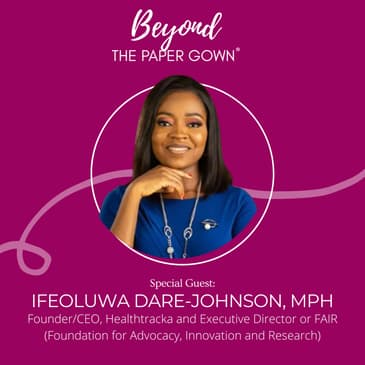

In this episode of Beyond the Paper Gown, Dr. Mitzi Krockover sits down with Ifeoluwa Dare-Johnson, MPH, founder and CEO of Healthtracker, to explore how technology is addressing critical gaps in women’s health, particularly in Africa. Ifeoluwa discusses innovative solutions like the self-sampling “Lemon” STI test, Lola, an AI-driven menstrual health support via What’s App, and the creation of a non-profit focused on advocacy, research, and innovation in women’s healthcare. Tune in to hear how these pioneering efforts are making healthcare more accessible, culturally sensitive, and impactful for women worldwide.
Please visit Beyond the Paper Gown (https://www.beyondthepapergown.com/podcasts) to join our community and to learn more about achieving your optimal health.
SHOW NOTES:
- Mitzi Krockover, Founder and CEO, Woman Centered, LLC and Host of Beyond the Paper Gown
- Ifeoluwa Dare-Johnson, MPH
- Healthtracka
- Lola AI by Healthtracka
[00:00:14] Hi, welcome to Beyond The Paper Gown. I'm your host, Dr. Mitzi Krockover. Today, we're joined by Ife Derry Johnson, a health technology entrepreneur and women's health advocate dedicated to advancing healthcare in Africa, especially in her home in Nigeria. As the founder and CEO of HealthTracker, she's transforming how women access diagnostic services in regions where healthcare infrastructure remains limited, and in a region where cervical cancer is a leading cause of the pandemic.
[00:00:44] And in terms of death for women, she's bringing screening to women who have little access to these critical services. Ife recognizes the specific needs of women in her region and across the continent. Through creativity and technology, she provides impactful solutions. So stay tuned to hear about what lemons have to do with sexual health, and how an AI bot called Lola can be a woman's new BFF when it comes to menstrual problems.
[00:01:25] I'm really excited to have you here, Aoife. Thank you so much for being here. The pleasure is mine. Thank you for having me. And you know, we just met a few months ago, we were in New York for a you at what I'm calling a UN adjacent conference, and I had the absolute honor and delight of sitting next to you, and really felt like I had met a kindred spirit.
[00:01:48] So I really wanted to learn more about what you did, and share that with our audience, and really provide just a really a different perspective than we're usually able to have on the show. So thank you again for for being here. I really, I'm glad that I'm here. Thank you. Of course. Thanks. So tell us a little bit about what HealthTracker is, and how you came about creating it. Yes.
[00:02:17] I always tell the story saying that it was a tragedy that turned into a desire to open that never happens to anyone. And it was that I got the call, one of the days that my dad had slumped. And it was weird because before that he wasn't sick. There was nothing wrong with him.
[00:02:40] At least so we thought until the doctor then told us, oh, he's, you know, based on his numbers, he's had hypertension and diabetes untreated for so long. And he had degenerated into a stroke. So I basically watched this super African dad, who is lively, energetic, full of energy, become a shadow of himself. Right. And basically dependent on, on everyone around him.
[00:03:08] He was, he became a literal shadow of himself and he passed away. Right. That was four years ago. So that was three years ago, actually, November 9th, 2021. And I remember when I got the call that he had passed, um, apart from the grief, I think the painful part of it was, it was, it was avoidable. Hypertension and diabetes is not, it's, it's not a killer disease.
[00:03:36] It's, these are diseases that can be managed, but we didn't know. Um, and I remember that all I kept thinking was, it doesn't make sense. If we had caught it early, you would be alive today. Right. Because obviously it's easy to manage. Um, and again, my, my background is science. I started biochemistry. Uh, but then I pivoted into digital technology and be working in, you know, and driving growth for the digital technology companies on the continent for the past seven years before that.
[00:04:06] Um, and all I kept thinking was, this was such a big problem in Africa. Cause I, you know, my scientist mind, and then my background in technology just didn't, it didn't make it make sense. Right. Um, and I, you know, I think that's a big problem.
[00:04:30] Um, and I think that's a big problem. Right. Um, and I think that's a big problem. Um, so there's obviously a problem here. Um, after going through her own devastating personal loss, if I couldn't help but connect it with what she'd been seeing professionally.
[00:04:59] That's what sparked her to start health tracker to make medical testing and diagnostics available to everyone by using digital tools. She also noticed a growing problem in Nigeria. More and more people were adopting Western lifestyles, but the healthcare system just wasn't equipped to handle all the health issues that came with those changes. Her company stepped in to bridge that gap.
[00:05:23] So L tracker started out, um, as a digital health company, um, that, you know, had applied on our platform users could order basic health checks, um, and get it delivered to them at home. Right. So we were aggregating labs, we were aggregating phlebotomist and sample collectors, and basically mapping them to the closest user order or, um, in terms of lab testing required. So, um, things like full body screenings, you could order on our platform.
[00:05:52] Um, and you would have, um, the closest phlebotomist or sample collector assigned to you to take your samples. And then we had labs who would analyze the samples. We also created a dashboard where you could view your results after. Uh, but not only that, we're also linking to treatment and care. So for each of, for every user who gets a result, a lab test done on our platform, you get a complimentary doctor's consultation to review your results.
[00:06:18] Um, and then, you know, you, you can then, then that linkage to treatment happens. So do you need medications? Do you need a repeat test? Do you need vaccination? Do you need to, uh, be referred to a specialist? So we, we handle that, uh, mentor, but we, we strongly believe that diagnostics needs to be the beginning because if you don't know, then you don't even know what you're treating. Um, and so we did that for the first, um, two years, uh, we delivered over 50,000 tests at home, you know, tens, tens of thousands of users.
[00:06:48] Um, and it was then that we discovered women's health because we, we clearly saw that women were spending more time in poor health than men. Right. And women's health is just being underestimated. For example, less than 8% of Nigerian women have ever been screened for cervical cancer. Um, and it's the leading cause of survival of cancer related deaths on the continent.
[00:07:12] So combine that with low vaccination rates, um, in the country, it, it, it's like women can't catch a break. Um, and then, you know, PCOS, we just saw that women were struggling with PCOS, uterine fibroids, um, breast cancer obviously is the number one cause of death, uh, cause of cancer related deaths in the country. Um, and it honestly feels like women can't catch a break.
[00:07:37] Almost all cervical cancers are caused by human papillomavirus or HPV, which is sexually transmitted. The infection itself is not painful and may not be evident on the cervix until years after introduction of the virus. So the only way most women find out they have it is through screening. Last year, we launched HPV self sampling kits, um, which is a kit where women can screen for cervical cancer from home.
[00:08:04] So we all we need to do is just mail it to your home. You can take your own sample, um, and we can even pick it up from you. So, and those are some of the solutions that, um, we have launched so far. Yeah. We, it's interesting that when, you know, we had the idea that because it's HPV is a, I mean, it's a DNA test, right? So which means that you just need to take the cervical sample.
[00:08:30] There has to be a way where you don't need to come all the way to the facility for anyone to take your sample. One of the reasons people, uh, at least in Nigeria, have on screen. One of course, affordability too is, um, it's just the fear of what if they find something? Then what happens or I'm dead, you know, cause it's cancer. Right. So it's even the fear of the unknown. Yeah. It's nerve wracking. Right. If we're being honest.
[00:09:00] Um, so what we realized that from a psychological point of view, it kind of feels a little bit more empowering. If you're taking it yourself, it doesn't feel as, as, as horrific because I'm just taking something. Right. He's like putting in a tampon. Right. Um, so we found just psychologically from a use products use and point of view, it gave people a lot more, um, space to just be like, Oh, let me try it.
[00:09:30] Maybe isn't that bad. Right. Um, especially cause I mean, we did a pilot in Carduna. Carduna is one of the, is on in the Northern part of, of the country. Um, and it's, you know, we did a pilot in the rural part of Carduna cause we wanted to test that for people who are not educated.
[00:09:48] These were female farmers in the villages, um, who would never have the opportunity to leave their market, to leave, uh, to leave what their farm, leave their children, leave their husbands. They would just want, there's no time. They won't do it. They have their husbands may not even allow anyone to put anything in their wives because they are Muslims and you know, it's against their culture and, and we need you, religion in that sense.
[00:10:14] So we wanted to pilot in and we realized that they were happy to use it. Right. Because now it's like, Oh, okay. I just put it in and that's it. Right. And you know, we spoke to them in their local dialect. Within five minutes, you're done. You're back to what you're doing. So, um, and that was when we knew that, you know what, we have to look at women's health in a more culturally sensitive, more contextual, um, approach.
[00:10:43] Um, so that was solving in a way that people can actually access healthcare in which that just suits them or else we're just going to be doing the same thing over and over again and wonder why there's a different reason. We wonder why, you know, it's not working. The success of their approach really showed that healthcare solutions need to work with local cultures and logistics, not against them. One simply cannot copy and paste Western models and expect success.
[00:11:11] What made health tracker effective was how they built the complete care journey for those women who tested positive. They were referred to treatment centers for those with negative results. They were referred for HPV vaccines. We then shifted to discussing the changing healthcare infrastructure in Nigeria.
[00:11:32] A combination of limited insurance coverage, urban concentration of healthcare facilities, and healthcare worker shortages has created significant barriers to care for many Nigerians, especially those in rural areas. Um, the interesting data is that less than 5% of the population has any form of health insurance at all.
[00:11:55] So which means, you know, people just don't have access to good healthcare, right? Um, and coupled with the fact that, um, affordability of healthcare is a huge challenge. People just can't afford good healthcare. This is just as simple as that. Uh, but what that also means is that most people, again, it's almost like a loop, right?
[00:12:23] It means that most people do not go in to, to anywhere until it becomes a real problem. And at that time, the risk is already increased, right? And, you know, and which is why it feels like the mortality rate can be higher. Um, and that's also why, you know, pharmacies are becoming the primary healthcare centers because at least you can treat, you know, some of the symptoms. So I feel better. I go back to, to my work and then, you know, we live to see another day.
[00:12:59] If you come to Nigeria today and you, you go straight to Lagos and Abuja, um, you would find good healthcare because obviously those are the urban cities, but you just need to take a little bit more, um, in some kilometers away from the centers and then you, you can begin to realize the true state, um, of the country. Right. Um, and that's generally even in Africa.
[00:13:26] Um, so the healthcare infrastructure that exists mostly, um, you know, obviously are dominated by private health sector, right? So which means they have to go where the money is, um, and then they stay in the urban areas. Whereas of course we have the primary healthcare centers by government, you have the secondary, you have the tertiary, which are overrun. And it's, you know, it's basically full to the brim.
[00:13:54] Uh, can't keep up because everybody else is trying to go there because I mean, obviously they can't afford that. We also didn't have, you know, a low doctor to patient ratio, which the last time I checked is getting close to one to 8,000. Um, so that's one doctor to 8,000 patients, um, which has gotten worse, worse and by the fact that most of our doctors are seeking greener pastures, which you can blame them. Um, and trying to leave the country, obviously.
[00:14:22] So, again, which goes back to why the primary, you know, the pharmacies are becoming the first point of cooking because what else are you going to do? Right, exactly. Um, and then right, right now we're depending a lot more on healthcare workers, training people, you know, like anyone who can support, who can help because, you know, we need everybody, you know, right now. We can provide basic healthcare services to people.
[00:14:51] Building on their initial success, HealthTracker continued expanding into other critical areas of women's health that were being overlooked. It was last year as well. We began, we began to see a lot more women. In fact, we did, because of my background in go-to market strategy and all of that, we did some social listening. And I realized that PCOS is such a big deal for women.
[00:15:14] It's, it's, it's insane how much, you know, young people are complaining and, you know, just talking about how difficult PCOS has made their lives. Right. Um, and we looked around and realized there was not, there was, there was no way to even know what you had. Diagnosis was late. Um, if I, people went, it was people talking about their symptoms, like, Oh, I have that too. Oh, maybe you have PCOS.
[00:15:41] Oh, now I have PCOS. I have, that, uh, launched that last year as well. Beyond that as well.
[00:16:07] We also noticed, um, that over 60% of new HIV cases are found in young women in Sub-Saharan Africa. Um, again, it doesn't make any sense, right? Because we thought we had their educated HIV, but apparently not. Um, and why young women? So, again, looking closely to the data, we realized, of course, cultural nuances, uh, distinctness, stigma around young girls, young women. You're going into hospital.
[00:16:36] You can't go in and say, Oh, I need this. That now it means that everybody knows you've had sex, but you're only 20. You're not married. So there is just no, you know, there was still a lot of that cultural, um, uh, complexities in terms of gender, but you know, so the confidence is not there to walk in. And as I'm because, because of the stigma, um, and all of that, and we're going to think about it to say, you know what, we, we are innovators.
[00:17:06] What can we do here? Um, and that was when we used the same model for self sampling, HPV self sampling and said, can we have STI self sampling? Um, and what we did was we called the lemon. Um, so that way, nobody knows. All you need to do is go into the nearest pharmacy to you and ask for a lemon, right? With that path, it would screen for HIV hepatitis B, syphilis, um, chlamydia and gonorrhea. So five tests in one, and we call the lemon.
[00:17:36] Um, and we just wanted a way for you, for it to be cute and you know, just very, yeah. Um, and we, we walked up to the biggest pharmacy chain in the country with over a hundred stores. I'm like, you know what, can we pile up this, roll it out, you know, put buttons everywhere and just say, ask for a lemon. Um, and all, and we began to see that, you know, people were a bit more confident to say, well, I just need a lemon. That's it. Um, and then they know what you're talking about.
[00:18:09] This year, recently we launched Lola. So, I mean, I smile because I really love Lola. So, and he's leveraging AI, um, to drive, uh, access to menstrual health products. Lola is meant to be like your best friend on anything menstrual health. Um, and we built it on WhatsApp, right? It's generative AI on WhatsApp. So that way it feels like a chatting with a friend.
[00:18:35] So Lola is able to talk back at you, you know, very friendly, very chatty. Um, and she's a girl's girl. We designed her to be a girl's best friend. Um, and be able to say, Hey girl, you know, the language, everything to suit in a way that makes you feel like there's somebody listening to me. Um, and obviously also be able to link in case you need to speak to a doctor. We'll be able to provide you some links, you know, and all of that.
[00:19:01] Um, again, just a few months, but we already have thousands of women and on it and they love it as much as we do. So we're hoping that we can scale that, uh, to a lot more women as well, because we just realized, you know what we need to build for women. Wow. That's terrific. Do you charge for it? Right now? We don't. Uh, we're hoping that when we get to critical mass, we'll be able to figure out the monetization plan for it. Sure. Mm-hmm.
[00:19:30] What language is it in? Right now it's in, in English, but again, because it's, of course it's generative AI, we can, it can be multiple languages. So those are some of the features that we're rolling out, uh, in a few. So if anyone that's listening, cause we do have not only from the U S but we do have some international listeners, can, um, women avail themselves of this? Oh, absolutely. It's a WhatsApp link. Um, if they put it in the notes. Exactly.
[00:19:57] If, if you're able to just click on it, it will take you straight to WhatsApp and you begin to chat with Lola. These innovations recognize the cultural context in which women's health needs exist by creating discreet, accessible tools that work within existing behavioral patterns, like using WhatsApp, which has over 95% penetration in Africa. HealthTracker removes multiple barriers to care simultaneously.
[00:20:22] And while technology offers important solutions, if they recognize that broader systemic change requires advocacy and research as well. Well, we realized that a huge part of what needs to be done. It's not just innovation, right? Because if you don't know, you don't even know that you need this because it's like, Oh, I wasn't even aware that this was a problem.
[00:20:45] Um, so we realized we needed to do a lot more advocacy, um, and more awareness and just more literacy about the different topics. Right. So during women's, uh, month, I actually, that was in early March. That was when we decided, you know what, let's create a conference. Um, and we called it banking on women's health. Um, so we had it in May. Um, that was May 6th this year. And what we did was we thought, you know, it was time for us to bank on women's health.
[00:21:15] Um, and I could see clearly how women's health ties to the economic growth of a country, of a nation, right? Um, you know, and the thesis around that was let's bring all the stakeholders to sit down and talk about this. Right. So we put at the conference, the first of its kind, it was an amazing event. I remember that, you know, um, one of the government stakeholders were like, you know, we only focus on the, on the problems that are, you know, talked about enough. We never knew that this was a problem.
[00:21:45] So now that you're talking about it, maybe we need to start to look into that. I'm like, okay, that's why we're having this right. And, and it makes me really proud because the feedback was really good. Even I saw the way people, women were asking questions that I'm like, oh my God, it's, it's not fair. We have suffered for so long. We've been silent for so long, but it just felt like a platform where you could say anything and everybody agrees. Like, yes, that happens to me too. Yes.
[00:22:14] And then the gynecologist on the panel saying, oh, this is a problem. Like, oh my God, I thought this, you know, and not, and it was such a beautiful, beautiful event. Um, and I remember one of the gynecologists, you know, was saying that, oh my God, I'm so sorry that happened to you.
[00:22:32] Because one of, you know, one of the attendees had mentioned that, you know, she had constantly be dismissed by a gynecologist, you know, and she was apologizing on behalf of all the, and like, you know what, we're going to go back to our association and talk about this because this is not right. We should listen to you more. Um, and, and I get it, you know, cause when people, when we think about women's health, especially in Africa, you're thinking maternal health only. You're thinking, oh, you know what? Of course. And I agree. Maternal mortality rate in Africa is high. So it should be priority.
[00:23:02] So it almost feels like the other part of women's health, um, in terms of hormonal, in terms of viral PCOS, anything other than that isn't really prioritized. So when you're coming in with something like menstrual, like, like, come on, PCOS, these are not priorities. So you, they don't get the same attention. Um, and it feels like it was the first time we were actually saying, this is, this is affecting us. We can't work. We can't do anything. Uh, the quality of our life. It means we're not making money. We're missing work. We're not getting promoted at work.
[00:23:32] So this is real. Eve took a three pronged approach of technology, innovation, advocacy, and research, addressing different aspects of the women's health gap in Africa. By leading research on conditions that disproportionately affect African women, her organization aims to create evidence-based solutions tailored to local needs rather than relying solely on research priorities set elsewhere.
[00:23:57] You know, I knew that, you know what, we need to, to create, um, a nonprofit that is focused on advocacy. So we call the FAIR, uh, which is, um, foundation for advocacy, innovation, and research. We, we have to be leading our own research. We cannot wait for the West to research on the problems that affect us. Uterine fibroids, for example, may never be the priority of the West because they just don't have as much.
[00:24:25] It's black women that, you know, that have to deal with this. Right. Um, and our diet is different. You know, we have researchers in different universities. How can we help them accelerate some of the research to get commercialization on time? Can we get regulators on ground? Can we create a center? I want a center where it would be, you know, um, a hub for all the research that is happening on women's health on the continent. And we can have access to it.
[00:24:54] So, I mean, I'm always an advocate of, um, looking at Africa differently. You know, I think even at the New York, um, event, one of the events where I spoke, I mentioned this, um, that the same way that the United States is not defined by the homelessness or the gun violence, at least not alone. And it's still defined as the world's power and, you know, the land of the free and land of the opportunity.
[00:25:20] Um, I would really advocate for people to be in to see Africa as the next frontier. Um, and not just see it as a, the poverty capital of the world, but see that that's not what we're defined by. There is a lot, there is a whole lot of innovation. There's a lot of industrialization that is happening on the continent. Um, that I, I'm, I'm usually just an advocate of people need to look closer and see the gold, um, in Africa.
[00:25:50] Ife Derry Johnson, thank you so much for being with us today and for shining a light on what you're doing and the continent as well. No, the pleasure is all mine. I had a great time. Thank you. Thank you. By combining technology with cultural understanding and advocacy, HealthTracker is transforming women's health outcomes across Nigeria and potentially beyond.
[00:26:18] In fact, these approaches offer valuable lessons for healthcare delivery in underserved communities worldwide. Thank you again to Ife Derry Johnson, founder of HealthTracker, and thank you for being with us today. I invite you to visit our website at beyondthepapergown.com and sign up for our newsletter so you can be up to date on our podcast, news articles, news events, and more.
[00:26:42] And while you're here, please subscribe to Beyond the Paper Gown and take another moment to rate us to let us know how we're doing. And until next time, take good care. Our podcast was produced by Patrick Shambayati and me, and our associate producer is Kyla McMillian.
[00:27:11] Pat Shambayati and Ji you