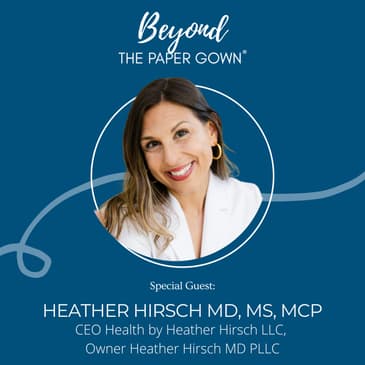

In this insightful podcast, Dr. Mitzi Krockover engages in a comprehensive discussion with Dr. Heather Hirsch, a renowned expert in women's health, focusing on perimenopause and menopause. Dr. Hirsch sheds light on the complexities of these life stages, addressing symptoms such as hot flashes, mood changes, sleep disturbances and more.. The conversation delves into the significance of individualized treatment plans, hormonal and non-hormonal therapy options, and the role of lifestyle choices in promoting well-being during perimenopause and menopause. Dr. Hirsch also introduces her innovative AI technology, designed to provide accessible and personalized information on women's health. This episode serves as an invaluable resource for women navigating the challenges and opportunities of perimenopause and menopause and for anyone who wants to learn more about this phase of a woman’s life.
Please visit Beyond the Paper Gown to join our community and to learn more about achieving your optimal health.
Show Notes:
[00:00:00] If you enjoy podcasts like this, you should check out our other shows on Health Podcasts Network. For example, Hopeful Hits, hosted by Dr. Tara, guides and supports those on the often challenging and isolating journey of women's health concerns and infertility.
[00:00:16] There's a particularly powerful episode that you should check out called All Things Endometriosis, which dives deep into understanding the condition to help the many women who suffer from endometriosis and have no idea they have it, and healthcare providers who are uneducated about it, making
[00:00:33] the diagnosis process so difficult. Check out Hopeful Hits on your favorite podcast platform or visit healthpodcastnetwork.com. Hello and welcome to Beyond The Paper Gown. I'm Dr. Mitzi Krockover. Today, we're discussing a topic that all women will be experiencing at some point.
[00:01:01] In fact, it's something we have in common with Oprah, Gwyneth, and other celebrities who've been open with their experiences, and even those who haven't been open. And that topic is menopause. We're joined by the fantastic Dr. Heather Hirsch, a leading voice in an absolute powerhouse
[00:01:18] in the realm of menopause and women's health. In fact, she's had a conversation with Oprah on just this topic. Together, we'll be talking about menopause and perimenopause, including how to know if you're in that phase of life, and discussing everything from hormonal and
[00:01:33] new non-hormonal therapies to the power of lifestyle choices in managing symptoms. We're also going to talk with Dr. Hirsch about her work with AI technology that can give more women more access to the answers they need.
[00:01:47] And just a reminder, this podcast is for informational purposes only and should not be taken as medical advice. We encourage you to talk to your provider if you have any questions about your individual concerns. Hi. Welcome to Beyond The Paper Gown.
[00:02:13] I'm Dr. Mitzi Krakover, and I couldn't be more thrilled to welcome our guest today. She is a clinician. She is a teacher, an author, a podcast host, and an entrepreneur. And she knows so much about the subject of menopause, which I'm sure has been
[00:02:35] on a lot of our minds, especially lately with the fact that there's been a lot more focus put on it. So I want to welcome Dr. Heather Hirsch today. Hi, Heather. Thanks for being with us. Hello, and thank you so much for having me. My pleasure.
[00:02:55] You know, menopause is finally becoming cool, ironically, right? And there does seem to be a lot of confusion, maybe some denial, and certainly a lack of information out there. So you are considered a menopause specialist. You are a menopause specialist. So a couple of questions.
[00:03:14] Number one, what makes you a menopause specialist? I know that you've had some special training and what do patients come to you for? So many good questions. So what makes me a specialist is I would say off the top of my head, the years
[00:03:32] and the depth and the breadth of experience treating women in midlife. But I'll really take you back a couple of years. I was in my OBGYN residency and realized rather quickly the most fun I had in a day was helping women make difficult decisions
[00:03:51] and not so much doing surgery or delivering babies, although those things are wonderful blessings. So I transitioned to internal medicine from OBGYN. And then I stumbled upon this fellowship at Cleveland Clinic in 2014 called Advanced Women's Health Training.
[00:04:07] And it was there for the very first time in 2014 after a year of OBGYN and three years of internal medicine that I really ever saw a menopause patient, per se. Now, of course, they'd been in front of my eyes the entire time,
[00:04:19] but I never really thought about menopause as the driving factor of symptoms. And my mentor, Dr. Holly Thacker at Cleveland Clinic, really opened my eyes to the fact that the biggest gap in women's health care was really not so much contraception or pregnancy or postpartum.
[00:04:37] But really what happened to women after they had children, if they had children at all? So I did it to your fellowship at Cleveland Clinic in Advanced Women's Health and I was fascinated with midlife and menopausal care. So that includes perimenopause, menopause hormone replacement therapy,
[00:04:55] sexual health, bone health, breast health and everything I learned about hormone replacement therapy at my seemingly top notch residency program was really not what the evidence was showing as I took a deeper dive into some of that research.
[00:05:11] So then I have spent the last 10 years of my career focused and dedicated to trading women in midlife. And it has been an incredible journey. I have seen patients who are 17, 23, with early menopause, premature menopause, surgical menopause,
[00:05:31] women with high risk genetic mutations, unsure if they should or can take hormone replacement therapy, women with natural menopause, your sort of bread and butter menopause. I guess if there is such a thing, sexual dysfunction, learning about sexual health, nothing of which I heard about in residency.
[00:05:47] And really I have come to find that this part of my career is just so satisfying. And I have morphed this over time now from doing academics into telemedicine private practice, but really also becoming an entrepreneur at the same time
[00:06:05] as I'm watching a lot of companies start up talking about midlife and menopause because it's becoming cool again and thinking to myself and knowing intuitively what women are really thinking, asking and looking for. And this is my job, but it's also my passion,
[00:06:23] which is really fun when the two are combined because that means I'm thinking about women's health all day, every day. And I couldn't be more happier to be in this place at this time. Terrific. I certainly resonate with you. You did use the term Perry menopause and menopause.
[00:06:41] So let's start there. What's the difference? If we go by textbook definitions, menopause is 12 months of no period. And women can see their falcule stimulating hormone or FSH level rise above 35 on several occasions. And Perry menopause is when women are still having periods or they're still bleeding,
[00:07:04] but we now know that this period of time, no pun intended, can last anywhere from one to 10 years, although on average about four to seven years and symptoms of menopause, particularly low estrogen, low progesterone, low testosterone can very much start while women are still
[00:07:22] having periods. And what can make this a little bit more confusing is if a woman has had a hysterectomy or she's on continuous birth control pills and doesn't bleed or an intrauterine device and doesn't bleed. But briefly, that's the difference between Perry menopause and menopause.
[00:07:38] You know, it's really interesting. You'd think as a woman's health professional, you know, it would be really obvious to me and I'll use myself as an example. I don't know if you heard this from other patients as well.
[00:07:51] But, you know, I couldn't see the force for the trees. I had just had my second baby at the age of 41. So I literally was attributing most of my challenges from a lack of sleep, hormonal changes from the pregnancy.
[00:08:05] But I was having, you know, anxiety and, you know, sleeplessness and night sweats. And I never ever thought because I'm sitting here with a baby that I could be going into Perry menopause. So and I would assume that there's a lot of other women
[00:08:22] maybe in the same boat who are having their kids at later day, later years that also might be in that same situation. But even without the pregnancy, you know, when you're in the midst of it, that Perry menopause thing that you hear about seems to be somebody else.
[00:08:40] That's somebody else's problem. So how do you approach that? Can I tell you for the record? The same thing has happened to me. I have been experiencing so much more irritability, and it's so easy to think, well, I'm traveling a lot
[00:08:56] and my kids are so young and my house is always a mess. But the other day I was running around with a plastic bag trying to throw out anything that was plastic in my kids, ran to their rooms to kind of keep away their favorite toys.
[00:09:08] And, you know, so even someone who thinks about Perry menopause all the time, it really can creep up on you. In fact, during the pandemic, when I was building a clinic at Brigham and Women's Hospital, women would come to me all the time
[00:09:21] and say the first time I got a hot flash, I didn't know it, but I was taking COVID test after COVID test thinking, well, this is COVID. And it's so interesting because really we always think,
[00:09:33] well, that's for if we're older or that's, you know, for my mom to experience. And now in this age of social media, we're learning more and then, you know, putting them together and thinking, well, could that be it?
[00:09:46] And then sort of, who do I ask or who do I talk to? And more and more research is coming out about Perry menopause and the fact that symptoms really do start when we're still having periods. And also I do see a lot of... Yeah.
[00:10:03] And I see a lot of women delaying childbearing, myself included. And the impacts that that may have on Perry menopause. And while we have so much research left to do, one of the fun things
[00:10:16] about being a clinician and a clinician first is because I see patients every day, I really kind of get this bird's eye view of watching all of these things and the trends in what patients and women are telling me.
[00:10:27] And so I think this is so fascinating to rethink and reshape. Hopefully at some point, medical education for doctors and for medical students to be able to look at some of the women's health, chronic conditions or very common lifestyle changes through the lens of hormones.
[00:10:48] You know, it's really interesting. Two things that you brought up, resonate with me. First of all, you talk about educating physicians and medical students. And I know that when I was teaching and also seeing patients, it was very much a protocol, if you will.
[00:11:05] And we didn't understand a lot of these nuances nor where we taught them, right? But the other piece, and I thought you might be wanting to go there, but I'm going to go there is that I think we should be educating our kids.
[00:11:17] I think sex education should include menopause. And, you know, it's interesting, I had Leslie Salem from Over the Bloody Moon, who is UK based, and she goes into the schools and talks about menopause. And it ends up for her to be a twofold benefit.
[00:11:38] Number one, the kids learn about the whole journey of life. But second of all, she's had kids come to me, come to her and say, thank you, I told my mom what you told us. And she went and got some help and she's a whole new person.
[00:11:55] And I think there's an opportunity there. So much. You've got little ones, but I've got 20 year olds. And I said, you know, we're going to have the menopause talk. We may have had the sex talk or maybe not.
[00:12:07] I don't know. But I think we're going to need to have the menopause talk. I couldn't agree more. So maybe that'll engender some understanding. Yes, you're right. But it's interesting because now I have a seven year old daughter
[00:12:21] and so I am starting to talk to her about these things. But it's not easy. I thought even I could do it, but it is it's not easy. And I wrote a book about menopause and I dedicated it to her.
[00:12:32] So I was kind of using that as a way to see your name and talk about what menopause is. But I think it went right overhead, but I'm going to keep trying as she gets older and starts menstruating and things because, you know, that's mommy's job.
[00:12:45] And so not only that, here will be the real the real kicker. I have two boys. So let's see if I can teach my boys also. And I think it'll be so interesting to see what my children start to learn about their bodies.
[00:13:01] I love that, you know, I really try to use the proper words for, you know, her anatomy and same thing for my boys as goofy as they think it is. And I couldn't agree more. I couldn't agree more.
[00:13:16] Sure. Well, you mentioned your book and it's called Unlock Your Menopause Type. And I was fascinated by that and talk a little bit about what's a menopause type? You know, I'm really interested in precision medicine, which we don't have at this current date and time.
[00:13:39] So the only thing I can really do is kind of go by trends since I said I've really had this wonderful career over the last decade of really just honing in on midlife and menopause. But the types came to me because I wanted to fund an interesting way
[00:13:52] for women to individualize their treatment plans and see themselves in a menopause book. I always felt as though younger women with premature ovarian insufficiency or surgical menopause for high risk genetic mutations kind of got cut out of menopause books because a lot of menopause books were
[00:14:09] really geared toward natural menopause. And the other interesting type in my book is the Silent Menopause Type, which is actually has been fascinating when I did my book tour over the summer. You know, it was really interesting for women to ask me a lot of questions
[00:14:27] about their bodies, even if they didn't have those, you know, typical symptoms like hot flashes and night sweats, they would say, well, I have noticed my cholesterol changing. I have noticed I'm gaining weight and I'm working harder because now my kids are out of the house.
[00:14:40] And so the types was meant to be both fun and entertaining. A nod to my dream of having precision medicine one day and really the love that I have for individualizing treatment for women as they go through menopause.
[00:14:58] And because I am kind of a lunatic, I'm also working now on a perimenopause book for the exact reasons we talked about when we opened this show is that they are different and how perimenopause might go may not be how menopause goes and vice versa.
[00:15:15] So the types and it's funny because now my patients will come to me who've read my book and they'll say, well, I'm the false model type. I've every symptom. Please help me. And they'll kind of even speak that language a little bit.
[00:15:27] And it's really fun to see people sort of finding themselves and figuring out their type and individualizing it just even with my book. I can see how that could be really useful. You know, you talk about, you know, menopause and how to figure
[00:15:44] out what your type is and all that. And it dawns on me that right now people just want to know if they're in menopause or perimenopause, I should say. And so there's a lot of diagnostic tests out on the market. What are your thoughts?
[00:15:58] Are some better than others? Are any of them really accurate or relevant? Well, such a good question. You know, one thing that complicates this. Is the fact that so many women will go to their clinician and say, I
[00:16:19] wonder if I'm in perimenopause and they'll say, oh no, you're too young. Your FSH is low. No. And they get so frustrated because they're feeling different symptoms. Women are smart and proactive. And then they're going home and scrolling on TikTok and saying, well,
[00:16:36] I think something else is wrong. And because the medical community hasn't done a good enough job of educating our clinicians. And, you know, the graduate medical education programs have not made menopause and perimenopause a priority. These women are kind of left to fend for themselves.
[00:16:52] And then they get these beautiful targeted ads that say, check yourself very testing or, you know, find out where you are or we'll tell you this or we'll tell you that or we'll fix your symptoms and getting lots of promises.
[00:17:04] And so truthfully, none of them are probably harmful, except for the fact that maybe it might ding your wallet a little bit. But what would be the most helpful going forward is if we had clinicians who could help women take this information that they
[00:17:19] have gathered and really put it into context for them and then consult with them to be able to go through their treatment options for their most bothersome symptoms. So if anything, I see them as a bridge to put perimenopause and
[00:17:35] menopause on the map ultimately for my purpose, which would be to get clinicians better educated. So when you see a patient, do you do any diagnostic tests first? Post menopause. We know that your estrogen is low. Your FSH is going to be high.
[00:17:58] So we really don't need it. However, some patients are so interested in their data. They've got their Oro rings, they've got their smartphones, they've got their Apple watches. And so if it really makes them feel more confident, I will get some labs beforehand.
[00:18:13] But I always tell them, it's not going to so much change our treatment plan. And then in perimenopause, because labs are always variable by nature because of perimenopause, they're also again, not really helpful. We're really going so much by symptoms in perimenopause.
[00:18:30] But again, the same principle applies that they're so interested, there's nothing wrong with getting blood level estrogen FSH testosterone, maybe progesterone. But they're really more to help my patients feel confident in their plan than it is for really me to know how to treat them.
[00:18:47] Now, the only exception to this is if women do have an IUD or if they've had an ablation or if they've had a hysterectomy, it behooves us to check their FSH to see if they're perimenopausal or menopausal. And so there could be some instances where if they still
[00:19:05] have their ovaries. Yeah, exactly. Because if they didn't have their ovaries, then their FSH would be high. But I did have a patient one time who came to me. She would not had periods for two years.
[00:19:16] And so but something struck me about it as I wanted to get her FSH and it was actually low and I repeated it and it was low again. So this was more of a case of abnormal uterine bleeding or amenorrhea in a woman who is actually in perimenopause.
[00:19:30] So I think there is such a good place for lab work, although so much of the decision making really is symptom driven. Sure. And you made a point to say again, that especially in perimenopause things fluctuate and can change.
[00:19:47] I don't know if you would agree that those over the counter snapshots may or may not be consistent over time. And secondly, what is the advantage of anti-malarian antibody? Yeah, exactly. The over the counters are difficult because they are a snapshot.
[00:20:08] But I will say and in disclosure, I've partnered with Clearblue on their menopause staging kit. And what I do like about that is that they give you five, five essentially tests to serially check your FSH, which I was probably the biggest reason I was
[00:20:29] very excited about this test because we know that a snapshot's not enough information. And then anti-malarian hormone is really interesting because there is a lot of research to show that this is actually the decline in this hormone can proceed all other hormonal changes as a woman starts perimenopause.
[00:20:52] And it's really important especially for women who want to get pregnant and they want to know sort of what their ovarian reserve is. And those reproductive endocrinologists can help use those AMH levels to help predict what their chances of pregnancy are either with assisted technologies or without.
[00:21:12] I don't routinely check them, but the research on this and its impact or sort of being the beginning part of the domino effect for perimenopause and menopause is really fascinating. Sure. And I misspoke your right. Anti-malarian hormone and not antibody.
[00:21:31] So let's talk a little bit about or maybe a lot about the big issue of hormone replacement therapy or hormone therapy. When I was practicing we prescribed estrogen for its preventive aspects for reducing bone loss and osteoporosis, improving heart disease
[00:21:57] on top of the symptoms of hot flashes, vaginal dryness and sleep. And then the women's health study came out and it was interpreted to suggest that this therapy could increase breast cancer and heart disease. So we stopped prescribing it. And then so many women went back to suffering
[00:22:16] with their symptoms. You know, we gave them things like clonidine, which made them sleepy and wasn't really effective. And so obviously things have shifted because new information has become available or a reinterpretation of the data. Yeah. You know, you you hear certain things
[00:22:35] on the on the radio about this is good for you and the next time you hear it's bad for you. So I think it's important to understand the process, how that happens. And then what are the recommendations at this point? I love this question.
[00:22:50] And because I went to medical school in 2006, graduated in 2010, that puts into perspective the context that I had. And I tell this story a lot about the time I learned about HRT and menopause. It was a hormone replacement therapy. Exactly. Hormone replacement therapy.
[00:23:12] Yeah, which we yeah, which I call HRT without even thinking. And actually, that's hormone therapy is as what we use for natural menopause. When I was in medical school, was a one hour lunch and learn that you could go to
[00:23:25] or not go to if you had other things that you wanted to study. And that's where I learned that hormone therapy was dangerous. And that was a takeaway message. I didn't learn much more about hormone therapy until my fellowship training. And it was there that I really learned
[00:23:44] the post hoc analysis and the nuances of the Women's Health Initiative. And I'll go on to explain all of those. But I had a officemate when I was at Ohio State, and he said to me, Heather, you'll never understand the day that that study came out,
[00:24:04] the fear as clinicians that we had and the fears that patients had. And that has stuck with us ever since it's like nothing else in medicine that I can even, you know, make parallels to now at the time COVID have hadn't happened.
[00:24:20] Sure. And I will interject and the guilt. Yeah, there was a lot of guilt for the clinicians like myself who had been, you know, thinking that we had been doing the right thing, which we actually had. But again, the data at the time was interpreted
[00:24:35] to say that perhaps we hadn't. Right. So I'm sorry to interrupt. No, because I think that adds so much context to the fact that that media reporting in the I think it was the summer of 2002 really shook the medical community. And I was celebrating, you know,
[00:24:53] spring break in college. So I wasn't really, you know, there at this contextual moment in time. And so what we learned about the Women's Health Initiative actually was that they had studied a much older population of women, very few of whom were having symptoms
[00:25:12] of menopause and the primary outcome was hormones in sorry, estrogen or hormone therapies impact on chronic conditions like heart disease and bone health and etc. What we now know very, very confidently is that for women who start hormone therapy within 10 years from their last menstrual period,
[00:25:37] the benefits far outweigh the risks. And the risks are really mitigated with different formulations and routes of hormone therapy that we primarily use now. So for example, transdermal estradiol, what we can be referred to as bioidentical, although I don't love that word. It means it's plant-based,
[00:25:57] it's not conjugated equine estrogens, although those are still on the market and I have some patients on them. So but transdermal estradiol and different formulations of progesterone such as Prometrium are extraordinarily safe. Truly do not increase the risk of breast cancers above a woman's baseline risk
[00:26:17] and can actually decrease the risk of cardiovascular disease and diabetes and bone loss if they take within the first 10 years. Now those are not FDA indications. The FDA indications are still hot flashes, night sweats, genitalia syndrome of menopause and osteopenia.
[00:26:35] But so much has now the door really has been opened to a lot of women, particularly we'll get to doctors next about the benefits outweighing the risks of hormone replacement therapy. And since the WHI, one of the biggest things that has come out of that
[00:26:53] is compounded and unregulated hormone therapy. And I see that as a huge problem if we don't educate or reeducate our clinicians that actually we're doing what we feared is that women are taking unsafe medications. And so we need to train our doctors.
[00:27:10] We need to really recenter hormone therapy as a viable and safe option so that women do stay safe and really know all their options going through the menopause transition. Absolutely. And would you say a little bit about why you would use progestin and with whom?
[00:27:34] So the primary hormone that really helps to alleviate the majority of symptoms truly is estrogen. But if a woman has an intact uterus, she must also take a progesterone with that estrogen to protect her intact uterus so that we don't increase the risk of uterine
[00:27:52] pre-cancer or uterine cancer. And really studies have shown that if you take your progesterone with your estrogen, there is no increased risk for uterine cancer. And the progesterone that seems to be the most popular these days is the quote unquote bioidentical form,
[00:28:11] which is mycognized natural progesterone or prometrium. And this can act on the GABA receptors in our brain, which can also make us feel a little calm and sleepy. So sometimes actually a lot of women will get some symptom relief from progesterone.
[00:28:26] If a woman does not have a uterus, she does not need to add a progesterone. But I do have some women who do still take it, even though they don't have a uterus, because again, it can help with sleep or can have some calming effects.
[00:28:41] Is there ever any role for hormone therapy for women who are more than 10 years out that maybe didn't get the memo about using the medication prior or during perimenopause? This is a great question. And it's interesting. I see women for this all the time
[00:29:04] because of where we are in coming out of the shadows of those, you know, that big media story of 2002. There are a lot of women who are still suffering and have never been able to be appropriately counseled. Or if they've asked for hormone therapy,
[00:29:23] their directions have said, no, absolutely not. So I do see women for this. And I will tell you, I take a very individualized approach to women who are outside the 10 year window. And a lot of times I am looking at their medical history quite strongly.
[00:29:37] How healthy are they? Do they have any metabolic syndrome or risk factors for cardiovascular disease like hypertension, diabetes or dyslipidemia? How bad are their symptoms? What have they tried? Because if they're, let's say, 12 or 13 years out of the window, but they're tossing and turning, they're not sleeping.
[00:29:59] They're having so much vasomotor instability and their overall, you know, profile. They haven't had any big red flags like heart attacks or strokes or cancers. I will prescribe low dose transdermal estrogen and watch them quite closely. And oftentimes they do really well. We need to remember that timing.
[00:30:19] Hypothesis really comes from the WHI, which was on oral conjugated equine estrogen and mojoxy progesterone acetate. So so the route was oral and the formulation was different than the transdermal estradiol and the prometram. Terrific. For those women who can't use hormones, say with a history of breast cancer,
[00:30:42] what are some of the options? My favorite option that I'm excited to really use more and more is Fezzaliniant, which is now Vioza is the brand name. And Vioza is a new novel, non-hormonal medication that was just approved this summer, summer of 2023. And it works in the hypothalamus
[00:31:07] to reduce core body temperature. And the reason I am so excited about this is because in the studies, it's been shown to be extremely safe and be very efficacious in reducing the frequency and severity of hot flashes and sleep and helping sleep, I should say, not reducing sleep.
[00:31:25] That would be the wrong thing. Right. A lot of women, you know, the other FDA approved option is Brezzal, which is Paroxetine salt. And some women do get a little worried about the use of a selective serotonin reuptake inhibitor or essentially an antidepressant,
[00:31:46] which can also be quite helpful. But I'm really excited about Vioza. Now, the only caveat is that it's really for hot flashes and night sweats. So if it's sexual dysfunction, there are some other non-hormonal options. If it's primarily mood, there are some other non-hormonal options.
[00:32:02] So I think it truly depends on the woman's symptomatology and health goals. And then the last thing I'll say is that we certainly do know with extreme confidence, the safety of local or vaginal estrogens for pelvic floor health. And not just for sexual function,
[00:32:22] i.e. pain with intercourse, but for bladder health. And vaginal estrogens in many different forms are truly safe for women with any medical history. Including breast cancer. Including breast cancers. And you know, there was a great study that just came out again of the fall of 2023.
[00:32:44] I forget which journal it's published in. But it did show that women, and there's actually several studies, that women with a history of breast cancer who used vaginal estrogen showed no increased risk of recurrence. And this practice still varies from one cancer hospital or geographic location to another.
[00:33:05] I know some of the best cancer hospitals in the country are absolutely hands down okay with vaginal estrogen and some are still not. So, you know, that's another area that I think it's just really interesting to watch to see how the education of our oncologists change.
[00:33:24] It's a really good point. What do you see as the role of lifestyle with respect to both the symptoms of perimenopause and menopause as well as longevity once you've reached that point? I think that the habit that we make,
[00:33:41] the lifestyle that we start to come to fall into routine with between the ages of 45 and 55 truly will set up or be the foundation for how the next several decades will go for us. While I think hormone therapy and essentially Western medicine are good options,
[00:34:02] the lifestyle is the foundation, sleep and movement, mental health and our diets are so fundamentally important. Whether we continue on our medications, our hormone therapy or not, it really does serve to set up how we're gonna treat our bodies and how we're going to age
[00:34:20] as we go through the next several decades of our lives. Any specific recommendations with respect to diet or exercise? I will say when it comes to movement, I like to use the word movement instead of exercise because as I'm every year that goes by,
[00:34:38] I also hate the word exercise, but I think that interestingly, I think that we should do what we like to do and what our bodies are wanting us to do, but I think for women and my patients who are really stuck, I've just started recommending walking,
[00:34:57] low impact aerobic exercise that you can definitely do every single day. All of us can hopefully take a walk and weight bearing exercise. Weight bearing exercise as we get older is immensely crucial to our muscle, our muscle maths and therefore our metabolism
[00:35:17] and our ability to fight off chronic conditions. And I think with something like the Mediterranean diet, it can really just suit everyone's needs of lean proteins, good fats like olive oil, fatty fish, salmon, chia seeds, nuts, almonds. So those are my recommendations.
[00:35:35] I like to keep it really simple for people and make it not so complicated because life should be beautiful and wonderful and happy and not a punishment to your body. Here, here. Specific areas like soy or anything specific in terms of addressing some of those symptoms?
[00:36:00] Well, yes, I'm glad you asked. In my book, in each sort of unlock your type, in each type I really go through diet and exercise recommendations based on those troublesome symptoms. And a plant-based diet has been shown to decrease hot flashes, both the severity and the frequency.
[00:36:24] Probably because they're getting a lot of soy, isoflavones and phytoestrogens in all those vegetables and potentially in the tofu and foods rich in soy and soy isoflavones. So there is a lot of research that they can be helpful, eating a higher plant-based diet.
[00:36:44] I need to incorporate more plant-based diet into my daily regimen because right now it's been airport food here and there. But there is a lot of good studies to show that certain diets are beneficial. If you're a cancer survivor
[00:37:00] or if you've just had a major surgery to reduce your risk like a mastectomy or bilateral uforectomy or even with Lynch syndrome, it's recommended your uterus is removed and anti-inflammatory diet with lots of berries and antioxidants can be really, really helpful to help to heal your body
[00:37:18] and alleviate those symptoms. And before we leave this topic and you talked a little bit about it, what about do we know if there's any data on acupuncture with respect to modifying perimenopausal symptoms? Great question. The last time I have checked, studies have shown benefits with low risk
[00:37:48] but not consistently. Truth be told, I've seen so many patients tell me it has been so beneficial. So again, if it's something that a patient wants to try and has the financial means, I bet one to three sessions will allow them to know
[00:38:04] this is something that's gonna be helpful for them. Sure. We've talked a lot and you've alluded to the fact that we need more physician training. The North American Menopause Society has a certification program so that has been suggested as a way to kind of vet your clinicians.
[00:38:27] But separate from that, how does one find a knowledgeable practitioner such as yourself and have you seen more interest actually from your fellow clinicians in terms of digging a little bit deeper and being more of a resource? This is an amazing question and I'm so glad you asked.
[00:38:51] And I'm gonna start with the last thing that you said which is yes, I am seeing a lot more interest from both OBGYNs, internal medicine specialists, women's health nurse practitioners, nurse practitioners in specialties like urology and sexual health. I'm seeing such a surge in these practitioners
[00:39:15] really wanting more information. The Menopause Society each year, the membership is going up and up and up which is great. Now there's still not nearly enough. I believe at last check there's 2000 certified menopause practitioners by the Menopause Society but that doesn't equate to the 67 million women
[00:39:39] in the United States between the ages of 35 and 64. I actually started teaching a class called How to Prescribe and Manage Hormonal Therapy over the summer and I only laugh because I didn't know it was gonna be so successful. And it's really meant to be complimentary
[00:39:59] to something like the Menopause Society because it's really meant to help my students learn the exact pieces of how to prescribe, where to start and how to change doses and how to get people off unregulated hormone therapy or pellets, for example.
[00:40:16] And so I'm seeing this surge of excitement and more practitioners thinking, I really wanna learn menopause because it is such a satisfying career and there are millions upon millions of women who are looking for experts. And one of the reasons I started actually
[00:40:33] even thinking about building some kind of new technology was because I have been on social media for the last five years and the amount of women who've reached out to me over the years of where can I find a doctor? Do you know anyone in this state?
[00:40:47] Do you know anyone in this country? You know, it keeps me up at night because there's just not enough. And so now we're at a stage, we're at an age where I'm hoping if we can use technology, if we can use artificial intelligence and inspiration from chat, GBT2
[00:41:06] actually increase the number of the brain power, that's something that really excites me because as I just mentioned, even though the numbers are going up, it's not yet enough. And to that point, can you talk a little bit about your new venture? Yeah, I'd love to.
[00:41:27] So I spent a lot of time thinking about how to scale and I spent a little bit of time at a digital telemedicine startup trying to scale my expertise and scale my knowledge to clinicians essentially who would go out and deliver care. And I realized that,
[00:41:49] and it's embarrassing to say, but I realized that took a lot of time. So what I've been doing in the last couple of months is actually building AI technology that is essentially, I guess the way I always explain it is a clone of me.
[00:42:09] And by that, what I mean is that I have taken all of my knowledge, be it from various different sources that I had it essentially stored on a hard drive, be it a class classes that I teach to my providers
[00:42:23] and my courses or my podcasts or my YouTubes or any of my intellectual property and put it into a learning language model and then run that through so they could start learning branching knowledge and how to have a little bit of a personality and things like that.
[00:42:40] And so it's really in the beginning stages, but I guess I thought to myself, if I could replicate all of this knowledge in my brain in some way, shape or form and in 2023, that's something that we can potentially start to do in peace together.
[00:42:55] What if this could help millions of women because I can't one-on-one see more than 20 people at a day, that's just not enough. So I'm really excited to see where this will go and to see how this could help support the mission
[00:43:11] of all women feeling that they can have the ability to have a discussion or consultation with a knowledgeable clinician about their menopause journey. Well, that sounds very exciting. Is it available at this point in time? Yes, so right now it's infancy stage
[00:43:32] and it is an app that can be downloaded with a link and she will answer questions as many questions as you have for her. I have released this to the first 100 users and they've really enjoyed it. The feedback that I got was so overwhelmingly positive
[00:43:54] and in fact, a lot of people tried to stump her by asking her questions that they thought maybe she wouldn't be able to answer. And truthfully, even when I ask questions, I sometimes get goosebumps and thinking, oh gosh, I just outsourced myself a little bit to this computer.
[00:44:10] Well, that is really exciting. So is there a link or can they download it in the app store now? It's almost ready for the app store as of this recording and there is a link that I can certainly send so that if you've got people who are interested,
[00:44:28] they can head over to the link and then they'll be imported to the app once it's all ready. Perfect, we'll put it in our podcast notes. So as we start to wrap up, again, could spend so much more time with you.
[00:44:41] Maybe I'll get on your AI and ask her as well. What are we naming or have you named her? You know, we call her the Heather Chatbot or the Heather AI or the Heather Educator. So we just kind of call her Heather
[00:44:56] and it's funny because she talks just like me and people just find it so funny and fascinating cause she has this sort of like upbeat sort of talk and she will send you a lot of emojis like rainbows and stars and it's funny
[00:45:11] cause people are like, that's sort of your energy you give off. So we played around a lot with the, you know, it was so much as you can with the personality of it. So we call her the Heather AI, Heather Chat. I love it.
[00:45:24] I'd love to have a chat with Heather. So two final questions. Actually, I have three. I'll tell you what they are and then you can pick how you wanna answer them in the time that we have. I do wanna touch upon a little bit
[00:45:38] about the mental health challenges of menopause and perimenopause and again, helping folks discern, you know, what to do when to go to seek help. Two is what did I not ask that you wanted to make sure that we covered? And third, what's an at least one action step
[00:45:59] our listeners can take in this area to make them more healthy? Mental health is so important and as a clinician, even I was surprised to learn that the rates of suicide among Caucasian women are highest between the ages of 45 and 55, which clearly coincides with menopause
[00:46:25] and the amount of mental health changes be it anxiety, depression, OCD, adjustment disorder, grieving because of children leaving the house or lost parents at this time, coinciding with the loss of hormones is an area of ripe for research.
[00:46:46] And to that point, I have a menopause type in my book called The Mind-Altering Menopause Type, which is another nod to the fact that for some women, their main symptom isn't the hot flashes or the night sweats, it's the mental health changes, it's the depression.
[00:47:01] Even Oprah herself said during the Live Your Life panel that this guy just wasn't blue. She said, I seemingly had a wonderful life and everything I've ever dreamed of, but this guy just wasn't blue and there was no reason for that. And that made me even more sad
[00:47:18] and I hear that all the time. There are some studies to show that transterminal estrogen has improved mood and does improve mood and estrogen helps in the regulation of serotonin, the happy neurotransmitter in our brain. So there's so much that needs to be done,
[00:47:39] there's so much research that needs to be done and I try to advocate a lot about this on my platforms that mood changes may not be out of the blue, they may be in relation to declining hormones. And another important question that you asked me
[00:47:53] is what's one actionable step that women can do? And I think that we both could say we should have done this too, which is track your symptoms. And I always say a few minutes a day is all that you really need.
[00:48:06] One of my favorite apps to do this is called The Balance App and the Balance App is by Louise Newsom in the UK but I like it because it's an app not based towards women who are trying to get pregnant but women in the perimenopost and menopause transition.
[00:48:21] And seemingly through doing something just as simple as tracking your symptoms and your periods and seeing when you're irritable, like me, or your mood is low, or you're having hot flashes or night sweats or dryness or brain fog can be so, so helpful
[00:48:40] as you start to realize what priorities you have, where your health goals lie and what your main symptoms really are. And those are the foundations for starting a conversation with your doctor. So I think those are the most important things that someone can do right away.
[00:48:57] That is really helpful. I'm gonna have to check out The Balance App. As you said, there's so much on fertility and reproductive health and hopefully there'll be more on perimenopause and menopause. Dr. Heather Hirsch, author, clinician, influencer, podcast host, thank you so much
[00:49:17] for sharing your time and your expertise. This was wonderful. Thank you so much. And that brings us to the end of today's episode. I hope you enjoyed it as much as I did. I want to thank Dr. Heather Hirsch for joining us and sharing such valuable insights
[00:49:39] into the world of menopause and perimenopause. You can learn more from Dr. Hirsch, not only through her books and website, but also on her podcast, Women's Health by Heather Hirsch. You know, there was a lot of good information, so I think it would be helpful to summarize
[00:49:53] some of the key points from our conversation. So menopause and perimenopause are significant phases in a woman's life that deserve attention and care. Perimenopause is the start of the changes that go along with reduced estrogen levels, which causes many symptoms, such as hot flashes,
[00:50:10] night sweats, mood changes and sleep disturbance. You're considered to have reached menopause after 12 months of having no periods. Natural menopause occurs on average around the age of 52, with perimenopause occurring 10 or more years prior. Menopause can also happen earlier in some cases. Any changes in menstruation
[00:50:32] should be discussed with your provider. Dr. Hirsch emphasized the importance of individualized treatment plans, the role of hormone therapy and how different types, such as transdermal estrogen or estrogen delivered through a patch on the skin can be beneficial. For women with a uterus, progesterone is also prescribed
[00:50:50] to reduce the risk of endometrial cancer and can also provide some symptom benefit as well in some women. Dr. Hirsch also told us about a new non-hormonal medication for symptoms of perimenopause, as well as the potential benefits of other modalities, including acupuncture and a diet rich in soy.
[00:51:09] Lifestyle choices also contribute to well-being at this stage of life. A balanced diet, regular movement and mental health awareness can all have a positive impact on the symptoms of perimenopause and of course, health in general. I encourage all our listeners to embrace Dr. Hirsch's suggestions.
[00:51:27] Track your symptoms, consider your lifestyle choices and consult with your healthcare provider or a provider with specific focus on menopause for treatment options. Remember, you're not alone in this journey. There's a wealth of knowledge and support available and Dr. Hirsch's AI technology is a testament
[00:51:46] to the evolving landscape of women's health education. Thank you for tuning in. If today's episode resonated with you, don't hesitate to seek out more information and support. You can find links in our podcast notes to the resources mentioned today and there are articles on menopause
[00:52:02] and other related topics on our website at beyondthepapergown.com and while you're there, subscribe to our newsletter. You'll not only get updates on our latest podcast but you'll also get information on women's health events and organizations, news about women's health issues
[00:52:17] and ways to take action to advocate for your health. We also add a healthy recipe. You can follow us on LinkedIn, YouTube, Facebook and Instagram and we always love to hear from you. Let us know your thoughts about this episode or any others by commenting on our post
[00:52:34] or sending us an email through the website. Until next time, take good care. Our podcast is produced by Patrick Shambayati and myself and our associate producer is Kyla McMillian. If you enjoyed podcasts like this, you should check out our other shows on Health Podcast Network.
[00:53:12] For example, Hopeful Hints hosted by Dr. Tara guides and supports those on the often challenging and isolating journey of women's health concerns and infertility. There's a particularly powerful episode that you should check out called All Things Endometriosis which dives deep into understanding the condition
[00:53:32] to help the many women who suffer from endometriosis and have no idea they have it and healthcare providers who are uneducated about it making the diagnosis process so difficult. Check out Hopeful Hints on your favorite podcast platform or visit healthpodcastnetwork.com