
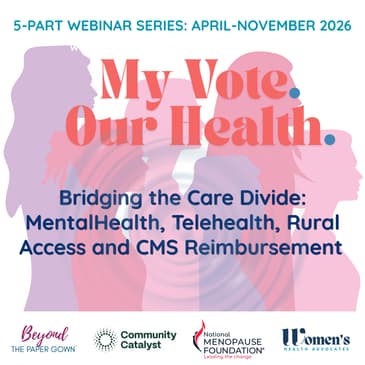

Women's health is shaped by more than clinical care—it is influenced by policy decisions that affect access, coverage, funding, reimbursement and insurance coverage, and research.
In this special recast from the My Vote. Our Health. webinar series, Beyond the Paper Gown is proud to partner with Women's Health Advocates, Community Catalyst, and the National Menopause Foundation to bring this important conversation to listeners.
Leading experts in medicine, mental health, advocacy, healthcare policy, and technology examine the barriers women face in accessing care. The discussion explores mental health parity, telehealth, rural healthcare access, maternal health disparities, reimbursement inequities, and the growing role of artificial intelligence in healthcare.
From provider shortages and healthcare deserts to insurance coverage and payment policies, the panel highlights how systemic challenges impact women's health across the lifespan—and what can be done to create meaningful change.
Featuring Dr. Jocelyn Fitzgerald, Dr. Nadia Johnson, Geovannie Gone, Vanessa Joy Walker, Lori Evans Bernstein, Linda Goler Blount, and Liz Powell.
This episode is the first of five of the My Vote. Our Health. series, which explores how policy decisions shape women's health and why advocacy, civic engagement, and informed voting are critical to advancing better health outcomes for women.
Because when it comes to women's health, policy matters—and every informed voice has the power to make a difference.
Please visit Beyond the Paper Gown (https://www.beyondthepapergown.com/podcasts) to join our community and to learn more about achieving your optimal health.
SHOW NOTES:
[00:00:14] Welcome to Beyond The Paper Gown. I'm Dr. Mitzi Krockover. Today's episode is a special recast from the My Vote, Our Health webinar series, which looks at how policy shows up in women's real lives, often in ways we don't immediately recognize. Beyond The Paper Gown is proud to partner with Women's Health Advocates, Community Catalyst and the Menopause Foundation to bring this podcast to you.
[00:00:38] This conversation focuses on bridging the care divide, mental health, telehealth, rural access and reimbursement. In practical terms, that means questions like, how can a woman in a rural community find an OBGYN without driving hours? What happens to mental health care if telehealth is no longer an option? Can a physician or health system afford to keep offering women's health services if the payment system undervalues that care? And will new tools like AI,
[00:01:07] help close these gaps, help close these gaps, or make them worse? At its heart, this episode is about connecting the dots between policy decisions and the care women can actually access. Because women's health is not just what happens in the exam room. It is shaped by funding, coverage, payment, technology, and whether our voices are heard. Enjoy the conversation.
[00:01:41] I'm Linda Goller-Blount, President and CEO of Community Catalyst. I have the pleasure and honor of being the moderator for today's amazing discussion and the first installment of My Vote, Our Health, a five-part webinar series brought to you by women's health advocates, alongside our partners Beyond the Paper Gown, Community Catalyst, and the National Menopause Foundation. Women's Health, Women's Health, and the National Menopause Foundation. Women's Health has been understudied, underfunded, and underprioritized for too long.
[00:02:11] And that government policy is one of the most powerful levers we have to change that. We translate lived experience and scientific evidence into education, advocacy, and action on Capitol Hill. These decisions ripple through every aspect of the healthcare ecosystem. They determine whether a Black woman in rural Mississippi can see a mental health provider,
[00:02:34] whether a cancer survivor gets the follow-up care she needs, or whether a gynecologist can afford to keep her practice open. So today, we're focused on bridging the care divide, exploring how mental health, telehealth, rural access, and CMS reimbursement policy intersect to either expand or limit what healthcare women can access.
[00:02:58] Our panelists bring clinical, payer, community, and patient advocacy perspectives, and they'll help us understand the gaps, and more importantly, what it'll take to close them. I want to briefly introduce each of our panelists, and then we'll get started. Dr. Jocelyn Fitzgerald is an obstetrician and gynecologist on the front lines of reproductive and women's health care.
[00:03:24] Who sees every day how policy shapes what she can and cannot offer her patients. Giovanni Gone is bringing the rural health and payer perspective from Blue Cross Blue Shield of Kansas, where coverage decisions determine whether care is even possible. Dr. Nadja Johnson, founder and CEO of the Black Women's Mental Health Institute,
[00:03:48] works to eliminate mental health disparities, and for her, this work is both personal and urgent. Vanessa Joy Walker, an advocacy and engagement strategist and lived experience expert who works where women's health, cancer survivorship, and mental health collide, translating personal lived experience into systems-level change.
[00:04:12] And Lori Evans Bernstein of Scene Health, a company re-architecting how women's health is valued and paid for in the AI era. She brings 30 years at the intersection of health, tech, entrepreneurship, and federal and state policy. So you all are in for a treat. So we'll start.
[00:04:36] Let's start, Dr. Fitzgerald, Jocelyn, if I may, with you sort of setting the stage and talking about everybody's favorite topic, reimbursement. You are an obstetrician and gynecologist. You live inside the health care system every day. When we talk about CMS, Centers for Medicare and Medicaid Services, reimbursement rates that are on average 30% lower
[00:05:02] for comparable procedures performed on women, what does that actually look like in practice, and how does it shape what you can offer your patients? Yeah, so that's a great question. Thank you all for having me here today. I am trained as an OB-GYN, and I practice as a urogynecologist, which is a subspecialist. It's essentially female urology.
[00:05:26] So it really does give me very head-to-head insight in terms of how we care for female urology versus male urology, which is a pretty apples-to-apples comparison. And in many research studies over the years have shown consistent disparities between the reimbursement rates that are garnered by hospital systems. These are health care systems, not physician salaries, although those are very much related.
[00:05:57] Compensation and reimbursement for the hospital when providing services to female patients are on average 30% less, often more than that. And how does that make things look in real life? So I practice in Pittsburgh, Pennsylvania at a very academic institution, but my institution is very dedicated to providing rural care to Western Pennsylvania. And so we do go into the community.
[00:06:24] I stay overnight and take care of a rural population and rural hospitals monthly. And I can tell you that it makes it much more difficult to hire a women's health practitioner and OB-GYN to be local in those communities because women's health care, while reimbursed less, is just as expensive as men's health care in urology.
[00:06:49] So there's a lot of incentive to hire, for example, a urologist in a rural community because that urologist makes a lot of money for the hospital. I'm not saying that there are tons of urologists and urology is available in rural places, but there is motivation from the health care system to hire that urologist. The same thing does not happen in OB-GYN because often it is very expensive to provide women's health care,
[00:07:18] but you lose money in the process of doing so. Obstetrics is one of the most severe examples of this, and a big reason there are obstetric deserts across the United States that are getting worse every day. So, you know, if it's possible to even answer this briefly, how did this happen? How did we get to a point where for pretty much the same procedure,
[00:07:44] physicians, providers, health care providers are reimbursed less for performing those procedures on women than men? Yeah. So the short answer, and I can provide more resources to anyone interested, we have a beautifully animated YouTube video explaining this very question, but it all started in 1992 with the Social Security Act and when CMS was putting forth their payment system,
[00:08:08] which uses a unit called the Relative Value Unit when you're comparing procedures between specialties. And it was based off of a report published by the Harvard School of Public Health. OB-GYN was essentially completely overlooked in that report. They used set points of surgical complexity for gynecology, for example, at the lowest level of what we do. For example, the DNC was kind of the standard.
[00:08:33] And we do so much complex cancer surgery, endometriosis surgery, prolapse surgery, fibroids, etc. And those conditions and those procedures were not valued at the table. What has made it pretty much impossible to change over the last 30 plus years is that the Social Security Act came with a budget neutrality clause, which basically means that you are unable to shift reimbursement or increase reimbursement,
[00:08:59] increase RBUs towards any one particular area or procedure without taking them away from another one. And so when you're set up to fail from the beginning, procedure lists like orthopedic surgeons, urologists, plastic surgeons have kind of gotten this jump. And they have captured a large amount of the RVU system.
[00:09:20] And I'll add one more point, which is that even though CMS creates the relative value specifications for patients with Medicare and Medicaid, 90 plus percent of the recommendations made by CMS are adopted by private and commercial insurers. So this inequity perpetuates regardless of what kind of insurance you have. Last, I guess, point is that women are more likely to be Medicare and Medicaid recipients.
[00:09:49] And so their reimbursement is less than commercial insurance. There's so much I could say about relative value, but I won't say that. It's right there in the name. But it's right there. Giovanni Gone is largely a rural state, speaking of relative value. When we talk about access to women's health care, what are the unique barriers that women in rural communities face?
[00:10:17] And how does the structure of insurance coverage either help bridge those gaps or maybe even make them worse? Yes. Yes. Well, good afternoon from Kansas. As I was getting kind of ready for this presentation, I was thinking a little bit back in 2012 when I was part of an initial team that implemented Canada, which is now our Medicaid program here in our state of Kansas.
[00:10:47] And at that time, I was hired specifically to implement this plan in 32 of the most rural counties in Kansas. And so it kind of took me back into thinking back into those days. And, you know, the structural barriers are real. And I'm going to just put it back to the electrolyte control center. Pulling some data from our state, it shows that 59% of women in Kansas lack access to local inpatient maternity services.
[00:11:18] And they lack like specialty care, preventative care. And it's usually because of having to travel long distances for care. Out of the 100 rural hospitals that we have in Kansas, about 60 of those are at risk of closure, mostly because of financial instability and workforce shortages.
[00:11:44] And so our rural communities do face a lot of barriers. They face fewer providers. Individuals have to wait longer wait times. There's a traveling burden that the family has to do. There's delayed in care due to lack of specialists in the area. And for women, this hits hardest in maternal care, preventative screening, and behavioral health.
[00:12:12] And Medicaid plays an outsized role in rural communities. And so does our federal qualified health centers. Kansas has historically struggled with affordability and access. And this might also be because 95% of our state is rural. And so when you think about, you know, Kansas, 95% of the individuals that live,
[00:12:39] you know, they have these barriers to access care. They have to travel. They have, you know, to be looking for specialists. There's a higher cost of service. There's coverage gaps. There's reimbursement rates. And also we have a very high uninsured rate. And that is, you know, due to several, several things happening within, within these communities.
[00:13:09] Federal qualified health centers are mostly trusted and accessible providers for our rural, rural communities because of their unique structure, both in the clinical and then the social determinants of health. And so FQHCs are very critical to the care of women because they are required to serve patients regardless of their ability to pay.
[00:13:35] And they do it under like a sliding scale depending on their income and, you know, their family size. And that's why FQHCs are the backbone of the rural healthcare safety net. But unfortunately, they receive a lot of funding from our federal government. And so when there's uncertainty because of our current political direction, you know, any federal
[00:14:05] cuts, any restructuring, any administrative disruption truly impacts the care of these individuals. And just, you know, talking a little bit about this uninsured rate that I was mentioning, the national average for uninsured rate is 7.9. Within our state, we have an 8.6.
[00:14:29] But unfortunately, there are even bigger disparities in certain populations. And so like our low income population in our Hispanic and Black communities, they have a 20% uninsured rate, which means affordability and other factors do affect, you know, how they see health and how they access health.
[00:14:53] And so as we think about, you know, rural communities nationally, uninsured rates, they usually stay longer than the norm. And there are several things that pile up. You know, we talk so much about social determinants of health in rural communities. That is a huge factor. Yeah, it is.
[00:15:22] And you're talking about access in rural communities. You know, you talked about maternal health, you know, preventive medicine, chronic care. Dr. Johnson, Nadja, when it comes to mental health, there can be even wider gaps. You know, the idea that mental health coverage should equal physical health coverage that's been around for a long time.
[00:15:44] And yet we see massive enforcement gaps, especially, as Giovanni pointed out, among Black and brown women, totally low income people. What is failing in policy implementation? Why aren't we there? And what would or could real enforcement actually look like? You're muted. Absolutely. That's a great question. And I appreciate the comments that have already been shared.
[00:16:14] I do believe it's a missed opportunity that's happening a lot of times, especially in regards to mental health policy, is that it's being discussed separate from holistic health. Mental and maternal health has already been mentioned. Cardiovascular health, reproductive health. These are things that have already been mentioned. And mental health is embedded into all of those things.
[00:16:33] So certainly in regards to mental health parity, the accountability in regards to implementing those kind of practices needs to be discussed across all forms of health and wellness. For our state, there's a lot of disparities that are impacting Black women in general. And especially when it comes to mental health, it's no respecter of your education level or even your financial level because mental health is being experienced across all paradigms of the Black experience.
[00:17:03] So, for example, and the same thing happens as well for maternal health. When you think about our state, which has gotten national recognition, unfortunately, for the stark statistics around maternal health, we have in our state that Black women are three to four times likely to die giving childbirth and then twice as likely to lose the loss of a child. Mental health is directly embedded into that.
[00:17:29] And that statistic is regardless of your income level, regardless of your education level. When you think about it now in rural, part of our state, which is I appreciate your comments, Giovanni, when it comes to places like for us, we serve our entire state. But when it comes to places like the Black Belt, certainly we do a lot of work in Selma. Those are health care deserts in general.
[00:17:51] So, when you're thinking about mental health, it's increasing access to all forms of health support, clinics, FQHCs, again, have already been mentioned. They're a big part of making sure individuals have access and having the policies in place to reinforce that, but also to hold clinics and providers accountable. Another aspect of that that I also think is a missed opportunity in regards to, for example, in our state, the expansion of Medicaid, Medicare, is reimbursement isn't spoken about enough.
[00:18:20] We have an exceptional workforce shortage in our state. Alabama historically and consistently ranks 51st in the country for mental health workforce and clinician accessibility, which means right now for Alabama, for every 780 residents, there's one available mental health clinician. And so, when you're thinking about why that is happening, first of all, certainly education. It takes quite a bit of time to get licensed. There aren't that many schools here that have those programs.
[00:18:48] The Department of Labor, we're having some of those discussions to kind of increase the pipeline, starting from high school all the way through graduate school, to increase that and address that. But also, for those who are licensed, who are already able to practice, there's not much incentive for them to do that kind of work because of the reimbursement. They have to eat. This is their livelihood. Many of them are in private practice.
[00:19:12] For those who are in other practices, whether it's a private practice or if it's with an FQHC, they need to get there. There's not much incentive for them to financially maintain themselves because of those reimbursements. I'll also say this about FQHCs, and I think it's another missed opportunity, especially in our state. A lot of them do not provide mental health services specifically. They're outsourcing those.
[00:19:37] Whereas things like having an LPC on staff, a psychiatric nurse practitioner on staff, increasing their network of practitioners so they can have a better and more streamlined referral process. All of these things can be implemented if there's more policy that supports them because with policy comes funding. Yeah. Yeah. And, Lori, we're going to hear sort of about mental health parity and survivorship in a moment from Vanessa.
[00:20:05] But as you kind of listen to what folks have said, reimbursement, rural health access, you know, how does what comes back is like, you know, how does women's health actually get paid for? You've spent a lot of time inside a system in government, CEO of a digital health company. Can you help us kind of see that connected, connective tissue?
[00:20:28] You know, what is that single structural problem, that thread that shows up in what you've heard just today and the stories that you hear when you're sort of out in the wild listening to people? Yeah. No, thank you. It's such a great question. And I'm so delighted to be here with this incredible panel. But, Linda, you named it.
[00:20:48] Like, every gap just mentioned on the panel is downstream of the same thing, which is a payment system that has never accurately valued women's health. And Jocelyn, Dr. Fitzgerald, just told us what that looks like from her perspective. And, frankly, she's one of the fearless leaders of elevating this issue. She's the reason why I'm tackling this, because I learned about it from her.
[00:21:19] And Giovanni just, Giovanna mentioned, you know, her, the circumstances in rural Kansas. And, you know, where it comes from and why it hasn't moved in three decades, Dr. Fitzgerald mentioned. And I would add that, you know, it really started with a medical establishment that dismissed women's symptoms and excluded us from research for so long.
[00:21:43] And then that bias got encoded into the fee schedule in 1992 that Jocelyn mentioned. And then, of course, commercial payers price off Medicare. So every undervaluation cascades through the entire payer mix. And it shows up in everything that was mentioned previously. You know, OBs who can't keep their practices open, the maternal health deserts that are getting worse and worse.
[00:22:10] You know, the rural hospitals that are closing, you know, L&D units and, you know, other things. The therapist who doesn't take insurance and all the rest. And I think when we're asking the question, why is it persisted? I think there's also, you know, it points to part of the solution that I think we need. And we need a lot of policy solution. And thankfully, everyone here in Women's Health Advocates is really leading the way.
[00:22:39] And I think we need a technology solution that supports that. And, you know, we've never built the infrastructure to really show the disparity and to prove it. And Nadia mentioned the mental health parity. And I would add that, you know, it was passed in 2008.
[00:23:02] And 17 years later, who are still working on mental health parity? And I think it's largely unenforceable because no one has built the means to measure and track and demonstrate a violation. It's a mandate without, like a mandate without measurement is an aspiration. Like I've always said, like, if you can't measure it, it didn't happen.
[00:23:29] And so we don't want to repeat the same mistake as we're making so much progress on this topic. Again, thanks to leaders like Jocelyn and Women's Health Advocates and everyone here. And what I am working on to contribute to that is to build a public asset, like a measurement infrastructure that Women's Health Payment has never had.
[00:23:51] So that the reforms that we're moving through, hopefully CMS and the Congress and other things have teeth. Yeah. Yeah. And, you know, we often talk about personal stories and how powerful stories can be in moving policy. Vanessa, you have a story or two.
[00:24:17] You know, you've spoken about how for many women sort of there's the mental health impact of disease and disease experience, but how it's different from the physical experience of illness, hormonal change, survivorship. But they're related. So where do you think the health care system most, where does it most often fail? And, you know, I mean, we're trying to be aspirational. Love some feelings of hope.
[00:24:45] But, you know, where do you think the system most often fails to connect these dots? Well, thank you for that question. And, yes, I mean, I always lead with my lived expertise because that's really why I became an advocate. I didn't choose advocacy because I thought it would be a cool career. I actually started my career as an opera singer. I always like to tell that because it's a fun fact.
[00:25:11] But I couldn't continue with my music career and being a music teacher because I was diagnosed with cancer at the age of 30. And when I was diagnosed, it was prior to the ACA. And I had to think about how am I going to keep insurance? How am I going to get around the prior, you know, authorizations? And it was, you know, incredibly overwhelming.
[00:25:38] And so when people ask me how long I've been in health care, I say, well, I've been in health care since I turned 30 because that's when I started advocacy. I didn't know that's what I was doing. And I think one of the best ways to describe this is that, you know, I didn't transition into menopause. I arrived there overnight when I was 36 years old because cancer gave me no choice. I was diagnosed with cancer a second time at 36.
[00:26:08] And that was part of my treatment plan. And the depression and the sleep disruption, the identity changes. These are all connected, just like Dr. Nadia was saying. But they were not addressed as one element.
[00:26:30] You know, you had one doctor prescribing you sleeping pills and another doctor prescribing you some other med to take the edge off. But no one is saying, hey, maybe we should think about psychiatric care or social work or no one is thinking about that. Now, it's not I'm not blaming the physicians. Right. I mean, it's it's incredibly difficult to be a physician in this country, to be a provider in this country.
[00:26:59] It is very, very difficult. And so it is a systemic problem. And my story is just one of many. You know, this is it's not an outlier. If you look at things like endometriosis or PCOS, you know, people with PCOS women are 60 percent more likely to have a mental health disorder. Yet only 35 percent of those women say that mental health is ever discussed with their primary care physician. Yeah.
[00:27:29] Those are, you know, 78 percent of women going under infertility treatment have anxiety. Fifty percent have depressive symptoms. Yet these things are very rarely ever addressed. And that's a problem. Yeah. I've talked to many physicians who have said, you know, sometimes we don't want to ask certain questions because we don't have the tools and resources to address them.
[00:27:58] So ignorance is not bliss, but that's essentially what happened. And but as you bring your lived experience and systems level experience into your advocacy, you know, the things that you want to see. I mean, you know, how how have you maybe how's your thought process about women's mental health change?
[00:28:21] As you think about the model that might treat the whole person rather than the body part or the complaint. I mean, you know, we kind of treat an individual problem. But this is a structural problem that you talk about. I mean, I think I think that there, you know, Laurie was talking about this on our prep call. You know, we were talking about collaborative care and we were talking talking about integrative care models. And Nadia just talked about this a few minutes ago.
[00:28:49] I mean, those are proven to be effective. I mean, these are things that we know. There's a lot that we don't know. Right. I mean, there's a lot that we don't know. We just heard about the fact that we have a lack of research, you know, a lack of money toward women's health research. But there are a lot of things that we do know. And we know that collaborative care works. We also know that measurement based care works. Right. But then the question is, what are we actually measuring?
[00:29:19] So that's a question that I'm very passionate about, especially as it relates to mental health. One of the organizations I work with, the Depression and Bipolar Support Alliance. And they've been working for a handful of years now on a project called Transforming the Definition of Wellness. And what they did is they brought together researchers, clinicians, people with lived expertise to figure out, you know,
[00:29:48] what actually should we be measuring when we're thinking about someone's quality of life or if they are, quote, symptom free, you know? And what they have found is that most people with lived experience care a lot more about different things in their life than they care about just being symptom free.
[00:30:11] So if we had measurement scales that people could put in place that would measure what the individual is really thinking about quality of life, that could be very helpful. Yeah. I think stigma is also something that needs to be addressed from a very early age. You know, if you think about this, this starts as early as, you know, period stigma. Yeah. You think about that.
[00:30:39] I mean, I'm sure everyone on this call can talk about that. Yeah. And it just filters down or up as we get older. So, you know, you're talking about these systems and structural issues. We all remember just a few years ago when telehealth was going to solve all the world's problems. So, Jocelyn, you know, it did. Telehealth was really important during COVID.
[00:31:09] It was really important. It can continue to be important, but we saw pullback of these policies. So from your clinical perspective, what aspects of women's care, I'm thinking about all these connections that Vanessa just listed, are most dependent on telehealth being sustained or even expanded? And, you know, what happens to women's health when that access disappears? Yeah, that worries me quite a bit.
[00:31:37] I actually did an entire day of telemedicine yesterday. And as a part of it, it does so many things, obviously, made it so these patients didn't have to come from three hours away to see me. We could follow up certain things that didn't require, you know, physical exams.
[00:31:58] Another thing it does that's very powerful, referencing what Vanessa was saying, is it helps you coordinate care between teams. And so I, in particular, was I have a chronic pelvic pain clinic that I do twice a month. And we involve probably close to a dozen specialists. And what really is a barrier, including mental health services, are embedded within that.
[00:32:26] But you don't really get reimbursed necessarily for the time that you spend as, like, the core physician forging those relationships with other specialists so that they can become, like, your go-to team. Unless you kind of work within a system that has prioritized that.
[00:32:46] And also when you have things like telemedicine where you can do that care coordination without having to bring the patient to your front door. So I think that would be a huge loss. That's, like, a very practical example of something I did yesterday because I can get reimbursed for that time I spend. But I'm not trying to do everything in one visit. Like, examine the patient and figure out what's going on. I then schedule a telemedicine follow-up.
[00:33:15] And we can do a lot of that care coordination and follow-ups in terms of, you know, who have you seen? Who do I need to message? Maybe myself. Pull some doctor leavers. So I think in the context of this conversation, that is one of the most essential things besides the obvious in terms of, like, travel and keeping access to specialists. That pipeline open. Mental health care, I mean, cannot be understated. Like, the access.
[00:33:44] Even for people, like, doctors I know. You know, they don't have time. Doctors need mental health care, too. Like, they don't have time to go to an office. But if you can jump on a Zoom call with a talk therapist or someone managing medications, for example, it's completely invaluable in every way. It allows people to have access to something that they otherwise would simply not prioritize. And that is critical. Critical. I mean, I can't emphasize enough.
[00:34:12] If they took telemedicine away from me, it would make my job much more difficult. I would. I know there are comments coming through. Hopefully, we'll have time to take questions. If not, we will answer all the questions separately. So, you know, just stay tuned and you will see the questions answered. But I would invite those listening, just if you've ever had a telehealth visit, just let it, no details.
[00:34:40] But just yes or no, you've had a telehealth visit. I'm really interested in, you know, kind of how many of us sort of take advantage of that. And, you know, talking about, you know, sort of being able to address maybe disparities, provide health care in a way that makes sense for the patient. Sounds really important. Nadia, you probably spent a little bit of time having this conversation.
[00:35:05] You know, what I've read is that telehealth, telemedicine has created a real opportunity to increase access to mental health in particular for Black women. Again, Jocelyn mentioned transportation barriers removed. There are privacy concerns. And in theory, culturally specific providers can provide or providers who have a cultural understanding or maybe congruency can understand and better reach patients.
[00:35:33] But that progress that we've made, even the system is fragile. So talk about what's at stake if Congress fails to make telehealth or telehealth mental health coverage permanent, particularly for Black women or women of color. So I'll say this in regards to telehealth. It's a tool and it's a valuable tool, but all tools have their pros and their cons. I'll use our organization as an example.
[00:36:01] We provide statewide counseling for Alabama. That's our pilot program that we're looking to scale throughout the Southeast. And we've had a great level of success. A lot of individuals who are tapping into the telehealth aspect of that are doing it out of convenience. Or maybe they're in a home that has multiple generations in it. So it's hard for them to get a quiet, private space. But at the same time, we know that tools like telehealth, AI, other kind of things that are happening in healthcare space that are increasing access,
[00:36:30] were oftentimes built on race-neutral frameworks that don't really create an avenue for exploring how bias shows up in those resources. So an example of that is with telehealth. That's great. We utilize it all the time. Telehealth is not going to guarantee, though, that you connect to a practitioner who has been trained in culturally responsive healthcare. And so it's able to provide the care that you need based on your own experiences.
[00:36:57] We know that that's a challenge, which is, again, why we've kind of ventured off into the space of workforce development, because we're making sure that our clinicians are trained in culturally responsive healthcare. Also, oftentimes, it's seen as a quick fix. Like, oh, if they have telehealth, they could do their teletherapy. That's all they need. But what I appreciate about, I believe, what a lot of people have said today on the call, but specifically going back to a lot of what you said, Vanessa,
[00:37:21] is that collaborative care model is necessary to really make sure that we understand that not everybody has access to a smartphone. We make those assumptions like it's fine. Not everybody is going to be, especially in the rural parts of the state, have access to phenomenal Wi-Fi or going to have a space where they can go and effectively do their sessions. So those are some of the issues I believe that we're having.
[00:37:47] I also feel like sometimes these resources and these tools, AI, telehealth, they are not being utilized in a way where people can say, okay, as a clinician, this is how we're using this. As a healthcare advocate, this is how we're using this. And as a community advocate, this is how we're using this. Vanessa, what I really appreciate about what you said, and I definitely want to tap into some of what you all are already doing because we're kind of moving in that space as well, is to say, how can we be solving these things together?
[00:38:17] We know that because of social determinants of health and political determinants of health, there's differences and disparities that exist. And the history that contributes to the persistence of those disparities that is oftentimes unaddressed that we need to work together to solve together. But oftentimes those conversations are happening in silos. Clinicians are over here having those conversations. Academics are over here having those conversations.
[00:38:39] But when you think about a collaborative care model, I truly believe that clinicians, healthcare executives, individuals with lived experience, community health workers, federally qualified health clinics, advocates, everyone should be in the room. We are a nonprofit organization. I'm an academic. I'm a social scientist. I use feminist frameworks to explore how disparities exist in the experiences of Black women and girls.
[00:39:07] But when it comes to do our work, we are working with elected officials, which is how I got connected to women's health advocates. We are working with physicians. I teach with the medical school. We are working with churches. We are working with nonprofit organizations. We are working with school boards. We're working with all of these individuals so that we're not trying to address these things separately, but we're working together to create systems, policies, and programs that are actually going to be beneficial.
[00:39:33] The flip side of it, and this is also very important, is that we're catching the data for this and that we're all working towards a goal that is actually going to communicate the value that this is going to have to individuals but also to our country. I already mentioned social determinants of health. We know Daniel Dawes has done work in the political determinants of health, but he also, and Daniel Dawes with Meharry Medical College,
[00:39:56] he also did a research project that talked about how mental health inequities in our country are costing us $14 trillion. If money is the motivation, which for me, it should not be, but we know it's important, people and their health are important, and that's the priority. But if money is the motivation, $14 trillion being lost in our economy can be addressed if we are doing this work collectively.
[00:40:24] And so these community care and collaborative care models that we're talking about are not just avenues for us to do feel-good work. It does feel good to do this work, but it's just not an avenue to do this feel-good work. It's actually making an impact on our economy and our health care systems and creating models that are going to bring about, Lori, some of the changes you mentioned should have already been happening since 2008 when the Mental Health Parity Act was kind of formulated. Yeah.
[00:40:52] And I would be remiss if I didn't just say yes, yes, yes to everything you just said, Dr. Nadia, but peer support. Peer support specialists. We don't talk about them enough. Peer support specialists, especially in the mental health community, are an incredible resource. And there is the Peers in Medicare Act right now. You know, I want to give a shout out. Look it up.
[00:41:19] It's very, very important because it will help create the codes so that a small organization in rural Kansas can hire peer support specialists to actually help their practice. Now, they're not going to replace an advanced nurse practitioner or a psychiatric nurse practitioner, but not everyone needs a psychiatric nurse practitioner every single week.
[00:41:48] When you can train people to be peer support specialists and then people can code and bill for that, that is a major game changer. Yeah. I mean, I'm so glad you brought this up. I mean, you know, obviously the health care system, health care delivery systems are very uneven. And, you know, Daniel Dawes and many others have documented disparities. Lori, there's a saying that effective therapeutics and technologies are always disparities producing
[00:42:17] because of one who's included in the research and also who gets access to them. Things that are not FDA approved yet, but are effective, you've got to pay out of your pocket. And if you can't afford it, you can't get it. Many, many women are left out of the data that AI is trained on. So scene health is using AI to re-architect how women's health is valued and paid for. But AI is also flooding into every corner, every aspect of health care right now.
[00:42:46] And much of it is being trained on the same payment data that Dasson talked about, undervalued women's health care for decades. So what is the risk we get? What is the risk if we get this wrong? And, you know, always wanting to be optimistic. What could it look like if we get it right? Yeah, I love this question. And, you know, on the risk side, AI is about to industrialize decades of underpayment.
[00:43:17] Clinical AI, revenue cycle AI, pricing AI, all being trained on the same data that has undervalued women and women's health for decades, including the lack of data on social determinants, et cetera, all the things Dr. Nadia was just saying. And, you know, what it means in the real world is a hospital's revenue cycle AI learns the historical coding patterns for GYN surgery,
[00:43:46] patterns that already undercapture the complexity of the work, right? It's automating this, the undercoding at scale across every claim in real time. A commercial payer's pricing confirms that a GYN surgeon's contract rate should stay right where it always has been, way, way, way below the margin that she needs to practice and that the health system needs to invest further in that area.
[00:44:15] And, you know, none of this is malicious, but they are scaling bias at an enormous speed. And they're narrowing the pipe that delivers payment to women's health care faster than, like, any human workflow could, you know, ever could. And underpayment drives underdiagnosis and undertreatment. Under-treatment starves the clinical data.
[00:44:46] Missing data starves the research. It already takes 17 years on average for a medical breakthrough to reach patients. And women have been paying that lag twice over. Once in the research that's never been funded, thankfully, it's happening, starting to happen and long overdue. And then it's happening again in the clinical data that was never generated to make the case for funding it.
[00:45:13] And we can't let that happen anymore. We can't let that happen to another generation. And why it happens is because AI, and this is, I read an article last night by an incredible journalist named Jerry Stengel. So I'm going to give her a shout out. She had a great article on this in Forbes, and she said this, AI can't outperform the evidence it was built on. The algorithm doesn't know it's wrong.
[00:45:41] It was never given the information to know otherwise. And the loop doesn't announce itself. It just keeps running. Right. So a century of research exclusion didn't just shape the 1992 fee schedule. It's the missing evidence inside every AI model built on the data that followed.
[00:46:03] And so on the positive, like getting it right side, you know, AI is a tool that we can use to read what actually happens in the clinical experience, in the clinical encounter. The complexity, the time, the decision making, everything that the billing codes were never designed to capture,
[00:46:26] and feed AI the truth, the clinical truth of the record, rather than the history of how the system paid. And with that, I think we can rebuild from the evidence up code by code, condition by condition, payer by payer. But the window is now. It's now. It is. So on that note, we've got about five minutes left. Because I always like to end on a positive note.
[00:46:54] For people listening who really want to move from understanding the issue to changing it, you know, I would love it if each of you would take, you know, a minute to answer the impossible. But, you know, name one concrete action that those listening can take in the next 30 days to make the change. And what gives you hope? Jocelyn, let's start with you. That's a hard question.
[00:47:22] But I will say that Women's Health Advocates has been incredibly helpful in helping me and some of my other colleagues from across the country form what we call the Surgical Parity Project. And we have a website now called surgicalparityproject.org. And you can go there and we have our YouTube video that explains this problem.
[00:47:43] We have quick links for you to write to Congress and to do some other, to share your stories that this is something that's impacted you directly. We're going to turn all of that into data. So that would be something you could do in the next 30 days that I think would be helpful.
[00:48:03] And just, yeah, keep in mind, vote for people that support women's health and looking for these deep embedded layers of problems. Thank you. Giovanni? Yes, I would just like to remind everyone that all of these health issues are also policy issues. And so be involved.
[00:48:26] I think that's something that brings me hope is that I have seen people being more involved in policy than ever before. And so when we come together as, you know, one voice, you know, it gets louder. And that's what we need to create change. Yeah. Very loud, especially in rural areas. You know, a lot of distance to cover. Nadia?
[00:48:55] So what I always say through our organization, through the Black Women's Mental Health Institute, is voting matters to our mental health. We do community work. We're boots on the ground. But oftentimes, as impactful as our programs are, it's going to be the policies that really need to be put in place. Because we're addressing a byproduct. A byproduct of a larger issue. And we need to get to the core of what that issue is. And that's where the work of policy happens. So we don't take our votes lightly. We say it all the time.
[00:49:25] We have our T-shirts on. You know, we're always with the Women's Health Advocates with our T-shirts on the Hill. So voting matters to our mental health. And we need to be engaged with our elected officials to let them know what matters to us and why it's important. Yeah. Lori? AI is going to solve all the world's problems. Oh, my God. I would say, I would echo just the Women's Health Advocates theme.
[00:49:52] One action, go to womenshealthadvocates.org, take the CMS reimbursement letter template, put your name on it. And send it to your member of Congress. Five minutes. Yeah. I was going to say that as well. I was going to say three minutes. But yeah. Three minutes. Three minutes. It doesn't take much time at all. And very impactful. And Vanessa, you get the last word on this.
[00:50:18] And send us out with, you know, not only the lived experience perspective, but again, like, how can we take on these policy issues? I mean, I think I would say that don't feel intimidated. You know, every time I get on a call like this, I, like, get nervous. Even though I have so much experience and I have so many degrees and I, you know, do a lot of stuff. But I think of myself still as just the patient.
[00:50:47] Because that's how I've been treated for so much of my life. And I want to tell people that you are not just anything. You are someone very important. Your voice is important. Your vote is important. So look something up. Decide what you're passionate about. Go to congress.gov. Figure out if there's a bill attached to that. And then reach out to your local congressperson. Right? Start small.
[00:51:14] Because every action makes a difference. And once you start doing it, it feels really good. I always say you don't become an advocate overnight. You learn to advocate by advocating. You learn to do it by doing it. I know that Dr. Fitzgerald did not learn what she did by not doing it. Right? So just get out there and do it. And ask questions.
[00:51:45] And invest in the things that you're most passionate about. Think about how they affect the women in your life. Yeah. And know that they do. Yes. I think a lot of folks, part of that fear is they think it doesn't matter. But I think after this conversation, it should be clear that it does matter. It does work. It does make a difference. So thank you all.
[00:52:12] You know, in the couple minutes that we have left, I think our panelists have made really clear today that the barriers women face in accessing mental health care, the issues of telehealth care in rural areas, and disparities that we see among Black women, women of color, low-income women are not accidents. You know, I guess in software terminology, Lori, they might say they're a feature, not a bug.
[00:52:42] They're the product policy choice that were made without women at the table and often without women's health in mind at all. That 30% CMS reimbursement gap clearly didn't have women in mind. The rollback of telehealth expansion didn't center women. And the enforcement failures in mental health parity clearly didn't prioritize the mental health needs of women. So they're not abstract.
[00:53:11] There are reasons, all of these are reasons why women don't get the care that they need. So I ask about sort of what to do with sort of the calls to action. All of my calls to action have been mentioned. So thank you all. You know, please let me reiterate, write to members of Congress. It does matter. And as Lori said, there is a letter on womenshealthadvocates.org. I think it takes three minutes. Just do it. Send them early and often. And I would say bring someone with you.
[00:53:41] Share this recording. Invite a colleague, a neighbor, a patient to the next webinar. The power of this series, what you're going to hear over the next few months, will grow every time we expand the community. And to reiterate, know who you're voting for and why. Do the research. Understand where your candidates stand or where the candidates stand on women's health funding, on telehealth, mental health issues, CMS reform.
[00:54:08] I know it's probably not everybody's favorite topic, but it determines the kind of care that we get, if it's reimbursed or not. Just know that your vote is a health decision. So let's keep learning, keep advocating, and keep showing up. Thank you for listening to this recast from the My Vote Our Health series. What stood out in this conversation is how many barriers in women's health are built into
[00:54:36] the system and how often women experience them as personal frustration. The long wait for an appointment. The specialist who is too far away. The therapist who does not take insurance. The telehealth visit that makes care possible. The condition that affects daily life, but is not valued, studied, or reimbursed the way it should be. My guess is that you may have experienced any one or more of these challenges. I know I have. These are not isolated problems.
[00:55:05] They're connected to policy choices about reimbursement, research, mental health parity, rural care, telehealth, and how we measure value in health care. The My Vote Our Health series continues with conversations on research and innovation funding, regulatory pathways and translation to care, maternal and reproductive health, midlife health, menopause, aging and caring, and advocacy and voting.
[00:55:29] To find out more and learn when these are going to drop, you can go to womenshealthadvocates.org or the beyondthepapergown.com website. You know, all of us can make a difference in the policies that are important to us by educating ourselves, advocating, and voting. So I hope you will follow along, and I thank you for joining us and take good care.
[00:55:58] Our episode was produced by Patrick Shalveati and me, and our associate producer is Kyla McMillian.