
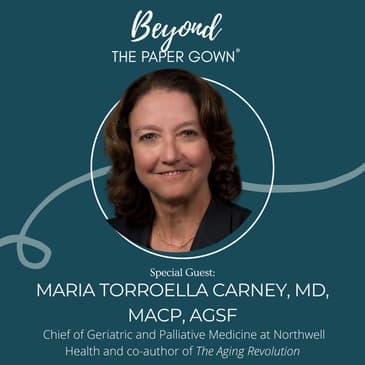

Dr. Maria Carney, Chief of Geriatric and Palliative Medicine at Northwell Health and co-author of The Aging Revolution, joins us to discuss how we can live not just longer, but better. We explore the distinctions between geriatric, palliative, and hospice care, and why end-of-life planning is a form of empowerment. Dr. Carney offers practical advice for family caregivers, sheds light on Medicare, and highlights the crucial role of connection and purpose in aging well. Whether you're navigating care for a loved one or planning for your own future, this episode
Please visit Beyond the Paper Gown (https://www.beyondthepapergown.com/podcasts) to join our community and to learn more about achieving your optimal health.
SHOW NOTES:
- Mitzi Krockover, Founder and CEO, Woman Centered, LLC and Host of Beyond the Paper Gown https://www.linkedin.com/in/mitzikrockover/
- Maria Torroella Carney, MD, MACP, AGSF https://www.linkedin.com/in/mcarneymd/
- The Aging Revolution https://www.amazon.com/Aging-Revolution-Groundbreaking-Geriatric-Medicine/dp/1510778829
[00:00:13] Hi everyone, and welcome back to Beyond The Paper Gown. I'm your host, Dr. Mitzi Krockover. I'm so glad you're here. Today, we're talking about something that touches all of us, whether we realize it yet or not, and that's aging. For some of you, aging can sometimes feel like this far off idea, but maybe you're already taking care of a parent or loved one who's needing more care. While people all over the world are living longer than ever before, we all need to start thinking differently about what we're doing.
[00:00:43] about what it means to grow older and how we care for each other as we do. By 2050, over 80 million Americans will be over 65. That's nearly one in four of us. And yet our healthcare system is still playing catch up, especially when it comes to chronic conditions, cognitive health, and support at the end of life. So in this episode, we're asking, how do we age well, not just longer, but better? What should we expect and request from our healthcare team?
[00:01:13] And how do we make sure things like compassion, dignity, and connection aren't lost along the way? To help us unpack all of this, I'm joined by the amazing Dr. Maria Carney. She's the chief of geriatric and palliative medicine at Northwell Health. And she's also the co-author of The Aging Revolution, which is a fascinating look at how geriatric care has evolved and what really matters most to older adults.
[00:01:40] We'll talk about what healthcare providers need to know about caring for older adults, how to navigate the differences between hospice and palliative care, and why end of life planning is really about empowerment, not fear. And maybe most importantly, we'll talk about the role of connection, community, and purpose in helping all of us age with grace and meaning.
[00:02:04] So whether you're supporting aged loved ones, thinking about your own future, or just curious about how we can do this better as a society, I think you'll really get something out of this conversation. I am so delighted to have our guest today, who is a geriatrician, Dr. Maria Carney. Maria, welcome.
[00:02:33] Thank you so much for having me. Oh, it's my pleasure. Let's start out by telling us a little bit about yourself and what you do. So I am a physician. My background is internal medicine, geriatric medicine, and also board certified in palliative medicine. I am at Northwell Health in the New York area, and we are the largest healthcare system in New York.
[00:02:59] I'm chief of geriatrics at palliative medicine here and medical director for continuing care across our health system. So tell us a little bit of difference between the palliative care and continuing care. Continuing care represents post-acute care. So it's home care, hospice care, skilled nursing facility.
[00:03:24] At Northwell, we're an integrated healthcare system. So we have outpatient offices, hospitals. You get discharged from the hospital. You may go to a skilled nursing facility for short-term or long-term, or you may go home and need home care services. And then when appropriate, you may need hospice care, and we have hospice care. So that's continuing care.
[00:03:49] Palliative medicine is a specialty where we're really trying to improve symptoms while facing an illness and at any time of illness. So if you're having to deal with, let's say, a cancer and you have a lot of pain, you may be co-managed with a palliative care specialist to help you be able to tolerate the therapy,
[00:04:12] the treatments, post-surgery pain that you may have. And then that gets confused with hospice, which is a form of palliative medicine, but really focusing at end of life. I want to get into all of that because what you're doing is so expansive and I think so salient to a lot
[00:04:33] of our lives, whether we're older and or if we're taking care of loved ones. So with that in mind, I'm going to go a little bit upstream, if you will. Talk to us about what a geriatrician is, does, and when should someone consult a geriatrician as opposed to an internist or a family practitioner?
[00:04:59] Right. So geriatric medicine is a specialty that you can go and do after your residency. So internal medicine, family medicine can do a specialty in geriatric medicine. I'd like to think that geriatric medicine, geriatricians, we are experts in caring of individuals with multiple conditions. As we get
[00:05:23] older, we start gathering, accumulating different illnesses, right? And the goal is to promote longevity, promote independence and promote safety. That's what a geriatrician does. And then help individuals through their journey and then be with them towards the end of life and help them with that end of life chapter. So it is, as you said, kind of upstream, promoting longevity,
[00:05:53] handling multiple conditions, complexity of care, facing frailty, and then knowing when you're at an advanced ill state and when to get hospice involved. So I think a geriatrician is comprehensive in looking at not only the patient, the individual, but their family support. You know, it's interesting because I think about, you know, usually pediatricians,
[00:06:19] you're done at 18. Right. Do geriatricians have a discrete beginning? No, I would say that geriatricians, well, I would say most older adults, and when we say older adults, we mean a demographic over 65, let's just say. That's the demographic. It doesn't mean you're old. It doesn't mean you're frail. It just means you're an older adult as opposed to a younger
[00:06:45] adult. More mature. More mature. Geriatricians are, there's not many of us. So I think in reality- Yes, that is true. The clinical care you're going to get is through your primary care physician, through your hospitalist. I think a lot of people don't realize that the specialty of geriatric medicine, you have to rotate through different aspects of healthcare, including, you know, hospital
[00:07:12] care, outpatient care, skilled nursing facilities, house calls, and hospice. So you see different models of care. You may be exposed to adult day programs, assisted living sites. So it's unique experience of seeing different models of care that you may need to help keep you out of hospitals. You made the point of saying that there's not a lot of you out there. And it's interesting because
[00:07:42] I'm in the Scottsdale area in Arizona. And that historically has been a place where a lot of retirees come to retire and to age. And I thought, oh, then there would be a really solid group of geriatricians. And I think I've come across maybe two geriatricians. If you don't have those resources in a place where you would expect them, my guess is that you're not seeing them in other areas where
[00:08:11] you don't have such a propensity for retirees, for example. So how does one find a geriatrician? And going back to the other question, kind of when is it important, if you will, to know if you should be going to a geriatrician versus an internist, for example? I would say that most geriatricians are in academic centers. And I would like to think that
[00:08:39] we can have a better outreach by pushing the research, the advocacy, the scholarly activity, so that it helps healthcare as a whole. Because it's just not possible to have enough geriatricians to see all, it's just not a realistic goal to be able to provide enough
[00:09:02] geriatricians to care for all older adults. What I will say in our system, those that find our practice are really the caregivers often, the family caregivers that are just having trouble taking their loved ones to specialists, no one seeing the big picture. And the reality,
[00:09:26] the internal medicine primary care offices are not established to do this the right way. It really needs to be reinvented primary care for older adults. Because again, the beautiful thing is we are living longer. We are able to treat so many more illnesses than we ever did in the past. And
[00:09:50] it's hard for a primary care physician to do all the care for all the problems in 15 minutes established and without a social worker available to them. Another way to look at geriatrics is the four Ms. And you can even say five Ms. You're able to evaluate mentation of a person.
[00:10:14] Is there a memory problem? Is there mood problem? You're reviewing their medications. Are you seeing that all the medicines that they're taking don't hurt each other? You're addressing mobility issues. You're keeping individuals as mobile, as safe as possible. And you're giving out handicapped parking when appropriate to help the family. And you're addressing when someone's facing so many issues,
[00:10:42] what matters most to them to help you create a care plan that will work. And I think that's where family caregivers struggle with their, they're being given all these different care plans by different doctors and they're not sure which one to prioritize. So I think that's often what a geriatrician can do, really address what matters most and help the patient, the family go in that direction.
[00:11:09] It seems to me that if you don't have access to a geriatrician, just those five Ms or something that a caregiver can come in with their loved one and talk to their primary care doctor about. So I think that's really helpful. Yes. The fifth M, I'm sorry, is... Oh, I'm sorry. Which the other four Ms are necessary is the multiple conditions, right? Yes. Right. So if you have
[00:11:34] multiple conditions or multiple comorbidities in the healthcare world, we say those four other ones help you work with it. But yes, I think it's a framework that any doctor can use. And you also had a great segue because you talked about having a social worker and to really kind of think about really a much more holistic approach to some of the needs of older people. And so my guess
[00:12:03] is that that has a lot to do with why you wrote The Aging Revolution, which is your book that you co-authored. Talk to us a little bit about that book and what you wanted to achieve by writing that. Thank you. The Aging Revolution, co-authored with the CEO of Northwell Health, Michael Dowling, who is an inspirational leader. And he approached me one day and said, I'd like you to give a presentation
[00:12:31] on all the aging services in our health system. And we interviewed hundreds of people, hundreds of people to come up with this book. But we have more to do in healthcare about how to improve delivery of care in the home, how to support our family caregivers, and Medicare is changing and we have to watch what's happening. And I think that's a really timely discussion. Absolutely. And Medicare,
[00:12:59] just as a reminder for folks, is the insurance that covers those over 65 for the most part. Yes. And I think we talk about that in the book. And for my friends that I have read the book that are not in healthcare, it's eye-opening to them about Medicare, the history of it, what it does cover, doesn't cover, and the changes that have occurred in the last 10 years with Medicare Advantage plans,
[00:13:28] that is a very interesting change that has occurred. And we don't know what's going to change now, given the post-election results. Any crystal ball predictions? I think the Medicare Advantage will grow. These are combination private insurance company,
[00:13:52] Medicare plans. What that does in general provides kind of a narrower network of physicians and clinicians you can see or can't see. So you have to really read the small print on the contracts of these plans. But in general, I think those Medicare Advantage plans will
[00:14:15] increase. While we're on this subject, I am aware of either a study or reporting that said that Medicare Advantage plans do not have as good outcomes as maybe the Medicare plus supplement plans. Any thoughts on that? And what should individuals be thinking about as they're looking at some of these Advantage plans?
[00:14:44] So that's a really important point that you just made. You can have straight fee-for-service Medicare, and then you can look for a private insurance company supplement, probably more costly. And Medicare Advantage plans tend to be lower cost on a monthly basis. But the studies, initial studies came out
[00:15:11] were favorable to Medicare Advantage, but follow-up studies have shown not to be as beneficial as before. So the question is, how do we assure quality? How are we improving health care quality with these plans? And how, you know, so it may affect cost, but are we at least getting equivalent
[00:15:38] quality or improved quality? And I think we can get there. We need to just really study it. Sure. And if, again, a layperson is listening to this and hearing this, should they be concerned, or is there something that they can do to make sure that they're using their plan to its optimal benefit?
[00:16:03] I think there's going to be some changes coming forward that we have to really be listening and reading about and have a better sense of what's important. I think what, if you're looking at Medicare Advantage plans, how do you try to, if you have a special need, if you get a health care condition
[00:16:29] that you have a special need, you should be asking, how can I go outside that Medicare Advantage plan network? Those are kind of the questions. So I think educating yourself about what the plan provides, who are, who's in your network, is there a health system you like that is nearby that you can use with
[00:16:52] that plan and really empower yourself and advocate. And be aware that there's going to be likely changes with this. Right. And we could probably do another whole episode on that. So I won't make you get into the weeds, but do you have any suggestions for resources for someone who wants to learn more?
[00:17:18] AARP is an excellent resource for individuals and families. And they have a policy area, AARP policy, which has been a very strong, informative advocacy group. So I think that would be a very good resource. Terrific. And then going back to your book, is this a book that obviously you're talking about the system
[00:17:47] and the systemic changes that need to happen and obviously with an eye to history and how they happened. So I would assume that again, people interested in policy, people interested, excuse me, physicians, healthcare providers might be interested, healthcare administrators. Is this a book that someone can pick up who is maybe again, a caretaker or caregiver,
[00:18:11] or even someone in the system as a lay person that can use this for any insights? Yes. This is for both health, those in the healthcare world to make them aware of where we have come from and where we are going. But it's also for people who are preparing this longevity journey, caring for
[00:18:38] loved ones, advocating for a loved one. And what I have found is a family and friends that have read this that are not in healthcare have said to me, oh my gosh, I am living this and I never understood. Especially, and I keep going back to family caregivers, but healthcare has shifted so much over the last two
[00:19:02] decades. Hospitalizations are shorter. Care is being provided in the home now where it used to go to rehab for a short period of time. So now family caregivers are giving injections, doing wound care, infusions are being given in the home. They're asked to do medical care, skilled nursing care with limited education.
[00:19:28] And so we really have to push this change to educate, to support and link resources to family caregivers. And that's just one chapter. But this book is for both healthcare, people in the healthcare system, as well as those who are trying to educate themselves about healthcare for lay people.
[00:19:52] Sure. You know, I was one of those people probably that would resonate because when my mother was starting to decline, you know, it was, and I'm a physician, but it was such an eye-opening experience. She lived in an assisted living space independently, but obviously as she needed more things, they were able to add on those kinds of things. And then they had a skilled nursing facility
[00:20:20] that she ended up stepping to. And then toward the end of her life, she was in a more- Yeah. Enhanced care needs. Yeah. Exactly. And it was exhausting trying to coordinate that care from afar because I was in another city. It was hard to know what her complaints were and the validity of those, I hate to say it,
[00:20:48] because she was a little cranky most of the time, you know, even before she had those. And, you know, again, to, and so I guess my question is, you know, how, what would you suggest to, again, caregivers that may again have to do this from, you know, from far away?
[00:21:16] What are the kinds of questions, even if you're not far away, you should be looking at in terms of knowing if those facilities are providing adequate care? You know, I know that's a big and loaded question. That is a big, yes. So, so you, so take a, take whatever part of it you want to answer and, you know, give us some advice.
[00:21:38] I'm a geriatrician. I too had this eye-opening experience, you know, I'm in this space, but I had this eye-opening experience with my parents' care and illness. I knew who to call. I knew what resources were available. My parents were frugal and fortunately they had resources to, you know, have care.
[00:22:09] Thank God. And still it was incredibly difficult. And I also saw how physicians, when my sister would go, or we'd go together to take our parents to the doctor's office, how we would be treated until I said, I'm a physician. I hate to say that. I hate, I hate to say, but I saw how my, my sister was
[00:22:36] the primary care family caregiver and she just felt ignored. And she kept saying, I don't know how I could do the care plan you want me to do. So in healthcare, we are really excellent of developing care plans for diseases, right? We know how to manage diabetes incredibly well, but can that care plan be
[00:23:03] done in a re you know, realistic way? So what I realized as a geriatrician by witnessing some of the most incredible family caregivers over my career is you can ask, can this be done differently? You know, a medication three times a day, it's just really hard to do. Can we make it a once a day medicine?
[00:23:30] Even my mother's insulin, she had dementia. She used to be very meticulous about managing her diabetes. And that was the first sign of her diabetes was her inability to manage her insulin. And she did it multiple times a day. And then when we had to take it over, we were like, we had to speak with the
[00:23:52] endocrinologist. We need a plan where we can't do it so often. And the endocrinologist was focused on the diabetes and not on us and the family. And eventually we found a plan and we were able to push back and she understood that yes, we're in a different stage. And we didn't want to cause harm. And so we would lightened up on the glucose goals and it worked for it. And my mother lived much longer
[00:24:21] after that without less harmful low glucoses. So, so what can family members do? They can, you know, just state what is realistic for them. What can't you do? What, you know, because caregivers are of all types and all abilities and most are women. Yes. 70%, about 70% are women. Although that is changing more and more men are becoming family,
[00:24:49] primary family caregivers. Some are educated, some aren't. Some are, most are working two jobs or, you know, the caregiving job and they're working outside the home. Most are caring for not only adults, but their children, sandwich generation. So we, we really have to be respectful and understanding of what a family caregiver is able to do or not able to do. And many are across the country,
[00:25:19] caregiving from afar. And we have to be realistic of what can be done or not done. And in the United States, family caregiving is largely familial. I mean, caregiving is familial. We don't have a social program like some other countries do. So we rely on family.
[00:25:44] Yes. And it's unpaid. Though I do know that you can get some paid payments from Medicare, if you go through a program. That's if you're, it's need-based through Medicaid. Medicare is for age-based older adults, 65 and older and Medicaid is need-based. So if you qualify for Medicaid, there is a program called CDPAP here in New York, where you as a family member can be the primary caregiver and get paid.
[00:26:14] You talked about the social safety net and you had talked about social work. So talk a little bit about your experience, maybe with a, maybe even there's a story with a patient that where you really felt like you could kind of fill in the gaps with social services and the kinds of things that
[00:26:44] maybe individuals or their caregivers might look to, to help with some of those things. So in our office, having a social worker is just incredible. And I think that's one direction that healthcare needs to be that in the outpatient environment, we need to have more social workers available so that families can see a social worker in the community. Usually the first time you meet a
[00:27:10] social worker is if you're hospitalized, right? So we need to be able to access social work services in the community. And what do they provide? For us, the family caregivers want three things. Family caregivers want three things. Support, kind of like acknowledgement that, wow, I'm doing this. I didn't realize. A lot of people don't even realize they're the caregiver, but just identifying them as a caregiver validates them, right? Exactly.
[00:27:39] They need education. They need to know like what they should be doing, shouldn't do, can do, and they want resources. And many don't know what's available. So the resources that we often connect individuals to are either support groups, adult day programs, senior centers, transportation, so that people can access. They can see if they qualify for community Medicaid, which will bring in
[00:28:09] home health aides to the, and companions into the home. Are they a vet? Have they served in our country? Some veterans have policies that they can get access to. Is there a long-term care policy that needs to be activated? We can do that. And the social worker will ask this kind of checklist of questions. Is there a vet? Did they serve in the U.S. military?
[00:28:38] Do you have a long-term care policy? If so, let's see if we can activate it. What zip code do you work live in so that we can see what programs are available that you can go to? There are more community centers that many people just don't realize that it would be good for them. Can they get meals
[00:29:00] on wheels? Food delivered? Are there shopping apps for grocery delivery that a daughter here, I'm in New York, a daughter in California can order for their loved one using delivery apps. So there's a whole range. And that's what a social worker can help. And there are also in,
[00:29:24] people can look up their area offices of aging or offices of, yeah, aging, office, OAA, Office of Areas of Aging. So you get a zip code and your local government can tell you what
[00:29:42] senior centers and other programs are available. McKinsey came out with a report, which probably, again, there's multiple sources that talked about the fact that women live longer than men. And
[00:30:04] so I think the assumption is that we're in better shape. But then what the science says is that we actually live longer in poorer health. Yes. So what can we do as women to modify that? And what should
[00:30:27] we be looking out for, maybe even as caregivers to our elderly patients? Right. So there's the term lifespan versus health span. And really, what we all want to do is live as long as possible, as well as possible. And have that, it's called compression of morbidity, have that state of
[00:30:50] being in a frailty and disability shorter, right? But what we're seeing with women more than men, men have a shorter period of time in their frailty and disability phase. And women have a longer period of time as frailty and disability. Why is that? We don't necessarily know. But it could be because
[00:31:16] muscle mass is less in women. Osteoporosis can maybe lead us into getting fractures and that affects our disability. So I think what women can do is, especially, you know, postmenopausal,
[00:31:36] perimenopausal, really look at our bone health, our muscle strength, exercising, weight bearing exercises, attend to our illnesses. And we really want to prevent frailty. And what's the definition of frailty? You know it when you see it, but the definition is your inability to handle stress. So I use the
[00:32:04] example of urinary tract infections. If I get a urinary tract infection at, you know, my age 20, you know, you could take a few antibiotics, you're fine. But if somebody gets a urinary tract infection in their 80s, and they're frail, they may just end in the hospital, right? That stress, more difficulty handling stress. And you're talking about physical stress as well as emotional stress.
[00:32:34] Physical stress, emotional stress, yes. But medical stress is what an inability to handle that, in this case, of physical stress is frailty. So we want to prevent that. Any suggestions that you give your patients in terms of kind of things that they can do to prevent
[00:33:00] frailty and to, you know, again, be more healthy and live that health span? There was a study that came out this summer that looked at decline of our organs. And it looked like we have, especially in women, a decline in our 40s. And again, in our 60s. Those are two periods of time,
[00:33:26] we really need to really adjust our living, you know, alcohol use decrease, our ability to metabolize it. But we really have to look at our muscle strength, exercise, sleep, alcohol, those are like three areas we need to focus on improving as we get older hard, because for many, you know, alcohol is also socializing
[00:33:53] for and that's a positive, but everything in moderation. So I think another aspect of healthy aging is your social network, right? We've heard so much about loneliness being such a pandemic and so important in terms of health. Yeah. And I see individuals outliving some of their friends and reevaluating who is their support group,
[00:34:19] their children. The longer we live, your children may be retiring also, right? I have 90 year olds whose children are retiring. They're moving to Florida. So they're here alone. I'm in New York, just to give examples how you may not be where your family support is anymore. So really think about what is your social support, your social network, and try to make plans around that.
[00:34:48] How do we change our mindsets, both as physicians, but also, you know, what should a layperson expect if they are that healthy person, but they're being looked at as a number? There is ageism in society and in healthcare. And what I would say, why this age-friendly
[00:35:09] 4M framework is important, it breaks down. And yes, I'll give an example. I have a 94 year old patient who had a incidental finding on a CAT scan of a mass on his kidney. And he went to urologist
[00:35:32] to get a look at it, discuss procedure to try to get a biopsy or surgery. And he was told very quickly, you're 94. I will not do this. We sent him to someone else because he's robust, lives independently, walks around the community. He's a community advocate. You know, he's very vibrant.
[00:36:00] World War II vet, you know, like I wanted to advocate for him. We went to another doctor, got another opinion and just advocated. He's healthy, he's independent, he's on minimal medicines. We should really discuss the pros and cons of a procedure. And we're not talking about a major procedure right now. We just want to find out what this is first, and then decide
[00:36:25] the treatment options. And he, so we found a different doctor that just did not look at the number and looked at him. And I called that doctor back and said, I just want you to know, you made such an incredible difference in this man's life and trust in healthcare, because you did not look at the number. And so he was very grateful. So I really think we
[00:36:52] need to advocate for your health, your independence. Here in New York, we, they just had the New York City Marathon last month. It was so impressive to see the diversity of ages running the 26 miles. You know, it's not just young. There were people with signs, this is, you know, I'm over 70. And
[00:37:18] it was just wonderful. So yes, we are living longer, we are able to treat diseases like we've never treated before. People are reaching these, we have more centenarians in the United States than we've ever had before, over 100 year old. And, you know, we don't really know how to care for individuals. So
[00:37:41] we have to look at their function, their medical problems, their lab work, their support systems, and not just look at the number. Absolutely. And because this is a women's health program, and we talk about this a lot. Talk a little bit about sex over 65. How is that for just dropping that in?
[00:38:11] Sorry. It happens. And I just want to tell our, our, our listeners, you didn't even skip a beat, and you didn't even, you know, change colors or anything. You just went, okay. So I'll tell you another patient story. A 90 year old gentleman, who I took care of his wife. And he was also my patient.
[00:38:34] And he cared for his wife till the end. And she passed with hospice care at home. And he was a wonderful husband and caregiver to her. And then about a year or two later, he came to me, and he looked nervous. He was, you know, I went through the whole exam. And, and then at the end, he looked uncomfortable. And I said, Mr. S, is there something else? And then he goes, well,
[00:39:05] I'm going to Puerto Vallarta for the winter. Could I get some Viagra? And I said, yes, you are healthy. You just had a stress test. Yes, you can. And so I, or, you know, I prescribed it. And I said to him, let me know if you need refills.
[00:39:31] And he said, from your lips to God's ears. So yes, it's happening. I think how it changes with age, it's less spontaneous. It's a little bit more planned. You may have to use either lubricants or Viagra to help at times. But I think it's an
[00:39:56] expression of intimacy that is important to many, many people. And so it should be discussed. And so when you say it should be discussed, I'm assuming that you can say basically what your patients did. And that is he actually brought it up with your encouragement. And so maybe this is an encouragement to anybody listening of any age, but certainly for those who are older, that it's a
[00:40:23] relevant conversation to have. It's a relevant conversation to have. It's part of, I would say, you're, you know, a social discussion. Are you lonely? Are you, who are your friends? Are you dating? Do you, you know, do you look sexually transmitted diseases are on the rise in older adults? And I keep using the term older adults. That's the demographic. It is on the rise. You need to be
[00:40:52] aware of it. You need to look for it. You need to ask about it and keep it on as a physician on the differential diagnosis for problems. Absolutely. And again, a reminder to people listening that it's not just about having sex, but it is also about protecting yourself just
[00:41:09] as you did, you know, when you were younger. And so thank you for reminding us. So fast forward a bit and let's talk a little bit more about palliative care, hospice care, and also, and we can, we'll break
[00:41:32] these down. And, and also the role of living wills. Talk a little bit about hospice care and when individuals should be considering that or their caretakers. So hospice care is a benefit provided by Medicare. So, and you have to qualify for it. So it is not only services provided, but it's also in
[00:42:02] insurance benefit. Okay. So Medicare and some private insurances will pay for hospice if you do not have Medicare, but it follows kind of the same guidance of qualifying. So you have to meet disease criteria to be a terminal illness. You have to really have come to the decision that you are no longer pursuing
[00:42:30] curative treatments. You have to have a certification by a physician that you may have six months or less of life, which is very hard to prognosticate. The goal was to stay at home and not go to the hospital. But we have individuals, many that they go on hospice, the medications get discontinued,
[00:42:57] and they do actually sometimes a little better. And then they graduate from hospice. And then maybe they'll decline a few months later and they'll get back on hospice. My mother was on hospice three times. She got worse. We thought she was declining. She graduated, she plateaued, she had dementia. So it's hard to predict the course of dementia. And went back on, plateaued, off, and then again.
[00:43:26] And is there a decision point about doing it in hospital versus at home? Is it personal preference? So Medicare benefit is really, it's more at home. Like 95% of hospice is at home. There's an inpatient hospice, which really is to handle short-term symptom management. We really don't want,
[00:43:55] the guidance is seven days or less. So, and this is a limitation of the way hospice is set up right now by Medicare. If you don't have a home or you don't have loved ones that can provide the care at home, then you really can't qualify for hospice. It relies on family caregivers. So, and many people just can't do it. So it becomes a problem. Where do you go? Can it be done at an assisted living? Can it
[00:44:24] be done at a skilled nursing facility? There's payment complexities that have some barriers to where the care can be done. And just very briefly, what can someone expect during hospice? Hospice is a program and a benefit and there are services. So, and I think of it as a geriatrician
[00:44:48] when I refer someone to hospice care, it's an extension, another added layer of support to help me. So nurses, a nurse will go to the home, assess a person, see if they qualify, enroll them. They will then get the medications, review the medications. The medications will be delivered to the home. So the family's patient doesn't have to go to the pharmacy. So that's an added service.
[00:45:15] You get chaplaincy visits. Chaplain will come to the home and address your needs. You can get some physical therapy, but the physical therapy is really to help with care at home. It's not for rehabilitation purposes to help transfer so that you're more safe at home. Maybe see if you need any equipment to function better at home. Social work is provided with hospice care.
[00:45:43] And so that's a, those are the services. There is, there are medical doctors with hospice to help with the management of symptoms. So, and you'll get a comfort pack often, morphine, Haldol, Ativan. These are medications for pain, delirium, anxiety to help because at the end of life, you want to make sure someone is
[00:46:11] pain-free, not in respiratory distress, not anxious. And so the nurse and the medical team of hospice will help assure that. Talk a little bit, just very briefly explain, because I was actually surprised during the pandemic, it sounds a little morbid, why we didn't have more of conversation about
[00:46:32] living wills and end of life decisions. So either as a caretaker or as an individual, you know, starting to think about that, even when you're well, we should be making those decisions. Yes. And advanced directives is what you- Thank you. I was blanking on the word at the term. Um, encompass a few different issues. One is a healthcare proxy. Do you have everybody 18 and
[00:47:02] over should identify who they want to be their healthcare proxy? And- Which means what? Which means if you're unable to make your own healthcare decisions, you have chosen this person to do it for you. So for me, I've chosen my husband. Okay. But now as I'm getting older, I'm starting and my children are becoming adults. I'm starting to think maybe I should re-evaluate
[00:47:29] and maybe I should name one of my children, my healthcare proxy in case something happens. Um, another example, my mother-in-law, she is mother to nine children. Oh my. She's widowed. So it doesn't have a spouse. She should have a healthcare proxy because it's going to be very hard for nine children to make decisions. Yeah.
[00:47:57] Or, you know, who's, who, who does the healthcare team listen to from a healthcare perspective? It's important because we want to know who you want us to talk to. Can it be a non-relative? It can. But if you don't have a healthcare proxy here in New York, we have the Family Healthcare Decisions Act, which puts in order, a guardian, spouse, if you don't have a guardian or a spouse,
[00:48:22] you go to your children and it doesn't say which child we should go to. So if you have more than one child and they don't agree, that puts us in a difficult decision. Um, so there's an order through the Family Healthcare Decision Act. So it is important to have a healthcare proxy, um, so that we know who to talk to on your behalf, who you trust. And then I think we have a responsibility
[00:48:46] to encourage you to speak with your healthcare proxy about your wishes, what you saw your parents go through that you wouldn't want, or you hear something in the news that something happened and, oh, you wouldn't want that, or that was handled so beautifully. That's how I would want to be at end of life. Um, so healthcare proxies not only decide end of life issues, they also may decide
[00:49:12] after hospitalization, do you go home or do you go to a skilled nursing facility? Um, and who helps make those decisions? So healthcare proxy has a lot more decisions than just end of life issues. So it's, it's really important. Then there's other advanced directives, a living will, a lawyer may ask you to complete. That living will kind of describes what is, uh, you want or don't want, and it really helps
[00:49:42] the healthcare proxy make decisions. And so is your physician generally a good place to start to find out this information and then also to answer your questions and are there other resources as well? Yes. Um, your physician is the first one to, uh, help. Studies have shown that physicians, individuals want, patients, individuals want to speak to their physicians about it. So in our office,
[00:50:10] we have it available, healthcare proxy forms, most forms, um, not all offices do, but we, in our health system are trying to promote the use of these advanced directives. Sometimes a lawyer, a friend, um, can access it, but you can hear in New York, Google New York state department of health, healthcare proxy form, and it'll come up and you can do it yourself. Okay, great. So you've been very
[00:50:38] generous with your time. So I'm going to, uh, wrap up. I've got two questions. One is, uh, there's been a lot of innovation in most of healthcare lately, remote monitoring, telehealth, uh, hospitals at home. Just again, very briefly, how is that changing your practice and what, uh,
[00:51:02] do you see as being useful, um, in the area of geriatrics? Yeah, I, I think, um, COVID helped modernize a lot of this where telehealth came really activated. So I think telehealth has been, really helpful for individuals when it's hard for them to, uh, get out and we can at least initiate a discussion evaluation through telehealth, um, remote monitoring from pacemakers, being able to be
[00:51:31] reported in getting, uh, devices checked through remote monitoring is great. The other thing that's come up, there's more mobile services where I can order blood draws in the home. I can order EKG in the home. I can order a chest x-ray in the home. Um, that will make it easier than having, if you have care
[00:51:56] needs or you can't drive yourself going somewhere. We're delivering medications now into the home. So that's better. So more and more is being done in the home. So that's where the innovation is coming. Um, I think that is the future so that what happens is as we become less mobile or more reliant on others to go to doctor's offices, that becomes more difficult. So what people are using are emergency
[00:52:25] departments for their primary care and that's expensive. So we really need to reinvent primary care and utilize these services that go out as people are evolving in their health journey. Um, and eventually house calls. We need to do more house calls and everything old is new again. Everything old is new again, but we really need to bring the services there because we're using
[00:52:53] really expensive hospital services when often we don't need that. Sure. I was just thinking that also, I think that we don't always utilize nursing services or visiting nurses and those kinds of home health and that kind of thing. Yes. Yeah. And those have, um, often limitations because of Medicare, but that's where we can advocate where maybe we need to reinvent that, that program a little bit.
[00:53:22] Absolutely. Final question. What did I not ask you that you think is important for our audience to know? Well, this was really a wonderful experience. I want to thank you for being part of this and, uh, thank you for letting me talk about our book, the aging revolution. So let me put a last minute plug
[00:53:46] there. Um, and I, I think what I want to end with your audience in particular is that women are often the medical leaders in their homes, right? For their immediate family, for their parents, they've,
[00:54:10] they play that role often. And they have a voice here to improve healthcare, to advocate for the changes that are needed. And I think we're going to see a lot of changes coming that we need to really start advocating for what is needed to help us deliver better care to our loved ones. Hear, hear. Thank you. Dr. Maria Carney, thank you so much for being with us. I could talk to you for
[00:54:40] hours. Um, and, uh, the information you gave us was priceless. So thank you so much. Thank you. Well, we covered a lot of ground today from what geriatricians do to the differences between palliative care and hospice, how Medicare is evolving and the realities of caregiving, especially for women. I really appreciated the reminder that aging well, isn't just about adding
[00:55:08] years, but about making those years meaningful with connection purpose and the right kind of support. I so appreciate Dr. Maria Carney who shared her time and wisdom with us and we'll include links to Dr. Carney's book, the aging revolution, as well as some helpful resources on caregiving, Medicare, and advanced directives, all the things we touched on. If you found this episode helpful,
[00:55:33] please share it with someone who might benefit and don't forget to subscribe, rate, and review us wherever you get your podcast. We'll also have related resources and articles on our website. And while you're there, subscribe to our newsletter so you can keep up to date with our podcast, events, news, and more. Thanks so much for being here until next time. Take good care.
[00:56:07] This episode was produced by Patrick Shambayati and me, and our associate producer is Kyla McMillian.