
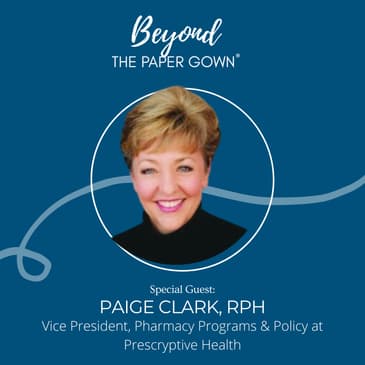

Pharmacist Paige Clark, Vice President of Pharmacy Programs and Policy at Prescryptive Health, guides us through the often-confusing world of medications and healthcare technology. Drawing from her decades of experience, she shares insider tips on finding the best prescription prices and making the most of your pharmacy relationship. From maximizing generic medications to utilizing digital health tools, Clark offers practical strategies to help you take control of your medication costs and overall healthcare journey.
Please visit Beyond the Paper Gown to join our community and to learn more about achieving your optimal health.
SHOW NOTES:
Paige Clark, RPh, Vice President, Pharmacy Programs & Policy at Prescryptive Health
Mitzi Krockover, Founder and CEO, Woman Centered, LLC and Host of Beyond the Paper Gown
Big Pharmacy-Benefit Managers Increase Drug Costs, FTC Says, Wall Street Journal (paywall protected)
The Opaque Industry Secretly Inflating Prices for Prescription Drugs, New York Times
[00:00:22] Does the following sound familiar? You go into a pharmacy and you're told the price of your prescription and then asked if you have an app that might get you a discount. Ever wonder why there's more than one price? And then you're asked to wait to be counseled by the pharmacist but the line's too long and you think, do I really need to stay? And is there an app for that? Well today we're going to answer those questions and more so you can better understand how to make the system work for you to access affordable medicine.
[00:00:52] Learn more about the medicines you're taking and why you should partner with your neighborhood pharmacist. Hi, welcome to Beyond The Paper Gown. I'm Dr. Mitzi Krockover. I had the delightful opportunity to speak with Paige Clark, registered pharmacist who offers a compelling window into the evolving world of pharmacy and healthcare technology. As the Vice President of Pharmacy Programs and Policy at Prescriptive Health, Clark brings decades of experience from both academic and practical pharmacists.
[00:01:37] to shed light on the challenges and opportunities in modern pharmaceutical care. There are many questions about the world of pharmacy, the ecosystem of pharmacy, pharmaceuticals, medications, how they get to us, how they don't get to us, formularies, payment models, all of it. It is just a very tangled mess and I'm delighted to be here today to answer questions and to share what I hope will really be some useful
[00:02:06] background for people, number one. And number two, that they can walk away with a little bit of a toolbox and some really, really helpful tips and advice as to how to navigate the pharmacy landscape, what to look for, and how to make, if you will, a pharmacist work for you really, really well.
[00:02:28] According to Clark, the pharmacy world has changed dramatically. What was once seen as primarily a dispensing role has expanded into other responsibilities for pharmacists, such as being part of a clinical inpatient team, for example, coupled with the explosion of new pharmaceuticals and therapeutics.
[00:02:45] This transformation is reflected in the education requirements for modern pharmacists.
[00:02:50] Starting in the education requirements for modern pharmacists.
[00:03:20] That it transitioned into what is known as a PharmD or a doctor of pharmacy program right in that time frame.
[00:03:28] So that you would have a four-year collegiate undergrad in a hard science, biology, chemistry, quite often chemistry, but biology, chemistry, you know, any of the standard core sciences.
[00:03:42] Then you would have a four-year graduate degree on top of that.
[00:03:49] Really? Oh, my goodness.
[00:03:50] And so we're talking about eight solid years of education of this healthcare professional.
[00:03:58] And in order to use that training, the pharmacists are licensed by the Board of Pharmacy in their state.
[00:04:03] One of the requirements of their job is to offer counseling on new prescriptions.
[00:04:08] Frankly, though, sometimes you may just not want to wait for that counseling.
[00:04:11] But Clark insists it's worth your while to hear what the pharmacist has to tell you.
[00:04:16] And it's also a good idea to identify a pharmacist that you can trust.
[00:04:21] You know, one of the, hopefully one of the most useful things that I can bring to today's conversation and to our listeners today is the thought and the advice that every person owes it to themselves
[00:04:37] to seek out and find a pharmacist that they absolutely connect with, they trust in the community setting, and who they can leverage as the amazing resource that this professional should be for every single family out there.
[00:04:56] I always like to encourage all of my friends, all of, you know, everyone that I come across, have you found a good pharmacist?
[00:05:03] And that means something different to everyone.
[00:05:07] And you are right.
[00:05:08] Pharmacists are, by Board of Pharmacy, by their licensure and their Board of Pharmacy, they are required in every single state in the nation to offer counseling on a new prescription.
[00:05:22] The interesting thing is to watch the general public, if you stand back, they'll go, oh, no, no, I'm in a hurry.
[00:05:28] I don't need that.
[00:05:28] And I'm like, no, no, no, please, please wait for that pharmacist to step over.
[00:05:36] And explain to you what that pharmacist wants you to know about that medication.
[00:05:41] It can be crucial.
[00:05:43] It can be, if you don't take this with food, you will not be able to tolerate this.
[00:05:47] You will not be able to, you know, X, Y, and Z will happen, etc.
[00:05:50] Or when I say three times a day, I do not mean, oh, three times whenever I can get it.
[00:05:58] I mean every eight hours.
[00:06:01] Break up that 24-hour period and you will take that medication three times a day every eight hours.
[00:06:08] And some medications, as you well know, you know, because of how they are dissolved, how they are metabolized, how they are excreted in our system, this matters enormously in the outcomes that patient's going to get from that medication.
[00:06:22] Pharmacists are the most accessible health care provider out there and most people underutilize that resource.
[00:06:29] Perhaps nowhere was the importance of pharmacists more evident than during the COVID-19 pandemic.
[00:06:35] I don't know what COVID would have looked like nationwide in small rural communities, in large urban settings,
[00:06:44] had we not been able to, frankly, fully leverage the ability of the fact that there is a pharmacy, or there was a pharmacy, on every corner, in every community, somewhere.
[00:06:59] However, this accessibility is increasingly under threat.
[00:07:03] There are a growing number of pharmacy deserts, areas where access to pharmacy services is limited or non-existent.
[00:07:10] These deserts aren't just a rural phenomenon, and according to Clark, the problem is exacerbated by the payment methods to pharmacies.
[00:07:18] Pharmacy deserts would mean a dearth.
[00:07:21] We don't have a pharmacy.
[00:07:23] It's a desert.
[00:07:24] There is no pharmacy within XYZ that is, you know, easily gotten to.
[00:07:31] A lot of people assume that's happening only in rural areas, a pharmacy desert.
[00:07:38] I'm certain to know it's also happening in urban settings as well.
[00:07:42] And sometimes it's happening in patient population areas of urban settings where there might be challenges with a variety of languages being spoken.
[00:07:52] And when we lose a pharmacy, perhaps an independent pharmacy, you know, individually owned pharmacy, in which a pharmacist maybe has staffed with pharmacy staff that speak a variety of languages, that loss is significant.
[00:08:14] All of this for pharmacies coming out of deserts is really attributed to really perverse payment systems.
[00:08:27] It's very difficult because pharmacies are not being paid what they can sustain themselves on any longer.
[00:08:36] And we are massively losing pharmacies across the nation.
[00:08:40] We're seeing it at the chain level.
[00:08:41] Even chains are closing certain sites, which is shocking and has gotten everyone's attention.
[00:08:49] And so we really need to correct this payment problem to keep these pharmacies in business.
[00:08:55] This is where Clark's current work with prescriptive health comes into play.
[00:09:00] The healthcare technology company aims to bridge these gaps through digital solutions.
[00:09:06] Prescriptive really seeks to empower patients, provide patients with excellent information at their fingertips.
[00:09:15] And by that, I mean, on their own cell phone, because frankly, particularly post COVID, I think even my geriatric elderly mother, you know, can shop on her cell phone, can do, right?
[00:09:28] And so having information, accurate information at our fingertips, utilizing and leveraging the technology that we have today is such an important way to think about healthcare.
[00:09:42] Through their MyPrescriptive platform, users can manage prescriptions for themselves and family members, compare medication prices across pharmacies, track insurance coverage and pricing, and access important medication information.
[00:09:56] And there's no cost to the consumer.
[00:10:00] And speaking of cost, we discussed one of the most pressing issues in healthcare, the price of prescriptions.
[00:10:07] Clark pulled back the curtain on the complex world of pharmaceutical pricing, introducing us to terms like PBMs, which stands for pharmacy benefit managers, which function as middlemen between the pharma companies and payers, like insurance companies, and the employers who partner with the health plans.
[00:10:25] She went on to explain PBMs' role in the current crisis.
[00:10:30] PBMs determine what goes on formulary, what doesn't go on formulary, what you're going to pay for it on formulary.
[00:10:36] If it's going to be in Tier 1, Tier 2, or Tier 3 on formulary, and there go your different levels of, you know, co-pays that you're going to pay as a patient.
[00:10:46] There are employers in the middle of this.
[00:10:48] Employers purchase health plans on behalf of their employees, and they are not even able to accurately see prices.
[00:11:01] And it gets very, very complicated and very convoluted very quickly.
[00:11:06] This opacity in pricing leads to situations where the same medication might cost dramatically different amounts at different pharmacies, even within the same neighborhood.
[00:11:15] It's a system that Clark believes needs fundamental reform.
[00:11:19] For more information on PBMs, do check our podcast notes for recent articles that explore the impact of these companies on prescription costs and access to drugs.
[00:11:34] Of course, the conversation turned to women.
[00:11:37] That's what this podcast is all about, right?
[00:11:39] While women make approximately 80% of healthcare decisions for their families, we've been underrepresented in pharmaceutical research,
[00:11:47] which means there's a lot we don't know about how medicines perform or affect women.
[00:11:52] Clark's response is passionate and direct.
[00:11:56] It is absolutely true that we need far more data, we need far more studies, we need women included in every single study possible out there.
[00:12:04] And women's care needs to be a very top priority.
[00:12:09] This gap in research has real-world implications, particularly for pregnant women trying to navigate medication safely.
[00:12:17] Because pregnant women were not included historically in clinical trials for obvious reasons, it's hard to know what medicines are safe to take during pregnancy.
[00:12:27] Pharmacists can help sift through the data to let you know what has been deemed as safe.
[00:12:31] But even beyond that, pharmacists can also offer practical advice to make the pregnancy journey easier.
[00:12:39] You know, if one is able to plan, right, and have a very planned pregnancy, you have absolutely not only got to find a great physician, you've got to find a great pharmacist.
[00:12:48] You're going to be wanting to take supplements.
[00:12:50] You're going to want to take vitamins.
[00:12:53] You're going to have questions probably every single day of your pregnancy about,
[00:12:57] I have a headache, what should I take, what can't I take, etc.
[00:13:01] Every person is slightly different and every individual is different.
[00:13:06] And it's imperative that you're able to help a patient sort out, probably in conjunction with their primary care provider or their OB-GYN.
[00:13:20] There are all kinds of things that as a pharmacist, I've had women come to me and say,
[00:13:25] I cannot tolerate these, you know, natal vitamins.
[00:13:31] I'm like, all right, here's what we're going to do.
[00:13:33] We're going to line up some peanut butter and some jam on the counter.
[00:13:37] And we're going to try a little scoop of peanut butter and we're going to roll it like I would for a child.
[00:13:41] And down it goes.
[00:13:42] And you may be able to tolerate that, not in the morning, but at night.
[00:13:47] Or with your largest meal, you're going to eat a third of your meal.
[00:13:50] You're going to roll this thing in peanut butter.
[00:13:52] You're going to swallow it and you're going to eat the rest of your meal.
[00:13:55] And we're going to go on with a golden life here.
[00:13:57] I mean, things like that.
[00:13:59] Or, oh, I can't stand that.
[00:14:01] Great.
[00:14:02] Let's roll it in a little bit of jam like I would for a two-year-old that I have to get something down.
[00:14:08] And we're going to have a quick sip of water and you're going to keep it down.
[00:14:12] These are the types of things that I think pharmacists are very attuned to because we deal with it all day long every day.
[00:14:24] One of the most common questions pharmacists face concerns generic medications.
[00:14:30] Clark provides nuanced insight that goes beyond simple cost comparisons.
[00:14:34] A generic, by definition, is required to be 80% the same, 80% the same as a brand name.
[00:14:46] Now, that may not be clinically significant.
[00:14:49] It's about clinical significance.
[00:14:51] Is that clinically significant?
[00:14:53] I will say it depends on the generic company.
[00:14:57] It depends on the patient.
[00:15:01] And in my opinion, it depends on what disease state we're talking about.
[00:15:05] She particularly emphasizes the importance of consistency in certain medications using thyroid medication as an example.
[00:15:13] The key, she explains, isn't necessarily choosing brand over generic,
[00:15:18] but maintaining consistency once you find what works.
[00:15:22] We want consistency.
[00:15:24] We want predictability.
[00:15:26] We want the same dosing.
[00:15:30] The last thing you want is somebody beyond 90 days of something and then, boom, we flip them to something else.
[00:15:35] We may not have the same outcomes.
[00:15:37] So if you find a generic that works and the brand is switched,
[00:15:41] it's worth having a conversation with your pharmacist about keeping your original brand.
[00:15:46] As I mentioned before, pharmacist roles are evolving and expanding to meet community needs.
[00:15:52] Many of us now get our vaccines administered by a pharmacist at our local drugstore, for example.
[00:15:58] Clark describes some groundbreaking initiatives she experienced as a pharmacist in Oregon.
[00:16:03] It has been a joy and one of my professional highlights to be an Oregon licensed pharmacist
[00:16:10] and to have been very fortunately with a group of us in a position that we began to stand up
[00:16:18] at the direction of our governor, the governor's health policy advisor,
[00:16:23] and our legislature who passed statute and then we rolled out rules so that pharmacists could,
[00:16:31] from a public health standpoint, assess a patient in a community pharmacy setting
[00:16:38] for purposes of prescribing birth control.
[00:16:41] This expansion of services now includes tobacco cessation programs and HIV prevention in many states,
[00:16:49] representing a significant shift in how pharmacists provide services in our healthcare system.
[00:16:55] As our healthcare system continues to evolve, Clark sees a future where technology and personal care
[00:17:01] work in harmony.
[00:17:02] Through her work at Prescriptive Health, she's helping to create tools that empower patients
[00:17:07] while maintaining the crucial role of healthcare professionals.
[00:17:10] Technology is not everything.
[00:17:14] Sure.
[00:17:14] It's a tool to help us access good information and maybe collate or put together the pieces
[00:17:24] like we have in our digital medicine cabinet for people, right?
[00:17:28] It's a tool to help you do that.
[00:17:31] Our conversation ended with Clark's vision for the future of pharmacy care in America.
[00:17:36] She advocates for a system rebuilt with transparency at its core, where technology empowers patients,
[00:17:43] and where pharmacists are fully utilized as the healthcare professionals they're trained to be.
[00:17:49] So really, I think where we are going to evolve in this nation is truly having pharmacists
[00:17:58] leveraged in the entire population of the United States in an entirely different way.
[00:18:22] I hope you enjoyed this conversation with Paige Clark, who really provided important information
[00:18:41] about the modern pharmacy landscape.
[00:18:44] Her insights reminds us that your local pharmacist is so much more than someone who just fills prescriptions.
[00:18:50] They're highly trained healthcare professionals who can be invaluable partners in your healthcare journey.
[00:18:57] A few key takeaways to remember.
[00:18:59] Don't skip that medication counseling session, even if the line is long.
[00:19:04] It could make all the difference in how effective your medicine is.
[00:19:08] And those prescription prices that are all over the place?
[00:19:11] They're a symptom of a complex system involving PBMs or, as we learned, pharmacy benefit managers
[00:19:17] and other middlemen that Clark suggests need serious reform.
[00:19:21] For now, using technology like the prescriptive health platform can help you navigate the pricing maze.
[00:19:28] Perhaps most importantly, Clark's advice to find your pharmacist, someone you trust and connect with,
[00:19:35] could be game-changing for your healthcare.
[00:19:37] As she points out, if you're taking more than three medications,
[00:19:41] having a knowledgeable professional looking at the whole picture is crucial.
[00:19:45] I know that even with my medical training, I've often called on the pharmacist to answer prescription-related questions,
[00:19:52] both for my patients and my own family.
[00:19:55] As we navigate the future of healthcare, Clark's vision of combining technology
[00:20:00] with the irreplaceable human touch of healthcare professionals
[00:20:04] offers hope for a more transparent, accessible, and effective pharmacy system.
[00:20:10] After all, she reminds us, medications are our number one tool in the healthcare toolbox,
[00:20:16] and we need to make sure everyone can access them effectively and affordably.
[00:20:22] I invite you to visit our website with even more information and resources,
[00:20:26] and while you're there, sign up for our newsletter.
[00:20:29] I also invite you to download our podcast on your favorite platform, and please do rate us.
[00:20:35] Thanks for listening, and take good care.
[00:20:37] Our podcast was produced by Patrick Shabayati and me,
[00:20:51] and our associate producer is Kyla McMillian.