
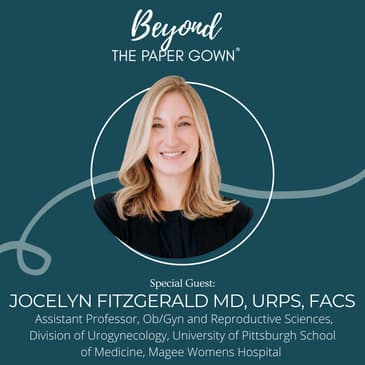

This episode features Dr. Jocelyn Fitzgerald, Assistant Professor of Obstetrics and Gynecology in the Division of Urogynecology and Reconstructive Pelvic Surgery at the University of Pittsburgh School of Medicine. Dr. Krockover and Dr. Fitzgerald have a candid conversation about how women's surgical procedures may get paid less than similar procedures for men. They explore how this payment gap can make it harder for women to get the care they need and impacts their overall health. Dr. Fitzgerald shares real examples from her research and clinical experience to illustrate how we got here and how these disparities affect access and quality of care. She also discusses the implications for policy and advocacy in striving for healthcare equity and what women can do to get the care they need.
Please visit Beyond the Paper Gown to join our community and to learn more about achieving your optimal health.
SHOW NOTES:
- Mitzi Krockover, Founder and CEO, Woman Centered, LLC and Host of Beyond the Paper Gown
- Jocelyn Fitzgerald MD, URPS, FACS Assistant Professor, Ob/Gyn and Reproductive Sciences, Division of Urogynecology, University of Pittsburgh School of Medicine, Magee Women's Hospital
- Price and Prejudice: Reimbursement of Surgical Care on Male Versus Female Anatomies
[00:00:04] Imagine needing surgery for a painful condition that affects your daily life, only to face a year-long wait while someone with knee pain gets treated within weeks. This isn't a hypothetical scenario. It's a reality many women face when seeking medical care, and the reason behind it might surprise you. It's because the system is structured so that many women's surgeries are valued less than others.
[00:00:30] Hi, welcome to Beyond The Paper Gown. I'm your host, Dr. Mitzi Krockover.
[00:00:48] Today we're going to talk about a troubling pattern of how women's health care procedures are less valued and result in less pay for the hospitals and doctors than even those that are equivalent to procedures for men. For example, a vaginal biopsy is reimbursed at just one-third the rate of a penile biopsy. This disparity isn't just about doctors' salaries. It fundamentally affects how hospitals allocate resources and operating room time.
[00:01:18] And this means women often face longer wait times and in some cases, no access to care at all. Today we're going to talk with Dr. Jocelyn Fitzgerald, Assistant Professor of Obstetrics and Gynecology in the Division of Urogynecology and Reconstructive Pelvic Surgery at the University of Pittsburgh School of Medicine about this troubling trend. Dr. Fitzgerald has had firsthand experience and perspective on this topic, and she's published a paper on her findings.
[00:01:47] We're going to talk about why this happens and what it means for your health. Welcome, Jocelyn. Thank you so much. It's so great to be here, to be back. I know. You were one of my first. I'm so honored. Oh, I tell you. It's awesome. You gave us such great information, and we're going to link to that as well.
[00:02:13] But today we're going to actually talk about something a little bit different in terms of, rather than medical conditions or issues, we're going to talk a little bit about advocacy and policy. And, you know, I'm sure our listeners are thinking, well, what does that have to do with urogynecology? But before we go there, let's talk a little bit about urogynecology and what it is that you do on a day-to-day basis and a little bit about your background.
[00:02:41] Yeah. And it has a lot to do with it. Urogynecology, which is a relatively young field of medicine in terms of its board accreditation and its sort of formal academic pursuits, I mean, honestly, less than 25 years, although there have been urogynecologists before that, is a field of medicine that is really focused around the female pelvic floor and really anything that can happen to it.
[00:03:08] So a lot of that starts off, although not all, with birth injury. A huge majority of women give birth in their lifetime. And as you can imagine, any sort of muscular injury or fitting a watermelon out of a small hole can create a lot of injury to the structures around it. And near a baby's exit point is the bladder, the rectum, the uterus, the vagina, the pelvic floor,
[00:03:37] all of its nerves and supports, the hip, the pelvic girdle, the lower back, the upper legs. So we really treat urinary incontinence, pelvic pain, prolapse of the uterus and vagina, dysfunction, which is really when things fall out. You know, it's really when the vagina protrudes out of its opening. And that can happen a little bit. And it can happen a lot. It can be quite dramatic and often require surgery.
[00:04:06] In fact, close to a quarter of women will have vaginal prolapse surgery in their lifetime. So that's the kind of surgery that I do. And then we overlap strongly with the surgeons and physicians who take care of endometriosis and other types of chronic pelvic pain. So our scope is expanding all the time.
[00:04:26] And the demand is very, very high, which has led me down the road of reimbursement and how that affects my ability to access operating room time and access the resources I need to take care of this really large and growing patient population. Sure. So talk a little bit about the issue about what is reimbursement when we talk about that. Who decides how you're reimbursed?
[00:04:56] Yeah. I mean, how much time do we have? Not enough on a podcast. I think anyone who has interfaced with the U.S. health care system and paid for the health care that they receive knows that it is a very muddy process and system. It's not very transparent. And so nailing down how health care services are reimbursed or paid for, who sees that money and who's spending that money
[00:05:26] and how it affects the rapidity and access with which we can provide that care to patients is very nebulous. However, there are some metrics that are very easy to add up and see. And so the easiest way that I found to really drive this point home when I'm talking about why reimbursement matters in women's health is something called the RVU system.
[00:05:53] And an RVU stands for relative value unit. And it is most applicable in the surgical realm and the procedural realm because you can say like a hysterectomy is worth X number of relative value units. And as you might imagine from the name, relative value unit is like a monopoly money term. It can be defined lots of different ways by lots of different payers.
[00:06:20] You hear relative value and all that means is it's like some arbitrary unit that tells you how much a certain procedure is worth relative to other procedures in medicine. And in theory, the calculation that's used to decide what procedures are worth what RVUs has a lot to do with the risk involved, the time involved, the resources needed, the difficulty, the training of the provider, etc., etc. So why is this important in women's health?
[00:06:49] It's important in women's health because most procedures in women's health are deemed to be relatively valued at a lot less than other procedures that would be considered to be equivalent in terms of their acuity, skill, resources allocated, etc. And as you might imagine, let's just say, for example, hysterectomy is worth it is worth around 10 to 16 RVUs, depending.
[00:07:17] We'll just say 10, even though it's a little more than that, but for simplicity. And then let's say you have a knee replacement, which is worth probably like 20 RVUs. Maybe they take a similar amount of time, similar amount of our resources.
[00:07:32] If you are running a hospital and you are trying to keep your lights on, you are going to be more likely to make sure that more knee replacements are done in that hospital than hysterectomies because you're going to recoup more money for that knee replacement.
[00:07:49] And so you see those things happening downstream in terms of how many hospital facilities are prioritizing women's health, how many operating rooms they're giving, how many nurses they're hiring in women's health is much less. And even sometimes totally eliminated compared to these other specialties and fields of medicine that can build so much more. Have you experienced that or how have you experienced that? I have experienced that.
[00:08:16] And I've also experienced the ways in which though having the right leadership in a hospital can protect you by bringing in those other specialties in a women's health hospital setting like mine to sort of like mitigate the losses that happen from gynecologic surgery.
[00:08:33] But I will say this, that where I practiced and trained in Washington, D.C. when I was doing my urogynecology training, that surgery center no longer provides women's health surgical services. It did and up until around 2022 when I was there, but they stopped providing those services.
[00:08:55] My friends across the country tell me all the time that their operating rooms are given away to orthopedic surgery, to plastic surgery, to urology, people all over the country. I practice rural medicine a couple of days per month. Labor and delivery units closing in most rural counties in America. Only 50% of counties in America have OB services. People wonder why that is.
[00:09:18] Some of it has to do with other policy like reproductive justice issues, which isn't the scope of this podcast, but a lot of it just has to do with the bottom line and that it's a money losing situation because of how undervalued all of these OBGYN services are relative. It's literally in the word relative value unit relative to these other procedures that other specialties are doing.
[00:09:44] Do you think that that's also a reason why so many GYNs are leaving the profession? I think it's a big reason. There was just a Doximity article that came through my email yesterday where they have polled medical students asking them how important what you get paid is to the specialty you go into.
[00:10:06] And anyone who thinks that medical students aren't with these huge loans and huge costs of living aren't thinking about how much they'll get paid when they're done with medical school is lying to themselves. It does matter to people quite a bit. And as you might imagine, fewer people may want to go into OBGYN. Thankfully, actually, OBGYN has become a very competitive specialty because of a lot of the kind of incredible reach and social impact.
[00:10:36] It is a very popular specialty still. However, it definitely creates some real brain drain. You wonder to yourself, are we getting the best researchers? Are we getting the best and the brightest? Because are the best and the brightest going into radiology or, again, orthopedics, urology, plastic surgery, dermatology, places where the relative value units are a lot higher. And I can talk more about kind of how we got here and why we haven't just fixed this. Right. Of course.
[00:11:03] Well, before we do that, you know, one thing is that I just saw that Medicare is going to reimburse physicians 3% less next year. Yes. And so I'm assuming that, you know, again, that, again, affects you because you're doing a lot of incontinence work and that kind of thing in pro lab. It's across the board. Exactly.
[00:11:22] And then the second thing is, is that in the back of my mind, I'm probably, I'm hearing potentially our listeners going, you know, that's, it's hard to feel sorry for a doctor, right? Absolutely. Don't you guys make a lot of money and, you know, X, Y, and Z. And of course, again, the time that it takes to become a doctor, the loans that are taken out in order to support that, you know, are significant.
[00:11:49] But I do think that there is a misconception that the minute you get out of medical school or residency, you know, you're on the gravy train. Yeah, you're buying a gold toilet. Yeah, I'm so glad you brought that up. And that is such a good point. And I think that actually that taboo is a big reason people haven't talked about this sooner. It's like, oh, woe is me. You make a great living. Yeah, I do. I am absolutely able to support myself. Well, no one is saying that doctors are not well paid.
[00:12:16] There's a separate podcast to be said about, you know, relative to the amount of training and sacrifice and skill that is required to become a surgeon. We're, you know, in America, happy to pay for a lot more money for entertainment than we are for our medical professionals. But that is not the scope of this. The scope of this is to point out that number one, OBGYNs are paid. We're the lowest paid surgeons in medicine.
[00:12:44] So all we're really asking for is to be paid the market value of the standard sort of market equivalent of what a surgeon, a highly skilled surgeon would get paid. So that include, excuse me for interrupting. Does that include a subspecialty like yours? Including a subspecialty like mine. Yeah. That takes even more time in training. Exactly. It takes even more time.
[00:13:07] And an interesting thing that happens is in urogynecology specifically, you can become a urogynecologist from gynecology residency or from urology residency. Very, very few, less than 5% of urology residents go into urogynecology because they lose money doing training on women. They make so much more money just being a general urologist doing less training than becoming a urogynecologist. They lose money to take care of women and they know it.
[00:13:36] And which, by the way, urology, the majority of those patients are men. Absolutely. And the majority of the patients are men, which leads me to sort of my next point, which is that we know from studies I have done and others have done that the relative value of men's reproductive body is worth much, much more.
[00:13:59] So we know that, for example, equivalent procedures done on women that are done on men, a vaginal biopsy versus a penile biopsy reimbursed almost triple on male anatomy. And most outpatient procedures, particularly office procedures that are equivalent in terms of their pain for the patient, skill required of the doctor, time to do the procedure on an equivalent body part, male versus female.
[00:14:29] And I mean that when I say, again, like gynecology versus urology. We're talking about like genitals here, reimbursed at least 50% more if it's done on a man's body than a woman's. So you can see how, you know, a urologist would consistently be not only paid more money the doctor, but what we need to really care about here is they make more money for the hospital.
[00:14:54] The hospital system for the healthcare stakeholders, they generate more revenue, which means don't feel bad for me and my salary. Feel bad for yourself as a woman that your body is worth less to healthcare and administrators and hospital systems than a man's body is. And so guess what? They're not going to give you as much time of day.
[00:15:19] And you had given another example about vasectomies versus tubal ligation. Mm-hmm. Yes. Talk about the technical aspects and the difference in reimbursement there. Yeah. And you know what? The reimbursement for those two, I think in response to some activism has come closer. Vasectomy is still reimbursed more.
[00:15:43] So yes, vasectomies do reimburse better than tubal ligations do. It used to be about double. It's not anymore when you look at the RVUs, but when you look at the amount of money that the hospital generates, it's absolutely still more. And many people would argue, is it worth the same?
[00:16:05] A tubal ligation probably is worth, from a skill, from a patient pain, from a downtime perspective, worth a lot more than a vasectomy. Vasectomy can be done under local anesthesia on an office table versus getting your tubes tied or having your tubes removed. It requires going intra-abdominally, a laparoscopic procedure. Anesthesia is involved. Or time is involved. It's much riskier. So I think it probably are not worth the same. And it requires more resources, it sounds like.
[00:16:35] Way more resources. So if you're only getting, yeah, let's just say 10 RVUs. I think that's around actually what it is. 10 is a good number. Exactly. If you're only making 10 RVUs to involve an anesthesiologist to use very expensive operating room time, to use all this expensive equipment, versus you can do a vasectomy for the same 10 RVUs and you need very little equipment and very little resources,
[00:16:58] you're going to save your margin, your profit on that same 10 RVUs is going to be so much bigger compared to the two bowl. Sure. And now let's talk a little bit about what I know is important to both of us, and that is the impact on women. At the end of the day, how is this changing the healthcare or even health of women? Yeah. A lot of those studies are ongoing.
[00:17:27] You know, what we really want to show is that these, this reimbursement discrimination, which is what I really believe it is, against women. We do know that women have delayed diagnoses for almost all cancers for a myriad of embedded healthcare sexist reasons.
[00:17:48] However, is the lack of access to the physician specialists that they need because hospitals don't have as much operating room time to manage women's pain, to do these biopsies and to do the workup that's required. You know, women are waiting. Even where I work, which has an incredible infrastructure, this really speaks to the demand. The wait for endometriosis surgery is getting close to a year.
[00:18:17] You know, so how much time and money are we losing because we don't have, women are waiting so long for a diagnosis than waiting so long for surgery. Are they waiting longer than a person who comes in with knee pain, knee osteoarthritis and needs a knee replacement? I don't even think you even need to do that study. You just need to work in healthcare to know that, of course, like that knee is going to be taken care of faster. But, you know, we need data.
[00:18:48] Yeah. You know, and just to kind of underline what you're saying. So you think about endometriosis, which is usually very painful. It can impact on fertility. And so if you're someone in pain or trying to have a baby, time is important. Yeah. Time is important. And does it affect your outcome to wait longer?
[00:19:13] Because the resources for women who need women's reproductive care is longer because hospitals don't see it as a moneymaker. I think it probably, there has to be an effect. Of course. You were saying earlier about how we got here. So talk a little bit about that. Yeah.
[00:19:39] So whenever I sort of tell this story, people say like, well, surely you can just go to CMS, Centers for Medicaid and Medicare Services, and point this out. And, you know, do an analysis, show them their research, and they can just make it be worth more. And then you'd get paid the same as another specialty. And that way hospitals would say like, hooray, gynecology is profitable. We're going to prioritize it.
[00:20:05] Sadly, it's not that easy because when the RVU system came about, it was baked into the Social Security Act in the early 90s. And plugged into the RVU system is a budget neutrality clause, which basically means that there is a finite number of RVUs for all of medicine. And so every like specialty gets their own piece of the pie.
[00:20:29] At this point, they have like a certain number of RVUs that all of OB-GYN has, all of orthopedics has, all of urology has. And they basically are free to divvy it up amongst themselves. You can switch it over. Like in gynecology, like if you think OB, like a delivery needs to be worth more, you have to take it away from gynecology. And if you're like, oh, well, OB-GYN needs a bigger piece of the pie.
[00:20:50] You have to convince orthopedic surgeons and urologists and plastic surgeons and all the other specialties, ear, nose, and throat, like all of it, to give you some of their RVUs to make your procedures worth more. It's all decided in a meeting called the RUC, the RUC committee, which has basically one representative for every specialty. And guess what?
[00:21:16] Like none of these specialties are trying to make less money or get less resources for their patients. Rightly so. I mean, they have patients to advocate for too. They are not going to give away resources that their patients are getting because of how much the hospital values them to women's health. I mean, no one in their right mind would. I don't blame them.
[00:21:35] But because it has to stay at a finite level, there's really no way to get more unless they raise the RVU kind of roof, which there is some discussion of doing that now, or get rid of budget neutrality. The other problem, not to drone on and on, is that OB-GYN, which is an enormous field of medicine, it's like really two fields of medicine, I argue all the time. It's OB and gynecology.
[00:22:04] And gynecology includes gynecologic oncology, urogynecology, endometriosis surgery, family planning. And then on the OB side, there's MFM and general OB. Maternal fetal medicine. Exactly. Maternal fetal medicine. All of those are represented by one person that ACOG, who are majority general OB-GYNs, puts on that committee. And so, you know, I don't blame them also. Most of ACOG's membership are general OB-GYNs.
[00:22:33] They make most of their money delivering babies. But from a GYN surgical perspective, we have all these subspecialist GYN advanced surgeons who are very much getting left behind by that system. GYN surgery is not represented on the RUC anywhere. I'll also, this last thing I'll say about the RUC is that I go on there and I look at all the members. There's 32 members of the RUC and only five of them are women, regardless of specialty.
[00:23:00] So you can see how like women's health would not float to the top of things. People are trying to have be worth more dollars. Fascinating. You know, I'm thinking about, you know, if I was a lay person and listening to this, I'd start getting concerned. Yeah.
[00:23:22] And or I think, well, would it be better to go to a women's health or a women's hospital, for example? What are some of the things that our listeners can do to make sure that, you know, to help themselves kind of obviate this issue? That's a really amazing question.
[00:23:47] I would say there are not very many women's hospitals in the United States. I could maybe list like five of them off the top of my head. I am very lucky that I work at a women's hospital.
[00:24:04] And so just working at where I work at McGee Women's Hospital has exposed me to a lot of this because I have seen from sort of the business side how they have maintained their status in the community and also the emphasis and prioritization of women's health. But in the last 20 years, the hospital did bring in, it used to sort of be all mostly OBGYN services, brought in orthopedics, brought in vascular, brought in plastic surgery.
[00:24:33] A lot of those things are kind of what equalize and keep afloat. Like those resources do get redistributed among the hospital to kind of keep us all doing well. So that is very awesome. But the president of the hospital is an OBGYN. Like people in leadership of the hospital are OBGYNs who value women's health. You have to have people in positions of leadership who recognize the value of women's health and keeping it going.
[00:25:03] It isn't to say that women's health isn't profitable. It's just not as profitable, you know, in a lot of cases. OB is different. I'm not even really here that much to talk about OB, but OB is really in dire straits. There are some real problems with how OB is reimbursed. There's like a global fee for most pregnancies. And without a NICU, for example, NICUs are really what pay for OB services. Neonatal ICUs, yes. Tensive care units.
[00:25:33] Interesting. Well, that is a whole other subject, isn't it? Especially since 50% of our births are Medicaid, which is basically government subsidized insurance. It's usually not the highest paying. Correct. And OBGYNs, not to interrupt, but there are studies that show that they take care of proportionately a much higher proportion of Medicaid insured patients compared to other specialties.
[00:26:02] And there is also a conversion factor in these RVUs. That might be the next piece. I don't want to switch over that too fast. But different insurance payers pay different amounts per RVU. So I don't know the exact number for what Medicaid reimburses. Let's just say they pay $10 per RVU. A private insurer might pay $15 per RVU. RVUs are just magical units that don't mean anything.
[00:26:28] So you could also see how a hospital would be more inclined to want to take a patient population that has more private insurance than an OBGYN population that is more likely to be insured by Medicaid. And I'll just underline that some folks have insurance that requires a referral, but it still is important to have that information, to have that discussion with your primary GYN if that's who it is or your primary care provider.
[00:26:57] Agree completely. I have patients who have walked into their primary care doctor's office and said, I would like a referral to urogynecology. I think that that's what I need. I have recurrent UTIs. Please refer me. And I think that most primary care doctors would be thrilled. That's a very easy appointment for them. Do I think that's a great system? You have to go and pay a copay just to get another referral? No. No. Maybe you can message them through a portal and say, hey, could you please put in a referral?
[00:27:26] That might be a cheaper and faster even option. This has been a really fascinating conversation. What did I not ask you that you think is important for our listeners to hear? Right now, healthcare is an enormous business. Some healthcare systems are more ethical about it than others.
[00:27:50] But if you don't look for where money is going, if you ever find yourself saying, wow, this is a very highly skilled, highly sought after service. Very high demand. But then it has very low reimbursement. That means the law of supply and demand is not working. And it should always work in capitalism.
[00:28:16] So if it's not working, you could pretty safely assume there is some sort of discriminatory system that is handcuffing that need from being profitable. Because there's no reason that highly skilled women's healthcare services shouldn't be worth billions if not trillions of dollars. That is what the McKinsey report that was done earlier this year showed. Insurance companies don't have to do what CMS has told them. That's another piece. I'll add that.
[00:28:46] The RVU system is what Centers for Medicaid and Medicare Services use. And insurance companies are not beholden to it whatsoever. They tend to adopt it as a guideline. But they don't have to. So, you know, insurance companies can decide how much they think women's health is worth. They can change it. They can also decide how many dollars per RVU they think women's health is worth. And that happens a lot too. There's even procedures I do that urologists also do.
[00:29:15] It's literally the exact same surgery. Like exactly the same. And they can get paid more for that same surgery simply because they're trained as a urologist. And that insurance company has decided that urologists get $50 per RVU and I only get $40 per RVU. So that's another, it's like a third layer of this, of like this pay inequity and this profit inequity that drives what healthcare is being offered readily in healthcare systems. That matters.
[00:29:42] And so if you work in a healthcare company and, you know, you think women's health is worthwhile, look into it. Is there a legislative aspect to this? I believe that there is. I have consulted with my legislative colleagues to try and find a legislative path forward.
[00:30:04] Yes, a congressional report that would then lead to like a reevaluation of budget neutrality could be a piece of this. Health and the, the director of health and human services could single-handedly probably change this on their own. Um, if they wanted to, and then, um, Dr. King, who's an endometriosis surgeon, but also a lawyer, um, has written a law review on the subject, um, with colleagues, I believe at Emory University.
[00:30:33] It was published a few months ago where they've gone through like the legislative routes and the, the legal routes showing that this is truly discrimination against women. Thank you so much for this really illuminating conversation. Um, I, it's kind of like you, once you hear this, you can't unhear it. I know. And, uh, hopefully, uh, it will, uh, not only raise some eyebrows, it'll raise some awareness.
[00:31:00] So Dr. Jocelyn Fitzgerald, thank you so much for being with us. Thank you so much for having me. Dr. Fitzgerald's insights expose a stark reality in our healthcare system. One where women's bodies are literally valued less than men's. This isn't just about doctor salaries or hospital profits.
[00:31:26] It's about women waiting a year for endometriosis surgery while knee replacements get fast-tracked. Rural hospitals closing their labor and delivery units and life-saving women's health procedures being deprioritized because they're not as profitable. But knowing about this problem is the first step to fixing it. If you need women's health services, consider seeking out hospitals and facilities that specialize in women's health.
[00:31:54] Dr. Fitzgerald also suggests asking for referrals to specialists early from your primary care physician. And don't hesitate to advocate for yourself. Most importantly, we can all spread the word. Share this information with friends, family, and especially anyone who works in healthcare or policy. The more people who understand this issue, the better chance we have of creating real change in how women's healthcare is valued and delivered. And that's good for everyone.
[00:32:25] Thanks as always for listening. I encourage you to subscribe and rate us at your favorite podcast platform and visit our website at beyondthepapergown.com. You can sign up for our newsletter and keep up to date on new podcasts, women's health news, events, and more. Until next time, take good care.
[00:32:55] Our podcast was produced by Patrick Shabayati and me, and our associate producer is Kyla McMillian.