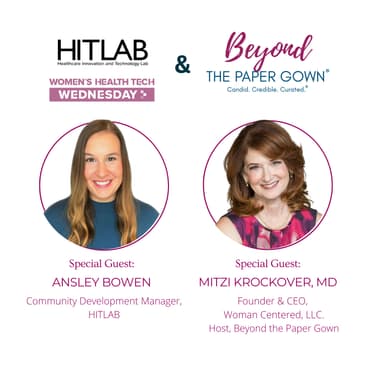

Beyond the Paper Gown host, Dr. Mitzi Krockover, joined HITLAB’s Women’s Health Tech Wednesday symposium with moderator Ansley Bowen to discuss the latest innovations in women's health. From AI and telehealth to menopause solutions and maternal health, she explores the transformative technologies shaping care for women. Tune in as she shares insights on investment in femtech, the need for more research, and how policy changes can drive better health outcomes. Don’t miss this thought-provoking conversation!
Please visit Beyond the Paper Gown to join our community and to learn more about achieving your optimal health.
SHOW NOTES:
Mitzi Krockover, Founder and CEO, Woman Centered, LLC and Host of Beyond the Paper Gown
[00:00:14] Welcome to Beyond The Paper Gown. I'm Patrick Shambayati, co-producer of the show. As regular listeners know, Dr. Mitzi Krockover, our host, brings you conversations with innovators and leaders who are transforming women's healthcare. Today's episode is a bit different. Dr. Krockover was recently invited to talk about women's health on the webinar series, Women's Health Tech Wednesday, sponsored by HitLab.
[00:00:38] The following is the audio version of the interview, recorded on January 8th, 2025. You'll hear Dr. Krockover sharing her own insights as she's interviewed by Ansley Bowen of HitLab's Women's Health Tech Wednesday webinar series. HitLab, the Health Innovation Technology Lab, is a leader in evaluating and accelerating digital health solutions, including a particular focus on addressing gaps in women's healthcare innovation.
[00:01:05] In this conversation, Dr. Krockover offers her unique perspective on how technology and innovation are reshaping women's healthcare, drawing from her extensive experience as a physician, innovator, and investor in the field. Thank you to HitLab for allowing us to share this thought-provoking discussion with our Beyond The Paper Gown audience. Without further ado, I would love to introduce our guests for today. Today we have Dr. Mitzi Krockover, who is the host of Beyond The Paper Gown.
[00:01:34] Thank you so much, Mitzi, for being with us today, and I'd love to hand it over to you for a quick introduction. Hi, Ashley. Thank you so much. It's a pleasure to be here. I am Mitzi Krockover. I'm an internist by training in previous practice, was the former medical director, founding medical director of the Iris Cantor UCLA Women's Health Center, and then vice president at Humana Women's Health.
[00:01:56] And most recently have become an investor and very focused on innovation in women's health, as I really see this as the way we're going to advance it. And I am a managing director of Golden Seeds, which is an angel investment organization that focuses on funding early-stage women-led companies. And we have a health sector group that I co-lead. We look at everything from life sciences to wellness.
[00:02:22] And I, of course, my sweet spot is women's health. And I also have, as you mentioned, a podcast called Beyond The Paper Gown. And I'm so curious to know, what led you to pursue a career in women's health? You know, it was, I didn't intend to do that, honestly. It was kind of, I hate to sound like this, but it was kind of a calling.
[00:02:45] When I joined the faculty at UCLA, they asked me, and this was, again, before women's health was a buzzword or a buzz term, what are you interested in? And I literally heard myself saying women's health. And so, you know, and I was so fortunate to work with some incredible colleagues who also were passionate about women's health. And when we got the opportunity to create the center, it was really a wonderful opportunity.
[00:03:13] That sounds amazing. I love when, you know, you hear about people's career and what they're doing. And sometimes you just kind of fall into it in a way, but it works out in the best way possible. So I love that you were able to do something that you were passionate about also. Thank you. Yeah, it's, you know, and it really has guided my life, you know, ever since then. So, and I have now two daughters, so it becomes even more personal as well.
[00:03:39] Yeah, absolutely. And as you mentioned, you are the host of the Beyond The Paper Gown podcast. I would love if you could share what inspired you to create it. Sure. Well, the real light bulb moment for me came when I went to a conference for providers, for, you know, physicians on women's health at a very prestigious organization, institution. And they were focusing on pelvic health on one of the lectures.
[00:04:05] And I raised my hand because they hadn't talked about some of the innovations I knew were already on market, FDA approved, and there was these blank stares. And I realized that physicians as busy as they are and focused as they are don't always have time to know about the latest and greatest innovations. And then therefore their patients probably don't know. So that was kind of my impetus to start the podcast and to really explain that.
[00:04:32] And I've always felt strongly that women's health is more than just your medical conditions. We are affected by so much, whether or not research has been done. And we know that that, you know, again, has been a challenge. Policies and politics, as we know so well, and what we call social determinants of health. You know, where we live, is it a food desert? Is there nutrition available? Is there transportation? Is it safe? Is it safe?
[00:04:59] And all of those kinds of things, as well as those innovations. So what I really wanted to do was talk to the clinicians and the scientists and the policymakers and the advocates and the innovators. And so that's what we do on Beyond the Paper Gown. Amazing. I love to hear that. Coming from a public health background myself, when I was going through my MPH program, I was constantly looking for ways that I could, you know, kind of be driving or, you know,
[00:05:28] working out or doing something where I could still listen and gain a better understanding of what's to come and kind of what's out there in the public health world. And there wasn't a ton of podcasts. So to know that you saw the need for that and started something and really helping to bring it to the people is amazing. And I just want to say that we definitely need more and more resources like this to really be able to spread the word because people are so busy, like you said, and it's so much easier when you're driving home to listen to a podcast than it is to sometimes read, you know, a paper.
[00:05:58] So I love that you brought that to the people. Thank you. And I'm very lucky to be a part of the Health Podcast Network. And so there's many podcasts in various specific areas as well. So I have a lot of colleagues that are doing the same in their area of expertise. Amazing. And as you did mention, you know, as a physician, what are some common misconceptions that women's health that are around women's health that you wish people understood more? Sure.
[00:06:27] Well, the first one is that women's health is not just about our reproductive organs. I think, you know, as an internist and because, you know, we came to it as a primary care with a primary care perspective, that's something that's always been intentional on my part. In terms of talking with people, because our gender and our sex are really variables in how we manifest disease.
[00:06:55] And so, again, women's health is those diseases that perhaps manifest differently than they do in men. Cardiovascular disease is a great example. We have different symptoms and perhaps even need different diagnostics. And then there's those that manifest more commonly in women. So autoimmune diseases or certain autoimmune diseases, as well as 66% of people with Alzheimer's are women.
[00:07:22] 80% of people with osteoporosis are women. So there's some, you know, variable there that makes women more susceptible to some of those issues. And then, of course, the big bucket of reproductive health and gynecologic health and things like breast cancer. So that's the first thing is that when we talk about women's health, we're not, we're talking about the entire situation of women, their health situation.
[00:07:52] The second piece is that, and I think we're increasingly understanding this, and that is that women are not little men. And for so long, because women have these hormones and they get pregnant, you know, it's expensive to do clinical studies on them. It's much easier to do that on men. And so the idea was, we'll find out what's going on in men and then we'll extrapolate it. Well, that doesn't work. And that is wrong.
[00:08:17] And so in 1993, as you probably know, the NIH Revitalization Act mandated that women and other underrepresented groups needed to be included in clinical trials. And in 2016, sex has to be looked at and analyzed as a biological variable. Because we know, for example, women respond differently to inflammation.
[00:08:40] And, you know, just, you know, everything has a biological and a very sex component. And then the third thing I really would like people to know is that when you invest in women's health, people think of it as, you know, why would you invest in women's health? It's, is it, I don't see big unicorns and things like that. Well, first of all, as a society, we need to really invest in women's health.
[00:09:08] McKinsey found that if we did that, we would add $1 trillion per year to the global economy just by doing that, by keeping our women healthy, because the caretakers were the unpaid caretakers in many instances. And we also, you know, are in the workforce. WAM, Women's Health Access Matters, it's an organization that funded studies that looked
[00:09:34] at if we just increased or doubled the really relatively small amount of money that we put into research on autoimmune disease, cardiovascular disease, lung cancer in women, and Alzheimer's, we could increase or we could get an ROI of $14 billion. So as a society, if we were to invest in women, it's only to everybody's benefit. But going to specific investments in terms of entrepreneurs and investors, we're seeing that,
[00:10:04] you know, Femtech is one of the largest or fastest growing sectors. And it is certainly good to do. You're doing good, but you're also can do well. And I think that with the amount of white space that there is, because this is a relatively new focus in the investment community and the entrepreneurial community, there's a lot of opportunity. Absolutely.
[00:10:30] I love the way that you answered that question and kind of the three parts, because first, you know, talking about how women's health is not just reproductive health, I think is it's a huge statement to make, because I'm kind of even guilty of associating like women's health. Sometimes it's just like reproductive or menopause or something along the lines of that and not really thinking like, yeah, we are also affected, you know, in cardiology or in cancer or in Alzheimer's. So just starting off by mentioning that, and I can't believe that it took until 2016
[00:10:59] for there to actually be recognition that, you know, sex does have an impact on the way things are studied and the way the disease can affect each body, every body. So that's wow. I mean, it's really important to lay that out in the way that you did that women's health is so much more than you would think maybe initially. And, and kind of on that, you know, what do you think is the most significant shift in women's health care that has occurred in recent years kind of beyond that?
[00:11:26] Well, I feel like there's a perfect storm because, you know, I've been doing this quite a while. And everything old is new again, to a certain extent. But it's really exciting to see, like I said, this perfect storm. We have more women in science, clinical practice, policy, and investment and entrepreneurship. And so we know, you know, statistically that women scientists are more likely to do women's health research, for example.
[00:11:55] So we're seeing this, you know, really blossoming of this ecosystem because of the women. For the most part, there are men and there's, you know, great, we need everybody. But I think the, the increase in women has really moved the needle quite a bit. I also think that the technology, I know that the technology has been a game changer. And the increase in telehealth so that we have virtual ways of, of, and asynchronous ways
[00:12:24] and, and accessible ways of communicating, remote monitoring, using wearables for real world evidence. And certainly, you know, AI, all impacts on that. And so I think those are the big shifts. And then I think, again, because of, you know, women in the workplace, women in leadership roles, there's much more awareness. We're getting rid of some stigmas like menopause.
[00:12:51] Thank you, celebrities for making it, you know, front and center. Yeah. And, you know, again, I think that all of that has really come together in a lovely way. And we saw that with the policy changes in November when the White House focused on women's health research and revamping, if you will, the federal agencies that focus on women's health. Yeah, absolutely.
[00:13:17] And, and kind of talking about the needs of women's healthcare today, from your perspective, what do you feel like are still the most pressing unmet needs that we probably need a little bit more focus in? There's so many, but I will say that I think the number one, number two, and number three, especially in the United States is our maternal mortality rate. We are a developed country. We spend more per capita on healthcare than any other country in the world.
[00:13:45] And yet our maternal mortality rates, we are 24th. Wow. Every developed country. And unfortunately, our policies have made it such, and I don't want to get political, but even it's becoming worse because in those states, for example, who don't provide care and don't provide even abortion support, we're seeing more women die during pregnancy than we have before. And so to me, that is, you know, something.
[00:14:15] And then we know that, for example, black women die more likely three times more than white women. So it is a significant issue. Those are our mothers, our sisters, our coworkers, you know, and all of that. And so that, to me, is one of the things that we really need to do as a country and as investors. There's some great technology out there.
[00:14:39] They are looking at dealing with postpartum depression and screening for it, as well as prenatal care and remote monitoring for high-risk OB, as well as even in the hospital, alarms for hemorrhage perhaps. You know, there's just a lot going on. And even after the fact, looking at that fourth trimester, if you will, that is so critical.
[00:15:03] But if we don't have the policies that will support both that innovation as well as that care, we're, you know, again, we won't move the needle there. So that's my bodily pulpit. And that's my number one. Number two is cardiovascular disease. Heart disease is the biggest killer of both men and women. But women are misdiagnosed, diagnosed later, even when they come in the emergency room and they have risk factors.
[00:15:32] And even when they are identified, our outcomes aren't as good as men. We aren't treated as aggressively. So we have certainly need for technology, but we also need technology that alerts doctors and healthcare providers that, you know, again, to overcome some of our bias, if you will. And then maybe a couple more. Again, there's, like I said, there's a lot of wide space. There's so much, but no, I'd love to hear this.
[00:16:01] But diagnosing cancer in women. We look at breast cancer and we've made such great strides, but if we just focus on imaging, it's not perfect. And we've had so much controversy about it. What we really need is a better screening tool, diagnostic for breast cancer. And it doesn't have to be in the imaging. We, you know, we keep focusing on the imaging, which is important, but we need to be more creative. And some companies are looking at that.
[00:16:27] We need a diagnostic for ovarian cancer before, in fact, you know, it gets to stage four. And also lung cancer in women is growing and it's growing in women who've never smoked. So we know that if you've smoked, you should be getting screened. But what about those women who aren't? What is it about them that we need to understand more so we can get a diagnostic? And then the focus on menopause.
[00:16:54] Yes, menopause, PCOS, endometriosis have been way too ignored for so long. And menopause is having a moment. I hope it has more of that. But we also need to be looking at some of those other GYN issues. And two final ones. Mental health in women is different in some cases than men. Some of it's hormonally mediated.
[00:17:17] We need to understand that and understand what we need to do in terms of creating better diagnostics and therapeutics for it. As well as, in general, the most pressing need is to increase research, to increase translating that research to the bedside. And we need more innovators that are funded using that research to make these diagnostics and therapeutics and solutions for us.
[00:17:47] So that's my list. That's a great list. I mean, everything that you mentioned. Again, not all these are things that I've even thought about for myself, for my own health. And to just learn everything that you just said in terms of the unmet needs of women's health. I think this is why it's so important to have conversations like this, not only for just education, but also just to be able to spread that awareness.
[00:18:13] So, you know, hopefully we can really move the needle in the direction of 2025 and forward in these areas of women's health, because obviously there is a much needed need for that. And, you know, I know you mentioned like AI and personalized medicine and remote monitoring. But what do you see the role for personalized medicine specifically in advancing women's health, particularly in areas like reproductive health and menopause management?
[00:18:39] And then also, do you know, like, how do you balance the evidence-based medicine with the individualized needs as well? Those are great questions. And first of all, I just want to thank HitLab. I don't know if I did that appropriately, because you all have brought, you know, these conversations to light, and you've also supported a lot of this technology that's helping move the needle. So I really appreciate that and the opportunity to be there.
[00:19:03] And to that point, a lot of this technology, whether it be AI, telehealth, remote monitoring, and all of that is, and including that in being available to women to do it for themselves, whether it be their wearables or point of care kinds of things, like we can now diagnose our own UTIs. We can diagnose a yeast infection. We can look at our hormones on a daily basis because of some of the technology that's been created.
[00:19:34] And so when you talk about evidence-based medicine, I want to take a step back. We're really talking about population medicine. You've taken a population of people, and hopefully you've included in that population representatives from different groups and that you analyze it in different groups. But again, I think we still have a lot more to go. So you have some basis to know what may or may not work.
[00:19:58] And then layering that with even more specific information, I think, is so powerful. And we're just trying to figure out, I think, now what to do with what's called real world evidence. But that's the personalization. So just looking at it, you know, I have an Oura ring, not to be a commercial, and I have an Apple watch and all sorts of other things. And I monitor things. And I can tell it's how I diagnosed my CPAP, really.
[00:20:27] I'm sorry, my CPAP is what I'm supposed to be doing, my sleep apnea. Because these, you know, and what was interesting is when I came to my doctor and said, you know, it looks like I'm, you know, my, I'm having breathing challenges during sleep and my oxygen's going down. And he looked at me and here I am, this thin woman, you know, not the typical, you know, sleep apnea person, patient. And, but he, you know, we did a pulse oximeter.
[00:20:56] Yes, it was, you know, wrong, not wrong, but it was abnormal. And long story short, went to a sleep specialist. And yes, it is not unusual, actually, for women after a certain age, a menopausal to have an increased risk of sleep apnea. We don't think about that. We think of people with thick necks, you know, that snore and all of that.
[00:21:17] So that's when that personalized information was able to direct me to, you know, to care and to the more generalized information about sleep apnea. Yeah. Wow. Because that's another thing you don't even realize too, is the data that you can have either on your wrist or even on your finger can tell you so much about your body. And that way you have the data to look at it and track it. I mean, it's also being increasingly helpful with tracking cycles as well and helping kind
[00:21:47] of do a more natural kind of birth control with body temperature. So seeing how these wearables can really help women's health just, you know, on their phone or on their app is a great start to really being able to kind of take that control back a little bit and saying like, hey, I have the data, you know, like you need to look at this and help me. So I love that. That was a personal example for you and how wearables can really, really be effective. Exactly.
[00:22:13] And, you know, I know doctors who are using, you know, who now integrate their patients wearable data with, you know, with their medical record and they find it being very, you know, I think at first there was some pushback a little bit because it was a little bit, it was unknown and threatening a little bit, but now many people and many physicians embrace it and it's a great partnership between patient and doctor as well. Yeah, absolutely.
[00:22:43] And talking kind of about those emerging technologies or innovations, which ones that have come out recently or that are, you know, going to come out soon in femtech that you're most excited about and why? You know, there's so much and there's kind of groups of them, right? So there's generative AI, for example, and we're seeing that both on the provider side, there's a great app for providers called Open Evidence, which is a terrific one.
[00:23:09] I'm on the advisory board of another company called The Pause, which is a menopause app that uses generative AI to provide education and information. And there are many others. So I think that's really exciting, again, because women can, you know, at least get some initial information to go to their doctors with. I also think that AI being used in imaging, AI being used even in infertility, looking at
[00:23:37] embryos to figure out which ones are going to be more viable and all of that. Reproductive, I think, again, maternal health is a very big focus in this area. And it's certainly about the maternal journey. We've got, again, a lot of like even, you know, it seems very basic, but having lactation support 24-7, having doula support, having, you know, those kinds of things that are using high-tech
[00:24:05] for low-tech kinds of interventions. And as well as what's going on in IVF and new contraceptives. And also in the menopause area, we're seeing non-hormonal therapeutics, if you will, for hot flashes. We're seeing even wearables, you know, that can reduce your hot flashes and, you know, cool you down. Even beds that do that, theoretically.
[00:24:33] And just, and then other therapeutics to maybe reduce pain for PCOS and endometriosis. So I don't know if that really answered your question other than I'm very excited because there's so many people. Part of the reason I got into investment in women's health was that these were women who were, they were curbsiding me for my medical expertise.
[00:24:55] And what I noticed is that they were all trying to solve a health problem that they couldn't solve in the healthcare system or find a solution for on the shelf. And so they were going to create this. And to me, that's what's most exciting about women's health right now is this just convergence of research and innovation. Absolutely. And a lot of the startups that we've seen are the women founders that we have seen in the women's health tech space.
[00:25:25] If they have said, you know, like I had this health problem, I couldn't find, you know, any solutions for me. So I created one. And I love that because it's really, it comes from a very personal experience and they know like this is what helped them or this maybe is not what helped them. And they can really help build a product or a solution that, you know, overall can affect the entire women's health community, entire women across the globe. So I always love kind of hearing the personalized story and kind of the how were you founded story.
[00:25:53] So it's, I love to also know that you're an investor as well as a, you know, physician and a women's health advocate all in one. And I also wanted to, you know, as a, as a woman leader in this field, I wanted to ask you what has been the most rewarding aspect of your journey in women's health? And also kind of twofold, what is advice would you have for other women that are looking to break into a leadership role? I have been very blessed being at the right place at the right time.
[00:26:23] First of all, even being able to be a physician and treating patients, that is the most kind of sacred relationship, you know, short of a clergy that I think you can have. It's very intimate and, and, and so meaningful. And when we had the opportunity to build the women's health center, and I was asked to lead that initiative. And again, shout out to Iris Kanter, who came to us and said, I want to build a women's health center.
[00:26:51] There was a group of us that had wanted to do that for a while. And to develop a model of primary care for women, along with integrating it with our subspecialty colleagues to do one-stop shopping, if you will. And then also integrating research and education was really a dream come true. It was one of the most, the things I'm most proud of, other than my two daughters. And so, so that was really wonderful. And then to have that opportunity at Humana as well.
[00:27:21] And more recently to be able now to be in this ecosystem of innovation and to, as I said, invest in and meet these entrepreneurs and meet everybody in the ecosystem and advise as well as mentor. So again, I think the whole, as you said, the whole package and as well as advocate. There is going to be a lot more advocacy, I think, coming up.
[00:27:47] And a shout out to an organization called Women's Health Advocates that is going to bring some of this to those policymakers. So stay tuned for that. Advice to others is to say yes. Even when you don't feel like you've got the I's dotted and the T's crossed. Women, gross generalization, do that. We wait until we feel absolutely ready. And now you've missed the boat.
[00:28:14] In general, men don't do that. They raise their hands probably more quickly. And I will say that if you're in a situation or an environment where you're being asked to do something or have the opportunity, then you're qualified. You have the baseline qualifications. And you'll get the other stuff. You know, I've never met anyone, to be honest with you, who said yes to something, who's been said, I wish I hadn't done that. You know, so that's my advice.
[00:28:43] It reminds me of the quote. I think it's you only regret the things that you said no to or the chances that you didn't take. So I love that as a kind of a piece of advice is to say yes. And, you know, in many aspects of life, it's just to go for it. But, well, Mitzi, thank you so much for joining us today. I can't believe we're already at time. Oh, wow. That was fast. It flew by. But it has been so such a great session. Just so much information, education. It was a pleasure to speak with you.
[00:29:11] Thank you again for all the support and work that you do within Women's Health and all the support you also do at HitLab through our Women's Health Tech Challenge and initiative. So thank you so much, Mitzi, for being here today. Thank you as well. I really enjoyed this. And thank you to HitLab as well for all you do. Again, thank you to HitLab for collaborating with us to bring this conversation to you.
[00:29:36] For more information about the topics discussed in today's episode, visit our website at beyondthepapergown.com. You can also sign up for our newsletter to stay updated on our newest podcasts as well as the latest in women's health. This is Patrick Shambayati. Thank you for listening to Beyond the Paper Gown.