
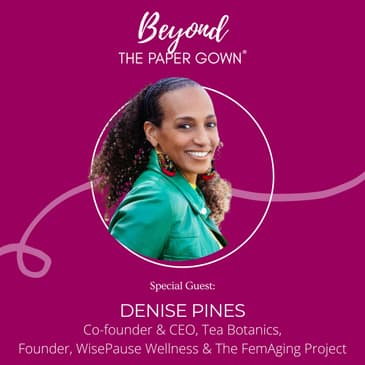

Join us as Dr. Mitzi Krockover sits down with Denise Pines, award-winning documentary and TV producer, publisher, marketer, medical board member, entrepreneur and wellness advocate.
Denise shares her groundbreaking research on aging and women from the women’s point of view. The FemAging Project provides Innovators a roadmap to providing solutions for women during this phase of life. She also created WisePause Wellness and Tea Botanics--ventures that offer not just products, but also support and understanding for women navigating the complexities of perimenopause. Her dedication to inclusivity shines through her efforts to ensure health solutions are accessible to all women, with a keen focus on addressing the unique challenges faced by women of color.
This episode is an opportunity to gain insights from Pine's vast experience and research and to understand the innovative approaches being taken to enhance women's wellness during a critical stage of life. Whether you're experiencing these changes yourself or are an entrepreneur curious about what the market needs, this podcast is for you. Tune in for an enlightening conversation that promises to inform, connect, and empower.
Please visit Beyond the Paper Gown to join our community and to learn more about achieving your optimal health.
Show Notes:
[00:00:00] Hi, welcome to Beyond The Paper Gown. I'm your host, Dr. Mitzi Krockover. As you may know, we focus on women's health issues, the factors that impact our health and the innovations and innovators who are helping to improve it.
[00:00:29] We have such an innovator and creative thinker and doer today who noticed that there wasn't a lot of information or innovation for women experiencing the symptoms of parimenopause in aging.
[00:00:41] So she found out what women want, developed wellness programs focused on menopause, and created a roadmap for innovators to help them meet the needs of this population.
[00:00:52] Oh, and she also started a company selling tea aimed at reducing the symptoms of parimenopause such as brain fog and hot flashes.
[00:01:00] Denise Pines is not only a trailblazer in women's health, her multifaceted career spans from leadership roles on medical boards that oversee the practice of healthcare providers and the admissions committee of a medical school,
[00:01:13] to producing award-winning and impactful documentaries as well as television and radio shows. Today, we'll hear about Denise's projects and learn from her wealth of knowledge and experience.
[00:01:26] We have a very special guest today who wears many hats and has really been a force in women's health in a variety of ways.
[00:01:47] In addition to all the roles I mentioned in the introduction, you're also a wellness advocate, correct?
[00:01:54] Yes, absolutely. Yeah, I call myself an age enthusiast.
[00:02:02] And yeah, I advocate mostly for women's health and I have a particular keen interest in women of color obviously because I'm a woman of color.
[00:02:13] And just the disparities that we find in women, just in women's health period but then when it extends to women of color, we see some more dire outcomes.
[00:02:26] So I try to make sure I'm always inclusive of those women in the work that I do.
[00:02:34] I mentioned that you are, you founded Wise Paws Wellness, Tea Botanics and the Femme Health Aging Project.
[00:02:43] All which again are very much around menopause. So give us a little taste of each one of those and then I want to drill down on each one as well.
[00:02:53] Sure, I sort of feel like all of this has just been kind of how my life has evolved.
[00:03:00] It was interesting when I was young I was in the fashion business. I worked for really luxury brands like Louis Vuitton and Neiman Marcus.
[00:03:10] And then I felt like in fashion that I didn't feel like the work that I was doing was really purposeful.
[00:03:18] So I decided I needed a new place to live and at the time I was in San Francisco where I grew up and I moved to Los Angeles.
[00:03:27] And literally the next day it was the Rodney King riots. And my interest shifted into social justice and advocacy work.
[00:03:36] And how to use media events and publishing to change and lift up African Americans and Latino voices.
[00:03:45] So over the years I've worked with the top 25 foundations in the world, the top 50 corporations that I've partnered with.
[00:03:53] And that and I've always had sort of this interest in health and wellness.
[00:03:57] You know, initially my own health and wellness because I was an asthmatic child.
[00:04:02] And then eventually I realized that my asthma had reached a point where I could actually start moving my body.
[00:04:12] And that was about when I was about between 18 and 19.
[00:04:17] And so that really created more of an interest in health when I realized that my health had transformed.
[00:04:25] Now, I still have asthma but it's very controlled.
[00:04:29] You know, I'm never without my inhaler that type of thing. But you know, I realize that we can stretch the boundaries of our health.
[00:04:39] And so in entertainment, I've produced over a thousand hours of media content and wellness, you know, and worked on wellness events.
[00:04:48] And then poof.
[00:04:50] I get a hot flash in all of this.
[00:04:54] In all of this right.
[00:04:56] So that changed my, you know, that hormonal impact sort of changed my journey.
[00:05:04] And it made me start advocating for women at this life stage because one of the things I noticed that I had noticed before in media is that we just didn't see, you know, women's voices.
[00:05:17] I was definitely talking in this particular space.
[00:05:22] And I knew that, you know, I could do it because I had the influence and power to be able to do it.
[00:05:28] And so I just decided I was going to bring all of my experience, my media experience, my event experience, and even public.
[00:05:35] I had a publishing company at one time and then with a person I worked with, we had a huge publishing division.
[00:05:43] And so you know, that led me to the hot flashes led me to creating or co-creating teapotanics and hot flash tea.
[00:05:54] And that led me to talking to so many women around the country and realizing that women were, you know, sort of I was hearing three consistent things that they were confused by the language, right.
[00:06:10] Perry menopause by Oidenticals, hormone replacement therapy.
[00:06:15] So they were confused by the language. They felt that they were alone, like they were the only ones that were experiencing this and that they didn't really know where they felt like they also weren't prepared.
[00:06:34] That why did, even for myself, why did as involved as I am in health? Why did I believe in my mind I was not going to have a hot flash.
[00:06:45] Why was I not prepared for the moment when it did happen?
[00:06:49] So we're in the healthcare journey for women in particular, have we let them down.
[00:06:55] And so that's when I decided I was going to create wise pause and bring the experts to these women in a place where they felt safe.
[00:07:05] And then one day I'm reading articles around FEMTEC, and everything was around fertility and pregnancy and periods.
[00:07:15] And there was very little about our technology around aging women's health, anything for women who were over 40.
[00:07:26] And so I decided that I was going to coin this work called FEMTEC, and it was going to mean this particular focus on women 40 plus around creating innovations specifically designed for them.
[00:07:44] And I thought to really do that was to release a report, right? So I worked with a third party research firm and we released our first report called FEM aging at the time it was 2020 health tech report.
[00:07:57] And so it was 2020 so it came out during the pandemic. So it was really tough. We ended up having to do a FEM aging COVID report to be able to get some traction, you know, sort of during that time.
[00:08:11] And that I did that to really create a roadmap for innovators to innovate correctly for women, for investors to know what is viable in the marketplace.
[00:08:24] And then for clinicians to work more with innovators, right? And so I also do menopause in the workplace training.
[00:08:35] I do it for sort of state of California and I do it for a lot of the major entertainment companies.
[00:08:45] And next year I'm hoping to work with medical schools to improve health women's health curriculum.
[00:08:53] I'm going to start with the school that I'm a part of, but we've really got to change like how we talk about women's health and specifically these years leading up to an including menopause.
[00:09:06] Nobody can see me, but I am nodding my head like you know a bobble head right now because that for me is one of the key areas we talk about innovation.
[00:09:16] We talk about investment. We talk about research, but what has not happened in the way that I we both obviously think is that clinicians and training aren't getting the information.
[00:09:28] And they're having to get it piecemeal outside with CMEs and it's you know very sporadic and fragmented I would say.
[00:09:38] Exactly. So what's so so what's scary about that right is that current practicing physicians that women go to including some OBGYNs, but definitely their general practitioners which most people go to.
[00:09:51] They have there's a knowledge gap there, but then there's here we are retraining the next doctors to take over for those doctors and they have a knowledge gap.
[00:10:04] Right. I mean it's mind boggling that's one of those things where I just go like you know huh.
[00:10:12] Now you know it's interesting when I was at the women's health center at UCLA, I was asked to give grand rounds at another medical school.
[00:10:19] And again, I guess when you're in the midst of it you think everybody you know understands it and I had students come up to me go we've never heard this before.
[00:10:29] I do think that with the increasing amount of women, I think with the increasing amount of focus.
[00:10:34] But as you know physicians and medical schools are kind of the last ones, late adopters let's put it that way.
[00:10:42] Yeah. Hopefully there's enough impetus right now.
[00:10:45] So let's talk a little bit about the roadmap and the report because you said you started this in 2020 and I just saw the 2023 report.
[00:10:55] So talk a little bit about as kinds of things that you're doing and the innovators that we're seeing out there and even the practitioners that are involved have we made an impact what what have you seen or are the same.
[00:11:10] We are you know I mean you know sort of like I said, you know women's health is beyond fertility right when I started this that's what I would always say.
[00:11:19] Because when we think of women's health which is one of the reasons why we see menopause in you know solutions and such a deficit and conversations and the healthcare industry and such a gap stage is that we've only focused on women in these sort of fertility years right.
[00:11:39] And so when it comes to post childbearing years innovation and research and even clinical practice has really suffered as a result of that over focus of that timeframe on women.
[00:11:55] And it just sort of follows with society right like we don't care in general about older people and so we just really wanted to look at them aging tech as you know innovations that were software.
[00:12:11] Innovations that were diagnostic that were devices that were neutral suitables so looking a little differently you know wearables and of course the pharmaceuticals and then clothing because of the you know the hot flashes or the night sweats there's you know interesting solutions that people have come up with around clothing for these women.
[00:12:35] So where we're seeing the biggest strides is in vaginal health right and vaginal health there's we're starting to see delivery of products more efficiently more efficiently in the vaginal area.
[00:12:54] We're seeing more improved solutions for women who have incontinence improves solutions for women who have dryness and we're starting to see more of that growth.
[00:13:09] And then on the other side from a digital side in telehealth we're seeing companies that are coming on board who are trying to find physicians specialist focused on women's health 40 plus so that women there is a place women can go to.
[00:13:27] Because of covid I think there's been a real turn to obviously telehealth but also along with that focus on convenience so being able to diagnose your own you ti or getting over the counter vaginal creams for yeast infections or just again having anything from Amazon delivered by tomorrow.
[00:13:53] My sense is that that has really propelled a lot of women into you know being more willing and able to look for their own solutions.
[00:14:03] Yes in our recent report the 2023 report one of the insights that came from that report was that women of color you know when they show up to the doctor the doctor tends not to listen to them so when they show up saying you know I'm having this I'm experiencing that you know the doctor sort of poo poo them.
[00:14:22] So what we found was that those women black women Latina women look for at home tests at home hormone test at home you ti test so they can come back to the doctors and say like look this is what this is saying can we talk about that can we.
[00:14:48] So what these results are right they feel that that is you know sort of a like a partner for them right in their healthcare so yes those kinds of I think that's going to grow I think personalization of health care is really going to explode you know AI now you know AI has been around for a long time you know people act like it's something new.
[00:15:17] But personalization of health you know your health care needs are different from my health care needs I want health care needs that are for me you want health care needs that are for you.
[00:15:28] So that's where I think health is moving and those people who are able to sort of connect that innovation around personalization is I think going to be the ones that are going to survive.
[00:15:43] So one of the things that we do with them aging as we partner with correct to form they're one of the largest angel networks in the world.
[00:15:52] The host pitch competitions so that we could help elevate a lot of this innovation in front of investors so they can see that there's a lot around the world that is happening and it needs to be finance you know like all you know I mean I just read about some company that got an AI company doing
[00:16:12] and generative AI now that got a billion dollar investment are you serious right now like there were women suffering with their health and some of these companies can barely get 50,000 over 100,000.
[00:16:25] Yeah they get told that it's a niche market it's like how can 52% of a population be in niche markets.
[00:16:33] Again a whole other thread there.
[00:16:36] Yeah you've really you know hit that nail in the head two things that come up from me after your comments one is the very important service that a lot of these companies are doing because we haven't had research in women's health because it is expensive.
[00:16:55] We haven't had a lot of data and now you've got these companies able to really generate their own data from you know their own clients you know they obviously ask for that permission but I think of a company heavy who has been focused on the microbiome of the vagina and they have evolved with the information that they've been able you know to get from a situation that will he didn't have a lot of data in the first place.
[00:17:24] Yeah and there's so many of those the second item that you brought up was the differences between different ethnic groups.
[00:17:33] And so I saw in your report that you focus a little bit on that so what are some of the other differences that we need to take a look at.
[00:17:43] Yes interesting so I mean so the report is you know about all women and then what we did is we over indexed on women of color black women Latina women and Asian women.
[00:17:54] And we found you know different help them text solutions that they're looking for you know black women are looking for things that help to release stress for them in their lives right just being a you know a black woman not on top of like having all of these other health issues that you may have
[00:18:12] but when you layer stress on top of that as a physician you know it exasperates that health issue so we found that that's what they are looking for Latina women are really interested around sexual and vaginal health.
[00:18:27] And so solutions around that are really important them Femtec solutions around that is really important.
[00:18:33] And then for Asian women what we have found is that hair loss so that community is experiencing thinning hair that we don't even talk about in their community and so solutions around thinning hair are really cropping up.
[00:18:50] So once you start actually doing research on women and women at you know particular ages and in particular communities.
[00:18:59] You start to discover what the needs are you know what their wants are and then you innovate around those as opposed to innovating something over here in a silo.
[00:19:11] You know we in March were launching something called Femte analytics and Femte Maya and they're both AI generative platforms that provides additional insights and education as well as connecting people to people in the space whether it's investors,
[00:19:29] whether it's innovators, whether it's clinicians we're creating this platform so that people are interested in women's health I made it give you you know broad women's health information but because we have such specific aging women's health I mean we really can drill down into some real narrow areas.
[00:19:49] I am working with Delta dental right now around oral health and menopause we never really talk about that at wise pause I've always had like a table topic conversation around oral health and menopause because of how the microme changes in the mouth as we age.
[00:20:11] And if you don't begin to address it actually early before you get there right you have you could start having an incredible amount of bone loss where you not even able to put an implant when you need one and so.
[00:20:26] You know I'm just for heart disease as well exactly the inflammation exactly.
[00:20:33] You know when I first met you just a few months ago you were on a panel and you talked about and it really you know stuck with me that when you first looked around to find out what's the information on women of this age you couldn't find it and so then you partnered with AARP so talk a little bit about that.
[00:20:54] Sure yeah AARP I love AARP I've worked with them for probably two decades now obviously ARP focuses on you know the older person and so when I started getting into this work I came to them and what was interesting they probably wouldn't want me to talk about this but what was interesting is I went to them saying hey I knew you guys are experts on and have all this menopause data here's some of the menopause data I'm trying to get can you.
[00:21:23] You know provide me with some research you have and articles and data in three weeks go by.
[00:21:29] And so I contact my friend and said like hey I asked you for this information can I get it she's like Denise I'm embarrassed to say we don't have it we don't focus on that and I was like your AARP.
[00:21:43] You target the 50 year old and so that opened up in their universe it opened up the fact that they weren't focusing on it and so we've had this great partnership on where we work with the wise pause wellness events as well as this research data.
[00:22:02] Was there any other findings that you thought were interesting in that respect one thing and we don't really think about this in the context of you know
[00:22:12] health but caregiving yes caregiving always falls on the woman and so when you think of that 40 to 60 year old woman not only is she caretaking for her family or husband let's be honest
[00:22:29] her children but also for her parents her husband's parents right on the right or grandparents if they're still alive and so caretaking became really for Asian communities a real standout issue right 40% of Asian women over the age of 40 are already caretaking
[00:22:58] for a family member outside their of their immediate family was that higher than for other groups of women yes it is one because there is an expectation in the Asian community for them to care take inside their home sure you know
[00:23:16] other communities it is to I mean a Latino community of black community but you'll also find those communities do look at other facilities to support that in an Asian community that's sort of a no-no
[00:23:32] talk a little bit about your botanical tease and how you came to be that kind of entrepreneur sure again it started with the hot flash
[00:23:45] and it was so funny you know when I had that first hot flash I thought I was having a heart attack and I thought you know the first thing I thought you know you know you know how your mom always says you're skirt my fly up and someone will see right and so my first thought was I thought oh my God
[00:24:02] do I have on the right underwear because when they come in here and get me I've got to have the right underwear on right and so once I had the fourth hot flash
[00:24:12] I finally realized I was actually having hot flashes and I thought you got to be kidding I call my doctor up and he said wow D you know I thought you eat pretty well and you exercise like all the time
[00:24:26] he's like I really just didn't think that was going to be your experience but he reminded me of this tea that had this hormonal properties that he had discovered some years prior and had given it to me maybe a year prior to this happening
[00:24:43] and said hey why don't you take that and let me know how it works out I realized that I was having severe hot flashes meaning I was having a hot flash every hour and through the night. Yes very very disruptive so it was easy for me then to once I had did that
[00:25:03] to then take this tea and to see whether or not it was effective and within five days like they had reduced down the half and by like the 10th 12th day that I was having maybe one hot flash a day
[00:25:19] and I called him up and said what is this and he talked to me about GABA and that you know I mean we had to go and study this for like a year but we we studied you know how to get GABA to a particular potency in the tea
[00:25:39] but other properties of this particular tea that also elevated to help balance sort of our control center in our brain and our reproductive system so that the hormones would balance themselves out.
[00:25:54] Now of course you have to drink the tea every day but it in fact has worked for about 75 to 80% of the women who actually drink our tea
[00:26:04] and so that's and then we then I discovered with drinking the tea that it really helped with my mental clarity right it really helped me to stay focused and because I do so much you know I'm super always multi-tasking
[00:26:20] and it really I stopped drinking the dream tea for half lashes because I didn't have them anymore but I still was having this sort of like mental like lack of clarity
[00:26:30] and so I drink my tea almost every day we came out with one called brain fog tea just for that mental clarity that I need in making decisions fast reading information quicker and being able to absorb it.
[00:26:48] Just to go back just to make sure everybody's on the same page so GABA is a neurotransmitter that is related to reducing pain.
[00:27:00] Yes and calming the nervous system and it's a couple other properties that we found that it has yes.
[00:27:09] So how did you study what was in the teas and so you say you have different formulations?
[00:27:16] Yes so my business partner is a doctor and a scientist and so we went to where this tea is from is in Taiwan and so we went and met with all of the tea experts who are specific tea experts in GABA tea
[00:27:34] and then we met the renowned woman which happened to be a woman who was the super uber expert in GABA tea and is a former professor at UC Davis and at the University of Taiwan.
[00:27:50] So we really studied this a lot. We also put a particular mineral in our soil to make sure that we have consistency of our harvest each time that we harvest the tea.
[00:28:02] Oh wow.
[00:28:04] And it's all organic. We only work with organic farmers. We test every one of the harvest.
[00:28:10] Do most people that seek these teas out are they doing that instead of for example estrogen therapy or they doing it as an adjunct?
[00:28:21] I think it's a first step. I say that RT is sort of a first step. You know if you're getting your first hot flash or whatever and you're not ready yet to go pharma is this could be a first step for you.
[00:28:38] Right to see you know what does this work does this help you to get under control and then if not you if you're still having severe hot flashes.
[00:28:46] Then you know the next step is definitely going to your doctor and seeing what other solutions might be available for you giving you know whatever your health condition is.
[00:29:06] I just want to shift because you are a filmmaker and you've made some very consequential films. And so talk a little bit about certainly about the one about birthing justice.
[00:29:20] So you know with birthing justice you know our overarching thing you know sort of tagline we would always say is that every woman deserves a beautiful birth story right birth you know having having a baby is a wonderful
[00:29:35] joyful experience. Why isn't every single woman enjoying that and you know in our country just from a maternal mortality standpoint. I mean America ranks 23rd we're number one.
[00:29:51] And when it gets to maternity outcomes we're 23 which means we are in the you know developing country stats and people don't really realize this and I'm not talking about black women 23 I'm talking about all women right we just have not had a focus on maternal care.
[00:30:15] You know birthing justice is definitely you know the film shines light on a really complex issue right there's no one answer to this issue because it encompasses racism it can compasses how the medical system is actually designed it encompassed the lack of financial resources that keep hospitals and OBGYNs working and midwives if they are part of that construct.
[00:30:42] In the really simple interaction between human beings with each other so in this sense the doctor and the patient right. And you know I always say that we have to get away from that relationship being transactional to be more interpersonal right so when it's interpersonal
[00:31:07] personal you're actually listening to the patient and one of the things that we have discovered in black women's mortality is that doctors don't listen to them.
[00:31:20] So if they call and say I'm having a little bleeding you know the doctor will say oh let's see how that is in another week well if you're a pregnant woman any bleeding is is urgent.
[00:31:34] Of course that is coming to my office immediately or I need you to get to the ER that's not less wait and see it's it you know I mean you know how critical it is during the whole you know nine months of of the birth journey.
[00:31:53] Every single moment is a moment that could be at risk so you know some people see the easy answers as you know women have a more dolas or they're being more midwives.
[00:32:05] They help solve this you know sort of deeply ingrained crisis but we wanted to show that it is some of those things and then it's more so we hope that what we did is really address that we have found that now that we are in the middle of the world.
[00:32:22] We found that now this film is a CME. We work with the Federation of State Medical Boards and we launched it on November 1st in about 438 physicians were able to get a 90 minute AMA credit and it's still that's still available for anyone that go to the Federation's website.
[00:32:46] What was really interesting about this film we also did a birthing justice impact report was that 48% of the people who saw this film were in healthcare and that the healthcare community really embraced this film and has used it on ground grounds they've used it you know inside their own organizations reviewing and their own policies their procedures.
[00:33:15] So we were really really surprised that it was going to be embraced by the healthcare community at such a high level that it has been.
[00:33:27] Well congratulations and thank you.
[00:33:29] Thank you.
[00:33:30] That is so powerful.
[00:33:31] Yeah.
[00:33:32] And it does show you know the impact of something like that.
[00:33:36] What did I not ask you that you wanted to make sure that we covered today?
[00:33:40] Did I mention I'm doing a menopause film?
[00:33:43] No.
[00:33:44] I didn't talk about that.
[00:33:46] Okay so I'm doing a menopause.
[00:33:47] We're shooting now like next week we are in Dr. Isimaskone the brain lady.
[00:33:56] Oh Lisa Maskone yeah.
[00:33:57] Listen Lisa Maskone we're interviewing her next next week.
[00:34:01] We're going to follow a physician, Dr. Shen out of John Hopkins along with a patient.
[00:34:10] We've already done a ton of interviews with so many people.
[00:34:14] So yeah so I see menopause as a public health issue right?
[00:34:18] I think that if we couch this around as a public health issue we can start to get more attention from government,
[00:34:26] more attention from philanthropy and more attention from corporations.
[00:34:33] If we get people to understand that if we let women suffer during these years,
[00:34:40] that what happens on the other side of menopause becomes real dire right?
[00:34:47] We know that more women have Alzheimer's.
[00:34:50] Why is that right?
[00:34:52] What happens inside these menopause of years does drop in estrogen and that connection with the brain.
[00:34:59] Again we need more research to really make that direct connection but we already can see certain things that are happening.
[00:35:08] But these are the things, that's why I'm going to call this, this is a public health issue and we need to look at it like that so we can focus more on everything that needs to change.
[00:35:18] Doctors closing the knowledge gap on treatment and management of menopause with physicians.
[00:35:25] Educating are up and coming physicians with the correct type of curriculum.
[00:35:30] And then educating women, letting women feel free to express what is actually happening with their bodies and not to not talk about that when they go into the physician's office.
[00:35:43] That's great, when will that be ready?
[00:35:46] We are hoping that it will air on PBS in October for International Menopause Day.
[00:35:57] Fabulous, we'll look forward to that and we'll again keep our listeners apprised, that's terrific.
[00:36:04] My final question and I know that you're very focused on wellness. What are one or two suggestions that you would recommend to our listeners that they can start today to do to better their health?
[00:36:18] I would say just take a pulse of your body, do a whole week where you go how do I feel from my head to my toes?
[00:36:29] What am I feeling and apply it to everything? How is my hearing? What's my vision? How far can I see right now?
[00:36:38] When I put something in my mouth, really actually tasted it.
[00:36:43] And you know, gosh that salty, that chip but I eat that chip all the time but really to get more in tune.
[00:36:52] I think this stage is the point of which we need to get in tune with ourselves.
[00:36:57] Make a decision to include something like that's for your body better, whether or not you go and get a massage, whether or not you say I'm going to take a stretch yoga class.
[00:37:14] So maybe you say I'm going to drink a bottle of water every day, right? You need to drink more but I'm going to drink a bottle of water every day.
[00:37:24] I'm going to have a piece of fruit, but not have that donut.
[00:37:31] And then I think from a doctor perspective is to be prepared when you go to the doctor.
[00:37:39] Don't just show up. Don't just show up and think a miracle on the other side is going to happen.
[00:37:45] You're going to figure all of that. You know, you're a clinician. You know that's what happened.
[00:37:50] Talk. You know, save me right in 15 minutes.
[00:37:55] In 15 minutes when you go if you're going and you have pain, no exact put a sticky on it, right?
[00:38:02] Put a little sticky or an x on it and go it's right here and be specific.
[00:38:07] It's a sharp pain or it's a dull pain. All of these really help your clinician really fine tune what is happening
[00:38:17] and they can really have, it can help to have a good outcome for you as opposed to you walk out of there.
[00:38:23] You know the doctor generally guessed something gave you a prescription and now in six months later and you're still that didn't get really soft
[00:38:32] and that could be something that's now exasperated.
[00:38:35] So be prepared when you go to the doctor or bring those test results that you talked about earlier.
[00:38:43] Yes, yes. It at own test.
[00:38:47] So Denise Pines I could talk to you for hours.
[00:38:51] I've enjoyed it.
[00:38:53] Oh, I did as well. Thank you so much for being with us.
[00:38:56] Oh no, thank you. It's been my pleasure.
[00:39:05] As we wrap up this episode of Beyond the Paper Gown, I'd like to extend my thanks to Denise Pines for sharing her journey insights and the incredible work.
[00:39:12] She's doing to transform the landscape of women's health as a force for change.
[00:39:17] We will have links to the resources we mentioned in our discussion in our podcast notes so do check them out.
[00:39:23] And I thank you for joining us on Beyond the Paper Gown.
[00:39:27] I invite you to visit our website at beyondthepapergown.com to sign up for our newsletter and browse our articles and podcasts as well as our marketplace
[00:39:37] and make an impact page of nonprofits focused on women's health and more.
[00:39:42] I also invite you to follow us on LinkedIn, Instagram and Facebook and one more request.
[00:39:48] Please leave a review and rate us on your favorite podcast platform. It does help us get noticed.
[00:39:54] Until next time, take good care.
[00:40:07] The Sapside was produced by Patrick Jean-Boyatti and me and our associate producer is Kyla McMillian.