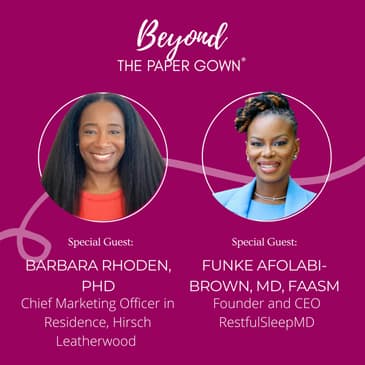

In this episode of "Beyond the Paper Gown," Dr. Mitzi Krockover hosts a compelling conversation with two esteemed guests: Dr. Barbara Rhoden, Chief Marketing Officer in Residence, Hirsch Leatherwood and an experienced healthcare leader with over 15 years in the industry, along with Dr. Funke Afolabi-Brown, a board-certified sleep medicine physician and pediatric pulmonologist and Founder & CEO, RestfulSleepMD. The discussion tackles the critical yet often overlooked topic of sleep health, highlighting its profound impact on our lives. Our experts discuss sleep disparities, challenge cultural attitudes towards rest, and offer practical advice for improving sleep habits. They also shed light on recognizing sleep disorders and their effects on daily life.
Tune in to learn why prioritizing sleep is essential for your overall well-being, how to maximize your resting hours and when to consult a sleep medicine specialist.
Please visit Beyond the Paper Gown to join our community and to learn more about achieving your optimal health.
SHOW NOTES:
https://www.youtube.com/channel/UCG1o0fL_GJI_Qlp4CDStR6g Get more by visiting our Beyond the Paper Gown YouTube Channel! Listen to more of the conversation with Dr. Afolabi Brown about the impact of pediatric sleep and how it intersects with women's sleep and also hear more insights on other sleep disorders like Restless Leg Syndrome, the importance of consistent sleep schedules and strategies for establishing good sleep habits.
[00:00:00] If you enjoy podcasts like this, you should check out our other shows on Health Podcast Network. For example, Better with Dr. Erica, hosted by Dr. Erica, provides support and guidance in navigating stress-related challenges to transform your relationship to self-care.
[00:00:17] Each episode arms you with the tools needed to be better, do better, and live better. There was an incredible episode that you should check out called Touch and Connections as Tools for Healing and Better Mental Health.
[00:00:30] In this episode, her guest breaks down ways to use physical touch as a form of healing for trauma and grief. Check out Better with Dr. Erica on your favorite podcast platform or visit healthpodcastnetwork.com.
[00:00:59] Welcome to Beyond the Paper Gown, a podcast that dives deep into the health issues that matter most to women. I'm your host, Dr. Mitzi Krockover, and in this episode, we're pulling back the covers on a topic that affects us all but is often overlooked.
[00:01:15] And there will be more puns. Joining us today are two distinguished experts who are here to wake us up, as I told you, to the importance of a good night's rest. First we have Dr. Barbara Rodin, a healthcare industry veteran with over 15 years of experience.
[00:01:31] Dr. Rodin brings her unique perspective on the cultural and societal barriers that prevent people, especially women, from getting the rest they need. Also with us is Dr. Funke Afalabi Brown, a board-certified sleep medicine physician with the background in pediatrics and pediatric pulmonology.
[00:01:49] Dr. Afalabi Brown is on a mission to help individuals, particularly women and children, change their relationship with sleep to reach their fullest potential. And all kidding aside, sleep is critical to our well-being, including our physical health as well as our mental and cognitive health.
[00:02:08] Yet in spite of the growing awareness of the need for sleep, our culture doesn't always make it easy for us to adhere to those healthy habits. And for some of us there are significant barriers and inequities when it comes to getting restful sleep.
[00:02:22] Today we're going to pay special attention to these issues as well as bust some stereotypes about sleep conditions, especially when it comes to women. And if you're caring for kids, we also have some surprising insights about the importance of sleep and development and ways to address sleep
[00:02:38] issues in children. Whether you're a busy professional, a parent or simply someone who wants to understand the power of sleep better, I know you'll find something useful in this episode. So let's dive into the world of sleep health.
[00:02:52] And just a reminder that this podcast is for your information only and should not be taken as medical advice. It is my pleasure to have two esteemed guests today who are going to be talking about a subject that is near and dear to everyone's heart or if
[00:03:17] it isn't, it should be. And I'm going to let them introduce themselves and tell you a little bit about themselves. Dr. Barbara Rodin, would you start us off? Thanks, Dr. Falkover. I'm Barbara Rodin. I've had over 15 years of experience in the healthcare industry with a
[00:03:36] diverse background that stands from my early days as a bench chemist with Dupont to leading growth initiatives at major enterprises like the healthcare and CMEM health in there. So my journey has taken me through various facets of healthcare, including
[00:03:53] my most recent role as Chief Marketing Officer at Greener Sun, where our mission was to pioneer digital pathways to make the medicine everyone can access. And this was a joint venture between Verily and Rosemead. And in that role, I developed a deep commitment to promoting
[00:04:12] sleep health, addressing the cultural and societal barriers that prevent people, especially women from getting the rest they need. I'm excited to join today and looking forward to the conversation. Terrific. Thank you. And we are going to get into many of those topics in just a little bit.
[00:04:30] Dr. Fonke Afalabi-Brown, I hope I pronounced that at least mostly correctly. Yes, yes. Please tell us about you. Yes, yes. Thank you so much for having me. So I'm Dr. Fonke Afalabi-Brown. I am a board certified sleep medicine physician. I have a background in pediatrics and pediatric pulmonology.
[00:04:52] And I obtained my sleep medicine fellowship at the University of Pennsylvania. And I have a speaking, coaching, and clinical practice. I'm a woman with multiple hearts, but I always say sleep is my super power. And so really my mission is to help individuals, especially women and
[00:05:11] children change their relationship with sleep so that they can thrive to reach their fullest potential. And I'm excited to be here. Fonke, you were just saying something about wearing many hats, but that sleep is your superpower. And to me, that seems antithetical.
[00:05:27] How do you have so many hats and have time to sleep? You know, one of the things I talk about a lot is about setting boundaries and realizing that we actually don't have 24 hours to do the things we have to do.
[00:05:41] We have probably about 16 as adults because women to be sleeping for those eight. So when I have that mindset shift of whatever I'm doing right now, it has to end in 16 hours. It helps me really with focus and prioritization.
[00:05:54] And I'm someone who's, I don't know, from when I was young, I've always been really sensitive to sleep deprivation. And so I can see directly the link and the correlation personally of course, and we know with research between poor sleep and impaired performance.
[00:06:10] And so when I start to see that I'm slowing down and becoming exhausted, I'm less productive. One of the first things that check in is, hmm, what's been going on with my sleep? So and I think that's just an awareness that many of us have
[00:06:23] to have that it's not sometimes working harder. It's about getting the rest we need to help us to move forward with whatever it is that we're tasked with. It's funny that you'd say that, Sonje, because I've been in, you know,
[00:06:36] throughout my career and particularly in corporate settings where sleep deprivation was often seen as a bad number. This is a pervasive mindset that I think culturally we we've really implemented, right? It's just we feel guilty about needing sleep, typically as women with many hats we wear.
[00:06:59] And then there's just this post-ital expectation that we undervalue risk and we grind and the 5 a.m. club and all of that. And, you know, I think we've glamorized sleeplessness to the point where, you know, we shifted our focus really.
[00:07:17] And I think it's important for us, particularly as women, to really look at that concept of feeling guilty about it. You know, as an early as a mom, my son had a reverse sleep cycle and I struggled with working and taking
[00:07:33] care of him and also managing the household, right? And as you're right, this is a research confirm that poor sleep doesn't just lead to us not functioning well throughout the day, but lead to significant health issues. And so we need to shift our cultural mindset to really
[00:07:51] recognize the importance of sleep for overall health. Absolutely. And Barbara, you wrote two great articles, one in Fortune and one in Fast Company that talks about women and sleep and that guilt that we I think feel that is also
[00:08:08] exacerbated by this kind of male model that says you have to get there early. So if you're a professional woman and a mother and, you know, everything else, you're getting all those messages. And then the second article that you wrote talked about
[00:08:23] the difference between Gen Z and the rest of us. I think certainly since the pandemic, not only that generation, but maybe all of us have started to really protect our time a little bit better and our lifestyle.
[00:08:37] But I loved what you quoted Bon Jovi is saying, I can sleep when I'm dead. And I used to say that all the time. Is that a terrible thing? Especially when my kid wasn't sleeping, you know? Absolutely. Absolutely.
[00:08:50] I mean, the music reflects what we think about as a culture, right? And it's really you're right post COVID, we're beginning to see more awareness around the need to prioritize sleep. But I'd say my generation, you know, we
[00:09:08] feel are kind of committed to look, you have to do what you have to do. You burn the candle at both ends. And what we're finding is that Gen Z saying, look, we're going to make choices here, right? We want to be productive.
[00:09:28] We are going to maintain our social connections and we're also going to prioritize sleep. And I think, you know, when you look at the pervasiveness of wearable, we have watches now that are helping us measure steps and also looking at how much time we're spending sleeping and
[00:09:45] helping us to understand more about sleep health. We have things like, you know, the aura ring that many of us wear, right? And so we're all monitoring this more. So you're right. I think there's hope and there's a light at the
[00:09:59] end of this tunnel where we're beginning to see signals that there are the shifts culturally where we're beginning to value sleep as an essential part of our health and recognize how crucial it is from a public health perspective. I absolutely agree.
[00:10:17] But I can't stop thinking about and Funky, you'll, I know, resonate with this and Barbara, I know, probably when you were doing your PhD, same kind of thing is that our academic institutions and our training was again very different in terms of the values.
[00:10:36] I mean, again, I remember 36 hours without any sleep on call. And we know that that is not good. And I know that there's been some changes, but they're not as much as they need to be. You've got doctors who are not walking the walk
[00:10:51] and their supervisors are certainly not. And then we have schools that start at seven o'clock in the morning because they've got to cram everything in in terms of the extra curriculars and in so many areas. What are we seeing as a society in general
[00:11:06] and as individuals because of those societal pressures to not get the sleep that we need? Yeah, no, I agree. I think there's there's a shift and there's an awareness. And when I look at this shift, you know, I typically look at it from multiple levels, right?
[00:11:23] So the individual levels, right, there are interpersonal levels and then there's structural and systemic levels. And I think while as individuals, like you said, now the narrative is changing, we're getting people being more aware, actually almost hyper aware of their sleep statistics.
[00:11:42] And it's now causing another sleep issue, which we call the Somnia. Now I'm telling you because people, the amount of data people are coming to me and saying, well, look, my ring said I didn't get enough deep sleep. Let's fix that. Right?
[00:11:55] So it's becoming the opposite of what we really want. But when we think about just even that structural and systemic level, like you're saying, like organizations say yes, we need to prioritize wellness and well-being. But when it comes to I will say when the rubber meets
[00:12:12] the road, literally, how are we implementing this? And we're not. We're not seeing this in schools, right? We're not seeing it in the health care system. So we still have a long way to go because we're seeing it across the board, right?
[00:12:28] When we're talking about physical health, right? We're talking about cardiovascular health, increased risk of stroke, hypertension. There's so many, you know, erythmias and, you know, so many things, immune functions, you know, our metabolism with increased risk of diabetes and obesity. When we think about even hormonal balances, right?
[00:12:50] And so so many levels. And then when it comes to actually what is driving this, which is we want to work harder so we get more results, you know, in terms of our emotional and mental health, we're seeing increased cognitive decline, decreased productivity, poor decision making,
[00:13:08] poor executive function. Leaders that are not necessarily working at the capacity they should be and it's impacting the bottom line. It's impacting the quality of work of their employees and their teams, right? We're seeing mental health crisis is all over in every sphere.
[00:13:26] And you know, and so the list goes on. So these things have not changed. There is an increase in awareness, but I think that we just really need to continue to put that pressure and not even talking about health care disparities and sleep health disparities.
[00:13:41] That's also a big issue where we now know that that also can impact, you know, our sleep overall. So yeah, there's still so much work to do. Sure. And it did bring up the sleep disparity issue. And again, Barbara, I'm so glad that you wanted to talk
[00:13:58] about this as well, because I don't think we appreciate that or why that is. So do tell us a little bit. I mean, I was fascinated by the what was actually the variable that that I used when I was making decisions around
[00:14:17] whether or not I would take the role of Steve Marketing Officer with Bruno Sons. I started doing research and I recognized there is a whole area, a whole field focused on equity, deep equity is a is a things an issue.
[00:14:30] And as I dug more into this, we did a number of experiments actually in different markets. And what we found is in certain urban centers where we started to talk about, oh, we need to focus on prioritizing sleep through data, people were saying that's fine.
[00:14:45] But I have to sleep with my TV on and with the volume at the highest level possible because that will deter potential invasion into my house, right? There are robbers who would then say, oh, somebody at home.
[00:15:01] And so it reduces the risk of me getting robbed at home. Right. When you think of the concept of weathering and structural racism and showing up at the only in in settings repeatedly, the impact that that has psychologically
[00:15:18] what data is showing us is regardless of social economic stock for black individuals across this country. You know, you could be at the head running a company or you could be working you know, you could be a shift worker.
[00:15:34] At the end of the day, the struggle from a sleep perspective is similar because of the weathering on your body and because of the structural racism that you're experiencing through the day. We now have data that shows that even some of the examples
[00:15:50] that I shared around look at night TV up or I may need to go work, you know, at midnight or I can afford a very extensive bed, you know, or have access to some of these wearables. Even when as black Americans, people can afford these things.
[00:16:09] We're still seeing significant trends with poor sleep health, poor sleep quality just based on the societal pressures that people experience during the day. This is an area that I often when I when I introduced the topic, people go, oh, that's an aha, it makes sense.
[00:16:28] We never thought of that. Right. And how do we then go in and address some of these disparities? Which then eventually obviously are linked to social determinants of health. Right. So how do we ensure that when there's food insecurity,
[00:16:42] how do I go talk to somebody about sleeping well when they can't think about what they're going to have for dinner? Right. And so we need to recognize that there's an ecosystem here at play. And from my perspective, I really believe that sleep is not a killer.
[00:16:59] It's actually foundational to health. And if we can't find a way to ensure that everybody accesses sleep as medicine, then what what's okay with talking about in terms of increase risk of cardiovascular disease, diabetes, depression, the linkages are strong, right? The data is there.
[00:17:22] And so I think when we find ways to address something as basic as sleep, we will really have a culture as a society be more productive and ensure that people can show up as their best self. Explain to the audience who might not know the specific term
[00:17:41] what weathering is. So when there is repeated exposure to also economic adversity, to political marginalization, to racism, to perpetual discrimination, that's harmful. And and and that phenomenon is what's called weathering. And it's basically shipping away at one's health.
[00:18:08] You know, when you're at the receiving end of discriminatory attitudes, it causes aging premature aging or even premature death. Right. And so that's the concept of weathering. In our discussion of sleep issues affecting women, we took a fascinating detour into the world of pediatric sleep.
[00:18:38] As many of you well know, a child's sleep patterns can have a profound impact on a mother's rest and overall well-being. When kids don't sleep well, it's not just their health that suffers. When kids don't sleep well,
[00:18:53] one of the first things we start to see is an impairment in their growth and their learning. We start to see things like behavioral focus problems. And actually now a lot of times when kids are diagnosed with ADHD, many times the symptoms they have,
[00:19:12] they pretty much mirror the symptoms a child who has not had enough sleep would have. Now, here's something every parent should know. The National Sleep Foundation has found that almost 60 percent of middle schoolers are not getting enough sleep. Almost 75 percent of our high
[00:19:27] schoolers are not getting enough sleep. And even the younger children are also sleep deprived. According to Dr. Afalobi Brown, a newborn needs about 14 to 17 hours a night. A school-aged child would need anywhere from about nine to 11 hours. And then your teenager needs about eight to ten hours.
[00:19:47] One sleep disorder that's often overlooked in children is sleep apnea. Sleep apnea, it is grossly under-recognized. Right now the prevalence is it's anywhere from about two to six percent, depending on the literature you're looking at. But I would dare say it's a lot more
[00:20:05] again because of access, because parents think snoring is cute or they were told by the pediatrician they're going to outgrow it. If you have a child that's snoring that has restless sleep, they are getting pauses and breathing. They're not getting oxygen supplied to their brain
[00:20:21] intermittently and it's going to fragment their sleep and it's going to cause daytime behaviors. So I would say that's one thing I would want people to be on the lookout for. If you have a child that's snoring, not just snoring with colds
[00:20:33] or snoring occasionally, but they have what we call habitual snoring. You do want to say, OK, I think I need to talk to my pediatrician and just be persistent. Tell them you listen to this podcast and you were told that snoring in kids habitually is not normal.
[00:20:47] So when they tell you they'll outgrow it, you could say I beg to differ. Right? We also touch on a topic I'm sure many of you grapple with, screen time and screens affect sleep in three ways, as Dr. Afalabi Brown explains.
[00:21:01] We do know that screens emit blue wavelength light, which suppress our brain's production of melatonin. Melatonin is the sort of darkness hormone that emerges and helps us to feel sleepy. So there is there are some studies that show that there might be a suppression of that
[00:21:19] and that might make it harder to fall asleep. And we tend to see it, I would say there's some studies that show that especially for younger kids, because they have a more clear cornea. So they absorb that light even more than adults.
[00:21:33] So the impact can potentially be more. There's so much more to unpack from our conversation about pediatric sleep and how it intersects with women's sleep health. Dr. Afalabi Brown shared insights on other sleep disorders like restless leg syndrome, the importance of consistent sleep schedules
[00:21:50] and strategies for establishing good sleep habits. We've placed that full conversation on YouTube and put the link in our podcast notes so that you can access this valuable information that could help both you and your children get a better night's rest.
[00:22:16] So let's shift a little bit and it's so typical we talk about the kids before we talk about ourselves, but I wanna talk a little bit about sleep in women. We started out talking about that. And Barbara, talk a little bit about your journey
[00:22:34] to the extent that you'd like to and then we can talk a little bit about some of the changes that happen as we go through life. Yeah, as we go through different life stages as women, obviously I leave it to Funkay
[00:22:51] to talk about the impact of hormonal changes. But what we do see is that about 20% or so women develop obstructive sleep apnea during menopause due to hormonal changes. And you're a perimenopause, which we are now all getting much more educated on to the great things.
[00:23:14] We learned that the prevalence of sleep apnea increases significantly as well. I was fine for the last five years or so. I know that family members on vacation would complain about my snoring. And I'm laughing because we have a very similar story, right? Yeah, we've wandered over this.
[00:23:38] My sister refused it. We were on vacation on the other side of the world in Thailand and she was just like, I'm exhausted, I'm jet lagged and you're not helping, right? And I said then forget it, I'll get the bigger room, the big big one,
[00:23:55] as better you guys go. But I recognized obviously after building in the state and to be fair, I walked around like that and thought no big deal, right? But then really understanding the link to cardiovascular diabetes and some of the other from a mental health perspective,
[00:24:19] the direct links to depression. I thought, okay, probably time for me to go and speak out and have an evaluation. And I actually went, I didn't do it in the most, what most people are doing now, leveraging home sweet tests, I actually went to a sleep lab,
[00:24:38] which was a heck of an experience. I spent the night in a converted warehouse, in a sleep lab. And it was interesting to have 50 wires hanging off and people telling me to sleep, when I'm obviously having trouble sleeping already. But it was also interesting from my perspective
[00:25:06] because I didn't realize, I wasn't educated on the fact that there would be gel put in my hair. And as a black woman having gel in my hair, and just assuming I'd go home and shower, isn't quite, that's not quite, that's not a tactical option.
[00:25:27] Yes, particularly depending on the style that I'm wearing at the time. So the first time I went to the sleep lab, I had to postpone my appointment because they explained they would be putting gel. I had meetings in the morning
[00:25:40] and I didn't have an appointment with my hairstylist. And so there are things, those are some of the nuances that we need to be, we need to ensure that we shine a light on from an equity perspective to ensure that even when we do have assets,
[00:26:00] we also need to ensure that the providers are educated on some of the nuances that women might show up and they may need additional support. But when you think of the fact that there's for every American, for 43,000 Americans, there's one sleep position.
[00:26:21] And then when you think of overcoming that hurdle to actually get into a sleep lab, there's an opportunity to really enhance the patient experience so that this becomes something where I could then, everybody who has the experience needs to be an advocate.
[00:26:41] And we try to educate everybody around the need for the testing. I know, Smithby, in our interaction, you and I are aligned on the fact that this should be a standard part of your annual exam. And I can tell you, I've raised before,
[00:26:57] look, I'm not sure I'm sleeping well and I have gotten a nod. And I understand the poor plight on the PCT, your primary care provider, think of the really convoluted pathways to get access to care. And so, unless you're really coming in with significant challenges,
[00:27:19] they tend to just say, look, manage it from a hygiene perspective, but we don't necessarily need to do those diagonals and have a disorder identified. Doctors really, in medical school, get very limited training in this area. And myself included my stereotype of someone who has sleep apnea
[00:27:40] is kind of a beefy truck driver, right? Who's got a thick neck and who's obese and is snoring and all that, not a thin old lady. And I think that my doctor felt the same way, right? Because I'm not going to go into mine
[00:28:00] and you can read about my story. I actually wrote a blog about it. I do agree we need to, not to get on my bully pulpit, but we need to screen. When you say what, 25% of women in menopause go through this, that's not a small number.
[00:28:17] And we're still not talking about it. So, Funke, talk a little bit about what sleep apnea is briefly and what are some of the changes that happen that make women more susceptible and are there any other issues that women have to go through?
[00:28:34] I know I just gave you three questions to answer all at once, so I will go back to them if you need reminding. So, sleep apnea is pure definition. It pauses and breathes during sleep. And really what's going on is there's collapse of the upper airway
[00:28:52] which makes it hard for you to breathe. And so two things can happen because you are making an effort to breathe, but there's an obstruction. You may start to work harder to breathe to take that breath in against that obstruction. Maybe it's the tongue,
[00:29:10] it's the upper airway muscles that are loose. What that creates is almost like a stress response and it kind of wakes you up out of whatever deep stage you're in. And so when we have repeated cycles of that overnight, you can imagine the sleep fragmentation piece.
[00:29:24] The other piece is the fact that now you have an obstruction, your oxygen levels are going to dip. And so that causes a lot of strain on the heart, increased heart pumping, heart muscle function. And over time we start to see those downstream effects.
[00:29:39] And overall all this does is it increases cortisol, increased stress response, and then we start to see all the downstream effects, you know, insulin resistance, hypertension, heart attacks, arrhythmias and things like that. Now the typical things we think about when it comes to risk factors
[00:29:57] are again the position, one of the things we think about is the position of the tongue in relation to the mouth, right? So if your tongue is falling back to your throat it might end up being a cause of obstruction. But then the upper airway muscles
[00:30:11] kind of get lost during sleep, especially when we get into that rapid eye movement sleep which is also known as dream sleep where your muscles are paralyzed. You're more likely to have collapse of the upper airway. Now on top of that,
[00:30:24] if there's excess fat, which is where the concept of obesity and things like that comes in, that's only going to make that airway even narrower. In women, there are with hormonal changes, there's some fluid shifts which puts them at risk. And then there are also facial structures,
[00:30:41] you know, depending on your jaw position and how far back it is and how it's probably contributing to that crowding of the upper airway that can contribute to sleep apnea. In terms of symptoms, right? For most men we would see things,
[00:31:00] the classic symptoms of super loud snoring, gasping, pauses, you know, scary looking stuff, daytime sleepiness. For women what we've seen is it's interesting, you may, you probably will hear some snoring but it may not necessarily be as dramatic but you may see more things like insomnia,
[00:31:22] they may present with insomnia, they may present with headaches, overall fatigue, depression, anxiety, hormone issues, right? That's the first thing everybody says when you go to your doctor and say I'm having all the symptoms they'll just say well it's your hormones.
[00:31:39] You know, so what does that even mean? Okay, so it's my hormones, but what do we do about that, right? So I think that's really something that it's important for women to understand. And so many times we get that,
[00:31:51] it causes a delay in diagnosing sleep apnea in women. Yeah, did you want to ask? To that point, you are having hormonal changes and those hormonal changes are messing with your sleep whether it be hot flashes or just the insomnia
[00:32:09] and so how do you make sense of it without going overboard? Yeah. But then the other question is that I had for my doctor and maybe, and I said well if it's a hormonal change that is making a change in my tissues would taking hormones reverse it?
[00:32:28] What would you say? So I would even take us back and walk through this, right? Most times if you're fortunate enough to share a room with a partner that says we can't share the same bed then of course that makes it easy
[00:32:43] to snore and you want to go get checked. But if as a woman you're having symptoms of poor sleep I think it's important to take a step back and say what does that even mean? Am I having a hard time falling asleep?
[00:32:56] In which case you might just have insomnia especially what we call sleep onset insomnia, right? And that can come from so many reasons that can come from, like you said, hot flashes, night sweats, it could come from your mind racing, it could come from sleep hygiene issues, right?
[00:33:15] So you want to almost be like a detective where is the issue? Or am I waking up multiple times at night when my mouth feels dry and I feel like I'm gasping or something then in that case that may clue you into saying okay maybe there's
[00:33:28] something wrong with sleep maintenance here. I think if you're unfortunate enough which most women have is a combination of both insomnia and sleep apnea which is why by that time you need to see a sleep specialist and see what's going on. So I think that is really important.
[00:33:43] Now when it comes to the hormonal changes, right? Around perimenopause, menopause, one of the things we start to see is a decline in estrogen and one of the things we know is that that actually helps estrogen in addition to all the many functions help with temperature regulation
[00:33:58] and things so decline is going to probably contribute to the hot flashes and night sweats and if you already have a busy mind that's a busy brain and then now you're waking up in a pool of sweat then your mind starts to race, right? So there's specific things
[00:34:13] that hormone recasement will help for that's one of those hot flashes. Those sort of vasomodal symptoms. You know when it comes to sleep apnea specifically because the phenotype or the way it works in women is a combination of issues. I'm not sure that we've seen research showing that
[00:34:34] HRT will fix suddenly strengthening exactly, I'm sorry, hormone replacement therapy so I would still go through the normal route but I think it feels messy. The outcome is as a woman you're exhausted all the time you're tired, you feel a little depressed, you're waking up
[00:34:51] I think it's key to kind of say where is the issue if you're around that stage especially if you've done all the basic stuff and you're still struggling you're never wrong to ask for a homesleep test it is easily accessible, relatively affordable
[00:35:07] you can hopefully get it in soon so you can have a diagnosis and start working towards treatment. I just wanted to say I live at interstections so I wanted to ensure that we talk about the fact that sleep disorders like sleep apnea
[00:35:21] are often on the diagonals in women especially black women and research shows that black individuals are 40, 43.5 somewhere around there around 43% more likely to suffer from sleep disorders but are likely to receive proper diagnosis and treatment and so as we look at some of these challenges
[00:35:46] we always need to ensure that we're raising awareness not just with those of us who can wear our Apple Watches and all of this but we're really addressing this the systemically. Exactly and then you know that leads also to a question about the accuracy of these tests
[00:36:06] in people of color because the pulse oximeter for example has been shown unless they've changed it that it is not as accurate and people with increased melanin actually in general than white individuals which begs the question what about anything else in terms of diagnostics?
[00:36:26] So for now I think the goal relatively for you know for diagnosing sleep apnea I think it's been fairly accurate there are other things that we would consider depending on where the pulse oximeter has been situated right is it over a painted nail
[00:36:49] or something of that sort where you may need to take that off because of the color but most times it seems to be to be relatively reliable there is a unique group of patients which are sickle cell patients where we've really struggled with that
[00:37:07] just because of the way the oxygen carrying capacity is and there have been studies that say okay maybe we should use of different devices called co-oxymetry where you're looking at this different spectrum of oxygenation and things like that it gets very technical, it gets very complicated
[00:37:24] and so for now you know these are the tools we have and I think also just looking at trends over time we can see that there's consistency in the results that we get Barbara do you want to talk a little bit about
[00:37:38] any differences you see when for example using CPAP or getting folks to you know what's the word cooperate if you will with their treatment plan or feel supported yeah I think the data shows that at here in the CPAP you know I won't be as transparent here
[00:38:05] on my personal journey but it hasn't been an easy ride for me right and so you know I want to show up and the authentic in that it's not the type of solution that you just you know you try and then you're consistently
[00:38:29] utilizing it and it's comfortable now look at the end of the day we do have data that shows that it is still the gold standard it makes a significant difference in terms of your sleep health what we do see though I know the folks that are resume would
[00:38:49] have significant data to show that when there is a digital platform that support people so you could actually see how many hours you were on CPAP you get data and there's this feedback loop then we see a significant spike in terms of adherence right women
[00:39:10] come to be to thrive in community anyway so that would be my recommendation is that as women we find opportunities to leverage the data that provided through the machine through the device but then also find communities to really help us as we navigate this journey with our CPAP
[00:39:31] devices. So I know that we have limited time and I want to get to just a couple of more things I want to talk a little bit about are there any other sleep disorders that women should know about and be aware of so in addition to sleep apnea
[00:39:48] apnea another big one is insomnia this is quite common in women as well I'm going to stop you there because it's really interesting and I've heard this before that it's a sleep disorder but I think most of us think of insomnia like it's a characteristic
[00:40:06] it's supposed to a disorder so there's I think the difference would be the fact that you might have transience insomnia you have stress in your life, you're aggravated your teenager is keeping you up and then that period gets better and then you're sleeping but
[00:40:24] when I'm talking about insomnia I'm talking about chronic insomnia where you've had difficulties falling asleep staying asleep or waking up at a time earlier than desired and it's causing daytime effect and this typically we say should have been going on for about three months you don't have to
[00:40:42] suffer for three months if it's stressing you out you get a seek out help but yeah those that's the main difference there's the short term insomnia and then there's more of the chronic insomnia which is an actual diagnosis and really two main states of therapy I mean main
[00:41:00] the gold standard is cognitive behavioral therapy for insomnia where you go through six or eight sessions where you're working with a sleep expert on this usually a behavioral sleep expert and then sometimes sleep medications may be needed especially if you're in that
[00:41:18] stage where you need to kind of bridge the gap but I think it's really working on an exit strategy when it comes to sleep medications and then there's restless leg syndrome or periodic limb movement disorders and these are just those discomforts we have enough usually our lower legs
[00:41:33] can also involve our upper arms we see it a lot in women who in pregnancy but we can also see it in certain conditions women with renal disease with anemia and things like that and then there's also narcolepsy and this is again really often under diagnosed
[00:41:48] it's mimicked as depression as ADD as thyroid issues for a long time before people finally get diagnosed and that's that irresistible urge you have to sleep despite getting relatively sufficient amount of sleep and usually it's associated with other symptoms like hallucinations sleep paralysis it's
[00:42:09] really profound sleepiness that's way out of the norm so I would say those are the main things you definitely want to be aware of there's also medical disorders that might contribute to sleep issues like thyroid hypothyroidism or hyperthyroidism low thyroid high
[00:42:24] thyroid can also affect your sleep so I would say those are the most common ones that I often encounter I know that depression can sometimes present with either early awakening or perhaps even more you know feeling more tired or being more sleepy are there any other
[00:42:45] conditions where someone I guess the narcolepsy is one that you oversleep is there are those the most common depression thyroid yeah I mean I think actually in some situations with diabetes especially when not well controlled you might also have that fatigue and
[00:43:06] even apart from narcolepsy there's a concept there's a disorder we call idiopathic hypersomnia meaning you're sleeping and we have no clue why there's also one diagnosis that you might see so as we wrap up Barbara this one's for you and that is
[00:43:24] you know we started out early on talking about disparities and just our cultural challenges in awareness and also appreciation for the need for sleep what kinds of initiatives and what are the changes would you like to see I think to create a healthier society
[00:43:53] we must instill the cultural mindset that views rest as a core value I'm Jamaican by birth and I can tell you culturally resting is equivalent to being lazy how do we shift cultural mindset and how do we make our rest as a core value
[00:44:18] I think that's important we do that by advocacy each of us can become an advocate for sleep health in our personal lives I mean our professional lives if we're managers if you're a provider a physician a parent or any other role how do we you know
[00:44:38] so that we can make a significant difference and then if you're managing teams how do you support like the work hours how do you discourage culture those are the things we need folks to start thinking about and not having people on call saying
[00:44:59] 2am or sending emails at midnight and seeing that as okay you're committed but when we shift the culture to ensure that we really the fact that there's a need to rest you know when physicians can emphasize the importance of sleep in patient care
[00:45:18] when we provide resources that really improve sleep health I think at the end of the day we all have a role to play and I think the clarion call for me is that we play our part and we become advocates for sleep health
[00:45:35] in our personal and professional lives beautifully said Funky just talk to us a little bit about what kinds of suggestions you'd leave us with as women in terms of in addition to all the great information that you gave us just maybe some last thoughts
[00:45:55] about what we can do to better take care of ourselves from a sleep standpoint so I use I share this acronym it's called rest R E S T really are a stance for respecting your boundaries like Barbara just talked about so elegantly and then E stands for expectations
[00:46:19] like setting the expectations ditch the superwoman Kate like stop being a superhero like you are not the saviour and we have to come to realize that there's ditch that badge of honour and then S stands for really making sleep a priority
[00:46:35] and what does that look like I use an acronym within an acronym I think I'm not complex enough so I use the acronym CREATE so consistent bedtime and wake up time as much as possible consistent sleep schedules R stands for having a routine
[00:46:51] that really just fills your cup whether it's a calming ritual that you take a bath, you read a book and it really sets you in the tone for bed listen to a nice podcast E stands for the environment so keep a very cool environment
[00:47:07] especially when you have the hot flashes and all that discomfort really keeping the bedroom as cool as possible and using breathable fact break is very important and making sure your room is pitch black as much as possible and A stands for assigning the bed for sleep
[00:47:23] and sleep only in bed we're checking our forms, we're eating we're watching movies, we're arguing with our spouse we're worried, we're doing all kinds of things in bed which is not ideal so you really want to limit non-sleep activities to the bed T stands for technology
[00:47:39] which we already talked about so find how the technology plan like beyond what time am I going to stop using devices and watching TV and then E is really looking into what do you want to eliminate so caffeine, alcohol and other things are going to interrupt your sleep
[00:47:55] so you want to limit it to use close to bedtime so that's create for priority, ties in sleep and then the final T in rest is really take stock and thanksgiving reflect on your journey it's not meant to be perfect celebrate the winds
[00:48:13] look for where you need to make adjustments reassess be true to yourself where do I need to set more boundaries where do I need to give myself more grace so that's it that's beautiful before we sign off I just want to make sure that there wasn't something
[00:48:29] that I didn't ask that you thought was really important for our audience to know and I'll ask Barbara that first now I think we touched on it all phenomenal thank you thanks so much for having us this has been very good it has been an honor
[00:48:49] and a pleasure thank you Dr. Funke, Afilabi Brown and Dr. Barbara Rodin for being with us today and for all the great information you've provided thank you bye bye thank you for tuning in today and thanks to our exceptional guest Dr. Barbara Rodin and Dr. Funke, Afilabi Brown
[00:49:14] we've covered a lot of ground today including understanding the cultural barriers to good sleep recognizing sleep disorders and learning practical tips for better sleep hygiene and learning practical tips for better sleep hygiene remember as Dr. Afilabi Brown emphasized sleep is not a luxury it's a necessity
[00:49:34] and a powerful tool for overhaul health and well-being I also want to underline Dr. Rodin's call to become advocates for sleep health in our personal and professional lives whether it's setting better boundaries creating a sleep friendly environment or simply giving ourselves permission to rest
[00:49:52] small changes can lead to big improvements on our sleep quality and overall health as we wrap up I encourage you to reflect on your own sleep habits what changes can you make tonight to prioritize your rest remember a good night's sleep is one of the best
[00:50:08] gifts you can give yourself and your loved ones if you found this episode helpful please share it with friends and family who might benefit from this information and don't forget to subscribe to Beyond the Paper Gown on your favorite podcast platform and rate us it really does help
[00:50:26] and for more information on future podcasts articles and events I invite you to subscribe to our newsletter at beyondthepapergown.com until next time take good care and sweet dreams and take care and take care