
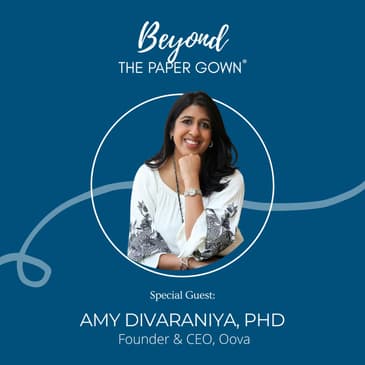

In this episode of Beyond the Paper Gown, host Dr. Mitzi Krockover explores the groundbreaking innovations in women's health with Amy Divaraniya, PhD, Founder & CEO, Oova. Dr. Divaraniya's journey from data science to women's health advocacy led her to create Oova, a platform empowering women with personalized data about their bodies through hormone monitoring. Oova's AI-powered tests provide valuable insights into fertility, perimenopause, and hormone fluctuations, challenging the one-size-fits-all approach to women's health. Join the conversation to discover how Oova offers personalized solutions and empowering women to advocate for their health with confidence.
BTPG Listeners can use discount code: OOVAPG10 to receive 10% off of an Oova product.
Please visit Beyond the Paper Gown to join our community and to learn more about achieving your optimal health.
[00:00:00] Hi, welcome to Beyond The Paper Gown where we explore the factors that impact on our health,
[00:00:19] including innovations like the one we're going to hear about today. I'm your host, Dr. Mitzi
[00:00:25] Krockover. On today's episode, we'll learn how Dr. Amy Diveraniya's own fertility struggles
[00:00:31] led her to pivot from a career in data science to launching Uva with the mission to empower women
[00:00:37] with actionable data about their bodies through hormone monitoring. You'll hear about how Uva can
[00:00:43] be used to monitor hormones throughout a woman's cycle. The AI-powered test was developed to specifically
[00:00:49] answer questions about fertility, parry menopause and even if the two are overlapping. However,
[00:00:56] Uva can also be used to monitor conditions like PCOS or polycystic ovarian syndrome
[00:01:01] and doctors can use Uva to remotely monitor their patients undergoing infertility treatments.
[00:01:07] You'll also get a peak at a future that goes beyond our current one size fits all approach to medicine,
[00:01:13] especially when it comes to women and hormones. It's a future where treatments are as unique as
[00:01:19] those seeking them and why personalized healthcare matters. It's about improving lives, one unique
[00:01:26] individual at a time. So whether you're intrigued by how you can monitor your own hormone levels
[00:01:32] to understand your body, know when you're about to ovulate or if you're in the midst of parry menopause
[00:01:38] or what the potentials are for this new innovation, you've landed in the right place.
[00:01:43] And just a reminder that our podcast is for educational and informational purposes only.
[00:01:49] We highly encourage you to share this information with your healthcare provider
[00:01:53] and any personal questions you might have about your healthcare needs.
[00:01:57] And finally, companies and products highlighted here should not be considered an endorsement by
[00:02:02] beyond the paper gown or me.
[00:02:14] It's my pleasure to introduce Dr. Amy DeVeronia, who is the CEO and founder of Uva.
[00:02:22] How did someone with your background end up starting this company and what does Uva do?
[00:02:30] Thank you so much for having me. My background is pretty heavy on the science side.
[00:02:34] I have a PhD in biomedical sciences focusing on genetics and genomics,
[00:02:38] but I'm actually a trained data scientist who worked in industry for about seven years before
[00:02:43] pivoting to start my own company. You know, it's funny because I never foresaw myself being an
[00:02:49] entrepreneur. It wasn't a goal of mine. I never wanted to be my own boss. It just wasn't this
[00:02:55] which I needed to scratch. But what ended up happening was towards the end of my PhD,
[00:03:02] my husband and I started trying to have a baby. And it just wasn't happening for us.
[00:03:08] I've always had irregular cycles my entire life. And I realized very quickly that all the tools
[00:03:14] that were available for women were designed for a woman with a 28-day cycle or who had a regular
[00:03:19] hormone pattern. And that just wasn't me. I would assume that that's not very many people at all.
[00:03:25] Actually. There was a study that came out showing that only that 87% of women did not have a 28-day
[00:03:33] cycle. And when we look at our Uva users, it's about 5% that actually do. So it's a really big
[00:03:39] disservice for women that we assume that the 28-day cycle is normal. But it really highlighted
[00:03:47] a few issues for me. One that our medical system is incredibly broken. And second, women just
[00:03:54] aren't given the data they need to truly advocate for their own health. And I realized I
[00:03:58] couldn't solve the medical system problem on my own very quickly, but I could solve giving women
[00:04:03] data. And so I decided to start Uva. We are a women's health platform that provides women with
[00:04:10] actual hormone levels by monitoring their urine on a daily basis. And we seamlessly share that data
[00:04:16] with our doctor if they're working with one. We believe that women should have access to this data.
[00:04:20] So they can understand what's going on with their bodies. Education is very critical for our
[00:04:25] platform. And it's not to school a woman. It's really to shed light on the fact that we're not
[00:04:31] taught the basics about our bodies, and yet we're taught the complete opposite. But if you have sex,
[00:04:36] you're going to get pregnant. That's absolutely not the case. We're really trying to shatter
[00:04:40] a lot of these myths that we think are true about. Women's health and our bodies overall.
[00:04:46] Take us through how someone would use this and what the information that they receive
[00:04:53] means, and how they would take action on it. Absolutely. So let me kick it off with we actually have
[00:05:01] two products that are available right now. So we have this trying to conceive product which is
[00:05:05] quite easy to understand. We identify when a woman's most fertile. We confirm this is released
[00:05:10] in agronaut and we provide that data to her. The second product that we have is actually helping
[00:05:16] a woman navigate the transition of pariamenapause. And that is a really dark period for a lot of
[00:05:22] women because we don't know what's going on. We just know something is off. And that's really
[00:05:28] hard to come to terms with when you keep getting more and more off, and you start accepting this
[00:05:32] to be normal when you're just really tired all the time. We're feeling sick all the time. I
[00:05:38] actually saw this billboard on the train ride into the city today. I was by city MD saying
[00:05:44] when you're sick and tired, a feeling sick and tired, that's when you have a problem.
[00:05:49] And I feel like that's what pariamenapause is. You're just always feeling off. So the way that our
[00:05:55] product works, and it works the same for both platforms but I know it's a podcast so you can't
[00:06:00] see this but I'll show it to you and I'll prescribe it. But our kit comes with the holder, a handle,
[00:06:06] and then 30 disposable cartridges that look like this. So 15 measure, loot nice and hormone
[00:06:11] in a progesterone and 15 measure estrogen. Every one of our cartridges has a QR code on it.
[00:06:17] So what you do is we're so long-satisfying as Marathon app. You download the app, you enter all
[00:06:21] of your information in the app and we figure out what days need to scan. On a scanning day,
[00:06:27] you'll provide a urine sample on our cartridge. You then scan it with your phone. Very simple. I
[00:06:32] mean, everyone knows how to scan a QR code. Thanks to COVID now. And we basically give you your
[00:06:38] result within seconds. And I should just say to our audience, it looks like a fancy pregnancy test.
[00:06:46] Absolutely. So we did that by design because what we realized during early user testing and this
[00:06:51] was quite a funny moment in like Ovens history, I bought a bunch of ovulation and pregnancy tests
[00:06:56] and I was still in my PhD. So I dumped it on the table, I called a bunch of my lab mates and I was like,
[00:07:02] what do you feel about this stuff? Just interactive it. And there's a bunch of men and a few women.
[00:07:08] The guys open up the boxes first thing they do is pull out that massive insert and start reading the
[00:07:12] instructions. Women grab the test and went to the bathroom. They knew exactly what to do. So I see
[00:07:17] what you're saying. Okay. Yeah, because usually men don't read their instructions. But I,
[00:07:21] they don't, this is the one area that they did. That's great. Let me ask you a question really quickly.
[00:07:27] How does your product and let's focus on the fertility piece just for a moment?
[00:07:33] Differ from those ovulation kits. So there's a lot of products in the market today for fertility
[00:07:41] and ovulation parking, right? But when I was using these products, there was a lot of gaps
[00:07:46] that identified very quickly. One, they shoehorned me into a 28-day cycle.
[00:07:51] Who doesn't do that? We're a completely personalized test. You learn every nuance about your body and
[00:07:56] guide you through that phase of life. So what's going on with your cycle? Are you in your fertile
[00:08:01] window or not? It's different for every woman. It's not that on cycle day 14, you're going to ovulate.
[00:08:06] We're not robots. Are you different in that you because you do check every day and the other ones
[00:08:12] don't? Well, some of them do check every day but they're not quantitative tests. They're qualitative.
[00:08:18] So you're getting a binary yes or no. Okay. And in layman's terms explain what you just said.
[00:08:25] Yeah, sure. So it's think of a pregnancy test, right? You either see two lines or you don't.
[00:08:30] You see one line or two lines. One line means you're not pregnant. Two line means you are.
[00:08:35] It doesn't matter how dark that second line is. If it's even kind of there, you're pregnant.
[00:08:40] You can't be 25% pregnant. But with Ufa, we give you an actual value, a hormone measurement for
[00:08:47] all three hormones every day that you test. So I'm telling you that your delutinizing hormone is 11.27.
[00:08:55] Your progesterone is 1.46 nanograms per mil and micro.
[00:09:00] So, milli-iupil later on my grant now. milli-iupil later for L.A.
[00:09:07] And so we're really trying to be mindful of understanding what every woman's unique baseline levels are
[00:09:13] and then detecting fluctuations by comparing to that because our surges, our peaks, are not the same
[00:09:18] from one woman to the other and Ufa learns those nuances to navigate a woman through those phases.
[00:09:24] So it sounds like it's much more personalized? Absolutely. That's one of our core pillars
[00:09:29] to be a personalized asset to a woman. How is it working? Do you have any outcomes data?
[00:09:36] I mean we have a ton. We've been in markets since 2020. We have over 10,000 cycles that we've
[00:09:41] monitored across those years and the stories that we hear are just so amazing. I'll give you
[00:09:50] one example. Like a lot of these fertility companies are going to talk about like oh we have a 90%
[00:09:55] success rate of getting women pregnant. On average our users get pregnant within three months.
[00:10:00] Like yes we have those stats too but what I find really encouraging and exciting is how educated
[00:10:07] women are walking away from our platform and I'll give you a really good example. So we do these
[00:10:12] consults with our users because oftentimes they'll have questions about like can you explain what
[00:10:16] might Ufa data means or I saw this weird behavior or can you help me understand it? So I take these
[00:10:21] consults often and I was talking to one woman and she was talking about like some nuances she
[00:10:27] saw in her cycle and she's like when I ovulate from my right side I have a 27 day cycle and when
[00:10:32] I ovulate from my left it's a 32 day cycle. So she can feel the ovulation? She feels the ovulation
[00:10:39] because we took away that stress point of am I ovulating or not? She became so much more
[00:10:46] in tune with her body that she was noticing what side the pain was coming from. Interesting. And
[00:10:51] she had monitored for so many months that she saw that pattern and it's critical to know this right?
[00:10:56] Like if you're trying to get pregnant and you're assuming that you're ovulating at the 50%
[00:11:01] mark of your cycle which is also not true we can debunk that later on in the conversation but
[00:11:06] like if your cycle is not equal one cycle to the next you could be completely off assuming that it is.
[00:11:16] Before we go further it might be useful to go through a review of the menstrual cycle and I'll
[00:11:24] try not to get too technical. There are four phases to the menstrual cycle and there is a communication
[00:11:30] system between the uterus and ovaries and parts of the brain that act as the control center
[00:11:37] which receives and sends signals to the uterus and ovaries. It's a very intricate system but for
[00:11:44] our purposes here these are the cliff notes. The first phase is considered the menstrual phase
[00:11:50] if there is not a pregnancy estrogen and progesterone levels are low and that results in shedding
[00:11:56] the lining of the uterus that's the menstrual period. During this time that control center in your
[00:12:02] brain notices that it's time to start over and sends a signal in the form of FSH or follicle
[00:12:09] stimulating hormone to prepare new eggs. The control center keeps sending the FSH signal to make
[00:12:16] sure the eggs are getting ready for one of them to break from the follicle. This is called the
[00:12:20] follicular phase and follicles are the small fluid filled sacs in the ovary each one contains
[00:12:27] one immature egg during each cycle a dominant egg emerges and sends out its own estrogen so FSH is
[00:12:36] rising and now so is estrogen. When the estrogen signal gets really strong it tells the control
[00:12:43] center that a dominant egg is ready. The control center then sends out a super strong signal
[00:12:51] this is the LH surge or the luteinizing hormone that tells the egg it's time to leave the ovary
[00:12:58] and start the journey down the fallopian tube toward the uterus. This is called ovulation
[00:13:05] and the prime time for fertilization with sperm. After the egg is on its way, the empty follicle
[00:13:12] starts making its own signals with progesterone and a little estrogen to further build up that
[00:13:17] uterine lining to make it friendly to a fertilized egg should there be one. This also tells the
[00:13:23] brain that it doesn't need to send out any more of its signals and that LH and FSH levels will start
[00:13:30] falling. If the egg and sperm meet and therefore a pregnancy occurs, the uterus continues to send
[00:13:37] out progesterone and estrogen making it more conducive for that fertilized egg to implant in the uterus.
[00:13:44] If there's no fertilization, the hormone levels decrease and the cycles start again.
[00:13:51] So for someone who's looking to get pregnant for example they're going to want to know when the
[00:13:55] LH surges or better yet when it's about to surge is that will be the most fertile time.
[00:14:02] Now we'll go back to the discussion. I asked Dr. Diverania about any data she had
[00:14:07] with respect to results for women who use the test
[00:14:16] and going back what are your numbers in terms of statistics?
[00:14:21] So we talk about success regarding pregnancy or I mean it's so we on average our users are
[00:14:29] getting pregnant within three months and then we I mean I don't want to give you a percentage
[00:14:33] of success on pregnancy because it's just that's not the only reason women are using us.
[00:14:39] So it's a bit different but not an ovulation test. We're really a hormone monitoring device
[00:14:44] and so I'll give you another example here but we have women that conceive with the lab
[00:14:52] and what happens is while we're not a pregnancy test monitor we are able to detect a pregnancy
[00:14:58] really early on because luteinizing hormone and beta HCG are very similar in structure.
[00:15:06] They only vary off of one antibody site so our luteinizing hormone antibody actually binds
[00:15:12] to the beta HCG so we have that non-specific binding happening on our test. It's not a problem
[00:15:17] because that hormone is not present unless if you're pregnant right but what we'll start to see
[00:15:23] is that the woman has her LH search and then she starts to see her progesterone rinsed
[00:15:27] and the LH starts to come back down right as it's supposed to but then in a couple of days
[00:15:32] the LH will start to pick back up and the progesterone is also staying elevated.
[00:15:36] So that like we get flagged when we see that pattern because we're like oh something's
[00:15:40] up with this patient's test so sometimes we'll reach out and we're like hey you may want to go get
[00:15:45] a pregnancy test and we find out oh no I am pregnant, Uva got me pregnant but I've had a
[00:15:51] struggle with reoccurring this carriage and I want to make sure that the pregnancy gets through
[00:15:56] the first trimester. So they continue using Uva to just get that piece of mind that their progesterone
[00:16:02] is staying elevated and their LH is staying up. Is that as good a test or how does that compare
[00:16:10] with doing a beta HCG level? You would absolutely want to do a beta HCG level because your levels
[00:16:16] for beta HCG both progesterone and beta HCG are going to be way over what Uva can monitor
[00:16:24] and in fact they're breaking our test because the die from the control line is being pulled
[00:16:29] into the LH and the progesterone reading so the test is not even reading properly like they're getting
[00:16:35] an error but they're getting that piece of mind that my levels are still high and I'm not miscarrying
[00:16:40] right now. We're not trying to replace like what getting a beta HCG or a normal blood test
[00:16:46] from doing the right things but it speaks to how scared women are on this journey and how much
[00:16:51] they're hungry for some some solace and we're providing that. And just to explain to our audience
[00:16:59] when there is a question about miscarrying or the early pregnancy,
[00:17:05] a blood test that looks at the basically the pregnancy hormone you can actually
[00:17:11] do levels of it to see if it's increasing in the right amount and so that's what we're talking
[00:17:17] about. Yeah that's absolutely correct and I'll reiterate that Uva is not designed to
[00:17:23] confirm or deny that a miscarriage is happening it's just a nice tool to get some soft
[00:17:28] confirmation it's never meant to replace any sort of medical advice. Thank you. Does anyone ever
[00:17:34] use it for contraception? We like to say that it's for off label use, it's an off label use
[00:17:41] of the product because with everything that we put out there for Uva,
[00:17:46] we have done studies to confirm that our results are accurate. We have not done sufficient studies
[00:17:51] to say that were an effective contraception. And before we jump over to the parimenopause
[00:17:59] information with what with everything going on with dogs, there has been a real focus on
[00:18:08] privacy, especially with these reproductive health apps because even if they are
[00:18:15] hypocompliant which is the law that protects patient privacy. Many of them are not I don't know
[00:18:20] if yours as you'll tell me but even when they're when they are if there was a government entity
[00:18:30] that wanted to file a criminal offense then they would have access to that data. So tell
[00:18:40] us about your approach to privacy. All right so let's go back to when dogs was overturned.
[00:18:48] It happened on a Friday and if you remember that weekend it was a frenzy on social media with all
[00:18:55] these companies putting on announcements that we are working to ensure your data is secure
[00:19:00] and I remember looking at those messages and I was like wow you guys really suck. How much data
[00:19:07] how much data are you holding on to that you've just kind of been biting time, not ensuring that it
[00:19:11] was secure and women didn't think to ask even I'm guilty of that like I didn't think to ask
[00:19:17] the app that I was tracking on if my data was secure so like we had a moment there where I was
[00:19:24] either we joined this conversation or we stay silent because OVA didn't have to do anything.
[00:19:30] We haven't hit a compliant and secure from the very beginning it's like it was a foundation my
[00:19:34] PhD work used a lot of EHR records so it was just like when you're building a database you have to
[00:19:39] ensure right it was dealing with medical records so I was like when you create a database you need
[00:19:45] to ensure it's secure so that's what we did it was it wasn't an afterthought for us and so we
[00:19:53] stayed quiet during that frenzy and we were getting a lot of messages from potential customers
[00:19:58] and current customers is my data secure can you delete my account I'm no longer using it
[00:20:02] and I was like I'm happy to do whatever you need but I can ensure you that your data is secure
[00:20:07] and then regarding the subpoenas that you could possibly get when you're using a fertility
[00:20:10] tracking app. The reason I can't necessarily tell you what our absolute success rate is is because
[00:20:16] we don't we don't keep record of whether a woman conceived or not in our system. We do that by
[00:20:22] design because we again are not an ovulation test. We are a hormone monitoring platform
[00:20:28] and so what I care about are what the hormone levels are and like fine we have what your health
[00:20:33] goal may be but it's not tied to a specific person it's completely deidentified
[00:20:39] and that key that maps everything is underlogged and key so I can't map it for anyone
[00:20:45] so if someone and I don't want to get too much in the weeds out this but if there was a subpoena
[00:20:51] for patient A you can't go into her file to see what her hormone levels have been. Depends on how deep
[00:21:00] that subpoenas but just if I was is there like I need the medical records of so-and-so it would be
[00:21:04] a huge lift for us to be able to map that out and then what are you getting you are getting a bunch
[00:21:09] of hormone levels. Okay I don't have anything on whether the woman conceived or not I don't have
[00:21:14] anything about whether the pregnancy was terminated we don't track we don't keep record of any of that
[00:21:20] and given what we just talked about even if they might have conceived it would be an indirect measure
[00:21:26] so it doesn't you know unless somebody was really sophisticated they may not be able to know
[00:21:30] okay it's a shame that we have to be having this conversation but unfortunately it's certainly
[00:21:37] something that's very important and to remind our listeners that when they're giving their data
[00:21:43] you know they really need to know how it's being protected and if it's being protected. I agree with
[00:21:49] you like I think it's unfortunate that we have to have that conversation but in a way it's
[00:21:53] the expected to a positive two right I think women's health has always been kind of this cursory
[00:21:58] thing that women's health is all periotracking and like fine that's the easiest app because it's so
[00:22:02] predictable but it's really not it's still health-dated and for these companies to be under fire now
[00:22:09] have the bars that you need to be hip-hop compliant I think that's a fantastic step forward for
[00:22:13] women's health and like we don't want to make this a political discussion but I think the positive
[00:22:18] that came out of this is that now even periotracking apps are being treated like health platforms
[00:22:24] that's that's a huge step for us. And to the end that you are collecting large amounts of data
[00:22:31] that really paint some more detailed picture of what is and isn't normal you know most of the
[00:22:40] of what we consider not normal is actually normal. How do you contribute to the data out there so
[00:22:49] that scientist and others can benefit from it and ultimately you know women in general can benefit
[00:22:57] from it? Absolutely it's one of our massive pillars because while we're trying to inform a woman
[00:23:03] about her body we're also trying to myth-bust a lot of these assumptions that we have around women's
[00:23:08] health. It is horrible that we all think that the 28-day cycle is normal, it's not. That was a
[00:23:14] marketing point that became basic healthcare. I think that's like that's just how a lot of women's
[00:23:20] health has been handled and so what we do is yes we have an amazing data set and I can talk about
[00:23:26] that data set a bit more. But with over 10,000 cycles what we do is actually release
[00:23:32] the publish and we present at some believing medical conferences about the data that we're collecting
[00:23:38] because it's not it's not necessarily just for the consumer it's also for the medical community to
[00:23:44] understand that we now have actual hormonal data over time to understand the nuances of every
[00:23:50] woman because the dynamic has drastically changed. Women are not in their early 20s getting pregnant
[00:23:56] anymore. The age of pregnancy first pregnancy is drastically increasing and if you look at our
[00:24:02] users 46% are above the age of 35, almost half of our users and this is just for the trying to
[00:24:08] conceit demographic are over the age of 35. That says a lot right? We can't compare that woman
[00:24:17] to an 18 year old who has a typical cycle. A lot has happened in those years that will impact
[00:24:24] her cycle so we're really trying to educate both the consumer and the medical community about what
[00:24:30] normal looks like and we work with REIs or re-bredital immunokinologist quite a lot they're very aware
[00:24:36] of the abnormalities in women and they embrace it because those are the cases that they see most often
[00:24:43] OBGYNs I think are in need of data but the only way to get that data is that a patient come in
[00:24:48] every day for blood work and unless if you're going through IVF you're not going into the clinic every day.
[00:24:54] And to that point can you use this modality with IVF or instead of having to go each day to
[00:25:06] getting your blood drawn? To being used across IVF I'm going to honestly say no not at the moment
[00:25:12] because our estrogen test doesn't reach the levels that women are typically going to see when
[00:25:19] they're going through an IVF cycle so I don't want to mislead anyone there but what we can be used
[00:25:24] for are any non-gonetic tropin cycles so that could be a natural FET or natural frozen embryo
[00:25:30] transfer a natural cycle an IUY trigger shot monitoring there's a whole slew thing that you
[00:25:37] can use OVA for today and it is being used in that way we're actually kicking off a study with
[00:25:42] mass general and the next few weeks looking at using OVA for frozen I'm sorry looking at OVA for
[00:25:48] trigger shot monitoring and what it should be really exciting sure so when you're going through
[00:25:52] an IVF cycle and you're you give yourself think about who's going through an IVF cycle right it's not
[00:25:58] really it's not always a woman who's in medically trained and they're they have to give themselves
[00:26:03] injections and medications it's a very scary thing especially cycle one but one of the first steps
[00:26:09] that a lot of clinics make their patients do is give themselves or self-administer a trigger shot
[00:26:15] which is often a BDHCG shot and that's to induce ovulation so what they're trying to do with an
[00:26:21] IVF cycle is override or natural cycle and put you into a predicted like a controlled and predicted
[00:26:28] cycle so the trigger shot is meant to induce ovulation so that when you come in for a retrieval
[00:26:34] of your egg you have ovulated and they can extract the egg so they can create the embryo outside
[00:26:39] and then do a transfer at some other date well the problem is that a lot of women who are self-administering
[00:26:45] that trigger shot don't know if they're doing it right and in many cases the clinic won't know
[00:26:51] that the shot was an administered right until the patient comes in for a retrieval and now if
[00:26:57] that shot shot was an administered correctly they have to let cycles waste okay so you're basically
[00:27:04] being able by a hormonal level to see if they had done it correctly correct yeah so you get a
[00:27:11] baseline you monitor the day of the shot and the day after the shot to ensure that the test was
[00:27:15] done properly and the beauty is that your doctor gets your data in real time through our HIPAA
[00:27:21] compliant dashboard so you don't need to send screenshots or images to your doctor they can see
[00:27:27] it all in real time and the nurse can call you the next day's incase he doesn't look like the shot
[00:27:31] was administered right come in and we can still we can do it and you're still in cycle so obviously
[00:27:37] you're a consumer product but when it's used in this way is it paid for by insurance
[00:27:44] not at the moment we're working on it okay let's switch a little bit and talk about
[00:27:51] how you might use this for or if you have a different kind of measurement for someone who thinks
[00:27:59] they might be in parimenopause sure so what's happening in parimenopause the bottom line is that there's
[00:28:05] a hormonal imbalance that's happening which is causing all of these symptoms the problem is we don't
[00:28:11] understand that hormonal imbalance we don't even understand the symptoms we just know that they
[00:28:16] exist and we don't know if when we're experiencing those symptoms if they're for parimenopause or
[00:28:21] because I'm feeling sick or I'm coming down with something or I just didn't get enough sleep
[00:28:26] it's very ambiguous so what we're trying to do here is forget I don't say forget the symptoms but
[00:28:32] put less emphasis on the subjective piece of it and let's get to the objective component which
[00:28:37] is the hormone hormone balance let's monitor your hormones across 15 or 30 days depending on what
[00:28:43] your where you are in your cycle and figure out if there is a hormonal imbalance happening or not
[00:28:49] is your estrogen behaving the way it should is your progesterone staying super elevated is being
[00:28:54] brought down what is going on because there's a reason it's called a menstrual cycle these hormones
[00:29:00] work in unison and in harmony together so if something is off it's going to cause a downstream
[00:29:06] effect and that is what leads to those symptoms so the way that we're using uva for parimenopause
[00:29:12] understanding that hormonal imbalance and then we also allow women to track their symptoms to
[00:29:17] layer that information on top of that hormone imbalance to figure out what the causal nature is
[00:29:23] the phd work was done in Bayesian networks so it's all about causality with for like
[00:29:28] that's where my head always goes so we're trying to see what that hormone pattern is that's causing
[00:29:33] you to experience certain symptoms and then start shedding light on that one of the questions
[00:29:38] that women typically ask us is am I in parimenopause that is a very tricky and multifaceted question
[00:29:45] to answer i don't want to say that we can absolutely 100% answer that today but what we can do
[00:29:51] is give you information to start teasing out what is happening on a day-to-day basis
[00:29:56] and that control is what i believe what we're seeing women are really hungry for today
[00:30:02] you know it's interesting because if you look at guidelines for clinicians
[00:30:08] if you talk to a clinician they'll say you don't need any hormone test we're going to treat you
[00:30:16] or you have the option to be treated if you have symptoms what do you think it's going to take
[00:30:21] for a test like yours to be included as part of the diagnostic process and what do you say to those
[00:30:33] clinicians who say we really don't need that kind of monitoring i mean we'd have this conversation
[00:30:41] every day with clinicians right because it's about changing a behavior that is the hardest thing
[00:30:46] to do right humans don't want to change and they don't they don't welcome change but my challenge is
[00:30:54] i understand you don't look at hormone data and blood work right now but why is that
[00:31:00] is it because you don't need it or is it because you don't have it
[00:31:05] and the answer is that they don't have it what do you mean when they say don't have it because we can
[00:31:10] take estrogen levels but what i was always taught is you really can't correlate those levels
[00:31:15] with what's going on in any kind of well concrete way are you getting those levels daily or are
[00:31:21] you getting that no it's a spot check exactly that's exactly it these hormones are not they're not
[00:31:28] stagnant hormones they're fluctuating every single day and every hour so being able to see your
[00:31:35] hormone trends over time is the true value of our platform and that is information that a clinician
[00:31:41] hasn't had because like i said earlier a woman is not going into the doctor every day for blood work
[00:31:46] unless if she's going through a really invasive treatment like what i'm excited about is this
[00:31:52] this new technique of being able to get daily hormone measurements can actually start supporting
[00:31:58] clinicians and women to get the right dosage and treatment for home and replacement therapy
[00:32:03] right now it's like this blanket no don't do it because i'm going to get cancer
[00:32:07] but why is that it's because the dosage isn't right and the monitoring isn't done correctly because
[00:32:12] women don't clinicians and women don't want to get blood drawn draws all the time
[00:32:17] but if i can provide you with that data daily by just using a urine test wouldn't you prefer that
[00:32:24] just to be clear though we don't have guidelines for that we don't
[00:32:28] you know we don't have data for that and all of that but what i'm hearing you say is that's the
[00:32:33] holy grail that's you know the the goal that's the next step yeah absolutely of course and that's in
[00:32:38] the way for change like the way that treatment is done we don't have enough data for it yet but that's
[00:32:43] one of our what we're trying to do here who about we're trying to collect that data to have those
[00:32:47] meaningful conversations with clinicians and how do we do that by publishing research by showing
[00:32:52] our findings not coming up with arbitrary like gimmicky scores or something some marketing material
[00:32:59] we're really trying to move science the medical field forward and the only way that i know what
[00:33:03] i do is that it's with data absolutely and so just uh again if i'm hearing you correctly or if i'm
[00:33:11] understanding correctly a woman who might be experiencing some symptoms but doesn't want
[00:33:19] isn't ready to go to the doctor yet or just really wants to have a little bit more information
[00:33:23] this is the kind of person that might use your test and get some more data if it is looking like
[00:33:31] you know it's pariamine-apause then they can come in with that dad and say you know hey i need to
[00:33:36] have that conversation or if it's not then they obviously need to go further to see what
[00:33:42] wide some of their symptoms are occurring is that a fear assessment that's a completely fair
[00:33:46] assessment and i mean just think about the change in mentality between those two women right
[00:33:52] one who's able to get the answers as she needs from our test great she's walking away confident
[00:33:56] another woman who has to walk into her doctor's office because she doesn't necessarily have the answers
[00:34:00] or to her questions but she has data to walk in with them being like can you explain
[00:34:05] what's going on to me for something is clearly off you're not walking in lost and um yeah i'll leave it
[00:34:13] and given that it's not reimbursed right now is it fsa or hsa uh eligible yes it is okay so
[00:34:21] that's one way that people can help afford it so here's my question you just said earlier that
[00:34:31] you've got a big percentage of people that are 35 and over trying to get pregnant
[00:34:38] and that's hard because you know for all the reasons we know as we get older becomes more hard
[00:34:45] to concede and more difficult to conceive and you're now kind of in that space especially if
[00:34:51] you're 40 and above maybe getting into parimenopause and for anybody who's heard my um podcast they've
[00:34:58] heard me say you know i was in parimenopause but i had my or i think i slid into it after my second baby
[00:35:05] at the age of 41 and so talk a little bit about are you using both tests or how would you suggest
[00:35:14] someone who is in that um kind of gray area and having difficulty if they're trying to conceive
[00:35:23] how would you approach that that is a great question and you know it's funny because i
[00:35:29] i got this like pushback early on when i was sharing with investors and potential investors like what
[00:35:38] my goal was for the company that we aren't like don't look at me as an ovulation test or
[00:35:43] fertility fatten tech company or a fertility test because we're scaling across other women's
[00:35:48] health areas and the pushback that i got from potential investors was how are you like you're
[00:35:55] talking about two very different consumers like you're talking about a young woman who's trying to
[00:35:58] get pregnant and an elderly person is going through parimenopause. How would you person?
[00:36:04] yes yes exactly i have a problem with that but okay thank you thank you yes i did too which is
[00:36:10] why they were potential investors and i've heard um i i really did too and i've walked away from a lot
[00:36:16] of tables because of that sentiment because i'm like you're just so disconnected with the reality
[00:36:20] and it's okay i'd like to read a quote from a woman i did a consult with her and she made a statement
[00:36:25] to me um she said i love how uva acknowledges and supports both the trying to conceive and parimenopause
[00:36:31] journeys recognizing the challenges women face uva is highlighting the continuity of these experiences
[00:36:37] rather than viewing them as separate paths and like that when she said that to me it resonated so
[00:36:44] deep because i'm like yes our average woman who's trying to get pregnant is over the age of 35
[00:36:49] and when you look at the average age of a woman who is going through parimenopause or you buying
[00:36:53] our test just 41 this is not an old woman exactly right i loved it when i was 36 and had my first
[00:37:02] child and i was considered a geriatric you know pregnancy yeah even the way that we talk about it
[00:37:08] that's another whole study that we actually presented about like what advanced maternal age
[00:37:12] action needs and looks like um so it's well it's a little bit about that
[00:37:18] because so we actually did is we did a study because we assume that if you're in an advanced
[00:37:23] maternal age you're going to have trouble getting pregnant or more difficult to getting pregnant right
[00:37:26] 35 is that magic pivoting age and there's absolutely some signs to this right that like the rates
[00:37:33] of infertility increase as you're getting older um and it gets more difficult to get pregnant but
[00:37:38] what we started looking at is what are the actual hormone patterns in the younger age group versus
[00:37:43] the older and there's not that much difference like these women are still cycling it's just
[00:37:51] slightly more irregular and it's not it's coming off as infertility because they're using these over
[00:37:57] the counter tests that are designed for a 20 year old woman but if you look at their actual hormone
[00:38:02] levels they are still cycling you just need to understand that woman do you know if you are
[00:38:12] more effective because of that i believe so i mean we're we have all the success stories and all
[00:38:20] of that like most other companies but what i think is amazing is we're able to provide that individualized
[00:38:27] care and it's not we're not dumping you into or trying to shove you into this like cookie cutter mold
[00:38:33] we're really embracing your individuality so this is really what the what spearheaded us
[00:38:38] we'll be launching a perimenopause sooner than we thought we had so many women that were telling
[00:38:43] us that we're trying to conceive but then also telling us that they had perimenopause i was like
[00:38:49] you're 37 like why do you like whatever let's just go with it and they were being told that
[00:38:53] they were in perimenopause because they were a little bit older and they had an irregular cycle
[00:38:59] that's not perimenopause right so that that end happened and on the flip side we have women who are
[00:39:06] like 41-42 who are still trying to have a baby there's nothing wrong you're still cycling but they're
[00:39:12] using our perimenopause test to see if they're cycling or not so the beauty of our platform is
[00:39:19] a woman basically goes into our app and selects what her health goal is and then the entire app
[00:39:24] experience changes based off of that the data is the same it's a quantitative test so your estrogen
[00:39:31] level your progesterone those are all the same whether you're using an anesthetical fertility or
[00:39:36] perimenopause kit but the interpretation is very different sure what did you have to go through any
[00:39:44] kind of regulatory approval for your product and i would assume if you did for the claims that
[00:39:50] you're providing yeah sure so we fall into our class one exempt device so we have registered
[00:39:55] with the FDA we've done all the things that we need to do on that front and we're really conscious
[00:39:59] about the claims that we make so it's a bit hard for us because we can detect signs of like
[00:40:04] polycystic ovarian syndrome but we can't tell a woman that she's experienced she has that what we
[00:40:09] can do is provide that insight to her physician or her clinician if she's working with one of our
[00:40:14] providers who can then use uva's recommendation to do a workout on her but we don't prescribe
[00:40:21] or diagnose a patient based off of any of our data okay how do you get to that physician
[00:40:30] we have a clinician dashboard that clinicians can log into to view their patient's data and
[00:40:36] so we have a network of over a hundred clinics that have partnered with us they range from
[00:40:40] natural pads to obi julians to fertility centers and basically what happens is when you have a
[00:40:46] patient that's using uva they can go into their app and select what clinics they want to have
[00:40:51] access to their data so the patient drives all of it once they select the clinic the clinic will be
[00:40:57] able to view that patient's data and their dashboard the patient the doctor is also able to add a
[00:41:02] patient but the patient has to opt into it of course though again the patient controls access to
[00:41:07] whoever sees their data terrific what do you see for the near future with uva oh my gosh it's so
[00:41:16] exciting right now i mean we we launched our parent mental pads product never expected it to take
[00:41:21] off the way it did it just really reinvigorated our entire team and reminded us of how
[00:41:27] important the work that we're doing is and how hungry people are for this information so
[00:41:32] we've really like kind of hit the ground running thinking about like what's next
[00:41:36] we are not limiting ourselves to just these two phases the goal has always been to scale across
[00:41:42] all different phases of women's lives um we like to think of our platform as uva for life so regardless
[00:41:49] of where you are in your life journey we will have a platform available to you to help navigate that
[00:41:55] and as we're wrapping up what did i not ask you that you wanted to make sure that we discussed
[00:42:03] one thing that i think we should definitely address is the feeling the women have about medical
[00:42:08] gas lighting and i mean i've experienced it myself as well like going to my clinician at um
[00:42:15] thirty how old was i i was 27 and i was just starting my PhD and i was like i have a regular
[00:42:22] cycle i don't want to get pregnant now but what can i do to optimize my chance of getting pregnant
[00:42:27] she glint looked me up and down once and was like come back to me at 30 if you're not pregnant
[00:42:33] i was like well i'm asking how to be proactive and you're literally not giving me anything when
[00:42:38] i know i'm gonna have trouble which i did have trouble um i never went back to that obi again but
[00:42:43] there's this sentiment that women don't aren't taken seriously when they walk into their
[00:42:48] clinicians office and i just want to interrupt for just a second because you just
[00:42:53] it's very interesting i think most of us when we think about this issue we think about a male
[00:42:58] physician but you just gave us an example of a female physician so yeah it's potentially gender
[00:43:04] neutral right? a great it is and exactly you would hope that a female clinician be older more
[00:43:10] sympathetic and understanding but like i understand the medical side of a tune obi has seven
[00:43:14] minutes with you she wants you in and out so if she can get you out in six minutes she gets a minute
[00:43:18] to breathe so i get that but as a patient it's really it's not the best experience
[00:43:26] so if you take a couple of steps back from that that journey of me actually walking to the doctor's
[00:43:30] office what are to take me to get into that office? if my son has a cough we're going to the pediatrician
[00:43:38] if my husband says that his shoulder hurts i'm making him an appointment with the PT
[00:43:42] i can have be going through so much stuff but until it becomes debilitating i'm not walking into
[00:43:47] that doctor's office because there's so much other stuff i'm monitoring on a day-to-day basis
[00:43:52] i'm always a last priority so if i drag myself to a clinician's office because something with
[00:43:56] bothering you so much to have to go to a doctor and then i get feedback like this
[00:44:02] that's incredibly disheartening so i took that feeling and i was like how do i build that into a
[00:44:09] product that women never have to experience that again and so what we've done with uva is
[00:44:15] everything as i've been saying is based on hormone levels so if i can give you a report to take
[00:44:20] to your doctor where they say okay xyz is wrong with you you can be like okay great i hear you
[00:44:27] but how does that relate to my hormone trends let me speak your language and now all of us and
[00:44:32] you we've opened up a two-way conversation with your doctor it's not one sided anymore
[00:44:37] and you're being heard but that's like really the ultimate goal of our of our platform here
[00:44:43] powerful statement you mentioned that your son so i assume that you were ultimately successful
[00:44:51] i was yes i had a beautiful baby boy who was so good that during my
[00:44:57] matley whatever you consider founders matley to be i was bored because he was so good and we ended
[00:45:05] doing a beta test and the feedback that i got then was just amazing like it built uva to what
[00:45:12] it is today and he has been really a core component of this company and to the point where like
[00:45:21] i mean as a mom and as a founder like there's a lot of guilt that you're kind of juggling on both
[00:45:25] sides right because both things are your babies um and so there's this one moment that we had where
[00:45:31] my friend asked him so what do you do like what does your mom do for work and this is definitely like
[00:45:38] during covid like where he's seen me on computers all day i thought my little three or all
[00:45:43] at the time was gonna say something like oh my mom sits on the computer is on zoom all day
[00:45:48] and he paused and he says my mom helps other families have babies
[00:45:56] and so it's i roll yet too
[00:46:00] oh my god that's a great story it just warmed my heart so much and i was like man i'm doing
[00:46:06] something right absolutely look what you have i'm raising a son who thinks it's appropriate for
[00:46:13] his mom to work this hard and to make a difference in the world oh that is a terrific story thank you
[00:46:19] for sharing that with us what's his name his name is arian arian i love that well dr. Amy divaraniya
[00:46:28] thank you so much for sharing your time and your expertise and your innovative spirit i think
[00:46:35] that this um was really educational and empowering so thank you so much for being with us
[00:46:42] and we'll look forward to following the company as well thank you so much for having me it's great chatting
[00:46:48] with you
[00:46:55] as we wrap up today's enlightening conversation with dr. Amy divaraniya it's clear we're standing on
[00:47:01] the threshold of a new era in women's health the work being done at uva tracking a woman's daily
[00:47:07] hormone levels opens up a world of possibilities not just for women interested in fertility or navigating
[00:47:14] parimenopause but for anyone who dreams of a health care system that sees and treats them as an
[00:47:20] individual this conversation doesn't have to end here so i hope you'll share this episode with
[00:47:26] friends and family spark your own discussions and keep the dialogue going please comment on our
[00:47:31] social media or drop us a line at info at womancentred.com or on our forum at beyondthepapergown.com
[00:47:40] while you're there subscribe to our newsletter for that latest on our episodes articles
[00:47:45] women's health news and activities and more and follow us on linkedin instagram and facebook
[00:47:51] and don't forget to subscribe and rate us on your favorite podcast platform thank you for tuning in
[00:47:58] for sharing your time with us and for being part of this important conversation until next time take
[00:48:05] good care
[00:48:17] our episode was produced by Patrick Shambayati and me and our associate producer is Kyla McMillian