
Perimenopause, menopause, testosterone, thyroid, GLP-1s, peptides, and promises of feeling younger: hormones are everywhere right now. But what’s backed by science, and what’s just hype?
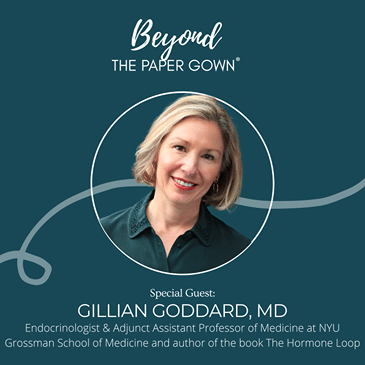
In this episode, Mitzi Krockover, MD, talks with Gillian Goddard, MD, endocrinologist, Adjunct Assistant Professor of Medicine at NYU Grossman School of Medicine, and author of The Hormone Loop. Dr. Goddard cuts through the noise and explains what women actually need to know, including:
What hormone testing can and can’t tell you
How menopause hormone therapy works, and who it may help
The role of testosterone in women’s health
How thyroid problems can mimic perimenopause and menopause symptoms
Why weight changes happen and what you can do about them
If you’ve been wondering whether your hormones are trying to tell you something, this episode offers practical, evidence-based clarity.🎧 Want more? Don’t miss our bonus minisode with Dr. Goddard: [minisode title / topic]. Visit Beyond the Paper Gown to join our community and learn more about achieving your optimal health.
GUESTS & RESOURCES:
Host: Mitzi Krockover, MD, Founder and CEO, Woman Centered, LLC, and Host of Beyond the Paper Gown
Guest: Gillian Goddard, MD, endocrinologist, Adjunct Assistant Professor of Medicine at NYU Grossman School of Medicine, and author of The Hormone Loop
Book: The Hormone Loop
Newsletter: The Savvy Patient
The Menopause Society: www.menopause.org
The Endocrine Society: www.endocrine.org
American Thyroid Association: www.thyroid.org
🎙️ If this conversation gave you answers, pass it on to a woman you love. Follow the show and leave a rating to help more women find us!
[00:00:06] People are often surprised to hear that we actually have dozens of hormones that we know of and that we're discovering new hormones all the time and that we have hormones that we haven't yet quite figured out exactly what they do. And so this is a constantly evolving system.
[00:00:25] Even women in perimenopause, which is a natural transition, can experience symptoms that are negatively impacting their day-to-day function. And those are symptoms that should be addressed and so those are symptoms that are always worth bringing up with your doctor.
[00:00:47] I think the most compelling case for using these medicines are women who are showing signs of blood sugar problems, whether that's insulin resistance or prediabetes. Women who are, you know, struggling with high blood pressure, high cholesterol, other cardiovascular risks. That's where you really get the most bang for your buck from adding a GLP-1 to your regimen.
[00:01:19] Anytime we're talking about doing a test, we want to know what we're going to do with that test result. Hormones are having a moment. Women are being offered hormone panels, menopause testing, testosterone, GLP-1 medications, compounded bioidentical hormones, pellets, peptides, melatonin, and increasingly elaborate promises about energy, weight, sleep, sexuality, and longevity.
[00:01:45] There's so much coming at us, it's hard to know what's help and what's hype. What we do know is that hormones do affect us in a myriad of ways and they don't operate as isolated switches. They communicate through interconnected feedback loops and when one part of the system changes, the effects may show up far beyond the gland or organ where the hormone originated. Hi, I'm Dr. Mitzi Krockover for welcome to Beyond The Paper Gown Podcast.
[00:02:12] My guest today is Dr. Jillian Goddard, an endocrinologist, adjunct assistant professor of medicine at the NYU Grossman School of Medicine, author of the Hormone Loop and writer of the Savvy Patient Newsletter. She's going to help us make sense of the increasing amount of information coming to us about hormones.
[00:02:31] We discuss what hormone loops actually do, why PCOS has been renamed PMOS, when hormone testing is and is not useful, how to think about menopause hormone therapy, testosterone, and GLP-1 medications, and why symptoms such as fatigue, weight gain, disrupted sleep, and brain fog should not automatically be attributed to menopause.
[00:02:55] Most importantly, we talk about how women can separate evidence-based care from hormone hype and have more productive conversations with our clinicians. And just a reminder that this episode is for general informational and educational purposes only. It should not be taken as professional medical advice, diagnosis, or treatment. Always talk to your doctor or another qualified health provider with any questions you have about a medical condition.
[00:03:24] Here's my conversation with Dr. Jillian Goddard. I'm Dr. Jillian Goddard. I'm an endocrinologist and an adjunct assistant professor of medicine at NYU Grossman School of Medicine.
[00:03:50] I'm also the author of the Savvy Patient Newsletter and the book, The Hormone Loop. Terrific. It is great to have you here today. And, you know, just to level set, what is an endocrinologist? Sure. An endocrinologist is a physician who's a specialist in hormones and the glands that make those hormones. Perfect.
[00:04:15] And so your book, Fitting Enough, is called The Hormone Loop. And so, you know, when I think about that, I think about my medical school training and then we learn about those hormone loops. But tell the audience what you mean by that and why it's important for a lay audience to even understand. Absolutely. I think that, you know, when physicians, when doctors like us, when we think about hormones, we automatically think about these feedback loops.
[00:04:45] But that concept can be a little bit confusing for people who, you know, maybe didn't go all the way through med school. But I like to think about it this way. So if you picture two people playing ping pong, they're good players. They're going to keep the ball in play. They hit the ball back and forth to each other, but they don't do it exactly the same way with exactly the same force each time. They make subtle adjustments.
[00:05:13] They may move around in front of the table. They may change the angle of their paddle, hit the ball harder or softer at a slightly different angle. All with the goal of keeping the ball going back and forth from one player to the next. I like to think of our hormones this way.
[00:05:33] I like to think of the glands as the players and the hormones as the ping pong ball, where the glands are making these subtle adjustments based on the environment and the other hormones that are around. They're making these subtle adjustments about when and how much of different hormones to release in order to keep our body in a nice, stable balance. You know, that is just a beautiful description and definition.
[00:06:02] So let's talk about maybe some specific hormones. I think that especially for those in midlife, we've heard about progesterone and estrogen and testosterone, but there are others that really impact us as well. So take us through a few of those. Sure. I think people are often surprised to hear that we actually have dozens of hormones that we know of and that we're discovering new hormones all the time.
[00:06:31] And that we have hormones that we haven't yet quite figured out exactly what they do. And so this is a constantly evolving system. But some of the sort of classic hormones that we think of beyond the reproductive hormones, which make up the reproductive loop, are thyroid hormone, growth hormone, and then our adrenal hormones that include hormones like cortisol, the hormones that help our body respond to stress.
[00:07:00] In addition to that, we have a number of other hormones that exist sort of outside the loops. And some of the ones that people have maybe heard of are hormones like insulin, which help our body to process sugar. And the very well-known hormone at this point, GLP-1, which we are still discovering the many ways in which that hormone affects our body.
[00:07:25] So how can women tell the difference between maybe what they think may be a normal hormonal transition, such as perimenopause, for example, or something that needs medical attention or evaluation? Yeah, I think that there's a couple of different clues that something can be awry. I think the first clue when it comes to something like perimenopause is, is the timing right?
[00:07:52] There's a lot of conversation now in the world on social media that women experience symptoms of perimenopause earlier than we thought. But what we want to be careful of is while they may be experiencing symptoms, women's periods should be regular all the way up until their early 40s.
[00:08:17] And so if a woman is experiencing irregular periods before the age of 45, while it's possible that it could be perimenopause, we always recommend that women see their doctors about those period changes and make sure that there's not something else going on. So that's one thing. The other thing that I think is important is to think about how the symptoms that you're experiencing are affecting your everyday life.
[00:08:47] So if your symptoms, whatever they are, are impacting your ability to function in your day-to-day life, impacting your ability to go to work, care for your family, engage in activities that you enjoy, then those are symptoms that should be addressed regardless of their cause.
[00:09:09] In some cases, in some cases, even women in perimenopause, which is a natural transition, can experience symptoms that are negatively impacting their day-to-day function. And those are symptoms that should be addressed. And so those are symptoms that are always worth bringing up with your doctor. Absolutely. I want to go back to something that you said, and maybe this is TMI, but I never had regular periods. You know, I think about in medical school, the closest I got was like every six weeks.
[00:09:39] And the reason I know that is because we had a test every six weeks. So it was whatever, why ever I synced to that, I will not know. So I'm just going to assume what you mean is that it's really kind of a change in your pattern. That is true. That is true. What I usually say is that in general, women should have a regular pattern to their periods from around the age of 18 all the way through about age 45.
[00:10:09] And so whatever your regular pattern is that you establish during those years, that is what you should expect to continue to see with the sort of exception of a couple of different caveats. So one obvious one would be pregnancy, obviously. Breastfeeding can affect period regularity. And then different types of hormonal contraception.
[00:10:34] So birth control pills and progestin-eluding IUDs. But sort of outside of that situation, at a point in your late teens or early 20s, you should, your period should establish a normal routine, a normal rhythm for you. Women will come to their physicians and say that they've got some changes or whatever.
[00:11:02] And I think there is a question about the usefulness of checking estrogen levels or LHFSH, that kind of thing. So talk a little bit about that and where we are with the science right now. Yeah. The current science suggests that if a woman is having period irregularity at a time that's
[00:11:29] unexpected, so between that age of 18 or so and 45, there is a lot of utility to checking reproductive hormone levels, including hormones like LH and FSH, to help us get a sense of what's going on. There are a number of different things that can cause women to have irregular or absent periods. And we want to make sure that we are identifying those.
[00:11:56] Where there is less data and sort of less understanding of how best to use hormone testing is in a woman who's at a more typical age for perimenopause. So a woman who's maybe in her late 40s or early 50s and is having symptoms of perimenopause, it's not so clear at that point that checking hormone levels is helpful.
[00:12:26] And the reason is, is because in the perimenopausal and early menopausal years, women's reproductive hormones, estrogen, progesterone, LH, FSH can be very, very high and then very, very low. And it can be really difficult to know where you are in a woman's cycle and whether those hormone levels are appropriate or not.
[00:12:51] And so the hormone levels are difficult to interpret. The other reason we don't necessarily recommend testing is because when we're treating the symptoms of perimenopause and menopause, typically with hormone therapy, estrogen, progesterone, and maybe testosterone, we aren't treating to a specific goal. Part of the reason the Menopause Society changed the name of hormone replacement therapy to hormone
[00:13:20] therapy is that we're not replacing estrogen and progesterone. We're giving them in doses that are therapeutic for managing symptoms. And so we're not targeting a specific range. And to that point, I would assume there's no efficacy or usefulness in monitoring estrogen levels once you start therapy. Yeah.
[00:13:46] There's no data that suggests that that's beneficial or that there's, or even that estrogen levels measured while a woman is taking hormone therapy correlate with the symptoms that she's experiencing or not experiencing. And so it's really difficult to, when, I think what I would say is anytime we're talking about doing a test, we want to know what we're going to do with that test result.
[00:14:13] And it's difficult to know what we would do with that estrogen result. Exactly. Thank you for clarifying that. Because there are, as you know, tests out there for women to see if they are, in fact, in perimenopause. What do you think about some of the technologies that let you test on a regular, everyday kind of thing to see your pattern? Do you think that's useful? I think it depends on, again, I always like to think about what you're going to do with the information.
[00:14:43] So some people like a lot of information about what's going on with their body. They really want to understand what's going on. And for some people, having all of that information can feel a little anxiety-provoking. My caveat to this would just be that when we think about treating the symptoms of perimenopause and menopause, we really are talking about treating symptoms.
[00:15:11] And so we wouldn't focus on those levels as being indicative of the right time to treat or indicating what type of treatment would be helpful. These types of tests don't work well if women have problems like PCOS or we now call PMOS.
[00:15:33] You know, anything that can sort of affect those hormones in an unusual way, those types of tests may not be so accurate. Sure. Makes a lot of sense. The other question I had that's related to this is the tricky part if you are someone who's older who is trying to get pregnant. Because you can get pregnant and be in perimenopause.
[00:16:03] Indeed. You definitely can. I have had a handful of patients who have gotten pregnant in their mid and even just beyond their mid-40s. And so if you don't want to be pregnant, I think perimenopause is a time when women underestimate the importance of contraception for sure. But perhaps you want to be pregnant during perimenopause. That's great.
[00:16:30] The challenge is figuring out when you are ovulating because ovulation kits rely on, like ovulation predictor kits rely on seeing that spike in LH. And it can be very difficult to identify that spike in a woman who is a little bit older.
[00:16:53] And so I really encourage my patients who are over, you know, beyond 40 even, to consider, especially if their periods are irregular, but even if they're somewhat regular, to consider consulting with a reproductive endocrinologist or fertility specialist earlier in the process,
[00:17:15] even if they don't think that they would use assisted reproductive technology like IVF, because the reproductive endocrinologist can monitor and really get a sense of where exactly you are in your cycle. And they often, they do a lot of that with ultrasound, actually.
[00:17:41] When you talked about hormone therapy as opposed to hormone replacement therapy, new nomenclature there, when is it appropriate? And what should women understand when they're considering taking hormone therapy? Yeah. With respect to perimenopause? Yeah, absolutely. So hormone therapy is appropriate for any woman in perimenopause who is experiencing symptoms
[00:18:10] that are impacting her daily function. So if you're having hot flushes, night sweats, sleep disruption, and those symptoms are making it difficult for you to function in your daily life, then that is a reasonable time to consider hormone therapy. There is no, you do not have to be in menopause to start hormone therapy. You do not have to, you know, be 12 months out from your last menstrual period.
[00:18:40] There's, we no longer have this clock ticking in the background that says that you can only take hormone therapy for a very specific amount of time at a very specific point in the perimenopausal transition. However, the way we will give hormone therapy may be very different for a woman who is still having relatively regular periods and maybe a little bit younger, perhaps in her early
[00:19:10] or mid-40s, as opposed to a woman who's having very infrequent periods or who maybe has already had her last menstrual period. In younger women, we often will use combination birth control pills that have a little bit of estrogen and progesterone in them to treat the symptoms of perimenopause. And as women get older, a lot of times we'll transition to an estrogen patch or gel plus a progesterone pill.
[00:19:39] And the reason for that is because hormone therapy in the form of an estrogen patch and progesterone don't suppress ovulation. And so you can have those crazy up and down levels of estrogen behind the scenes causing all kinds of problems, including irregular periods and symptoms. Birth control pills work as contraception by suppressing ovulation.
[00:20:04] And so you get a nice even level of estrogen and progesterone. That's less important in an older woman who is not cycling very often. That smaller dose of an estrogen patch can definitely get the job done. I think the biggest thing women should know is that while there has been a lot of chatter about the potential long-term benefits of hormone therapy, and here we're talking about the potential that
[00:20:34] hormone therapy reduces women's risk for cardiovascular disease in the future and may reduce the risk for dementia in the future. Unfortunately, that data is going to be really difficult to collect in a high-quality way. And so at the moment, we don't really have great evidence that hormone therapy is beneficial for those things.
[00:20:58] And so we don't currently recommend hormone therapy just for the prevention of future disease like heart disease and dementia. However, 80% of women experience hot flushes and night sweats. And we know that estrogen, that hormone therapy is the best treatment for hot flushes and night sweats, bar none. So you don't have to justify it in any other way.
[00:21:26] Treating symptoms is a good enough reason to start hormone therapy. And talk a little bit about folks that may not be able to use the estrogen. Sure. You know, it's interesting. The more we are learning right now, the smaller this group gets. But there are a subset of women where it is recommended that they not use hormone therapy in the form of estrogen or progesterone.
[00:21:52] This is often because they either have a personal history of cardiovascular disease or have a personal history of blood clots, although there's some wiggle room there. Or the most obvious group are women who had estrogen positive breast cancer personally in the past. In those cases, we do have more options than we've ever had before for managing certain types of symptoms.
[00:22:23] So while we may not want to use an estrogen patch and oral progesterone, we can safely use vaginal estrogen in those women. And so if women are having a lot of vaginal dryness, if they're having a lot of vaginal discomfort, if sex is painful, if they're getting urinary tract infections, then we can absolutely use vaginal estrogen in those women to manage those specific symptoms because estrogen given in
[00:22:51] that way doesn't circulate in the blood at very high levels and it does not put those women at risk. We also have some amazing non-hormonal treatment options, particularly for hot flushes and night sweats. There are two medications in this class now, Vioza and Linquette, and they are once-a-day pills that act like estrogen just in the hypothalamus in the temperature-sensing cells.
[00:23:20] So they basically trick those particular cells into thinking that there's estrogen around and keeping the body temperature a little bit more stable, dealing, you know, getting rid of those hot flushes and night sweats that can be really uncomfortable and really disruptive. Absolutely. And I think it's really worth underlining the point that you're making about the vaginal
[00:23:49] estrogen because I think that depending on where a physician, you know, is in their training or, you know, practice, they may not have gotten the message. So if you are a woman who is experiencing vaginal dryness, recurrent urinary tract infections, and who's been told you can't have vaginal estrogen, I think it's worth maybe having another conversation because those are really significant
[00:24:16] symptoms. And, you know, and now we know that those can be addressed. So thank you for reminding us about that. Absolutely. And then the other point I wanted to just have you make is why we use progesterone because we're really thinking about the estrogen and treating the hot flashes and all the other symptoms. But for those who may not be aware, why are we using the progesterone?
[00:24:46] Sure. So when we give women estrogen, the estrogen will continue to act on the uterine lining and it can cause a buildup of the uterine lining. When that happens and we're not having regular periods to slop off that uterine lining, some of those cells can mutate and it can put women at risk for
[00:25:09] endometrial cancer, which is cancer of those cells that line the uterus. So what we do is we give progesterone to keep that buildup of the uterine lining from happening. And so that is really the main goal of progesterone. And for many, if a woman has had a hysterectomy, if she doesn't have a uterus,
[00:25:33] she doesn't actually need the progesterone to safely take hormone therapy. However, there is a little bit of data suggesting that progesterone on its own or in conjunction with estrogen may do more than just protect the uterine lining. It may also be helpful for sleep. Oh, very interesting. And we all need that. We can talk about that later.
[00:26:03] And then I'm sure you get this question a lot about bioidentical hormones. So what does that mean? And then without getting too exhaustive, the thoughts about the different forms of hormone delivery? Yeah, this is a term that has gotten very confusing and confused in conversations about
[00:26:29] hormone therapy. And so I think it's helpful to quickly address the history of where this comes from. So the Women's Health Initiative study was a large study that was done in the 1990s and into the early 2000s, a study of hormone therapy to prevent heart disease in women. And that study very famously
[00:26:52] had a negative outcome. Instead of preventing heart disease, they saw an increase in heart disease. The hormone therapy that was used in the Women's Health Initiative study was an oral hormone preparation that included a type of estrogen called conjugated equine estrogens, which are estrogens that are collected
[00:27:16] and isolated from the urine of pregnant horses, and a type of progesterone called medroxyprogesterone. And so as when people looked back at why the outcome of the Women's Health Initiative was unexpected and negative, one of the things that they started talking about were these specific formulations of estrogen
[00:27:39] and progesterone. And so one of the sort of knee-jerk reactions after the Women's Health Initiative study was toward hormones that are quote-unquote bioidentical. So what bioidentical technically means
[00:27:57] is that the estrogen and progesterone are the same chemical formulation as the estrogen and progesterone that women's bodies make. That was not true of the conjugated equine estrogens and the medroxyprogesterone.
[00:28:19] And so there was this desire to switch back to or to switch to hormones that were identical to the hormones that our bodies make. At the time, there wasn't as much availability of these types of hormones in off-the-shelf preparations. And so women were going to compounding pharmacies and to doctors who would prescribe
[00:28:47] compounded bioidentical estrogen and progesterone and compounded creams. The problem with those products is that compounding pharmacies are not regulated by the FDA. They're regulated at the level of the state. The products they make are not quality controlled by the FDA and often not well controlled by the
[00:29:14] state-level regulators who regulate compounding pharmacies. And so you really just have no idea what you are getting from a compounding pharmacy. So many of us who work in this area really would prefer women be getting a high-quality product that's going to act predictably. And luckily, at this point, the estradiol that is sold in estradiol patches and estradiol gels
[00:29:42] from conventional pharmacies, from conventional pharmaceutical manufacturers who are heavily regulated by the FDA is also bioidentical. And we also have bioidentical progesterone in pill form, and we have bioidentical estrogen in pill form as well. And so I really want my patients to be taking a product that I know is high quality, that I know has the amount of estrogen or progesterone in it that
[00:30:11] I want them to have. And you talked a little bit about the gels and the patches, and then there's also pellets. So when a woman is making a decision with their physician about how to take hormone therapy, what are some of their considerations? Sure. I mean, I think the biggest consideration is a woman's risk for blood clots or heart disease. We know that oral estrogens, particularly as women
[00:30:40] get older, are more likely to cause heart disease or blood clots, that taking estrogen through the skin, either as a patch or a gel, is the risk of blood clots and heart disease is virtually zero. It doesn't increase the risk substantially at all. And so that is often a decision-making
[00:31:06] factor between pills versus patches or gels. Certainly cost and availability are a factor. Pellets are a little bit different. So pellets are compounded in special pharmacies that make pellets, and they are compounded to the physician's specification. They can contain a number of different hormones,
[00:31:31] estrogen, progesterone, but also testosterone, DHEA, pregnenolone, you name it. You can put it in one of these pellets in many, many cases. Those pellets are inserted under the skin in the subcutaneous fat, and they typically release hormone for about three months is the lifespan of most
[00:31:57] pellets. The benefit is you, you know, you set it and forget it. You're done. The downside is that you can get a little bit of a spike and drop in hormone levels. So when the pellet is first placed, the hormone levels get very high, and then over the course of the lifespan of the pellet, they can drop. The other issue with the pellets is that you don't remove them. And so once they're in, they're in. And so if you don't
[00:32:26] like how some of the hormones are affecting you, there's really nothing you can do but wait it out. That sounds like a cocktail more than anything else. So when would one think about using that as opposed to some of the more traditional preparations?
[00:32:45] You know, it's not a direction I send my patients in very often, honestly. I think that some women like getting testosterone that way. We haven't really talked about testosterone in women yet, but it is definitely a hormone that many women feel they benefit from in the perimenopausal years. And some women
[00:33:10] like to get their testosterone in pellets. There's not a great way for women to get testosterone right now. There is no FDA approved testosterone product that is formulated for women. And so women end up taking little doses of testosterone formulated for men, or they end up going with compounding pharmacies.
[00:33:35] And so that's sometimes a time when that can make sense. But in general, pellets are not my favorite option because I think that they don't deal with the fact that what we're really aiming for with hormone therapy is nice, even levels of estrogen and progesterone. Sure. And I do want to talk about testosterone, but I want to go back to something you said about
[00:33:59] cardiovascular issues and using the patches. Is that true regardless of age or is there an age limit to which you really can't use the hormone therapy anymore? What's the latest and greatest on that? The latest and greatest. This is a real moving target at this point. So out of the Women's Health
[00:34:29] Initiative came some data that suggested that part of the issue was that women were started on hormone therapy when they were many years past menopause. So we came up with this idea of the timing hypothesis, which is this idea that giving estrogen right around perimenopause may be not only safe, but may in fact be beneficial. It's definitely safe. We don't know for sure that it's beneficial. But that if you wait
[00:34:58] 10 years beyond the age of your last period or after the age of 60, that your risk for the hormone therapy increasing your risk for cardiovascular disease increases. We're kind of reassessing this a little bit
[00:35:20] more and we are changing how we think about these hormones in the context of older women. And so what do I mean by that? The way we are thinking about these hormones more and more is that this is not a black and white situation, but rather a balance of benefits versus risks. So if someone is very symptomatic,
[00:35:47] but they're in their early 60s and they had their last period in their early 50s, one might argue that that patient would get more benefit than they would get increased risk. And so this becomes a very personal calculus about a specific woman's symptoms and a specific woman's cardiovascular risk.
[00:36:14] We are getting away from hard and fast cutoffs when it comes to thinking about these issues. Fascinating. I have so many other questions, but I have so many other questions that we need to get to. I think the message is what I think you're trying to say is that it is a moving target, but keep up with the evidence and make sure that your physician's keeping up with the evidence as well. A hundred percent. So now getting back to testosterone, we talked a little bit about it. When would someone be interested
[00:36:44] in potentially supplementing with testosterone and where are we with the FDA approval? I was hoping that we were making some progress in that area. So let's start with sort of what people think testosterone is good for and what the evidence actually says it's good for. There we go. If you talk to women or you go on social media, you will often hear that testosterone is like
[00:37:12] the hormone that's going to like put the spring in your step and you smile on your face, that it is going to be the answer to all of your perimenopausal woes. And I think that people kind of think it's going to be a little bit of a fountain of youth in a way. The only thing that testosterone has been well studied for in women is managing hypoactive sexual
[00:37:41] desire disorder, which is essentially women who are struggling with low libido and poor sexual arousal. They don't feel like they get the same response to sexual stimuli. Testosterone has been shown to improve libido and to improve women's experience of sex compared to
[00:38:09] placebo. Although I will tell you those studies are fascinating because they have huge placebo effects. So the women who get the placebo also are having better, more frequent sex. The women, yeah, the women who are getting testosterone, they're getting more of a bump for sure. And it is statistically significantly better. But I think it's really interesting that just offering women a possible treatment improves their
[00:38:39] experience so much. So that is the one thing that testosterone has actually been approved for. And like I said, at the moment, we don't have approval for a testosterone product for women. The challenge is that, you know, a pharmaceutical company has to spearhead that process because
[00:39:01] you need the financial support often of a pharmaceutical company to do the kinds of studies that show that a drug is safe and effective. There are a few workarounds with that, and there are people exploring those other paths. But I don't think we're I don't think we're super close to a testosterone product that's approved for women.
[00:39:27] And I'm hopeful that eventually we'll have one, but I don't think it's going to be in the next year or two, probably. So I want to go back and just make sure I understood what you were saying. You said that it is indicated for low or low libido hyposexual disorder in women. So if that's the case and someone is experiencing that, perhaps as a result of these hormonal changes during menopause,
[00:39:55] would they not be eligible for that? So I think here we're getting into a little bit of semantics around medical language. So there is data that shows that testosterone can be effective, but there is testosterone does not have an indication for treating hypoactive sexual desire disorder,
[00:40:24] which the indication comes from the FDA. And so you don't have that. OK. Yeah. So what that means is while women are certainly can safely take testosterone if they're appropriately monitored by their doctor and taking an appropriate amount, it will not be covered by insurance.
[00:40:46] And they will be, like I said, either using a compounded product or using a very small amount of a product that is formulated for men. Women need about a tenth of the testosterone that men need. Talk a little bit about the downside of testosterone. What are some of the risks? So, I mean, the biggest risks are ones that women really find just undesirable.
[00:41:11] So you can get some increased body hair growth, scalp hair loss. That really doesn't happen if you keep the levels sort of in the levels that are typical of a woman. Where you really get into trouble with testosterone is when women are taking much larger doses.
[00:41:38] A lot of times women are doing this in an effort to maintain muscle mass, but we really don't have a lot of data on that. And when women are taking much larger doses, if their testosterone levels are approaching those of a man, they can not only see body hair growth and scalp hair loss, they can also see voice changes. They can experience voice deepening. And they can see clitoral enlargement. So the clitoris can actually become enlarged.
[00:42:08] And so we do want to be really careful with how we're dosing these medications and making sure that we're dosing testosterone in a way that is providing the potential sexual benefits without those downsides. So moving on in this journey of perimenopause and menopause,
[00:42:34] one of the complaints is my body's changing. I'm gaining weight. And we talked a little bit about GLP-1s. And when would that be appropriate? Or what is happening with our hormones at that time that would make them responsive to something like a GLP-1 or other medications?
[00:42:58] Yeah, I think that this is an area where we get the crosstalk between hormones in the reproductive loop and other hormones. Sure. And this is an area that we think we understand a little bit. We thought we understood it. And now we're realizing that maybe we didn't have all the pieces of the puzzle together. But essentially what happens is estrogen drops.
[00:43:22] Estrogen keeps women storing fat as fat in their hips and thighs. That's subcutaneous fat. And when estrogen levels drop, for the first time, many women will gain weight in their midsection. And some of that weight in the midsection is in and around the organs in the body and is called visceral fat.
[00:43:48] And that fat is important because it affects how our body processes sugar, glucose. It makes our body resistant to insulin. It makes us need more insulin to keep our blood sugar levels normal. And insulin is a hormone. And it has sensors all over the body, including in the brain, where it can signal that we are hungry and that we are craving carbs.
[00:44:18] And so now all of a sudden our appetite is increased and we are consuming more carbohydrates, which we are then storing as fat in our midsection, which then makes us more insulin resistant. And we get this big feed forward cycle. And so the piece that is not well understood and that people are just starting to look into is the idea that FSH may play a role.
[00:44:43] And the reason we think this is the case is because we know that hormone therapy doesn't actually have a big effect on women's weight. So if you start hormone therapy, it's not going to help you lose weight that you've gained in perimenopause. We think and the reason we think FSH may be involved is because hormone therapy does not significantly reduce FSH levels.
[00:45:10] We thought that FSH was only acting in the ovaries, but it turns out FSH has effects all over our body. And one of the places it has effects is in the adrenal gland. And we think that FSH may be affecting the production of adrenal hormones that could be further adding to this insulin resistance, causing women to gain weight in midlife.
[00:45:36] The reason this type of weight gain is important is not just because we're vain, although I certainly am a little bit vain and I'm happy to admit it. But also because this is the weight gain that can have real effects on our long-term health. It can have effects on our blood sugar, blood pressure, cholesterol, all of which put us at risk for cardiovascular disease, which is the number one cause of death in women.
[00:46:05] And so especially when women are starting to see those other metabolic changes, it can be really reasonable to consider a GLP-1 receptor agonist to help manage that weight gain. I think that for me, there's a couple different criteria that I like to think about before starting a GLP-1.
[00:46:31] So one is making sure that a woman is following a healthy diet and lifestyle. By the time my patients get to me, usually they are already doing that. But we want to make sure that we're not missing something. Two is that we want to make sure that these medicines are really not intended for losing a small amount of weight.
[00:46:57] We really want to make sure that we're talking about someone with an appropriate body size. At the moment, we base that on body mass index, which is not my favorite measure of overweight and obesity, but it is the current measure being used. And so these medicines are really indicated for women who have a body mass index in the overweight or obese range.
[00:47:26] And then I'm always looking for these metabolic changes. I think the most compelling case for using these medicines are women who are showing signs of blood sugar problems, whether that's insulin resistance or prediabetes, women who are struggling with high blood pressure, high cholesterol, other cardiovascular risks.
[00:47:48] That's where you really get the most bang for your buck from adding a GLP-1 to your regimen. And that's because it's not just the weight loss that helps lower the blood pressure, the cholesterol. It's actually the direct action of the GLP-1 on the blood vessels in the liver that affects those levels.
[00:48:15] So it really is doing more than just helping people lose weight in that situation. Yeah, it's really an interesting balance because if you're not grossly overweight, but you're seeing some of those changes or you're seeing some of those metabolic changes through cholesterol, blood pressure, all that, it's very enticing as a, you know, kind of like where we were with statins, you know, decades ago.
[00:48:44] However, it does not come without side effects and quality of life issues. And so I think that's something that we have to be mindful of because, you know, the risk benefit profile, I think, is still evolving. Would you agree with that? I would absolutely agree with that.
[00:49:03] And one of my big concerns now is in patients who maybe weren't particularly struggling with overweight or obesity before starting these medicines, and then they're starting on GLP-1s and they're losing a lot of muscle in particular because maybe because they didn't have a whole lot of fat to lose to begin with. Right. And so my concern is that we're going to see women who have maybe gone a little too far with these medicines
[00:49:33] or maybe they weren't the right candidates to begin with struggling with osteoporosis and frailty in the future. And that is nearly as big a cause of disability and death among women as cardiovascular diseases. Thank you for bringing that up because that's the, that's the, just to kind of underline that, the relationship between muscle and bone is so important. Absolutely. And if you're not losing muscle mass, it's going to impact on your bone. And 100%.
[00:50:02] That is a huge issue. So I guess we haven't found the magic bullet or the magic pill yet. You know, I think for the right person, these medicines are paradigm shifting and they're so important. I'm just not sure that the right person is every person. That's right. Absolutely. Well, moving on a little bit more in terms of, you know, we talked about symptoms with menopause and perimenopause,
[00:50:30] which could be fatigue, weight gain, brain fog, hair changes, mood shifts. That also then overlaps with potentially other hormonal issues such as thyroid. So how do you, you know, tease those out?
[00:50:51] Yes, this can be really challenging because the symptoms of thyroid disease can be skin changes, hair changes, fatigue, weight gain. It all sounds very, very similar, right? I think that at that point, the way to tease things out is really to talk to your doctor and think about testing.
[00:51:15] It can be really, really difficult to separate out a woman who's experiencing perimenopausal symptoms and a woman who's experiencing symptoms related to a new thyroid problem. And we know that big hormonal shifts in our reproductive hormones, big shifts in the reproductive loop
[00:51:39] are times when women are particularly vulnerable to developing new thyroid disease. So puberty, perimenopause, and pregnancy are the three times when women are at highest risk of developing a new thyroid problem. And you can see how in perimenopause in particular, you might miss the thyroid problem because the symptoms are so similar to perimenopause.
[00:52:05] So I think at that point, it really is talking to your doctor and doing the blood testing to check. Particularly if you have a family history of thyroid disease, hypothyroidism is highly heritable. It runs in families. And so if you have mothers, sister, aunts with thyroid disease or children with thyroid disease,
[00:52:35] this would be something I'd be particularly on the lookout during the perimenopausal transition. Is there any indication for screening for thyroid? You know, the current guidelines don't recommend screening in all women. Some primary care doctors definitely do do that. But it is not something that is universally recommended. Thyroid disease is quite common.
[00:53:05] And so when you start asking people about their family history, you often find a first degree relative with thyroid disease. And at that point, you're not really screening anymore. So I think that, you know, when someone is symptomatic, it's definitely worth looking for. But at the current point, at this current point, we don't recommend testing everyone. Sure. And it's not just one and done, I would assume, as well.
[00:53:33] It's, you know, you're looking at this specific situation. Yeah. Yeah. Thyroid can be quite dynamic. It can change over time. So just because you've had your thyroid checked in the past and it was normal, if you're having new symptoms, it's worth checking again, especially if you have risk factors. Sure. And as we're on the topic of fatigue and tiredness, as a lot of women can relate to,
[00:54:00] there is a lot of talk, if you will, about adrenal fatigue and cortisol levels and all of that. So help us understand what is actionable and what is, you know, hype. Yeah. So this idea of adrenal fatigue, that chronic stress taxes your adrenal glands and they can no longer appropriately produce cortisol,
[00:54:30] is not an idea that is borne out in the medical literature. So adrenal fatigue is not a medical entity that we have evidence to support that it exists. Adrenal glands can keep making cortisol for as long as they need to. They can just keep churning it out.
[00:54:57] However, chronic stress can have real impacts on how we're feeling. And so that does not mean that we should not be getting adequate sleep, doing, you know, positive things beyond sleep to manage our stress levels. Women in midlife are often peak career. They may have, you know, adolescent or young adult kids who are still reliant on them.
[00:55:24] And often they also have aging parents and other family members. And so like the stress is the stress is real. But the ways to manage that stress really are to focus on getting sleep. I tell people sleep is the number one thing that you can do to improve your health now that nobody smokes cigarettes anymore. We used to say quitting smoking was that.
[00:55:54] But these days it's sleep. And really doing, you know, productive things to manage stress wherever you can. Getting respite if you're caring for others. My personal favorite way to manage stress is exercise. But everybody is different and different people find different things helpful. Sure. And I mean, and it doesn't mean to say that you get cortisol doesn't have, you know, negative effects on your body. That's. Oh, for sure. You're not saying that.
[00:56:24] That that's not. No, not at all. So I mean, cortisol makes us. Yeah, absolutely. Cortisol makes us insulin resistant. It raises our blood pressure. It it it primes our body to run away from the tiger. But if we are experiencing chronic stress, there's we're not running away from the tiger. We just keep churning out the hormones that get us ready to run away from the tiger.
[00:56:48] And so if we're not using that increased blood pressure, that increased blood flow, that increased blood sugar, it's just, you know, churning around and increasing our risk for other health problems. Sure. And speaking of sleep and hormones, what's your take on melatonin? You know, I think the best data for melatonin is using it to reset your sleep. So melatonin is best at helping us fall asleep.
[00:57:17] It has been shown to shorten sleep latency, which is like how long the time you spend between when your head hits the pillow and when you actually fall asleep. Normal sleep latency is about 15 minutes. And so if you're spending a lot more time on a regular basis lying in bed, not able to go to sleep, you may want to, you know, take something that will improve your sleep latency. And melatonin is great at that.
[00:57:48] It works best if you take it nightly for a chunk of time to sort of reset your sleep latency. It works. It works. It works beautifully for things like jet lag because you take it nightly about a half an hour before you want to go to bed to try and prepare your brain for sleep.
[00:58:11] We do recommend typically that people take it for a week or so, but not necessarily every single night for forever. Yeah, interesting. And dosage? It's all over the place. The doses that are most often studied are between three and five milligrams.
[00:58:30] Lots of longevity clinics out there, lots of opportunities for hormone panels and peptides, and we didn't even talk about growth hormone. So what's your overall advice if someone is looking to consult any of these kinds of practitioners? Yeah, there's not a lot of evidence on what helps us live longer.
[00:58:57] It seems like the number one factor in longevity is genetics. But I always tell my patients that they should, if they're looking to live healthy longer, they should take a page out of my grandmother's playbook. She lived to be 99, and she lived independently until she was more than 97 years old. All right.
[00:59:24] And yes, so what I would say is she engaged in many things in moderation. She made the best milkshake. She always had one, but she had it in a little. We all drank them out of little tiny tumblers when we had them. She surrounded herself with friends and family.
[00:59:47] We know that people who have strong social connections age better, that being lonely, that being socially isolated actually rewires our brain. And so that's important. You should not smoke. You should manage any chronic medical problems you have. The one medication she took was a baby dose of Losartan, a blood pressure medicine. Oh, my goodness.
[01:00:18] Yes. Yes. And you should exercise. She was an avid gardener and spent a lot of time outside in her garden. And you should find exercise that you enjoy doing. Be active. And you should use your brain. She played bridge until her very, you know, very toward the end of her life.
[01:00:38] So I think if you're doing those things, staying active, using your brain, surrounding yourself with others and engaging in things that you enjoy in moderation, you've done the work that you can do. And there's not a peptide or growth hormone or anything else that has any data that suggests that it's any more effective. More expensive, but not more effective. That's really great advice.
[01:01:08] You know, I don't want you to leave without talking a little bit about the book and how you feel that people can use it. And then also your newsletter and how we can connect with that. Absolutely. So my book is called The Hormone Loop. It really covers women's hormonal health from puberty all the way through menopause.
[01:01:32] I think that understanding where we've come from is informative as far as where we're going from a hormonal perspective. And so I obviously would encourage everyone to read the whole book. But it also comes in standalone chunks chronologically.
[01:01:50] So if there's a particular part of the female reproductive life that you are interested in, whether that's perimenopause, menopause and beyond, or puberty, because perhaps you have a teen at home. The sections themselves can stand alone. The other thing that I think it's really important to know is that one of the goals of this book is to help you have better conversations with your doctor.
[01:02:16] And we support that, you know, the book supports that in a couple of different ways. One is with some examples of questions you might want to ask your doctor at the various different stages. But also the final chapter is really about how best to prepare to make the most of the 15 minutes that your doctor has to spend with you by doing a little legwork before you go to the doctor's office. It is available everywhere books are sold.
[01:02:44] My newsletter often gets into more of the current research that's going on, perhaps new research that's come out. It is called The Savvy Patient. And you can subscribe at SavvyPatient.Substack.com. Terrific. Well, again, great resources. And I can't begin to thank you. I have learned so much during this conversation.
[01:03:10] And before I let you go, is there anything that we did not touch upon that you think is important for our audience to know or learn? Yeah, I think that the biggest thing that all women should know is that it's really not necessary to suffer.
[01:03:30] If you're suffering, if you're experiencing symptoms that are impacting your day-to-day function, whether you're a teen just coming out of puberty or whether you're a woman in menopause, it's important to address those symptoms with your doctor because there's so much that we can do to manage them.
[01:03:52] And I think so often we as women are often our worst enemies in sort of not addressing and managing our symptoms and talking to our doctor about them so that we can get some help. At what point do you need to consult an endocrinologist? Unfortunately, there are only about 9,000 endocrinologists practicing in the United States right now. Really? I did not know that. And there's 168 million women.
[01:04:18] So unfortunately, for many women, getting access to an endocrinologist may be very difficult. But I think that anytime your primary care doctor or your gynecologist and many oftentimes, you know, gynecologists function as primary care doctors for many women, anytime they're out of their depth when talking to you about your hormonal health, I think it's reasonable to ask for a consultation.
[01:04:48] You may have to be a little patient in getting in to see an endocrinologist, but I think it's worth asking for that referral. Terrific. Well, Dr. Jillian Goddard, again, thank you so much for being so generous with your time and your expertise. This was, I really feel, a master class in hormonal health and so helpful. Thank you so much. Well, thank you so much for having me. I really enjoyed our conversation.
[01:05:17] As we've heard today, hormones influence nearly every system in the body. But the central lesson from this conversation is that hormone care should begin with the woman, not the laboratory result or the latest product. Symptoms that interfere with sleep, work, relationships, sexual health, or daily functioning deserve attention. At the same time, more testing is not always more informative.
[01:05:42] And treatments promoted for energy, weight loss, muscle, or longevity may have far less evidence than their marketing suggests. So a few questions to take to your next medical visit are, what else could be causing these symptoms? Would a test result actually change the treatment plan? What are the expected benefits of this therapy? And what are its drawbacks or risks? How will we know whether it's working? And how will we monitor for adverse effects?
[01:06:11] You can find Dr. Jillian Goddard's book, The Hormone Loop, wherever books are sold, and subscribe to her newsletter, The Savvy Patient on Substack. And you can find more conversations about women's health, healthy aging, innovation, and the forces shaping our health far beyond the examination room at beyondthepapergown.com. And I invite you to sign up for our newsletter. Until next time, take good care. This episode was produced by me.
[01:06:40] Our audio engineer is Patrick Shambayati. And our associate producer is Kyla McMillian.