
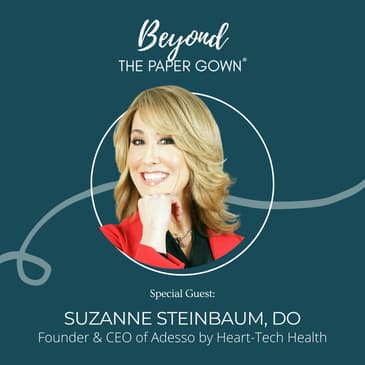

In this important episode, host Dr. Mitzi Krockover is joined by Dr. Suzanne Steinbaum, a leader in preventive cardiology and a strong supporter of women's heart health. They discuss the often overlooked issue of heart disease in women, which is the number one cause of death for women in the United States.
Heart disease claims more lives than all forms of cancer combined, yet it remains underestimated and misunderstood, particularly in its impact on women. This episode explores why heart disease is so deadly for women, how their symptoms differ from men, and why their treatment often falls short. Dr. Steinbaum also provides invaluable insights into how simple lifestyle changes can prevent up to 80% of heart cases.
Women often face misdiagnosis or underdiagnosis because their risk of heart disease goes unrecognized. Our conversation delves into the challenges women encounter when seeking healthcare, underscoring the importance of education and self-advocacy.
Whether you're a healthcare professional, a woman concerned about heart health, or just someone interested in learning more about this critical topic, this episode is a must-listen. Remember, knowledge is power — tune in to empower yourself with life-saving information and take charge of your heart health.
Call to Action: Don't forget to subscribe, rate, and review "Beyond the Paper Gown" on your favorite podcast platform. Visit Beyond the Paper Gown for more resources and join our community forum to share your thoughts and experiences about heart health.
SHOW NOTES:
[00:00:00] If you enjoy podcasts like this, you should check out our other shows on HealthPodcast Network.
[00:00:06] For example, Health Care for Humans, hosted by Dr. Sundar, expands our understanding of
[00:00:12] the history and culture of different communities and how to provide culturally responsive
[00:00:17] care.
[00:00:18] There's an episode you should check out where guest Dr. Durran details the systemic
[00:00:22] barriers faced by individuals with DACA status and highlights the importance of addressing
[00:00:27] these barriers.
[00:00:28] Check out Health Care for Humans on your favorite podcast platform or visit healthpodcastnetwork.com.
[00:00:50] Welcome to Beyond The Paper Gown, I'm your host Dr. Mitzi Krockover.
[00:00:54] Today, we're going to talk about the number one killer of women, heart disease.
[00:01:00] Does that surprise you?
[00:01:02] Deaths due to heart disease surpass all forms of cancer combined and even though
[00:01:07] it's a prevalent issue, it's often underestimated and misunderstood when it comes to its
[00:01:12] impact on women.
[00:01:14] So many women don't realize that they're having a problem or when they do go to the
[00:01:18] doctor's office or the emergency room, they are many times dismissed.
[00:01:23] That's why we've got Dr. Suzanne Steinbaum, a pioneer in preventive cardiology and
[00:01:28] a passionate advocate for women's heart health with us today.
[00:01:32] She'll provide some much needed insights into this pressing topic.
[00:01:36] She is founder and CEO of Adesso Health, a Medtech innovation to decrease the risk of women's
[00:01:42] cardiovascular disease.
[00:01:45] She launched and directed heart prevention programs at Mount Sinai Heart, Northwell Lenoxhill
[00:01:50] in Beth Israel, and two of those focus specifically on women's heart health.
[00:01:55] She is also the author of Dr. Suzanne Steinbaum's heart book, Every Woman's Guide to
[00:02:00] a Heart Healthy Life, and she's a national spokesperson for Go Red through the American
[00:02:05] Heart Association.
[00:02:06] We're going to explore why nearly one in every five female deaths in the United States is
[00:02:13] due to heart disease and how symptoms in women often differ from that classic Hollywood
[00:02:18] heart attack with someone clutching their chest that most people expect.
[00:02:23] We'll also cover the unique risk factors for women, which can significantly increase
[00:02:28] heart disease risks.
[00:02:30] Plus we'll discuss why women are less likely to receive aggressive treatment post heart
[00:02:34] attack and are more likely to fare worse than men in heart disease outcomes.
[00:02:39] But we've got some good news too.
[00:02:41] Dr. Steinbaum will also share practical advice on how small lifestyle changes can profoundly
[00:02:48] impact heart health and potentially prevent up to 80% of heart disease.
[00:02:54] And just a reminder, this podcast is for informational purposes only and should not
[00:02:59] be construed as medical advice.
[00:03:01] We encourage you to consult your health care provider to discuss your personal health issues.
[00:03:16] It is my delight to be able to introduce Dr. Suzanne Steinbaum.
[00:03:20] Suzanne, it's so great to have you here.
[00:03:22] Thank you for being with us today.
[00:03:24] Thank you for having me here.
[00:03:27] So we're going to talk a little bit today about heart disease in women.
[00:03:30] But before we do that, how did you decide to get into cardiology?
[00:03:36] I tell this story often.
[00:03:38] And when I share it, I almost go back to the moment when it happened because it was the
[00:03:47] ah-ha, the Oprah ah-ha moment for me.
[00:03:50] I was in my training.
[00:03:51] I was in my residency and I was in the emergency room.
[00:03:56] And I was there as this really perfect student following the attending physicians around, taking
[00:04:08] notes on everything they said.
[00:04:10] And this one particular day a 53-year-old woman was wheeled into the emergency room.
[00:04:16] She was nauseous holding her chest, her stomach, she was vomiting, she was sweating.
[00:04:22] And she was given the diagnosis of gastroenteritis.
[00:04:27] And she was put in the corner in the emergency room where she proceeded to have a heart attack.
[00:04:36] As this precocious note-taker looking at these attending physicians as they were gods,
[00:04:44] I, everything stopped.
[00:04:46] That was it.
[00:04:47] It was like everything went in slow motion.
[00:04:50] Talk about an ah-ha moment.
[00:04:52] That minute I said, this is what I'm going to do.
[00:04:55] I need to take care of women's hearts.
[00:04:58] It wasn't the first time it happened.
[00:05:01] But I used to go to the floors.
[00:05:04] After the women were admitted to the hospital, I would go to see what happened.
[00:05:08] And they always did worse than the men, always.
[00:05:12] And this was the point that I said, this is what I'm going to do.
[00:05:17] So to follow up that little story, I decided I had to meet with the chief of cardiology
[00:05:22] and I couldn't get an appointment.
[00:05:24] I stalked him.
[00:05:25] This was not, this wasn't a casual let me call his secretary.
[00:05:30] I started following him around the hospital.
[00:05:32] I think at one point I was like at the men's room about to go in.
[00:05:36] He's like, okay, I'll talk to you.
[00:05:39] And I finally got to meet with him.
[00:05:41] And I said to him, I would like to do a fellowship in women and heart disease.
[00:05:46] And guess what he said?
[00:05:48] There is no such thing.
[00:05:50] And then I said, well, I like to do a fellowship in preventive cardiology because if we can
[00:05:56] prevent heart disease in women, then we can do this.
[00:06:01] And you know what he said?
[00:06:03] There's no such thing.
[00:06:04] Oh goodness.
[00:06:06] I was so determined and to give him amazing amounts of credit, so was he.
[00:06:12] And he was working with Dean Ornish who was running the lifestyle heart trial out in San
[00:06:18] Francisco.
[00:06:20] And we became the East Coast site for Ornish's research and he got a preventive cardiology
[00:06:29] fellowship CGMD approved.
[00:06:31] And I was the first preventive cardiology fellow in New York, I think.
[00:06:37] So talk a little bit.
[00:06:39] You're a preventive cardiologist.
[00:06:41] What does that mean?
[00:06:45] We as a system are focused on treatment strategies.
[00:06:51] So early diagnosis isn't usually how we do things.
[00:06:55] We wait till people get chest pain.
[00:06:57] We wait till they have symptoms and then we put them through it.
[00:07:00] What happens if we take someone and risk stratify them early in their lives and say,
[00:07:07] this is someone who might be at risk.
[00:07:10] Let's start treating them now.
[00:07:12] Let's tell them how to eat.
[00:07:14] Let's tell them how to exercise.
[00:07:16] Teach them how to have stress management tools.
[00:07:21] Teach them how to sleep and guess what?
[00:07:23] You change the trajectory of heart disease.
[00:07:26] Heart disease does not develop unless the arteries are unhealthy.
[00:07:32] The lining of the arteries, it's called the endothelium, it's a treatable thing.
[00:07:37] If we treat the lining of the arteries and prevent the arteries from getting stiff,
[00:07:44] right then and there we've prevented heart disease.
[00:07:46] And 80% of the time it is preventable.
[00:07:49] So that's where I sit and that's what I focus on.
[00:07:54] And you talk about preventing it or diagnosing it early.
[00:07:59] But I want to underline that actually, again, easier said than done, if we started some
[00:08:05] of these things earlier, it could actually be totally preventable.
[00:08:09] Is that a fair statement?
[00:08:11] Absolutely.
[00:08:11] Not totally, I shouldn't say, but 80%.
[00:08:13] That 80%.
[00:08:15] I would say 80% is what we all use as a standard.
[00:08:20] It might actually be closer to 90%.
[00:08:22] Really?
[00:08:23] OK.
[00:08:24] So let's talk about the risk factors for heart disease and well,
[00:08:29] obviously since we're focused on women, we'll talk about those.
[00:08:34] And if there's any differences from either sex.
[00:08:40] So I've been a spokesperson for the American Heart Association through Go Red
[00:08:47] for Women, which is an arm off of the American Heart Association focused on
[00:08:53] education and empowerment and research for women's hearts.
[00:08:57] So I'm going to quote the American Heart Association as I often do.
[00:09:02] We talk about the essential eight and these major risk factors are high blood
[00:09:07] pressure and high cholesterol and diabetes and obesity, sedentary lifestyle,
[00:09:13] poor diet and smoking.
[00:09:17] And the last and the new one is lack of sleep or inadequate sleep.
[00:09:22] So those eight things are what's considered to be the major risk factors
[00:09:28] and what leads to heart disease 80% of the time.
[00:09:32] Let's talk about women and let's talk about some of the obvious things that
[00:09:37] weren't listed.
[00:09:38] What about family history?
[00:09:40] So then we look at other issues like menopause.
[00:09:45] Women spend 40% of their lives in menopause.
[00:09:48] And guess what?
[00:09:50] 70% of those women will have some form of heart disease.
[00:09:54] So that's a major risk factor.
[00:09:57] And in fact, early menopause gives them a greater risk.
[00:10:01] Then we look at women with adverse outcomes of pregnancy like preeclampsia,
[00:10:05] gestational diabetes, even high blood pressure.
[00:10:08] Those women are at risk for heart disease.
[00:10:11] What about with women with multiple miscarriages or preterm labor?
[00:10:17] Those women are at risk of heart disease.
[00:10:19] Women who have autoimmune diseases, inflammatory diseases.
[00:10:25] These women are at greater risk of heart disease.
[00:10:28] And then let's talk about the women with depression, anxiety, social
[00:10:34] isolation. These women are at greater risk.
[00:10:38] So now we take the essential aid and we say who's at risk.
[00:10:42] But then we look at women and look at how many different issues
[00:10:48] that women have to deal with that we're missing in that risk analysis.
[00:10:53] Obviously our listeners can't see, but you could.
[00:10:56] I kind of smiled when you said lack of sleep, not just for the fact
[00:11:00] that there's all sorts of reasons why people can't sleep.
[00:11:02] But I was diagnosed recently with sleep apnea and I am a thin white woman.
[00:11:10] You know, never thought I was going to be at risk because we always
[00:11:13] have that idea that it's somebody with a thick neck, you know,
[00:11:16] and kind of obese and all of that.
[00:11:19] You want to talk a little bit about sleep apnea and what it's a risk factor for.
[00:11:25] Sleep apnea is associated with atrial fibrillation, with hypertension,
[00:11:30] with coronary artery disease.
[00:11:31] And it's one of those things that often does go undiagnosed.
[00:11:36] That's another one that's not even in the risk analysis.
[00:11:40] And we know it's a huge, huge issue.
[00:11:43] I actually have a patient right now with new onset atrial fibrillation
[00:11:48] and evidence of plaque in the arteries, elevated calcium score
[00:11:54] and sleep apnea when undiagnosed probably for a solid, I'm going to say,
[00:11:58] five to ten years.
[00:12:01] So if it's something that we don't address and look at,
[00:12:04] it's definitely one of the risk factors and one of the things
[00:12:08] that can lead to heart disease.
[00:12:09] Sure. And you know, I don't think my doctor ever thought about that.
[00:12:13] We don't ask about it.
[00:12:14] I don't think or, you know, with respect to kind of that review of systems
[00:12:18] that I talked about.
[00:12:19] Right. You bring up one of the most profound issues
[00:12:24] that when it comes to women,
[00:12:27] you don't represent the standard, the typical.
[00:12:31] You don't look like the patient that has sleep apnea,
[00:12:35] but it's what doctors perceive a heart patient to look at
[00:12:40] or someone with sleep apnea has.
[00:12:42] And you don't fit into that stereotype.
[00:12:46] So true.
[00:12:47] And just to underline what you're saying in terms of we don't look like
[00:12:51] the typical patients, it's because those typical patients were
[00:12:56] the research was done on men.
[00:12:59] And so when we say typical, we're really talking about typical for men
[00:13:04] and we call women's symptoms atypical, which, you know, is
[00:13:09] it's all in relationship again to men.
[00:13:12] So talk about, if you would, those that I'm putting this in air quotes,
[00:13:16] atypical symptoms of women when they are having
[00:13:22] challenges with their heart, especially with respect to blockage of the arteries.
[00:13:27] One of the most typical symptoms is shortness of breath.
[00:13:30] And in fact, women will have shortness of breath almost as often as they will
[00:13:34] have a chest discomfort, but not only shortness of breath, nausea, vomiting,
[00:13:40] jaw pain, back pain, even flu like symptoms
[00:13:46] can be a sign of heart disease.
[00:13:48] And every time I talk about these symptoms, especially in New York, all the women
[00:13:52] in the audience get very uncomfortable.
[00:13:53] They're like, I feel this way every day of my life.
[00:13:56] Exactly.
[00:13:57] So I say one of the things about exercise is not only is it good for your heart,
[00:14:02] but it is a way to measure yourself if you are exercising and you're moving
[00:14:08] and walking around and all of a sudden things become challenging
[00:14:11] and you're more short of breath or you're getting these atypical symptoms
[00:14:16] of jaw pain, back pain.
[00:14:18] You know, think about your heart, but when you're sitting and not moving,
[00:14:22] you never really can tell what's happening with you in terms of those
[00:14:26] symptoms, but these atypical symptoms are not really so atypical.
[00:14:33] When I went on your website, it noted that you have a holistic approach.
[00:14:38] What does that mean?
[00:14:40] I think another issue with how we approach patients,
[00:14:45] I think that every system separately is interrelated to the other system.
[00:14:50] And the most straightforward example of that is the mind and body connection
[00:14:56] and certainly the mind-heart connection.
[00:14:59] We see that with psychosocial issues.
[00:15:02] I mentioned depression, stress, stress hormones that get released throughout the body.
[00:15:09] We have a disease of the heart called Takotsubo's cardiomyopathy,
[00:15:14] which is really known as the broken heart syndrome.
[00:15:18] It is the profound effects of stress hormone that get released within
[00:15:22] the body and the heart almost gets shocked by trauma, by stress.
[00:15:28] And it's all due to stress hormones that happen from your mind.
[00:15:34] There are receptors on the heart that are the same kind of receptors
[00:15:41] that are found in the brain.
[00:15:43] This study was done in the early 90s and referred to the heart
[00:15:48] then as the little brain.
[00:15:50] And that research was really the beginning of understanding
[00:15:55] the true heart-mind connection.
[00:15:59] So if we don't address a woman in her entire life,
[00:16:04] we're going to miss the boat.
[00:16:07] I think that asking the question, are you stressed is not nearly enough.
[00:16:14] Asking the question, are you a caretaker to parents, children?
[00:16:20] Is there anyone else you're giving up yourself for during your days?
[00:16:25] Asking about relationships, about support system, about job satisfaction.
[00:16:33] There is an amazing statistic out there.
[00:16:36] Thirty percent, thirty eight percent of women who describe stress on the job
[00:16:42] have an increased risk of cardiovascular disease.
[00:16:46] So if we don't talk about a woman in her whole life
[00:16:50] and who she is, that holistic concept of what makes her tick
[00:16:56] were missing these risk factors that actually lead to heart disease.
[00:17:00] You know, that's a fascinating statistic.
[00:17:02] I didn't know that specifically.
[00:17:05] I am on the board of the Black Women's Health Imperative.
[00:17:08] The Imperative has done a lot of work and they have found that one
[00:17:12] of the biggest sources of stress for black women is actually being at work.
[00:17:17] And we also know that they have a higher risk of heart disease as well.
[00:17:23] We can look at those basic risk factors and then we can ask why.
[00:17:29] And I think the root cause of things, getting back to this notion
[00:17:33] of prevention, why things develop?
[00:17:36] Is it familial?
[00:17:38] Is this hereditary?
[00:17:39] Is it from this horrible job and the caretaking and not enough sleep
[00:17:43] and not the right diet, not exercising because there's not enough time?
[00:17:48] What is the big picture of the story?
[00:17:51] And unless you address it, you're just not going to be able to understand it.
[00:17:57] And I honestly think from the physician side,
[00:18:00] you're not going to be able to take care of that patient
[00:18:04] the way that she needs to be taken care of.
[00:18:08] I think one of the most important things that's happening
[00:18:11] is exactly what we're doing here today.
[00:18:14] Education, empowering people to take charge of their own health,
[00:18:19] to understand who they are so they can be advocates for themselves
[00:18:24] to get the help that they need.
[00:18:26] What do you suggest to anybody listening that may have some symptoms?
[00:18:33] How would you suggest that they talk with a doctor about it?
[00:18:38] I think part of advocating for yourself
[00:18:42] is empowering yourself with the important information and the knowledge.
[00:18:46] And so knowing what your risk factors are,
[00:18:49] understanding and paying attention to who you are
[00:18:53] and really taking a rigorous assessment of your life.
[00:18:57] I always say, pretend you're a journalist, be very objective.
[00:19:01] Don't put your emotion in it.
[00:19:03] Follow yourself during the day and really outline what your issues are.
[00:19:08] If you're having symptoms and you think it's your heart,
[00:19:13] whether it is or it's not, you are obligated to yourself to get checked
[00:19:18] and having risk factors that means cholesterol
[00:19:22] and elevated blood pressures and elevated sugars
[00:19:25] and maybe sleep apnea and knowing all of these different risk factors
[00:19:31] become so important to understand how rigorously
[00:19:35] you need to be investigated and how much testing needs to be done.
[00:19:40] But you need to get a health care provider
[00:19:43] provider to be on your team to work with you.
[00:19:48] Absolutely. And then at what point
[00:19:53] would you suggest someone consult a cardiologist like yourself?
[00:19:57] I believe if you go to your primary care provider
[00:20:00] and you say, this is what I want,
[00:20:03] your primary care provider can actually do it for you
[00:20:06] and can be the person that can take care of you.
[00:20:10] I don't think you necessarily need a cardiologist
[00:20:13] if you get early prevention.
[00:20:16] I do think you need to see one
[00:20:18] if you're really having symptoms
[00:20:21] and they have impacted your life.
[00:20:23] That's your first step.
[00:20:26] You know, a lot of women use their OBGYNs as primary care physicians
[00:20:31] and do you see a big difference
[00:20:34] with respect to who gets referred to you?
[00:20:37] The referrals from obstetricians are less than they should be.
[00:20:43] The feeling is often that once a woman gives birth, she's cured.
[00:20:48] Blood pressure resolves.
[00:20:50] She's had complications is what you're referring to.
[00:20:52] Yes. Yeah.
[00:20:54] And so so they might not refer.
[00:20:56] What I what I always talk about is what happens at the next pregnancy?
[00:21:01] What happens five years down the road
[00:21:03] when that woman now has hypertension?
[00:21:05] Pregnancy is considered the first stress test for a woman.
[00:21:09] And if she has an adverse outcome and she fails the test,
[00:21:13] then she really needs to have her arteries looked at
[00:21:16] and really needs assessment, her blood pressure,
[00:21:20] her sugars, because she will develop hypertension
[00:21:24] and diabetes five to ten years down the road.
[00:21:27] And as I say, we can prevent these things.
[00:21:29] So that's the moment to really take care of her.
[00:21:34] When you look at the statistics around mortality
[00:21:36] for women in this country surrounding childbirth.
[00:21:40] Yes.
[00:21:42] It's the one moment where I get sick to my stomach
[00:21:45] because it doesn't have to be that way.
[00:21:47] It does not have to be that way.
[00:21:50] Talk a little bit more about that for listeners who may be
[00:21:54] not be aware.
[00:21:56] The number one cause of death during pregnancy
[00:22:03] and right after pregnancy is heart disease.
[00:22:08] Now, when you look at this around the world,
[00:22:12] hemorrhage is probably the most common in the United States
[00:22:17] of America.
[00:22:18] It is heart disease.
[00:22:21] When I say this out loud, I honestly could cry.
[00:22:25] How is this possible?
[00:22:28] When you look at the reasons why it comes down to,
[00:22:34] again, we get back to these risk factors.
[00:22:37] There's an increase in obesity.
[00:22:39] There's an increase in hypertension.
[00:22:41] There's an increase in diabetes.
[00:22:43] But we can manage these things.
[00:22:46] We can take care of these things.
[00:22:49] Why isn't it happening?
[00:22:51] Access to care, insurance.
[00:22:54] It's all of the reasons, the social reasons that go into it.
[00:23:00] But then it's also the follow up reasons from our side
[00:23:04] that we are failing women in this country.
[00:23:07] We are 100% failing all women.
[00:23:11] But when you think about women in the age range of pregnancy,
[00:23:17] these are supposed to be young healthy women who have estrogen.
[00:23:20] We know when estrogen goes away and menopause, it's another story.
[00:23:25] But when there's young healthy women who are having babies who are dying,
[00:23:30] this is a wake up call.
[00:23:32] I want to underline what you said with respect to, again, heart disease
[00:23:37] being the number one cause of death in women in the United States
[00:23:41] that are pregnant for pregnancy.
[00:23:43] Just to underline that our United States maternal mortality rate
[00:23:48] is number 24th in the world.
[00:23:51] We are behind every developed country for black women.
[00:23:57] It's five times worse as you stated.
[00:24:01] One of the biggest factors for that is heart disease.
[00:24:05] You talked about all the preventive factors,
[00:24:09] but is it also with respect to treatment as well or lack of treatment?
[00:24:13] 100%.
[00:24:14] When a woman comes in at risk, whether that risk is high blood pressure,
[00:24:24] whether it's diabetes or the fact that she can't get healthy food,
[00:24:29] we have to address all of these issues or we are missing the vote.
[00:24:36] And in the big picture, when you look at the statistics around women
[00:24:41] who have cardiomyopathies, this is a decrease in heart function.
[00:24:51] So the heart stops beating as effectively so much so that very little
[00:24:58] blood is pumped throughout the body to sustain the mother.
[00:25:02] And you could imagine that leads to a lot of problems and hospitalization
[00:25:06] and certainly an inability to take care of her newborn,
[00:25:12] which leads to other risk factors for that baby.
[00:25:16] If we don't address all of the issues and treat these women aggressively
[00:25:22] and this is part of my personal mission right now
[00:25:26] to really get these women treated in that third trimester postpartum
[00:25:32] to get these risk factors under control to make sure she has what she needs
[00:25:38] to get healthy.
[00:25:40] It's just going to get worse.
[00:25:42] It's really just going to get worse.
[00:25:44] We look at the increase in obesity and diabetes in this country
[00:25:49] over the past 10 years.
[00:25:51] It's an epidemic.
[00:25:53] Let's throw COVID on top of it that has turned out to be a cardiovascular disease
[00:25:58] more than it's been a pulmonary disease.
[00:26:02] And that's what we originally thought that it was just a virus of the lungs.
[00:26:07] It's not the case.
[00:26:09] It's a virus that attacks the lining of the artery and leads to clots
[00:26:13] and heart attacks and major problems with arteries and heart disease.
[00:26:20] So now we layer all the COVID on top of this and I expect
[00:26:24] and suspect that these statistics are just going to get worse.
[00:26:30] Well, you talked a lot about prevention.
[00:26:34] So let's be a little bit more optimistic.
[00:26:38] I was going to say on a happier note.
[00:26:40] Exactly.
[00:26:42] But I think it's really important.
[00:26:44] That whole thing about COVID, I'm sure we could do a whole other podcast on that.
[00:26:48] But I'm wondering are doctors now considering that a risk factor for heart disease?
[00:26:54] So to answer that question, I think that more and more doctors are understanding it.
[00:27:01] COVID, you know, when we could talk about it forever was the most bizarre thing to happen to physicians because as much as all people didn't know what was going on,
[00:27:10] neither did the doctors.
[00:27:11] Right.
[00:27:13] And it took a really long time to understand what COVID did to the body.
[00:27:19] And to this day, I think physicians are still catching up to understand how to best treat patients when they get COVID or have long COVID.
[00:27:30] And so I do think now as we're living with this disease, there is a greater understanding of its risk for heart disease.
[00:27:38] I will tell you in my world, it's on the list.
[00:27:42] It added to the essential aid, it's on the list.
[00:27:45] Do you do anything differently with respect to treatment or approach?
[00:27:50] My approach in general is different because I study the endothelium.
[00:27:57] And so for patients with COVID, I study that endothelium and the microvascular chur,
[00:28:04] which are the tiny, tiny arteries behind those big arteries that we know of that often cause the massive heart attacks.
[00:28:12] The microvascular chur, they're tiny ones, but there's so many of them that if they sequentially die off,
[00:28:19] they can cause the same amount of problems as one of those big arteries.
[00:28:23] And so that's what I look for in people with COVID, with symptoms with long COVID to really treat those, those arteries.
[00:28:31] Before we start talking about your company, which I'm excited to do, talk a little bit if you would about prevention
[00:28:45] and what recommendations you have that you feel are effective.
[00:28:50] Well, I hate to bring up the bad news on this one too.
[00:28:56] It requires, it requires that we do things like eat healthy and exercise.
[00:29:02] You know, those standard things matter.
[00:29:08] But we have an understanding more and more of what kind of food works for what kind, for what kind of people.
[00:29:17] You know, you can say to someone, just eat a healthy diet.
[00:29:21] Well, what does that mean?
[00:29:23] And we can look at things like metabolism and genetics to understand what kind of diet is best for you.
[00:29:32] There's the generalization of, you know, fruits and multigrains and low fat and vegetables.
[00:29:43] And, you know, we know good fats and that sort of thing.
[00:29:47] But how do we determine who needs a low, low fat diet versus who needs to stay away from sugars?
[00:29:56] Are there a group of people that do best with intermittent fasting?
[00:30:01] And we can kind of understand a little bit about metabolism to really understand what kind of diet might be best.
[00:30:11] We know that genetically, ApoE can tell us how well we process fats.
[00:30:17] It's associated with Alzheimer's and heart disease.
[00:30:21] But it means that our body just cannot shuttle those saturated fats out.
[00:30:27] And they land in our lining of the arteries and either lead to plaque in the sense of Alzheimer's or plaque in the sense of atherosclerosis in the form of heart disease.
[00:30:38] So these people need to be on a mostly vegetarian diet.
[00:30:42] How does the average person figure this out, or where can they go to do so?
[00:30:47] I can tell you all the scientific nuances around it.
[00:30:52] And I have said jokingly, just go to your home on a big holiday.
[00:31:00] Thanksgiving, look around the table.
[00:31:03] In your family, does many of the people there have some issue with their heart atherosclerosis, where there's stents, where there's strokes, heart attacks?
[00:31:13] Or do you look around the table and see diabetes and obesity?
[00:31:17] That's how you know your genetics. You just look around your table of your family.
[00:31:22] And those who are obese and have diabetes most likely have a problem processing sugars and should be on a low carbohydrate diet.
[00:31:34] And those who have a strong family history of heart disease and Alzheimer's, stay away from the saturated fats.
[00:31:40] That's an interesting place to start.
[00:31:44] I recommend the Mediterranean diet, which really is the most nutrient dense.
[00:31:50] There's a study, the Lion Heart Child that showed a 72% reduction in cardiovascular disease.
[00:31:56] We know that good fats, omega 3 fatty acids, vegetables.
[00:32:02] I say think of yourself as being on the beaches of Greece.
[00:32:06] What are you going to eat there?
[00:32:07] And eating that way is really the healthiest for your heart.
[00:32:11] I was thinking I'd probably eat a lot of pita, unfortunately.
[00:32:15] Dipped in olive oil.
[00:32:18] Yeah, exactly.
[00:32:21] Before we leave food, obviously there's a lot of interest in one shot cure is all with respect to the aseptic and those kind of drugs.
[00:32:37] What's your thought on that?
[00:32:39] Oh boy.
[00:32:43] I'll tell you because I read the research as we all have to and then I digest it and kind of think what does this mean in the big picture of people?
[00:32:59] And certainly these medications have made a lot of people very skinny, very quickly.
[00:33:05] But in the big picture, is this sustainable?
[00:33:10] I think the one thing that it made us all realize is that in the medical community we have looked at patients who are overweight and obese and almost blamed them.
[00:33:26] If they only ate differently, if they only exercised differently, are they being lazy, not disciplined?
[00:33:32] And the second obesity became a diagnosis.
[00:33:38] We were able to look at this as a disease process and for some people there's, and I forgive the word, it's an odd word, but we call it a metabolic derangement that people have trouble processing calories for whatever reason they cannot lose weight based on just diet and exercise.
[00:33:59] And for these patients with elevated sugars, with problems with their joints, with high blood pressure, diabetes, all of these issues.
[00:34:12] This is a magic, magic thing that was created.
[00:34:16] For the people that want to lose five pounds, ten pounds, do me a favor.
[00:34:23] There is a shortage of this medication out there for the people that need it.
[00:34:27] So, you know what? You've got to figure out how to go to the gym and exercise.
[00:34:33] And I say that out of love because it's worth it.
[00:34:38] By the way, exercise is my favorite thing.
[00:34:41] So we've got to talk about that when I can give this gift to my patients.
[00:34:46] The gift of feeling vital.
[00:34:49] The gift of exercise, which actually releases serotonin, feel good hormones, which actually does stabilize blood pressure, brings the cholesterol down, helps with bone strength, decreases hot flashes by the way.
[00:35:06] Really, as one of the primary treatments of hot flashes being exercised as it stabilizes the autonomic nervous system.
[00:35:14] But it is in some ways a cure all for so many things.
[00:35:20] If not just breathing, which breathing is one of the most powerful tools in our stress management bucket.
[00:35:32] And also one of the best ways to start a day when you have a lot of stress ahead of you.
[00:35:38] Not that this was stressful.
[00:35:39] Mitzi, I couldn't wait to talk to you.
[00:35:43] Thank you.
[00:35:45] Again, we always say exercise.
[00:35:47] Again, it's not a one size fits all if you will.
[00:35:52] All puns intended, I guess.
[00:35:54] And what would your general recommendations be as well as should everybody consult their physician for example or who shouldn't exercise?
[00:36:06] So American Heart Association, I've got to go back to them.
[00:36:11] 150 minutes of moderate intensity exercise per week with two days of strength training.
[00:36:18] Now let me talk to you a little bit about moderate intensity exercise because this also fascinates me.
[00:36:24] And this is when you start thinking about how medicine changes.
[00:36:28] Early on we used to think of exercise as being that point at which you're huffing and puffing so hard and sweating so much that you almost feel like you want to die.
[00:36:39] That was the way that exercise was recommended.
[00:36:42] Well, we know that does not really provide cardiovascular benefit nor is it necessary.
[00:36:48] And moderate intensity exercise, if you have no other tools is when you're speaking and you're a little short of breath so you can't finish your sentence but you can get the words out.
[00:37:02] I always say, you know, if you're by yourself talk on the phone and if you can have a conversation and walk for 30 minutes but you're a little short of breath, that's really your sweet spot.
[00:37:12] I think that exercising on your own includes walking.
[00:37:20] Walking is a form of exercise and if you get up and you walk good for you because that's much better than having a sedentary lifestyle.
[00:37:31] And we know, you know, the saying goes that sedentary lifestyle is the new smoking.
[00:37:39] Being sedentary is equal to risk as smoking which is a profound statement to Nake.
[00:37:47] So standing desks, would you suggest those or standing?
[00:37:50] Standing desks, walking around.
[00:37:54] Don't ask someone to get coffee.
[00:37:57] Get up and get it yourself.
[00:37:58] You know, take the stairs instead of the elevator.
[00:38:02] All of the things but getting up every hour at work even for a minute, jogging in place doing jumping jacks and then sitting down has an impact.
[00:38:13] It is so important not just to assume that going to the gym for 30 minutes is enough.
[00:38:19] It's not.
[00:38:21] It's really changing our sedentary lifestyles to move.
[00:38:23] And by far it is the one thing that you can do for yourself to prevent heart disease, to promote longevity, vitality.
[00:38:34] It's the fountain of youth in so many ways.
[00:38:41] Who should not embark on that until they speak with their doctor?
[00:38:46] Anyone who has been sedentary for a long period of time should not start jogging.
[00:38:58] You know, go talk to your doctor before you really embark on a formal exercise program.
[00:39:07] I do not suggest you talk to your doctor before you get up and walk around the block.
[00:39:11] I think that's safe.
[00:39:14] And I think it's important for you to know how you feel.
[00:39:17] Are you getting chest pain?
[00:39:19] Are you getting shortness of breath?
[00:39:21] Do you have symptoms?
[00:39:23] Because that means you need a cardiologist.
[00:39:25] But if you're really going to say, I'm going to do this and I'm going to do it in six weeks, go talk to your doctor before you start going crazy in the gym.
[00:39:35] Great advice.
[00:39:37] Any other preventive suggestions before we move on?
[00:39:39] Yes.
[00:39:41] I think that we all talk about stress kind of as a one-off.
[00:39:47] And I want to get back to COVID because I think that put a magnifying glass on the lives of many women in this country
[00:39:59] and the profound pressure that women have in their homes and in their work life and in their caretaking.
[00:40:06] And stress, I think at that moment and even now we talk about mental health so much more than we ever did because we started to understand the profound impact that this has on our health, our well-being
[00:40:25] and certainly an effect on cardiovascular disease.
[00:40:28] So I think it becomes important for everyone to find what they need to do for themselves to manage this issue.
[00:40:39] I talk often about meditation and the powerful role that meditation has played in decreasing blood pressure.
[00:40:48] There are studies that show even a 30% reduction in blood pressure compared to standard of care for people who meditate regularly.
[00:41:03] We need to figure out what it is our tools are.
[00:41:07] Is it yoga, mindfulness, breathing, meditation, exercise, going to a class and I know there's like a laughing therapy, whatever it is.
[00:41:17] You just need to find your own sweet spot and don't put it at the end of the list.
[00:41:24] It's up there with your self-care.
[00:41:27] Self-care is more than a manicure.
[00:41:32] Self-care is really about how we choose to live our days.
[00:41:38] So let's talk a deso.
[00:41:41] You founded this company so tell us what it is and what it does.
[00:41:44] So after 20 years of being in the hospital system and I ran women in heart health programs and three major hospitals in New York and as a spokesperson for Go Red,
[00:41:57] I sat here for 20 years, one in three women died of heart disease more than all cancers combined.
[00:42:02] And after 20 years of feeling like I was doing this really profound work yet still saying the same thing,
[00:42:09] I thought, nope, this is not going to work for me.
[00:42:13] And again, we get back to COVID.
[00:42:16] We all had to take a pause and when I took my pause, I said, I want to change the statistics around heart disease.
[00:42:23] That is what I want to do.
[00:42:25] And so I left the hospital system and created a deso, which is the language of love in the heart Italian.
[00:42:33] And it means now.
[00:42:35] And I kept saying if the time is not now, not only for me but for women across the world to address this issue.
[00:42:43] I don't know when the time is.
[00:42:45] So a deso seemed like the perfect name.
[00:42:47] It is a software solution designed for women's cardiovascular prevention, health and wellness.
[00:42:55] It is focused on early testing, early diagnosis, early treatment in a holistic approach that partners a woman with her primary care provider.
[00:43:06] If she so chooses to empower herself with her own data, her own information to create lifestyle changes and have an impact on the outcome of her life.
[00:43:21] So all these toys that we have.
[00:43:24] The ORA ring and the Apple watch it all integrates with the platform.
[00:43:29] So you can track your days, you can journal, you can set goals for yourself.
[00:43:36] You can really empower yourself by understanding who you are.
[00:43:41] It forces you to be that journalist I mentioned to really take a real kind of view at your life and what needs to change.
[00:43:50] We don't talk about diet.
[00:43:52] We talk about nourishment.
[00:43:54] We talk about exercise.
[00:43:56] We talk about movement.
[00:43:58] Not about job stress, but about relate and relationships and how you handle yourself.
[00:44:03] And we don't talk about stress.
[00:44:06] We talk about refresh and how we're going to get through our lives.
[00:44:10] But not only that, we risk stratify women based on all the risk factors that we talked about plus more.
[00:44:16] And that initial risk stratification is a game changer.
[00:44:20] It's really what enables a woman to understand what her risk is, but in the medical community it enables her to have a conversation to get tested early.
[00:44:31] We use a special kind of stress test called a cardiopulmonary exercise test that really looks at the health of not only your heart,
[00:44:41] but can assess the microvascular chur.
[00:44:44] Can also look at the lungs and the integration of the heart and lungs,
[00:44:49] but it is one of the cheapest and easiest ways to determine if there's stiffness in the arteries that endothelium or if there is microvascular disease.
[00:44:59] And it could provide an exercise prescription.
[00:45:03] So we talked about diet prescriptions.
[00:45:06] We can provide an exercise prescription.
[00:45:08] So instead of me saying go out and exercise, what does that look like?
[00:45:13] We can tell you the perfect heart rate zone based on your own personal stress test.
[00:45:20] Is the algorithm that you're using for the risk stratification, does it take into account your race or ethnicity or any other of those kinds of variables?
[00:45:30] Absolutely.
[00:45:31] I mean if we left out some of the basics, the fact by age 20, 50% of African American women will have some form of heart disease.
[00:45:44] If we didn't ask these questions then we're not going to see the woman as who she is.
[00:45:50] And then so who's your customer in terms of can women purchase this as an app or how do they get access to it?
[00:46:01] This is my favorite question and I'll try and not talk for 30 minutes.
[00:46:07] So it is going to be an app and we are in the process of releasing it.
[00:46:12] My goal in the future is that we're all going to be able to go into a local lab and get all of our blood tests done and our cardiopulmonary exercise tests done
[00:46:23] and all that information will integrate into our app and we will be able to bring that to our physicians and with the information and with your provider, whether it's a physician and PPA, whoever you see will help you on the journey to make sure your blood pressure is right where it needs to be.
[00:46:44] Your sugars are right where it needs to be.
[00:46:47] What did I not ask you that you wanted to make sure that our listeners know?
[00:46:52] I feel like women haven't really connected to their hearts and there was one survey that was done asking women what her greatest health threat was.
[00:47:07] And in this particular survey, there were 1000 women, they were very educated.
[00:47:11] 98% of them said heart disease was her number one health threat.
[00:47:16] Then the survey said, what is your personal risk of heart disease?
[00:47:22] And in this particular third survey, 13% of the women said it was her own problem.
[00:47:29] This was a while ago, but it's been a driving force for me because women have not connected with their hearts.
[00:47:37] And I want to say this.
[00:47:40] It is truly the metronome of our lives.
[00:47:43] When we're happy, we feel it in our hearts.
[00:47:47] We know what heartache feels like being heart sick.
[00:47:51] We know what loss feels like in our hearts.
[00:47:55] We feel this and I want women to understand your heart is carrying your life.
[00:48:02] It is carrying your choices every single day.
[00:48:07] So you wake up that day and spend the day feeling as good as you can.
[00:48:13] Vitality, happiness, health, all of these things are connected.
[00:48:20] I don't believe you can live the best life you can live without having health.
[00:48:26] And so you've got to put your heart first.
[00:48:28] We're going to leave it at that because that was so beautifully said.
[00:48:33] Dr. Suzanne Steinbaum, thank you so much for your wisdom and for your time today.
[00:48:39] Thanks so much for having me. It's been great talking to you.
[00:48:43] I hope you enjoyed and learned a lot during this discussion.
[00:48:53] I want to thank Dr. Suzanne Steinbaum for being with us and providing such important insights.
[00:48:59] Heart disease is such a significant condition in women that often goes unrecognized and untreated.
[00:49:06] So let's take a moment to review what we've heard today so we can help protect ourselves and improve our health.
[00:49:13] First, it's essential to recognize the signs.
[00:49:17] The symptoms of heart disease in women can be subtle and can differ from those experienced by men.
[00:49:23] And we're talking about specifically heart disease caused by blockage of the arteries to the heart.
[00:49:29] And so while chest pain can occur, shortness of breath, arm pain, jaw pain, nausea and even profound fatigue may be symptoms as well.
[00:49:40] If you experience any of these symptoms, seek medical attention.
[00:49:44] Advocate for yourself and don't let you or your symptoms be dismissed.
[00:49:49] Secondly, prevention is truly powerful.
[00:49:53] 80% of heart disease and Dr. Steinbaum thinks that's closer to 90% can be prevented with lifestyle changes.
[00:50:01] We all know a heart healthy diet and regular exercise are important and so is stress management and sleep.
[00:50:09] So baking good habits into your daily routine can profoundly impact our heart health and overall well-being.
[00:50:16] Thirdly, don't wait for severe symptoms to seek help.
[00:50:20] Early detection and proactive treatment are vital to managing heart disease effectively.
[00:50:26] So don't miss those regular checkups to discuss and manage risk factors like high blood pressure or high cholesterol so that you can help catch issues before they escalate.
[00:50:36] And if you had any problems during a pregnancy, make sure your doctor knows that as well.
[00:50:42] That could increase your risk for heart disease.
[00:50:46] You know, taking control of our heart health is one of the most empowering steps we can take.
[00:50:52] You can start today and what one thing will that be to take care of your heart?
[00:50:59] We want to know so drop it in our forums at beyondthepapergown.com and on our social media.
[00:51:05] You can also sign up for our newsletter on our website and if you would please rate us on your favorite podcast platform.
[00:51:12] It helps us get noticed.
[00:51:13] Thanks for being with us today and take good care.
[00:51:30] Our episode was produced by Patrick Shambayati and myself and our associate producer is Kyla McNeilian.
[00:51:46] If you enjoyed podcasts like this, you should check out our other shows on HealthPodcast Network.
[00:51:52] For example, Health Care for Humans hosted by Dr. Sundar expands our understanding of the history and culture of different communities and how to provide culturally responsive care.
[00:52:04] For more information on this episode, you should check out where guest Dr. Durran details the systemic barriers faced by individuals with DACA status and highlights the importance of addressing these barriers.
[00:52:14] Check out Health Care for Humans on your favorite podcast platform or visit healthpodcastnetwork.com.