
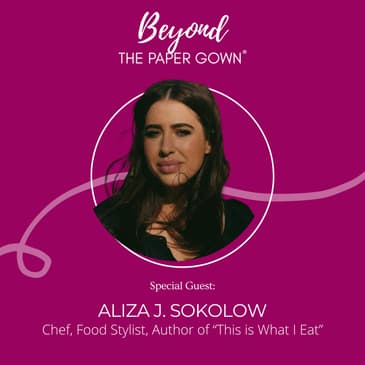

Join Dr. Mitzi Krockover on this engaging episode of "Beyond the Paper Gown" as we meet Aliza Sokolow, a talented chef, food stylist, photographer, and author of the children's book "This Is What I Eat." Aliza shares her journey from her architectural background to her passion for making fruits and vegetables fun and appealing for both kids and adults. She discusses her work with Jamie Oliver’s Food Revolution and various community programs, highlighting how they are improving food education and access. Whether you're a parent, a food enthusiast, or just looking to enhance your meals, this episode offers practical tips and inspiration for enjoying healthy cuisine. Tune in to explore how simple it can be to create a nutritious and visually appealing plate. Don't miss this insightful discussion!
Please visit Beyond the Paper Gown to join our community and to learn more about achieving your optimal health.
SHOW NOTES:
[00:00:00] If you enjoy podcasts like this, you should check out our other shows on Health Podcasts Network.
[00:00:06] For example, Nurse Wellness Podcast, hosted by Wendy Garvin Mayo, focuses on the power
[00:00:12] of stress management and how it's foundational to being your best, doing your best, and
[00:00:17] giving your best.
[00:00:18] There's a wonderful episode that you should check out called Letting Go, where Wendy
[00:00:23] Garvin Mayo shares six strategies to release control and manage stress effectively.
[00:00:29] Check out Nurse Wellness Podcast on your favorite podcast platform or visit healthpodcastnetwork.com.
[00:00:50] Welcome to Beyond The Paper Gown.
[00:00:51] I'm your host, Dr. Mitzi Krockover.
[00:00:54] I am so glad you're joining us for today's episode.
[00:00:57] We have got a fantastic guest with us, Aliza Sokolow.
[00:01:02] Aliza is a chef, food stylist, and the author of the children's book, This Is What I
[00:01:07] Eat, which came out in January of 2023.
[00:01:11] She's worked with Jamie Oliver on his Food Revolution project and has won an Emmy, two
[00:01:16] Emmy nominations, and a James Speard Media Award.
[00:01:20] Pretty impressive, right?
[00:01:21] Today we're diving into Aliza's journey from studying architecture to becoming a
[00:01:26] successful food stylist, food photographer, and author.
[00:01:30] She's going to share her passion for fruits and vegetables and how she's made
[00:01:34] healthy eating fun and exciting for kids.
[00:01:37] Her book is all about using colors and textures to get kids interested in fresh produce.
[00:01:42] We'll also learn about Aliza's work in underserved communities and her involvement in school
[00:01:47] garden programs.
[00:01:49] She's got some amazing insights on how teaching kids to grow their own food can really
[00:01:54] change their eating habits and make healthy choices more accessible.
[00:01:59] So whether you're a parent trying to get your kids to eat more veggies or just
[00:02:03] someone interested in the intersection of food, art, and education, you are going to
[00:02:07] love this conversation.
[00:02:09] Aliza has so many great tips and stories to share, and I know you'll walk away feeling
[00:02:14] inspired to add a little bit more color and nutrition to your own life.
[00:02:18] And before we get started, please remember that this podcast is for educational and
[00:02:23] informational purposes only and should not be taken as medical advice.
[00:02:28] Now let's get started.
[00:02:37] We have a fabulous guest today, something a little bit different and very interesting.
[00:02:44] But let me go ahead and introduce her.
[00:02:45] Aliza J. Sokolow is a chef, food stylist, author of her debut children's book, This
[00:02:51] Is What I Eat, which launched January 2023.
[00:02:55] So we are just really thrilled to have you here today.
[00:02:59] I mentioned the photography that you do, which is really beautiful, very colorful.
[00:03:05] It's using fruits and vegetables as the main characters, if you will.
[00:03:10] So how does that tie in with the book, which I know you focus a lot on color?
[00:03:15] Aliza J. Well, I have always used color as a method of learning and eating.
[00:03:22] And I studied to be an architect in school and I didn't become an architect.
[00:03:30] I ended up working in food as my, I guess one of my first jobs out of it.
[00:03:36] I had gotten a job doing set design for TV shows.
[00:03:40] And the first show I did was a food show actually.
[00:03:45] And I saw all the food stylists when I had walked on to set and I was like,
[00:03:49] oh, this is what I'm going to do for a living.
[00:03:52] I see this as teeny tiny architecture.
[00:03:57] My project will be done at the end of the day instead of in months and years from now.
[00:04:04] And I found that very exciting.
[00:04:07] I was like, oh, I found my calling.
[00:04:09] My degree will be put to use somehow.
[00:04:13] Still unclear, but it's all a way of thinking.
[00:04:17] Well, you became a food architect.
[00:04:19] I think of the way I assemble food is very architectural.
[00:04:22] Everything has its place.
[00:04:26] Things have a home the way colors are used.
[00:04:29] But I grew up with my grandmother who was an artist and she was really into colors.
[00:04:36] And we would do a lot of art together.
[00:04:40] It was really like a visual art, so where things went.
[00:04:44] So a lot of the art I had created from things I found at the farmer's market,
[00:04:50] which when I started doing that, I wanted to use it as a tool to share different things
[00:04:58] I found at the market in a health way.
[00:05:01] So like the first print I had made was an avocado print and one of my favorite farmers,
[00:05:08] Laura from JJ's Lone Daughter Ranch grows like 20 something different types of avocados.
[00:05:16] And I had taken a few of each home and I organized them in a way that I thought was quite beautiful
[00:05:22] because they all had different shapes and the pits were different shapes and sizes and
[00:05:28] the peels were different and so many people around the world in the country think, oh,
[00:05:33] you just have one type of avocado.
[00:05:36] And that's not that's not how it is, which is also something I talk about in my book.
[00:05:42] But I had made this.
[00:05:44] To me it was a print.
[00:05:45] I don't know.
[00:05:46] I just wanted to share what what I had found in Food and Wine magazine had reposted it
[00:05:52] and I was like, oh, this must be actually very cool like professionally cool that food
[00:05:58] and wine and whoever working there had thought that was exciting.
[00:06:03] And I was just very excited by all of the colors and the shapes and all of these
[00:06:09] things that are very basic concepts that you're taught when you're younger of just
[00:06:13] shapes and colors and sizes.
[00:06:15] And I use that as a method in my book for teaching kids and whoever gave them the
[00:06:22] book, a way of learning about fruits and vegetables and telling someone to eat
[00:06:29] healthy is not a good enough way to get them to try things these days.
[00:06:34] That is true.
[00:06:35] That's what I see a lot of especially kids eat this.
[00:06:39] It's healthy.
[00:06:40] They don't understand what health is.
[00:06:43] That that's not a concept that they can grasp, but seeing if something is big or
[00:06:48] small or green or blue or oval shaped or they can pick out a shadow of an apple
[00:06:59] or whatever it is like these are things that they can really get their heads
[00:07:02] around so and their hands on right their hands on and everything so
[00:07:08] tactile with eating as well.
[00:07:10] I realized the thing kids are most, I guess adults also people texture is a
[00:07:17] thing that people it uses like a preventative thing for why they don't
[00:07:23] like to try something.
[00:07:25] But for the most part, I think it's really cool to discover if something
[00:07:30] is crunchy or if it makes a sound or creamy or smushy or I always go back to
[00:07:40] an avocado of just like the different textures it has and how adding just
[00:07:46] like a little bit of salt to something can change a flavor more than
[00:07:50] anything else or what I'm sitting here next to a whole bunch of fruits
[00:07:55] and vegetables and that's how I live.
[00:07:58] But it's really cool to me all the different things.
[00:08:03] So that is before we leave the color.
[00:08:06] I just want to, you know, underline or mention we talked about health and as
[00:08:13] a physician, one of the easiest ways to tell people how to quote eat healthy is
[00:08:18] really just to start with a plate full of color.
[00:08:21] And I'm not talking about colorful M&Ms.
[00:08:23] I'm talking about obviously fruits and vegetables.
[00:08:25] And so that's a first step, but I would assume that that's the connection
[00:08:30] that you're making with the kids and health.
[00:08:32] Hundred percent.
[00:08:34] And a lot of it within that realm is the way you present things.
[00:08:39] I've learned so much that parents or whoever are taking care of kids.
[00:08:45] If you present something to your kid and you're like, yeah, I don't know
[00:08:49] if you're going to like it.
[00:08:50] Well, they already don't like it.
[00:08:52] You already presented it in a way where they don't like it.
[00:08:56] And every time I make something and I have, I'm surrounded by friends with children.
[00:09:03] I'm always like, this is so good.
[00:09:05] Usually I truly do feel that way.
[00:09:08] And also when you're eating things that come from the market or you're
[00:09:12] eating in season or I eat so many cucumbers all the time and there's
[00:09:18] so many different ways you can eat them or I'm that person that went to the movies
[00:09:23] last week and I pulled out a like clamshell blueberries out of my purse,
[00:09:28] which to others might be very strange to me.
[00:09:31] It's very normal and my friends are used to it at this point.
[00:09:35] Blueberries also just as a side note, they're the only blue fruit.
[00:09:40] Like if you try to find anything else blue, there's plums that are sort of blue,
[00:09:45] but blueberries are usually available and they, I think are the healthiest thing
[00:09:51] that anyone can put in their bodies.
[00:09:54] And they're so delicious.
[00:09:56] But why did I?
[00:09:58] But it's the way you present things to kids.
[00:10:00] And if you go, this is so good or parents often are like, how do I get
[00:10:06] my kids to eat this?
[00:10:08] And I'm like, if they get home from school or whatever it is and you
[00:10:14] put out a plate of chopped vegetables and fruit, that's their option.
[00:10:20] They're going to eat it.
[00:10:23] If they get hungry enough, it's now you're going to have it.
[00:10:27] It's just that's that's what's available.
[00:10:30] Absolutely.
[00:10:32] One of the things that comes up and I'm and I know that you've done
[00:10:35] a lot of work with underserved populations as well, especially when
[00:10:39] you were working with Jamie Oliver.
[00:10:41] What do you do with kids or for kids who live in what's called a food desert
[00:10:48] that they're not of that grocery stores may not be readily available
[00:10:52] or those fresh fruits and vegetables may not be readily available?
[00:10:56] I'm really happy to see that since I worked on that project, which was
[00:11:01] about, I want to say 15 years ago, there have been a lot of changes
[00:11:08] in those underserved communities.
[00:11:11] That project was the I can tell you the moment that my life changed
[00:11:18] when I was working just elbow to elbow next to these kids.
[00:11:22] They were probably like about 10 years old.
[00:11:26] Had never eaten fresh fruit or veg.
[00:11:29] We did a lot of work with them in the classroom, but it was
[00:11:33] we're like making salads together and this girl
[00:11:37] was like, I've never eaten a salad before.
[00:11:40] And I realized, A, what a privileged upbringing I had because we were
[00:11:44] big salad people in my house.
[00:11:46] But the way you feel when you eat things that come from the earth
[00:11:51] is very different.
[00:11:52] And a lot of these kids had so many health issues and type two
[00:11:56] diabetes and recess was being cut in schools.
[00:12:00] And so much about being a kid is if you're not healthy,
[00:12:05] nothing else matters.
[00:12:07] Like you can't focus in school.
[00:12:09] The school lunch program was giving them pancakes with syrup for breakfast.
[00:12:14] And then they would say, everyone has 80 D.
[00:12:17] I'm sure they do if they're just having syrup and pancakes for breakfast.
[00:12:21] You're not setting them up for success.
[00:12:24] But there's been a lot of garden school programs that have
[00:12:29] been going in around the world.
[00:12:31] And there's a few different organizations that have been helping
[00:12:37] public schools get those garden school programs.
[00:12:41] More convenience stores are carrying fruits and vegetables.
[00:12:45] I mean, this this issue is so beyond
[00:12:50] what feels like any of us at this point.
[00:12:53] But I do see progress happening here in Los Angeles.
[00:12:58] And I know it's happening across the country.
[00:13:00] I think it's just very small steps.
[00:13:03] And I really hope that, you know, it's really our lawmakers make this more
[00:13:08] of a priority in these privately funded garden school foundation
[00:13:15] type organizations that are going in and even Lettuce Grow
[00:13:19] has an initiative where they want to put those vertical food towers
[00:13:24] into to more public schools.
[00:13:28] But I see kids having more access to learning about
[00:13:32] gardening and growing their own food.
[00:13:34] And that makes me very hopeful for them.
[00:13:37] And I will get the links to those organizations so that we can post them
[00:13:43] on the website and then talking about, you know, getting your hands on things
[00:13:49] and seeing them grow or understand where they're coming from
[00:13:52] is a big part of your book as well.
[00:13:55] And so talk a little bit about that.
[00:13:58] I so as you know, my dad is a scientist and my sister and I growing up,
[00:14:05] which we are grown ups now, which is unfortunate, but it was bound to happen.
[00:14:09] And we still I still to this day, regrow my avocado pits in the window.
[00:14:17] I find it very exciting.
[00:14:21] Never get sold and just doing those types of small activities.
[00:14:26] I knew that when I put that page of Grow Your Own in my book,
[00:14:30] that it was something that a child with any economic background,
[00:14:36] they can participate in this activity, whether that be regrowing
[00:14:40] a tomato seed or a lemon or.
[00:14:46] All all fruits and veg for the most part have seeds.
[00:14:49] So that is something that they could do.
[00:14:53] And I remember a few years ago being in actually in Israel with my cousins
[00:15:00] and my Hebrew is.
[00:15:05] Not great, but he was showing me that he grew a carrot.
[00:15:09] It's like four years old, so he didn't speak English.
[00:15:13] But he was showing me that he planted a carrot
[00:15:16] and was so excited and we pulled it out of the ground and we ate it.
[00:15:20] And I was like, Oh, see, this is a very universal concept.
[00:15:23] You don't need language in order to do this.
[00:15:27] It's something everyone does all over the world.
[00:15:30] And just planting a seed and growing it is something that also
[00:15:35] makes the kid feel really accomplished and they're more excited to eat it.
[00:15:39] So if you get your kids involved in just growing something,
[00:15:44] they're going to want to eat it because they played a really large part in that process.
[00:15:50] It just seems that we're so divorced from that.
[00:15:53] And so I think it's really I'm thinking about how that would be really cool to do.
[00:15:57] You know, and I don't have grandchildren yet, so I may be doing it by myself.
[00:16:02] By yourself, it's it's so much fun to just grow your own things.
[00:16:06] And somehow it tastes better if you grew it yourself.
[00:16:10] Everything starts from a seed.
[00:16:11] It doesn't start from the grocery store.
[00:16:16] Some things have to go along.
[00:16:18] New slash, they don't.
[00:16:19] They're all all of the produce you eat was once planted in dirt.
[00:16:24] Right now there's hydroponic systems, but for the most part,
[00:16:29] dirt has been the one thing we've been using since the beginning to plant.
[00:16:34] So I find it very cool.
[00:16:37] I do too.
[00:16:38] And I'm thinking it's, you know, the corollaries of that.
[00:16:42] And, you know, I'm here in Arizona, you're in California.
[00:16:45] I'm jealous from a food standpoint or fruit and vegetable standpoint.
[00:16:51] But I think it's good to learn what is in season and what isn't
[00:16:56] and what can be grown in certain places.
[00:16:59] It always bugs me a little bit because I've always looking forward to summer fruit
[00:17:05] and the fact that now you can get summer fruit year round.
[00:17:09] I don't know, it seems a little sad.
[00:17:11] I agree. I think it's bizarre.
[00:17:13] My mother cut a melon the other day and I looked at her like she.
[00:17:20] I was I was confused as to what she was doing.
[00:17:23] I go, Harriet, you cannot eat a melon in the winter.
[00:17:27] It's just not something you do.
[00:17:30] And it's so interesting being Jewish and and cooking
[00:17:35] because all of the holidays are really based upon what's in season.
[00:17:40] Right, yeah.
[00:17:41] And I I love that.
[00:17:43] And I too, I go to the store and I'm like, why are there plums in March?
[00:17:51] I'm not eating it.
[00:17:52] I truly I wait for those like first summer peaches
[00:17:56] and we have early peaches and early girl tomatoes that come.
[00:18:01] I'm currently very excited for summer to come as well.
[00:18:05] I feel like I eat stone fruit until my blood sugar spikes
[00:18:11] to the highest levels.
[00:18:13] I just think it's incredible.
[00:18:16] But by the end, I'm very much ready for fall
[00:18:19] and looking forward to eating plump not plums, eating apples
[00:18:25] and winter citrus.
[00:18:27] I get very excited by I'm very into eating car, car oranges right now.
[00:18:32] And I should really plant my own tree because I am consuming that many of them.
[00:18:38] But it's it's interesting that we can have access to different fruits and vegetables.
[00:18:45] But I think our our bodies, much like in winter, you want to have those.
[00:18:51] Warmer, more like.
[00:18:54] Because, you know, warmer things in your body and during the summer,
[00:19:00] you've got those sugar spikes with all of the different melons and stone fruit.
[00:19:05] Exactly. And then going back to the, you know, from a.
[00:19:10] Ecologic standpoint, those plums that you get in the middle of winter,
[00:19:16] you know, had to travel a long way.
[00:19:18] And so that's the other reason for me to be a little bit more purest.
[00:19:24] But you also talk, you know, and then if you're going to the farmer's market,
[00:19:27] you're going to see what's been growing locally and what's been what is in season.
[00:19:34] Hundred percent.
[00:19:34] And I always see people who come around the big holidays like Thanksgiving or
[00:19:41] I guess Easter and they come with a list to the farmer's market
[00:19:45] and they're looking for things that are not in season.
[00:19:48] And you just want to give them a tap on the shoulder and be like,
[00:19:52] it's you're not eating it.
[00:19:54] It's not in season.
[00:19:56] It's not what's happening.
[00:19:58] There's certain things that do grow year round, but that's
[00:20:02] there. It's not what's available.
[00:20:04] So I just find it very interesting.
[00:20:07] But when you go to the farmer's market, they tell you what you're eating.
[00:20:12] That's right.
[00:20:13] And I'm curious, what is your thought about organic versus non-organic
[00:20:17] fruits and vegetables?
[00:20:19] You know, it's actually changed over the last few years, because when I was
[00:20:23] younger, I was said,
[00:20:26] as long as you're getting fruits and vegetables into your body,
[00:20:30] that's sort of that's great.
[00:20:33] And over the last few years where I've learned so much more and
[00:20:40] a lot of it starts with soil health.
[00:20:42] But I do realize that what they're, I feel like I know too much at this
[00:20:49] point, but it's I really think prioritizing eating organic is really
[00:20:53] important for your body.
[00:20:55] And people are doing us a disservice by spraying fruits and vegetables.
[00:21:02] It goes so much deeper than the actual produce.
[00:21:05] But what sort of permeates into the vegetables and the chemicals and
[00:21:15] that effect of that on your gut?
[00:21:18] Because as we know, gut health isn't just gut instincts, but your microbiome.
[00:21:23] It affects everything.
[00:21:26] And I really wish that we as a country could take health care a little
[00:21:32] bit more seriously, starting with farming practices.
[00:21:36] And I work with a farmer who grows grain, but then I spend a lot of time
[00:21:45] on their farm, they grow heritage grain.
[00:21:49] And I always say to people when I make baked goods, I know that we've sent
[00:21:53] you some of my Pala and cookies and those things.
[00:21:56] Wonderful.
[00:21:57] The best, I mean, but also I feel like I don't really have to do that
[00:22:01] much just because I'm buying fabulous grain and that what provides us those flavors.
[00:22:07] But I say there's this, so many people have gluten sensitivities these days.
[00:22:14] And the grain I buy is the original grain.
[00:22:17] This is the grain when you're eating grain in Europe, which I know
[00:22:20] they're farming practices have also changed in the last few years.
[00:22:24] But the soil, much like with wine has terroir.
[00:22:30] So there's the flavor of the different regions of where you're growing your grain.
[00:22:36] But this is the original grain and in the US, we've taken a lot of the
[00:22:41] proteins out of our grains.
[00:22:43] So it's O.G.
[00:22:46] grain is higher in protein and lower in gluten.
[00:22:50] What they've done in the US to feed the masses is they've taken the protein
[00:22:55] out of our wheat and the gluten content is higher.
[00:22:59] So once we put the grains that have been sprayed, it creates a whole lot of gut issues.
[00:23:11] That's interesting because we were actually just talking about this at
[00:23:14] dinner the other night.
[00:23:16] And I didn't even know this is that the actual milled hand milled flowers,
[00:23:21] especially for example in Europe, are do have less gluten.
[00:23:26] And I had no idea.
[00:23:28] And so my question is where would if someone is interested in finding
[00:23:31] those kinds of grains, where would they find them?
[00:23:34] Especially if they don't live in Los Angeles.
[00:23:36] Right. The one I use is called the Chahachpe grain project.
[00:23:41] I don't think they sell locally.
[00:23:43] It's grain grown 75 miles north of where I live.
[00:23:47] But there's other mills like Griss and Toll is one of them.
[00:23:53] And they ship all over the country.
[00:23:55] But if you look online for a smaller mill, they exist on the internet.
[00:24:02] But when people I'm like, Oh, do you want one of my cookies?
[00:24:07] And they go, I don't eat gluten.
[00:24:09] I go, are you celiac or are you gluten sensitive?
[00:24:15] Because this has become even amongst parents.
[00:24:18] I've seen this so much in the parent feeding their child space.
[00:24:23] My kid doesn't eat gluten.
[00:24:24] I'm like, that's do what's good for you.
[00:24:27] But it's you can eat the cookies I make because I use grain
[00:24:33] that's similar to the one in Europe, which as you see in Paris,
[00:24:37] these kids get out of school and they're eating.
[00:24:41] I forgot the name of it, but there's there's like a name for their
[00:24:44] afterschool snack that's very chic, obviously, and they're eating
[00:24:48] a small baguette with like a piece of cheese in it or some chocolate in it.
[00:24:54] They're not here.
[00:24:56] I feel like I grew up eating like crudité after school.
[00:24:59] And that's what my option was.
[00:25:00] But they parents, they're so comfortable to give their kid a piece of bread.
[00:25:07] Because there it is higher in protein and does have nutritional benefits.
[00:25:13] And even I eat I eat sourdough bread a lot, which is also lower in gluten.
[00:25:19] But it's you know, the fermentation process does a lot for it.
[00:25:24] So it's there's there's so much in this category.
[00:25:29] But if you have the means to be able to buy really great grain
[00:25:35] and make your own, I don't know if people are still in their sourdough
[00:25:40] pandemic state of life.
[00:25:43] But supporting your local bakeries that they usually love
[00:25:48] to experiment with different types of grains.
[00:25:52] You talked a little bit about your cultural background
[00:25:56] and or our cultural background.
[00:25:58] How do you include culture in either in the book or when
[00:26:04] you're out and about doing some of this?
[00:26:10] There's sort of twofold.
[00:26:11] I have one page that I talk about.
[00:26:15] I guess I don't talk.
[00:26:16] There's visuals of foods from all over the world,
[00:26:19] which I was really excited by.
[00:26:21] And you realize that even within this every month's different.
[00:26:25] But we're all very similar.
[00:26:27] There is only so many options of things to eat.
[00:26:31] You know, I've been all over the world.
[00:26:33] And you see that food is is pretty much the same.
[00:26:37] It's just cooked a little bit differently or spices are a little different.
[00:26:42] But we all have the same goal in this.
[00:26:45] Everyone has to eat.
[00:26:47] It's the only way to keep going.
[00:26:49] And it's very similar.
[00:26:52] And I love tapping that page in my book because it showed that,
[00:26:56] you know, things I spent time in Ethiopia right before the pandemic.
[00:27:01] And they it was sort of like things.
[00:27:05] They don't really use utensils.
[00:27:06] We were using in Jira, so like made out of teff,
[00:27:10] which is also naturally gluten free bread.
[00:27:14] And you use that to pick up your vegetables.
[00:27:16] And, you know, the way that they cooked their vegetables,
[00:27:21] I was like, oh, this is some of these things are things that I grew up
[00:27:25] eating and had a lot of lentils and like that's in other cultures.
[00:27:29] And I just realized that food is something that can really bring people together
[00:27:36] more than any other thing because we all have to eat.
[00:27:39] And another thing I was really happy about that whenever I do an in school event,
[00:27:45] I ask the kids, what way do you give back to people who don't have food?
[00:27:51] And the more in school events I did,
[00:27:55] the more I realized like this was my most important page for me.
[00:28:00] And growing up, I went to Jewish school and every week on Friday,
[00:28:05] every kid had to bring what we called sova.
[00:28:08] So a canned food item or some sort of food that went to people who were not as fortunate.
[00:28:15] And there's different items on that page that talk about going to a soup kitchen
[00:28:19] or keeping a packaged food in your car for when you drive by someone who is unhoused
[00:28:28] and eating is so much bigger than you are.
[00:28:32] Everyone has to do it and you need to make sure that, hey, you're fed
[00:28:36] and like you're kept healthy, but that your neighbor, whoever they are,
[00:28:42] we don't have to know anything about them, but they also need to eat.
[00:28:46] We need to think about others besides ourselves and make sure our
[00:28:50] our brothers and sisters are fed.
[00:28:52] So I really liked having that in my book.
[00:28:57] Yes, it's so important.
[00:28:59] Along those lines, it's on again, you're somewhat talking about a ritual
[00:29:04] or some tradition, if you will.
[00:29:06] And I believe you also talk about rituals that you can have around meals.
[00:29:13] I like that when parents ask me, they go, what can I do to get my kid
[00:29:18] involved in eating or at dinner time?
[00:29:22] And there's so much involved growing up.
[00:29:25] I know everyone has a different.
[00:29:29] I guess it truly is a ritual how they have dinner during the week,
[00:29:33] whether one parent is home or both or your caretaker or your grandparent,
[00:29:38] whoever it is is raising you.
[00:29:41] There's something you do every day.
[00:29:43] And for us growing up, even I talked to my mom about this,
[00:29:47] my mom's job growing up, she was the youngest of three.
[00:29:51] And she made the salad every day.
[00:29:54] And every night they had salad and she was in charge of it.
[00:29:58] So if you can give your kid one thing to do,
[00:30:02] even if you're someone who doesn't cook or someone else is cooking
[00:30:07] or whatever it is to give your kid the one thing that they can do to help.
[00:30:13] That's something that they know that they can do in the food space
[00:30:17] in feeding themselves every day.
[00:30:21] You had said something earlier about before we were recording
[00:30:25] about the health benefits or skin benefits of fruits and vegetables.
[00:30:31] So I think for our audience, that might be very salient.
[00:30:34] I agree that every 30 days your skin regenerates based upon what you eat.
[00:30:40] So not only is drinking a lot of water great for you to keep everything going.
[00:30:48] But I would say to women for a while, because this is mostly women,
[00:30:53] I go, do you want your skin to look like Fritos or a chopped salad?
[00:30:59] It's up to you.
[00:31:01] I'm really into an 80-20 rule of just eat healthy 80% of the time
[00:31:07] and eat the cookie, eat whatever it is.
[00:31:11] Like you're alive when you eat things with joy.
[00:31:14] I genuinely feel like your body reacts to that.
[00:31:20] At this point in my life, I have no regret about things that I eat.
[00:31:24] If I want to do it, I do it and I love it and I enjoy it.
[00:31:27] And I won't eat a cookie that looks awful to me, but I will eat the great one.
[00:31:33] But you really are what you eat.
[00:31:34] This is your skin.
[00:31:36] That's your skin health.
[00:31:38] Everything is connected no matter how hard we try to separate a lot of things.
[00:31:43] But your skin on your face, like Aliza, your skin is so glowy.
[00:31:49] I go, I eat really well.
[00:31:52] Nothing is complicated that I eat.
[00:31:54] It's just very straightforward food.
[00:31:56] Most of what I eat does not have a nutrition label on it, which is also
[00:32:04] something when I tell, when people look at nutrition labels, they're like,
[00:32:08] I don't know what this is.
[00:32:09] And they're like, if you don't know what it is, maybe don't eat it or
[00:32:13] look it up, but when you're eating fruits and vegetables, there are no nutrition
[00:32:18] facts or seeds or nuts.
[00:32:20] There it doesn't exist because that's what it is.
[00:32:24] But speaking to that, what are your thoughts about cooked versus raw?
[00:32:30] I think it depends upon what it is.
[00:32:35] I also love a blanche, which is somewhere in the middle of just like
[00:32:39] explain that for people like me who don't cook.
[00:32:42] Okay, for blanching, if it's something like a sugar snap pea, which I love,
[00:32:49] which it's spring.
[00:32:50] So snap peas and peas and everything from that category are in season.
[00:32:57] And you boil water and you put your snap peas in it and you wait until
[00:33:02] they change color to a brighter green.
[00:33:06] And then you take them out and you do what's called shocking and you put
[00:33:12] them in ice water or if you're kind of lazy, not lazy.
[00:33:17] If you just want it done in a different way and you don't have any ice,
[00:33:21] you just put it under cold water and it stops the cooking.
[00:33:24] And it turns it into a crispier, crunchier sugar snap pea.
[00:33:29] So I do have a page in the book about the different ways to what you
[00:33:34] like and you check off if you like things raw or cooked or steamed.
[00:33:41] It depends upon what it is, but I think most vegetables, if they're in season,
[00:33:47] tastes pretty delicious.
[00:33:49] So I personally, I love like a raw orange pepper.
[00:33:55] I don't like green or red, but I do like a yellow or an orange
[00:33:58] and I don't like them cooked, but I love them raw.
[00:34:01] So dealer's choice for that one.
[00:34:06] But you've got options.
[00:34:09] Some people only like them cooked, so it's whatever you like
[00:34:14] so that you'll actually eat it, especially for kids.
[00:34:17] So where can we get your book?
[00:34:19] My book is available at most local indie bookstores or it's on Amazon.
[00:34:27] I believe it's on sale on Amazon as well.
[00:34:29] So that's a great spot to find it.
[00:34:34] It's a great book.
[00:34:35] And again, I'm just I have one for myself for when I either can find another
[00:34:40] child or have a grandchild, but I've also given them as gifts
[00:34:45] and they have been very well received.
[00:34:47] So and they're just fun to look at and even do yourself.
[00:34:51] I think if you thought about doing an adult version.
[00:34:55] You know, everyone keeps asking me if I will do this is what
[00:34:59] I drink book for adults.
[00:35:01] And I don't think that book is happening anytime soon.
[00:35:06] But it gets a part.
[00:35:08] The Eid, I really think that this book is for the grown up as well.
[00:35:14] I think that these really basic concepts and using colors
[00:35:19] and shapes and sizes that as a tool is something we can all relate to.
[00:35:24] I love doing the activities.
[00:35:27] I love to color and do the crossword puzzle and these very simple
[00:35:33] activities, which really make you feel really young and use your brain in a way.
[00:35:41] We don't always use it.
[00:35:42] I remember when I did the crossword puzzle after I'd gotten my first copy
[00:35:47] and I couldn't find one of the words and I was like, there are kids
[00:35:52] that are going to be able to do this much faster than I am.
[00:35:54] But it's I don't know if I'll do an adult book anytime soon.
[00:36:00] I will keep sharing my recipes on my newsletter, though, which I think
[00:36:04] fabulous. The grown ups are excited about because they're always very easy
[00:36:09] but very delicious.
[00:36:12] I love that and I will be one of your subscribers.
[00:36:17] Well, Aliza Sokolow, thank you very much for being with me today.
[00:36:20] And I learned a lot and I'm going to go back to that book
[00:36:24] and go through it myself.
[00:36:26] Well, thank you for having me.
[00:36:28] This is a lot of fun.
[00:36:35] Well, that brings us to the end of this episode of Beyond the Paper Gown.
[00:36:39] I hope you enjoyed our conversation with Aliza Sokolow as much as I did.
[00:36:43] From her incredible journey in the food world to her innovative approaches
[00:36:47] to making healthy, eating fun and accessible.
[00:36:50] Aliza has shared so many valuable insights and ideas today,
[00:36:54] whether it's incorporating more colorful fruits and vegetables in our diets,
[00:36:58] getting involved in community garden programs or simply taking a moment
[00:37:02] to appreciate the art and joy of cooking.
[00:37:05] There are countless ways we can all benefit from Aliza's wisdom.
[00:37:09] What I took away from this episode is the reminder that healthy eating
[00:37:13] doesn't have to be complicated or boring.
[00:37:16] It can be as simple as enjoying the vibrant colors on your plate,
[00:37:19] taking time to appreciate the texture of different foods
[00:37:23] or trying out a new recipe with your kids.
[00:37:26] And who knows, maybe even starting a little garden of your own.
[00:37:30] If you love today's episode, don't forget to subscribe, rate and leave us
[00:37:33] a review on your favorite podcast platform.
[00:37:36] And of course, share it with your friends and family.
[00:37:39] You can find Aliza's book, This Is What I Eat at your local bookstore or online.
[00:37:44] And I highly recommend picking up a copy.
[00:37:46] It's not only fun for kids, but I enjoyed going through it myself.
[00:37:50] And if you want a sample of Aliza's recipes and other healthy recommendations,
[00:37:55] subscribe to our newsletter at BeyondThePaperGown.com.
[00:37:58] You'll also stay up to date on future podcasts, articles, events and activities.
[00:38:04] Thanks for joining me and take good care.
[00:38:18] This episode was produced by Patrick Shambayati and myself
[00:38:22] and our associate producer is Kyla McNeilian.
[00:38:45] Focuses on the power of stress management and how it's foundational
[00:38:49] to being your best, doing your best and giving your best.
[00:38:52] There's a wonderful episode that you should check out called Letting Go,
[00:38:56] where Wendy Garvin Mayo shares six strategies
[00:38:59] to release control and manage stress effectively.
[00:39:03] Check out Nurse Wellness Podcast on your favorite podcast platform
[00:39:07] or visit healthpodcastnetwork.com.