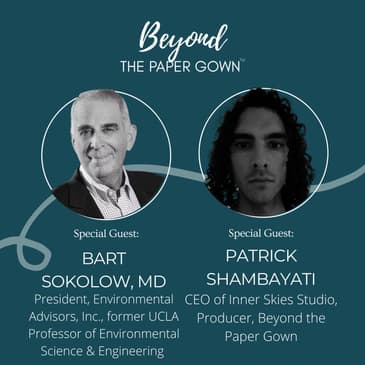

Dive into an insightful episode of Beyond the Paper Gown with me, Dr. Mitzi Krockover. This time, I'm joined by Dr. Bart Sokolow and Patrick Shambayati, as we discuss personal stories and insights into women's health and find out why they are avid listeners of the podcast. Their transition from general awareness to active advocacy provides a unique perspective. Engage with us in this meaningful dialogue to gain new insights and learn how men can contribute to positive change in women's health and thus improve everyone’s well-being... It's not just a podcast; it's a commitment to understanding and progress. Cheers to an episode that's set to be a listener favorite.
Please visit Beyond the Paper Gown to join our community and to learn more about achieving your optimal health.
[00:00:00] If you enjoy podcasts like this, you should check out our other shows on Health Podcasts Network. For example, Better with Dr. Erica, hosted by Dr. Erica, provides support and guidance in navigating stress-related challenges to transform your relationship to self-care.
[00:00:17] Each episode arms you with the tools needed to be better, do better, and live better. There was an incredible episode that you should check out called Touch and Connections as Tools for Healing and Better Mental Health.
[00:00:30] In this episode, her guest breaks down ways to use physical touch as a form of healing for trauma and grief. Check out Better with Dr. Erica on your favorite podcast platform or visit healthpodcastnetwork.com.
[00:00:43] Hello and welcome to Beyond the Paper Gown, the podcast where we explore women's health from all angles. I'm your host, Dr. Mitzi Krockover. Today we're embarking on what we're calling Women's Health Happy Hour, inviting
[00:01:12] guests to join me about once a month in a conversation about their perspectives and opinions on various topics related to women's health. And today we have a bit of a twist. Our guests are two men. We're posing the question, why should men learn about women's health?
[00:01:29] Our special guests are from different generations and they've enthusiastically agreed to join us to share their perspectives on the topic that's often considered solio women's domain. They've been tuning in to Beyond the Paper Gown, absorbing information and now they're
[00:01:45] here to share what they've learned, what surprised them, and honestly just a chat about why they think understanding women's health matters for everyone, not just women. I'm so appreciative they've agreed to share their views with us today.
[00:01:59] We'll dive into the biases in healthcare, the challenges women face, and how men can be better allies. It's really about understanding, empathy, and yes, a bit of unlearning and relearning. So grab your favorite drink, settle in, and join us at our inaugural Women's Health
[00:02:16] Happy Hour as we delve into what I hope you'll find is a candid and fun conversation. I know I learned a lot. Let's get this conversation started. Hi, welcome to Beyond the Paper Gown. I'm Dr. Mitzi Krokover.
[00:02:43] And today we're going to, I think, have a really fun conversation. We're calling it the Women's Health Happy Hour and I have two wonderful guests who have joined me today. Dr. Bart Sokolow is the CEO of Environmental Advisors, which is an environmental consultancy
[00:03:02] dealing with toxic and hazardous waste. I should also say he is the father of two wonderful daughters and married to a very wonderful woman. And Patrick Shambayati, who's CEO of InnerSky's Studio, which is a podcast production agency. Thank you gentlemen for joining me. My pleasure.
[00:03:23] Great to be here. And I noted that Bart is surrounded by women. And Patrick, what's your connection to Women's Health? It's the women in my life, my mother, my sister, my friends. These are people I deeply love and care about.
[00:03:42] And this is why I now care about Women's Health. They're my first reason to care. That's great. So you're also our producer for Beyond the Paper Gown, a small detail that I omitted. I apologize for that. So you've had a chance to kind of come along with us.
[00:04:02] So I know how you came to listen to Beyond the Paper Gown. But Bart, how about you? My wife is a listener. So she's heard all of the podcasts and is a real advocate. So with that, I decided there was no question I had to start listening.
[00:04:19] Patrick, we've been together for about two years or so. And I'm just curious about how the podcast has changed your understanding of Women's Health issues. Like I said, the first people I think of are the women closest to me in my life.
[00:04:36] And I think there's a tinge of anger that I get when I think about how far behind we are as a society on Women's Health. Because I guess as a man, I have this privilege of not having to deal with these issues.
[00:04:54] So listening to the podcast really put myself in their shoes. And to be an activist or to care about a cause, I think there is a certain amount of anger and frustration you have to have. And I think that's what I developed. Well, I appreciate that.
[00:05:13] You know, it's interesting because I think that also women are now being able to maybe more fully understand why they've been feeling angry or we've been feeling angry for a long time, but not knowing exactly why. And obviously, that's what we're trying to do with this podcast.
[00:05:31] And I'm just wondering, have you shared some of the information with women in your life and found that they also, you know, that this was new information to them as well? They're listeners of the podcast.
[00:05:45] And so like my mother who's a different age than my sister will have different things that she that resonated with her in that reflect experiences she's had. And then my sister who's younger than me looks at different things as well and has a different perspective.
[00:06:05] Like one thing that really stuck out to her was the social media, basically the medical, the gas lighting and the social media censorship of women's health issues because she's active on social media.
[00:06:19] And I don't think a lot of young people realize that their own well-being is not in the best interests of these social media companies and there's a massive amount of censorship.
[00:06:29] Just for our listeners to make sure you understand what Patrick is referring to is that there has been shown that there is definitely a difference between what men's health companies can show and women's health companies
[00:06:47] and a number of companies in the women's health space have actually been banned.
[00:06:55] And they can't show their advertising because it may be too considered too sexual, but yet it's not the same for men's health that not only, you know, again hurts the companies, but it also as you I think referred to,
[00:07:13] it takes away women's information, you know, information for women about these companies and even about just even their own health. So thank you for mentioning that. Bart, and I should mention that both of you are from relatively different generations.
[00:07:32] And so I'm kind of interested in Bart, your reaction to some of the topics that we have covered and, you know, what your thoughts are? I guess I've been very naive for a long time.
[00:07:50] I guess I just kind of accepted kind of just watching the train go by. My recognition of more reading and the recognition that a lot of health decisions and medical research have been primarily focused on men, not women.
[00:08:09] And subsequently, the readings I've done is there and listening to your podcast. It's very clear there are specific medical issues that are specific to women.
[00:08:20] And quite frankly, there are others that are not that are both for men and women but are not presented or researched in the context of the fact that the implications are different. The display of these problems are different for men and for women.
[00:08:38] Heart attack being one very good example. Absolutely. And so there's kind of an immunity that's been built in well they've done the research must be correct. Wrong answer. It's it's literally avoiding and not even dealing with half the people.
[00:08:53] But I've been so naive that I assumed that that was just fine because that's the way it's always been still the wrong answer. I live with three, not no longer but have three strong women in my life. They don't cower very easily and get really ticked off.
[00:09:09] And I listen a lot. But I think along with Patrick, it's just there are things that we that I was not aware of that listening to them talk about. It was no longer in isolation.
[00:09:22] There's been a lot more in the press and on the research that indicate they're clearing on disparity between the reaction of women in medical areas and men, even just, I think as Patrick mentioned going to the doctor. Women are kind of.
[00:09:41] Oh yeah, that's fine and they'll just and then you're kind of given up Pablo, you know, just kind of ignored how bizarre my daughter just had surgery. I think I mentioned to Mitzvah earlier. Right. And she was giving she was constantly being given medication.
[00:09:57] Oxycontin as a matter of fact. And she kept saying no, I don't want medication. I want you to fix the problem. She finally literally decided that she was going to the emergency room. It's not a heart attack, so it's going to take longer.
[00:10:11] She was there for 12 hours, but somebody finally did an MRI and said, oh my God, you need surgery. She's going like hello. But for six months they've been giving her medication. She knew what the problem was, but she was being ignored.
[00:10:25] Now is that because she was a woman and a young woman possibly. And I think probably. And that's really disgusting. And how is she doing? She's doing fine. I mean, recovery has been two weeks is taking time, but she's getting there with a lot of physical therapy.
[00:10:41] She's a strong woman. But she was so frustrated because nobody was listening. They were giving her answers that she wasn't asking questions of and she was responding to what was going on, but nobody was listening. And I think unfortunately the doctor was a woman. The main management position?
[00:11:00] Yes. Interesting. Well, that brings in all sorts of questions about medical training versus, you know, because I won't go into this right now. But, you know, I think there was a lot of bias spaked into our medical training.
[00:11:17] And so then, you know, trying to undo some of that is also a challenge whether you're a man or woman. We assume that women are going to be more understanding, sensitive and all of that.
[00:11:30] And we'd hope that that might be the case, but it may be that it's more of an upstream issue. You know, my question was going to be, do you feel more equipped to be allies for women's health? And I think that you guys have answered that question beautifully.
[00:11:45] And how do you see potentially enlisting other men and educating them as well? Patrick, what are your thoughts on that? Maybe the way to access men is to really tell them that they're going to be better men.
[00:12:10] So if you want to better yourself as a man and provide more value to your family and your relationships, then step it up. Educate yourself and learn this stuff. Know that the signs of a heart attack in a woman are completely different.
[00:12:29] And I learned through this podcast about the Hollywood heart attack, the clutching of the chest, the gasping, the keeling over. Heart attack signs in women is just different. And that's shocking to me. I can't believe that.
[00:12:42] Heart attack signs in a woman can just look like being kind of lightheaded and having to sit down as you're dizzy. There are a dozen examples I can think of, of information that I now have that's going to make me a better man.
[00:12:55] Also, even a best first responder, just understanding health issues as they're happening. It's not just about empathy. It's about dealing with something that's happening, knowing, oh no, I need to call 911 right now. Because sometimes even women don't recognize that, right?
[00:13:12] So many guests on the show in Mitzi have talked about this. Women do not complain. Men complain 10 times more than women. Women go through so much and if you're a mom, you've gone through decades of... You've just learned not to complain. You're tougher. I'll just say it.
[00:13:31] I'll be the first guy to say it. You're tougher, okay? And that only becomes a problem when you're looking out for your own well-being and when you're trying to prioritize your own wellness, which is usually like number 20 on the list of your priorities as women.
[00:13:47] So to answer your question, Mitzi, what men can do is they can be aware of all of these issues and they can be educated but also be aware that women and moms will not complain
[00:14:01] and be proactive, maybe reach out and propose that they take some time to rest and relax. That's my thoughts on it. I love that. Bart, you were writing something down. Did you have anything to add to that?
[00:14:15] The one thing I wrote down was something that Yogi Berra said, you don't know what you don't know. If you don't know something, ask. And most people are afraid to do that.
[00:14:25] And then also, if you're given a response from someone who's an expert, you listen to them and you go half the time, okay, what did he say?
[00:14:34] That's part of, it's not just women. It's just people who when they are confronted with information they don't understand are afraid to say, I don't get it. What does that mean? How does that apply to me? And how do I deal with it?
[00:14:48] And that's the biggest problem and it's not just feminine. So beyond the paper gown, doesn't just all of a sudden say, oh, I just mean women. Your podcasts are way much more universal than that.
[00:15:00] And I think the issue is trying to get people to realize, oh, I can digest this and not only that, this is the part I really love. Normally in experts, the kind of people you wind up interviewing, you get for a 30 second sound bite on radio or TV.
[00:15:14] You don't get them for 45 minutes. Oh my God, you've got these people who are talking conversationally because it's like you're sitting there with a glass of wine or just having a nice lunch. And they're waxing poetic and I don't mean to be sarcastic.
[00:15:29] They're talking comfortable, they're comfortable with you. They're opening up and telling you stuff that they may be not inclined to tell a patient because they only have five or 10 minutes with them.
[00:15:39] But you've got people who are real experts talking about things that you go, oh, I didn't think about that. And it wasn't in a sound bite where it's okay, now we're going to commercial. I so appreciate that. Thank you very much.
[00:15:55] We're very lucky to have experts like you said willing to share their time and their expertise with us. And that was certainly our goal. I want to go back to something Bart said and ask both of you this.
[00:16:08] And I know that what you probably both have heard some of these podcasts that we've done on menopause. And talking about menopause in the workplace. And I think Bart, you mentioned about something that maybe men don't want to talk about it.
[00:16:25] But it affects the workplace, whether you're an employer or a colleague. And so I'll go to Patrick first. You know, what do you think about that? And how would you feel, I guess if you had a colleague like that and as a man, what would be your response?
[00:16:48] Or what do you think people's levels of comfort are? That's a great question, Mitzi. I think I would have two completely different perspectives as somebody who didn't listen to the podcast and now as somebody who does listen to this podcast.
[00:17:05] So if I had never listened to this podcast, nobody would have taught me about menopause and its effects on workplace performance. And I would just be completely ignorant. And I can only speculate what I would think. I just wouldn't understand. I wouldn't understand the issue at all.
[00:17:27] But I listened to this podcast and I do understand the issue now. So if I were leading a team and I recognize that issue, I would have a completely different perspective and a completely different approach. And we've had, you can just go back just a couple episodes.
[00:17:46] But we had an interview with Leslie Ford who talked about work-life balance, menopause in the workplace, and countless others who have brought up this issue. It's a very real issue. And I think it has a fairly elegantly simple solution.
[00:18:02] And that's just understand what's happening and bring some very basic tools like empathy and understanding to the table. It's very interesting to me and it's something for me to think about as the owner of a company.
[00:18:22] And it's something, it is truly the responsibility of any managers, any coworkers, anyone who's in a company with women to understand exactly how menopause effects work-life. Thank you. Bart, do you have anything to add to that? No, he dealt with it.
[00:18:49] Because it's not something you can bring up in conversation. HR would have me in their office in 12 seconds. And I think the flexibility required now in the workplace now allows for it more than it ever did as part of just a natural progression of dealing with life.
[00:19:10] And perhaps the remote issues dealing with work now make it a little bit easier because the kind of stuff I'm dealing with, it's always centered on getting an objective done.
[00:19:23] If indeed you can't do it, you have to go to, you have to take doctors appointment and take care of the kids. That's something that even has been more acceptable now than even five years ago.
[00:19:34] I mean, I've been on phone calls where someone said, excuse me, is my daughter on the other phone? I don't think five, ten years ago the work community would accept that as an alternative. There's an option.
[00:19:46] And to that point, do you feel that because of this, hopefully increased awareness that men are feeling like they have more permission to share caretaking duties or to actually have to leave the office to take care of something or even looking at family policies?
[00:20:09] Oh, absolutely. I have done carpool and I have screwed up. I think I was banished from doing it for a while from one. But I think that it's an indication of being a Gallitarian as well as almost you get points for doing that.
[00:20:29] Not necessarily in the male community, but recognition that I'm part of it. A lot of even people my age, it was like it was okay to drive carpool and it wasn't something that was only for women. I think is really the point you're making.
[00:20:47] I think that the of recognizing that the duties are not just male and it was me to go out and hit stone and be able to continue bringing income is the only function. It's not just for a man.
[00:21:01] And I think the recognition of that kind of you don't you could call it feminine traits, but I would say just more the recognition that you're part of a family and that you're not just out there just to make money, but you have other obligations, not because it's an obligation, but it's part of your part of a larger family.
[00:21:19] And I think that's important because it makes you feel better. That's the other part I think that we don't talk about. Men do have feelings on occasion. And they bring into the service by actually participating, not by saying it, but just by doing things by making dinner. Absolutely.
[00:21:37] You know, and going back to what Patrick noted about one specific podcast with Leslie Ford. She was talking about how, you know, managers can emulate or be role models and say, Hey, I've got a therapy appointment.
[00:21:51] I'm going to leave early today or I'm going to go pick up the kids. And so then it just really normalizes it for, for everybody in the workplace. We did a webinar that had four parts with respect to the Dobs decision.
[00:22:09] And what our focus was trying to do was to show that it's not just about a woman ending a pregnancy. It was about the fact that there are economic consequences to not only that woman, but to her family.
[00:22:25] There are health consequences and there might even be consequences with respect to other laws down the road. And I wonder if you did hear that webinar. This is a little bit of a loaded question, but don't take it that way.
[00:22:45] Did it change the way that you looked at the abortion issue, which is a really one example of a women's health issue and the ramifications of it? And Patrick, you're nodding. So I'm going to start with you.
[00:23:00] That webinar really did educate me as a, again, as a pretty ignorant man who didn't understand really anything about this topic. And what the real impacts of doing, of allowing such a decision to move forward really are and to, you know, the title of it was aftershocks.
[00:23:24] So I really did understand that the societal implications down the line of what that really meant was pretty disheartening. It wasn't our happiest episode. I'll put it that way. We had a lot of very passionate people about that.
[00:23:42] One of the other reasons that we wanted to show it in this way was that it doesn't just affect women, but it affects really all the way up to our GDP and, you know, families and, you know, if someone, privacy issues and so forth.
[00:24:04] And we really wanted to make that noted that it's certainly a women's health issue because obviously it starts with, you know, a woman's body, but the ramifications go so much farther. That's the biggest issue is, again, lack of understanding and education.
[00:24:22] And that's simply something that has, it's going to take generations for people to comprehend that there were other options. If they've never been able to figure that out, that's the biggest issue. And that's a great segue in terms of education.
[00:24:37] You know, a lot of women probably have never really explored their own anatomy. You know, you'd be surprised. Obviously we're talking about education in schools being very varied depending on where you live.
[00:24:58] And then we have these ads, you know, and I always joke that my girls knew what erectile dysfunction was before they knew what a vagina was. And did you just cover your ears, Bart? In any case, so I'm going to hopefully not make you guys blush too much.
[00:25:21] But looking at these ads, it seems like we're much more comfortable with ads for erectile dysfunction no matter how graphic they are. But yet there's a real discomfort with period products or menopause products.
[00:25:38] And I just want to get y'all's take on that, not to put you on the hot seat, but I will. And Patrick, I'll let Bart recover for a few minutes while you answer that question.
[00:25:49] So I think this is, I hate to say this with every answer, but this is why people should listen to the podcast. Feel free. Let me explain why. I have a good reason.
[00:26:04] It's this part of our brain that kind of lights up when you find out that like a conspiracy theory is actually true. I had that experience when I learned about this particular women's health issue. So by the way, this happens all the time in the podcast.
[00:26:24] An expert will come in and will actually provide empirical evidence showing that no research was not done on women. They only did it on a man and then they released a drug and didn't consider the side effects and like a pregnant woman.
[00:26:39] And so there's a ton of fascinating conspiracy theory like things that have been proven true that if you, as a man listening, if you want to go to a party and really shock some people, just tune in, gather some of these facts.
[00:26:53] One of them that really got me was that, that you brought up Mitzi that on the internet and on social media and basically I'll just call it our algorithm. Whatever content, content is just placed in front of us now.
[00:27:08] That content is extremely biased and to the level that's like it's a little suspicious. Like what is the ulterior motive here? I still haven't figured it out. Well, we were actually, there was a couple of our Instagram posts that were taken off and we're still not sure why.
[00:27:32] It's fascinating. You don't get an answer to that question, right? It kind of speaks to a larger problem of having private companies decide what content goes in front of us, which is fine for a purely entertainment platform.
[00:27:50] Like, okay, if Netflix wants to decide what to show me or not show me, that's okay. But when you're using these platforms to get all of your information and all of your news and to inform yourself on your own health and wellness,
[00:28:07] and it's being so heavily censored and to use your word Bart literally in obscene way. It is obscene the level of censorship there is a woman's health product cannot even have the word.
[00:28:20] Rest in it can't basically can't have any female anatomical words in it to describe a medical issue to sell a medical device to people who are suffering,
[00:28:31] who are in pain, who are just toughen it out through life and this product will not find them because the algorithm will not place it in front of them. I think that's something that people should be pretty riled up about.
[00:28:46] Sure. Let me ask you a somewhat different question. You as a man, how do you feel when you see women's health or women's, yeah, women's health products advertised whether it be on TV if you even watch TV anymore or, you know, on social media?
[00:29:06] Well, that's really interesting, Mitzi, because to be honest, I don't see them advertised. That's a really good point.
[00:29:16] I'm just being honest, I don't see them advertised and I don't watch TV, right? So everything I watch is has an algorithm and it knows me and it knows my interests. So that might be the root of the problem here in some regards.
[00:29:31] However, I know that women, it's been proven through multiple guests who have come on and explained this and really broken it down the science behind it, that women are also not getting this in their algorithms. So somehow the women are still seeing all of the men's health.
[00:29:51] You talked about the ED medical solutions and stuff but aren't even getting their own issues addressed. So there's something profoundly wrong with this algorithm where I'm not seeing it and we know now that women aren't seeing it either.
[00:30:07] I'm interested in what you think about how can society better support and address women's health issues. And Bart, I'll ask you first.
[00:30:16] I find that when someone talks about the essence of things, whether it's a man or a woman, you don't, I'm not in a position where I ignore women. If I did that, I'd be living in a hut by myself. That's true. There's no question.
[00:30:34] And the only way that we can make the changes are on one by one. It's kind of the other side of death by a thousand cuts. Interesting. Patrick, did you want to say something? Yeah. I just want to echo what Bart said.
[00:30:52] I was really well put that one that every individual has to change their perspective on women's health. On the bottom of the pyramid as the individuals, there has to be the change there.
[00:31:07] Then I guess like the middle of the pyramid, which is corporations or companies or medium sized groups of people. The management of these companies has to understand issues like menopause and has to develop empathy for mental health.
[00:31:26] And that has to be written in the procedures as well, because that's just how corporations work. If it's not outlined in ink in standard operating procedures for how to deal with human issues, then it just won't be done. And it'll be ignored in favor of the bottom line.
[00:31:45] Then at the very highest level, going to what we've discussed in our webinars and brought on panels of experts who are talking about what the government can do and what health organizations can do like the NIH. There has to be a complete 180 of how we're approaching it now.
[00:32:06] And there has to be the understanding that a happy and healthy society is not one that has the dominant world military or the largest corporations or something. It's one where every individual person is getting the attention and care that they need and that their voices are being heard.
[00:32:29] And that women's health policy is being decided by people who understand women's health, preferably women, maybe not 80 year old men. So I think that you can't just change things at one level.
[00:32:47] You can't just have a policy change and expect 300 million Americans to become educated and become experts and advocates for women's health. At the same level, you can't just change the individuals as we've experienced Mitzi.
[00:33:02] How do you even access these individuals if the algorithm is censoring information about women's health?
[00:33:08] That's where you have to change the corporation and the fact that Metta Facebook and I know this isn't going to become a clip because this is going to become censored if we try to put this one on social media.
[00:33:19] Only the podcast listeners get to hear this one, but that if Metta is censoring life saving information about women's health and everything has to change. And I really hope it does.
[00:33:33] I do have optimism though that we can change because we have a whole new generation coming in that is pretty skeptical about what our older generations have been doing and wants to do things differently. But I do have hope that we can do this.
[00:33:54] But I think if it doesn't work at the policy level or if it doesn't work at the corporate level, then it's just going to delay that end goal even further. And that's the problem.
[00:34:05] I hope that all of these avenues can open up so we can finally just move on as a society and just really be a proper modern society and address these really basic issues of wellness. And when will you be running? Because I want to be your campaign manager.
[00:34:30] We're going to take a quick break and when we get back, we'll continue our conversation with Patrick Shambayati and Dr. Bart Sokolow and find out which of our episodes resonated with them, how we can encourage other men to educate themselves more about women's health issues and their own health and get some concluding comments as well.
[00:34:49] As the holidays wind down, you may still have a few gifts you need to get. Check out our holiday gift guide at BeyondThePaperGown.com. We also have a new Making an Impact page highlighting nonprofit organizations working to make women's health better. So check it out as well.
[00:35:08] Happy New Year from all of us at Beyond The Paper Gown and best wishes for a happy, healthy and peaceful 2024. We're back with Dr. Bart Sokolow and Patrick Shambayati.
[00:35:26] I've kept you all pretty long so I just want to ask a few more questions and totally self-serving, and that is, and I'll start with Bart, what topics or episodes resonated with you the most? And also, were there any episodes or subjects that were uncomfortable to listen to?
[00:35:48] Well, I'll start there. I'm not prone to start a conversation with women about menopause or their period. I will listen so it's not that I'm uncomfortable but I recognize there are limits to what I can do.
[00:36:03] But it's not discomfort but just that I don't think I'm the one to bring up those topics. In terms of, there were several podcasts I really thought were wonderful. The one where the two people from YouTube Health was extraordinary because it's the, that's universal.
[00:36:23] The topic basically being there's so much stuff out there. How do you decide what's really important and going back to the kind of comments we've made? And I think they really have been able to part the waters and say, we have real true information.
[00:36:40] The other part was something that was Dr. Pete talked about, read the labels, which also really got to me because one of my daughters is basically a chef and an expert in food.
[00:36:53] And she's written a book called This Is What I Eat for Kids. She had surgery and had a breathing tube so she had a soreness in her throat.
[00:37:02] I was instructed to get popsicles. Well, I went to the market and got every popsicle I could find and she came back and looked at them and said, did you even read the label?
[00:37:14] Well, apparently one of the names of the popsicles was Good Popsicle or something. And I thought she just wanted a quote, Good Popsicle. No, that apparently was because it didn't have gluten. And so it was Dr. Pete brought up like read the label.
[00:37:28] Because you've got all these things which are going to destroy your body, but you never bothered reading the label. I mean, you want sugar and not fructose. There's some on a very basic level. So that really resonated with me.
[00:37:42] The other part that you'll get a kick out of was Lavender. I was listening to this person talk about the doctor talk about insomnia. I never, I mean Lavender sound to me kind of foo-foo.
[00:37:53] I mean, it's that. But it was, that was my first reaction. I'm sorry. I was a guy and I was like, but you know what? She said it and it had resonance.
[00:38:02] It really was like, get off it Bart. Recognized there are certain things that work. So there was all this great information. And the other part that I think I mentioned earlier was that Dr. Lapuma said, don't eat anything that you could wad up and throw.
[00:38:17] Now that's an image that's going to stay with me for a long time, but he wasn't kidding. Right.
[00:38:25] And so there is so much stuff that I could glean from these podcasts. And again, I'm not a walking commercial for you, but it's too easy not to be because there's all this great information that I just sat there and was right.
[00:38:37] I was writing stuff down because it was just so interesting. And again, scientifically based. These are people who really knew what they were doing and you had them from more than a sound bite. Oh my God, I would pay for this. Be careful that you ask for it.
[00:38:55] How about you, Patrick? Yeah, you brought up the John Lapuma episode of using food as medicine. I really took a lot from that. I think it really goes to the spirit of this podcast of you're just so, you feel so empowered with knowledge after some of these episodes.
[00:39:13] It's also a great example of why men should listen, right? I don't think there's a single thing that doesn't apply to men in that episode and so many others.
[00:39:22] It's just about the well-being, how to navigate the grocery store aisles, how to decide what should go into your body and what's actually going to slowly make you unwell.
[00:39:36] Some other episodes that really stuck out to me were, I had somebody who was in a hospital recently and there was an episode with Monique Nugent who talked about advocating for your hospitalization experience
[00:39:49] and how to navigate that. You have to actually take the steering wheel and you have to be in control. So really important lessons I took from that that I immediately applied to my life. Some other ones, Angela Marshall episode where I think it was called Dismissed.
[00:40:07] That's her book, right? Confronting bias. Just about the gaslighting, a woman can sit in front of a doctor and say, here's the issue I'm having. And I say, you're fine, just go home. That's normal. You're supposed to have a massive pelvic pain or whatever your issue is.
[00:40:26] They just send you on your way. So that was another thing that I don't think I'll ever forget. What this podcast does so well is it gives you a glimpse behind the veil of this medical system and from people who are on the inside of it,
[00:40:43] people who work in hospitals, people who are clinicians. And you really get the inside scoop of what's actually going on. I also really enjoy the episodes on censorship. It's something that I've seen firsthand, whereas we work with posting social media clips of the best moments of this podcast.
[00:41:04] They're censored. So why? We're not talking about anything inappropriate. We're not talking about anything that everybody shouldn't know. Yet somehow they get removed and they get flagged and they get taken down.
[00:41:16] Well, meanwhile, you know, the most inflammatory and appropriate clips are going viral and rising to the top that are essentially total garbage content that contain nothing useful or in sight, you know, division or just not positive things to consume as content. We provide the exact opposite.
[00:41:39] We provide the most important thing that women should know and those get removed. So these are all great things to going back to our very first question. How can we bring men into this?
[00:41:55] These are great things to get them riled up and to get them to spread the word and get them to talk to the other guys, you know, when the guys are sitting around, you wouldn't believe this. You've got some good stuff to share. I love that.
[00:42:13] And you actually answered my next questions. I'll give it to Bart as well. But how do we get more men to take a listen to this? Good question.
[00:42:23] I think the universality of your of the podcast have to be emphasized because I think you your intent is to educate women on women's issues.
[00:42:37] But with a sub group of that is men, because a lot of the as I say a lot of the issues you brought up are not just feminine or not just women centric.
[00:42:48] And I think that you almost do a disservice by saying that because there's so much I learned that I don't think I necessarily would have picked up except we'd had the conversation and my wife had been listening to it. And it was really interesting.
[00:43:03] Again, I'm sorry to be so complimentary, but you have a way of being able to listen. You make people that you're talking to comfortable and they start talking.
[00:43:16] Now I know that you've done a lot of research that doesn't come to the surface is the tip of the iceberg, because it has to that had to have occurred for them to feel comfortable and few to ask the right questions. And I think men are reticent.
[00:43:29] I think as Patrick said, we don't because you don't open up a can of beer and start talking about prostits. I mean, or health in general. It's not something that we talk about and except with very close friends and even then it's in parsed segments and very quick.
[00:43:47] So you're dealing not necessarily with generational but almost a sexual issue because men don't do this. They don't talk about politics. They'll talk about the football and the basketball games. They may talk about health issues in the abstract. Oh, I just went to the doctor comma past tense.
[00:44:06] Not I'm going to the doctor. Well, let me ask you a question because you alluded to it. How has it changed your conversation either with your daughters or wife or other women? Well, I think it has. Well, I'm not sure if it necessarily changed the conversation.
[00:44:22] It changes my understanding the context of what they say. I have a now a different context of understanding what they're saying and comprehending where it fits in the residents to talk about things. I think at times I could have interpreted as being timid. Wrong answer.
[00:44:40] The reality is it's all there Bart. You're just not picking up on it and asking for the questions about it. So I as started to say when we began, I was kind of not like I was naive.
[00:44:52] I didn't understand all the stuff going on behind the curtain and now I think I have a much better handle on because there are so many issues that I never dealt with. Interesting. And Patrick, how about you? In terms of your conversations or your relationships with other women?
[00:45:12] The women I'm closest to in my life do listen to the podcast and so we understand it's okay to talk about these things. And that's what the podcast did for us is it helped me understand what women are dealing with, but also help the women understand.
[00:45:27] No, no, we talk about this now society talks about this 20, 30 years ago. These were things that you felt like you couldn't talk about. These are the people we care about the most. So let's just start the conversation.
[00:45:41] And then I think 90% of the time just starting to talk about something with somebody who loves and cares about you. You're already headed towards a solution. You're almost there. Last question and you guys have been really terrific in terms of being so patient.
[00:45:58] What did I not ask you that you think would be important for our audience to hear and you're talking to both men and women? My comment is that the only thing that's constant is change.
[00:46:16] And in terms of what we don't talk about are the implications of what's going on now. I don't have the ability. I don't have a crystal ball. I don't understand all the implications for activities that occur today and what will happen tomorrow.
[00:46:34] And so what I think I'm saying is that the education for health for women and men is in static. You have to keep it up in the 1920s. A tetrachlorothylene which a dry cleaning fluid was used as an anesthetic in the 20s. TCE was used as an anesthetic.
[00:46:58] Now it's a carcinogen. Oh my God, how intriguing. And so the understanding of the synergy between what we do and its implications in the future are unknown. For me at least.
[00:47:14] And the one therefore you are charged with having to keep current with what's going on because you don't know what's going to happen next or how to do it. You have an obligation to yourself to keep abreast of new events.
[00:47:29] And so you're constantly providing new input and new data. And so what happens you asked the answer is I don't know. But if you keep asking, you're going to get closer.
[00:47:44] Patrick, I'll let you have the last word for me that question is how do we get the word out? And how do we get this to spread? I wish I had an answer because things are not stacked in our favor as people advocating for women's health.
[00:48:04] So we talked about the algorithm. I'll just come back to it. It's something I think about a lot as a podcast producer, but we're going to be prioritized below. Muscled guys who are talking about eating raw meat and taking ice baths at 4 a.m.
[00:48:22] Maybe rightly so. That's kind of interesting. It's not and it's useless information. And I kind of reflect how did I fill my head every time I reach for my phone or every time I scroll on the Internet?
[00:48:38] How am I filled with so much useless information and somehow all of this useful information about women's health completely eluded me for so long. I posed this question. I don't know what the answer is, but how do we get the word out?
[00:48:54] I mean, if you're listening to this right now, you can share this podcast with people who need to become enlightened and who will pass on the word. So hopefully that you could spread it to a few people, but something big needs to happen.
[00:49:08] I really like the YouTube health initiative where YouTube is creating a separate subsection for real vetted medical advice from professionals that's fact based. And beyond the paper gown will be a part of that as well. So stay tuned because what you hear on this podcast is not misinformation.
[00:49:31] It is vetted by Mitzi a professional and it is scrutinized every every word of the transcript this podcast is reviewed and you can use as a resource. You can have confidence in.
[00:49:47] And I will let that be the last word because that was really a great way to end the podcast. Dr Bart Sokolow and Patrick Shambayati. Thank you very much for joining me on this conversation.
[00:50:03] I had a lot of fun and got some insights and I really appreciate you sharing those insights as well. My pleasure. Thank you for asking. Thank you, Mitzi. Well, we've journeyed through some thought provoking topics uncovering some of the nuances of women's health issues.
[00:50:29] And it's no surprise the role empathy and awareness play in this context. Personally, it's been enlightening and inspiring for me to see men who want to contribute positively to these conversations and become staunch allies and advocating for women's health.
[00:50:44] And I'm sure you know many of those in your life as well. I want to extend a huge thank you to Bart Sokolow and Patrick Shambayati for joining us and for being so open and candid.
[00:50:56] You know, it's not every day we get to hear such engaging discussions from this angle and I'm sure you are listeners found it as enlightening as I did. Remember, this really isn't just a one off conversation.
[00:51:08] I do hope you'll consider this an invitation to keep these discussions going in your own circles be it at home at work or even during a happy hour. Every step towards understanding and empathy is a step towards better health and well being for everyone.
[00:51:24] And don't forget to subscribe to our podcast for more insightful episodes on your favorite platform. You can share your thoughts with us on Facebook, Instagram, LinkedIn and YouTube and do let us know what topics you'd like to explore next.
[00:51:37] Check out our website at BeyondThePaperGown.com for articles, events and our new page Making an Impact that lists selected women's health organizations working to improve women's health across the globe. You can subscribe to our newsletter there as well.
[00:51:54] Join me in raising a glass to better health and understanding for all. Thanks for joining me and take good care. Our podcast is produced by Patrick Shambayati and myself and our associate producer is Kyla McMillian.
[00:52:54] In this episode, her guest breaks down ways to use physical touch as a form of healing for trauma and grief. Check out Better With Dr. Erika on your favorite podcast platform or visit healthpodcastnetwork.com.