
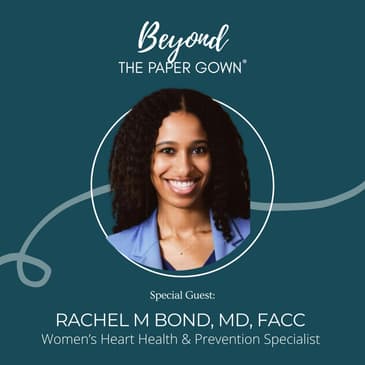

Continue our exploration of women’s heart health on "Beyond the Paper Gown" as Dr. Mitzi Krockover continues her enlightening discussion with Dr. Rachel Bond, an esteemed preventive cardiologist specializing in women's heart health. Building on the previous episode's insights, Dr. Bond elaborates on particular cardiac conditions prevalent among women, including diastolic heart failure and irregular heartbeats, specifically atrial fibrillation.She also highlights the heart challenges faced by transgender women and emphasizes the importance of tailored interventions and comprehensive healthcare for everyone. Finally, explore the frontier of innovation with insights into precision medicine and wearable technology.
Tune in now to gain valuable information about women's heart health that everyone needs to know. You can also hear more from Dr. Bond by listening to “What You Need to Know About Heart Disease in Women”.
Please visit Beyond the Paper Gown to join our community and to learn more about achieving your optimal health.
[00:00:00] Hi, welcome to Beyond The Paper Gown I'm Dr. Mitzi Krockover. In our last episode, I set
[00:00:14] down with Dr. Rachel Bond a board certified adult cardiologist with a practice in preventive
[00:00:21] cardiology and we talked about women and our number one cause of death, cardiovascular disease.
[00:00:27] Specifically, we talked about ischemic heart disease which involves blocked arteries.
[00:00:33] If you haven't had a chance to listen, I highly recommend checking out that episode.
[00:00:38] It's full of information about symptoms, risk factors and also how to prevent heart disease.
[00:00:44] In today's discussion, we're diving deeper into what makes women's heart health so unique
[00:00:50] and we're specifically talking about arrhythmias or abnormal heart rhythms and heart failure,
[00:00:56] especially the kind that affects women more but may remain unrecognized. Dr. Bond will also tell
[00:01:03] us what needs to change in research and treatment to improve outcomes in heart disease that affects
[00:01:09] women and we'll also talk about a number of other issues including heart disease and transgender
[00:01:15] women, advocating for more inclusivity and healthcare for everyone and how technology can help doctors
[00:01:22] and patients become a team to work together to improve personal health.
[00:01:27] Here's a little more about Dr. Rachel Bond. She serves as a system director for the Women's
[00:01:32] Heart Health program at Dignity Health in Arizona. She also holds leadership roles in the American
[00:01:38] College of Cardiology, the American Heart Association and the Association of Black Cardiologists
[00:01:44] and drives initiatives that emphasize diversity in medicine as well as an increase in the numbers
[00:01:49] of women, particularly women of color in the field of cardiology. In just a reminder, this podcast
[00:01:56] is for educational and informational purposes only and should not be taken as medical advice.
[00:02:02] What we hope you'll do is to share what you've heard today with your healthcare provider
[00:02:07] and consult him or her for any specific questions you have about your own personal health.
[00:02:13] Now let's join the second part of our conversation with Dr. Rachel Bond.
[00:02:30] We've talked about heart conditions and pregnancy. We're now talking about cardiovascular disease.
[00:02:37] What are some of the other heart issues that affect women?
[00:02:44] So women have the same, I would say, if not more, symptoms, not symptoms but conditions.
[00:02:52] That could affect them when it comes to their cardiovascular system. So oftentimes we talked a lot
[00:02:58] about the blocked vessels, how the pattern of it may not be as discrete where you have one single
[00:03:05] vessel that's blocked but more of like a sort of lining and lumpy, bumpy plaque that's going
[00:03:11] through the big vessels or maybe the microvascular has disease. But then we know that cardiovascular
[00:03:18] disease encompasses a larger array of conditions. As an example, we have arrhythmias. So arrhythmias are
[00:03:24] in the form of abnormal heart beats. The most common arrhythmia in the United States is a condition
[00:03:30] called atrial fibrillation. That is when the top chamber of the heart beats erratically and as
[00:03:37] a result of that, if you're not protected depending on your risk in the form of being on a blood thinning
[00:03:43] medicine, it can increase your risk of having a stroke. I bring this up for us as women because
[00:03:49] we know that data supports the fact that even though women do better by coming out of A-5 and having
[00:03:57] procedures that remove them from A-5, they are less likely to be referred to have such procedures.
[00:04:05] And again, this is where that unconscious bias comes into the mix. The other condition that I think
[00:04:11] is really important is heart failure and there's different types of heart failure. So what is heart
[00:04:16] failure? Heart failure is when there could be an inability of the heart which is a muscle to either
[00:04:23] pump blood or relax the heart to allow that blood to be pumped to the rest of the body. When the
[00:04:29] heart is unable to pump the blood, you have a weakened heart muscle and oftentimes women can have
[00:04:35] that but more commonly they don't have a weakened heart muscle. We as women more commonly if we're
[00:04:40] having heart failure have the inability to relax the heart. It's a condition called diastolic
[00:04:46] heart failure and because it's often more common in women than men, it hasn't been as studied
[00:04:53] and you will notice that when it comes to cardiovascular disease and they're focusing in on research,
[00:04:59] the research is always usually for the conditions that impact men. The reason behind that is that
[00:05:05] when we first did our cardiovascular research studies, they used men often men from the VA. At the time
[00:05:11] it was majority men in the Veterans Affairs Hospital. Now that we are seeing that there are other
[00:05:17] conditions, one of this being diastolic heart failure, we now in the year 2024 are realizing we
[00:05:24] have to do more research to figure out how do we best treat it? Why does it disproportionately affect
[00:05:30] more women than men and if we're not treating it appropriately, how are we doing a good service
[00:05:37] to our patients? The answer is we're not and as a result of that, we really have to hone in on what
[00:05:42] is the best way to treat these patients. So when women present with signs of heart failure, which a
[00:05:48] lot of times could be shortness of breath, weight gain, swelling in their legs, a pressure in their
[00:05:55] chest, usually the first thing that they do is an ultrasound of the heart and oftentimes what I
[00:06:01] notice is that if the heart demonstrates that it's doing its job by pushing blood out, the doctors
[00:06:08] just end there. And that's a challenge because again, it's not just the fact that the heart is able
[00:06:13] to push the blood out, is the heart able to relax and oftentimes it's not able to win women
[00:06:19] and we have to do a better job in diagnosing that. That way we can figure out how best to treat these
[00:06:24] women and improve their quality of life but also their longevity of life. So those are probably the
[00:06:30] differences when it comes to men and women with heart disease. You know, as you will know, just
[00:06:38] it's a recurrent theme that we don't have enough research and therefore it hasn't been translated
[00:06:44] to the bedside so I'll just leave it at that. At the very beginning we talked about gender versus
[00:06:52] sex and I don't want to get too much in the weeds but I feel like I want to ask the question about
[00:06:58] how if you're a transgender woman, where does your risk lie and are there any other considerations
[00:07:07] that you might have with respect to cardiovascular disease? Absolutely. So somebody who is a transgender
[00:07:16] female often meaning that biologically they were born male and have since transitioned to a female
[00:07:26] and based on their gender identify as female, have sometimes a plethora of risk factors and
[00:07:34] a large portion of that could occur in that transition. So when you are taking sometimes those
[00:07:40] supplemental hormones it could as noted depending on when's risk impact the other risk factors we
[00:07:46] talked about, the cholesterol, the blood sugar and also the blood pressure. As a result of that,
[00:07:53] we are very much recommending that the primary care clinicians or the clinicians who are prescribing
[00:07:59] the hormone therapy before providing these hormones are checking those basic labs but also periodically
[00:08:07] continuing to check them. I would say the greatest driver though that we're seeing in the LGBTQIA
[00:08:13] plus community, not just specific to transgender, but the entire community as a whole is the impact
[00:08:21] that stress plays on their cardiovascular system. The community itself is a marginalized community,
[00:08:28] there's lots of biases often not unconscious, lots of conscious biases that are directed towards
[00:08:35] that community and the strain and stress of that absolutely impacts their cardiovascular health
[00:08:42] and it's absolutely for that reason that we are encouraging and not only are we helping them in
[00:08:48] their transition but we're screening for depression, anxiety. We're screening for sometimes other more
[00:08:55] riskier conditions that could not only affect their mental health but also their physical health
[00:09:00] and their physical health in the form of cardiovascular disease. And I know I alluded to the fact
[00:09:06] that stress in of itself is a risk factor. Yes one that disproportionately affects women
[00:09:12] it affects all marginalized groups because of the lived experiences that they're encountering
[00:09:19] and just imagine the amount of stress that one may encounter even in a transition where that
[00:09:25] stress is consistently leading to the release of adrenaline. It's affecting their inflammatory
[00:09:31] systems and oftentimes it could lead to premature heart disease as well as cognitive impairment.
[00:09:37] So I would say the greatest, greatest risk for the entire LGBTQIA plus community oftentimes has
[00:09:44] to do with the mental health that has to do with the societal view of them as an individual and we
[00:09:51] do it's a society need to do better to prevent that and more importantly treat these patients equally.
[00:09:59] I couldn't agree more and as you know policy politics all impact on not only that issue but so much
[00:10:10] more. Are you working in any way in terms of advocacy for certain policies and if so what do you
[00:10:18] feel is important? Absolutely and you know I will say from an advocacy perspective we have to have
[00:10:26] better access to mental health screening also making sure that there's access to affordable
[00:10:33] healthcare which I think at the minimum is where it should start. The American College of Cardiology
[00:10:39] as an example, I am I sit on the National Leadership Committee for Diversity, Equity and Inclusion
[00:10:46] and we have a subcommittee that's specifically dedicated to the LGBTQIA plus community where
[00:10:54] we provide a series of educational materials out to the community but we also provide our clinicians
[00:11:00] with probably best practice of what we should be doing in terms of screening and how best to manage
[00:11:07] these patients. And I assume that you apply those same principles to advocating for women
[00:11:14] and other underrepresented or marginalized populations as well? Absolutely for myself the advocacy
[00:11:23] always starts with that which is my core. A lot of the work that I've been doing in the advocacy field
[00:11:29] on women has been through maternal health. When we think about cardiac disease and maternal health
[00:11:35] there absolutely is an intersection and in the United States which is a first world country as you
[00:11:41] know you have the highest highest rates of maternal mortality and it's pretty much equivalent to
[00:11:47] that of third world countries. And when you actually separated by race as well as ethnicity we see
[00:11:54] that black women are dying at the highest rates two to three times higher than white women when it
[00:12:00] comes to largely, largely preventable conditions. Hard disease being the greatest cause of death during
[00:12:06] that pregnancy and we know at the end of the day it's not because black women inherently are at a
[00:12:12] higher risk biologically. It has to do with the social construct, the social aspects and more
[00:12:18] importantly the structure at the core racism being that that is leading to these disparities that
[00:12:26] we're seeing. Hearing women not believing them, not believing their symptoms, not believing their
[00:12:31] stories but more importantly not treating them to the same capabilities of their white female counterparts
[00:12:39] and sometimes even male counterparts. As a result of that it would be largely, largely important
[00:12:45] that when we are doing this advocacy the advocacy is really making sound change. One way that we've
[00:12:52] been trying to do that is by extending the coverage of health insurance to not just occur during
[00:12:58] pregnancy but even outside of pregnancy because a lot of these conditions can occur up to one year
[00:13:04] after delivery. So a lot of the advocacy that I've been doing with these cardiovascular societies
[00:13:09] has been to accept the fact that we need to have all states extend Medicaid coverage up to 12 months
[00:13:18] in past it would be 60 days and then they're done. Now the majority of states have extended it
[00:13:24] to one year giving them the opportunity to have a transition of care and an obstetrician
[00:13:30] preferably to a primary care clinician as well. But beyond that we have to do a lot of other policy
[00:13:37] changes where we're not only making sure that we're educating the patients but probably the clinicians
[00:13:43] as well on this intersection and most importantly probably even educating the patients on implicit
[00:13:50] bias training because I think at the core those unconscious biases are leading to these disparities
[00:13:56] that we're seeing and if they're not aware of their unconscious bias they're not going to change
[00:14:02] it and we're going to see the same outcomes in care which are I would say deplorable when it comes
[00:14:08] to the maternal mortality crisis. Let's switch a little bit to innovation and you know this is a time
[00:14:22] of technology and AI and you know hope for the future. Is there anything out there that you're seeing
[00:14:31] that you're especially excited about? I think that the future of innovation when it comes to cardiovascular
[00:14:38] disease is very robust why do I say that well two-date we are really trying to best predict who
[00:14:45] is at risk of having a cardiac event. We tried this and have been successful when it comes to
[00:14:51] something called precision medicine which is where we're able to predict based on your genetic
[00:14:57] makeup what your risk may be for cardiac disease and if your genetic makeup is high maybe we need to
[00:15:04] be more aggressive in managing your traditional risk factors. This to the same degree we're working
[00:15:10] on doing that when it comes to imaging modalities and trying to actually look at those same studies as
[00:15:17] an example and ultrasound of the heart but instead of looking at the larger muscles at the
[00:15:22] microscopic level are we able to see those subtle changes that may develop before we actually see
[00:15:29] that the muscle becomes an issue. So I'm really excited about where we are going in the world of
[00:15:35] innovation particularly as it pertains to cardiovascular disease because I think for me as a preventative
[00:15:41] cardiologist it's only going to largely focus on that prevention finding the issue before there
[00:15:48] actually is a problem. You know I know you're not a surgeon but do you see any innovation or
[00:15:56] need for innovation in even things like surgical equipment for working on women if you will?
[00:16:03] That's a great question. I will say that when it comes to surgery there actually is data to
[00:16:11] support that the outcomes of women as an example after an open heart surgery because they had to
[00:16:18] have a bypass procedure because they had blocked vessels or even more so a valvular replacement.
[00:16:25] Women usually have a much harder time recovering versus their male counterpart and we have to get
[00:16:32] to the core of why if we had an innovative way to determine that is it because the standard of
[00:16:39] care of how we're doing the procedure perhaps should be different in a woman versus a man.
[00:16:45] Perhaps but I think you bring up a very valid point that because we see that these sex and gender
[00:16:51] disparities exist using innovation to figure out how can we prevent that? How can we best treat
[00:16:58] these women are going to go a long way? Surgery has been around forever. We probably do need to have
[00:17:04] some innovation are they to figure out why these disparities exist and how we could ultimately
[00:17:10] prevent them in the future? That's a great question. And along thank you and along those lines in
[00:17:17] terms of technology are you incorporating patients wearables and their data in your practice?
[00:17:26] Yes so wearables I would say are standard it has to be standard at this point in time not for
[00:17:32] every patient of course but for patients that have all often symptoms or have underlying diagnoses.
[00:17:40] And when we think about the wearables the focus that I often look at most are the abnormal heart rhythms,
[00:17:46] the arrhythmias that we're often able to capture with those wearables. We have smart watches,
[00:17:52] we have other devices that could be utilized and the value of that is that there is some accuracy.
[00:17:59] Is it equivalent to the data that we collect? Of course not but it gives us again a better idea
[00:18:06] of what is going on and that comes into I would say a huge benefit because if we have you wear data
[00:18:14] or if we have you wear devices and we're not able to capture something then and there,
[00:18:20] we're missing it. We're missing the opportunity to diagnose you sometimes with a very abnormal
[00:18:26] heart arrhythmias that could lead down the road to cardiovascular complications. If you have
[00:18:32] a wearable device perhaps we can capture it on that and it will again direct us in that right path
[00:18:39] and as a result of that I am always in favor if my patients have one access to it already or the
[00:18:46] means to afford it to use these wearable devices and to that point our cardiovascular societies
[00:18:54] right now are trying to work with Medicare and other insurancees to see if some of them will be
[00:19:00] covered because we know that there are benefits in having them as an extender often for our most
[00:19:07] symptomatic patients because it only helps us as clinicians to better diagnose them but
[00:19:13] sometimes even diagnose them a little bit earlier. Will we see success in insurance coverage?
[00:19:19] I don't know but we will continue to advocate for that because we know it's the right thing to do.
[00:19:26] Sure well you've been so generous with your time what did I not ask you that you think is important
[00:19:33] for our listeners to understand? The women out there that are listening I think it's important
[00:19:41] that we as women understand that oftentimes we put everyone above our own self when it comes to our
[00:19:48] health. We have to take a pause we have to go to the doctor or the clinician at least on an annual
[00:19:54] basis. We also have to do things that are all more importantly going to help our mental health because
[00:20:01] our mental health equals our physical health and if our physical health needs a little bit of
[00:20:06] health oftentimes that means our mental health needs a little bit of health as well so as women
[00:20:11] out there that are listening it's really important that we take a step back focus on our self
[00:20:17] because if we don't focus on our self we won't be able to care for our loved ones our colleagues
[00:20:22] our friends our family. That's a great way to end. Dr. Rachel Bond as always I've learned so much
[00:20:30] thank you so much for being here with us today. Thank you so much it was a pleasure.
[00:20:36] So as we wrap up our chat with Dr. Rachel Bond you can now see that women's
[00:20:48] heart health has many differences compared to our male counterparts whether it's disease caused
[00:20:53] by blockages and arteries or Rhythmias like atrial fibrillation or heart failure yet we need to
[00:21:00] increase the amount of research to understand not only the differences but how to diagnose and
[00:21:06] treat these conditions successfully innovations like using wearables to help monitor patients
[00:21:12] outside of the doctor's office is a great example of how technology can help us improve our heart
[00:21:17] health. Here are some action steps that we can take from our conversation keep learning about
[00:21:23] heart health so you can recognize symptoms that need to be attended to don't hesitate to speak
[00:21:29] up about your health concerns if something doesn't feel right seek medical advice consider
[00:21:36] supporting organizations that focus on women's heart health and those that advocate for inclusive
[00:21:41] health care such as women heart and the American Heart Association you can find links to these
[00:21:47] organizations in our podcast notes finally share what you've learned with friends and family awareness
[00:21:54] can save lives thanks as always for joining us today you are always welcome to our website
[00:22:00] at beyondthepapergown.com that also has articles resources a marketplace and more you can subscribe
[00:22:08] to our newsletter while you're there and speaking of subscriptions do subscribe to our podcast on
[00:22:13] your favorite platform until next time take good care
[00:22:25] you
[00:22:31] beyond the paper gown is produced by Patrick Shambayati and me and our associate producer
[00:22:36] is Kyla McMillian