
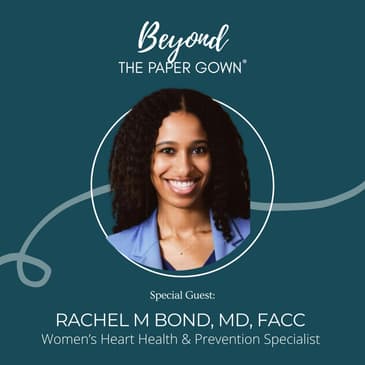

We explore women's heart health in our latest episode of "Beyond the Paper Gown." Join Dr. Mitzi Krockover as she interviews Dr. Rachel Bond, a renowned preventive cardiologist who specializes in women’s heart health. Dr. Bond unravels the complexities of ischemic heart disease—the number one killer of women. Discover how symptoms, often subtle yet crucial, differ in women and men, and may delay diagnosis. They also discuss prevention strategies like risk factor management, stress reduction and mental wellness. Dr. Bond also delves into the unique risks of stroke in women, as well as specific risks for communities of color for all vascular disease. This episode is a must-listen for anyone seeking to protect their–or their loved ones– heart health. Tune in now for empowering knowledge and practical advice.
Plus, check back next week for the second part of the interview where we delve into other heart conditions experienced by women and Dr. Bond's advocacy for policy change and cutting-edge innovations in heart health management. Tune in now to safeguard yourself and your loved ones against heart disease!
Please visit Beyond the Paper Gown to join our community and to learn more about achieving your optimal health.
[00:00:00] Hello and welcome to Beyond The Paper Gown where we focus on the issues and factors that
[00:00:13] impact women's health. Our goal is to provide the most credible information, from scientists,
[00:00:19] clinicians to innovators, to help you live your healthiest life. And I'm Dr. Mitzi Krockover.
[00:00:26] Do you know what the number one cause of death is in women? If you said heart disease,
[00:00:30] you'd be correct. While we tend to think that the typical person with heart disease
[00:00:35] as a man, usually a white obese older man who comes to the doctor clutching his chest,
[00:00:41] women experience heart disease just as commonly but differently and therefore their diagnosis
[00:00:47] may be missed or delayed. What we're going to do today is talk about who's at risk,
[00:00:52] the symptoms of heart disease in women, as well as how to prevent it and how to get
[00:00:57] the medical care you need. To clarify we're primarily going to talk about
[00:01:01] ischemic heart disease or heart disease that occurs when there's a blockage of an artery
[00:01:06] bringing blood and therefore oxygen to the heart, as well as its relationship to stroke
[00:01:11] and other blood vessel diseases. Joining us today is a leader in the field of cardiology
[00:01:17] Dr. Rachel Bond. She's a board certified adult cardiologist with a practice in preventative
[00:01:23] cardiology and serves as system director for the Women's Heart Health program at Dignity
[00:01:28] Health in Arizona. She also holds leadership roles in the American College of Cardiology,
[00:01:34] the American Heart Association and the Association of Black Cardiologist and drives initiatives
[00:01:40] that emphasize diversity in medicine and bolster the representation of women, particularly
[00:01:46] women of color in the field of cardiology. Just a reminder, this podcast is for educational
[00:01:53] and informational purposes only and should not be taken as medical advice. What we hope
[00:01:59] you'll do is to share what you've heard today with your healthcare provider and consult
[00:02:03] him or her for any specific questions you have about your personal health.
[00:02:16] Hi, I'm Dr. Mitzi Krock over and this is Beyond the Paper Gown. Welcome and I also want
[00:02:27] to welcome our guest today who is extraordinarily accomplished has such great expertise that
[00:02:33] I'm just really excited to dig in and talk about heart health today. So Dr. Rachel Bond,
[00:02:42] welcome. Yes, thank you so much for having me. I'm looking forward to this. Talk a little
[00:02:48] bit about kind of how you got into cardiology and your focus on women's health. I will say
[00:02:56] that I wanted to be a doctor my entire life. I'm the first medical doctor in my family.
[00:03:02] It was a great accomplishment for me when I did finally match into medical school and then
[00:03:07] eventually residency and I knew at a pretty early age that I wanted to do cardiology.
[00:03:12] I just didn't know quite what in cardiology. And as I journeyed through school and understood
[00:03:18] that heart disease is our greatest threat, but it's so largely preventable. I wanted to
[00:03:24] really hone in and focus my energy on the prevention piece of it because many people don't
[00:03:29] realize, but it is 80% preventable and a lot of times that's through conventional risk factors
[00:03:36] and making sure that those risk factors are under control. And I understanding that the
[00:03:43] prevention piece was such a key factor then decided to journey into the different sex and gender
[00:03:49] disparities because glaringly we see especially in the field of cardiology that oftentimes women
[00:03:57] are under diagnosed. They have delayed diagnoses and even when they're diagnosed, they have delayed
[00:04:02] treatment. And I really wanted to be the voice to help improve that but also help to educate
[00:04:08] the next generation so we weren't having the same replication of how we're treating patients.
[00:04:14] You brought up two topics that I really wanted to dig into, number one or the gender and other
[00:04:21] disparities in inequities as well as the preventive part. So let's take the gender and other
[00:04:27] disparities first especially when it comes to men and women. What are those differences? And why
[00:04:35] are those women getting their diagnoses later or perhaps not even at all? That's a wonderful
[00:04:43] question and I would say that it's multifaceted so when we think about first of all the differences
[00:04:49] biologically, the XX chromosome versus the XY chromosome, we know that as women we do have more
[00:04:56] unique risk factors compared to men. So what are those? So a lot of the risk factors that could
[00:05:01] increase your risk for heart disease could occur during one's pregnancy if they decide to have
[00:05:06] a pregnancy. So risk factors such as gestational diabetes, high blood pressure during pregnancy,
[00:05:13] a condition called preoclampsia where you have an elevated blood pressure and it can actually
[00:05:18] sometimes affect your other organs like your kidneys, your brain, your heart. Those are actual risk
[00:05:24] factors for heart disease which many women don't realize and I will say that our obstetricians
[00:05:29] are doing a much better job now in providing that education but then there are other risk factors
[00:05:35] that are more predominant in women stress, anxiety, depression. Yes everyone experiences it
[00:05:42] but women often have a greater impact from it than their male counterparts and as a result of that
[00:05:49] the release of adrenaline that often can occur just being a woman living in the United States
[00:05:55] going through the sort of patriarchy of the United States can often release those extra stress
[00:06:04] hormones and that in of itself can predispose them to cardiovascular disease. And then when we look
[00:06:10] at the more traditional risk factors like high blood pressure, high cholesterol, diabetes even a
[00:06:16] history of smoking. We know that women often have actually higher likelihood of heart complications
[00:06:24] if they have those risk factors as compared to their male counterparts and that's the XX versus
[00:06:30] the XY so the biological means behind that. As an example I always say this to my patients if you
[00:06:37] smoke the same number of cigarettes for the same duration as your male counterpart, you're at a
[00:06:42] 25% greater risk of having a stroke and heart attack. And of course we suggest smoking is bad for all
[00:06:50] regardless of sex, gender, race, ethnicity but there is disproportionately a higher burden on us
[00:06:57] as women versus our male counterparts. The other factor that we have to think about when we
[00:07:02] think about the differences is also the symptoms so oftentimes women present with more vague symptoms.
[00:07:10] So what do I mean by that? When we think about a heart attack, we always think in the movies
[00:07:15] someone clutching their chest they describe it as an elephant is sitting on their chest and maybe
[00:07:20] it radiates to their jaw. It goes to their arm maybe they feel a little sweaty, they feel a little
[00:07:26] dizzy and short of breath. Women may not have those symptoms, they may have more subtle symptoms where
[00:07:32] they have shoulder pain, back pain perhaps they feel a little indigestion or nausea or even tired
[00:07:40] or fatigue is the best word to use. Fatigue and tiredness is a common common
[00:07:46] risk, a common common sign that there may be something going on from a cardiovascular perspective
[00:07:52] and oftentimes I tell my patients particularly those who have risk factors for heart disease
[00:07:58] if you're getting enough sleep if you are ruling out other things that can cause fatigue and tiredness.
[00:08:04] It's really important that you talk to your primary care doctor about getting your heart
[00:08:09] checked because that could be an early sign that there is something going on with your heart.
[00:08:15] In my mind I'm hearing the voice saying yeah I'm gonna go to my doctor,
[00:08:19] I'm gonna tell him I'm tired or I'm tired and they're not going to really take me seriously.
[00:08:26] So you know it is hard you know as a clinician you know fatigue can be a sign
[00:08:33] under symptom of so many things. So what do you advise your patients or others you know just
[00:08:42] the folks that you're educating about how to communicate with a physician whether it be in
[00:08:49] the doctor, you know the outpatient doctor's office or the emergency room?
[00:08:55] Yes and it's very different in the outpatient doctor office versus the emergency room.
[00:09:00] So if we're in the emergency room I always encourage my patients particularly my female patients
[00:09:05] if they believe they're having a cardiac event to express that. When you tell someone you believe
[00:09:11] you're having a heart attack, they can't ignore you, they have to rule it in or out preferably.
[00:09:18] With that being said even sometimes when women do that there are still challenges because of those
[00:09:24] implicit or unconscious biases that people have and I will say that we in the medical field are
[00:09:31] really trying our best to improve education at the level of medical school and nursing school.
[00:09:37] That way these unconscious biases don't exist, that way if someone does present the emergency room
[00:09:43] perhaps not with the typical symptoms but maybe more atypical subtle symptoms especially if they
[00:09:49] have risk factors or thinking about cardiovascular disease. But for the patients and the outpatient
[00:09:55] setting, the first and most important thing that I tell them is that you have to be with a clinician
[00:10:00] you trust someone who is willing to listen to you, someone who is willing to express to you what
[00:10:06] your risk factors are but more importantly explain to you what those risk factors are and what we can do
[00:10:12] to improve them. You talked about the risk factors, what is your advice in terms of screening
[00:10:21] for those risk factors so that you know if you're at risk or at increased risk and also
[00:10:29] talk a little bit about the effect of age in women and menopausal status with respect to risk.
[00:10:36] Absolutely so all adults, men as well as women need to go at least once a year for what we call
[00:10:45] well check up and that well check up looks at all of those standard risk factors through blood work.
[00:10:51] They check your blood pressure, they check your weight, they discuss with you if your weight is
[00:10:55] appropriate for your height, they counsel you on your nutrition and your physical activity level
[00:11:00] and when they're looking at your labs, they're specifically looking at key things,
[00:11:04] your blood sugar, your cholesterol, your kidney function, your thyroid function all things that
[00:11:10] absolutely can affect your cardiovascular health. If you have a family history it's most pertinent
[00:11:17] that you start this conversation as early as possible and when we think about a family history
[00:11:23] we know that if you have a first degree relative which includes mom, dad or siblings
[00:11:28] in a woman before the age of 65 or in a male before the age of 55 then you actually could be at
[00:11:35] a higher risk or a height and risk of having a cardiac event. Therefore that screening may occur
[00:11:41] a little bit earlier or it could actually occur more frequently but the basic basic basic basic things
[00:11:48] that we always do includes that well check up or we're examining you, we're reviewing your blood
[00:11:54] work and always, always, always also doing what's called an electrocardiogram where we're able to
[00:11:59] actually look at the heart and see if the heart has any abnormalities even without symptoms. So
[00:12:05] it's a great screening tool to help dictate if additional testing should occur. For women that
[00:12:11] reach menopause, even parry menopause I would say that that is probably the second chapter in our
[00:12:19] life that is of most importance, the reproductive years 100% are important but once we reach the
[00:12:25] years of menopause it's important because we always see that with a depletion of the hormones
[00:12:32] that our body is naturally producing it affects our arteries. It makes the arteries differ so
[00:12:38] oftentimes we can see a rise in our blood pressure. It also makes it a little bit harder for us to
[00:12:44] release cholesterol. As a result it's not uncommon that when women are going through either
[00:12:49] parry menopause which is right before a menopause or have fully gone through menopause they may have
[00:12:54] elevations in their cholesterol. We also notice that menopause could affect our ability to keep stable
[00:13:01] weight so oftentimes it's not uncommon that we may notice some weight gain and with weight gain
[00:13:07] that could affect cholesterol, it could affect blood pressure, it could put us at risk of insulin
[00:13:12] resistance or diabetes. There's a lot that menopause can do in terms of our risk for cardiac disease
[00:13:19] because of those risk factors that it can sometimes lead to. With respect to that
[00:13:29] I think back about when I was practicing on a regular basis and we were giving estrogen for
[00:13:37] not only symptoms of parry menopause but also reducing the risk of heart disease, osteoporosis
[00:13:44] and cognition. Then the Women's Health Initiative came out and suggested that by giving estrogen
[00:13:53] you might increase cardiovascular risk. Then once the data was analyzed to say that no that was
[00:14:01] only for women that are older, 65 and up. Yet there's still not recommendations for using
[00:14:09] estrogen as a cardiovascular protector. Is that correct? Do you have thoughts about that?
[00:14:19] Yeah so you're 100% correct so the data confuses us. It's still this day confuses us.
[00:14:26] We stopped. The WHO came out, we dropped estrogen and then all these women suffered for that.
[00:14:36] They suffer from it and I see so many women who are desperate to be on hormone therapy but they
[00:14:43] don't know if it's right for them. What is their risk? Is it safe? Oftentimes I actually
[00:14:48] have referred patients to help answer that question. What I can say is that to date there is no
[00:14:55] recommendation that we should be using hormone replacement therapy for the prevention of cardiovascular
[00:15:01] disease. There are several other things that we can do that would be preferable before we go to
[00:15:07] hormone therapy such as focusing on nutrition, physical activity, making sure that those risk factors
[00:15:14] are under better control so that is what the guidelines suggest. With that being said if we have a
[00:15:20] patient who has what are called vasomotor symptoms so those hot flashes, the night sweats,
[00:15:26] the fatigue, those symptoms that really really impair their quality of life. The use of hormone
[00:15:33] therapies as early on as possible can be safe when we have those other risk factors under control
[00:15:41] and oftentimes for my patients because there are women out there who have cardiovascular disease
[00:15:48] and also are going through menopause we have to have that sort of shared decision making and
[00:15:54] that discussion where we talk about well what are the risks, what are the benefits and if the
[00:16:00] benefits of the hormone therapies because it's going to improve their quality of life
[00:16:06] over seed the potential risks we have that conversation as well. That may mean for me as a
[00:16:12] cardiologist I'm monitoring them most closely but I'm also giving them guidance on what the
[00:16:18] right thing to do is and the right path to go. I would say I'm very excited because in the world
[00:16:25] right now we're actually talking about menopause it was very taboo before no one ever even discussed
[00:16:31] it but now we're having conversations about it and as a result of that even back a few months ago
[00:16:38] there was a non-hormonal medication that helps with menopause symptoms so now we're actually going
[00:16:44] down a path of the use of non-hormone medications to help with these symptoms for those patients
[00:16:51] that may be deemed at higher risk. What I will say to patients out there is that it would be best
[00:16:57] to speak with your clinician before starting hormone therapy because there are several things
[00:17:02] that the clinicians can do to determine what your risk is. If your risk is low absolutely you can
[00:17:08] proceed if your risk is high this is again where that shared decision-making is so important.
[00:17:14] Absolutely one of the questions that I often get is what's a good cholesterol? What should my
[00:17:20] cholesterol be? What's the good cholesterol? What's the bad cholesterol? So help us make some
[00:17:25] sense of that. Yes and another comment that I often hear is well my good cholesterol's good so
[00:17:32] it's okay that my bad cholesterol is a little bit high. The answer is it's not so when we think about
[00:17:38] when we think about what is actually causing the plaque to build up in the arteries of the heart
[00:17:44] it's that LDL which is that bad cholesterol and as a result of that we want that LDL for the general
[00:17:50] population to be less than a hundred. Those are our basic goals of course if someone has
[00:17:56] underlining heart disease or if someone has evidence of several risk factors that may predispose
[00:18:02] them to heart disease our recommendation may be a little bit lower so every patient is individual
[00:18:09] but the rule of thumb is that the lower your bad cholesterol and the higher your good cholesterol
[00:18:15] the better your overall cardiovascular health and there are several factors that we can look into
[00:18:21] when it comes to cholesterol. 25% of our cholesterol comes from what we eat so nutrition is such an
[00:18:28] important aspect. Another percentage comes from our physical activity and the American Heart Association
[00:18:34] as an example recommends at least 150 minutes per week of moderate physical activity. That could be
[00:18:41] in the form of walking but we would want to walk at a brisk pace and that's what I always tell my
[00:18:47] patients that if you don't have access to a gym or exercise equipment going out in the environment
[00:18:53] going out in your community going for a walk is going to make a significant difference. The rest
[00:18:59] of the percentage is family history when it comes to your cholesterol and this is why it's so
[00:19:04] important to know what your family history is because again it will help to pre at least for us
[00:19:11] predict what your risk may be of requiring additional therapies or additional management for yourself
[00:19:17] in the future. So say you are someone at high risk you start having some symptoms,
[00:19:26] you go to your physician, what is there a difference in how you diagnose or the kinds of
[00:19:32] diagnostics you use for women rather than men? So that's a wonderful question. So women because
[00:19:42] we are such a unique entity often have heart disease that's a little different than male pattern
[00:19:48] heart disease. So when we think about male pattern heart disease it's usually where there could be
[00:19:53] a single vessel where there's a severe blocked vessel. Sometimes yes women can encounter that and
[00:20:00] it's usually women in the postmenopausal period. Before our women of reproductive age who are
[00:20:05] presenting with signs or symptoms concerning a heart disease, if we do additional testing
[00:20:11] it's not uncommon that we may see a little bit of plaque spread across the vessels and many people
[00:20:18] would say well if that plaque is not causing a blockage how is it possible that that plaque could
[00:20:23] be causing symptoms? It could and we're now actually exploring that because it's not just the big
[00:20:28] vessels that have that plaque probably. It's probably the little tiny vessels that come off of
[00:20:34] those little vessels a condition called micro vascular disease and oftentimes that predisposes women to
[00:20:41] have issues with their heart in the future but that condition actually predominantly is in women
[00:20:47] more than men. The treatment right now we are still in the early phases of what would be best
[00:20:53] in terms of treatment but what we do know at a minimum is that we want to control their risk factors.
[00:20:59] So if their cholesterol is high we make sure that we talk to them about lifestyle management,
[00:21:04] a lot of times we recommend medications as well if their blood pressure is high we would do the same
[00:21:10] but as a result of that women often have more of those unique presentations and this is why again
[00:21:17] anytime you're coming in with symptoms you want to make sure that you're not only trusting your
[00:21:22] clinician but that your clinician is aware of the differences that women may present with because
[00:21:28] there are several women that have presented to my clinic who have gone through two or three different
[00:21:34] cardiologists before we diagnose them with their heart condition because they weren't thinking
[00:21:40] about the more specific conditions that could affect women and they were thinking more about the
[00:21:45] conditions that often affect men. Are there any other things that we need to do or that a woman
[00:21:51] should expect to have been done to see some of those kinds of things that you just talked about in
[00:21:56] terms of microbascular changes? So I would say that the key is first figuring out if your symptoms are
[00:22:06] due to a cardiac cause or not so traditionally in the past often we start with the basics which
[00:22:13] is an electrocardiogram which is an EKG of the of the chest and what the EKG will help to dictate
[00:22:19] is the next test. If the EKG shows that there are changes that if we changes in the sense that
[00:22:27] if we compare it to your prior that may make your symptoms more alarming at which point we would
[00:22:33] determine do we want to go straight to what's called anatomical evaluation meaning looking at
[00:22:39] the vessels so the first thing we would want to do is make sure that the big vessels don't have
[00:22:45] blocked vessels or blockages and the only way to do that would be to look at them so that would be
[00:22:50] through the use of a CAT scan where they place an IV in your arm, they give you contrast which is
[00:22:56] die and they're able to light up the arteries in your heart. That also alternatively could be through
[00:23:01] a coronary angiogram or catheterization where similarly they instead of going through the vein go
[00:23:07] through the artery either in the wrist or the groin and they're able to access the heart through
[00:23:12] contrast by again looking for a blocked vessel. If that doesn't demonstrate a severe blockage but
[00:23:19] our suspicion is still high that the symptoms are due to cardiac disease then we would go down
[00:23:26] the route of doing more of different types of stress tests and also even tests that are called
[00:23:34] MRIs to help us explore if there's a possibility of it being the microvascular.
[00:23:40] For us in cardiology we have so many different imaging modalities that it can want to be overwhelming
[00:23:47] not just for patients but also for us as providers but again you want to make sure that you are
[00:23:54] at the in the hands of a provider who knows which tests to look for because it's not uncommon
[00:24:01] that I'm ordering one test and then going down the path of ordering another for me to make that diagnosis.
[00:24:08] Sure and with respect to treatment are there differences in treatment options or if efficacy if you
[00:24:18] will between the genders or the sexes? What I can say when it comes to treatment and I will use a heart
[00:24:25] attack as an example is that oftentimes when women present with heart attacks even after we diagnose
[00:24:32] them with a heart attack they are less likely to be treated with the guideline suggested medication.
[00:24:37] This includes aspirin this includes cholesterol medications sometimes medications to relax
[00:24:43] the heart which could be in the form of blood pressure medication and this is again even when
[00:24:49] we diagnose them with a heart attack. The other thing that we've noticed and there's a lot of
[00:24:54] data to suggest that patients after they present with a heart attack do amazing when they're referred
[00:25:00] to something called cardiac rehab. Cardiac rehab is an exercise program where it supervises so
[00:25:08] there's a nurse who monitors you after the event you go three days out of the week for a total
[00:25:14] of 12 weeks for a total of 36 sessions and it leads to better outcomes. It leads to decreased
[00:25:20] hospitalizations, it improves longevity, it improves a reduction in having another event.
[00:25:27] Women on average are less likely to be referred to cardiac rehab than men
[00:25:33] and then when women are referred they're less likely to complete it so to date we are working now with
[00:25:40] again these cardiovascular societies to try to see if we could have more flexibility in the time
[00:25:46] of the cardiac rehab perhaps they should be outside of the work hours perhaps they should be maybe
[00:25:53] on weekends because right now it's more of a Monday through Friday 9 to 5 but we have to get back
[00:25:58] to the core of why our women less likely to receive these treatments versus men even when data
[00:26:06] supports that they're helping them just as much as they are their male counterparts and it goes
[00:26:11] back to that unconscious bias that we still have in the medical field. Talk also a little bit about
[00:26:18] you alluded to not only sex or gender differences but other inequities and differences.
[00:26:27] Absolutely so another passion of mine is not just speaking about women's health but also
[00:26:33] health inequities and health disparities as it pertains to one socioeconomic status race and
[00:26:39] ethnicity and when it comes to cardiovascular disease there's a plethora of that. When we actually
[00:26:45] look at the statistics we see that the greatest culprit often of our health is the social
[00:26:52] determinants of health so access to you know is there access to medical care? Is there access to
[00:26:58] equitable medical care? What environment are you growing up in? Do you have a safe neighborhood
[00:27:05] where you could actually exercise? You have the nutrients that you need in that neighborhood and
[00:27:10] oftentimes if the answers no it's going to predispose you to many of those risk factors and
[00:27:15] those risk factors are going to lead to heart disease. So it should come as no surprise that the
[00:27:20] black and brown community have the highest rates when it comes to cardiovascular conditions
[00:27:26] specifically I would say the black community especially black women. They are probably the
[00:27:32] largest group when it comes to the highest risk because of the fact when we look at a black female
[00:27:38] and myself and the black females I'm very aware of this we see that black women above the age of 20
[00:27:46] nearly 60 percent of them have some form of heart disease and oftentimes that's because of
[00:27:53] the greatest risk factor which is high blood pressure. It's a commonality in the community
[00:27:58] and when it is diagnosed another issue is that it's very much under treated so even though patients
[00:28:06] are being told that their blood pressure is elevated we as clinicians are not aggressively
[00:28:11] managing that blood pressure we're not educating them on the nutrition or aspect, the physical
[00:28:17] activity aspect and we're often sometimes not even prescribing them the right medications and as a
[00:28:22] result of that they're not getting the adequate blood pressure management and in the long run this
[00:28:28] is why we're seeing these heightened rates of stroke and heart attack which are largely preventable.
[00:28:34] So if a key factor for me has really been to make sure that we are targeting those highest risk
[00:28:39] groups and as a result of that a lot of my community education has been going out to the community
[00:28:46] working with churches and faith-based organizations to try to get the education out there
[00:28:52] to go to a trusted clinician yet your numbers check but make sure you understand how best to manage
[00:28:59] your risk factors. Talk a little bit about the relationship between stroke and heart disease
[00:29:07] and what are some of the symptoms? Yeah that's a great question so when we think about heart disease
[00:29:13] stroke even a condition called peripheral arterial disease which are blocked vessels in the arteries
[00:29:19] in our in our arms or our legs typically our legs it falls under the umbrella term cardiovascular
[00:29:27] disease so often what is cardiovascular disease that is when you have disease and the arteries
[00:29:32] of any piece or any part of your body and if somebody had a stroke commonly the cause of stroke
[00:29:41] to date in the United States the most common cause is an ischemic stroke which means that you had a
[00:29:47] transient episode where you had decreased oxygen to the brain often in the form of a blockage
[00:29:53] and that blockage could either be in the neck vessels possibly even in the brain vessels
[00:29:58] and if that is the case that predisposes you to have a heart attack because the risk factors for stroke
[00:30:05] are the exact same risk factors for heart attack. The medical way we treat stroke and the lifestyle
[00:30:12] way we treat stroke are the same way we medically and lifestyle wise treat heart attacks so they're
[00:30:18] equivalent and as a result of that for all of my patients that I see who have had a stroke
[00:30:23] I'm always hypervigilant in making sure that there isn't any disease in the arteries of their heart
[00:30:29] and other vessels because the likelihood is is that they're at a much greater risk of having it
[00:30:35] as such they need to understand what their risk factors are and make sure that they're getting
[00:30:39] appropriate treatment for it. If you would review the symptoms of a stroke
[00:30:46] absolutely so when we think about the symptoms of a stroke and I do want to preface the fact
[00:30:51] that the symptoms of a stroke in women can be very different than the symptoms of a stroke in men
[00:30:56] the same way the symptoms of a heart attack is a theme there's a theme exactly so when we think
[00:31:04] about we think about the classic symptoms of a stroke we think about somebody who may have word
[00:31:09] finding difficulty they may have an inability to actually speak they may have a sudden acute
[00:31:16] onset of numbness tingling inability to move any of their foreextremities and absolutely
[00:31:23] slurred speech but also they may have visual loss those are the acute symptoms that warrant you
[00:31:30] to go immediately to the emergency room because just like the saying goes time is muscle when it comes
[00:31:37] to a heart attack time is brain when it comes to a stroke now women yes can present with those
[00:31:44] same symptoms but just like when it comes to cardiovascular disease or a heart attack they
[00:31:49] sometimes present with fatigue and that could be a sign that there is something neurologically going on
[00:31:56] they also may have more subtle symptoms where they feel dizzy or having an imbalance which again
[00:32:03] that's very non-specific are they dizzy because their blood pressure is low or are they dizzy
[00:32:07] because there's a neurological event going on so it's really really important to know these
[00:32:12] little subtle symptoms know if they're not going away but most importantly know your risk factors
[00:32:18] because if you have a family history of stroke if you have a history of high blood pressure high
[00:32:24] cholesterol diabetes these symptoms can't be ignored because we would be very very concerned that
[00:32:30] they may actually be a cardiovascular event sure well you've been so generous with your time
[00:32:38] what did I not ask you that you think is important for our listeners to understand
[00:32:45] I think what I would just be emphasized which I had stated before is that with heart disease being
[00:32:52] so largely preventable but still our greatest threat at a minimum go to your doctor every year
[00:32:58] go to your clinician every year but not just go understand what your true risk factors are
[00:33:04] ask them those questions predominantly what are my risks and what can I do to prevent these risks
[00:33:10] from happening there are several additional tests beyond blood work and beyond a physical exam
[00:33:16] that sometimes can come in favor we talked a little bit about a calcium score with a cardiac
[00:33:22] cat scan we talked a little bit about an echocardiogram we talked about an electrocardiogram asking
[00:33:28] the questions would you benefit from any of those tests really helps to direct your clinicians
[00:33:34] that way we don't miss things and again knowing your risk largely can help to dictate that so
[00:33:41] for me that was really the most important messaging and for the women out there that are listening
[00:33:47] I think it's important that we as women understand that oftentimes we put everyone above our own
[00:33:55] self when it comes to our health we have to take a pause we have to go to the doctor or the clinician
[00:34:01] at least on an annual basis we also have to do things that are all more importantly going to help
[00:34:07] our mental health because our mental health equals our physical health and if our physical health
[00:34:13] needs a little bit of help oftentimes that means our mental health needs a little bit of help as well
[00:34:17] so as women out there that are listening it's really important that we take a step back
[00:34:23] focus on our self because if we don't focus on ourselves we won't be able to care for our loved ones
[00:34:29] our colleagues our friends our family that's a great way to end
[00:34:35] Dr. Rachel Bond as always I've learned so much thank you so much for being here with us today
[00:34:42] thank you so much it was a pleasure
[00:34:52] I hope you enjoyed our in-depth conversation with Dr. Bond in fact let's do a quick recap on some
[00:34:58] critical information that we discussed because it's really too important to let slip
[00:35:03] heart disease doesn't play favorites it's a leading cause of death for both men and women in
[00:35:09] the United States the common risk factors like high blood pressure diabetes high cholesterol
[00:35:15] smoking and a family history of heart issues affect everyone but for women there are extra layers
[00:35:22] to consider pregnancy complications like gestational diabetes and preeclampsia as well as stress
[00:35:29] depression and the changes that come with menopause can all influence our heart health remember
[00:35:35] those annual checkups are more than just a date on the calendar there are crucial step in
[00:35:40] monitoring and managing your health plus with 80% of heart disease being preventable lifestyle
[00:35:47] choices like a balanced diet regular exercise and stress management can be game changers heart
[00:35:55] disease in women often goes under the radar the symptoms can be chest pain shortness of breath
[00:36:01] or left arm pain but they can also be subtle and not what you or maybe even the doctor typically
[00:36:07] expect like shoulder pain indigestion nausea or even just fatigue without an obvious reason for
[00:36:14] being tired and that can lead to delays in diagnosis and treatment which in turn leads to poor
[00:36:20] outcomes in women so if something feels off speak up your voice could be the key to timely
[00:36:26] and effective care doctor bond emphasizes the importance of women being proactive about their
[00:36:32] heart health so understanding your risks recognizing the symptoms and consulting your doctor are
[00:36:39] vital steps and let's not overlook mental health it is deeply connected to your physical well-being
[00:36:46] I hope this discussion has equipped you with knowledge to safeguard yourself and your loved ones
[00:36:51] against heart disease especially a skimic heart disease in the second part of my interview with
[00:36:57] doctor bond we impact some other heart conditions experienced by women such as abnormal heart rhythms
[00:37:03] and heart failure as well as the specific concerns for the LGBTQIA plus community and other marginalized
[00:37:11] groups you'll also learn about doctor bond's passionate advocacy for policy change to better
[00:37:17] women's heart health and her insights on cutting edge innovations like wearables which promise a
[00:37:23] future where managing heart health is more personalized and proactive it's another treasure trove of
[00:37:29] information you won't want to miss I also invite you to explore beyond the paper gown for more
[00:37:35] resources articles and a community focused on wellness while you're there sign up for our newsletter
[00:37:41] to stay informed about our latest podcast events and health tips and don't forget to subscribe to
[00:37:47] our podcast on your preferred platform for the most current insights on women's health thanks for
[00:37:53] tuning in and take good care
[00:38:02] you
[00:38:09] beyond the paper gown is produced by Patrick Shambayati and me and our associate producer is Kyla
[00:38:14] Mcmillan