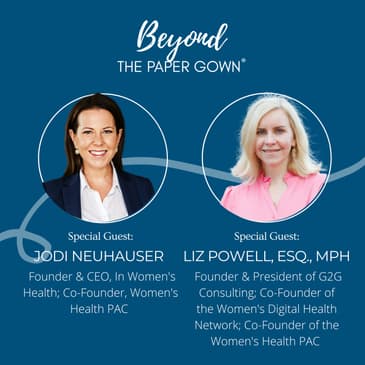

In this episode of Beyond the Paper Gown, Dr. Mitzi Krockover is joined by Jodi Neuhauser and Liz Powell, Esq., MPH, two of the Co-Founders of the Women's Health Political Action Committee (PAC), to discuss the critical intersection of women's health, policy, and politics. They explore the gaps in women's healthcare, the barriers faced by female entrepreneurs in the women’s health sector, and the transformative power of policy in shaping better health outcomes. They also share their story about building the PAC and creating a movement beyond the next election. This timely conversation sheds light on how legislation can impact women's health and what we can do to advocate for meaningful change. Don't miss this compelling discussion that highlights the importance of policy on the health of women and how to become involved in improving the future of women's health through advocacy and voting.
Please visit Beyond the Paper Gown to join our community and to learn more about achieving your optimal health.
SHOW NOTES:
[00:00:07] Hi, I'm Dr. Mitzi Krockover and welcome to Beyond The Paper Gown where we discuss the issues
[00:00:13] important to living our healthiest lives and the factors that affect it.
[00:00:18] So let me ask you, did you know that only 11% of NIH research funding goes to women's health?
[00:00:25] Or that it's more difficult for devices than therapeutics for women to get to market, partly
[00:00:31] because of that lack of research on various women's health issues, and partly because regulators
[00:00:36] aren't always knowledgeable about some of those issues?
[00:00:40] On the flip side, did you know that increasing access to preventive services and expanding
[00:00:46] health insurance to lower income individuals through Medicaid actually saves lives?
[00:00:52] For the 50% of pregnant women in the United States that are on Medicaid, that's certainly
[00:00:57] a huge advantage.
[00:00:59] So what do all of these issues have in common?
[00:01:02] Each one is impacted by decisions made by our lawmakers.
[00:01:08] We've certainly seen the challenges of changes in reproductive health legislation,
[00:01:13] but what might not be so obvious is all the ways that policy impacts on women's health.
[00:01:19] From heart disease to Alzheimer's, autoimmune disorders to cancer, policy shape, everything
[00:01:26] from research funding to insurance coverage.
[00:01:29] These decisions impact millions of lives, yet women's health often takes a back seat in
[00:01:35] Washington.
[00:01:36] But that's changing.
[00:01:38] Today I'm joined by Jody Newhouser and Liz Powell, co-founders
[00:01:43] of the Women's Health Political Action Committee or PAC.
[00:01:47] They co-founded the PAC with colleague Candice McDonald,
[00:01:50] and they've created a groundbreaking bipartisan approach to elevate women's health
[00:01:55] in the political arena, whether you're a health care professional,
[00:01:59] concerned citizen, or someone looking to make a difference.
[00:02:03] My guests have developed actionable ways to get involved and amplify our voices in this
[00:02:08] crucial conversation which will hear all about in this podcast episode.
[00:02:14] Jody Newhouser is a serial entrepreneur and women's health leader with 19 plus years of
[00:02:19] experience building and scaling B2B and B2C consumer health care brands across health care
[00:02:26] travel, consumer products, and media.
[00:02:29] And she was recognized as a top 10 inspiring healthcare entrepreneur to watch in 2023 by
[00:02:35] entrepreneur.
[00:02:37] She is also the founder of In Women's Health, the first careers platform for women's health.
[00:02:43] Liz Powell is the founder and president of GDG Consulting, a bipartisan government
[00:02:49] relations firm. GDG provides strategies for businesses and nonprofits,
[00:02:54] focusing on health, high tech, and innovation.
[00:02:58] Liz is an attorney and former lobbyist.
[00:03:00] She has served as legislative director for multiple house representatives
[00:03:04] and has worked on various political campaigns.
[00:03:07] Her expertise spans legislative drafting, committee work, and coalition building.
[00:03:35] I can't be more excited about this episode.
[00:03:39] It is timely, it is provocative and it is important.
[00:03:43] So I'd like to welcome my guest, Jody Newhouser and Liz Powell.
[00:03:48] We're going to talk policy and packs in time for the election.
[00:03:55] Now, Missy, first of all, thank you so much for having us and for bringing this important message
[00:03:59] to your audience.
[00:04:00] It's really important to have opportunities to speak with people like you.
[00:04:05] They can help us get the message out there, so thanks for having us.
[00:04:08] Thank you.
[00:04:10] Liz, in recent years, women's health has gained more attention, but despite this,
[00:04:15] there are still significant gaps in research funding, access to care, and improved outcomes.
[00:04:21] What are some of those gaps?
[00:04:24] There are many.
[00:04:25] There are sort of key areas of women's health where it either solely
[00:04:29] disproportionately or differently impacts the health of women.
[00:04:32] And so, for example, autoimmune disease, 80% of patients are women, all summer 66% of patients
[00:04:37] are women, interestingly over 80% of caregivers are women, so there's like a double whammy with that one.
[00:04:43] Heart disease, especially after menopause, number one killer of women, and when a woman is sent home
[00:04:49] after ER visit for a heart-related condition, twice as likely to die than men.
[00:05:03] So, listener, let me take a moment.
[00:05:05] Are you surprised to hear these stats?
[00:05:08] They are pretty staggering.
[00:05:10] I'd like to also take a moment to underline the definition of women's health that Liz mentioned.
[00:05:16] When we talk about women's health, we are, of course, talking about those conditions that affect
[00:05:20] women's solely such as reproductive health and cancers.
[00:05:25] And we're also talking about those conditions that manifest differently from men, such as heart disease,
[00:05:30] where the symptoms may be different in women.
[00:05:33] And then there are conditions where women are the majority of those with that condition, such as
[00:05:39] certain autoimmune diseases, Alzheimer's and osteoporosis.
[00:05:44] And with respect to cardiovascular disease, that kills almost one in three women annually,
[00:05:51] and cancer in women, research and resources dedicated to women's health lack far behind.
[00:05:57] So, there's lots of statistics, cancers.
[00:06:00] Obviously, we know a varying cancer, 50% mortality rate, way higher than the other single-sex
[00:06:07] cancers. Another lung cancer impacts men and women, and yet it's women who have never smoked
[00:06:13] that rates are soaring. And we don't have the science, we don't know why.
[00:06:17] So, there's these gaps, and then there's also the gaps, and there's still so much more we need to learn.
[00:06:22] So, how does policy come into play with all of that?
[00:06:28] Policies at the core. So, when you're developing an innovation to address a gap,
[00:06:34] there are so many different barriers that you have to move through to bring something to market
[00:06:39] into patients. And so, the early side is getting funding. And so, there's VC money,
[00:06:45] there's government money, there's grant programs. And if the grant programs aren't
[00:06:50] pointing out that need for sex-based data collection or sex-based focus studies, right?
[00:06:56] Then we're not getting enough funds at that early stage to just develop that science into a
[00:07:01] product or an innovation.
[00:07:04] Let's go on to highlight a fundamental issue. The structures that are supposed to support innovation
[00:07:09] often fall short when it comes to women. Beyond funding challenges, once you have an idea
[00:07:15] and create a product, you then have to navigate the FDA's approval process, which can be another
[00:07:22] major hurdle. FDA well-intentioned and has a lot of bipartisan support, which is great.
[00:07:28] However, there are, they don't have the talent, they don't have the expertise in women's health.
[00:07:32] So, what we have found is many, many companies having to go through FDA and spend time educating
[00:07:39] on just basic biology of women and basic process of how whether it's a drug device will impact
[00:07:45] the female body and because of the structure of the way the government system is set up, you
[00:07:50] then have to wait another 30, 60 days before you can do your next meeting. Which then if you
[00:07:55] add that up, that's months and months sometimes years of delay when an innovation could have
[00:08:00] been brought to market much faster. So there's a change in cheaper, good point.
[00:08:06] Liz also pointed out that representation of women and inclusion of women of color has also
[00:08:11] been a challenge and is not always ensured to the end of the trial.
[00:08:17] But getting back to the challenges of bringing a product to market, even if one manages to
[00:08:21] clear the regulatory hurdle in order to be competitive or even successful, the product or service
[00:08:28] needs to be reimbursed by insurance. The Centers for Medicare and Medicaid Services or CMS
[00:08:34] determine in large part what these insurance plans cover and influence other insurers.
[00:08:40] If CMS doesn't reimburse, then it can be next to impossible to get product adoption of your
[00:08:45] innovation and patients lose out. They don't get access. So government plays a key role.
[00:08:50] Those are just a few examples in shaping the landscape of women's health, which is why
[00:08:54] we have to educate Congress, educate the administration and then show them solutions. There are
[00:09:00] solutions out there. There are ways that we can change policy and funding to truly impact the
[00:09:04] women. Jody just to underline a little bit of what Liz was talking about as an entrepreneur,
[00:09:11] what was your experience in terms of how policy impacted what you are able to do?
[00:09:17] One of the first ideas I had was about how do we aggregate data in the fertility sphere
[00:09:22] across a number of different platforms, blood data, psychological data, a number of different
[00:09:28] things and bring that together in a personalized algorithm in order to provide literally
[00:09:34] personalized care. But when I looked at the regulatory pathway of what that would have to look like
[00:09:39] in order to actually bring an innovation like that to market, we didn't really see an easy
[00:09:44] regulatory pathway to market that wasn't to Liz's point going to take us lots of time and money
[00:09:49] to commercialization, to bring it to commercialization. And so what we ended up with was an idea
[00:09:55] to essentially create almost like an Amazon of women's health, which was consumer-facing,
[00:09:59] but very different than the actual delivery of care and impacting someone's
[00:10:04] someone from a care delivery perspective. As you're speaking, I'm also thinking about the fact
[00:10:10] that many women's health companies have a role challenge with respect to getting funding and so
[00:10:16] I would assume that by reducing some of that regulatory process that it might make it even more
[00:10:22] attractive to funders. Is that a fair statement? Yeah, absolutely. Exactly. And Liz talk a little bit
[00:10:29] also about some of the ways that policies can impact on specific areas of women's health.
[00:10:37] How does policy really affect the care or the prevention and diagnosis of those conditions?
[00:10:45] Yeah, it's a great question. So, in so many conditions, there's policies around like grant programs
[00:10:53] that fund specific initiatives. So around rare disease, there's some grant programs that fund
[00:10:59] specific diseases. And so what that does, that puts more money out into the marketplace for entrepreneurs,
[00:11:05] for researchers to be able to use to advance science and bring innovation and market, which of
[00:11:11] of course then helps get VC money if there's money to match that. So I think that it can
[00:11:18] definitely impact there. The other ways setting like quality measures, right? That would that have to
[00:11:24] be met. And so with Obamacare for example, there was a lot of preventative health inserted into
[00:11:30] basic required access to care that has shaped health care for women. So there's still more to do
[00:11:37] there. But those are there's are sort of little steps that we've seen of improvement and another
[00:11:42] interesting one is more on the state level. We're seeing almost universal state,
[00:11:47] medicated adoption of care for women throughout the full 12 months of pregnancy and postpartum,
[00:11:55] which is new. And interestingly, it was somewhat of a political issue of whether or not
[00:12:00] the governors if they were a Republican or a Democrat, that would determine whether they would
[00:12:04] do Medicaid expansion. But with this issue across the board, everyone is finally seeing the need
[00:12:11] for maternal health. So a little success, a little something to see that it does work to advocate
[00:12:18] to talk to government decision makers that you actually can influence policy.
[00:12:23] If I can underline those two examples that you gave with the coverage of preventive health
[00:12:28] services, there was a demonstrable effect, positive effect on finding cancer's earlier and intervening
[00:12:36] earlier as well as with those states that did adopt that Medicaid expansion, they had better
[00:12:41] outcomes in the states that didn't. So those are great, tangible examples of what we were talking
[00:12:48] about. Another area that has been shaped by policy is breast cancer screening. According to
[00:13:05] the CDC, early detection of breast cancer leads to a five years survival of about 99%.
[00:13:11] The FDA has passed laws that require radiology facilities to inform patients of the results
[00:13:17] by letter and most recently inform patients if their mammogram showed dense breasts,
[00:13:23] which makes it harder to find lesions. The recommended step is for those women to obtain a
[00:13:29] second imaging study, either ultrasound or MRI, but insurance may not cover these as screening techniques,
[00:13:36] which adds to the out of pocket cost of these women and may lead to later diagnosis and poor
[00:13:42] outcome if they don't follow up. So I asked Liz to comment, you're going to get me very fired up on
[00:13:49] this one. So let me do a little bit of background, I'm going to get right into the policy challenge
[00:13:54] with that one. So up to 50% of women have dense breasts, 71% of breast cancer patients have dense
[00:14:01] and yet mammograms alone do not pick up tumors or do that detection of cancer in women with
[00:14:08] dense breasts. So it's great in that the U.S. preventative services task force has come out with
[00:14:14] a recommendation that women 40 and over should get mammogram, so that's good. However, they're
[00:14:19] not recommending supplemental screening or what we call additional screening that's essential
[00:14:25] for women with dense breasts. And so that gives the okay to insurance companies to not provide it.
[00:14:31] And if a woman has genetic predisposition, her mother or her, you know, it's in the family
[00:14:37] that someone had breast cancer then in those cases they are usually getting some access. But for
[00:14:43] the mass public, they're not getting that access. And so there was legislation called the
[00:14:48] find it early act that would require coverage for supplemental screening. So across the board,
[00:14:55] whether it's private, CMS or Centers for Medicare and Medicaid all would be required to cover
[00:15:02] this supplemental screening. We've laid the groundwork for the connection between policy and
[00:15:18] women's health. So I asked Jody what the motivation was for creating the pack and what issues
[00:15:23] they intend to focus on. Yeah, I think the, you know, I'll give a little bit of the founding
[00:15:29] story because it helps provide some context to answer your question. And I think the,
[00:15:33] you know, when we looked across the board, I had some experience in, in Presidential Pack,
[00:15:39] our staff co-founder. I'm also a Candace also as a experience in Pax, Liz's Worktime Campaigns
[00:15:45] and has also worked, you know, has experience with Pax. And so we all have had this, we have
[00:15:49] had this really interesting experience understanding the role of a political action committee in our
[00:15:54] government. And I was blown away by the fact that there wasn't already a women's health pack
[00:16:00] that looked across the board at this holistic picture of what makes a woman healthy. And so
[00:16:05] that's I think one of the defining differences in the pack that we have put together focused on
[00:16:10] women's health versus some of the others that are out there that are focused on, you know,
[00:16:13] very specific causes related to women's health. So we're looking at unifying and supporting
[00:16:19] candidates and spreading messages that help have us understand that as women regardless of what
[00:16:25] side of the, of the isle or the issues we fall on on certain issues within women's health,
[00:16:30] we have a shared experience as a woman. Right? We all go through administration. We all go through
[00:16:34] menopause. A lot of us will go through motherhood. A group of us will go through for infertility.
[00:16:40] And so how can we really see women's health as an opportunity to bring women and men, but, you know,
[00:16:46] women together around a shared experience related to their health? I think if you ask any woman out there,
[00:16:52] every woman has some sort of women's health story. So we wanted to bring together an organization
[00:16:57] that brought those stories to these policy makers on, you know, in Washington and also helped get
[00:17:04] more policy makers in Washington that are that are, that understand where we're coming from
[00:17:10] and are supportive of what we want to accomplish. How are you going to decide which candidates
[00:17:17] will receive a commitment from the pack? Liz, I'm all you take that one. Sure. So we have a political
[00:17:26] committee and we are watching the top races that will have the biggest impact on who controls
[00:17:33] Congress. So we really want to shape those key races as much as we can. So we're watching those.
[00:17:41] But we are also coming up with a questionnaire that we are going to be sending out to candidates to answer.
[00:17:46] And so we want to hear what they think about of, you know, how they even defied women's health
[00:17:51] broadly. And then what they think about key issues around access to contraception for example,
[00:17:58] maternal health, menopause. We want to see that they have either taken action in those areas
[00:18:05] and these broad areas of women's health. They are planning to if elected. Those are the types of
[00:18:11] things that we want to hear from candidates. And then, Jodie Candison, I will sit down and review
[00:18:17] and make that final list of 10 candidates that we are going to support financially.
[00:18:23] Terrific. And so where is the funding coming from? And how can people get involved?
[00:18:30] A lot Jodie answered that one. Yeah, so we have a number different ways that people can
[00:18:35] involved. And this will talk about the funding piece. So we have a number of events that are happening
[00:18:40] around the country between now and the election. And then a few planned for after the election as
[00:18:45] well in cities like San Francisco, Boston, New York, Pittsburgh, Colorado. We're really kind of all
[00:18:53] over the place. And that has, you know, midseats really been a ground swell of support. When we launched
[00:18:58] this pack in May in DC, we were overwhelmed with the amount of people who came to us and said,
[00:19:04] how can I get involved? How can I support? Can I lead something? Can I use my voice to bring more awareness
[00:19:11] to what you guys are trying to do? And because of that, we've been able to host a lot of these events
[00:19:16] in a lot of these cities. So the first way they can get involved is go to our website,
[00:19:21] women's healthpack.us. So we're all coming together as one us and sign just sign up for our email
[00:19:28] newsletter to make sure that you're in loop on both policy things that are happening out of Washington,
[00:19:33] but also what we are doing as a pack. And then from there, attend an event in your city or in
[00:19:40] a city close to you. And then the last way to get involved is really to be a part, become a part of
[00:19:44] our founder circle. And our founder circle is really that close-knit group of people that we turn
[00:19:50] to as the co-founders of the pack for guidance on a number of things, from a policy perspective,
[00:19:55] from a marketing perspective, from a legal perspective, from an industry perspective. And so it
[00:20:00] is an exclusive group of industry leaders that meet once a month. This is not just going to stop
[00:20:07] at the election, correct? No. Yeah, we really see this first election as this first election
[00:20:15] cycle as our proof of concept. And sort of showing the industry and those on the hill that we
[00:20:21] have a group of a significant group of people behind us, both from just a numbers and a political
[00:20:26] capital perspective, but also a financial perspective. And then we'll use the momentum that
[00:20:33] we're building in this election cycle to move into what we'll probably look at as a two and four
[00:20:38] year strategic plan based on longer election cycles. And really thinking about, what do we want to
[00:20:43] do in more off-cycle years? And what do we want to do in sort of on-cycle years? And how are
[00:20:50] we going to continue to build those relationships with those on the hill between those cycles?
[00:20:55] So much longer play here and we're just getting started. And if folks can't necessarily join in
[00:21:03] person, in one of those events, how else can they contribute or get involved?
[00:21:09] They can come to any of our webinars. So we're hosting a number of webinars throughout the
[00:21:13] course of the rest of the year and into next year. So stay tuned if they sign it for our email
[00:21:19] list. You'll get all that information on when those are happening and what those opportunities
[00:21:23] are. And I think, you know, the other thing is to start conversations. You know, one of the ways
[00:21:28] we're really going to make change in our system is, and start to see cracks in our system, which we
[00:21:33] already are, is for people to tell them again, tell their story. And have a conversation about those
[00:21:38] issues, which may feel more taboo to some than others. And I think sharing our stories as women,
[00:21:44] normalizing those stories between us as women, I think really helps just start the conversation
[00:21:50] and the more conversation that's happening at the ground swell level, the more attention
[00:21:54] that will be brought to this over time. The pack launched in May, and I had the pleasure of attending
[00:22:04] that launch. A small group of legislators attended and spoke to the group. I asked Liz about
[00:22:11] the importance of those individuals participation. I think it's really important that we have
[00:22:17] congressional interest and support in our efforts and that it's bipartisan. And so we had five
[00:22:22] members come both sides of the aisle and all talking very passionately about women's health,
[00:22:28] and how this really does need to become a national priority. So that unity is really important.
[00:22:33] And it's important I think for advocates and those that are joining this movement and joining our
[00:22:37] pack to see that connectivity. And just to add to ways to get involved, it's super important to
[00:22:44] share those stories, get your friends engaged, join the pack, just sign up for our list, find out
[00:22:49] about our events. We've got committees that are active as well, whether it's a political committee
[00:22:54] that I am running. We've got strategic partnerships, marketing, fundraising. There's lots of ways
[00:22:59] to contribute and with these events, it takes a real team to plan these events. So there's lots
[00:23:05] of ways to help with those events. And then just make sure you're registered to vote, right?
[00:23:11] Get your friends to vote. You've got to vote and make women's health the reason that you're voting
[00:23:15] and talk to your friends about that, make it clear. And then your members are Congress,
[00:23:19] go see them and very politely point out, hey, you know, women's health is really important to me.
[00:23:24] What do you think about that? What are you doing on women's health or more specifically? What about
[00:23:28] maternal health, heart disease, cancer, can you share your thoughts and policies that you're
[00:23:34] going to work on? Just asking those questions brings it to the front of mind for those members.
[00:23:40] And they are all in election mode, right? So they are really want to be listening to their
[00:23:44] constituents. So there's so many ways to have impact. And then finally, I'll say,
[00:23:48] op-eds, right? Op-eds to your local paper. Talk about menopause, talk about whatever health
[00:23:53] issue is of concern to you. All these different efforts, plus social media, they really elevate
[00:23:58] this and it shows that this is the time. This is not just a moment. This is a movement. And
[00:24:04] together, this pack is turning into a mandate for change. I know that you guys just started and
[00:24:10] have done so much in such a little time. But have there been any wins? Have you seen any successes
[00:24:16] just because this pack has been created? Yeah, I mean, I think the success I would point to
[00:24:24] is really the mobilization, right? The how fast this ecosystem has mobilized around what we're
[00:24:31] trying to do here and coalesced really around our work together. And I think that is a win
[00:24:39] because it just demonstrates I would say the pent-up need a desire and passion for those
[00:24:44] who are in this space to want to see change. We are seeing wins across the board.
[00:24:51] The continuum that I think about is again, this research at the beginning, regulation
[00:24:55] in the middle and then reimbursement at the end. Sure. And Liz, what do you see as some of the
[00:25:01] challenges, either that you are seeing now or that you anticipate? Many challenges. Unfortunately,
[00:25:09] I try to speak with realism and this whole effort and hope. So we're seeing some changes,
[00:25:17] so let's hold on to that. But it's a real process. I mean the way our whole government is designed
[00:25:22] by structure is to move slowly. It's going to take a while. The one thing I will say,
[00:25:31] the annual appropriations process where they come up with those top lines of what they're
[00:25:36] going to fund for all the different agencies and different programs. There, we're seeing changes
[00:25:41] every year and we're working hard to shape that around women's health. Like a greater recognition,
[00:25:46] just within military, for example, that it's the fastest growing population within the military.
[00:25:50] Are women? Therefore we have to have not just women's health research, but we have to have
[00:25:54] women's health care that's like available and meeting their needs and the different ways
[00:25:59] injuries happen in women, for example, access to contraception. Like there's all kinds of aspects.
[00:26:03] So we are seeing language and some funding directives in those appropriations bills.
[00:26:09] So those kinds of changes you can see each year happen. But the bigger changes, like there was
[00:26:15] a great new bill that Senator Patty Murray, who's the chair of the appropriations committee
[00:26:19] in the Senate introduced in a bipartisan fashion. She had basically all the women senators together,
[00:26:25] Democrats or Republicans, one of the big champions is Susan Collins, for example,
[00:26:31] who's a great Republican, really forceful on women's health. They all came together and they said
[00:26:36] we've got to do legislation on menopause. We've got to do more research. We've got to do more
[00:26:40] public awareness. We've got to make sure doctors are trained on symptoms and things that can be
[00:26:46] done when a patient is expressing some concerns. And so that legislation was introduced. They had
[00:27:00] a lot and because we're coming up in the end of this congressional sessions, they'll have to
[00:27:05] start all over in January. However, because she's chair of the appropriations committee, she did put
[00:27:10] in menopause language into the Senate version of the health funding bill. So the big bill won't
[00:27:17] probably happen for another year or two but small pieces of it were seen in that appropriations bill.
[00:27:23] So it's a long-winded way of answering that there's there are challenges and just how structurally
[00:27:29] government is set up. But there are ways to get little successes and so so that's where that's where we work.
[00:27:36] You all are focused specifically on federal candidates. At this point, yes. Right. And so
[00:27:46] talk a little bit about and I'll give us to Liz and certainly Jodie engage as well.
[00:27:54] The impact of the federal legislation and the role of state legislation just again because we're
[00:28:02] in this voting season. We're to state impact this issue in comparison with federal legislation.
[00:28:11] Yeah, a good question because the two interact and are really key to meaningful advancement
[00:28:17] of women's health. And I think a good place to start is what does the state,
[00:28:24] do they have mandates on coverage for certain services in women's health? Whether it's the
[00:28:28] diagnostic screening side or the treatment side, is there even like a woman's health task force or
[00:28:34] some women's health committee within the department of health for the state? And also how can
[00:28:41] you get involved in that, right? They must have public meetings so you want to shape that. You
[00:28:47] activity in the state. So I do think that there is definite ways to look for engagement and
[00:28:53] indication of dedication to women's health on that state level and then talk to your state
[00:28:57] legislators even if they just hold hearings addressing some of these issues. That raises a lot of
[00:29:02] awareness, you get media coverage. So there are different things that can be done state level,
[00:29:06] not just federal level. Sure. And so we're going to start wrapping up and I want to make sure
[00:29:13] that we leave folks with information that you feel is important, not only to engage with the
[00:29:22] pack but other ways and lose you just mention some others as well. But what would you have folks
[00:29:28] do in the next 30 days? Make sure your registered vote and your friends are registered to vote
[00:29:35] and your colleagues at work and people in your universe are registered to vote. You would be amazed
[00:29:41] at how time flies by and suddenly there's a cut off and you can't register anymore. So number one,
[00:29:45] make sure that number two, if you're going to be busy on election day then apply for that absentee
[00:29:50] belt, nothing wrong with that in certain states like Nevada for the first time ever they're actually
[00:29:55] mailing ballots to every single voter. So that's really going to shift what happens on election day
[00:29:59] because what happens on election day is all about GOTV get out of the vote. Who gets out to vote?
[00:30:04] That determines who wins. So I'll you do all the polling in the world but it's actually who shows up
[00:30:08] on election day. So make sure you're registered get your ballot if you want to vote absentee
[00:30:12] or make plans to vote those types of things I think are super super important. Go to town halls
[00:30:17] they're going to be back home, end of September all the way through to election day looking for
[00:30:22] opportunities to interact with constituents. So go talk to them again in polite manner but point out
[00:30:27] gaps and women's health ask them what they're doing about it. What do they think about it? How can
[00:30:31] you work with them? Don't end with that. Who do I talk to on your staff? How do I work with you?
[00:30:35] Would you be interested in creating a women's health task force? Like there's all kinds of
[00:30:38] things you can nudge your member of Congress and state level two the state house too. So there's
[00:30:44] lots of things that you can do to keep nudging and elevating the profile of women's health. And then
[00:30:49] as I said earlier, opits, opits are great and they love local, local newspapers love opits so
[00:30:54] those are just a couple ideas. Thank you. I would I would add figure out find a community find a
[00:31:00] community if you're passionate about women's health find a community of other people and other
[00:31:04] men and women who are also passionate about women's health because I think just having that regular
[00:31:09] conversation and that regular sort of touch point of education perspective from opportunities to
[00:31:15] get involved it could be the pack, it could be you know a state level, it could be a local
[00:31:19] level there's lots of things happening especially in this election, this election is cycle
[00:31:23] and then I would say get smart on the candidates who who are the candidates in your market
[00:31:28] who are running for office what have they done on women's health what have they voted on in
[00:31:33] the past if they put any bills forward what is their stance on certain issues just so that you can also
[00:31:38] one understand you know if they if they work for you or not but all if you want to vote for them or not
[00:31:43] but also how to work with them like Elizabeth saying in the future but I think that starts with education.
[00:31:49] What did I not ask you that you think is important for listeners to know?
[00:31:55] I think that we are at an incredible opportunity where people are finally paying attention to women's health
[00:32:05] from all sectors and it's like we have everyone's attention and now we need to take action
[00:32:12] to make sure that's just not attention it's just not like oh that was interesting in 2024
[00:32:17] we have to really turn that into a constant drum beat in Congress among agencies whoever takes
[00:32:23] away house we have to be a constant drum beat constantly on their radar and shaping and influencing
[00:32:29] where they're directing funding and the policies that are impacting the health of women so my
[00:32:34] future vision is that we will have that impact that we're not going away that it's like we've now
[00:32:40] become this unstoppable force that is just going to keep going so I think we're going to see
[00:32:44] real change in 2025 and 2026 that is going to have meaningful impact on the health of women.
[00:32:52] Jody, new house or Liz Powell co-founders of the Women's Health Pack and so much more
[00:32:57] along with Candice McDonald who couldn't be with us today. Thank you so much for spending your time
[00:33:01] with us today. Thank you. Thank you. Thank you. So I hope you see that the message is clear.
[00:33:22] The time for women's health is now and everyone has a role in shaping its future.
[00:33:28] One example is the Women's Health Pack which works through policy change, community engagement
[00:33:33] and strategic support of candidates who champion women's health and they aim to make this a
[00:33:39] movement not a moment. I also truly believe it's important to remember that change and vehicles
[00:33:45] like packs can only be impactful if you add your voice and your vote. I urge you to stay informed
[00:33:53] get involved and vote so we can close those gaps in women's health and register to vote if you
[00:33:59] have already done so. I invite you to go to our website at beyond the paperground.com where we
[00:34:05] have podcast on various women's health policy issues with more coming soon as well as resources
[00:34:12] to learn more about the issues as well as ways you can get involved and while you're there
[00:34:17] subscribe to our newsletter so you'll continue to be informed and updated. Thank you for spending
[00:34:23] your time with me today and take good care. Our podcast was produced by Patrick Shambayati and
[00:34:42] our associate producer is Kylamic Million.