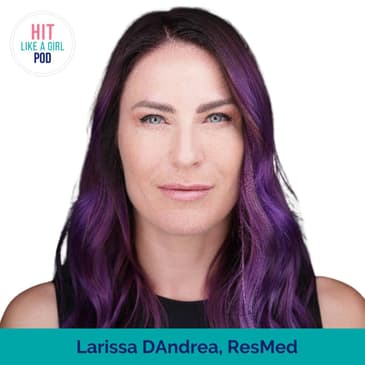

In this episode, Joy sits down with Larissa DAndrea, Head of Global Impact Programs at ResMed, a leading sleep apnea medical technology company. Larissa shares insights into ResMed's initiatives in the healthcare space, emphasizing their focus on amplifying underrepresented voices and empowering patients through innovative digital tools. Through engaging storytelling and impactful art installations, ResMed strives to bridge the gap between technology and patient experience, ensuring inclusivity and meaningful impact in healthcare.
The conversation delves into the importance of incorporating real user experiences in product development, exemplified by ResMed's collaboration with patient associations to capture diverse perspectives. Larissa also discusses the potential of augmented reality and virtual reality to further enhance storytelling and immersive experiences in healthcare. With a keen eye on inclusive design and technological innovation, Larissa and ResMed are paving the way for transformative change in the healthcare ecosystem.
[00:00:00] Hey there, HIT Like a Girl Pod listeners! We've got some exciting news that's too good to keep to ourselves.
[00:00:07] You all know Grace Minton, whose stories have captivated us over the past couple years?
[00:00:11] Well Grace has been doing such an amazing job with her show, High T With Grace,
[00:00:15] that it's time for her to shine even brighter.
[00:00:18] Yes, you heard that right, High T With Grace has graduated to its own show with its own brand new RSS feed.
[00:00:25] While we've loved sharing Grace's episodes as special bonuses on the HIT Like a Girl Pod,
[00:00:30] it's now time to give Grace the spotlight she deserves.
[00:00:34] So what does that mean for you?
[00:00:36] To continue enjoying the compelling stories and insights from Grace,
[00:00:40] head over to your favorite podcast platform and hit that subscribe button for High T With Grace.
[00:00:45] Trust us, you don't want to miss out on what she has in store.
[00:00:49] Her latest series is dedicated to understanding the VC funding world,
[00:00:53] aka Fund Like a Girl.
[00:00:55] Thank you for supporting us and let's show some love for Grace on her exciting new journey.
[00:01:00] Remember, search for High T With Grace and subscribe today!
[00:01:19] Welcome to the HIT Like a Girl podcast.
[00:01:23] My name is Joy Rios.
[00:01:25] On this show we talk about the Julian puzzle pieces that makes up healthcare
[00:01:29] because it is a super complicated world and I like to amplify the women who are making a difference
[00:01:35] and contributing to that space.
[00:01:37] So please, I'm so excited to get to know you.
[00:01:39] Can you take a moment to introduce yourself?
[00:01:41] Sure, well, so first of all, thank you for having me.
[00:01:43] I've actually followed the podcast, so I was super excited to get the invite.
[00:01:47] But just a bit of background on me, so my name is Laura Cedandre.
[00:01:50] I'm head of our Global Impact Programs at ResMed,
[00:01:53] which is a medical device medical technology company in respiratory software as a service.
[00:01:57] We provide different digital tools for patients, for clinicians, for others.
[00:02:02] So really in the healthcare space and we've got a lot of engagement with associations
[00:02:07] and organizations to really improve and enable access in the healthcare ecosystem.
[00:02:11] My job encompasses functions like government affairs,
[00:02:15] so all the public policy work across the world,
[00:02:18] working with different governments associations.
[00:02:20] I've got a clinical advocacy group, patient advocacy focus.
[00:02:23] We also do environmental and social governance stewardship for the company.
[00:02:28] Hello.
[00:02:29] And we started to fill in some gaps by having a bit more of a communications and event management
[00:02:35] really tied to sort of campaigns and engaging with physicians, patients and others.
[00:02:40] And I was just mentioning before we jumped into this,
[00:02:42] my other passionate storytelling.
[00:02:44] So while I grew up in the sciences,
[00:02:46] I also was a storyteller and during the pandemic,
[00:02:50] I took an opportunity to start to fund self-fund underrepresented voices
[00:02:54] and that has nicely translated and brought that back into ResMed,
[00:02:57] so we've done a lot more of whether it's graffiti art or other filmmaking mediums
[00:03:04] with patient stories and really centering everything we do around patients
[00:03:07] and actually the technology impact on patients.
[00:03:10] That is so important and it's so great to hear because that's been something
[00:03:13] we've been talking about a lot of like, okay, there's all this technology
[00:03:16] but how is it actually helping the end user?
[00:03:19] And so can you share any examples of some of those patient stories
[00:03:22] and how they have actually affected the technology?
[00:03:25] Yeah, absolutely.
[00:03:26] And I think you're talking about two things here too.
[00:03:28] Right, one is the inclusivity of real users as part of the design development deployment
[00:03:33] so that you know, we're not just in the cyber tower making something
[00:03:36] and then deploying it but truly incorporating a diverse set of voices
[00:03:40] and users as part of the development of product services, et cetera.
[00:03:44] It's one aspect and then really thinking about how that patient journey or clinician journey
[00:03:50] is impacted by whether that's the policies or the technology or things that exist today.
[00:03:55] So I'll give you a bit of an example.
[00:03:57] So one of the things we're well known for is we have Sleep Apnea Diagnosis
[00:04:01] and Therapy Technology.
[00:04:04] Part of that technology all has cellular connectivity so you can have data in the cloud.
[00:04:09] The patient can have an engagement application so they can follow their own therapy
[00:04:13] engage in their own their their empowered.
[00:04:15] And then there's clinical applications so a clinician can look at how their therapy is going
[00:04:19] and then actively engage, changing their settings or have a better conversation.
[00:04:24] And when we took a stab at really thinking about patient stories
[00:04:28] we started working with some of the patient associations so the ASIA
[00:04:32] which is the American Sleep Apnea Association.
[00:04:35] And we pulled together stories from a diverse set of voices.
[00:04:38] We tried to be representative of ethnicities and male to female in the population
[00:04:44] and they really just told their story about how was I diagnosed?
[00:04:47] How hard was it?
[00:04:48] How accessible was healthcare in general to even whether it's get to a doctor, get their diagnosis?
[00:04:54] And then what therapy was like and you know it is no secret that starting on a CPAP machine is not easy.
[00:05:00] You have a mask and it can be difficult and I have a partner who who has that as well.
[00:05:05] I want to talk about this.
[00:05:06] Yes, let's do it.
[00:05:08] But it's that empowerment and those stories are important and you shouldn't shy away from like the tough stuff.
[00:05:13] Yeah so my sister's partner is where's the CPAP machine now?
[00:05:16] She says it's like sleeping like said Darth Vader.
[00:05:19] But I'm sure her partner feels that way too.
[00:05:23] But you know what he was telling me about the app because he's a lawyer and was recently in trial
[00:05:28] and there was one night before that he was in trial that he had a sleepless night and like intentionally
[00:05:33] and he was going and tracking the quality of his sleep over the last several weeks or whatever
[00:05:39] and it was to be discussed with this doctor.
[00:05:41] And they were like oh yeah we understand why this happened.
[00:05:44] It was and they were really digging into the data so cool.
[00:05:47] It's very cool.
[00:05:48] It's super interesting and I am like to just pull on that threat a bit
[00:05:52] because it empowers him to have a conversation using data.
[00:05:56] And you know from a lawyer's perspective he's well educated,
[00:05:59] but there are lots of patients out there that either are more reticent to have deeper conversations.
[00:06:05] But when you put tools in their hands that they can own their own healthcare journey and give them data
[00:06:11] to like inspire them to have conversations and sometimes maybe contentious with their physician or their care team
[00:06:18] it really empowers in a new and unique way.
[00:06:21] And they have an opportunity to dictate more what their journey is going to look like.
[00:06:25] And okay so tell me more about some of the storytelling that has come from that.
[00:06:30] Yeah, it was so fantastic.
[00:06:32] I was just looking at some of the art, the graffiti art.
[00:06:34] I'm hugely passionate about art that has a message.
[00:06:37] One of the I think second events that we did a couple of years ago we actually hired a graffiti artist
[00:06:42] to come in and we took two patients, a sleep apnea patient and a patient who had asthma and COPD.
[00:06:47] He interviewed them, had conversations and then he did these massive panels that we ultimately showcased
[00:06:54] and it was really meant to provide a visual interpretation of that patient's experience
[00:06:59] and there is nothing like really seeing something and feeling it in a different way
[00:07:05] because that's actually what creates empathy, understanding and can create change
[00:07:09] and certainly from my perspective the way we drive access, the way we drive empowering folks
[00:07:15] it is through changing some of the policies in the healthcare system.
[00:07:18] But to do that through visual meetings mediums is so powerful and actually the COPD patient
[00:07:23] they'll have to send you an image of it but it'll just pay to picture.
[00:07:26] The image of it is a body underwater with a snake wrapped around.
[00:07:30] And it's kind of jarring and shocking and to have that as a tech conference people were like well
[00:07:36] but when we filmed the patient walking in and seeing it for the first time
[00:07:40] she cried and her response to it was oh my gosh this is really what it feels like
[00:07:47] often with COPD people tell you it feels like an elephant on your chest
[00:07:50] you said no it feels like I'm being squeezed.
[00:07:52] And it's just that powerful and we coupled that visual piece of art
[00:07:56] with stories of those these two patients and we had interview style
[00:08:00] and then actually just had them in their own elements, their home or the beach or the environment
[00:08:05] and just documentary style really gave them an opportunity to use herb voice
[00:08:09] which is just a cry every time.
[00:08:11] We've thought a lot about murals and how to bring artwork like one
[00:08:16] just like on the surface level tells a picture and it's meaningful for whoever has seen it
[00:08:20] but have you guys put any tech in there that it's like where you can go a layer deeper
[00:08:26] and so if you're wearing I don't know if you have your phone and you kind of like a QR code
[00:08:30] and it takes you to more information do you guys incorporate any tech into your art ever?
[00:08:35] You just speak my language with all of this stuff.
[00:08:37] So when we first started doing this storytelling and it evolves right it evolves over time
[00:08:42] it started with these static images and in the most recent conference
[00:08:46] we attended Vive last year we created and I'm all about immersive experiences
[00:08:52] so we tried to create an improved evolved immersive experience and we had a series of walls
[00:08:57] one side of the wall you might have some visual cartoon pathway or artistic medium
[00:09:02] another side of the wall would actually have the videos with closed captions
[00:09:06] that might be a montage of the story and then of course QR codes
[00:09:09] yeah because I love QR codes
[00:09:11] and we created the first resmed YouTube patient playlist
[00:09:14] and part of the idea behind that was to say how do you take these stories
[00:09:18] and put them in bite size digestible bits along with the quotes and the experience
[00:09:23] but then also trying to provide people an opportunity where they could learn more information
[00:09:28] whether that's through the association or otherwise.
[00:09:30] The first time we tried this we actually did a QR code that went to the patient
[00:09:34] association group because I'm all about how do you give people the tools
[00:09:38] and then we've tried it a bunch of different ways so I'm always excited to experiment with new ways.
[00:09:42] There's a second idea of AR VR what you know what's possible
[00:09:46] or even if you have a mural that's in real life that you could hopefully transfer into
[00:09:51] the virtual world would be interesting.
[00:09:53] I would love to do that it's all money and time.
[00:09:56] It is everything.
[00:09:58] It is with everything but what I've been really excited about particularly across the industry
[00:10:02] is that you see so many more MedTech tech other companies leaning into that patient journey story
[00:10:09] were the clinician journey experience because it has so much more powerful
[00:10:13] and with some of the newer technology I'd be super excited to do any AR VR
[00:10:17] and I actually had some early conversations with someone who had a blink technology.
[00:10:21] So it would like change every time the person blinked into their headset.
[00:10:24] We haven't done anything like that yet but such great opportunities to explore
[00:10:28] storytelling in different ways.
[00:10:30] Okay if you ever have the time and money to go down that road,
[00:10:32] the only concern I have is as it glasses where it's like
[00:10:37] I don't want to transition into contacts.
[00:10:39] I like my glasses and I'm like okay what's my experience?
[00:10:42] Am I wearing glasses over glasses?
[00:10:44] What's the immersion?
[00:10:46] It's a really good question.
[00:10:47] I mean, I'm not an expert in that field but I actually wear glasses as well
[00:10:50] and I cannot stand contacts.
[00:10:52] Me too.
[00:10:53] I don't do it in a very uncomfortable way.
[00:10:56] But it is a really good question and I think the technology continues to evolve
[00:10:59] and it was interesting just what was it yesterday or maybe the initial Siemens Sony
[00:11:04] announced spent around the industrial design using sort of that metaverse.
[00:11:09] To me it looked like those glasses kind of came down over it so you could use both.
[00:11:12] I would assume that that would be something that would be useful but
[00:11:16] I go back to what I said at the beginning which is all about inclusive design
[00:11:19] and when you think about it.
[00:11:21] So okay so I mentioned to you before we suppressed record that I live down in Baja
[00:11:26] and so like can we just dream for a second about the future of technology?
[00:11:31] Because I'm like okay my real use case scenario needs to be away from a plugin
[00:11:38] and away from Wi-Fi.
[00:11:40] It cannot be connected only to what if I'm off grid?
[00:11:44] I'm totally off grid, unavailable and I want a language translation.
[00:11:49] That would be really powerful to me.
[00:11:51] To be able to go explore the world and not be stuck to having to plug something in
[00:11:57] and it have it be something that makes it super obvious that I have a very expensive piece of technology on my face.
[00:12:04] Totally agree. I off grid again speaking my language.
[00:12:08] I like to go up into mountains a lot and there's no cell service.
[00:12:11] Right.
[00:12:12] So the only way and I use all trails as an app to help with any of my hiking,
[00:12:16] the only way to do that is actually to download.
[00:12:18] Exactly.
[00:12:19] And so there's got to be different ways in which you can utilize that type of technology.
[00:12:23] I mean I think that one's pretty basic.
[00:12:25] Part of it is like we're in this perfect world where if everything is working just right,
[00:12:29] the technology is just so fancy and so impressive but get into a real world scenario
[00:12:34] where people experience very normal problems.
[00:12:37] I mean you know go back to that inclusiveness right in the accessibility.
[00:12:41] There's so many rural communities whether that's in the US or otherwise
[00:12:45] that don't have access to broadband, that don't have access to internet.
[00:12:48] That it is too costly to go drive several hours into a doctor's office.
[00:12:52] So when you think about whether it's telehealth or chat or other modalities
[00:12:57] in which you can engage in healthcare becomes really important.
[00:13:00] And having the policies that support it but then also the technology that's designed with that in mind is really critical.
[00:13:06] I think we have a lot of really good people doing amazing things
[00:13:09] that's not to take away from their work.
[00:13:11] It's just like we have to be thinking holistically around everybody,
[00:13:14] not just the people who currently have access.
[00:13:17] You said in your like your title sounded pretty big and it said
[00:13:22] if I remember correctly global impact.
[00:13:24] In a lot like how do you knock it overwhelmed with that?
[00:13:27] Oh my goodness, it's incredibly overwhelming.
[00:13:29] And you know resmed like many companies are going through organizational change
[00:13:33] and one of the things that I'm incredibly proud of is that some of the work that we incubated
[00:13:38] and I report into our chief medical officer but some of the work we've incubated in my team
[00:13:43] is now moving over into a broader marketing organization with the funding.
[00:13:47] And this support I'm super excited and it's often what I like to do
[00:13:51] is to start to incubate things and then put them deeper in the organization
[00:13:54] where they should sit with the right resources.
[00:13:56] So my way out of getting too overwhelmed is finding the right homes for things over time.
[00:14:01] So starting small and then giving them a home where they can grow.
[00:14:05] Yeah, absolutely.
[00:14:06] That sounds like a dream job.
[00:14:09] It's fun. It's fun.
[00:14:10] How do you get into what you do?
[00:14:12] You know it's a good question.
[00:14:13] So my background is in science.
[00:14:15] I did work in immunology and vaccine research.
[00:14:18] I got into my dad's in pharmaceuticals and my mom is a nurse.
[00:14:23] And she was always an advocate too, particularly for women's health.
[00:14:27] Particularly for cardiovascular and women's health which is often under reported, under diagnosed.
[00:14:32] And so I learned from kind of both of them both in my wanting to be an advocate
[00:14:36] and a voice for people in general to make healthcare better.
[00:14:40] And then also in trying to get innovations to market faster.
[00:14:44] And so I actually started in the regulatory quality working with lots of governments
[00:14:48] to get products to market faster, being the hot, you know bridge with engineers, etc.
[00:14:52] And then I really got excited about creating an advocacy program at ResMed
[00:14:57] to really work on policy in different ways.
[00:15:00] And one of the things I'm very proud of is that we do not have a political action committee.
[00:15:04] We work based on data and making all of our policy changes and really advocating.
[00:15:09] And which kind of policy do you mean internal policy, regional policy, federal policy?
[00:15:14] Absolutely, no it's a really good question.
[00:15:16] So primarily I'll just use the United States as an example.
[00:15:19] We primarily focus on federal policy however we engage with associations and organizations
[00:15:23] to support state policy, local policy.
[00:15:25] So we look at it from a broad perspective and then drill down as needed
[00:15:29] and put ourselves in positions to influence some of these more powerful organizations
[00:15:34] in a data driven way.
[00:15:36] In Europe it's a similar example we work at the Brussels level,
[00:15:39] but then you also have in the major markets folks that work locally
[00:15:43] and it's a lot of what it is to drive access.
[00:15:47] And we're kind of variety of activities.
[00:15:49] But for me the most important thing is how does it align with the patient needs,
[00:15:53] the end user needs, the clinical pathway to really enable that access
[00:15:57] and affordability at the end of the day.
[00:15:59] Which policies, if you don't mind gaking out on your radar right now?
[00:16:02] So many.
[00:16:04] Given that we are at CES, policy is tied to AI of course you can't get out of a conversation at CES
[00:16:10] without talking about AI, data privacy.
[00:16:13] You know the United States is certainly behind in what Europe has done
[00:16:17] in terms of their broader privacy regulations and rules and their AI act etc.
[00:16:21] There's a lot of work being done at the federal level now to dig in further
[00:16:25] to all the things we've talked about for the last you know,
[00:16:28] decades privacy, cyber security, AI, machine learning.
[00:16:31] And so trying to really typically we take the approach of providing input
[00:16:36] and real world examples to policy makers on this is how it works in reality
[00:16:42] and here are some of the barriers and challenges
[00:16:44] because you can go very conservative in many ways in saying let's close off all data
[00:16:50] it can't be transmitted but then you have challenges where a patient can't access something
[00:16:55] and there were some of those hiccup scene throughout COVID.
[00:16:57] So there is this especially in health that is a very fine balance
[00:17:00] we are not a social media giant that's just using data to sell more products
[00:17:05] that it really, you know, you do have to think about the context.
[00:17:07] So that's on the radar.
[00:17:09] But we also look at a variety of other things like the regulation and policy
[00:17:13] that can dictate how a patient gets qualified for particular diagnosis or a
[00:17:19] therapy and that requires clinical engagement and it requires that clinical pathway expertise
[00:17:26] to say, okay, listen if here are their symptoms they should be authorized
[00:17:30] and that often is working with insurance companies and with Medicare.
[00:17:33] Yeah.
[00:17:34] So it's kind of both on the federal side data side and then access and affordability.
[00:17:38] Wow, that's a lot.
[00:17:40] You are involved in a lot of really cool things.
[00:17:43] But I got a lot of really great people who are absolutely amazing
[00:17:46] who are much smarter than me, who drive all of that amazing work.
[00:17:49] How big is your team?
[00:17:50] Oh gosh, it's a good question because it's changed over the years.
[00:17:53] It's gone anywhere from like five to 20 to back and again as I mentioned
[00:17:57] as you move sort of functions into the right areas
[00:18:00] it's always just such a pleasure to bring on people and just help cultivate them as leaders
[00:18:05] and so, absolutely myself always.
[00:18:07] Yeah.
[00:18:08] They're amazing people.
[00:18:09] Oh, I love that.
[00:18:10] And that's basically the best kind of job ever here.
[00:18:11] And honestly that's a true sign of leadership.
[00:18:14] That's what I really believe that way.
[00:18:16] Which is like, okay, I'm going to empower the people coming up under me
[00:18:20] so that I'm no longer needed.
[00:18:22] Absolutely.
[00:18:23] I mean you also have to approach it with you're learning all the time with everyone
[00:18:27] and sometimes it's giving people the confidence and the courage
[00:18:30] and challenging their thinking but really cultivating particularly women
[00:18:33] but I enjoy mentoring across the board and so it's fun.
[00:18:37] Okay, last question.
[00:18:39] What are you most well?
[00:18:40] No, not my two more questions.
[00:18:43] I wanted to know, kind of we all had this idea of how COVID changed everything
[00:18:48] right?
[00:18:49] We were going through it and then everyone just got tired of even saying the word for a while.
[00:18:52] We all want to pretend it's gone in your in resmed and like the world after
[00:18:58] and it's debatable for even after but like what do you think has changed
[00:19:03] in a way that is like sticking?
[00:19:05] Mm-hmm.
[00:19:06] That's a good question.
[00:19:07] Yeah.
[00:19:08] A couple of things.
[00:19:09] Resmed is also a ventilator manufacturer.
[00:19:10] Okay.
[00:19:11] Well, I didn't sleep.
[00:19:12] Most of resmed didn't sleep trying to make sure that we got products to market
[00:19:16] where they were needed and obviously supply chain crises and other things
[00:19:19] made it really challenging.
[00:19:20] So I come out of COVID to your point whether we're out very proud of resmed
[00:19:25] and resmedians should be very proud of the work that they've done.
[00:19:29] There's two things I would say.
[00:19:30] One is particularly in the United States but this is also consistent in another
[00:19:34] part of the world because people had to be at home this notion
[00:19:38] of enabling telehealth or remote engagement or use another word that is about using text,
[00:19:45] audio, visual to engage with clinicians or care teams in a health care space has proven
[00:19:53] that that has value and can work.
[00:19:55] And part of that in the United States was largely hindered by policies that essentially
[00:20:01] said we're not going to pay for that type of work and it's obviously a complex issue
[00:20:05] but that is no longer right.
[00:20:07] So that's a lot of I think one of the fantastic things that have come out of it
[00:20:11] and I think you see similar things in other places.
[00:20:13] I think the other area and I you know I'll mention this one particularly because of CES
[00:20:17] but when you think about data and technology and the ability to have that
[00:20:22] right balance of information to think about population health, to think about risk,
[00:20:26] to think about patients more broadly and where you might need to target clinical care
[00:20:32] or provide access to technology in new ways, I still see that momentum continue
[00:20:38] and there is an acknowledgement in markets and with policy makers around that balance of data.
[00:20:43] Again, and really segmenting this isn't sort of social media health care data is special
[00:20:48] in many ways and how do we help patients clinicians utilize it in the right way
[00:20:53] but also help us think about population health more broadly.
[00:20:57] Okay thank you. My last question officially is what are you excited about for the future?
[00:21:03] In life and technology?
[00:21:06] Yes, in tech.
[00:21:07] When we stop I'll ask you about in life but now for in time.
[00:21:11] It's always a great question.
[00:21:13] You know I really was inspired by honestly this Siemens and Sony industrial design metaverse
[00:21:20] and not even necessarily that specific technology but I'll go back to the inclusivity
[00:21:25] right the ability to leverage folks and designers, patients, whatever it is
[00:21:31] but to have people at the table who can collaborate effectively on developing the next generation
[00:21:36] of products and innovations that I can't imagine is so much more powerful if you're able
[00:21:41] to do it remotely and again collaboratively and inclusively.
[00:21:45] Okay thank you.
[00:21:47] People want to follow you connect with you engage with you where would you direct them?
[00:21:52] I would direct them to LinkedIn.
[00:21:54] Okay so just you'll probably put it in the show notes anyway but just Laura Sadeon Dre.
[00:21:59] Sounds great.
[00:22:00] Thank you so much for your time today.
[00:22:02] Thank you so much for such a pleasure.
[00:22:03] I really appreciate it.
[00:22:04] Me too this has been great.
[00:22:06] Thanks for listening.
[00:22:07] You can learn more about us or this guest by going to our website or visiting us
[00:22:11] on any of the socials with the handle hit like a girl pod.
[00:22:15] Thanks again see you soon.
[00:22:17] Again thank you so much for listening to the hit like a girl podcast.
[00:22:20] I am truly grateful for you and I'm wondering if you could do me a quick favor.
[00:22:24] Would you be willing to follow or subscribe to this podcast or maybe leave us a rating
[00:22:29] or review, or if you're feeling extra generous would you share this episode on your
[00:22:33] Instagram stories or with a friend?
[00:22:35] All those things help us podcasters out so much.
[00:22:38] I'm the shows host Joy Rios and I'll see you next time.