
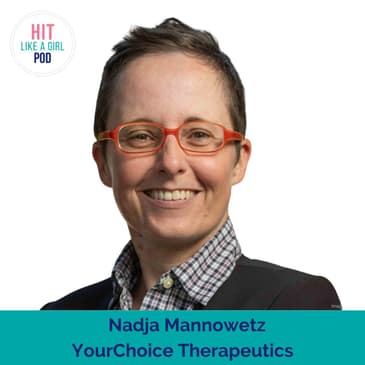

In this episode, Joy engages in a compelling conversation with Nadja Mannowetz, a pioneer in the development of a non-hormonal contraceptive pill for men. They discuss the innovative approach of this new product, which aims to provide an effective alternative to traditional hormonal birth control methods that have been predominantly available for women since the 1960s. Mannowetz shares insights from her extensive research on male fertility, including the rapid onset of the pill's effectiveness and the timeline for sperm recovery after discontinuation. The conversation also delves into the societal implications of male contraception, the challenges of building trust with potential users and regulatory bodies, and the importance of education in bringing this groundbreaking product to market within the next five to seven years.
Episode Highlights
- [00:03:13] Interesting Facts About Sperm Cells
- [00:04:26] Biology of Male Reproduction
- [00:06:00] Founding YourChoice Therapeutics
- [00:13:13] Discussion on Male Fertility and Birth Control
- [00:21:00] Viability of the Male Pill and Challenges
- [00:21:25] Challenges in Developing Non-Hormonal Products
- [00:23:24] Building Trust in the Market
Stay connected to Nadja Mannowetz:
- LinkedIn | Twitter
- YourChoice Therapeutics | LinkedIn
[00:00:00] Hello, podcast listeners! Are you ready to advance your career in health care? Then join us at the Women in Medicine Summit, a two-day power-packed event designed to propel you forward. The HIT Like a Girl Pod crew will be there cheering you on at the Drake Hotel in Chicago,
[00:00:16] happening on September 13th and 14th. Get ready for skill-building workshops, inspiring talks, and actionable strategies to help you thrive in your health care journey. Here's the best part. Use code, referral5 at checkout to snag your ticket at a special discount.
[00:00:32] We can't wait to see you network, learn and grow alongside other amazing women in medicine. Secure your spot now at womeninmedicine-summit.org and enter the code, referral5, to unlock your exclusive discount. Hello there and welcome to another episode of HIT Like a Girl Podcast.
[00:01:01] My name is Joy Rios. I am this show's host and this is a place where we talk about the complicated world of health care. So, I liken it to our 30,000-piece puzzle. Each one of our guests is bringing in an area of their expertise.
[00:01:16] And today we have a very exciting conversation. This is something we have not tackled on the podcast before, so I'm excited to bring this puzzle piece to light. Nadja, can you please take a moment to introduce yourself and the great work that you
[00:01:30] do and kind of shed a light on the puzzle piece in health care that you're bringing to the table today? Absolutely. Thank you so much, Joy, for having me. My name is Nadja Manovitz. I am the co-founder and chief scientific officer of Your Choice Therapeutics, a company
[00:01:47] that is building the future of non-hormonal family planning. I see your excitement and I am equally excited and I will talk about what that all means in a bit, but I want to point out while it seems kind of
[00:02:02] straightforward, okay, she's the co-founder and CSO of a company. I have to say my path has not been straight. For example, so by training, I am a food engineer. I then received my PhD in 2004 in biology. My first postdoc position was in a project around immunology at Phillips
[00:02:26] University in Marburg, Germany. And it was mandatory for me to participate in teaching medical undergrad students in human anatomy, physiology and histology. And I was teaching together with a colleague of mine, Gunther Venemut, who at the time had been studying sperm cell physiology for quite some time.
[00:02:50] And I thought, well, I mean, I was happy with my immunology project. But then hearing about sperm cell physiology, I got hooked immediately. And I thought, wow, this sounds so much better. And yeah, a few years later, he started his own group, which I joined.
[00:03:08] And yeah, since 2007, I had been studying sperm cell physiology. My time in Gunther's lab was really formative because it started my career to become a sperm expert. And in 2012, I joined Polina Lischko's lab at UC Berkeley just to expand on my technologies to study sperm cells.
[00:03:32] And that was formative in a way that I was in an environment where the first time I was not absolutely in academia. It was a mix of academia and entrepreneurial spirits. And this was completely new, exciting and fascinating for me.
[00:03:50] So in 2018, yeah, it culminated in me co-founding your choice, therapeutics to develop non-hormonal family planning products. Okay, there is so much to talk about there. And I just like, can we just pause for a second and for you being an expert on sperm cells?
[00:04:09] Like, I feel like we have some factoids that people kind of call on of things that are just interesting, right? Like how many millions of sperm are in a spoonful of, you know? I'm sure that you must have a handful of interesting factoids at
[00:04:29] the top of your mind. Can you please share some with us just because I think it would be memorable and fun. I think what is the most relatable? It's a thousand sperm cells per heartbeat that are being produced.
[00:04:42] And think about it, a thousand cells are being produced, released per heartbeat. I mean, it's crazy. Okay, wait, so you must have some very, you must have big opinions. I don't want to push anything on you, but this, can we talk for
[00:04:58] a second about the whole embryo being a baby? I'm like, if it's cells in a heart, like a thousand cells on a heartbeat, how far away is that from actually getting to become an embryo and maybe we're going off topic? But I don't think so.
[00:05:14] I was not expecting that, but I am happy to talk about that. So, okay, now we are diving a little bit into the biology of male reproduction. I feel like I have a lot to learn. So if we, yeah, please. Okay.
[00:05:29] So sperm cells, they are produced in the testis and it takes about 71 days in men for sperm cells to be produced. So it's a constant cycle, but after 71 days, sperm cells are ready to leave the testis and enter another organ, which is
[00:05:51] called the epididymis where sperm cells further mature. For example, what they gain in the epididymis is motility. I mean, you, I think it's easy to understand a sperm cell that is not motile. I mean, it has no meaning.
[00:06:08] So this passage takes about two-ish weeks and then sperm cells are really ready to be released from a man's body. So sperm cells are then deposited if we just think of intercourse between straight people into the vagina, which is actually a pretty rough environment for sperm cells,
[00:06:32] because the pH of the vagina is very acidic. And sperm cells are not made for an acidic environment. So they try to get into the uterus as fast as possible, where they have a not acidic, so a basic environment.
[00:06:49] And the uterus is also rich in a chemical compound that is bicarbonate. And this is what speeds up sperm motility. So they can travel quickly into the fallopian tube, where at the very end, the egg is waiting to be fertilized.
[00:07:08] And in every step that I just described, be it the vagina, the uterus or the fallopian tube, a number of sperm cells just get eliminated so that at the end, you have a few hundred sperm cells that make it close to the egg,
[00:07:24] but ultimately only one sperm cell will be the winner of this Tour de France of sperm cells and be able to fertilize the egg. Your work now is in the family planning aspect of that. So let's dig into that a little bit.
[00:07:42] So as I said already, your choice therapeutics is a company to build the future of non-hormonal family planning. And even that has so many facets, non-hormonal family planning. Let's perhaps start with family planning. So yes, our main technology is studying sperm cells.
[00:08:03] If we find molecules that stop sperm cells, yet we stop motility or we stop the production of sperm cells, we can develop contraceptive products. On the contrary, if we find molecules that speed up sperm motility or other functions, we can develop
[00:08:23] fertility enhancing products and allow couples who cannot conceive naturally to exactly do that. So we can work in both aspects of family planning, be it preventing a pregnancy or increasing the odds of getting pregnant. Can I stop and ask a question? This is for me.
[00:08:44] So a woman is born and has every single egg in her body that she's ever going to have. The same is not true for men and sperm, is that correct? Like they're correct. They have infinite numbers or like every single heartbeat
[00:09:00] until from a certain age until the day they die can produce a thousand sperm cells. In essence, that is correct. Perhaps it's not at all a man, 80 years old, perhaps it's not a thousand, but in theory it's still enough to get a woman pregnant. Yeah.
[00:09:19] So that's the thing. One man hit puberty or once boys hit puberty, they will go on. I mean, unless something really crazy happens. But yeah, that is a huge difference between men and women. Women only have a period in their lives of being fertile,
[00:09:37] whereas for men it means they technically constantly have to think of contraception or their fertility. So it's different ballpark. When we're talking about the non-hormonal part, can we go into more of that? Because it's just natural planning. I mean, natural reproduction versus someone intervening. Right?
[00:10:03] I love talking about this, why our focus is on non-hormonal products. Because so the pill for women was launched or approved by the FDA in 1960. And yes, it gave women reproductive freedom. It gave them power and I don't want to downplay the role of the pill for women.
[00:10:27] But shortly after women already started complaining about the side effects that came with that hormonal burden. And in the 60s, it was a shit ton of hormones that were put into women's bodies to prevent pregnancy. I mean, that has changed since the 1960s.
[00:10:46] So it's now less hormones that are put into a woman's body. But still, women mainly have contraceptive products that are hormone based. The only thing that has changed or the main thing that has changed is not just only the pill.
[00:11:02] You can have a patch, you can have an injectable, you can have a vaginal ring, it's still hormones. And we have talked or I have talked to many women, I think over 100 now. And I think only a very small percentage of those women said,
[00:11:19] it works for me, I have no issues. But 97% of those women, they told me everything that I had read, like mood swings, weight gain, decreased sex drive. They became easily irritable. It's just crazy. It's crazy. I mean, I'll share my...
[00:11:40] I started the pill when I was in my teen years and I didn't get off of it until I was nearly 30. And there was a time that I looked back and I was like, wait, how much of my personality is mine?
[00:11:52] Or is it actually like, is it influenced by taking this pill? Right? Or just like, do I know myself or do I... The self that I know is heavily influenced by this pill that I take every day. That is so interesting, Joy, that you are sharing this
[00:12:07] because you're not alone with that feeling. I have heard this from women before. And now comes the really interesting and uplifting part because we have now talked a lot about who is all hormone-based and it's really shitty because that long laundry list of side effects has been document...
[00:12:27] has been well documented. So I grew up at a time when I think it was socially very accepted and perhaps also expected that women take care of contraception. And I sometimes jokingly say, I think the boys or my male classmates,
[00:12:44] I think they didn't even know how to really spell the German word for contraceptive. But that was just that time. What is the German word for contraceptive? The Hütungsmittel. I don't think I could spell it either. But you are not somebody who grew up...
[00:13:02] Does that have the point? Yes, I should. And what has changed now over the past few, let's say, 10, 15 years that a woman openly start talking about the side effects, they becoming more vocal about it. Over 70% of women and men say contraception should be joint responsibility
[00:13:26] and men are saying we need something better, we want something better. That's something that is better than condoms and insectamines. And I am just amazed and blown away whenever I read it, whenever I hear it, because it's just so different how I grew up.
[00:13:47] And I am thankful for these, I think mainly young people to push for something because it just so happens that your choice therapeutics is developing the pill for men. Okay, so men now have the opportunity to take a pill.
[00:14:06] I imagine that women have had to bear the burden of like, sure there's all these side effects, but it's the, like you said, it's the expectation. Is, do you see a future in which that is shifting and men will start to bear the burden? And how do we...
[00:14:21] There's fear, there's a lot of fear there, right? Where I can imagine, I don't know, I mean, it's certainly not fair. But at the same time, I get it. Men have had the opportunity to use condoms, which oftentimes they don't particularly like,
[00:14:35] or vasectomy, which is kind of a big decision. And when do you do that? So there's an in-between. What can you tell me about this in between an option? The in-between, I would say, is nonexistent at the moment. And as you said, just think about it.
[00:14:53] Condoms and vasectomies, does anyone think they work for a teenage boy? I think a condom barely works for anyone. I mean, they come with an 18% failure rate. I mean, that has to come from somewhere. And a young person who is just developing their...
[00:15:13] Or finding their own sexuality, have to now fumble with a condom. I think we know how that's going to end. And vasectomy, it's definitely not something for a 16-year-old. So but what do they have? Yeah, you could say them be abstinent.
[00:15:28] That's I mean, that's never going to fly. You can say that, but that's not going to work. Exactly. What I am reading that more and more people now start using the withdrawal method. But it is hard for me to even consider that a method because it's also...
[00:15:46] And leaving things up to chance. You have to know your body very, very well. You have to know your partner's body and be able to track things and pay all kinds of attention and don't ever stop paying attention because when she stopped, the risk is high.
[00:16:00] If you're trying to avoid something... Exactly. I mean, we are talking about a situation where your brain pretty much is shut off and you cannot think of all the ins and outs of it. So I am very happy that your choice therapeutics is working on the in-between
[00:16:15] because so it's going to be a non-hormonal pill for men. And the non-hormonal, I think, is kind of a no-brainer because in my opinion, in our opinion, hormones are outdated. It's just a technology from a different era. Yes, they are effective, but they come with too much baggage
[00:16:40] and society, I think, is ready for something new. So our pill that we are developing, I said, is non-hormonal. It will be taken, I think, once a day and it stops sperm production in men. And if there are no sperm,
[00:16:58] there is no risk of fertilization or creating an unwanted pregnancy. And I am just really proud and excited that we are the first to study our non-hormonal pill in the clinic because no one has ever done this before.
[00:17:19] And I am just really, really so excited of having a product that has a shot of transforming society and improve the lives of so many men and women. It could be a real game changer. Yes. Okay, here's my technical questions.
[00:17:39] How soon after a man starts taking the pill, is it effective? And second part, how soon after they stop taking the pill, does their sperm count come back? That is a great question. So, so far we have data in animals.
[00:18:00] So we have studied several species and all the species that we have dosed with our pill for men, it just worked. The animals stopped producing sperm cells and that was true for all the species within three to four weeks. Okay. That is a pretty short timeline
[00:18:19] because what I have not mentioned, they are also hormonal technologies currently being studied in the clinic and they don't see effects within four weeks technically even longer. Oh, really? Yeah. When dosing with the pill for men, we have what is called a fast onset.
[00:18:39] It starts working very quickly. So within three to four weeks. In terms of recovery, there is pretty much nothing we can do about it because that's where nature dictates the timelines. What I mentioned earlier in men, it takes 71 days to produce sperm cells
[00:19:00] and we think that within one to two cycles, men should be fertile again. But these are all things that, yeah, we need to suss out in further clinical trials. I just feel like I learned something right now that from point of creation,
[00:19:17] like a sperm cell needs 71 days before it leaves the body. Okay. So I'm thinking now let's think about in times of a relationship. You have a crush on the teenagers, have crushes on each other. They decide that they're going to date. They hold off.
[00:19:33] I mean, at what point could somebody have access to this pill? And is it available yet or are we still in theory? It is not available yet. Okay. We started our first clinical trial with this pill for men in December of last year.
[00:19:49] And if things go according to plan, I would think it should be on the market and available within the next five to seven years. My other question is, does it affect sexual drive? So if it's reducing their, since it's non-harmonal, we would think probably no,
[00:20:10] but I just want to hear you confirm it. We have not seen any decrease in sexual drive or perhaps virility. Fun fact, we ran a study with non-human primates and... Sorry, I really have to laugh because I do remember that email so vividly.
[00:20:30] So we got that email and they said, ooh, many of the animals started masturbating and they have never done this before where I thought, okay, at least sex drive is not decreased. It's, I would say, we still have a healthy population in our non-human primates,
[00:20:51] which are the closest relative to humans. So no, so far nothing would point to such a side effect. And as you said, we are developing a non-harmonal product. We have not seen any changes in testosterone, which is the main male sex hormone. That's exciting. Yeah.
[00:21:13] Okay, so you have been working on this since 2003 in order to get it out into the public, you think is, no, you have not been working on this particularly. You've been studying sperm since a long time ago. I personally have been studying sperm cells since 2007.
[00:21:28] So now nearly 20 years, yeah. But we have been working on the pill for men in... Oh my God, COVID is really still screwing up my timelines in 2021. Yeah, that's when we started our first animal studies.
[00:21:47] So it sounds like this might be a viable option that is on the market, hopefully by 2030, if we're lucky. That sounds wonderful. Yeah. So what are some of the biggest challenges? Like I imagine it's an exciting field to be in,
[00:22:05] but I imagine there's also a ton of challenges that you guys face with it. So I don't know, top three. Yes, you are right. There are ups and downs. It's always a roller coaster, but we are very mission driven. So we have overcome every low.
[00:22:24] I think what still sticks with me the most, because I think I was just not expecting it, was the response that we have heard from so many people. Like, oh, but you are messing with male fertility. Like, oh, you are reducing a man's sperm counts.
[00:22:47] Oh, and I'm just like, yeah, I mean, if you want to develop a male product, you have to either stop sperm production or you make them all immobile or whatnot. So what is the real problem here? And then I learned, I think male fertility
[00:23:07] is the holiest grail of all holy grails. When no one talks about, there are women who really struggle of regaining their fertility after being on the pill for several years, but who cares? Right. For me personally, it is not so much the scientific part that's challenging.
[00:23:28] It is now more the educational part that we have to do. And yeah, it just takes a village to bring such a product to the market. We have to build trust with potential end-year source. And not only men, I actually think women
[00:23:46] will also be great drivers for this product because they know firsthand what it means to be on hormonal birth control. And if they have a their long time partner where there is trust and they can say, I can offload some of that, I'm happy to do that.
[00:24:03] Building trust with regulatory agencies. And yeah, building trust with investors. I mean, in so many puzzle pieces. I think about trust is a big one. So to your point about like not even the science, but trust, here's another piece of trust.
[00:24:20] Do you think that a woman is going to trust that a man is going to remember to take a pill every day? Like even that is something that is not culturally that they have done in the past. And so that would be a shift of like,
[00:24:33] oh, I'm going to trust my partner to remember to do this on a daily basis and take their spot. I mean, maybe that becomes part of the culture shift, right? Of reminders. I totally agree with you. And sometimes I am rolling my eyes when I hear the question,
[00:24:51] oh, can women actually trust that their male partner is taking the pill? Or can we trust men that they do that? And I am just like, think to me, trust always, it always sounds as if we are belittling men.
[00:25:05] There's a weaponized incompetence that men have a way of doing. I don't know if you've heard that term before, but it's basically like, oh, you know what? You do the dishes better than me. So maybe you should just do the dishes from now on.
[00:25:20] You know, I'm not that good at it. You do it better, so you should do it. I can see that how that would perhaps work for a sermon. But I don't know, I just think of all the men who push for change
[00:25:34] and who express a pill would be something I would prefer most. I mean, rather than an injectable or a dermal gel, why would those men not be involved in exactly doing that? Why would they really not play their part?
[00:25:52] All the gay men who take their prep every single day. They're responsible to do it? That's true. You know what else is like, if they're driven by sex and they're driven by the want to have it, then they should be driven to take care of the ability
[00:26:07] to do it with less risk for everybody involved. I strongly believe that that's how it's going to go for the majority of men. And the other good thing about our technology is men actually will have the possibility to show their partner,
[00:26:25] look, my sperm count is zero or below what are called fertile limits. And let me take a step back here. So if we assume, yes, a woman, let's say a woman is on the pill, everybody just hopes the pill works
[00:26:43] and there is no risk of an unwanted pregnancy. But in fact, neither that woman nor her male partner actually know that that's the case. There are so many ways the pill could not be effective, but no one knows.
[00:27:00] So we just always think women take the pill and it's going to work and no worries. But the pill also comes with a failure rate. And why is that? So what men can do, and this is a technology that has already been developed for men who undergo vasectomy,
[00:27:20] there are at home tests and they pretty much work like these lateral COVID flow tests. You produce a sperm sample at home. I think that's not a complicated task. And then you put this sperm sample into the test tube
[00:27:39] and then it will show you your sperm count is below or above a certain threshold. That is one thing where you could show I am safe here. I have nothing to worry about. And you, my dear partner, also have nothing to worry about.
[00:27:54] There are also technologies where you can take videos of your sperm sample and it shows you do you have sperm cells? Are they motile? Are they all immotile? So there are technologies where I think men will actually have a huge advantage in that.
[00:28:12] And I see this non-hormonal future with a non-hormonal pill for men as just something so valuable and transformative on many, many, many levels. I imagine that if a pill is created, then it's not unheard of or a patch to also be created
[00:28:34] or something that is less of a daily reminder. I mean, I imagine that there's a future that that's possible. Would you agree or no? Yes, I would agree. I mean, there is always you use.
[00:28:47] Yeah, you start with one product and sure, then you try to figure out how can we make this good product even better. I love this aspect of just being intentional of like, OK, well, this is as a couple.
[00:29:01] We either want to have a start a family and we can focus on making a family. Or if we're not ready for that step, that we can also be proactive in making that happen too. Yeah, it's got to be work that feels really good.
[00:29:16] Yes. And what also feels very good is we started this company with the mission to decrease the hormonal burden that come with contraceptives for women. And then we started working on the pill for men.
[00:29:33] And the and my first thought was, wait, are we still true to our mission? And five seconds later, I was like, hell, yes, we are. Because if we are developing the pill for men and men out of a sudden now have an easy,
[00:29:51] efficacious option that has just never existed before, they can take on reproductive or family planning responsibility. This offloads the burden for women of contraception in general, but also specifically the hormonal burden. And it's women's history month.
[00:30:13] And while I talk about the pill for men, I also talk about women, how we will decrease their hormonal burden. Well, I think it's amazing just to be thinking about shifting the burden. I mean, it's not unheard of that women have more emotional.
[00:30:31] We take on emotional labor, the home labor, this actual physical labor for the children and also just considering everything that comes along with whether or not you're going to be bringing another human into the world. Like that's a lot. Yeah, I am so excited to follow your journey.
[00:30:51] And I guess I'm curious if people want to know more, if they want to get involved, how can you direct them so that they can learn more about this subject and perhaps be their first purchasers when it's ready to go out to market?
[00:31:07] Well, there is definitely going to be many press releases once it's ready to be on the market. But I think for now, yeah, we are on LinkedIn. So just look for your choice. That's going to be enough or visit our homepage, yourchoicetx.com.
[00:31:24] And yeah, just follow the press because we have many, many things coming along. Wonderful. And for you in particular, do you like being reached out to on LinkedIn or anywhere else? Yes, please reach out. I am there. Fantastic.
[00:31:40] Well, it has been such a pleasure getting to know you and getting to know your work and sharing it with our listeners. Thank you so much for this time together today. Likewise. Thank you so much for having me, Joy. It's been a real pleasure. Thanks for listening.
[00:31:54] You can learn more about us or this guest by going to our website or visiting us on any of the socials with a handle hit like a girl pod. Thanks again. See you soon. Again, thank you so much for listening to the hit like a girl podcast.
[00:32:07] I am truly grateful for you and I'm wondering if you could do me a quick favor. Would you be willing to follow or subscribe to this podcast or maybe leave us a rating or review?
[00:32:17] Or if you're feeling extra generous, would you share this episode on your Instagram stories or with a friend? All of those things help us podcasters out so much. I'm the show's host Joy Rios and I'll see you next time.