
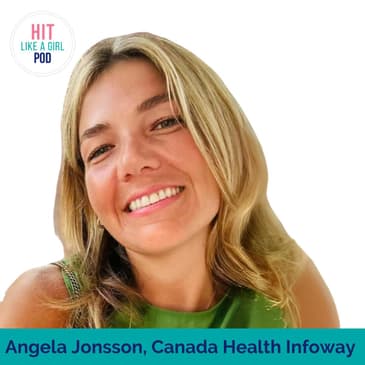

In this episode Joy Rios sits down with Angela Jonsson, the Vice President of Public Affairs at Canada Health Infoway, to discuss the critical role of interoperability in healthcare systems. Angela shares her journey in the healthcare sector, highlighting her responsibilities in connecting various medical systems to ensure seamless communication and access to patient information. She emphasizes the importance of translating complex healthcare standards for policymakers and stakeholders, ensuring that they understand the implications for everyday patients.
Episode Highlights
[00:01:08] Understanding Interoperability in Healthcare
[00:01:59] The Importance of Patient Information Transfer
[00:07:41] Angela's Day-to-Day Responsibilities
[00:09:40] The Unique Role of Canada Health Infoway
[00:19:32] The Value of Learning from Others
[00:20:51] Pathways to a Career in Healthcare Communications
Stay Connected with Angela Jonsson:
LinkedIn | Twitter
[00:00:00] You're listening to a Health Podcast, which means you probably care about health and you enjoy podcasts.
[00:00:05] I'm Dan Kendall, the founder of Health Podcast Network, and I want to invite you to join me in thousands of healthcare professionals and leaders at the annual Health Event taking place in Las Vegas, October 20th to 23rd.
[00:00:16] When you're there, I'd love to meet you at our exclusive reception on Monday, October 21st.
[00:00:20] In fact, the host of the show you're about to listen to plans to be there too.
[00:00:24] Reserve your spot, visit healthpodcastnetwork.com slash health.
[00:00:28] That's healthpodcastnetwork.com slash HLTH and save $250 with our special discount code.
[00:00:35] Again, that's healthpodcastnetwork.com slash HLTH.
[00:00:40] I look forward to seeing you there.
[00:00:50] Hello there, and welcome to the Hit Like a Girl Podcast. My name is Joy Rios.
[00:00:55] This is a show where we talk about the million-piece puzzle that is all things healthcare and we're each one of our guests gets to come on and share their piece of the puzzle.
[00:01:04] So I'm really excited to bring on today's guest Angela Johnson.
[00:01:07] Can you please take a moment to introduce yourself and tell us about the piece in the big health care puzzle that you hold onto?
[00:01:14] Awesome. So yes, my name is Angela Johnson.
[00:01:16] I am the Vice President of Public Affairs Corporate Strategy and Communications. I can't have a health info away.
[00:01:22] And also where another had as a chief of staff. So it's an exciting role that in so way what we do is connect systems.
[00:01:31] So ensuring that each of our systems are able to talk to one another in a clear and concise way.
[00:01:37] And so that is what we're after.
[00:01:39] Is that one of those where you're trying to get different pieces of interoperability,
[00:01:44] but is interoperability among technology systems or is it other types of stakeholders?
[00:01:50] So it's interoperability as it relates to ensuring that EMR, for example.
[00:01:55] So if you were to the best way to explain it is that if you were to go to a hospital and you had previously gone to perhaps a walking clinic to get some information
[00:02:06] and then two days later, rush to the hospital.
[00:02:09] That information would be transferred.
[00:02:11] So when you arrived at the ER and perhaps you were incapacitated unable to, for example, get information
[00:02:18] and or say which you're allergic to that information would pop up on the screen and they would be able to see where you had been before.
[00:02:26] And lots of parts of Canada and some province they are interoperable.
[00:02:30] But in most cases that's not always happening.
[00:02:33] And so it's really making sure that each of those systems can talk to one another and to bring it back to the patient
[00:02:39] so that they can actually see how that sport.
[00:02:41] And you've been with the organization for how long?
[00:02:43] Five years actually it's almost my anniversary, so yes, five years.
[00:02:50] I'm curious to know what kind of change or advances you've seen in your time within fully.
[00:02:55] Yes, so you know what?
[00:02:56] I think healthcare is one of those spaces that is always changing.
[00:02:59] So I think much like politics, they say, a day is so we can politics and you think it happened.
[00:03:06] I often feel like that about healthcare that there's always something going on, there's always something transitioning.
[00:03:13] And I think that COVID really changed things for a lot of people but we also became with a bit more sexy in lots of ways, right?
[00:03:23] Is how are those systems connecting?
[00:03:25] Where is all of this data being stored?
[00:03:28] How is it being stored?
[00:03:29] How are we communicating with one another?
[00:03:30] And so I think the digital world and lots of folks would agree is that it became exciting.
[00:03:36] Before I think we were fighting to be the cool kid and but after COVID and during that piece of like during COVID,
[00:03:44] it was like, oh, now we have to actually do virtual appointments.
[00:03:48] We have to make sure that we have systems that are able to transfer information with out being in person to do that.
[00:03:55] Luckily we're now in a position where we can do both.
[00:03:58] And I think that some had seen, oh, this is actually beneficial to do virtual care or to have those types of things available.
[00:04:06] But also not losing that in person ability as well.
[00:04:09] You guys experienced the same thing because we're starting to see it a little bit in the US where there was a huge push for virtual visits but because of reimbursement rates and whatnot.
[00:04:19] They're not really sure if they're there to stay.
[00:04:21] If it was just during COVID, do you guys feel a little bit more permanency with it?
[00:04:26] I think it depends on who and where you are.
[00:04:28] So I think, and it also depends on I think the physician and the patient as well, right?
[00:04:34] What is it that actually needs to be addressed in the circumstances?
[00:04:38] I can speak from personal experience that my current family doctor does offer virtual visits but also offers in person visits.
[00:04:46] And so it becomes a bit of preference.
[00:04:48] I'm not seeing that there's necessarily one going one where the other,
[00:04:52] I think it was a bit of that joy to be honest where it was like wait a minute, now I want to be in person because I could be in person and I think that's sort of happened with folks as they were also trying to get back outside.
[00:05:04] So to speak of, oh wait, I can do things in person.
[00:05:07] I want connection.
[00:05:09] I want to see my doctor in person.
[00:05:10] I want to do all of these things.
[00:05:12] And so I think there was a bit of an opposite reaction to what happened in COVID.
[00:05:17] And now I feel like it is starting to balance out and making sure that it's just very equitable across the board because there are a lot of circumstances in virtual visits that,
[00:05:26] or I often think folks that you know, in rural parts of our country or more remote virtual care really offers that that opportunity to have that fair and equitable care that they otherwise may not be able to have in person.
[00:05:39] One of the other use cases, I think for virtual care is people that like, honestly they're families when you have a lot that you're juggling
[00:05:46] and you've got kids and appointments and schools. And all of that, if you can just talk to a doctor virtually without interrupting your entire life and still be able to manage the million things that are going on as an individual or who perhaps working and also taking care of their family.
[00:06:04] I feel like that's something that like once we've experienced it, it's really hard to go back.
[00:06:08] I totally agree. I think that the sandwich generation, some of my colleagues are talking about that is that it makes it, it does make it easier, right?
[00:06:18] Because you have kids or and you have perhaps you're taking care of your parents or other elderly folks in your family.
[00:06:25] And how can you possibly do it all by working full time and doing this taking a full day off is not possible for a lot of people.
[00:06:32] And that's also not especially when this economy, I think you need to be very mindful of that and what that means for people as they're taking care of those loved ones.
[00:06:41] I also think it's interesting too because I think that brings up a good point that, for example, having medication and being able to look at what was recently prescribed for perhaps your mother that is not able to do that.
[00:06:53] So you're joining on these appointments and that you're available for those things as well as healthcare, right?
[00:06:59] If you wanted to see your record as a patient, it's sometimes difficult in Canada to be able to get that oftentimes you're paying, you're doing all sorts of things.
[00:07:08] But through an interoperable system, if everything is talking to one another and the systems are talking, then you're actually able to have that at your fingertips.
[00:07:16] Similar to how you have your banking information with those privacy and all those things in touch.
[00:07:22] So I do think it offers a wide range of benefits and I think that we have a very savvy generation, we use computers and our phones for everything, right?
[00:07:32] So why not help care too?
[00:07:34] I also imagine you guys are dealing with the 10 of stakeholders, 10 of stakeholders.
[00:07:37] So you're like, help me understand your organization. It's a nonprofit that's federally funded, but in order to make sure that both payers, patients and the healthcare system are all connected and talking to each other.
[00:07:50] Do I have that correct?
[00:07:51] You do.
[00:07:52] Yeah, that was great.
[00:07:54] You can take my job.
[00:07:56] I'm going to go into podcasting and you can say,
[00:07:59] What do we do to like freaky Friday we can switch?
[00:08:03] I think you do a lot better than me to be honest.
[00:08:06] I think that your job is pretty difficult, and I don't know that I would want this step into your shoes.
[00:08:11] It sounds like it's a lot.
[00:08:12] What is your day-to-day like? How do you like do work on projects? Are you in meetings all day long?
[00:08:18] Are you in a government office? What is it like connecting all of these different stakeholders for you?
[00:08:24] For me it's a bit different because I come from a background of public affairs of communications.
[00:08:29] And so, essentially my job is to take what a lot of our experts are doing.
[00:08:36] Our subject matter experts in the field when they're talking about standards like fire and HL7.
[00:08:42] And all of those things are super vital.
[00:08:44] You ask me to go in and start talking to about standards.
[00:08:47] I wouldn't be able to, but my job is to understand what it is that they're saying.
[00:08:51] And then be able to communicate that out.
[00:08:53] And there is lots of translation in some ways of, I always say,
[00:08:59] Would my grandmother understand what it is that we're trying to say?
[00:09:02] And so I think that kind of goes to your question of there's so many stakeholders.
[00:09:05] How do we go out? How do we communicate?
[00:09:08] And that is vitally important.
[00:09:10] And I would say my day-to-day, no-day ever looks the same in my world.
[00:09:15] I have anything from being traveling to different provinces and territories,
[00:09:21] meeting and educating both on our elected officials to make sure that they understand the work that we're trying to engage with in the province or territory,
[00:09:31] as well as meeting with what would be our bureaucratic department staff in each of those province and territories,
[00:09:38] and connecting them back to the federal government and what info-ways doing.
[00:09:42] And just to go back to info-ways, it's a very unique role we are a pan-Canadian health organization,
[00:09:49] and sit between the federal government and the provinces and territories.
[00:09:54] And so often times there's so many different stakeholders that we do have.
[00:09:58] And so it's very important that we cater in that way, but that is our unique role that sits there.
[00:10:03] So no-day is the same for me. And I think similarly to my background, no-day has ever been the same in my life.
[00:10:11] But that's great. That's actually like the best way. I'm sure it's not wrote. You're just like, okay,
[00:10:17] and it exactly what's going to happen today, but in a way that's exciting.
[00:10:21] Exactly, exactly.
[00:10:22] I will curious, first of all, I think you'd make a great podcaster.
[00:10:27] Thank you.
[00:10:28] You're made because I think it has a better ring to it.
[00:10:32] But I think that's what you brought up earlier about trying to bring information back to the policymakers.
[00:10:38] And that's something that's like a cute interest to me because I think that, okay,
[00:10:42] a lot of people are in the government that may not necessarily understand the bills that they're signing fully
[00:10:49] and how that they impact the community and patients and keep every day people.
[00:10:55] And so is that your job to help translate? Okay, this is the decision that we need to make.
[00:11:00] Here's why we need to make it and here's why you're support matters so much,
[00:11:05] but not quite in a lobbying type way. And I don't know. I'm going to say do good or type way.
[00:11:11] Yeah, and more of an educating ways to say, hey, this is what's happening in your province or your territory,
[00:11:17] or this is even what's happening federally like we get funded by the federal government.
[00:11:21] Sometimes even elected officials won't even be aware of what exactly that means or the role as governments are large.
[00:11:29] There's lots of organizations, there's lots of arms, lenders, what we call pectnidian health organizations, et cetera.
[00:11:35] I think it's really vital that yeah folks elected folks understand, hey, this is why is going on?
[00:11:42] This is why we need the support. I often think that interoperability.
[00:11:46] I'm trying to make it a helpful world then word and to be honest, it has become way more people are using that word for the longest time.
[00:11:56] I didn't even know how to spell it. And so I'm like, here we are talking about something that the average person has no idea about what that means but it's so vitally important.
[00:12:07] And I think that's true of politicians too. There's so many issues, there's so many things that play, how can you possibly be on top of everything all of the time?
[00:12:17] And so that is part of our role as to make sure that we're educating on okay way of the minute, what is interoperability? Oh, it just means connected care.
[00:12:26] What does that mean for my mother? What does that mean for me? Which does that mean for my child? How can I see that play out?
[00:12:32] And that is super important because always making sure that we're keeping the patient, we're keeping that human being at the focus of it.
[00:12:40] And that actually makes it a little bit easier to explain because everyone understands when it's like, oh, I've been frustrated when Canada especially it's, oh you've gone here.
[00:12:50] Oh, you need to do this again because I don't have this or I can't see that or it takes ex-long time to get these things and I think there is some frustration.
[00:12:59] But when we are in an interoperable system, things can work a lot more smoothly. Here is a, stop me if you think I'm crazy or out of line just I'm to go ahead and
[00:13:09] But one of the things that they say about Canadian health is okay first of all it's paid for but a lot of times people have to wait the wait the wait times are significant for folks.
[00:13:19] Does the interoperability quicken that up does that, does it make it faster? What it allow for
[00:13:26] More patients to be seen in a more timely manner. We have a great healthcare system in Canada looking at across the world and seeing how the level of service that we get.
[00:13:37] There are way times and that is dealt with within the province and territory on how to look at that interoperability really tries to make sure that it's a letter more seamless experience.
[00:13:48] So even if you are waiting that you actually know that information got there it's less about it's more about making sure that it's connected.
[00:13:56] If you think about how we still use back machines in Canada today to make sure information is going in some parts of the US as well and other parts of the world.
[00:14:04] We're talking about security and privacy and all of these things. If you look at that event, it's how you could question a whole bunch of other items in that area.
[00:14:13] But I really think that interoperability helps to make it a more seamless process for the patient so they can have all of their records. They know exactly what's going on.
[00:14:23] They can speak to their physician about what is in their records or their knock-in-fuse, no one's googling to wonder what does this mean.
[00:14:30] There's always those concerns because as I would imagine, I'm not a physician but being a physician, if all of a sudden here's your whole record.
[00:14:37] Oh, what does that mean? What happened all of those types of things that we need to make sure that our communicator in the right way?
[00:14:44] So I think it's about finding that balance but I think interoperability definitely makes it a more seamless experience with the patient.
[00:14:50] For me and Leamins terms, I'm like, that connects the timeline. So whether you saw somebody three years ago or 20 years ago and then you have an appointment next week, that information is available to you.
[00:15:01] And I don't think any of us have that or have had that. That is the future. Hopefully the future is now but that's what we're working on.
[00:15:10] And I think you could be very savvy in the healthcare space and keeping everything in line, but even still in some complex situations or whatnot, it's to your point is, wait a minute, where is that?
[00:15:21] And you can imagine that even newcomers to anywhere trying to understand a system is how do you make again? That's about the equity issue, right?
[00:15:30] Is making sure that everyone has that same opportunity and looking at healthcare in that way.
[00:15:36] And then making sure that it is seamless so that way we're connecting to international standards.
[00:15:40] So if you do have records or whatnot that are brought into another country theoretically, this is the dream that it would be seamless and approach and that they would be able to understand and the systems could talk to one another.
[00:15:54] That's a dream that is applied to the dream that I know we're not quite there yet and I can speak from experience.
[00:15:59] I've just had my first healthcare experience in Mexico and it is so different than the US in both good and bad ways.
[00:16:08] I'm just like a not very much like technology to be spoken to us, but certainly in terms of EHRs or patient portals, I don't have access to any of that or like digital access to my labs.
[00:16:19] However, I had a doctor come in and talk to me for an hour and a half and she literally said, I want to know every boarding detail about what happened.
[00:16:28] Don't leave anything out and I'm like, in the US we get 15 minutes so try to get all the boarding details and it's going to be nearly impossible.
[00:16:37] But it would be incredible to be able to that is the dream across international borders to be able to share that level of information in a secure and private way.
[00:16:46] I'm just like, oh there's the holy grail. So how do you get to interact with the privacy and security aspects of that? Is that is it more in communication or how deep in your knowledge set do you have to be?
[00:17:00] So I would say for me we do have subject matter experts that are dealing with that privacy and security looking at that to help inform what is happening in provinces and territory so that they're able to have legislation.
[00:17:12] They're able to look at what that means to ensure that a patient's record is kept private and you have that opportunity to either talk out of a situation if that's not what it is that you're looking at.
[00:17:25] And there is legislation right now that is for it to Canadian government federally to look at similar to the CARES Act in the US where it allowed for that interoperable system.
[00:17:37] And that is exciting in and of that. And so I think that we're all trying to get by the best that we can and your story actually reminded me of a situation in which I remembered hearing from one of our patient partners and indigenous patient partner.
[00:17:52] And she had not always been treated well by in the hospital and things like that but when someone had come in and actually took time to talk to her and understand where she come.
[00:18:03] They understood more of why she wanted to do what she wanted to do there was a different aspect and look to her care versus and that actually honored more of where she was coming from.
[00:18:14] And these are the types of things that you know whether it might not be in the record entirely but there could be things that could be captured in that way that can always help to make that a full experience for the patient.
[00:18:27] Absolutely and I think that just at the core it's relationships right and to feel seeing it to be seen for literally feel seen by your doctor or your healthcare staff of just okay, I'm not just a number I'm not just a cog in this wheel you're not just trying to get me out the door.
[00:18:43] And you care about my health and well-being and hopefully we all live happily ever after to the best of our ability.
[00:18:51] Yeah at the end of the day everyone just wants to be seen right and everyone does want to feel like oh I'm out in this moment as they do and as they should and so I think that is probably the most important thing and so while it's yes we're talking about interoperability we're talking about connecting systems and making sure.
[00:19:09] But at the end of the day that is actually helping the patient to be able to see that more fully and I think to even learning from examples in Mexico where you were it really makes me think that oftentimes and this is why I encourage people to travel and do things like that because we're so often in our own mind right you are somewhat constructed and how you think and oftentimes people have dealt with these things.
[00:19:35] There are other solutions that perhaps are there that we just haven't looked outside because we're too busy and I really think that can give a new way of looking at things.
[00:19:47] How you felt it's I didn't have this but I had that and that really made me feel good and different about it right and so oftentimes I think that those are really good learning experiences and can help broaden by learning from other people and not we don't necessarily have.
[00:20:02] But it's not necessarily the right answer right I don't know everything that's going on neither do our sneeze neither does.
[00:20:09] I would argue that no one we have to share and we have to learn from each other and so that's what I think is.
[00:20:14] I would echo that a million percent because I think and that's part of the reason for having having this podcast is like to allow to see more right and learn more from people that we don't get to see as much and get out of our own headspace hey I see the same thing over and over so that's what I think is possible.
[00:20:31] It's hard to imagine what's possible if you're only seeing one thing you're like there's a million other things that could be possible and could be perfectly great and it's I love that idea of being able to imagine like.
[00:20:44] It could be so much maybe it's not exactly as I want but it could be even better because I can't even imagine it yet so what is meant for me is something that I can't even picture yet and how cool is that.
[00:20:55] It's so true.
[00:20:57] Honestly, I always think it's the simplest way to innovate is to learn what people already do elsewhere because it's there for us it's there for us at our fingertips is that we just have to open our eyes and see and be open to that in a bigger way right.
[00:21:12] Somebody wanted to imagine having a job like yours what did you study where did you how did you what did you do in order to get to where you are and say your title again and also sounds like it's communications it sounds like there's a lot of.
[00:21:28] Public relations in a way and also learning about government and technology like what's the major.
[00:21:33] I would say that I came about a unique way I don't know this doesn't mean you shouldn't go to school you should absolutely go to school.
[00:21:41] My degree was in political science but it didn't necessarily leave me here I was very involved in politics for many years and worked in different levels of government and Canada and even in the US and seeing that actually made me want to make change I think that I really got more interested in healthcare after.
[00:22:01] I was working at the Toronto District School Board and looking at what breakfast and lunch programs are for students that are coming in that are not having that and how that impacts learning and so.
[00:22:14] That kind of started in that health realm and then moving I worked at the Ontario Medical Association which represents all the physicians in Ontario.
[00:22:23] In an advocacy and government relations role and so that really I think took off more from that healthcare space and then ended up here so yeah my role I work in public affairs which is really.
[00:22:36] Government relations it's talking to a number of our government stakeholders both on the political and non-political side corporate strategies so looking at how what we're doing where we're moving how we are moving with the funding that we receive from the government.
[00:22:52] And then lastly that communications piece where you know to your point the PR the media how we're talking what are those notes so often I'm not on podcasts like this in fact I prefer not to be on podcast.
[00:23:05] I'm like my team is my team is please do this.
[00:23:09] Yeah talking to join like this is what I'm like oh yes we all need to travel we need to learn I have all the waiting ideas I don't think there's one way to ever get to a career I think you just have to really be passionate and be open and see what the world costs offer because I think that's how I become better and try to be better every day.
[00:23:31] Well Angel I thank you so much for sharing your professional journey with us and all the good work that you're doing if somebody wanted to connect with you or follow you or work with you where would you point them.
[00:23:41] You could go to our website which is that info a dash info route dot CA so info a Canada help info a you can definitely put it into Google we're also on LinkedIn and we're on Twitter also now x and a whole bunch of other spaces so yeah please connect.
[00:24:00] Great thank you. Thank you again this has been a pleasure so much fun. Thank you.
[00:24:07] Thanks for listening you can learn more about us or this guest by going to our website or visiting us on any of the socials with the handle hit like a girl pod thanks again see you soon.
[00:24:18] Again thank you so much for listening to the hit like a girl podcast I am truly grateful for you and I'm wondering if you could do me a quick favor would you be willing to follow or subscribe to this podcast or maybe leave us a rating or review.
[00:24:30] Or if you're feeling extra generous would you share this episode on your Instagram stories or with a friend all those things help us podcasters out so much.
[00:24:39] I'm the show host Joy Reos and I'll see you next time.