
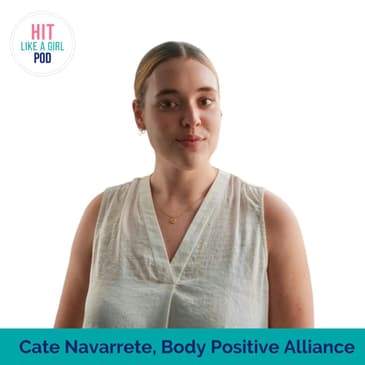

In this episode, Joy Rios interviews Cate Navarrete, the founder and executive director of the Body Positive Alliance, a nonprofit organization dedicated to promoting body positivity and systemic equity for all bodies. Cate discusses the growth and impact of the organization, highlighting the challenges of retention and engagement within the chapters. She emphasizes the importance of knowledge and community in fostering body positivity and social justice awareness. The conversation delves into measuring success in promoting body positivity, and the potential impact of their work on a larger scale.
Episode Highlights
[00:00:00] Introduction by Joy Rios
[00:13:00] The growth and impact of the Body Positive Alliance
[00:13:30] Challenges of retention and engagement in the organization
[00:16:17] Measuring success in promoting body positivity and social justice issues
[00:22:42] The importance of knowledge and community in promoting body positivity
[00:24:50] Potential impact of work on a larger scale
Stay connected to Cate Navarrete:
[00:00:00] Hello podcast listeners, are you ready to advance your career in healthcare? Then join
[00:00:06] us at the Women in Medicine Summit, a two day power packed event designed to propel
[00:00:10] you forward. The HIT Like a Girl pod crew will be there cheering you on at the Drake
[00:00:14] Hotel in Chicago happening on September 13th and 14th. Get ready for skill building workshops,
[00:00:21] inspiring talks and actionable strategies to help you thrive in your healthcare journey.
[00:00:26] Here's the best part. Use code referral five at checkout to snag your ticket at a special
[00:00:31] discount. We can't wait to see you network, learn and grow alongside other amazing women
[00:00:36] in medicine. Secure your spot now at womeninmedicinesummit.org and enter the code referral five to unlock
[00:00:44] your exclusive discount.
[00:00:45] Hello there and welcome to another episode of HIT Like a Girl podcast. My name is
[00:01:01] Joy Rios. I am this show's host. This is a show where we talk about how complicated the world of healthcare
[00:01:07] is. I liken it to a 30,000 piece puzzle and each one of our guests gets to bring on their area of
[00:01:13] expertise and share their puzzle piece so we get a better picture of the whole big thing. So I'm
[00:01:19] very excited for today's guest. I'm going to give you a minute to introduce yourself. Kate, please
[00:01:24] tell us all about you.
[00:01:25] Thank you, Joy. Hi everyone. My name is Kate Navarrete. I am a 19 year old college sophomore currently
[00:01:32] studying at Emory University originally from the DC area. I'm the founder and executive director of
[00:01:38] Body Positive Alliance, which is a nonprofit that I started back in 2020 to promote the fair
[00:01:44] treatment representation and systemic equity of all bodies regardless of background,
[00:01:53] appearance or other identity. And I'm a really passionate body positive advocate. I'm really
[00:02:00] committed to promoting greater inclusivity in pop culture. And otherwise, thank you, Joy, for
[00:02:05] having me. I'm excited to talk with you today.
[00:02:07] I am thrilled. So first of all, I can't believe how young you are and how much you have
[00:02:12] actually accomplished in your short time. I was thinking this morning, I'm like, I think I'm more
[00:02:16] than twice your age. Holy cow, you've done quite a bit in your life. Can you talk to me
[00:02:21] and our audience about how did you get involved in this? And what started you like, what gave you
[00:02:26] the impetus to start a Body Positivity Alliance? And it sounds like it was something that
[00:02:31] started when you were in high school. Is that accurate?
[00:02:34] I had a personal struggle with body image, which I think really motivated me to do this
[00:02:38] line of work, which for a lot of other people in this space feel find is a common thread
[00:02:43] between most of us. I entered high school and developed two eating disorders. And as an athlete,
[00:02:53] and as someone who had considered themselves an athlete their whole life in this being a
[00:02:57] really prominent fixture of my identity, when my eating disorder started to get in the way
[00:03:02] of my performance, I found myself at a loss for deciding between my sport or my recovery.
[00:03:11] And I also felt a lack of inspiration because when you've identified with one thing your
[00:03:17] whole life, it's pretty difficult to pivot to a different set of interests or a different
[00:03:21] set of beliefs. And so I really prioritized my recovery during this time and the pandemic
[00:03:27] sort of forced that anyways, you know, not being able to compete anymore. But I gave
[00:03:33] up swimming in a completely competitive capacity and still maintain the commitment
[00:03:39] otherwise and more the fun side of things, the team aspect. But I had previously started a
[00:03:45] body positive club at my high school when I was transitioning out of the sport. And I really
[00:03:50] wanted this to be a place where people could discuss what they thought about body
[00:03:56] positivity, how body image had affected their lives and just really be a safe space to
[00:04:01] convene and talk about it. This was something that I noticed that my peers alongside
[00:04:06] myself were struggling with and we really needed a space to talk about that. And so when
[00:04:11] the pandemic hit, I really wanted to be able to build upon the work that I was doing at my
[00:04:16] high school in some ways. And body positivity was becoming really prominent on social
[00:04:21] media, especially with platforms like TikTok, which really took off during the pandemic.
[00:04:26] And so I started doing some online advocacy work, ended up getting an article of mine
[00:04:32] published at 15 in a UK magazine. And after that, really, really became passionate about
[00:04:38] pop culture inclusivity. After a couple months working in the online space, I really
[00:04:44] wanted to latch onto something more substantive. And I ended up getting the idea
[00:04:50] to expand my club that I'd started at my high school to neighboring high schools and
[00:04:57] using my network as a swimmer who had friends from different schools and different parts of
[00:05:02] the country. I took it upon myself to reach out to these people, do some external
[00:05:07] sourcing and ended up gaining interest at a few neighboring high schools to launch
[00:05:12] these clubs. And once I realized that there was a demand, I think it was really easy
[00:05:16] to recruit team members and think of it more as an organization and an umbrella, if
[00:05:23] anything. And so at that point, it was probably around January of 2021 when I started
[00:05:29] bringing on team members. It was around that time also where I started my own podcast
[00:05:33] focused on the subject. And after that point, we've just continued to grow. And now
[00:05:38] being a sophomore in college, four years later, I'm still running the organization
[00:05:43] and it's now a 501 C3. And I am so proud of how much we've been able to spread
[00:05:50] our mission and now bringing it to the elementary school level through an
[00:05:53] anti-bias program. And yeah, that's a little bit more about how it's been.
[00:05:58] That is so impressive. I have a lot of questions and one is around social media.
[00:06:03] Like that I feel like that is a conversation that is in the general public when we
[00:06:07] talk about its effect on young people. And I imagine with filters and the way that
[00:06:14] people change their appearance and AI and how much of that is part of your guys'
[00:06:19] conversations. And is it something that you are cognizant and aware of the effect
[00:06:25] that it's having on you as it's happening?
[00:06:28] And I say that just because we're all influenced by technology and what we see
[00:06:35] on our small screens and big screens and whatnot.
[00:06:38] But like, it's hard to have the awareness that you're also being influenced
[00:06:43] by it and how it's affecting you in some way positive or negative.
[00:06:47] I would just love to know how that conversation shows up.
[00:06:50] Right. It's a huge conversation at our organization, especially since all of the team members.
[00:06:55] I was joking in our previous call.
[00:06:57] I think I'm the oldest team member and I'm 19.
[00:07:01] This conversation is something that's really, really important to our generation.
[00:07:05] And we understand how much of an impact social media has on each of our body images.
[00:07:10] I got on social media when I was nine and that was around 2014.
[00:07:16] And that's pretty much when social media started to blow up.
[00:07:19] But at that point, there was so little research on it.
[00:07:22] So I've really grown up in this guinea pig generation where we were too old
[00:07:30] to have so many regulations around social media, but too young to have avoided
[00:07:35] social media altogether.
[00:07:37] In a lot of ways, it feels like, you know, that screwed us over a little bit,
[00:07:40] but we make do.
[00:07:42] I think talking about social media and body image is incredibly important
[00:07:46] because it is something that can hinder not only our personal body image,
[00:07:53] but also our interpersonal relationships.
[00:07:55] We are seeing people who are in our lives or around our lives,
[00:08:00] whether it's our classmates or our friends from a sport
[00:08:04] or our friends from camp or whatever it may be.
[00:08:09] We're seeing them in this highlighted way that doesn't actually reflect
[00:08:12] the day to day interactions or happenings of that person's life.
[00:08:16] And so I know in my personal life, it occasionally leads to resentment
[00:08:21] in those personal relationships, right?
[00:08:23] I don't think it's necessarily the healthiest thing for maintaining
[00:08:27] relationships, even though it is supposed to be this source of connection.
[00:08:30] And technology as a whole has had a huge impact on the way
[00:08:33] our generation communicates and also the way that we communicate
[00:08:39] and express ourselves and what we hold to be sacred.
[00:08:44] And I think there's a huge lack of privacy that comes with that
[00:08:48] and also a huge lack of reality.
[00:08:51] There's this really harmful aspect of social media
[00:08:56] that can make things look so real and so authentic.
[00:09:01] But behind the scenes, that person's teeth is, you know, they've been whitened.
[00:09:05] Their skin has been smoothed.
[00:09:07] Their waist has been slimmed.
[00:09:08] And these are things that we're not necessarily always cognizant of.
[00:09:12] Right. Photoshop isn't always the obvious kind of face
[00:09:16] tune fails we mock like it is.
[00:09:18] It's everywhere.
[00:09:19] And I think this is something that when I was a young person, I engaged with.
[00:09:23] I was altering my physical appearance on social media
[00:09:27] because I felt like I had to.
[00:09:29] And now being a bit more of a veteran user of social media
[00:09:36] and still having a very complicated and complex relationship with these platforms
[00:09:41] and typically trying to avoid them altogether, even though that's impossible.
[00:09:45] But I don't use filters.
[00:09:47] I don't do any sort of alterations.
[00:09:51] I think I've noticed that it doesn't make me feel good about myself when I do that.
[00:09:56] And I also would prefer to put content out there that doesn't spread that.
[00:10:00] But at the same time, I understand that it's a really nuanced issue
[00:10:05] for a lot of people.
[00:10:06] And as someone who's really passionate about photography,
[00:10:09] I understand why someone may want to apply a filter to their photo.
[00:10:14] I think overall, I tend to be pretty opposed to physical alterations,
[00:10:20] but it's a bit more of a blurry line when it comes to creative expression.
[00:10:24] That conversation comes up a lot.
[00:10:25] It's something that we talk about a lot on the team
[00:10:28] and we make a lot of content on our platforms about just because it is so relevant
[00:10:33] to our generation.
[00:10:35] I know it's something that our clubs talk about a lot.
[00:10:37] And even now, I just started a chapter of the organization on my campus.
[00:10:41] And that's been a topic of discussion that's come up very frequently, too,
[00:10:45] just because it is this unavoidable thing within the scope of Gen Z
[00:10:50] and life as a whole now.
[00:10:52] I mean, I can imagine being excited as a young person to get online
[00:10:57] and be part of this bigger social media conversation.
[00:11:00] But even over the last decade with your experience,
[00:11:03] I'm sure that that's ebbed and flowed of just like, OK,
[00:11:06] maybe you've been overexcited and just like want to get super involved
[00:11:10] and throw yourself out there.
[00:11:11] But, you know, in the best light, I'm curious about
[00:11:14] how do you frame those conversations because they will likely be different
[00:11:19] for elementary school kids, as you said.
[00:11:21] And then now university kids, you know, like they're all in different
[00:11:25] stages in their life.
[00:11:26] Their ability to participate and post is going to be different.
[00:11:30] And I'm sure the folks that they follow and what they're consuming
[00:11:34] is different. And those are big conversations for young people
[00:11:37] to be having. So share, please share.
[00:11:41] Yeah, at the university and high school level,
[00:11:45] we emphasize that social media is a really integral part of our lives.
[00:11:50] I know I use social media for club communication.
[00:11:53] Like it's something that is unavoidable at this point.
[00:11:57] You know, when I remember my parents are both Gen X through and through.
[00:12:02] And growing up, I would complain about social media and say, oh, like,
[00:12:08] it's so exhausting or it makes me feel bad.
[00:12:10] And my parents would just say, OK, then just get off of it.
[00:12:14] And I would say to them, well, that's not really how it works.
[00:12:18] Like I use social media to communicate.
[00:12:21] I use social media to feel in the loop.
[00:12:23] You know, there's different it meets different needs that
[00:12:26] for my generation is really, really, really important.
[00:12:31] And I have spent time off of social media before and enjoyed it.
[00:12:35] But I think the way that we frame conversations
[00:12:39] is that you may not be able to get off of social media,
[00:12:43] but there are ways that you can improve your experience on it,
[00:12:46] whether it's moderating the content you see, being a more cognizant consumer,
[00:12:51] following people who make you feel good.
[00:12:53] Again, just techniques to manage usage rather than eliminate it altogether.
[00:12:58] Because I think again, that all or nothing approach
[00:13:00] can be really detrimental and unhelpful in this circumstance.
[00:13:05] And at the elementary school level, it's interesting.
[00:13:07] We don't talk about that as much.
[00:13:10] We often talk more about like behaviors when engaging with media,
[00:13:14] as opposed to specifically social media.
[00:13:17] Our lesson plans incorporate a lot of techniques
[00:13:22] in order to be able to be a more conscious consumer.
[00:13:25] Like, what is this advertisement saying?
[00:13:27] You know, what does this make you think of?
[00:13:31] And we hope that by establishing those foundational
[00:13:34] mindsets, we're able to have them develop
[00:13:38] maybe when they're in leader elementary school or middle school
[00:13:41] and getting on social media, hopefully have better behaviors
[00:13:45] and techniques to be able to mitigate that.
[00:13:48] You said something to me when we talked a little bit ago,
[00:13:51] and it stuck with me.
[00:13:52] And I'm just like, wow, that is so kind of brilliant.
[00:13:55] And I'd love to hear more about it where you said scale is easy,
[00:14:00] but retention is the hard part because you have grown this,
[00:14:04] you know, like you had mentioned, it started at your school.
[00:14:06] And how many campuses now is the body positivity alliance
[00:14:11] and where are all you guys all having these conversations?
[00:14:15] It's it's quite extensive.
[00:14:18] We it's grown a lot.
[00:14:20] I want to say I don't have an exact number off the top of my head,
[00:14:24] but I'd say we're definitely at over 30 at this point campuses.
[00:14:30] And a lot of them are concentrated in that DC, Maryland, Virginia area
[00:14:34] where I'm originally from.
[00:14:35] But we also have chapters in most of the United States,
[00:14:40] I'd say, and we've begun expanding internationally to shout out
[00:14:45] to our programming team. They're awesome.
[00:14:47] I need to update our little map on the website that's on me.
[00:14:49] But yeah, it's the retention aspect is difficult, right?
[00:14:53] Managing managing chapters is difficult.
[00:14:56] You don't want to be overbearing.
[00:14:58] You want to allow for some aspect of autonomy when you're letting,
[00:15:02] especially people who are around your age operate their own thing.
[00:15:06] Like, I know these people are capable and they're passionate.
[00:15:08] And I want to give them that that privilege.
[00:15:12] But it's also, you know, you want people to be engaged
[00:15:14] members of a community and that requires levels of accountability
[00:15:17] that we're still working to establish.
[00:15:20] Again, those are conversations we have really frequently on the team.
[00:15:23] Like, what criteria do we need to set in order to retain chapters?
[00:15:27] You know, what does it look like for them to be engaged with us?
[00:15:30] We've had we've had fundraisers through chapters before.
[00:15:33] We've done special chapter community events.
[00:15:37] And, you know, those are things that can be incentives
[00:15:40] for people to join our community on a deeper level beyond just,
[00:15:42] you know, the follow on Instagram.
[00:15:44] And so I think it kind of goes hand in hand,
[00:15:47] like being able to incentivize while also holding people accountable.
[00:15:51] Well, you're also giving young people quite a bit of responsibility, right?
[00:15:55] They I would imagine it's similar to a job or even sort of just club.
[00:15:59] Would you consider it? It's called an alliance.
[00:16:02] But is it does it function as a club meeting?
[00:16:05] How often do you guys all meet and have these conversations?
[00:16:09] Like, what is the cadence?
[00:16:10] The team meets very often.
[00:16:11] We have like a couple of meetings per week at the organization level.
[00:16:16] And then our chapters operate independently from us,
[00:16:19] but they may meet on a weekly or biweekly basis similar to like
[00:16:23] any other university or high school club.
[00:16:26] I know the chapter that I lead now at Emory meets on a biweekly basis.
[00:16:31] There may be a couple more meetings if there's a special event of some sort.
[00:16:34] But at the organization, again, we're meeting pretty,
[00:16:37] pretty regularly and always on Slack, communicating back and forth.
[00:16:41] There's just a lot to get done, as you can imagine.
[00:16:43] I can imagine. And so what are the like you said tools
[00:16:47] and I guess like defining success, right?
[00:16:49] What would that look like?
[00:16:50] What does it look like when you're like, OK,
[00:16:53] everybody has a better understanding of what it means to have a better
[00:16:57] image of bodies and what they look like
[00:17:01] and that they're not just one shape and size that we should consider beautiful.
[00:17:05] Right. I think something that I always interpret as a measure of success
[00:17:09] is when someone may say a self-deprecating comment,
[00:17:12] but they kind of immediately like snap out of it and correct themselves.
[00:17:16] I notice that a lot.
[00:17:18] And that's when I really notice a mental shift for people.
[00:17:21] It could be, oh, you know, my hair looks so bad today.
[00:17:26] But you know what?
[00:17:27] It doesn't matter if my hair looks bad today because,
[00:17:29] you know, it's kind of that da da da da.
[00:17:31] After the fact, you know, there's always that saying that your first thought
[00:17:35] is what comes to mind, but your second thought really represents
[00:17:39] who you are and your values.
[00:17:41] And I think that corrective mentality is something that I always look for
[00:17:44] when I'm, you know, trying to categorize or characterize rather progress.
[00:17:50] I also think having competencies
[00:17:53] around social justice issues that we discuss is really, really important,
[00:17:58] whether that's concepts relating to fat phobia,
[00:18:01] the interpolation of fat phobia and racism,
[00:18:05] concepts related to maybe issues in the medical field
[00:18:10] that can get a little bit more dicey when it comes to this,
[00:18:12] you know, thinking about the history of the body mass index and,
[00:18:16] you know, that sort of thing.
[00:18:17] Tell me about that.
[00:18:18] What do you know about the history of the body mass index?
[00:18:20] Oh, OK.
[00:18:22] So the VMI, as far as I am concerned, was created.
[00:18:27] I would have to pull up one of our blogs about this,
[00:18:30] but created in the late 19th century by a Belgian astronomer
[00:18:35] and originally used as a bell curve measure
[00:18:40] for weight and height distribution among white men
[00:18:42] and then was later adopted in the 70s by,
[00:18:46] I want to say, the World Health Organization to establish
[00:18:50] a correlation between height and weight among all people.
[00:18:54] And that's kind of been used as an indicator of health ever since.
[00:18:58] I take issue with the lack of changes being made
[00:19:02] to the system that don't account for people of color or women, especially.
[00:19:07] I take issue with the lack of consideration
[00:19:12] for body fat versus muscle mass,
[00:19:15] for general weight fluctuations,
[00:19:18] for the fact that everyone weighs something different
[00:19:22] and your blood work is probably a better indicator of how healthy you are.
[00:19:26] It's a very Western way of thinking about health.
[00:19:30] And I think that it's perpetuated a lot of bias.
[00:19:33] And I would like to deconstruct it.
[00:19:36] What happens when you see things in the like, even in the institutions?
[00:19:40] Because thinking about systems in place, when you're like
[00:19:43] when you go to the doctor and they're looking at your BMI,
[00:19:46] do you have opinions?
[00:19:47] Do you talk to your medical staff about that too?
[00:19:50] Or where does that conversation fit in?
[00:19:53] Yeah, no, it's interesting because since I'm in eating disorder recovery now,
[00:19:57] they don't tell me my weight like we don't have conversations about weight anymore,
[00:20:02] which is awesome.
[00:20:03] But it's actually if you are listening to this and you don't know this,
[00:20:07] you don't have to get weighed at the doctor's office.
[00:20:09] That's not, you know, this legal requirement.
[00:20:13] You can choose to opt out of it.
[00:20:15] And there is some privilege being said that if you exist in a smaller body,
[00:20:19] they may be much more flexible with that decision that you're making.
[00:20:23] When I started in this line of work,
[00:20:25] I was very much still struggling with body image and with food.
[00:20:28] But I was still very vocal at the doctor's office about my thoughts on this,
[00:20:33] which I'm sure you know, I was seeing a pediatrician at the time.
[00:20:36] I was probably 16 or 17 years old.
[00:20:38] So I you can imagine this was a little annoying for them.
[00:20:41] But I was always considered more in like the quote, like healthy BMI range.
[00:20:47] And then as I got older and I just began developing as human women do,
[00:20:52] that changes.
[00:20:53] And I think that what's really interesting is that when I was
[00:20:58] at a very low point with my relationship with food in my body,
[00:21:02] I was considered, quote, healthier on the BMI scale than I am now.
[00:21:07] And I have a very healthy relationship with food and with my body.
[00:21:10] And I'm very active.
[00:21:12] And so for me, I've stopped measuring my health in terms of BMI,
[00:21:19] because I know that that's just not something that as a Hispanic woman
[00:21:23] is going to reflect my health.
[00:21:25] And I don't think again, it can be a measure of health for most people.
[00:21:30] I just don't I don't see that being viable.
[00:21:33] You brought up something that just kind of ring a bell for me, where I'm like,
[00:21:37] I can think of four people on my hand right now that have
[00:21:40] were told that when they were sickest because they had lost a lot of weight
[00:21:45] and that they in generic terms looked great,
[00:21:50] but they were like it looked their best every day.
[00:21:52] We're probably getting more compliments than they'd ever gotten before.
[00:21:55] But was it was actually when they were the least healthy. Right.
[00:21:59] That was going on with them.
[00:22:00] And it's just interesting that that dichotomy of like what we experience
[00:22:05] or what we're told to think of that looks like a healthy
[00:22:08] human being is often very different.
[00:22:10] Totally. I think this idea that thinness and health are automatically
[00:22:15] associated with one another is really problematic, because again,
[00:22:19] you can't look at a thin person and know they're healthy.
[00:22:23] That's not you don't know anything about their life, their medical history,
[00:22:27] whatever. You can't make that assumption.
[00:22:29] You can't make that assumption about people in general. Right.
[00:22:33] Someone could be the most active, perfect.
[00:22:37] I don't know if you've seen Parks and Rec, but Chris Traeger
[00:22:40] ask human being ever and may just look different
[00:22:44] than what you consider to be the quote picture of health.
[00:22:48] Our idea of health is really skewed by again, this Western ideal
[00:22:52] of someone who is thin and able bodied and white.
[00:22:55] And this often leads to again, not only bias in the medical field,
[00:23:00] but also interpersonal bias and can then lead to internalized
[00:23:05] prejudice toward people with particular bodies or, you know,
[00:23:09] self-deprecation of your own if it's not meeting this ideal.
[00:23:14] So in what ways do you feel like the
[00:23:17] I'm going to say kids, but young people that are part of the Alliance,
[00:23:21] how are you seeing their behavior change or attitudes change?
[00:23:24] Do you see them being empowered to move through the world differently?
[00:23:28] I think so. I can really only speak to the chapters that
[00:23:31] I would hope that everyone is, you know, this is working and all that great stuff.
[00:23:36] But I would say in the chapters that I've led, it's been really,
[00:23:40] really rewarding to see that progress among people.
[00:23:43] I we did a collaboration the other day with my campus's chapter
[00:23:47] with an all female fitness group and having conversations with them
[00:23:52] about what body image looks like in the fitness space
[00:23:55] and in exercise was so fascinating because they have
[00:24:00] all these feelings and all these ideas
[00:24:05] and they know what the right beliefs are and they're getting there.
[00:24:07] And if you can just fill in those last little information gaps,
[00:24:12] it can completely change someone's mentality.
[00:24:14] Like you discussed this puzzle piece earlier,
[00:24:16] and I think it's the same way with body positivity on an individual
[00:24:20] and an interpersonal and systemic level, because when you give people
[00:24:24] the access to information, it won't automatically cure
[00:24:28] what they're going through.
[00:24:29] But having knowledge is the foundation for whether it's recovery,
[00:24:34] whether it's existing in the world in a better way,
[00:24:38] that's more tolerant and accepting of all bodies or whatever the case may be, really.
[00:24:43] And I think that, again, like seeing people be able to talk out loud
[00:24:48] about this and think about things that they maybe kind of it just
[00:24:52] it's the way of the world, so to speak, is what they're thinking before.
[00:24:57] It's really cool to watch those pieces come together
[00:25:00] because it happened for me at one point.
[00:25:02] It continues to happen for me.
[00:25:05] And I love seeing it happen for other people
[00:25:08] because it can really be a weight off your shoulders.
[00:25:10] And just to know that it's not your fault.
[00:25:13] Right. Like this idea that I'm the only person struggling with body image.
[00:25:18] I'm the only one who thinks about this.
[00:25:20] This person is perfect.
[00:25:21] This person, you know, they couldn't possibly go through this.
[00:25:26] Right. And you realize that that's just not the case.
[00:25:29] Like, you don't you don't know what someone is going through
[00:25:33] and giving people the access again to that information
[00:25:35] in that community is really, really valuable.
[00:25:37] There's one last piece that I want to touch on.
[00:25:39] And I feel like you are in a unique position
[00:25:43] with this experience that you have had, that you now have evidence,
[00:25:46] real evidence that your efforts and what you do matters and makes a difference.
[00:25:52] Do you ever feel like what you do
[00:25:56] can have a much bigger impact?
[00:25:58] I think a lot of people as individuals feel like, oh, what does it matter?
[00:26:01] What do like my participation or lack of participation?
[00:26:05] Me showing up or not showing up.
[00:26:07] Like, who cares? Right.
[00:26:08] It's just I'm just a drop in the bucket.
[00:26:11] But you have evidence that your drop in the bucket
[00:26:13] is actually creating a pretty big ripple.
[00:26:16] How does that make you feel?
[00:26:17] Well, I appreciate that. First of all, I like to think that it is.
[00:26:21] Sometimes, you know, I am in college.
[00:26:24] I'm living the very normal life of a 19 year old,
[00:26:28] while also living a very not normal life as a 19 year old.
[00:26:31] And so it's a balance between the two and being so involved
[00:26:35] on my university's campus.
[00:26:36] Also, it's a matter of balancing.
[00:26:39] OK, I have this thing that I love and it's my baby
[00:26:42] and I've been with it forever.
[00:26:44] But then I also, you know, want to get involved at my school
[00:26:46] and I want to make friendships and do all these things.
[00:26:49] And so I definitely feel as though
[00:26:53] what keeps me going is that because these chapters run independently,
[00:26:58] I have the privilege of knowing that the work that I've done
[00:27:03] is helping someone who doesn't know who I am.
[00:27:07] And I think that is rewarding in and of itself. Right.
[00:27:10] There is a chapter in a state thousands of miles away from me
[00:27:14] that I don't personally know the leaders of.
[00:27:19] I don't personally know the members of.
[00:27:21] They may have no idea who I am and just be thinking to themselves,
[00:27:25] hey, this nonprofit school, I'm going to start a chapter of this. Right.
[00:27:29] No. Who you know, who cares?
[00:27:30] Who's at the face of it? Whatever.
[00:27:32] I think it's really rewarding knowing that again,
[00:27:35] I don't have to position myself in the center of something
[00:27:39] to make a positive impact,
[00:27:42] because I think I'm only one person with one story.
[00:27:46] And although that may be a story that I perceive to be worth sharing,
[00:27:52] it doesn't mean that it's everyone's story.
[00:27:55] And it doesn't mean that I can represent everyone's experiences.
[00:27:58] But being able to cultivate a diverse community
[00:28:02] will accomplish what I want it to accomplish.
[00:28:06] And it really takes a village to be able to do that.
[00:28:10] And I'm so grateful for our chapter leaders and our team
[00:28:14] and really the collective effort that goes into making this possible.
[00:28:18] And again, knowing that like there was that foundation
[00:28:22] and now someone in California could be benefiting from something
[00:28:26] that I'm doing is really, really cool.
[00:28:28] I love that so much.
[00:28:29] And it's so it rings very, very true to me as well.
[00:28:32] I just think you don't have to be at the center of it.
[00:28:34] And it's almost better if you're not like if you get to leave a legacy
[00:28:39] and you have been somebody who started really great conversations
[00:28:43] that continue on even when you're not part of it.
[00:28:46] Like I would define that as success.
[00:28:48] That's that's legendary.
[00:28:51] Definitely. And I again, I appreciate all your kindness there.
[00:28:54] Yeah, my pleasure.
[00:28:55] I mean, I'm genuinely impressed with what you're doing
[00:28:58] and would love to be able to send people your way.
[00:29:01] So on that note, if somebody wanted to start a chapter
[00:29:04] or get involved with you or just connect with you and follow your work,
[00:29:08] where would you send them?
[00:29:10] I am Kate Navarrete on LinkedIn.
[00:29:14] I'm definitely an active LinkedIn user.
[00:29:16] If you would like to connect with me personally, feel free to do it there.
[00:29:19] Otherwise, Body Positive Alliance, we're on pretty much
[00:29:22] every social media platform you can think of.
[00:29:25] We're at Body Positive Alliance on Instagram, Facebook, LinkedIn, Tiktok.
[00:29:30] And we're also on Twitter slash X, not as active there, though.
[00:29:35] And yeah, we also have a website
[00:29:38] with all of this information that I've talked about and more.
[00:29:41] Body Positive Alliance dot org.
[00:29:43] If you're interested in starting a chapter or implementing
[00:29:45] the anti bias curriculum in your community,
[00:29:48] there is more information on that website.
[00:29:51] And otherwise, yeah, that's about it.
[00:29:53] Awesome, awesome, awesome.
[00:29:54] Thank you so much for everything that you're doing
[00:29:56] and the good work that you're putting out into the world
[00:29:58] and inspiring others to do the same and more of that.
[00:30:01] So I commend you and thank you for being here with me.
[00:30:05] Thank you. And thank you so much for listening, everyone.
[00:30:07] Joy, thanks for having me again.
[00:30:10] Thanks for listening.
[00:30:11] You can learn more about us or this guest by going to our website
[00:30:14] or visiting us on any of the socials with the handle Hit Like a Girl Pod.
[00:30:19] Thanks again. See you soon.
[00:30:20] Again, thank you so much for listening to the Hit Like a Girl podcast.
[00:30:24] I am truly grateful for you.
[00:30:26] And I'm wondering if you could do me a quick favor.
[00:30:28] Would you be willing to follow or subscribe to this podcast?
[00:30:31] Or maybe leave us a rating or review?
[00:30:33] Or if you're feeling extra generous,
[00:30:35] would you share this episode on your Instagram stories or with a friend?
[00:30:39] All those things help us podcasters out so much.
[00:30:42] I'm the show's host, Joy Rios, and I'll see you next time.