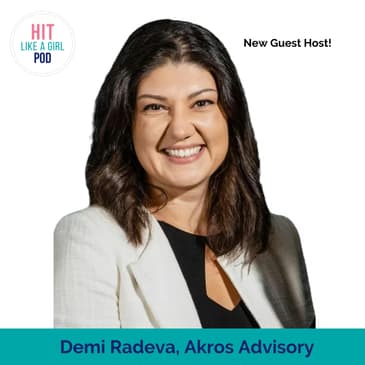

With a new administration under President Trump, the healthcare industry is poised for significant shifts. How do we adapt, innovate, and lead through change? That’s the focus of this special series on HIT Like a Girl podcast, hosted by Demi Radeva, our newest guest host and a powerhouse in health system financing and innovation. 🌟
In this series, Demi shares her journey and sits down with 6 incredible women experts to explore how they’re navigating change, driving innovation, and shaping the future of healthcare.
In this first episode, we get to know more about Demi—her background, her mission, and the unique perspective she brings to the conversation.
Here’s what you’ll hear:
00:00 HIT Like a Girl Podcast Returns
04:12 Building Health Equity at Optum
08:09 Missing Startups at ViVE
11:59 Exploring AI's Impact on Stakeholders
13:45 Women's Health Data Privacy Concerns
17:24 Navigating Changing Times Together
Why This Episode Matters
This episode sets the stage for the entire series, introducing Demi’s expertise and passion for healthcare innovation. Whether you’re a healthcare professional, a patient, or simply curious about the future of the industry, this conversation will inspire you to think boldly and act decisively in the face of change.
Coming Up in This Series
Demi’s conversations with 6 incredible women experts are just around the corner! All episodes were recorded at #ViVE2025
Here’s a sneak peek at what’s coming:
- Shirel Daniel (Extrico Health): Branding, marketing, and the evolving definitions of AI.
- Molly Schreiber (Savvy Coop): The patient perspective, women’s health, and data privacy.
- Shriya Palekar (CLEAR): Patient access to data and care, and the role of startups.
- Patty Hayward (Talkdesk): AI’s role in improving patient experience.
- Kim Perry (emtelligent): Clinical documentation and the intersection of AI and interoperability.
- Kristen Valdes (B.Well): Interoperability and how tech companies are transforming healthcare.
Stay in Touch:
[00:00:08] Hello there, welcome to the HIT Like a Girl Podcast and welcome back. We have been on a bit of a pause for a little bit. So my name is Joy Rios, I am the host of the HIT Like a Girl Podcast and it has been my absolute pleasure to be able to bring amazing conversations with incredible guests and from guest hosts about the 30,000 piece puzzle that is healthcare and health IT and trying to understand this industry that we work in because it is complicato or complicated as we say.
[00:00:38] I am excited that today I get to introduce our audience to our newest guest host who was able to represent us at the VIVE conference in Nashville, Tennessee in February and I would like everybody to take a moment to get to know her. So Demi, can you please introduce yourself and let us know a little bit about your background and you know why you are stepping into this seat?
[00:01:04] Absolutely. Thank you so much for having me. This has been such an incredible opportunity. A little bit about me and my journey, actually I started my podcasting journey with Digital Health Today and Dan Kendall years ago when I studied and lived abroad in London. And so it's super exciting for me to be in the driver's seat and actually interviewing these amazing guests that we're going to talk about. I have spent over a decade in the health insurance industry and specifically focusing
[00:01:34] on health system financing, how do we align incentives and make sure that patients get the care that they need and they get access to care in an affordable way. So that is the perspective that I'm coming from. I have a master's in health economics from the London School of Economics and a lot of experience in industry comes from United Healthcare and Optum where I was director of strategy and BD.
[00:02:03] Can we talk about following the money and incentives and just a little bit more about your experience in that area and what you have done to help incentivize the right things within the industry?
[00:02:15] Yeah. I am extremely passionate about changing the industry, leading disruptive innovation. And so after years of being in corporate and changing the system from the inside out, I decided to package and take all of my insights and started a company called Acros Advisory where what we do is partner with innovative firms and bring their products to market better and faster, more intelligently using all of those insights that I have from inside the system.
[00:02:45] So that is how I bring about change in the industry is partner with founders, partner with all types of nonprofits that are thinking about things differently and social care and how do we integrate it more with healthcare. That is what I like to focus on.
[00:03:01] Well, before we get into your experience at Vive, can you share any of the projects that you have been a part of that are helping to disrupt? If you're able to talk about that, I would love to hear it, especially at this time when it seems like DEI is a bad word.
[00:03:16] But here in the Hit Like a Girl pod community, we are champions of diversity, equity, and inclusion and social programs and thinking about things on a holistic level. How can we actually meet people where they are and help them there in healthcare? And it's hard to do. It's a hard nut to crack, but it's an important one.
[00:03:37] I agree. So a couple of thoughts. Personally, I am very passionate about DEI. I'm myself an immigrant. My family and I moved here 20 years ago. And from there, I moved to Minnesota, which can be a very different community, very different culture.
[00:03:56] And so now it's our home. We've been here for so long, but there's still difficulty in connecting with the locals, building relationships. There are folks that I know who know each other since kindergarten, and they've gone through middle school and high school and college. And I'm like, what is this place? Very unlike if you live in New York or San Francisco or some of the other parts of the country.
[00:04:18] So long story short, given that passion, I was one of the folks that established and co-founded the Optum Equity Office back in the day when I was a consultant at Optum and really rallied and helped create a safe community for folks to talk about topics that traditionally weren't appropriate to discuss in the workplace.
[00:04:40] And then from there, that passion just has continued to build and unfold. And in one of my roles at UnitedHealthcare ended up helping create the national and local strategy for health equity for UnitedHealthcare, specifically within our Medicaid line of business.
[00:05:00] And so across 20 health plans, it was all about how do we stand up and create the national infrastructure to support the individual health plans and what they do and how they interact and deliver care to members better. But then also, how do we empower each state to really customize what they do? Because each state's population is so different. The policies are so different. And so it needed to be robust, but also flexible enough to be able to serve our members best.
[00:05:28] And then from there, I just learned so much. I ended up actually becoming a co-founder in a couple of different startups, specifically focused on connecting and making a difference in social care and connecting patients to social care services because social care can make such a huge difference in healthcare.
[00:05:50] And so that's a topic that I definitely have a passion in and like to support founders in those spaces. We also, as a company over 50%, I don't remember the exact number of our founders that we work with are actually BIPOC. They're women, they're black, African-American, they're immigrants. And so this is specifically a community I like to focus on and help bring their ideas to market.
[00:06:18] You know, it's really hard sometimes to treat things. Our world is very nuanced. And like to your point about the states being different, their populations being different. We're not, we're unfortunately not able to say like have a cookie cutter approach and say what's going to work in one city or town or region is also going to work in another. So I really appreciate the work that you have done and are continuing to do. So thank you. Thank you.
[00:06:44] Can we transition to talking about Vive? And one of the things that was special about it, well, interesting is that it was one of the first conferences that happened after the inauguration. So I'm sure that the tone was slightly different from conferences past. And I was not able to enjoy it. I know that there was also a snowstorm or apparently very cold weather during that week in Nashville.
[00:07:09] I would love it if you could share with our listeners what the vibe was and how you felt being there that week. Yes. Thank you. It was so exciting. I've been attending Vive since it first launched. I've also been attending Health or HLTH. They're both owned by the same company and ran by the same company.
[00:07:30] But I have personally enjoyed Vive because it's a little bit more intimate than health is typically. And then also there's a lot more digital health tech founder presence at that. And that was probably one of the biggest surprises that I noticed quite a few people noticed and talked about was, where's all the startups?
[00:07:52] That was the word in the conversation on the street was everyone was trying to unpack what happened to the expo floor and where were all the founder boots. And so if historically 50 to 75% of the floor was covered in startups, this time it was more like 10 to 25 maybe. Oh, wow. And so that was a big point of conversation for everybody is what happened. And I think what I took away from it, it's a combination of a bunch of factors.
[00:08:21] There is just the general fundraising over the last few years that there's been a lot of headwinds. And so potentially that has been one of the reasons why there's not enough startups there. There's just a lack of funding in the space. Additionally, one of the other points that folks made was around, are these conferences really the places that are creating value for the startups?
[00:08:48] Are they seeing the same value today as they're seeing a couple of years ago at the same conference in terms of getting access to potential customers on one end and or investors on the other end? And so that was another component in terms of, yeah, how valuable is this for me to spend money for as a startup?
[00:09:05] We also in general saw less presence of accelerators and or these groups that would host a bunch of startups to showcase their innovations that are in their networks. So that was also pretty limited presence. And then in general, I mean, just uncertainty. Yeah. What about government presence? Was there much government presence?
[00:09:29] There was a lot of conversation about policy. In terms of government presence, I would say that there was a few folks that were former and I would say, yeah, probably more on the former CMS and or HHS structures. But I didn't really see much of like the currently elected and newly elected folks there.
[00:09:52] Yeah. And the reason I bring that up specifically is that a lot of times what's going on in the government ends up influencing the themes of these events and the conversations themselves. And it seems like right now we're in a time where instead of building, we're actually taking down. So I imagine there's not much conversation to be had about that. Like, how do you get involved? I don't know that one would want to necessarily.
[00:10:15] A lot of folks hesitated to talk about policy. And so I'm just so grateful that I did have a great lineup of fantastic women change makers that were completely open to talk about policy changes and how that's affecting their own businesses and how it's affecting them personally, even their daughters. And so I'm really excited to share some of those takeaways.
[00:10:41] Well, good. Let's get into that part, too, because thank you for sharing about just like the vibe of vibe. But ultimately, you had an opportunity to talk to six women, all that had slightly different roles within health care, just about how and the theme of this series is they're adjusting to the administration change.
[00:11:01] So, you know, you were the ears on the ground. Let's talk about it. Who did you get to talk to? And also, like overarching 30,000 foot view. What do listeners have to look forward to in the upcoming conversations?
[00:11:15] Yes. So I wanted to, and when Joy, you and I got together, we talked about the idea of having a container and basically bringing in different perspective from the patient perspective to the reimbursement perspective, to the CEO perspective, to the growth leader perspective. Like how do we bring these different stakeholders to show how they're being affected by the changes that are happening?
[00:11:40] And so I felt very lucky to have conversations as broad as talking about the definition of AI. And one of the biggest takeaways was that it can be very hard when you are using the same word to describe very vastly different things and technologies.
[00:11:59] And really unpacking what policies affecting what part of the definition of AI. There's many different sub definitions and or components of that. And so it was, you know, talking about the vibe of the vibe of vibe. Like you couldn't go afoot without hearing the word AI. I believe that.
[00:12:23] And so it's like, I don't think anyone walked away without having heard or talked about or been in a session where AI was a point of conversation. And so Sherelle from Extra Co Health and I had a conversation about just definitions and branding and how we all need to start speaking the same language and we all need to get more granular and specific.
[00:12:47] So then we're on the same page. So then we're on the same page because when you're not on the same page, there's no understanding, then that can create a lot of chaos and lack of clarity. Yeah, that makes a lot of sense. From there, I love that I was able to have conversations with the patient perspective as well.
[00:13:04] So I had Molly Schreiber from Savvy Co-op and really talk about how the current administration is affecting topics like privacy of health data and how that potentially is affecting women's health.
[00:13:18] And specifically, women's health being such an understudied space and how we should have more privacy and we should feel more comfortable and confident sharing that information so that there's actually more research generated using it. But how there is a lot more hesitation to share and talk about things.
[00:13:41] And even Molly spoke about having conversations with her own daughter about what's okay to share and what's not okay to share on some of these platforms and making sure that you're reading the terms and conditions. So I think one of my biggest takeaways talking about the patient side of things was with the current administration, it is up to the patient to really be paying attention. Where is their data being used and what context and what situations?
[00:14:10] Who are they giving access to their data? And so we really need to get more educated and start paying a lot more attention about where data is being used. On the flip side of that, I had some wonderful conversations with other folks around patient access and data saying that there is actually at state level an increased scrutiny and increased push for visibility to share with patients how their data is being used and what is happening.
[00:14:39] So while we're seeing a move away from that at the federal level, now the states can step up and actually put more protections in place and our disclosures in place. That's going to be an interesting conversation. I look forward to listening to that one. Yeah. And then any others? Were there other perspectives that you got to hear from? Yes, absolutely. I think one of my really favorite ones was talking with Kristen Valdes from Be Well.
[00:15:03] And we chatted about interoperability in general and how, you know, are we moving closer? Are we moving away from that? And so it was interesting to hear that from a technology standpoint, there's so many things that are possible. And so a lot of the time, the technology is not necessarily the issue. It is policy that is creating the fragmentation.
[00:15:28] At the same time, it was interesting to get some examples of where the policy is not the issue at all. It's actually the technology that is holding us back from true interoperability. And so I'm excited for you to hear more about those opportunities where tech can really make the difference. There is so much going on. It is hard to keep up.
[00:15:50] So I want to just thank you again for being the boots on the ground and the ears and eyes and ears for Hit Like a Girl at that conference. It was really great. And I'm excited to share, to listen and to share with our listeners the series that you have recorded. So it will be coming out over the next several weeks. We're going to be releasing one episode per week for a total of seven weeks. So get ready. Hold on to your hats and glasses.
[00:16:19] I'm sure a lot will have changed by the time, you know, everything is out. But since it was recorded in February, because this pace of change that we're all trying to keep up with is kind of impossible. But that's what we're here for is to try to support one another and navigate these changing times. Thank you for being a trust source.
[00:16:39] If people would like to connect with you, follow your journey, work with you, or somehow get connected with you and all of the good work you're doing, how would you recommend they do so? First of all, thank you so much for having me. I had a blast. And I definitely want to do it again. And then feel free to reach out on LinkedIn at Demi Radeva and or check out our website at Acros Advisory.
[00:17:05] We'd love to have folks that can benefit from our academy of courses and or if they want to tune into some of our upcoming workshops and join in the conversation that way. Okay, wonderful. Well, thank you again, Demi. And I am excited for our audience and community to get to know you. Yay, thanks. Thanks for listening. You can learn more about us or this guest by going to our website or visiting us on any of the socials with the handle HitLikeAGirlPod. Thanks again. See you soon.
[00:17:34] Again, thank you so much for listening to the Hit Like a Girl podcast. I am truly grateful for you. And I'm wondering if you could do me a quick favor. Would you be willing to follow or subscribe to this podcast? Or maybe leave us a rating or review? Or if you're feeling extra generous, would you share this episode on your Instagram stories or with a friend? All of those things help us podcasters out so much. I'm the show's host, Joy Rios, and I'll see you next time.