
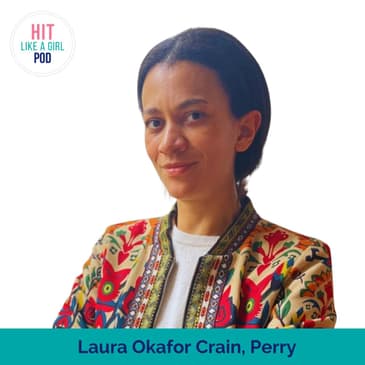

In this episode, Joy Rios talks with Laura Okafor Crain, the founder and CEO of Perry, a leading platform dedicated to supporting women through the often-overlooked phase of perimenopause. They discuss the critical role of community in navigating this transition, emphasizing the importance of peer support and access to vetted information. Laura shares insights about the resources available through Perry, including a physical journal designed to help women track their symptoms and emotions, as well as the most frequently asked questions from the community. The conversation highlights the emotional and physical challenges of perimenopause, the transition to menopause, and the need for increased awareness and education to empower women during this significant life stage.
Episode Highlights
[00:00:41] Meet Laura Okafor Crain: Advocate for Perimenopause Education
[00:01:22] The Role of Community Support in Navigating Perimenopause
[00:04:00] Resources and Tools for Managing Perimenopause Symptoms
[00:08:20] Common Questions and Concerns in the Perimenopause Journey
[00:16:21] Understanding the Transition from Perimenopause to Menopause
[00:18:15] Promoting Awareness and Connection Among Women
Stay connected to Laura Okafor Crain:
[00:00:00] Hello, podcast listeners! Are you ready to advance your career in healthcare? Then join us at the Women in Medicine Summit, a two-day power-packed event designed to propel you forward. The HIT Like a Girl Pod crew will be there cheering you on at the Drake Hotel in Chicago,
[00:00:16] happening on September 13th and 14th. Get ready for skill-building workshops, inspiring talks, and actionable strategies to help you thrive in your healthcare journey. Here's the best part. Use code, referral5 at checkout to snag your ticket at a special discount.
[00:00:32] We can't wait to see you network, learn, and grow alongside other amazing women in medicine. Secure your spot now at womeninmedicinesummit.org and enter the code, referral5, to unlock your exclusive discount. Welcome to the HIT Like a Girl podcast! You? At Health Europe! Yes!
[00:01:01] So happy to be here. Me too! I have been looking forward to talking with you just ever since I had the upper, like the idea came in and I'm like, you have no idea how many questions my peers and I and I'll
[00:01:13] have just because there's so much lacking information on paramedic pause. 100%. Yeah, so I almost want to ask you tell me everything. Don't leave anything out. Where should I start? Well, first of all let's talk about who you are. Yeah. Please introduce yourself. Yeah, absolutely.
[00:01:31] So very happy to be here Joy. I'm Laura Kappar. I am the founder and CEO of PERI. PERI is the leading PERI menopause platform. We're all about community peer-to-peer conversations, support, vetted content, vetted knowledge, and just bringing the right experts in for the many questions everybody has throughout
[00:01:52] the menopause transition. We all have because we go through it whether you like it or not and you don't really know when it starts. It's very vague. So I imagine the community aspect has been really impactful. Yeah.
[00:02:05] Can you talk about how you specifically got started and what has your journey been like? Absolutely. Two paths which brought me here. One of them is really being my mother who so I'm originally from Germany.
[00:02:17] So imagine Germany in the 90s, I was the only child and I saw changes in my mother. She was always a very loving, very supportive mother but I just saw that she her personality changed a bit. She wasn't as easygoing as she used to be.
[00:02:31] We didn't know back then what it was and really many, many years later it turned out that that was her menopause transition. So fast forward 20 years later I'm in my mid-30s. I'm actually having a small child and I start noticing first changes for myself already.
[00:02:47] Very subtle, nothing you see in cartoons with women with big red hats, nothing like that but just more mood changes. I couldn't sleep as much anymore as I used to and I was like, that's weird.
[00:02:59] We have so much education and conversation around pregnancy, fertility but then when it comes to that next step which is perimenopause the education is really like it was in the 90s in Germany right? Nothing changed. It's still a stigma. We're still not educated.
[00:03:15] We're still not kind of warned of what's coming next. So that led me to build Perry and really like you were saying joy with this peer-to-peer angle first because there are times in our lives where we do need community and we do need to
[00:03:27] talk to others with the same lived experience and that's what Perry is about. And it's not always something that needs to happen with a doctor. I feel so conversations I'll share with you that I'm having with friends, family members
[00:03:40] and anybody who will listen are just like the hundreds of possible symptoms that people might experience and we can list some of them. I'm like, oh number one for me has been night sweats. I freaking hate it. I hate it. I hate it.
[00:03:53] I know people that have like super dry eyes, scalp-y, like itchy scalps. Like things just change in brain fog. Not being able to think as well. Not being like you said earlier not being able to sleep and apparently there's hundreds
[00:04:07] of symptoms and no individual experiences at all the same. And so what is this mystery? What is going on? It really feels like what I've started to understand is like you feel less like yourself. I know it's like it's foreign.
[00:04:23] We're starting a campaign now which is called I don't feel like myself anymore because that's the main sentiment we get in our community. So you're right, of course some of the conversations require a doctor but many of them is really
[00:04:35] just finding validations with others that what you are experiencing is not crazy. Because many just feel crazy at the beginning of this journey because they cannot place any of these symptoms and they really don't feel like themselves anymore like they used to.
[00:04:52] That feeling and that almost like grieving your old self, that requires community of others just saying look I might have different symptoms but I also feel displaced. Right. And what has been the experience of providing that space for people?
[00:05:07] Like how do you get to monitor that or like watch it grow? How has that been experienced? Yeah, that's a good question. We are now at 60,000 women on our platform. Wow. So we're a dedicated app. It's called PERI.
[00:05:20] We started on Facebook and then realized that Facebook can be a hostile place sometimes for conversations and there's a lot of misinformation so we really wanted to create that safe space for these conversations.
[00:05:33] And of course we have moderation so we have part of our team who is moderating the conversation because we really want to make sure that there's no misinformation when it comes to solutions or treatments or symptoms. Not everything is perimenopause.
[00:05:47] Also sometimes something can be a little bit more severe and women should see a doctor but so there is moderation happening in the app but it's also very much we call it a sisterhood because you see so much support and so much there's no shaming, there's no negativity.
[00:06:02] It's really everybody is going to similar crap at that time but there's light at the end of the tunnel and you really see how the members are uplifting each other. The ones who already have that made an experience come back and say, you know, it gets better.
[00:06:16] So it's really like an organic way of growing and seeing it grow and having such an incredibly positive impact on many lives. So tell me more about PERI. Well, it's a community but it's also an app as a technology as well.
[00:06:31] So tell me about the technology and also well as much as you want to tell me. I want to know everything. We are this ecosystem so we have an app that's at the center of it. It's a community app. It's free of use.
[00:06:45] You can just it's in both app stores. You can download it, you create a profile and you start chatting immediately. So you can imagine as a forum where you ask questions and you see others react and we have a lot of content on there as well.
[00:06:58] We have articles, we have a weekly podcast which is called Perimenopause WTF where we invite all leading experts, really gynecologists, cardiologists and oponologists just to answer the community's questions. So everything we're doing is really based on the community and the questions which come from the community.
[00:07:16] We have a book which is called The Perimenopause Journal, which is essential perimenopause knowledge, but also the chance to journal and to track your mood and track your symptoms, something which is proven to make the experience better if you just write down what's happening to your body.
[00:07:32] We have asked many things, sessions with our experts, which is all in the app. So the app is really the centerpiece of what we're doing. It's the heart and soul. And what's really driving it is the community and the conversation.
[00:07:43] And the journal itself is actually like a physical journal. It's pen and paper. Is there a reason why that hasn't gone to tech? Yeah, very good question. We ask the community and the feedback was that in crazy times and especially perimenopause where so much is going on
[00:08:00] and you have never the chance to be mindful. It sometimes really helped to go back to old resources and just sit somewhere, write things down, journal and have some time for yourself. That's why we deliberately decided to put it into a book
[00:08:15] into a pen and paper old school book, not online to really just sit there and track your symptoms. But I have questions about that. Is there a missed opportunity to be able to leverage any of that data?
[00:08:25] Or is there a possibility for both and or is that unnecessary? There's probably from a tech side, there might be missed opportunity in saying, OK, how can I also use this data for myself to speak to a doctor?
[00:08:39] So we're looking at options and bringing this to an online forum, online place. But right now we really just want to be true to the purpose of it, which is allowing people to just pause for themselves, read and write down.
[00:08:53] The book has been co-authored again with leading voices within the space. We have Dr. Sharon Malone and there Dr. Kelly Kasperson, all different experts within menopause who just contributed the essential knowledge to the book as well. That's fantastic.
[00:09:08] I would love to hear from you some of the most engaging questions that have been asked and answered within the community. Absolutely. We have one subgroup which is called Is This Normal? And that's the most visited group in the app.
[00:09:23] And really in that group, people are just posting questions on is what I'm experiencing normal. And one of the key ahas for us is that you can almost cluster these hundred symptoms into two main parts. One of them is more physically, so weight gain, hair loss,
[00:09:40] night sweats, hot flashes and the other one is more emotional, anxiety, depression, grieving your old self. And most of the questions are really more in the emotional side. And I think that's one of the most underserved conversations within the perimenopause space, that of course we are worried
[00:09:59] about weight gain and hot flashes. But the emotional part is really the one which is changing our lives. Please continue. Yeah. Go deeper into that. That's fascinating. Yeah. And really one of the most asked questions is Is This Normal? I don't feel like myself.
[00:10:15] I'm much more angry than I used to be. I'm much more moody than I used to be. I'm much more have less time for bullshit, which is good as well, because you kind of deal with less, but also it's more like
[00:10:27] I don't realize the old character and the old personality I used to be. And that's much more broad. Of course, other things are also playing in there like life changes. Some of us who have kids who then have teenage kids.
[00:10:39] But it's really this which I find fascinating in the last three years learning about perimenopause. It's not only the hot flashes, it's really the you're becoming a different person which you at the beginning might not recognize, might not like, but then growing into that next chapter of yourself.
[00:10:55] OK, so the conversation that you just tapped on, which is the emotion of anger. And I feel like that's something that women in particular have been sort of whether intentionally or not to sort of it's been kind of taught that that's not that's not a good emotion, right?
[00:11:09] Like we tamper it down as much as possible. So are there ways that we are talking about how to cope and manage and release that anger or somehow process it in a way that is healthy? Yeah, the first step towards processing it is understanding that
[00:11:26] often this is feeling angry and feeling more irritable is very normal throughout the perimenopause transition. And it's really often blamed on hormones. And it's true. And I think just realizing that that there's something actually chemically happening in your body which might contribute to being
[00:11:43] more irritable and being more snappy with people around you. That's already a huge realization because it's not just that your life pisses you off. It's really something which is happening in your body.
[00:11:53] But then I think it's also time and that's what we see in a lot of conversations or a community. It's a lot of often the time for women to just decide what they want to spend energy on and what they don't.
[00:12:03] So I think it's a time of great awakening to understand does my do my friendships serve me? Does my relationship serve me? Is my job the one I want to do for the next 30 years? If you flip that around, it's really a good time to just understand
[00:12:18] what is my current life set up and do I want to continue with that? It's a painful process for many, but it's also a very good moment to have that conversation with yourself. And not quite like midlife crisis in the sense of like you're going to go by
[00:12:31] a fancy car or whatever, but it is a really good time to reflect. And I think it's a common thing for women in their 40s to make significant life changes and perhaps it's as a result of coming to terms with that anger.
[00:12:44] And I think our anger in some ways serves us well because it's trying to protect us. Exactly. I love the way you put that. It serves as well. It does. It feels it feels strange, of course, but it has a purpose.
[00:12:55] And that's what most women or people who are then graduating out of perimenopause are saying is that it gets better. And I love the person who I am coming out of this, especially because I started prioritizing more for myself. And it maybe sounds a little bit cliche
[00:13:10] because not every woman has a partner or kids. And but it is for many just a great time of change and just starting to prioritize yourself again. Sean, also the conversation of hormones. And I think that there's a lot of confusion around when should somebody
[00:13:28] have their hormones tested and what do they do with that information? But it's also like it affects our hormones affect everything. So what insight can you tell us about just that aspect? And is it more and more common for women to be getting their hormones tested?
[00:13:46] And then what do they do from there? Yeah, the biggest insight is that it can start much earlier than many things. And it's normal to feel first changes in your late 30s, early 40s. That doesn't mean that your fertility is gone or that you cannot have children anymore.
[00:14:03] It's just your body is changing. And that's something we hear in our community a lot is that women are being dismissed by doctors because the doctor often themselves not educated on menopause is saying, you're too young with 40, you're too young with 41, which is just not the case.
[00:14:18] It's very normal to transition into menopause for 10 years. And the average age of menopause really not having your period for a whole year is 51. So it's very normal that you start noticing first changes 41, 42. Hormone testing itself and a disclaimer, I'm not a doctor,
[00:14:36] but I've learned a lot from very good doctors. Hormone testing itself doesn't make much sense because your hormones are so much fluctuating that you often get just a snapshot of that current kind of state which can change again in a couple of weeks.
[00:14:52] It is important, however, to track symptoms because that's how you prepare yourself with your for the conversation with your doctor. And that's often how perimenopause is diagnosed based on the symptoms. So if you're experiencing night sweats, mood changes, a regular period,
[00:15:08] which is really a hallmark for perimenopause, then it's likely that you're in perimenopause and based on that, your doctor will diagnose you and being in perimenopause and look for appropriate solutions. Are there things that we can get?
[00:15:21] One thing to track your symptoms, but is it just for the knowledge? Or is there anything we can do to stop them? That's the question of question. Yeah, yeah. I won't go too much into the detail of hormone therapy, but I encourage
[00:15:37] anybody who's listening to this and who's experiencing perimenopause symptoms to have a conversation with their doctor about hormone therapy because there's more and more research that hormone therapy can be very beneficial to elevating perimenopause symptoms. And the risk factors which have been assumed in the past don't
[00:15:55] look as bad as they used to. So it's actually more the benefit than the risk for many. So that's something we really want to educate our community as well about there are lifestyle interventions, nutrition, fitness, and that's kind of a must for anybody.
[00:16:09] But then also for somebody who wants to look into hormone therapy, we always encourage them to learn as much about it and read to have the conversation because we have heard from so many women in our community that hormone therapy next to the right
[00:16:24] diet, next to the right movement has been a lifesaver. And are those the kinds of conversations that people are talking about in the app? All the time. Yes, we have dedicated groups as well to hormone therapy, where members are talking about their experiences with taking hormone therapy,
[00:16:40] but also asking about lifestyle interventions, what to eat, what to do in terms of weight training. So we have all these conversations in our community. OK, so you said 60,000? Yes. And I'm sure that's all around the world. We're mainly in the US.
[00:16:55] We start in the US, but we see more and more signups from really around the world. I mean, women exist all over the world. Like is it going to? So I imagine it's applicable to be available in other languages. Is that on your radar? It's on the radar.
[00:17:09] Yes, for sure. We see a big uptake in Spanish countries, Spanish speaking countries. So that's something definitely in our radar. French, I myself, I'm German. So that is one point will be so, yeah, for sure. And then also any kind of what you're specifically focused on,
[00:17:25] Perry menopause and then the like the handoff to the big menopause. How does that transition work? Where would you where do you advise people that are kind of, you know, reaching the end of the Perry chapter? Yeah, yeah, Perry can take up to 10 years, even 40 years.
[00:17:43] That's a long conversation. It's a long consumer lifetime value for us. Everything after that we see this graduating already. All the conversations around nutrition, around fitness, of how of aging, really of aging well and longevity is another conversation which we already see evolving in the app.
[00:18:01] That's how we see the members staying in and engaging more even after their turbulent Perry years. It's really how to make that second half. I hate that word, but second half the most healthy and the most happy really
[00:18:13] in community will always be a big part of it because isolation is real, especially as you're getting older. So just staying in touch with community members, with new friends and exchanging on tips and tricks around longevity is just that's our kind of second step to strategizing Perry.
[00:18:30] Well, I'm pretty sure that we are out of time, but I am loving everything that you are doing. Please and thank you because honestly, I have people just like talk longer, make that one a longer podcast. I want to keep listening because there's so much information there.
[00:18:44] And I feel like women are really grasping for as much education as possible because we have been ignored and neglected. And this particular phase of our life, we feel so unprepared for. So I just want to say thank you for the work that you're doing to help us
[00:18:58] empower ourselves and feel more prepared for these major life transitions. Yes, absolutely. And thank you, Joy, for raising awareness because that's what we need on all different channels, really shouting it from the roof that it exists, that it's normal and you're not alone with it.
[00:19:12] Sisterhood, the sisterhood is strong. I love it. Thank you again. Thank you, Joy. Thanks for listening. You can learn more about us or this guest by going to our website or visiting us on any of the socials with a handle hit like a girl pod. Thanks again.
[00:19:27] See you soon. Again, thank you so much for listening to the hit like a girl podcast. I am truly grateful for you and I'm wondering if you could do me a quick favor. Would you be willing to follow or subscribe to this podcast
[00:19:39] or maybe leave us a rating or review? Or if you're feeling extra generous, would you share this episode on your Instagram stories or with a friend? All of those things help us podcasters out so much. I'm the show's host, Joy Rios, and I'll see you next time.