

In the inaugural episode of the Hit Like a Girl podcast's Techquity series, host Joy Rios welcomes Janna Guinen, Executive Director of the the HLTH Foundation, who is spearheading efforts to advocate for equitable digital health solutions.
The series aims to uncover the essence of Techquity, its significance, and upcoming highlights. Janna outlines the Tech Equity for Health Coalition's mission and recent endeavors, including a case study competition spotlighting innovative projects promoting health equity through digital means.
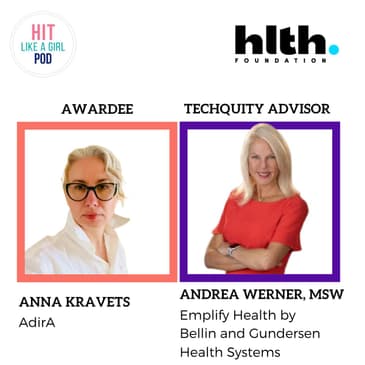
Each episode features a winning project, the first features Andrea Werner, Chief Population Health Officer for Bellin and Gundersen Health Systems, who interviews guest Anna Kravitz from AdirA to discuss "Nia," a digital guide addressing high breast cancer mortality rates among young black women.
Join the conversation as they delve into the intersection of technology and targeted health interventions, making a profound impact on underserved communities.
Want to learn more about the inspiring projects making healthcare more equitable? Head over to hitlikeagirlpod.com/techquity
Episode Highlights
[00:00:45] - Techquity Coalition's Focus on Health Disparities
[00:05:24] - Role of Technology in Addressing Health Disparities
[00:09:07] - Nia Solution for Empowering Women to Advocate for Their Health
[00:12:03] - Addressing Breast Cancer in Young Black Women
[00:21:09] - Providing Agency and Resources for Breast Cancer Awareness
[00:25:58] - Importance of Micro Moments in Health
[00:41:36] - Impact of Language Options on Engagement Rates
[00:00:00] Calling all Swifties and Champions of Change, Like a Girl Media is rolling out the red
[00:00:05] carpet for you with our Thrive Like a Girl contest.
[00:00:08] We're all about celebrating powerful women leaders who inspire us to dream big and push
[00:00:12] boundaries.
[00:00:13] And who embodies that spirit more than Taylor Swift herself?
[00:00:16] Here's your chance to see her live in concert.
[00:00:19] We're giving away two tickets to Taylor Swift's show in London on Saturday, June
[00:00:23] 22nd.
[00:00:24] Imagine being part of the magic all thanks to Like a Girl Media.
[00:00:28] Entering is easy.
[00:00:29] Subscribe, share and show us which episodes inspired you the most.
[00:00:33] Visit our website or check our social media for all the details.
[00:00:37] Don't just dream it, be it.
[00:00:39] Thrive like a girl and make this summer unforgettable.
[00:00:43] Contest opens globally.
[00:00:44] Voidware prohibited.
[00:00:45] Must be 18 or older to enter.
[00:00:47] No purchase necessary.
[00:00:49] Subscribe and share with hashtag Thrive Like a Girl and tag us at Like a Girl
[00:00:52] underscore media for entry.
[00:00:54] Unlimited entries means unlimited chances.
[00:00:57] Enter chosen at random after contest closes May 20th, 2024.
[00:01:02] We'll be notified via DM.
[00:01:03] Make sure your profiles are not private.
[00:01:06] Check full rules on our site.
[00:01:07] This is your shot to see Taylor Swift live.
[00:01:10] Don't miss it.
[00:01:22] Hello and welcome to the Hit Like a Girl podcast.
[00:01:24] My name is Joy Rios, the show's host, and today we are embarking on an exciting
[00:01:28] journey through our new five part series focused on tech-quity, which is the
[00:01:32] intersection of technology and health equity.
[00:01:36] In this inaugural episode, I am thrilled to welcome Jana Guinan from the Health
[00:01:40] Foundation. Jana is at the forefront of this initiative advocating for
[00:01:44] equitable digital health solutions that cater to the needs of underserved
[00:01:48] populations.
[00:01:50] Jana, thank you for joining us today and help us unpack what tech-quity
[00:01:53] actually is, why it matters and what we can look forward to in this series.
[00:01:58] Thanks, Joy. I'm really happy to be here to kick off this series of five guest
[00:02:02] episodes focused on tech-quity and health care, each of which will feature
[00:02:07] one of our well, feature five winners of the Tech-Quity for Health Case Study
[00:02:11] competition. And just to set the stage.
[00:02:14] So Health Foundation is a nonprofit organization and we're focused on five
[00:02:19] imperatives for sustainable and ethical health care, which are access,
[00:02:23] affordability, equity, inclusion and innovation.
[00:02:27] And technology, when you think about it, complicates all of these variables in
[00:02:31] health care. So about a year ago, the Health Foundation started the Tech-Quity
[00:02:35] for Health Coalition.
[00:02:37] And as a coalition, what we're really trying to do is help the industry
[00:02:40] understand and manage these factors so that we can have greater success and
[00:02:45] consistency in addressing health disparities through digital health.
[00:02:48] I mean, technology can be like the hero or the villain, and it needs to
[00:02:52] be at least a good supporting actor, you know, in the story of health
[00:02:56] equity. And that's why we started the coalition.
[00:02:58] So and then very specifically, the coalition is working on defining best
[00:03:02] practices and recommendations and also looking at metrics that we can use
[00:03:07] for digital health equity again or tech-quity.
[00:03:10] Before I go on, I just want to take a second and give credit and say
[00:03:14] thank you to the organizations that stepped up and supported the coalition
[00:03:18] from the very beginning before it was really anything but an idea.
[00:03:22] So big thanks to the American Medical Association, Amazon Web Services,
[00:03:27] Epistemic, Outcomes for Me, UST, also the National Association of
[00:03:32] Community Health Centers, ResMed, Empirics, VSP, Global Innovation.
[00:03:38] We've had some fantastic support to get off the ground.
[00:03:42] And also I have to just give some credit to our dedicated and
[00:03:48] really experienced group of advisors that are helping to drive this
[00:03:51] initiative, who have just been an incredible and valuable resource.
[00:03:54] And we have a lot of fun as a group, too.
[00:03:56] So thank you to the advisory committee of the coalition.
[00:04:00] And then that brings us to where we are right now.
[00:04:03] The Tech-Quity Coalition just completed its first case study competition
[00:04:07] where last fall we put out a call for cases and we're completely
[00:04:11] thrilled to get about 200 submissions from across the industry.
[00:04:15] It was one of the exciting things about this is not just the number,
[00:04:18] but the huge variety in these case studies.
[00:04:21] So across sectors, settings, technologies, just a great process for us
[00:04:27] to learn and to understand the landscape of Tech-Quity right now.
[00:04:31] And in the end, we awarded 11 projects.
[00:04:33] This was at the end of February at the Vive event.
[00:04:36] We held an award ceremony. It was really, really fun.
[00:04:38] And then just to explain why, like, why did we do this?
[00:04:42] The whole purpose for this competition was to bring visibility
[00:04:45] to the best practices as they stand today, to kind of confirm our understanding
[00:04:50] of Tech-Quity, how health equity can really show up,
[00:04:55] when we're implementing or innovating in digital health.
[00:04:58] And then to look at novel approaches to Tech-Quity and health care.
[00:05:01] And it really did give us some very interesting visibility into the landscape.
[00:05:06] So in each of the five episodes in this series, as I mentioned,
[00:05:10] we will feature one of the winners of the case study awards.
[00:05:14] They'll talk about their projects, the insights, you know, what they've learned.
[00:05:17] And we'll have a guest host, a different guest host for each of the interviews,
[00:05:21] which are one of the coalition advisors.
[00:05:24] And this has been great because we are our winners.
[00:05:27] Actually, there's a sort of a relationship.
[00:05:29] We were able to find an advisor to conduct each one of these interviews
[00:05:32] who is in one way or another kind of connected to or doing work
[00:05:37] in a related area. So great conversations.
[00:05:41] So here's the final thing.
[00:05:42] In just a moment, you'll hear from our first guest, Anna Kravitz.
[00:05:46] Anna is the president and the co-founder of Adira,
[00:05:48] which is a digital strategy consultancy.
[00:05:51] So she recently sat down with Andrea Werner,
[00:05:54] who is the chief population health officer at Bellin and Gunderson
[00:05:58] Health Systems and an advisor to the coalition.
[00:06:00] So I'll give you a little bit of background on what they're talking about here.
[00:06:04] So Anna and her team at Adira were challenged by Merck
[00:06:08] to confront the issue of high mortality rates from breast cancer among black women.
[00:06:13] And just I want to share one statistic.
[00:06:16] Black women have among the highest incidence of breast cancer among women in the US
[00:06:21] and women younger than age 50 are twice as likely to die from breast cancer
[00:06:27] as white women. So black women younger than age 50.
[00:06:30] And also, black women have just a higher overall mortality rate
[00:06:34] just at any age from breast cancer.
[00:06:36] So it's a big problem.
[00:06:38] So Merck sought to enhance awareness and encourage earlier
[00:06:43] and proactive health screenings among younger black women.
[00:06:46] Just, you know, that's going after consumer behavior is one way.
[00:06:50] But, you know, patient behavior, just make sure they understand the need
[00:06:52] and that they're able and know the resources to follow up
[00:06:55] and how it pertains to them.
[00:06:57] So what Adira did and their response was to develop NIA.
[00:07:01] And NIA is a digital guide that was created
[00:07:05] to educate and also to really provide like genuine support
[00:07:09] to black women. And it really resonates with them.
[00:07:13] It's you'll hear Anna talk about their success rates,
[00:07:17] like how long people stay and really do the consultations with NIA
[00:07:21] and different measures of success that they use.
[00:07:25] But in any case, this is an initiative that's really a standout example
[00:07:29] of how very thoughtful, targeted and culturally relevant interventions
[00:07:34] can make a significant impact.
[00:07:35] So I'm excited for you all to hear it.
[00:07:38] Wonderful. Thank you so much for all of that setup.
[00:07:40] And I can't wait for our audience to listen in to this conversation.
[00:07:44] So without further ado, let's dive in.
[00:07:47] Hi, my name is Andrea Werner and I'm the chief population
[00:07:50] health officer for Bellin and Gunnarsson Health System.
[00:07:52] And I've also had the privilege of sitting on the Tech
[00:07:55] Woody for Health Coalition for the last couple of years.
[00:07:58] It is a privilege for me to interview today
[00:08:01] Anna from Adira Health to learn about wonderful work
[00:08:05] that she and her team are doing with a solution that is called NIA.
[00:08:11] For me, leading population health, it has become crystal clear
[00:08:14] for the last couple of years that the intersection and interdependency
[00:08:18] between technology and improving the health of our communities is so important.
[00:08:23] And a lot of the health tech companies that we are learning about
[00:08:26] these days are really existing to solve one problem or another
[00:08:31] as it relates to delivering on triple aim or quadruple aim or quintuple aims.
[00:08:36] So when we think about equity results to the communities that we serve.
[00:08:40] So, Anna, maybe you can introduce yourself.
[00:08:42] Tell us a little bit about your story and how you got started with Adira
[00:08:48] and then bring us into learning a little bit about NIA.
[00:08:51] Thank you, Andrea.
[00:08:52] So my name is Anna Kravitz, and I'm a co-founder of a company called Adira.
[00:08:58] Adira is really was born out of the need to help people
[00:09:04] navigate the complexity of our health care.
[00:09:07] There is a lot of information, a lot of education.
[00:09:10] But what we decided to focus on is help people to take health action
[00:09:16] because there is so much information people can drown in.
[00:09:20] So we are a consumer health action company.
[00:09:23] My co-founder and I started this company to really focus on helping people
[00:09:30] navigate the complexity of health care, but specifically help people deal
[00:09:35] with the mountains of information and come to what is absolutely relevant
[00:09:41] for them and can help them lead to the proper health action for themselves.
[00:09:47] So we started about a little over five years ago.
[00:09:50] We build a number of solutions, both for private sector and public sector.
[00:09:57] We build some of the platforms that we own that have not been sponsored
[00:10:02] by anyone and always had health equity in mind because we felt that health
[00:10:08] action has to be achievable for everyone in the country.
[00:10:12] So we're not just a health equity company, but our health action
[00:10:18] is focused on delivering it for everyone.
[00:10:20] So double click, if you will, on NIA and the solution NIA.
[00:10:24] What problem were you trying to solve with NIA?
[00:10:27] So when we looked at the issues that exist in breast cancer, it's a complex
[00:10:36] topic for a lot of people to navigate, but specifically there was a much
[00:10:43] higher kind of barrier to overcome for younger black women.
[00:10:47] I don't know if everybody knows, but for younger black women ages 25 to 45.
[00:10:54] So it's in this pre-guideline phase for a regular screening, such as mammogram.
[00:11:02] That population tends to have very poor outcomes.
[00:11:06] They're more likely to get aggressive forms of breast cancer called TNBC.
[00:11:14] They're almost like three times more likely to get that aggressive form of breast cancer.
[00:11:20] In addition to that, because they get it at the younger age, oftentimes when
[00:11:25] they turn to the doctor, what they hear is you're too young to have breast cancer.
[00:11:31] The normal screening doesn't work very well because they have denser breast tissue.
[00:11:39] So because they are not being heard for their issues, the outcome is they tend
[00:11:46] to be screened later, diagnosed later.
[00:11:50] And ultimately younger black women in that age group end up with a 41% higher
[00:11:59] mortality rate from breast cancer than white women of the same age group.
[00:12:05] So what we wanted to focus on is to help the younger black women to understand
[00:12:12] signs, symptoms and the risks of breast cancer for that, their population.
[00:12:17] And be able to advocate for themselves and start taking more active role in
[00:12:24] their breast health, things like self-exams, regular clinical checkups with our doctor.
[00:12:32] So when something starts changing, they can catch it earlier.
[00:12:36] So the Techquity for Health Coalition has really been focused on thinking
[00:12:40] about technology that can equally distribute access to services, provide
[00:12:47] tools that are engaging and empowering to all populations.
[00:12:53] And one of the things that I've loved about NIA and one of the
[00:12:57] reasons why I scored NIA high in the radiance as a reviewer of these
[00:13:02] cases is the fact that you co-designed the solution with people who have
[00:13:08] lived experience, experts who came from the community.
[00:13:11] Can you tell us a little bit more about that Anna?
[00:13:13] Like who did you partner with?
[00:13:15] Absolutely.
[00:13:16] It takes a village to tackle difficult problems.
[00:13:19] First of all, I wanted to mention and acknowledge that the sponsor
[00:13:24] for Project NIA is Merck from Suricall Company.
[00:13:28] So they provided sponsorship and thought leadership around the subject matter.
[00:13:34] Our expertise is health action.
[00:13:36] Our expertise is not breast health necessarily, this clinical domain.
[00:13:41] But to make sure it's clinically relevant, what we have done is brought in
[00:13:47] black women's health imperative to really bring that voice of the community.
[00:13:52] So we worked with them to really zero in on that population.
[00:13:58] They helped us organize several focus groups and moderate those focus groups.
[00:14:03] Actually, the moderator herself is a black woman who is breast cancer
[00:14:08] survivor, so it really helped to bring that relationship and with the
[00:14:14] women that were part of the focus group and make sure that they felt
[00:14:19] comfortable to speak up about their experience.
[00:14:22] We also worked with black women's health imperative to really set the
[00:14:28] direction for the visual design, both for the look and feel, the palette,
[00:14:35] the tone of the conversation, design of the avatar for the experience was
[00:14:41] very important for us, making sure it's someone people will find relatable.
[00:14:46] But at the same time, they can connect with that avatar that they're having
[00:14:52] conversation with and Nia is the name of the avatar and hence the name for
[00:14:58] the project, Project Nia.
[00:15:00] So we knew that we got the design right.
[00:15:02] One of the reviewers from the community saw it and said, oh, Nia
[00:15:08] looks like a cousin who made it.
[00:15:10] Right?
[00:15:11] So it's like a cousin.
[00:15:12] Someone is from my community I can relate to.
[00:15:16] But at the same time, I can look up to them so I can take their advice.
[00:15:21] In addition to bringing the cultural expertise, sourcing it from the
[00:15:26] community, we engaged with the clinical expert from the community as well.
[00:15:31] So the clinician with whom we developed the algorithm for the digital
[00:15:36] conversation, Dr.
[00:15:38] Christy Johnson is herself a black female clinician who practices in
[00:15:43] Philadelphia and sees the population.
[00:15:46] So we bring it both from the clinical and then the cultural, and we try to
[00:15:52] immerse herself as much as possible with the representatives of the
[00:15:56] community we're trying to reach.
[00:15:58] I have to tell you that I experienced Nia and it was a really interesting
[00:16:03] experience.
[00:16:03] So I went out there and I found her in the Bellen region within our
[00:16:08] enterprise.
[00:16:09] We have a promise that we talk about and it's I will know you.
[00:16:12] I will show you respect.
[00:16:14] I will go with you on your journey and I'm here to help you.
[00:16:16] And I honestly felt like that's what Nia was doing with me all the way
[00:16:21] along.
[00:16:21] What was so interesting is that she would ask me questions and I had
[00:16:26] to be honest with her about an opportunity I have to improve with
[00:16:30] self breast exams.
[00:16:32] And it was so awesome because she did not feel bad about it.
[00:16:36] She framed it in a way where, well, great, but you could do
[00:16:41] better if you did this.
[00:16:42] She was instructional.
[00:16:44] I felt like she displayed empathy and it was so fascinating.
[00:16:48] And she kept telling me that at the end of the experience, I would walk
[00:16:51] away with a personalized report that I could take with me on my own
[00:16:56] health journey.
[00:16:57] And I thought that that was so fascinating and all along I could tell
[00:17:02] that she was designed in a way to meet people where they're at, not
[00:17:06] only culturally, but as unique individuals as we engage with her.
[00:17:11] And one of the outcomes that I'm really fascinated with with the Nia
[00:17:16] solution is the amount of time that people are willing to engage
[00:17:20] with her.
[00:17:20] So, Ana, my understanding, a really impressive outcome measure for
[00:17:24] Nia is that 66% of women who engage with her, engage with her
[00:17:30] longer than four minutes and 25% of people who engage with Nia
[00:17:35] engage with her longer than eight minutes.
[00:17:37] For me, I found myself spending a lot of time with her, partly because
[00:17:41] I was a curious healthcare professional, but also because Nia was challenging
[00:17:45] me to be a better steward of my own health.
[00:17:48] And it was fascinating.
[00:17:49] But I think that that's an outcome measure that is truly impressive.
[00:17:53] What other outcome measures or measures of success would you highlight
[00:17:58] for us that you're proud of with Nia?
[00:17:59] There are actually a few things.
[00:18:01] One, I would say is just targeting, making sure that we get to the right
[00:18:07] people because how many young women that are otherwise healthy may not
[00:18:15] realize that they have this higher risk factor for breast cancer would
[00:18:21] want to click on and add and talk about breast health.
[00:18:25] So making sure we're able to reach and engage young black women was something
[00:18:32] that we were not sure initially we'll be able to achieve, but because we have
[00:18:37] this kind of continuous loop between our outreach campaign and data coming
[00:18:43] from that and the data coming from the experience, we were able to get
[00:18:50] very, very tight targeting and about like 60% of women that come through
[00:19:00] the experience are black women, actually young women who ages 25 to 44,
[00:19:09] basically sub 45, and we have another pretty good number of women in that
[00:19:16] 18 to 24 age group.
[00:19:20] We, our experience is not under 18 so we politely exit people that come
[00:19:26] that are under 18 but that like think about that number of women in that
[00:19:31] younger age that are curious about that topic and starting to think
[00:19:36] about it early so we definitely got our age targeting down and then
[00:19:43] race also were close to 80% with getting right race targeted and one of
[00:19:51] the things is we definitely are not excluding anyone else but young black
[00:19:58] women first type of solution.
[00:20:00] It's mainly for them, but we have somewhere 16 to 17% of combined
[00:20:08] white and Hispanic coming to the solution and they still get a
[00:20:12] meaningful experience, but they're not the primary audience.
[00:20:15] So definitely getting the targeting right.
[00:20:17] Something that was pins and needles for us in the beginning, making sure
[00:20:22] that if we're trying to help this population, we're able to reach them.
[00:20:26] The second thing is the completion rate.
[00:20:30] We talked about how long women engage, but we also have this
[00:20:34] benchmark for us, how many women who started the experience
[00:20:39] actually complete that.
[00:20:41] And there we are at somewhere for the life of the program.
[00:20:46] We launched late last summer.
[00:20:48] We somewhere around 16, 17%, but we are continuing improving.
[00:20:53] So we're higher, but like the blended completion rate, which is
[00:20:57] three times industry average.
[00:20:59] And again, going back to the example I mentioned from the New York
[00:21:04] State WIC program and that program is called Project Wanda.
[00:21:10] One day sister of Mia there, there was a concern if we're able to meet
[00:21:16] the industry standard of about five to 7%, but we were able there to be
[00:21:22] that and be somewhere around 15, 16%.
[00:21:25] So here we're doing as much of not better.
[00:21:28] It's so fascinating to me.
[00:21:30] I mean, in population health, we think a lot about really
[00:21:33] solving those last mile problems.
[00:21:36] What do we really need to do to reach everybody, to drive outcomes and impact?
[00:21:41] And what just struck me is that you're leveraging technology in the
[00:21:46] spirit of equity and you're doing it by myth busting.
[00:21:50] Like you're creating a credible avatar, a credible experience, and you're
[00:21:56] busting the myth for these young black women and you're giving them the
[00:22:00] facts and you're equipping them with tools and information.
[00:22:04] A report, a guide to do the right thing.
[00:22:08] And normally these women may not have access to these types of resources
[00:22:13] and information, and you're creating a new narrative for the right thing
[00:22:17] to do with for breast cancer and young black women.
[00:22:20] It's really awesome.
[00:22:22] That's really awesome.
[00:22:23] Thank you.
[00:22:24] We definitely, we want to give them agency.
[00:22:27] We want them to be able to come, first of all, understand and take in that
[00:22:35] this problem exists, give them knowledge, give them tools and give them resources
[00:22:42] to have the better conversation with a doctor.
[00:22:45] We're not there of course to replace the doctor, but we want to make sure
[00:22:50] when they go for those checkups, they come informed and being able to
[00:22:56] advocate for themselves.
[00:22:57] Because as I said, we heard the stories of women getting a long windy road
[00:23:04] towards diagnosis, feeling something is off with them and not being heard
[00:23:10] for a few times when they voiced their complaints or sometimes even
[00:23:14] themselves not realizing that if I'm feeling something is off, it's
[00:23:19] important to go and get checked.
[00:23:21] But you would know that something is off if you know what the signs
[00:23:25] and symptoms are and what are your risk factors?
[00:23:30] I love the thought of giving agency in that that's exactly what you're doing.
[00:23:34] Knowledge is power, having someone support you, giving you information
[00:23:39] so that you can take charge of your health.
[00:23:40] I absolutely love that.
[00:23:42] I'm curious, what was your biggest surprise in all of this?
[00:23:46] Good, bad?
[00:23:47] What was the biggest surprise or biggest learning that maybe didn't expect?
[00:23:51] Yeah, that's a good question.
[00:23:53] The biggest surprise, we were a little bit again, speaking of myth busting,
[00:24:00] right?
[00:24:01] There is this notion that there is a complete mistrust of pharma industry
[00:24:08] among patients, among the population.
[00:24:11] So we were not sure if our statistics of engagement and completion would be
[00:24:18] on par with our other solutions.
[00:24:21] We've built solutions for travel health, for contraception, for, as I said,
[00:24:27] this women infant children program.
[00:24:30] And we had very good engagement, but this time it was very clearly stated
[00:24:35] that it's sponsored by pharmaceutical company.
[00:24:39] And guess what?
[00:24:41] We meet the same levels of engagement and in some cases even had better
[00:24:50] performance.
[00:24:51] And that speaks to, it doesn't matter who sponsor it.
[00:24:55] If you do it right, if you show through your solution, that you're
[00:25:03] speaking authentically, you truly care about them, you treat their time
[00:25:09] with respect and you treat them with respect and you don't talk down
[00:25:16] to people, you don't judge them and you give them something useful and
[00:25:21] relevant at the end.
[00:25:23] People will listen, people will work with you, people will take your
[00:25:27] advice and the information.
[00:25:30] So I think one example again, going back to the solution that we have
[00:25:36] done for New York state, for Wanda, when we were testing and that one was
[00:25:42] the person participating in the research or kind of giving feedback on
[00:25:47] the solution was a man taking care of the nephew and needed some support
[00:25:54] with nutrition.
[00:25:55] So went through our experience called Wanda, came to the end of it
[00:26:00] and said, Oh, that was simple.
[00:26:03] I got everything.
[00:26:04] It was quick.
[00:26:05] And you know what?
[00:26:06] It didn't make me think less of myself, right?
[00:26:09] Because a lot of time, even in the sense of efficiency or getting to the
[00:26:16] point of things, people feel like they're being talked down or it's
[00:26:21] some sort of going through the process type of experience.
[00:26:26] And it's hard for people to talk to another human at the time when they
[00:26:30] are vulnerable, they're not sure of themselves that meant the world to us.
[00:26:35] Right?
[00:26:36] It's those little comments, little remarks.
[00:26:41] And we spend a lot of time making sure we get the voice, right?
[00:26:45] The tone, right?
[00:26:47] Of that conversation because each of our solutions has its own, a
[00:26:53] little bit of the personality, a little bit of fun, making a joke.
[00:26:58] We hear there and depending on the topic, obviously we keep it within
[00:27:04] of what it is, but things don't need to be boring.
[00:27:08] Right?
[00:27:09] Even when you talk about serious topics.
[00:27:11] Absolutely.
[00:27:13] The TechWiddy for Health Coalition, we talk a lot about technology and the
[00:27:17] role in preventing further advancement of health disparities and closing the
[00:27:23] gap on disparities and solutions like the ones that you're describing,
[00:27:28] where you do the research and you do the hard work and you get to know
[00:27:35] through voice and through data, each unique population that you're
[00:27:39] serving just is so powerful.
[00:27:41] I think it's just incredibly powerful.
[00:27:44] And you're working with communities and populations who have had to
[00:27:48] struggle in the past and giving support right from the very beginning
[00:27:54] with the solution based on research.
[00:27:57] And again, through collective voice and experience, I think is just one of
[00:28:02] the most powerful things in the space of TechWiddy.
[00:28:05] That's one of the reasons why you won the award that you did.
[00:28:08] Congratulations again on that one.
[00:28:09] Thank you.
[00:28:10] What do you look forward to next?
[00:28:13] Like what is your next horizon with Adira and with this
[00:28:16] great work that you're doing?
[00:28:17] There are a few things we're currently working on a few other solutions.
[00:28:23] Some of them are in oncology space as well.
[00:28:27] I cannot talk about the specifics yet, but once they launch, I'm sure
[00:28:33] we'll want the world to know.
[00:28:35] But you know, we're also looking to build solutions that are more
[00:28:43] open for broader collaboration and participation from the ecosystem.
[00:28:49] Because I think it's really important to, especially for those complex
[00:28:54] problems for various organizations, whether it's public sector, private
[00:28:58] sector, academia, to be able to come together and leverage what was done
[00:29:05] by others and add on to their solutions.
[00:29:08] So think about having, we now have this great tool that provides
[00:29:15] education and then personalized curated summary of resources for women.
[00:29:22] Wouldn't it be wonderful to have other organizations that want to close
[00:29:27] the last mile of actually finding the doctor, setting up an appointment
[00:29:33] if someone doesn't have a doctor or really...
[00:29:37] So one of the things we always include in our solutions is social
[00:29:41] determinants of health, assessment of what gets in the way of you getting
[00:29:46] care that you want, that you need.
[00:29:49] Everything from transportation, childcare, work and so on.
[00:29:55] There's so many organizations that provide those services.
[00:29:59] So being able to at the end of it, to connect into all of that.
[00:30:05] So we don't just give like a summary guide with the resources at
[00:30:10] the end, but we provide integration and we've done that for our health
[00:30:15] and travel, a platform at the end if a person is interested in after
[00:30:19] we help them understand food and water safety, vaccines they need for
[00:30:24] the travel destination they're going to.
[00:30:27] They want to, we help them schedule an appointment for
[00:30:30] pre-travel health consultation.
[00:30:33] But that's the platform that we own ourselves and there is no
[00:30:38] constraints of what can be sponsored by different sponsor.
[00:30:43] So we really would like to do more of those solutions that
[00:30:49] multiple parties can participate in.
[00:30:51] So we're thinking of applying for some grants so we can build those
[00:30:56] more solutions that are open for collaboration and participation
[00:31:02] for everyone who is interested.
[00:31:04] Partnerships, I think are one of the most powerful things in those of us
[00:31:10] and who are part of organizations and individuals who care about
[00:31:14] advancing health equity.
[00:31:16] How do you approach partnerships or what are your thoughts on partnerships?
[00:31:21] We partner as much as possible.
[00:31:25] One thing or one guiding principles for us in ADHERA is not to build
[00:31:32] anything that already exists in the market.
[00:31:35] And also strong recognition that we're not experts in everything.
[00:31:42] So we are a self-funded bootstrapped company and from the beginning,
[00:31:48] we decided that technology wise there's so many technical
[00:31:54] platforms in the market.
[00:31:56] We'll find the right ones.
[00:31:57] We'll partner with them.
[00:31:58] We'll leverage it.
[00:32:00] And what we will focus on is what I have seen as a tremendous gap in the
[00:32:10] health IT innovation across the board is coming up with really good use cases
[00:32:17] for various technology, defining your problem while bringing the data that
[00:32:23] has the evidence that it's a problem and having those statistics because
[00:32:28] that helps you define a good solution that you can also measure.
[00:32:33] Are you making a dent by your solution in solving that problem?
[00:32:37] Number two, executing it with as much care, creativity, fidelity,
[00:32:45] cultural intentionality, focus on excellent user experience,
[00:32:51] beautiful design, good, good content.
[00:32:56] That's another piece is a great execution of the solution to problem,
[00:33:01] to the use case that is well defined.
[00:33:04] And then last but not least is operating it well because oftentimes
[00:33:09] wonderful things are built and then they put out there and if they don't
[00:33:16] get continuous care and feeding and looking at the data and feeding,
[00:33:21] what you learn from the data back into improving your solution or maybe
[00:33:27] modifying it to be a better solution and using this data to identify
[00:33:34] opportunities for other unmet needs and maybe either expanding your
[00:33:40] solution or building new solution.
[00:33:43] It's no good for anyone, right?
[00:33:45] Everything needs care and feeding.
[00:33:47] You plant a beautiful garden if you don't weed it.
[00:33:50] It's going to go bad on you quickly.
[00:33:53] And because of that philosophy, wherever possible, we bring the right expertise.
[00:34:00] We're experts in defining the problems while building great consumer
[00:34:05] health action solutions, but we're not clinical experts in any
[00:34:11] particular clinical space.
[00:34:13] As I said, we've done solutions, everything from nutrition to cancer,
[00:34:17] to contraception, to travel health, you name it.
[00:34:21] For those we bring the right clinical expertise and we typically work with
[00:34:27] people who are not just KOLs and focused on just like a high level
[00:34:32] thought leadership, we want people that actually work closely with the
[00:34:36] patients because our solution is patient facing and we see our solutions as
[00:34:42] almost like an extension of that clinical capacity into the form of
[00:34:47] digital conversation.
[00:34:48] So we can take 80% of the common topics or ways that this problem framed
[00:34:56] and exists in people and digitize that.
[00:34:59] So we bring in clinical partners, we bring cultural partners,
[00:35:04] depending on what it is.
[00:35:07] We work with outreach partners that have maybe footprint in the
[00:35:11] community or oftentimes when we do it for sponsors, they often have
[00:35:18] agency already doing digital outreach, but we engage with them in a
[00:35:23] completely different way that they've ever worked with anyone else.
[00:35:28] Any other digital solution, we have weekly meetings with them.
[00:35:33] We compare notes of what we're seeing in terms of the traffic that
[00:35:38] comes from that outreach, how they're behaving.
[00:35:41] We're moderately giving them that feedback.
[00:35:45] They refine their campaigns, their messaging, their targeting.
[00:35:49] We were able to make tremendous improvement from the initial start of
[00:35:56] those campaigns to how well they're performing ultimately when we get
[00:36:00] into a steady state.
[00:36:02] So we partner a lot.
[00:36:03] And I love that you mentioned humility as the key to being a good
[00:36:08] partner. And I love that you gave a strong nod to quality improvement.
[00:36:13] I always say life and work is one big PDSA, one big quality improvement
[00:36:17] project. So when you think of the solutions that you have at Adira,
[00:36:21] do you have a standard scorecard for all your solutions that you use
[00:36:26] and metrics that you look at across the different solutions?
[00:36:30] And do you have a common way of reporting those out to stakeholders
[00:36:33] and then improvement methodology that you use or how do you go about
[00:36:37] formally integrating that into your work?
[00:36:40] Yeah, because we're very clear about what we do.
[00:36:43] We know the problem we're solving and it's data-backed and we know
[00:36:48] what health action we're looking to affect.
[00:36:53] Basically, between that, that sets the framework.
[00:36:57] So people, we know who we're targeting.
[00:36:59] So the first thing we always focused on, are we getting the right
[00:37:03] people who this solution is for?
[00:37:06] Because if we're not, we are spraying and praying.
[00:37:09] We are very specific about who are we after?
[00:37:13] And because we know what we're trying basically for them to
[00:37:18] complete that experience, driving that to that point that
[00:37:22] we consider like a completer, there are certain milestones
[00:37:27] on the way to that. So every solution we have, we built,
[00:37:31] has what we call funnel.
[00:37:34] Right? For people that come and then what happens with them,
[00:37:37] like where are we losing them?
[00:37:39] And we monitor that and we adjust our solution both from
[00:37:45] starting from getting quality input in people who are actually
[00:37:49] this is for and then delivering the right experience to them.
[00:37:53] So this is why we always very clear, like what we report on
[00:37:58] is our targeting on point, is our completion on point.
[00:38:03] Are people engaging long enough to comprehend the information?
[00:38:07] And of course, with every solution we ask for rating.
[00:38:11] So going back to Project NIA, I would say as last time I looked
[00:38:16] about 84% gave a five-star rating and the five-star
[00:38:22] and four-star combined was 93%.
[00:38:26] So congratulations.
[00:38:27] Thank you. Thank you.
[00:38:28] So imagine talking about not the most exciting topic of
[00:38:32] breast health for four plus minutes and then after that,
[00:38:36] giving five-star rating is extremely humbling for us
[00:38:41] when we are grateful.
[00:38:42] Congratulations on that.
[00:38:44] What are you curious about in terms of the next evolution
[00:38:48] of NIA? Do you see NIA evolving into doing even more
[00:38:53] in this space or do you see NIA serving her purpose?
[00:38:57] So one thing I would imagine NIA staying there for as long
[00:39:02] as she is useful, because there is always that next young
[00:39:06] generation coming in that need to be informed,
[00:39:10] educated and activated to be serious about managing their breast health.
[00:39:15] But in general, what we try to do is what kind of like,
[00:39:21] why do we create experiences that we create?
[00:39:24] Right.
[00:39:24] Those are digital conversational experiences that somewhere
[00:39:30] three to five minutes long.
[00:39:32] We call those experiences micro moments.
[00:39:36] So that's what we try to create for people because we realize
[00:39:40] everyone has their busy life.
[00:39:43] They have million things that they're responsible for.
[00:39:46] Oftentimes health is not a priority for people until
[00:39:51] it's there's something acute.
[00:39:53] So somewhere along the journey from being healthy to having
[00:39:58] been diagnosed and dealing with the diagnosis and so on,
[00:40:02] there are always those moments like we call them sliding doors
[00:40:06] where you can fall off the wagon and don't give yourself
[00:40:10] the right attention, the right care.
[00:40:12] It could be by just not knowing and doing nothing or knowing
[00:40:17] and thinking that it's the problem is insurmountable or you have
[00:40:22] other things or whatever gets in the way of you either doing
[00:40:27] the wrong thing or doing nothing.
[00:40:29] And what we want to do is create the right experience,
[00:40:34] the build those micro moments for people to do the reality
[00:40:38] check, do the education, give them tools to that health action.
[00:40:43] So they stay on the right course so they can have the best
[00:40:48] health trajectory for themselves.
[00:40:50] So what we want to do is with Nia or her sisters is to make sure
[00:40:57] that we cover all continuum.
[00:40:59] So if you think about Nia, she's in this population screening phase,
[00:41:04] but there are also people who are in this like symptomatic
[00:41:09] pre diagnosis going through diagnosis.
[00:41:11] There's so many people that get stuck and they get something
[00:41:16] abnormal and don't necessarily take it all the way through or take
[00:41:20] too long to get fully diagnosed so they can get treatment and then so on.
[00:41:26] So definitely we want to build more along that continuum of disease
[00:41:33] progression, but also think about like all the other things that branch out.
[00:41:40] So I love micro moments and TechWidi has such a huge opportunity because we know
[00:41:48] 80% of our health and wellbeing has nothing to do with clinical care.
[00:41:53] 20% has to do with being inside walls of a defined healthcare situation or
[00:42:00] experience.
[00:42:01] Micro moments empower a unique kind of access, levering technology
[00:42:06] that's available to everyone.
[00:42:09] And so I just love that concept of micro moments because people have the ability
[00:42:13] to access information that can empower them on their terms, when they want it,
[00:42:18] where they feel safe, when they have time and when they can act.
[00:42:24] And then they can revisit it.
[00:42:25] So TechWidi and Access walk hand in hand together and your solutions that
[00:42:30] you're describing Nia, Wanda are just great examples of that.
[00:42:35] Such great examples of that.
[00:42:37] You're giving Access an agency.
[00:42:39] It's so, it's just brilliant.
[00:42:40] Thank you.
[00:42:41] That's Access an agency with respect without judgment.
[00:42:47] That's what we're shooting for.
[00:42:49] Well, Ana, I would just like to express my gratitude to you, to the
[00:42:52] Black Women's Health Imperative, to Merck, to Adira for giving the
[00:42:57] communities that we serve collectively the opportunity to engage.
[00:43:02] The fact that vulnerable young Black women have a resource to go to, invite
[00:43:09] and engage and empower them in leading their healthiest lives is spectacular.
[00:43:13] So on behalf of Bellin & Gunnarsson Health System, whom I am employed by
[00:43:19] and loyal to and proud of, and on behalf of the TechWidi for Health
[00:43:23] Coalition and Hit Like A Girl, I just want to say thank you and keep going.
[00:43:28] And I look forward to hearing in a few months and years.
[00:43:32] What Adira is up to next.
[00:43:34] So take care and thank you so much.
[00:43:35] Thank you, Andrea.
[00:43:36] And thank you, TechWidi Coalition.
[00:43:40] Thanks for joining us as we've explored this winning TechWidi case study.
[00:43:44] To learn more about the amazing work being recognized by the
[00:43:47] TechWidi for Health Coalition and see all the incredible winners we
[00:43:51] featured throughout this series, head over to the dedicated TechWidi
[00:43:54] landing page on the Hit Like A Girl website.
[00:43:57] You'll find it linked in the show notes.
[00:43:59] Before you go, remember to like, follow and subscribe to the Hit Like
[00:44:02] A Girl podcast wherever you listen.
[00:44:04] And if you've enjoyed this episode, please share it with a friend who
[00:44:07] might be interested in digital health equity.
[00:44:10] All right.
[00:44:10] Thanks.
[00:44:11] See you soon.