
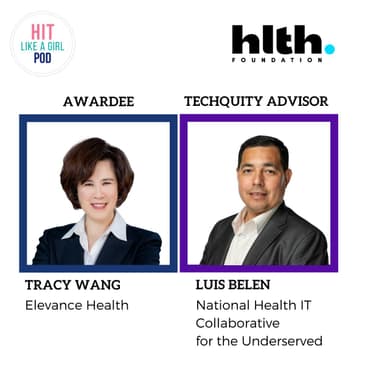

In the final episode of the Techquity Series, Luis Belen and Tracy Wang delve into the realm of health equity and technology, showcasing the transformative power of data-driven initiatives.
Tracy Wang, Director of Digital Solutions at Elevance Health, shares insights into a groundbreaking project aimed at addressing health disparities through innovative data visualization and analytics. The conversation highlights the crucial role of community engagement and the strategic use of data to drive impactful interventions.
Luis and Tracy explore the challenges of building trust in underserved communities and the importance of aligning priorities with community needs to maximize the impact of health equity efforts.
Want to learn more about the inspiring projects making healthcare more equitable? Head over to hitlikeagirlpod.com/techquity
Episode Highlights
00:07:29 - Introduction by Luis Belen and Tracy Wang
00:08:22 - Recognition of Tracy Wang's Initiatives
00:08:55 - Description of the Project's Objectives
00:13:46 - Importance of Data Visualization and Engagement
00:26:52 - Discussion on Trust in Underserved Communities
00:27:53 - Engagement Strategies and ROI in Health Equity Efforts
00:40:09 - Value of Centralized Data for Addressing Disparities
[00:00:00] .
[00:00:08] Hello and welcome back to the HIT Like a Girl Podcast. I'm your host, Joy Rios, and you are tuning into the second episode of our five part series on TechWiddy, Digital Health Equity. Our goal is to explore how technology can be harnessed to create fairer health outcomes for everyone.
[00:00:25] Today we continue our conversation with Jana Guinan from the Health Foundation. Jana, it's great to have you with us again to discuss the significant role of the TechWiddy Case Study Awards in driving forward the agenda of education, research and advocacy.
[00:00:39] In our last episode, we delved into the origin story of this initiative. So thank you very much for sharing all of that.
[00:00:46] Today, let's explore the criteria and selection process that's used to identify the winners of these awards. What specific metrics and rubrics were implemented to evaluate these award winning initiatives? I'm so eager to hear how these helped distinguish who became a standout awardee among the submissions.
[00:01:07] Thank you, Joy. Good to be back. First and foremost, before we even start, I just want to recognize up front that the TechWiddy for Health Coalition are not the pioneers in qualifying or quantifying health equity or addressing health disparities. There are decades of research studies and I don't even know how many thousands of dedicated individuals over the years contributing to this field.
[00:01:32] I just want to make sure we acknowledge all of that existing work. But we are still at the emerging stage of understanding how to use data and technology to reduce disparities and mitigate inequities related to health.
[00:01:46] And so this is why we run the TechWiddy for Health Coalition. We're focusing on that gap in knowledge and the goal is to help the industry sort of standardize approaches to digital health, specifically for underserved populations.
[00:01:59] So it's all about overcoming health disparities and doing it with more consistency and success.
[00:02:04] Alright, so about the case study competition. This is a really interesting process to go through with our advisors and the conversations that we had had in the basically for the previous year helped to inform where we went as well as I mentioned before, existing knowledge and health equity, right?
[00:02:19] But we did have to establish our own criteria for the case study competition that reflects the values of technology, of TechWiddy and health care.
[00:02:27] So all of this typical standard measures that you might use like a clear problem definition, the use of smart goals and achieving defined outcomes.
[00:02:37] Although I will say in this, we also invited works in progress. So we wanted to make it clear that we wanted to award like learning and insight and setting yourself up in a project for learning and insight as much as we would award outcomes or if it's not as much as that we would consider and weigh heavily how much a project was set up for learning because a big piece of TechWiddy just has to be collaboration.
[00:03:04] But there you go. And beyond the traditional kinds of metrics that you would see, I'll just mention a few of the factors that we looked at. So the degree of collaboration with other stakeholders. There's just never one stakeholder group.
[00:03:17] It seems very clear again from like previous research and and frankly from what we know about diversity on any project that collaboration between stakeholders is really important.
[00:03:28] So we weighed that heavily. We also looked at how projects delivered value to the surrounding community. So rather than distracting knowledge from the population intended to benefit, it was what was there a give back? Was there a consideration to how to extend value beyond the project itself, beyond the technology itself?
[00:03:47] We also looked at how projects engaged with the intended beneficiaries of their work, specifically patients. So did they take the time to challenge assumptions with thorough research into patient needs and perspectives at the beginning of the project?
[00:04:01] And we also looked at how or whether they built in feedback loops so that patients had a chance to weigh in or professionals too. I mean, some of these are patient facing, but there's a maybe a professional usage to the technology as well.
[00:04:16] So did the users and the attended beneficiaries have a chance to weigh in on their experiences during or after the project? Right. That's the only way you can learn about a community or a population upfront, but then how well did it really go?
[00:04:29] And the only way to adapt is to ask those questions during and after as well. And then I'll throw in one innovation, innovative criterion that we used as well. And that was around environmental impact measures.
[00:04:40] And honestly, this I don't know if we had anyone report on that yet, but we know that the healthcare industry contributes significantly to nationally to greenhouse gas emissions. It's like a I don't know what the number is, but it's a high percentage, like maybe 8% or so.
[00:04:55] So we do hope to see more projects as we move forward that we'll consider their environmental footprint. Just moving forward, it just has to happen. So by introducing it, we hope that at least we generated some awareness.
[00:05:07] So ultimately, by applying the values that we have around equity to these case study awards, we're aiming to paint just a clearer picture of the current landscape in equity projects and then to share their practices.
[00:05:20] So as listeners here each episode, I hope they'll appreciate how these values and aspects set our winners apart because they really blew us away.
[00:05:28] It's so inspiring to hear about the emphasis that's placed both on community involvement and that proactive approach to environmental impact that is so, so, so important. Both of those elements are crucial to making a real difference and achieving genuine equity, I think.
[00:05:45] So today we continue our exploration of these great projects as we introduce another award winner. Can you tell us about who we will be hearing from in today's episode?
[00:05:55] So today's episode focuses on enterprise data and analytics, and this is a project submitted by the Carillon Division of Elevance, I mean, Elevance the health insurer.
[00:06:05] So they earned an equity for health case study award for their like super comprehensive approach to developing insights around social determinants of health data among their members.
[00:06:15] And it was really complex. They had to harmonize data across sources and ensure interoperability of data, develop dashboards and reports for all of their users.
[00:06:26] And it was just an extensive effort to bring visibility to health related social risks again among their members and a really cool thing they did like so groundbreaking in this, I think.
[00:06:38] They made new tools available both within Elevance like across their enterprise, which is enough right there, but also to their surrounding community.
[00:06:48] So for the audience, when you hear this interview, listen for the ways that they are supporting the data users and learning from them.
[00:06:56] They did so much to make this project interactive and to make it a learning experience for the project managers as well as for the people making use of the data.
[00:07:08] So here we go. You are going to hear from Tracy Wang, Director of Digital Solutions for Enterprise Data and Analytics at Carillon, who will be interviewed by Luis Belen, the CEO of the National Health IT Collaborative for the Underserved.
[00:07:22] Luis is also an advisor to the Tech Equity for Health Coalition.
[00:07:25] Wonderful. All right, let's dive in.
[00:07:27] Hi, my name is Luis Belen. I'm the CEO of the National Health IT Collaborative for the Underserved, NHIT.
[00:07:34] The organization itself was launched in 2008, funded by the Office of Minority Health at HHS and the National Institute of Minority Health Health Disparities.
[00:07:44] And our entire focus has been leveraging health information technology to address disparities.
[00:07:51] I'm also a proud advisor of two, the Health Foundation's Tech Equity for Health Coalition.
[00:08:00] I'm here with Tracy Wang, who's the Digital Solutions Director and the Enterprise Data Analytics team at Carillon Digital Platforms within the Elevance Health, who recently won an award in our Tech Equity for Health case study competition.
[00:08:20] Tracy, welcome.
[00:08:21] Thank you for having me.
[00:08:22] We're happy to have you here with us today.
[00:08:25] Tracy, your initiatives made a remarkable strides in using data visualization analytics and interoperability to identify and make visible health related social risks across the enterprise and in your surrounding communities.
[00:08:43] Can you take a moment to describe your project?
[00:08:46] What problems you were trying to resolve?
[00:08:49] What do you do?
[00:08:50] And what do you hope to accomplish with this project?
[00:08:54] Happy to do so. So I'll just start by framing the why. Why is addressing health equity so important?
[00:09:01] And just to level set a bit, health equity means everyone has a fair and just opportunity to be as healthy as possible.
[00:09:09] And we know that barriers to doing so has to be removed. And that's like discrimination or met needs.
[00:09:16] It definitely is not the same as health equality, which is like a one size fits all approach that suggests we give everyone the same resources, whether they need them or not.
[00:09:27] So, of course, more equitable health care is attainable. But are we there yet?
[00:09:32] So let me give you some statistics. One in five people don't have transportation to the doctors.
[00:09:39] And about 50 percent of Americans can't even find affordable, healthy food and inequities create 93 billion dollars in excess medical costs.
[00:09:50] So how might we overcome these barriers to achieve equity?
[00:09:54] Well, we know unique life circumstances and experiences impact every individual and their health.
[00:10:01] As we look more broadly at what drives health, it's clear that health is driven by social and behavioral factors in addition to the physical factors.
[00:10:09] We must build partnerships where people are to support health holistically.
[00:10:14] We also need to imagine the health system, and that's going to start with harnessing the data, which gives a more complete picture of each individual and their health needs.
[00:10:24] This can also help make health care more personalized and equitable.
[00:10:28] We also need tools to help us gain data driven insights and take actions to address whole health.
[00:10:34] Then we track population health over time.
[00:10:37] So at Elevance Health, we come into something called the Health Equity by Design, which means we create personalized and intentional approach to ensure that all people,
[00:10:46] regardless of their race or ethnicity, sexual orientation, gender identity, disability and geographic or financial access can receive individualized care.
[00:10:58] In other words, it means that we prioritize our efforts and investments that deliver on optimizing health at the individual level for all.
[00:11:06] So now that we have the chance to kind of frame that the reasons for advancing health equity and the why conceptually,
[00:11:13] I'm going to talk through the what that makes the data and tools so valuable for driving improvements in equitable care.
[00:11:20] And so to really address whole health, we need centralized and actionable data.
[00:11:25] When we look at the factors that drive the health of our communities, we see that only 20% of those drivers are connected to clinical care.
[00:11:33] So it's things like your physical, behavioral and maternal health, inpatient emergency and pharmacy utilization.
[00:11:40] The other 80% of health is driven by what happens outside of the doctor's office, such as your social economic factor, environmental factor, geographic and behavioral factors.
[00:11:52] We need to be able to gain data-driven insights into that 80%.
[00:11:57] So looking at all these factors allows us to address more than medical needs so that we can improve whole health and track population health over time.
[00:12:06] So what exactly do we do?
[00:12:09] We ended up adding social data to our clinical data to create this holistic view of our membership and the communities where they live.
[00:12:17] We brought in community social risk data like social vulnerability index based on latest information available from reputable public sources, such as your American Community Survey.
[00:12:29] We also ingested member social needs data, things like food insecurity, housing instability and transportation insecurity based on member and vendor sources like your claims data, social needs screeners.
[00:12:43] And then we summarize all of these public and member data by demographics.
[00:12:48] So we stratify by age, by gender, race, ethnicity, where they reside, the type of community, and then by geography with a state level, regional, county zip code.
[00:12:58] And then we employ a framework for whole health management analytics.
[00:13:03] And this framework begins with the identification of health needs through the insights that's given by these data.
[00:13:11] And the insights are then used to develop strategic priorities, initiatives and goals.
[00:13:17] Next, we deploy the programs and interventions.
[00:13:20] And after these interventions are launched, we continue to rely on analytics to evaluate the effectiveness of these programs.
[00:13:28] And our reflection from these evaluations will guide us to return to our strategic development of these initiatives.
[00:13:34] And then the process continues in this continuous data driven cycle.
[00:13:39] So ultimately, success is about decreasing disparities in the outcomes that we're seeing in our populations.
[00:13:45] Thanks a lot, Tracy, for giving us that background.
[00:13:48] I like to say that data for the sake of data is just data.
[00:13:52] And the fact that you use data to actually look at innovations and engagement is so important.
[00:13:59] So thank you for doing this. The type of work that NHIT has been doing with the Data Fusion Center.
[00:14:04] Tracy, the other part that I think is so crucial in these type of efforts are partners.
[00:14:11] Making sure that the community relations and the community partners are involved.
[00:14:16] Can you talk to us and give us some background on how you leverage community relationships
[00:14:21] and how important they were in the aspect of this project?
[00:14:26] And can you tell us that or any other key partners that you work with to make sure the success of this project and this initiative?
[00:14:34] Absolutely. I think we all know that it takes a village and effective partnership to make lasting, impactful changes
[00:14:42] that will benefit all individuals in their communities.
[00:14:45] And I'll just tackle this with both internal and external partners that we've engaged with.
[00:14:50] So within Advanced Health, cross-functional teams, we work together and share the goals.
[00:14:56] And I'll just kind of give you a view of what that looks like.
[00:14:59] We have the Enterprise Data and Analytics Team or EDA in.
[00:15:03] We aggregate disparate data inputs from these public and member sources.
[00:15:08] We apply interoperable data standards and that with guidance from other teams like Advanced Analytics and Health Outcomes Organization.
[00:15:18] And we also maintain this centralized repository so that our downstream data consumers like care management team can use the information with confidence.
[00:15:28] So EDA, we tag team with government analytics area to create the data analytics reporting capabilities.
[00:15:37] Then we work together to train the whole health equity and quality team so that they can claim actionable insights that inform their population health management strategies.
[00:15:46] Each of the local health plans engage in short term sprints where they use the data to identify health needs,
[00:15:53] their implement interventions locally to find those smart goals, and then they measure outcomes to evaluate program success.
[00:16:01] Internally, we have regular touch points to communicate feedback and best practices as well as leader update to ensure there's continuous buy in.
[00:16:10] And then externally, we engage with industry leaders like the Gravity Project where I sit on its operating committee.
[00:16:16] This is where we shape data standardization priorities and I can bring back Intel so we can align accordingly.
[00:16:23] So secondly, outside of the company, we lean on community based organizations and social service vendors to help support our members physical, behavioral and social needs.
[00:16:34] So for expectant mothers, we implemented doula programs and we're seeing positive results so very exciting.
[00:16:42] We funded community based organizations to increase access to doula services by training new doulas in black and rural communities that needed them the most.
[00:16:53] And we also offer programs that support members with chronic conditions.
[00:16:57] Things like we deployed a home visiting program, and it is staffed by community health workers to engage the black and Hispanic families in pediatric asthma management and home remediation.
[00:17:10] We implemented food as a value added benefit, so that we can support our black members with diabetes and targeting body mass index reduction.
[00:17:20] So those are just a flavor of the partnership that we engage into.
[00:17:24] I cannot overemphasize how important that is right, that a lot of the times we're building these efforts from the top down, and we leave the communities out right and so the fact that you proactively engage the communities in this project is amazing.
[00:17:39] Tracy, a lot of this work comes down to are we making a difference?
[00:17:44] Can you talk to us about the measures that you use both quantitative and qualitative and also tell us some of the outcomes that you achieved.
[00:17:55] It seems like this was an amazing project but can you share your best practices around this because I think that's crucial for our audience to learn.
[00:18:05] Yes, totally agree. I think measurement and evaluation of success is super important if we want to continue to work on this initiative.
[00:18:15] And I'll just talk about two groups of goals and metrics. The first one is tied to the analytics and insights tool that we have developed.
[00:18:24] And it's going to focus on tool adoption, the usage frequency and user experience. So first of all, we were given a chunk of money and so we have to release a product right?
[00:18:36] And then we have to make sure that they're released according to the timing indicated on the product roadmap. And then we had to make sure that there are ongoing enhancements.
[00:18:47] And then second of all, once the product is released, we want to make sure people are using it and are happy with it.
[00:18:53] So we have increased digital tool adoption rate for the associate by greater than 5% year over year as a goal.
[00:19:02] Specifically that measures looks like the number of cumulative users that are using their tools.
[00:19:08] How many people are actively using it each month? And how many sessions are active each month?
[00:19:14] We look at presentations conducted for both internal and external audiences.
[00:19:19] And we also look at how many proposals or reports that the tool supported, including for our regulatory and accrediting bodies.
[00:19:29] And then thirdly, in terms of experience, we want to achieve a favorable net promoter score or NPS.
[00:19:36] And we target achieving above 20 each year. So that's about the tools itself.
[00:19:42] The second group of goals and metric really is like the impact.
[00:19:46] What did we make a difference? So that's going to be the population health management interventions that have been established by each health plan.
[00:19:54] And that's going to vary by local circumstances. But typically they would include things like improved clinical outcomes.
[00:20:01] So like preterm birth, asthma control. Second, reduce unnecessary utilization and things like inpatient admissions, emergency department visits.
[00:20:13] And third would be increased access to care and services.
[00:20:17] And that will be looked at by how many get a prenatal care visits they've had.
[00:20:22] How many social interventions do we perform?
[00:20:25] And then fourthly, we look at controlling overall costs.
[00:20:29] And that would be looking at the health care spend. Was there some sort of return on investment?
[00:20:35] And then lastly, we want to be able to improve participant experience and satisfaction.
[00:20:40] And that can be done through experience survey that we conducted and also the qualitative feedback that we're receiving from the participants in the program.
[00:20:50] So I know it's a lot, but I feel like it gives us a more comprehensive picture into how successful the program is and making an impact.
[00:20:58] Tracy, I like to talk and think about health equity and working with and underserved communities.
[00:21:05] And even the last mile, right? The reality is that this is tough work, right?
[00:21:10] And you've got to be committed for the long term outcome to have this success.
[00:21:16] At the same time, we've got to understand that there are challenges in these type of projects and hence why we need the long term commitment.
[00:21:24] Can you talk to us about some of the challenges that you had to overcome implementing this initiative?
[00:21:32] Sure. I would say that probably the greatest roadblocks for us was making sure that there is continuous funding for this work.
[00:21:41] And then that we're prioritizing any new development appropriately.
[00:21:46] So the minimum viable product or the MVP of the tools were funded initially with reallocated dollars from Medicaid growth team.
[00:21:57] So it's designed with their interests in mind.
[00:22:00] And I think initially it was tempting to want to try to boil the ocean.
[00:22:04] So we focus on the 80-20 rule.
[00:22:07] What 20 percent of data is going to bring us 80 percent of the value we're looking for?
[00:22:12] And we know that's not going to satisfy everybody, but it's a start.
[00:22:16] As we promoted the tools and obtained additional user feedback, we had to work with Medicaid analytics team to prioritize the enhancements and the new features that they want enabled.
[00:22:28] And then there was a time when the initial funding ran out and we have to have past development for a period of time.
[00:22:34] Then we work together with existing and new business partners to seek new technology dollars.
[00:22:41] And I'm glad to say that we successfully obtained the funding so that we can expand our work because it is so important for the company and it's a priority.
[00:22:50] Congrats on that, Tracy.
[00:22:52] And I do have some questions later on about the status.
[00:22:55] But, you know, the reality is that we need to look at beyond the tech.
[00:23:00] Right. So can you talk to us about what factors beyond the technology do you believe are crucial to addressing social determinants of health?
[00:23:09] Absolutely. So actually quite a few factors come to mind as I think about how to bring people along in this journey.
[00:23:17] So for me, I'll just start with aligning with industry standard requirements.
[00:23:21] So we start by looking at what is the demand of us?
[00:23:25] What's CMS asking? What's Medicaid state asking? What is our accrediting body like National Committee for Quality Assurance is asking?
[00:23:34] They want to make sure that there's leadership buy-in and adoption for resources and who is at the table and is willing to sponsor this work.
[00:23:41] What's the value we're bringing to them?
[00:23:44] When I think about streamlining stakeholder interests so we can scale this appropriately, I want to know what is on their mind.
[00:23:51] What is their agenda? Is there a way to create efficiency?
[00:23:54] Then we want to make sure we collaborate and have a team across enterprise focus on this work so that we can leverage collective expertise.
[00:24:04] And then there's sharing out the knowledge and making sure we bring new people along.
[00:24:09] So how do you make sure we have forums to ensure everyone stays on the same page?
[00:24:14] And then lastly, we kind of like enabling the analytics and insights that have been derived from these tools.
[00:24:21] And how do we scale best practices so that everyone benefits at the end?
[00:24:26] I cannot all emphasize about keeping both the community and the partners engaged in these type of initiatives.
[00:24:34] One of the things with these type of projects is that sometimes they just go away.
[00:24:40] So can you talk to us about where the project is today?
[00:24:44] What are your plans to expand and replicate this project and keep the momentum because this is such an amazing initiative that I believe a lot of folks should know about and that it should be replicated.
[00:24:56] Can you just give us where we stand right now with the project?
[00:25:00] Sure. I'm super happy to say that it is still going on.
[00:25:05] And I know I've seen a lot of projects come and go as leaders change, but because there's such an invested interest in addressing health equity and it comes from top down.
[00:25:16] And then the greatest is that we mentioned earlier that Elevens Health invested additional technology dollars so that we can continue this work and not just continue, but really to expand the data foundation.
[00:25:29] And that's focused on maybe collecting more self-attested data to understand stratifications by demographics and then also additional social screening data.
[00:25:41] So this is really a priority.
[00:25:44] And we've also developed a suite of complementary analytics and insights tools, which have been incredible resources to our associates because they can use the self-service features and empowers them to do their own data analysis.
[00:25:59] Then they can use these data driven insights to inform intervention efforts and really saves them a lot of time trying to hunt down information from multiple sources.
[00:26:10] So we're in the process of consolidating the vast many numbers of analytics tool and to simplify it for users.
[00:26:19] So it's a streamlined experience for them.
[00:26:21] We continue to keep our user interest high and consistent by training and having office hours to answer questions from the users so that they can share about their use cases and then expand it into additional use cases that was not initially implemented.
[00:26:39] So all in all, this benefits not just the group of people who are using it, but it's being taken across the enterprise and making a difference by making things a little easier and more simplified for them.
[00:26:51] Thanks a lot for that update on Tracy. Tracy, one of the big concerns in underserved communities and health equity is trust and keeping that trust and the fact that that trust in those communities.
[00:27:04] And one of our concerns at NHIT is that we understand the rising pressures on health equity and the N.I. efforts, right?
[00:27:14] Especially in industry. And how do you keep people engaged and focused on its importance, including the impact on health equity efforts?
[00:27:24] And what's the R.I.? Can you talk to us about that? How do you keep folks engaged, address the trust factor issues, but also if you could share some of your best practices, right?
[00:27:37] Because I think it's so crucial for industries to understand how important this type of work is and why we should continue to focus on health equity efforts and that there is an R.I.
[00:27:50] Can you talk to us about that? Sure. So I agree with you that trust is such a crucial factor, especially when we're trying to build something new with a huge group of people and working toward common goals, especially I think within Elevance Health is a matrix environment.
[00:28:09] And so to me, building trust is going to tell, well, do the right thing. Right? We're going to make sure that we're doing this because it is the right thing to do.
[00:28:18] And we're considering users feedback and solutioning and we're aligning where we can to minimize deprecative efforts within the organization.
[00:28:28] And then we have to deliver on our commitments. Right? We have to hold stakeholders accountable. We're going to release information as we promise, making sure that we have the right people doing the work.
[00:28:40] And then we address conflicts as they come up. That's definitely there and that's going to take communicating effectively. We negotiate compromise when needed in order to have these win situation or solutions.
[00:28:56] At Elevance Health, health equity building is a high priority. Internally we know that it is the right thing to do. It is good for the business.
[00:29:06] So in fact, I'm going to share 21 of our Medicaid plans with the first in the nation of 28 to receive health equity accreditation plus from the National Committee for Quality Assurance or NCQA.
[00:29:19] And the tools that we develop support the NCQA accreditation write ups. So that's a firm commitment of the organization to have health equity at the forefront of our strategy.
[00:29:31] And then last year, 75 associates, including myself, were selected to participate in Harvard T.H. Chen School of Public Health's Health Equity by Design Certificate program.
[00:29:43] And with that we work together to create solutions to decrease health inequities for specific populations. We've even set up several forums to talk about social and health equity data to bring everyone up to speed.
[00:29:57] Again, this kind of minimizes duplication, drives alignment across an enterprise and creates some sort of efficiency.
[00:30:04] And this is where we're seeing dollar savings because we can just piggyback and leverage what's been built already.
[00:30:10] So these forums could be things like a learning collaborative where you have broad representation of functional units across enterprise.
[00:30:18] We come together to share information, onboard people, ask and answer questions.
[00:30:24] The second group is more like a smaller work group where folks discuss in depth those social and health equity data model.
[00:30:32] How do we secure access? How to make decisions based on what's coming from the industry, from ONC, USCDI.
[00:30:40] And then we have office hours for users to continue to share best practice and use cases.
[00:30:46] And plans can come and show us the data, show us what they've implemented and were successful in both their outcomes and also any cost savings that may have been estimated.
[00:30:59] So I think advanced high-end health equities definitely is everyone's business.
[00:31:04] And at Elevance Health, associates are part of that solution so we can move in the same direction.
[00:31:11] Wow. Tracy, along these lines, can you share some of the successes Elevance achieved, for example, with the Close to Home project or the Project Whole Health?
[00:31:26] And specifically, can you talk about the community's health outcomes achieved?
[00:31:30] Sure. As we're using tools like Close to Home, Project Whole Health and act on the data insights to make informed use of the limited resources,
[00:31:41] we think that there is success in improving outcomes and health disparities.
[00:31:46] And I'll just share one example. With our annual population health analysis, we've identified maternal health as a consistent of priorities across our health plans and particularly improving birth outcomes for Black individuals.
[00:32:01] There are a few initiatives that are in flight, but today I'm going to highlight Dula Care.
[00:32:08] So Dula is, for those of you who don't know, it provides person-centered care to pregnant and postpartum individuals through information, education, and physical, social, and emotional support.
[00:32:21] The Dula is help birthing people achieve a healthy and satisfying experience.
[00:32:26] Dula Care is evidence-based and addresses the specific needs of the people in their own community.
[00:32:33] So what did we do, where, who, and how? So with the data insights gained from the tools, members with high risk factors in pregnancy, for example, diabetes, hypertension, and depression were prioritized for referral into this program.
[00:32:49] We then partnered with local community-based organizations or CBOs who made visits during pregnancy period.
[00:32:58] They provided ongoing birth support during labor and delivery.
[00:33:02] They also made home visits in the postpartum period. They screened these individuals for behavioral and social needs, and then connected them to community resources that would address needs like transportation to their doctors, making sure there's enough diapers, and then clothing.
[00:33:20] We observed a pretty fundamental difference in members who use services and the outcomes for the women who receive Dula Care compared to women who did not.
[00:33:32] The women who received Dula services had superior outcomes, and that includes quantitative things like they have significantly greater odds of having a churn birth as opposed to pre-churn.
[00:33:44] And then they're less likely to have babies of low birth weight or requiring NICU emission, and they also have significantly lower odds of cesarean delivery, significantly greater odds of prenatal and postpartum care.
[00:33:58] And women using Dula also had $1,675 lower prenatal and birth costs.
[00:34:07] We also observed that more black women are using Dula Care compared to Hispanics and Asians.
[00:34:13] So in conclusion, the use of Dulas appears to be an effective strategy for improving maternal health, especially among the socially economically vulnerable and marginalized minority populations.
[00:34:27] It's no surprise that Dula Care became a key priority area for expansion into different markets we operate in.
[00:34:34] Each health plan can use data-driven insights from the analytics and insights tool to inform the where, and who, and how of implementing Dula Care.
[00:34:44] I have a couple of friends that are Dulas and wholeheartedly believe that what you're doing is so right.
[00:34:50] How has the availability of enterprise and community level socially determines data, guiding elements on decisions about new interventions?
[00:35:01] And in your opinion, how do these two specifically enable health plans to address the needs of diverse populations?
[00:35:10] Great question. And I'll describe how we're using the three tools that together to understand our population and strategize intervention.
[00:35:20] I'm going to sort of picture this in your mind.
[00:35:23] So imagine that I work for a whole health and health equity team, and we have the task of managing populations with coexisting clinical condition and social need in, let's say, California.
[00:35:34] So where do we begin? We're going to start with kind of understanding the community than the individuals impacted.
[00:35:42] We're going to go to the first tool, which is called Close to Home. And we can select any state, county, or zip code to see community level attributes populated.
[00:35:52] And we're going to compare one county, for example, Los Angeles County, to its neighbor, Orange.
[00:35:57] And we're going to see that Los Angeles is less affluent and has more social needs, including food insecurity.
[00:36:04] So as an intervention, we can advocate that our Outer Vents Health Foundation fund a food as medicine program in Los Angeles to work with programs like Feeding America and then Essential Hospital.
[00:36:18] And then now that we understand the factors influencing the health of the community, we use the second tool, the Project Whole Health, to identify prevalence of clinical conditions combined with social needs for our members.
[00:36:32] Sticking with a California example, we see that diabetes prevalence by county and prevalence.
[00:36:39] We see L.A. or Los Angeles County has the greatest membership and a higher diabetes prevalence than California plan average, where some of our members are food insecure.
[00:36:49] We can then as an intervention screen all members with diabetes for social needs, and then we prioritize those with food insecurity for programs like Medically Tater Meal to help them control sugar level.
[00:37:02] We can also use this tool to slice and dice by racial ethnic disparities and then help our members accordingly, prioritizing a particular population for outreach.
[00:37:14] Now that we understand the historical prevalence disparities by geography with ethnicity, we can use our third tool, Project Inform, to glean additional insights about members who are active.
[00:37:26] So where we are able to drill through to see members who have top conditions and a large member membership for intervention and track their outcomes over time.
[00:37:38] As an intervention strategy, we can develop cultural retailer messaging as well as information or materials within certain literacy level to educate them about managing their conditions.
[00:37:50] And then we can screen them for social needs and provide help from the community.
[00:37:57] So this really demonstrates how we're sort of using our data driven insights to inform our intervention efforts and then placing limited resource into places where it makes sense.
[00:38:08] Talking about using the data for action, right? You're doing it.
[00:38:13] Oh, and so thank you for that. Sincerely, thank you for that.
[00:38:17] Do you have any closing remarks or recommendations for other innovators and community members doing this type of work?
[00:38:25] And what do you think others can learn from your experience? This heavy lifting experience that has meaningful impact?
[00:38:33] And I'll just share that to me, like lack of data, perpetuates lack of understanding, which perpetuates lack of action.
[00:38:41] There's definitely no lack of data at Elevance Health or in a public space.
[00:38:46] And the challenge is really how do we package or connect them in a way that is meaningful for people so we don't go on a scavenger hunt every time we need information.
[00:38:56] Understanding the population's need will enable us to do something to make a difference.
[00:39:02] We have, I'll just share that we have seen the value of building the centralized data to make sure we understand disparities and deploy interventions to ensure success.
[00:39:14] And a key aspect of success really is in working collaboratively with multifunctional teams and aligning our priorities with the community as well.
[00:39:24] And then eight gauge strategies to maximize our investments, to improve health equity.
[00:39:30] This way we can leverage the power of many to scale programs and impact.
[00:39:36] So in closing I want to express my thanks to Health Foundation and Tequity for Health Coalition for this amazing opportunity to share Elevance Health's journey in using our data and technology to impact health disparities and inequities.
[00:39:52] Hopefully our work inspires others in a same engage in a same space to do their own innovations and make a positive change to improve the health of humanity.
[00:40:03] And Louis, thank you for hosting this conversation. It's been a pleasure to talk to you.
[00:40:08] Thanks a lot Tracy.
[00:40:09] I want to say, Tracy, from an NHIT perspective the work that we've been doing the last 15 years and the NHIT data fusion center around this work.
[00:40:18] And it's so important to us so thank you for the work that you've done and for taking on the challenge. And I just want to thank you for taking the time to talk to me today.
[00:40:28] Setting the bar high for tech equity in health care. You're leading the way. Thank you for doing that.
[00:40:34] And on behalf of myself and the tech equity for Health Coalition, congratulations again on your award. We can't wait to see what you do next and please reach out if we could be of any help.
[00:40:47] Thank you so much Tracy.
[00:40:48] Thank you.
[00:40:51] Thanks for joining us as we've explored this winning tech equity case study. To learn more about the amazing work being recognized by the tech equity for Health Coalition and see all the incredible winners we featured throughout this series, head over to the dedicated tech
[00:41:04] equity landing page on the hit like a girl website, you'll find it linked in the show notes.
[00:41:09] Before you go, remember to like follow and subscribe to the hit like a girl podcast wherever you listen. And if you've enjoyed this episode, please share it with a friend who might be interested in digital health equity.
[00:41:20] Alright, thanks. See you soon.