
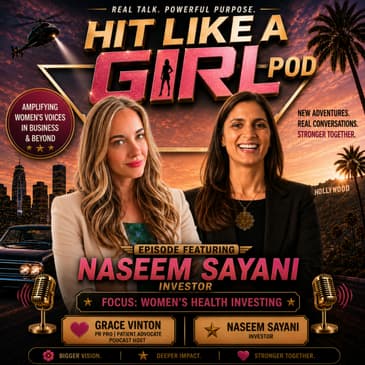

In this episode, host Grace Vinton welcomes Naseem Sayani, founder and CEO of GCWC and Director of WHAM’s Innovators Circle. They dive deep into a critical question: why does it matter who allocates capital, not just who raises it? Naseem shares her journey from incubators to founding her own fund, revealing the collaborative and abundance-driven style that sets women investors apart.
She debunks persistent myths—like the idea that women-led funds are "sweet" or that women are bad with money—and offers invaluable advice for founders: lead with the market opportunity, not just the pain point. The conversation explores the need to bridge the social capital gap, the coordinated approach behind WHAM's Innovators Circle, and her vision for redesigning venture capital from the ground up.
Tune in to hear how Naseem is building a new kind of pipeline and learn how you can be part of the change.
What You'll Learn:
Why having more women as decision-makers changes what gets funded and the behaviors that technology creates.
The collaborative, "abundance" style of investing that is reshaping GP-founder relationships.
The truth behind the top myths about women investors (spoiler: we're great with money).
Why building social capital across the gender divide is crucial for getting startups through Series A and B rounds.
How WHAM's Innovators Circle is coordinating capital to prevent losing critical innovations in women's health.
Practical advice for founders: lead your pitch with the money and the market, not just the problem.
Naseem’s thoughts on the future of health tech, biotech, and why a more integrated approach to "the health of women" is needed.
Resources & Links:
Naseem’s Substack: gcwccapital.substack.com
Naseem’s Podcast: The Capital Flex
Connect on LinkedIn: Naseem Sayani
Chapters:
00:00 | Welcome and Intro
00:20 | The Case for Women Allocating Capital
01:52 | A Collaborative Investing Style
03:03 | Debunking Myths About Women-Led Funds
05:15 | Early Investing Lessons & Diligence
07:09 | Is Venture Capital's "Game" Changing?
08:54 | WHIM's Innovators Circle: A Pipeline Engine
11:13 | GCWC's Media Platform & New Fund
13:24 | The Stigma & Semantics of Women's Health
15:33 | Pitching "The Health of Women"
17:12 | Opportunities & Structural Shifts for Investors
19:43 | Advice to Younger Self & Where to Find Naseem
[00:00:08] Welcome to the Joy, Love & Grace series on HITea With Grace. I'm Grace Vinton and I'm honored to welcome to the mic Naseem Sayani, founder and CEO of GCWC and director of WAMS Innovators Circle. Thanks for joining me today, Naseem. Naseem Sayani: Absolutely. It's good to be here. Naseem Sayani It is so awesome to have you back to the pod. I know you have spent the past few decades moving through consulting, incubators, corporate VC, and now your own fund.
[00:00:36] Naseem Sayani What was the moment you decided the industry needed more women allocating capital, not just more women founders raising it? Naseem Sayani Yeah, it's a really good question because the moment was when I was spending a lot of time at the incubator building startups, working with great teams. Naseem Sayani The diversity angle was not sufficient. There just weren't enough women involved in building, involved in thinking about what the building needed.
[00:01:01] Naseem Sayani And then the capital layer becomes that much worse. So the skew is so heavy towards profiles that don't look like the two of us. Naseem Sayani And that dramatically changes what gets attention, what gets funded, and ultimately what we see grow up and do well in venture. Naseem Sayani And there's two problems there. One is we don't get the products and then we also don't get the behaviors. Naseem Sayani So a lot of what Uber and Airbnb did was actually taught us new behaviors.
[00:01:28] Naseem Sayani And if we're not funding products and solutions coming from different profiles, we're missing entire behaviors. Naseem Sayani And knowing that would only really change if we had more women involved in check writing, in activating capital and bringing their money to this ecosystem. Naseem Sayani That's the lever to pull to grow the pie and then redirect that pie to things we care about and things that we know matter for growth and for revenue and all the human benefits that we also want.
[00:01:54] Naseem Sayani So true and such an interesting way to see it. Now I've heard you say in the past that women just generally bring a more collaborative, less command and control leadership style to investing. Can you point to a specific deal or founder relationship where that style actually kind of changed the outcome? Naseem Sayani Yeah, it's a very different style of engagement and how we team, right? And across the ecosystem at the GP level, and it's also the founder level. So how we get deals done on this side of the ecosystem, I should say,
[00:02:24] Naseem Sayani It's very collaborative because we want everyone to succeed. Naseem Sayani It's not pervasive, we're working on it. But there's a real push towards abundance thinking and making sure that if I can be in this deal, then you can be in this deal and you can be in this deal. Naseem Sayani Because if we all support this company, that company will do well and we all do better on the other side of it. Naseem Sayani And so the sharp elbows mentality, in my experience, just doesn't exist.
[00:02:48] Naseem Sayani And it also is, it's shifted how we work with founders as well, because it goes well beyond capital. Naseem Sayani It's really about resources and supports and how we can ensure that founder can build a business in the best way possible. Naseem Sayani And that it requires more than capital. Naseem Sayani What have you found to be the most frustrating myth about women investors or women-led funds that you still have to correct in fundraising meetings? Naseem Sayani There's two. Naseem Sayani One is that we still get a little bit of the, oh, that's so sweet.
[00:03:18] Naseem Sayani Oh, you're investing in women. Naseem Sayani And now it's wild. Naseem Sayani And you just look at them and you go, what are you talking about? Naseem Sayani This is about making money. Naseem Sayani That is 100% why I'm doing this. Naseem Sayani And I'm also here to change the world and help people and high impact should be able to run parallel to high revenue. Naseem Sayani And that combination is almost brand new for a lot of people. Naseem Sayani And so that we have to work around that logic and that mindset quite often. Naseem Sayani And then the other is just the continued trope that women are bad with money.
[00:03:47] Naseem Sayani And we aren't. Naseem Sayani There's more than enough data in the wild now around companies led by women that perform well, that have strong stock market performance. Naseem Sayani We have women that aren't, we aren't emotional the way we get characterized to be. Naseem Sayani We actually are really good at money and a lot of it comes from the role we play in our households. Naseem Sayani A huge majority of us manage, coordinate 80% of household spend. Naseem Sayani If we weren't good with money, we wouldn't be able to do that.
[00:04:15] Naseem Sayani So it just doesn't make sense. Naseem Sayani And so it still comes up. Naseem Sayani It's still like, oh, that's so sweet. Naseem Sayani But we just have to talk around it and say, well, let me show you why that's not true. Naseem Sayani But we're not sure that, but also not surprising, I think to any of us as well. Naseem Sayani That might still be a misconception and it makes so much sense that we would be great at money. Naseem Sayani Hello guys, we're right. Naseem Sayani Right. Naseem Sayani It's also not about being better than, right?
[00:04:40] Naseem Sayani It's about also showing up in the same rooms with the same credibility and the same ability to perform or to invest or to make the kind of change we want to make. Naseem Sayani I have to remind every room I say this in that I'm not here to tell you to take money from him and give it to her. Naseem Sayani I'm asking you to grow the pie and I'm asking you to take everyone seriously and not undercut someone simply because they look different than you.
[00:05:05] Naseem Sayani And I love that you're saying this too as somebody who is angel invested in 30 plus female founded companies over the past decade. Naseem Sayani And I'm wondering what kind of pattern matching mistake did you make kind of early on that you'd warn other women investors about kind of with your experience kind of just wanting to teach them better about, yeah. Naseem Sayani Yeah. Naseem Sayani That they should be able to. Naseem Sayani Yeah, that's a great question. Naseem Sayani My investment portfolio includes my angel investments and my fund investments.
[00:05:33] Naseem Sayani And early on, you can make the mistake of getting very excited about an opportunity because it's something that you know you want and not testing enough for scale and for growth and for the ability to actually build on a fairly accelerated growth curve. Naseem Sayani And it takes a while to build the intuition to do that.
[00:05:54] Naseem Sayani And so one or two of my early checks were great and fun and I loved what they were doing, but there just actually wasn't a way for that business to scale the way that it might have wanted to. Naseem Sayani And so getting better at testing for those things. Naseem Sayani Also, it's okay to make mistakes when you're investing and we have to not be, it's good to be cautious. Naseem Sayani You should be risk averse.
[00:06:16] Naseem Sayani I don't want to take away those things, but we have to give ourselves a little bit of grace on understanding what it takes to build a company and asking questions of our peers and looking for information that we may not have. Naseem Sayani And I was reasonably good at it upfront, but I have now become much more deliberate about seeking out information that's coming from other people in the space or coming from other companies to really stress test what that company is doing before I get involved. Naseem Sayani It's just seeking information from the founder is not enough.
[00:06:46] Naseem Sayani You have to go broader than what the founder is telling you. Naseem Sayani As more women enter the investor seat, do you see the rules of venture changing at all? Naseem Sayani Are our women investors still mostly playing a game designed 10, 15, 20 plus years ago? Naseem Sayani So it's a little bit of both. Naseem Sayani We are absolutely still deeply embedded in a game that was built decades ago. Naseem Sayani And it has not shifted to fully include our perspective and include our way of engaging, interacting, investing in the way that it could.
[00:07:15] Naseem Sayani I like to describe it as we've moved into the house and the walls and we're repainting walls and moving furniture. Naseem Sayani We're doing all these things and the people already there are going, what the hell is going on? Naseem Sayani And so we have to, we will continue to do that. Naseem Sayani And then we also need to be building our own houses and setting our own tables and designing it differently from the ground up. Naseem Sayani That's happening right now. It just, it has to go faster. I always want things to go faster. Naseem Sayani And we also have to bridge the gender divide, right?
[00:07:43] Naseem Sayani There's a lot of social capital that moves across the female founder, female investor side of the ecosystem. Naseem Sayani And similarly, there's an expansive amount of social capital that moves around the male founder, male investor side of the ecosystem. Naseem Sayani We have to bridge those two things because we need that social capital to move back and forth. Naseem Sayani The hurdle we're at now is that a lot of the companies that we invested in, pre-seed and seed, are now reaching their series A and B rounds.
[00:08:08] Naseem Sayani And enough of the relationships across those two sides of the investing game are not built strong enough for us to hand, warm hand our relationships and our investments to those later stage funders. Naseem Sayani And that's a lot of what the ecosystem is talking about now. Naseem Sayani So tell us a little bit more about WAM's Innovators Circle. Naseem Sayani You've called it the pipeline engine for women's health innovation. Naseem Sayani What does that pipeline look like? Naseem Sayani Where do most promising companies kind of stall out before they get funded? Naseem Sayani What is it?
[00:08:37] Naseem Sayani And what are some of your key learnings alongside it? Naseem Sayani Sure. Naseem Sayani Yeah, we launched the Innovators Circle about a little over a year ago. Naseem Sayani And the entire purpose was to put more collective energy around the early stage pipeline, specifically around solutions that support women's health, whether they be directly, differently or disproportionately related to conditions that matter to us.
[00:08:58] Naseem Sayani And the objective is on one part to coordinate the funds more deliberately and have us all talking to each other more often, looking at pipeline together, looking at our portfolios together. Naseem Sayani The other is to coordinate capital more efficiently. Naseem Sayani So right now, everyone, the founders are sending individual emails to all of the founders they could speak to, which takes a lot of time and energy.
[00:09:21] Naseem Sayani When if we were paying better attention or more coordinated attention, I can say, to what's happening in the ecosystem, what companies are building, what innovations they're building, where are they in their development and growth process? Naseem Sayani What kind of things do they need? What resourcing do they need? Naseem Sayani Then we can be picking up what we know is coming and planning ahead for it and saying, great, this company is hitting their A round. Naseem Sayani How can we help coordinate it? Who can be involved? Who doesn't know about them yet that we can teach?
[00:09:46] Naseem Sayani Who can we shun the deal to? And we can support that growth at the fund level and take and be more coordinated with the founder level. Naseem Sayani The biggest need behind that was two things. One, we don't want to lose any innovations early stage. Naseem Sayani So there's a lot of activity happening early stage. And if it doesn't get funded early stage, it'll never make it later stage, especially if it's very important and can scale in venture.
[00:10:09] Naseem Sayani We want to make sure we catch it. And then the second is making sure we have good, smart, well-built companies ready for later stage investment. Naseem Sayani So there's also an investment collaborative underneath the WAM umbrella, which is the later stage funds that are also committed to women's health. Naseem Sayani And we want to be able to bridge relationships across those two groups so that we know what they're looking for and what their pipelines want. Naseem Sayani And we know what's in our pipeline and we can connect the dots more easily.
[00:10:34] Naseem Sayani So interesting. And now tell me a little bit too about GCWC and the work that you're doing there as well. Naseem Sayani Yeah. So GCWC I launched late last year. It stands for Game Changers, World Changers. Naseem Sayani And it's two parts. So on one part is a media platform that houses my podcast and also my sub stack and the conversations there. Naseem Sayani The podcast is fully focused on fundraising conversations with female founders. Naseem Sayani It's all the really hard stuff. It's the real deal things that happen when women go out to raise.
[00:11:03] Naseem Sayani And the intent is to land on the insights and the learnings and the things that I know now that I didn't know before. Naseem Sayani So that if any other founder listens to the series, they walk out with a toolkit and they have a better understanding of what they're what they could see and then how to navigate it. Naseem Sayani And most importantly, they'll know that it's not personal. Naseem Sayani These things are happening all over the ecosystem. And so it's not you. It's the system. And you just have to have a way to navigate around it. Naseem Sayani So that's the podcast. It's been a lot of fun. We're recording season three right now.
[00:11:33] Naseem Sayani And the sub stack is focused on this core question of what it looks like to redesign venture capital. Naseem Sayani And if we were to think about it from a female lens, if we were to think about it with AI as a baseline rather than the addendum, how does that change pattern recognition? Naseem Sayani How does it change fund construction? How does it change engagement with founders and with the ecosystem? Naseem Sayani So I'm working on exploring a lot of those topics and surfacing some new thesis statements, hopefully, on what venture could look like.
[00:11:58] Naseem Sayani And that's what the sub stack is for. And then on the other side is I am fundraising again. Naseem Sayani So I'm working on putting something new together that could still focus on health tech and fintech and get into later stage rounds. Naseem Sayani Series A rounds are part of the strategy and want to be able to support founders that are building real infrastructure, a real intelligent infrastructure that can power health tech and fintech in much bigger ways so that we're set up for what the future needs. Naseem Sayani And will you be building it now? Naseem We love to hear that, Naseem.
[00:12:29] Naseem And you have always been an inspiration to us. Naseem Sayani You've been on the pod years ago and it's just so amazing to see your growth and just see the growth of the community since then. Naseem Sayani It's just fantastic to hear. Naseem Sayani From the folks that you've interviewed on your podcast, folks you've interviewed for your sub stack, what are some of the biggest challenges you feel are just going under reported right now in the industry? Naseem Sayani It's just under the radar. Naseem Sayani Yeah, so I don't know if it's under the radar so much as we're just not fixing it.
[00:12:57] Naseem So there's still a really big stigma problem. Naseem So it's a stigma problem in the broad understanding and I'll stick with women's health because I spent a lot of time there. Naseem So broad understanding of what women's health actually is and why it matters and what the different variations within that.
[00:13:14] Naseem So broad understanding of what women's health is and why it's not so important to understand that.
[00:13:42] Naseem So broad understanding of what women's health is and why it's not so important to understand that. Naseem So broad understanding of what women's health is and why it's not so important to understand that.
[00:14:11] Naseem So broad understanding of what women's health is and why it's not so important to understand that it's more well understood, broadly understood, and we're not having to do the education all the time. Naseem And then it's to my point earlier, it's the social capital that isn't being fixed fast enough. Naseem And then it's the social capital that we all have to engage in the social networks and we're not bridging it enough yet. Naseem That's what I really believe we have to spend more time on, is making sure we can all walk into the different rooms and be as effective as possible. Naseem So interesting.
[00:14:38] Naseem So if a founder is building in women's health or the health of women, which I love that phrase. Naseem I do think that quote unquote women's health needs a rebrand to the health of women. Naseem A true statement. what does a woman founder in women's health need to do differently in a pitch rather than a founder in a kind of a more generalistic health category? What would you recommend? So my big recommendation, and I've said this in a few rooms recently, is I want founders to lead
[00:15:08] with money and not lead with pain. And what happens in this category a lot is that the pitch decks will spend two or three pages on pain, on what the audience is experiencing and on how bad their lived experiences, on XYZ problems that come with whatever the condition is, which is all very important and necessary and not to be discounted. However, you lose your audience if you spend too
[00:15:32] much time on it. And so instead, I would recommend starting with how big the category is, how much enterprise value is being lost, how much money is getting spent on solutions to support that condition and how much more could be spent? Is it fragmented? Can we consolidate it? What is going on with the money flows related to that lived experience? Anchor the story there upfront and then absolutely talk about the pain, but don't overdo the pain story upfront because now we're asking the person,
[00:16:00] because in that instance, we're asking someone to believe in the lived experience of something that they have no awareness of rather than talking to them about opportunity. Now for women's health investors, great advice. Now for women's health investors, I would love for you to give advice too on where are areas where they can easily change the system and it's just like a quick, it's something that they can absolutely do in their day-to-day and where areas you feel maybe they need to just keep things going as it is until the system's ready to change.
[00:16:28] So for women's health investors or health of women investors, there's a lot of opportunity in digital health. There's a lot of opportunity in biotech as well. There is continued opportunity in consumer health. And right now funds are dedicating themselves to one or more of those swim lanes, but not looking across them. And I believe there's an opportunity to look across them more than perhaps we are right now. Biotech is a very hard sector because it needs so much capital
[00:16:56] upfront. And so a lot of biotech is struggling right now because it doesn't actually fit venture easily. And so the place where we could be thinking really differently is structurally, what kind of fund can better support biotech? Is it a longer fund life? Is it a different vehicles that support early stage biotech versus late stage biotech? Do we need to set up different expectations for our LPs? Because we risk losing a lot of great innovation in biotech right now because it just doesn't
[00:17:24] fit a 10-year model the way we would like it to. And that's where I think there's more problem solving that we could get into. The other part is we are still in a lot of cases focusing on women's health still in siloed conditions. So focus on maternal health or we focus on autoimmune or we focus on XYZ other condition. And I would love for us to be thinking more about the full integrated experience of her health because these things are all connected and related. Autoimmune conditions
[00:17:53] are connected to endometriosis, which is connected to gut health, which is connected to everything else. All of that affects your maternal health. So we have to address these things in combination and in coordinated ways rather than as individual things because it affects scale, it affects growth, it affects the quality of the companies we invest in. And we're not having the impact on care delivery at the level that we could be because product solutions and even our
[00:18:20] investing styles are still living in conditioned swim lanes rather than more coordinated swim lanes. Fascinating. So fascinating. Now, as we're thinking about your history and your past and what led you to where you are today, if you could give your younger self a piece of advice, knowing what you know now, like what would you tell her? And if you could tell young women looking to get into investing, what encouragement or advice would you give them? I would tell them to ask questions sooner. The biggest piece of advice I would give myself is I
[00:18:50] should have been doing this earlier. I should have been thinking about investing when I was in business before business school and I didn't really start thinking about it till years after. And now we can be thinking about these things sooner. We should be thinking about what we want our portfolios to look like, where we want our capital to go, getting out of just having a checking account and a savings account. And this is getting better. So there are a lot of young women who are now building funds earlier or thinking about VC much earlier than I ever was. So it's great.
[00:19:20] And I just want to see more of that happen because of the amount of influence we can have. And once there's more of us that show up in the room, it's not an exception anymore. To finish this conversation off right, where can our listeners find you online? They can find me on LinkedIn for sure. So I'm fairly active there. You can follow, ping, try to connect. We can always find time to talk. And then the Substack is the other one. So it just launched a few weeks ago. You can find it. It's gcwccapital.substack.com.
[00:19:48] And subscribe and follow along and read and comment. And I want engagement. So I want us to talk about all these ideas and build this together. So that's the second. And then the podcast, it's called The Capital Flex. You can find it on any platform where you listen to pods. And then there's 2 seasons of content out there that are exciting and fun and so interesting. So listen in, send me your thoughts. I'd love to hear how people like it. Love it. Thank you so much, Nassim. It's so great to have you on again. And it was awesome
[00:20:14] learning from you today. And I hope we'll have you again in another two to five years to see what else you're just up to and what other ways you're changing the world. Oh, absolutely. Thank you so much for having me. This was a lot of fun. It was good. It was good to be back. And thanks to you folks for joining us too. Check out the Hit Like a Girl pod and High Tea with Grace website for more interviews with great guests like Nassim today. Cheers. Thanks so much for listening to this episode of Hit Like a Girl pod.
[00:20:40] If this episode resonated with you, please follow us on social media at HitLikeagirlpod. That's H-I-T Like a Girl, P-O-D, across all platforms. And to learn more about the show, our guests, or to join our waitlist for what's coming next, please visit our website. The link is in the show notes. The Hit Like a Girl podcast is built on joy, fueled by love, and led with grace. We're so glad that you're here. We'll see you next time.