
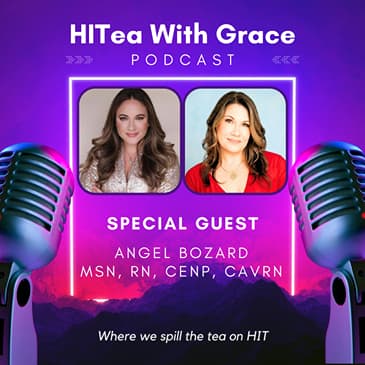

Why do some virtual nursing programs give bedside nurses real relief while others barely make a dent? On this episode of HITea With Grace, where we spill the tea on HIT, Grace sits down with Angel Bozard, MSN, RN, CENP, CAVRN, Chief Nursing Officer at VirtuAlly, to talk about what separates the two.
A JAMA Network Open analysis of 880 bedside nurses found that 57% saw no drop in workload from virtual nursing, and 10% said it made their jobs harder. At MUSC, 87% of bedside nurses said the opposite. Angel explains that the difference comes down to how each program was built. Internal programs often draw on the same short-staffed nurse pool. External partners bring in new capacity.
Angel walks through her principles for virtual nursing success:
- Design programs with bedside nurses, not for them
- Set clear role boundaries, so virtual nurses take on admissions, discharges and patient education while bedside nurses focus on hands-on care
- Treat virtual nursing as a permanent clinical partner, not a staffing patch
- Prevent screen fatigue so burnout isn't just moved from the bedside to the virtual team
- Measure success beyond FTEs, including turnover, staff satisfaction and patient safety
She also shares why VirtuAlly keeps the "human in the lead" when using AI. Nurses check every piece of AI-generated data before it goes into a patient's chart. To close, Angel offers advice for women in healthcare and health IT, and tells us about the tea she brought and the story behind her mug.
Subscribe to HITea With Grace for more conversations with women leading in healthcare IT - cheers!
[00:00:04] Welcome to HITea with Grace, where we spill the tea on HITea. Today, I'm honored to welcome to the podcast Angel Bozard. She is a nurse and she is actually the chief nursing officer, which we love to see that, a virtue ally. Thanks for joining me today, Angel. Thanks, Grace. It's been great. I appreciate you inviting me to this. Oh, we're so excited to learn from you today. So tell me a little bit about the career path that brought you to your role today.
[00:00:31] Sure. So about 20 years ago, I graduated with my first degree. I have three. I'm working on my terminal degree now, but my first degree in nursing. And I went to med-surg like most of us did back then and did a couple of years in med-surg. You know, I served my time in the medical surgical units. And then I moved into a NICU here in Charleston, South Carolina and worked in the NICU and other places and mother baby and women's and children's for many years.
[00:00:58] And then as I continued my degrees, I continued in leadership and the health care systems. And one of my fun projects I was able to do is creating a maternal fetal medicine clinic, two of them actually, one in Myrtle Beach and one in Augusta, to provide access for high-risk moms and babies. And so that was kind of my first real look into virtual care. And I became fascinated with it. And at that moment, I realized this is the evolution of health care, right? This is exactly where we need to go.
[00:01:25] This was pre-pandemic. So no one was really doing this yet. It wasn't widely accepted. But of course now and during the pandemic, it helped so much because we were able to get great care for our moms and babies through virtual care that we already had set up. And it just, so when this position came available at Virtual Ally, I just jumped on it. I thought this is exactly what I want to do with the rest of my career. So inspiring. And I just love that you were a NICU nurse and then moved forward into this innovation world of virtual nursing.
[00:01:55] I recently read that a JAMA network open analysis of 880 bedside nurses found that 57% saw no reduction in workload from virtual nursing. And then 10% said it made their job harder. Yeah, that was surprising. Yeah. So same care, same model, opposite results. And then another study, 87% of bedside nurses, they said the exact opposite thing.
[00:02:18] So there is like an odd thing going on in the industry right now. And nurses are really on totally hyper different ends of the spectrum on this. What is actually different about how these different programs are built? And why is it like that? That's a great question. I'm glad you read both of those studies because that's what we're seeing out there, right? So how we set up our program is different than how most people are doing it. A couple of different ways.
[00:02:42] So it's not about the technology for most part. I mean, there's definitely some shiny, really cool stuff different technology vendors use, which is amazing. And I love all of it. But it's really in the implementation side of it. It's how you get these programs up and started. And sometimes when you're trying to do these programs internally, meaning these healthcare systems want to utilize their own nurses, which is amazing. They just they're still pulling from a depleted resource, right?
[00:03:07] So that's probably why those nurses are not seeing the same impact of taking away that burden is because they instead of having Sally right beside you. Now, Sally cannot do hands on care. She's a virtual nurse. Now, if you utilize a staffing resource, then you're not pulling from the same group, right? So if you work in a town that's only so many nurses in that town and you're already competing with several different healthcare systems and bedside and virtual nurse, you're pretty much out of nurses.
[00:03:36] But we're able to utilize the whole state. So if you're looking at the state of Virginia or South Carolina where I am, then we can utilize nurses from anywhere in that state to be in that one program. And that's where the nurses truly see the impact where we're taking away all of that burden. So as a nurse, I did not become a nurse to document and chart. Right. So that was not why I was like, I really want to just go in there and talk to patients and put it all in a chart. This is exciting. I wanted to take care of patients. I want to have hands on care.
[00:04:06] And a true impact. And so when we're able to take away that and get that time back to the nurses where they're able to take bio breaks, which is always great, they're able to take their own lunches and they get out on time to spend time with their families. It really creates this really cool new dynamic of making nursing desirable again, because right now it's not really a highly desirable profession. So, yeah. Very interesting. Now, you've said in the past, and I've heard you say this, your first principal for virtual remote nursing,
[00:04:35] success is designed with bedside nurses, not for them. So what does that mean? Elaborate on that. Yeah. So the nurses, the bedside nurses that are closest to the work should always be valued for their expertise. And I don't know that in health care, we're really great about that. We don't really allow them to be co-designers of the programs. We allow them to be end users. So that means it almost feels like it's being done to them.
[00:05:01] Whatever initiative it is, if it's virtual nursing and new EMR, we're like, here's what we have for you today and you're going to use it. And that doesn't feel good, right? They don't have the same buy-in as they would if you said, hey, Grace, we're going to design this. I really want your input with this. This is really cool, but I want to see what you would do with it. And then all of a sudden, everybody's like, yes, absolutely. And then as leaders who are a little probably removed from the bedside, we're not making decisions for them. We're making them with them.
[00:05:31] And that's so valuable. That's lessons learned over many years of leadership that we just simply have to obey by now. I love that idea of co-creation because everyone knows the nurse is the hero. Doctors look up to the nurses. They're like, these people know what's going on more than anyone else does. Why wouldn't they and couldn't they be co-creators versus just folks that are forced to do another thing that may not actually work in their workflow? And so I love that idea.
[00:05:57] I also saw you talk about an idea of boundaries. Can you kind of go into that and how important it is to define clear boundaries between the virtual and the bedside teams and how maybe that is also really important for that virtual remote nursing success? Absolutely. Boundaries are really important. And even more than the word of boundaries, it's just a matter of this is what I'm here to help you do during the day. This is your part. This is my part.
[00:06:24] We never want it to feel like who's on first, right? Am I supposed to be doing this? Are you supposed to be doing this? Who's supposed to be doing this? And the other thing we're really cautious about is making sure it doesn't feel big brothered, right? So virtual nursing, we're not here to take anyone's job. We're not here to big brother you and tell your leadership what you did or didn't do. We are simply here to work as one care team so that the patients get the best care and the nurses get cared for, right?
[00:07:22] Is it admissions? Is it discharges? Is it patient education? Do you need mentorship? How can we best serve you so that you can do what you do best at the bedside? It does seem like the health system sees virtual nursing as some type of staffing patch rather than like a clinical partnership between multiple nursing teams. Where do you see hospitals really crossing that line and without realizing it? And what are some of the early warning signs that a chief nursing officer should watch out for?
[00:07:51] Yeah, so virtual nursing is not meant to be a patch at all, right? This is not contract labor. This is not a temporary solution. This is a permanent solution. And by that, I mean, we don't come in and for just 12 weeks, we are part of the care team. And that's something we certainly forget. When we're talking, when I think about a care team as a nurse, I think about everyone that's in our little pod, right? We're taking care of these patients on this unit. I have amazing CNAs that are helping me. I have other nurses. I have providers.
[00:08:20] I have pharmacy techs. There's just a whole system, a community that are taking care of these patients. And now with this evolution, we have to filter in the virtual nursing to that. And that's become a little bit of an interesting dynamic because it's not in addition to your nurses. It's just part of your nursing team.
[00:08:42] And that's something that's just going to take a little bit of time to make sure that we have that embedded into leadership's mindset, but also so the bedside nurses know for the first time in a really long time, we're taking something off of your plate, right? We're doing this. Finally, we've added so much on to nurses. And then finally, now we're saying, look, I've actually, I've got this. I'm going to go do this mission. It's going to take 45 minutes, but that gives you 45 minutes to go do all the other things that you need to do at the bedside.
[00:09:12] So it's really cool. It's just a different mindset. Yeah. And I like that you kind of mentioned that 45 minutes. Like, you know, I think some of the nursing programs, there's like a lot of different math on why they're useful and helpful. And sometimes people just judge it based on labor math kind of alone. But what are some of the other metrics that really matter beyond just talking about FTE equivalents or more? Yeah, I mean, certainly FTE equivalents are important, right? You have to have your financial metrics in place. But really what we want to look at is what most CNOs are looking at as well.
[00:09:42] Are my people happy, right? So are my staff, are they satisfied? And do I know that because I'm not getting this higher turnover? I'm not getting high burnout rates because it does cost a lot of money to replace just one nurse. It's like 60 grand. And even more than that, you can't replace that expertise of a nurse who's been at the bedside for 35 years. Regardless of what amazingly educated new novice nurse you get, they just don't have that time in service. And we don't want to lose that. That's so valuable.
[00:10:10] But then you have the patient indicators as well. Are patients happy? Are they falling less? Are they getting that focused care that they came into our healthcare system to get and why they didn't go down the road, right? So that's something that you can't really package. We certainly can talk about ROI all day long with virtual nursing and virtual sitting. And it's there. It is there.
[00:10:34] But this is just part of your care team that is embedded in all costs every time you send out a bill, right? So it's important to look at your people and make sure that we're taking care of the people that are receiving care and delivering the care. What are some of the innovations in this space that are exciting you about the future of this space where you're like, wow, this is just going to make virtual nursing and sitting even better? Yeah. We have a lot of AI stuff coming down.
[00:11:00] Now, we're bullish about it here at Virtual Life because as much as we want to be the innovative side of things, we certainly have to remember it's not the human in the loop. It's the human in the lead. And those are our nurses, right? So I was presenting yesterday, the day before yesterday, and a great question came up. And the question was, will AI replace virtual nursing? And that's an amazing question. And the answer is no.
[00:11:25] Because one, when you're in your most vulnerable times and you are sick, say you're in an emergency department, it's fine. I think we can certainly use chatbots. We can use ambient listening. But you still want to see a person. A person still has to be there. A person still has to look at you and say, okay, five minutes ago, you were behaving in this way. And now five minutes later, you look like your speech is slowed or you're showing signs of being uncomfortable. Those are certainly things that AI cannot do.
[00:11:53] But once again, it all has to be validated. So every time ambient listening goes in, they can say all kinds of fun things. And you can't just toss it into a chart because you do not want your whole care being based off something that may be wrong. So we have to, as nurses, validate all of that data. I love to hear that. And it is very interesting to see where AI is fitting in to actually fix real-world problems in healthcare. And I love to hear about how that's happening in nursing as well in a safe and appropriate way. It's really cool to hear about.
[00:12:22] Now, while my listeners love to hear about trends in the space, and thank you for sharing your insights with us so freely on this topic that everyone is very interested in right now. We also love to learn from leaders like yourself about what drives you and helps you work your best to make a difference. So as a busy professional woman, nurse, innovator, leader, person, what are things that you do that help you work your best and make a difference? And stay on the top of your game. Yeah, I think the thought leadership piece of it is really important for me.
[00:12:51] So I'm privileged to be able to go to a ton of conferences and really get to talk to different leaders who are doing some really cool stuff in the field and listen to presentations and be involved in a lot of those presentations. And when I come back, I'm just rejuvenated. I'm like, this is amazing. Like, this is all doable. We can, we've got this. Because if not, if it's just one voice out there where I'm saying the same thing, it becomes a little redundant.
[00:13:16] But if you go out to there, it's the conferences and the amazing things that nurses and providers and technology is doing. It just helps your heart, right? Because we know that the healthcare system is broken. We know it was fractured before COVID and now it's just busted. But we are finally kind of banding this together in this really cool virtual care space that helps the bed care team, bedside care teams. And we have to do that. So we keep our bedside care team. You have nurses that love being at the bedside.
[00:13:46] They love patient care of all different types, from tiny little babies to our geriatric population and everything in between. And we have to keep that momentum and that passion going for healthcare. Because if not, people are not getting any less sicker, right? Like, we're kind of prolonging life, if anything, and people are living longer. And that means there's going to be some sick people that need to be taken care of. And we've got to be able to do that in a really cool space for everyone. Absolutely. I love that.
[00:14:14] And I know that as a leader, you've experienced challenges and have had to overcome them, as everybody has. What are things that you do to stay resilient? I mean, you have such a positive attitude. And I just think that you're such an inspiration to the people around you. And how do you do that? What is that in you? What do you do to stay strong? Well, thank you. First and foremost, I have an amazing family support. I have four kids. They're fantastic people. A great husband. And I have a wonderful work family. And I know that doesn't trend, right?
[00:14:43] No one wants to hear about work families anymore because it's kind of a weird thought. But I have an amazing CEO that's very supportive. I have amazing leadership that helps me every day and brings me into every conversation. And it just makes me wake up feeling like I'm making a difference today. And that was the goal of becoming a nurse is I want to leave this place eventually better than I found it. And I feel like those are the people that just keep me going and keep me motivated. Oh, I just love it.
[00:15:10] And I also love this idea, too, that you're creating a category you could have never anticipated when you first started your career that you would be literally leading an entire category forward. And it would be an innovation. You go in knowing, OK, maybe I will do some great medicine, right? You become a nurse. And now you are doing some great medicine and then forwarding the entire industry on something new that's really critical to its future success.
[00:15:35] Yes. So, you know, thinking back to your younger self, if you could give your younger self a piece of advice, what would you tell her? Oh, goodness. I do have a book of shoulda, woulda, couldas. After everything I do, I write it down, literally write it down. I don't even type it just because I want to look back at those things and say, OK, I'm about to step in that same hole. Right. But I think what I would tell myself back then is just be able to find your own peace and calm and take better care of yourself.
[00:16:05] Because as nurses, we're wonderful at taking care of everyone else. We're terrible about taking care of ourselves. Or maybe I should just be for myself in that category. But, you know, I think that's one of those things we forget sometimes that we have to do self-care. And that's something I'm still struggling with every day. So true. You guys hear that? Even Angel struggles with it, too. So, you know, we're all in this together. Let's encourage each other to really be sure that we're taking care of ourselves.
[00:16:30] As we're thinking about and kind of wrapping this up, virtual remote nursing, what are some misconceptions the industry has that you wish you could just write? Like, that's a misconception. This is what it really is. Or this is what the future really looks like. No, that's great. This is one thing that, you know, I get every, almost every day somebody asks me, so your nurses are going to come in and they're just a call center, right? No, absolutely not. Our nurses are very qualified.
[00:16:56] They have about 13 years of experience, which is great. Most of them have taken the cavern certification, which is amazing. It teaches them about website manner. It teaches them how to escalate to nurses and be great care partners. But what I feel like is a huge misrepresentation of virtual nursing today is that we just come in and do our piece in part and then we check out. And that's not it. We are very embedded. We go to staff meetings. We go to shared governance. We know the nurses that are on the floor.
[00:17:25] We know what's going on with them. And it's just, it's the same thing as if we were at the nurse's station. We're just virtual. Love that. Now, to finish this conversation off right, where can our listeners find you online and learn more about virtual remote nursing? Yeah. So Virtual Ally, which is spelled virtually. I'm sure it'll be on the podcast.io. And we have a beautiful website out there. I have a ton of information. But if not, you can always reach me through LinkedIn and I'll be happy to set up a conversation for anything that's needed. That's terrific.
[00:17:54] Now, before I forget, did you happen to bring tea with you today? And if so, let me see your blog and tell me your personal story around it. Okay. So, one, I'm a huge Halloween fan and it's after September. So that means we're in Halloween town, right? So this particular mug actually has an Edgar Allan Poe, a little quote on it, which I think is fun. But I love tea. So, Grace, I have an apothecary cabinet at home just full of every ingredient you can make with tea. And so most nights I make myself and my husband and the kids are home.
[00:18:24] I make them tea or they have started making tea, which is really cool. But it depends. I don't have one set type of tea I like. I kind of depend on what happened during the day. So if I need something calming, I have different pieces and parts I pull from my little, my apothecary cabinet and I make my calming tea. Or if I know I need a good night's sleep, I have a dream tea. So I've created these like tea recipes throughout the years. And now my kids are into it, which is really cool because my youngest daughter, she wants to be a physician.
[00:18:53] She wants to do holistic care. And I think a lot of it's because we've been building these holistic tinctures for her whole life. Actually, she was in utero during nursing school. So I said, you've already been to nursing school once. You might as well just become a doctor. So, but yeah, so we love tea and it's always something that's a big part of our life. Oh, that makes me so happy. It's a high tea dream. Too good. So thank you so much for joining us today. It was awesome learning from you. Yeah, thank you so much, Grace.
[00:19:23] I can't wait to look forward to talking to you soon. Yeah, here we'll repeat that again. That's terrific. That is too good. Thank you so much, Angel, for joining us today. Thank you so much, Grace. I appreciate you. And thanks to you for joining us too. Check out the High Tea with Grace podcast for more interviews with great guests like Angel today. Cheers. Cheers. Like a Girl Media is more than a media network. It's a community.
[00:19:47] We want to meet you and amplify your voice and the voices of outstanding women innovating in healthcare. Interested in starting your own podcast or hosting an event near you? Connect with us online or in person. We're here to support and empower you. Thank you. Thank you.