
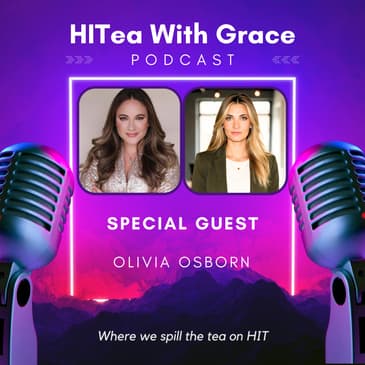

Today I'm honored to welcome to the pod Olivia Osborn, Clinical AI Success Consultant at Kontakt.io. Olivia brings a rare blend of frontline and strategic experience - from her days as an EMT to leading operational transformations at Boston Children's Hospital and advising health systems nationwide with Huron Consulting - before landing at the forefront of AI-powered hospital operations.
In this episode, Olivia challenges one of the biggest myths in healthcare leadership: that operational improvement is a project with an end date. Spoiler - it's not a renovation, it's a garden. She breaks down why hospitals are especially vulnerable to operational drift, what signs tell you an optimization effort is losing steam, and how AI adds a real-time dimension that dashboards simply can't match.
Olivia also shares what thriving health systems will look like five years from now, and leaves us with some wisdom for women navigating non-linear careers in healthcare IT.
Pour your favorite tea and tune in!
[00:00:04] Welcome to HIT with Grace, where we spill the tea on HIT. Today, I'm honored to welcome to the pod, Olivia Osborn, Clinical AI Success Consultant at Contact.io. Thanks so much for joining me. Yeah, thank you so much for having me. So tell me a little bit about the career path that brought you to your role today. Absolutely. So all through school, I was always interested in healthcare. I was an absolute nerd. I loved science. I was an EMT in college, and I later worked as an administrator at Boston Children's Hospital.
[00:00:33] And that's really where I became impassioned at the translation between findings into operational practice. I then transitioned to work for Hero Consulting Group, where I had the opportunity to work with many different health systems, hospitals, clinics across the country, and really partner with their leadership there, clinic managers, clinical champions, to institute operational changes and implementations.
[00:00:58] I then moved to contact really fueled by the focus of I want to address the persistent challenges that I had seen undermine the operational efficiency that we were striving for in my previous roles. And the biggest challenge being that there's a constant flux within hospital operations. Healthcare is always shifting. Staffing is changing. Demand is changing. How would you optimize something that is constantly shifting?
[00:01:25] And so contact really builds that intelligent care operations platform for hospitals and healthcare systems to react and support their operations in real time to make those decisions most effective. We love ourselves and operational efficiency, girly. So we're so thrilled to learn from you today. Okay. So in your experience, having been at the hospital health system and then having been at a consultancy working on improving operational performance,
[00:01:55] what is the biggest misconception healthcare leaders have about operational improvement projects? I would say that the biggest misconception is that there's ever an end date. I think that sometimes leaders treat operational projects and implementation work like a renovation, like home renovation. I'm going to come in, I'm going to put in new cabinets and new countertops and I get to enjoy this beautiful kitchen from here on forward. But it's a hospital is a living system.
[00:02:20] It's much closer to a garden where, yes, maybe you are dedicating some lift on the front end to say, I'm planting vegetables here, I'm putting my flowers here. But then you have to tend it and weed it and water it. And you have to watch the environment that it's in, understand what's the weather going to do. Am I going to have to water a little bit more this week? Right. And so the misconception of saying we touched this clinic last year and we've fixed their and completely optimized their patient throughput. That was last year. Maybe it was optimized last year.
[00:02:48] What's different about this year that you need to continue to shift and maybe just tweak those operational decisions so that they stay effective. That is so interesting to think of it that way. Was there a moment or example that made you realize that those traditional optimization approaches weren't really delivering lasting value? Yeah, I have a very clear example. And this is my one of my favorite things to think about because I think a lot of people think of changes sometimes as a negative.
[00:03:14] Right. We lost staff or this is closing or this resource isn't available anymore. Right. But in health care, something that's growing so quickly, a lot of it is it's an exciting change. I was on site with a primary care clinic. We had gone live two weeks prior and it was going wonderfully. And I was on site kind of just making sure if folks had questions or keeping a pulse on things. And I was talking with their clinic manager and they had some construction next door. And I was just making conversations. What's going in? Is anything exciting like a great new coffee shop?
[00:03:43] And she said, no, actually, we're getting five new exam rooms. And in my head, I was like, OK, that's wonderful because we're increasing access. You can add providers and that's additional resources. How wonderful. But also, how are the operational decisions that we just made in this project going to change in six months when you're able to open these and put patients in them?
[00:04:04] And so I think that's a really wonderful example because it's to say that it didn't mean that anything that we did to optimize during that project was wrong. And it didn't mean that it wasn't all the right decisions to make at that time. But it means that there might be new decisions and adjustments that have to be made as you move forward. Again, as things grow in flux, whether that be for the better, like adding exam rooms or the worse and unfortunate reality of staffing shortages. That is so interesting to think about.
[00:04:33] So following that train of thought, what are some of the most common changes inside a hospital that quickly make some of those changes that you're making yesterday's recommendations obsolete? Yeah, I think that the important thing is that recommendations are often made on assumptions that conditions are going to stay what they are. Whether that be staffing or patient demand, the resources that you have at your disposal. And those things seldom don't shift.
[00:05:01] So staffing turnover is so real, especially in the world of burnout for healthcare workers, right? We know that there's an incredibly high turnover rate for our healthcare professionals. Additionally, we are all humans. People go on maternity leave. People retire. People leave to go get continuing education. Again, the positive and the negative of both things causes shift in staff. And so with the shift in staff, there's change to who is supplying the care.
[00:05:29] There's also a loss of institutional knowledge. Every time someone leaves, you bring in someone new that needs to get trained up on a new process. And then there's the larger scale shifts, which happen at a system level where there's mergers and acquisitions happening. A large health system acquires a smaller hospital and envelops them into their fold. How does that now become part of their symphony of operations in this larger system?
[00:05:53] And so the growth and the flux of what is our operational area we're serving and what resources do we have to serve it are constantly changing. So what signs should healthcare executives watch for that indicate an optimization effort is beginning to lose impact? Or on the alternate side, they just need to put an optimization effort in place. I'm sure they're just things that are signs that are pointing all to fixing the issue. Yeah.
[00:06:20] And I like to spend that in a more positive way and say, okay, maybe it's not losing impact, but maybe there's new operational opportunities that we can capitalize on. So the same indicators that are saying this isn't working anymore or something can shift is an opportunity for us to be more effective. I think at the executive level, you might see this as the KPIs that you've outlined. You're seeing a little bit of a dip in them. Those baseline metrics are shifting, right?
[00:06:45] But more like boots on the ground, the people that are actually executing in the scaffolding of our operations, the nurses, the clinicians, the techs, orderlies, everyone that makes a hospital run. If they're starting to find workarounds because healthcare workers are scrappy, like they're going to find a way to get their patient the best care possible and make it happen as quickly as possible. And so when those start to come up, those workarounds, those slipping back to baseline behavior,
[00:07:13] you start to see patterns that aren't part of the typical documented process. Those are all signs that maybe there's something that we can do to tweak or hone operationally how that runs. And so, again, at the executive level, that becomes more difficult, right? Because you're overseeing an entire system. But with AI-powered solutions, those get bubbled to the front. And it can see the systemness and see those patterns and see those recommendations and flag it off the jump.
[00:07:41] I've heard you say in the past that AI is adding a real-time dimension to hospital operations. What do you mean by that? And how should healthcare leaders think about AI when they're thinking about the next level of how operations can be optimized? Yeah. So the real-time piece is incredibly important because traditional optimization efforts are really a snapshot in time of, what is my hospital doing now? What does it mean now? How do we optimize for now?
[00:08:08] Real-time measures means that a system is continuously sensing current conditions, understanding where patients are, where is a bottleneck potentially forming, and how can we intervene and surface it while there's still the time to act and reduce the downstream impact of, I waited 40 minutes in the ER, but maybe that means I'm waiting two hours in radiology. So it creates opportunity to intervene on operational failures or barriers right now,
[00:08:38] not in next month's report when we're able to see, oh, our operational effort doesn't look like it's working anymore, or, oh, this seems like it's slipping. It helps us prevent the need to launch new, more large-scale operational interventions. What types of operational decisions can AI help improve right now? As we're thinking of all the different areas, I always like to think of it like I get on an airplane, right?
[00:09:04] And there are so many things happening in the background to get on that airplane and to get my luggage in the right place, etc. And yet in healthcare, it is so much more trickier because lives are on the line. So tell us what are some of the type of operational decisions AI can help improve? And then also, what are the kinds of operational blind spots that become visible when you're using AI and constantly analyzing these workflows? The short answer is an exciting one.
[00:09:30] It's that AI can do a lot operationally to support decision-making and help everything run smoother. I'll bucket them into kind of two domains. The first is in an inpatient hospital. So contact supports a patient flow agent. And what that agent does is it focuses on exactly what it's named for inpatient flow. It contextualizes the patient journey from the point of admission to discharge. It predicts bed availability, any discharge obstacles that might be upcoming.
[00:10:00] It flags to caregivers' recommendations for how you can progress care along. Again, staying out of that clinical space, but supporting what's appropriate based on those clinical decisions. And then I think that this is really fantastic on the supply chain side. I think often our supply chain teams are the unsung heroes of our hospitals, keeping all of the resourcing and equipment that's needed to even deliver care in the first place.
[00:10:24] The agent is able to support equipment and asset management, forecast equipment demand, and reallocate assets the hospital already has, and support the utilization of those resources that, again, a hospital has already invested in 500 IV pumps. How are those being deployed effectively so that someone isn't waiting a long amount of time to get their IV treatment, right?
[00:10:47] So helping streamline that supply chain piece, which again, I think is very quickly and often forgotten because it is one of those background pieces. When you're getting onto an airplane, you don't think about how your luggage got from where you checked it to under the plane itself. Yeah. And then the other piece that I do want to highlight is in the outpatient space. So ambulatory settings, right? Your primary care doctor's office, your dermatology office. There's an access agent.
[00:11:15] And what that does is it evaluates exam room space, exam room usage, helps hone and optimize scheduling so that you don't have to wait eight months for an appointment, which I think is a very common experience of, I went on my patient portal, I want to see my doctor, and I don't want to wait for over half a year to be able to see them. As a patient and caregiver and patient advocate, I'm like, this is a dream.
[00:11:39] Like, this is like amazing that this is like a reality that exists for hospitals and health systems. And so it's very exciting to think about what it could mean for, like you said, access and just supporting public health and communities. So looking five years ahead, what will separate health systems that thrive operationally from those that really struggle when it comes to operations?
[00:12:05] Yeah, I think that the marker of who is going to be thriving operationally is going to be those that are able to build continuous improvement into how they're running every single day. So the differentiator isn't going to necessarily be I bought the most AI and all of my people love to use AI all the time. It's going to be who is able to use that in an effective way to support the frequent optimization.
[00:12:30] Who's building the muscle in their system to act on that continuous intelligence and the culture to trust that it's going to serve them well. Thriving systems are going to be actively closing the loop between the insight and the recommendation that's brought forward.
[00:12:47] Again, that's not just to say that you're just blindly trusting AI at every turn, but really like building that effective feedback loop is important because otherwise your optimization projects, you're going to be doing large scale optimization projects that take your staff's time. They take resources. They're expensive if you're bringing in a third party group. And if you're doing that every two to three years to try to stay operationally on the ball, that's a lot of lift. So true. So true.
[00:13:14] So while my listeners love to hear about trends in this space and thank you for sharing your wisdom with us, I feel like we all learned a lot about this topic. And so I feel I'm just very grateful for your generosity there. Women also like to learn from other women here about what drives you and what keeps you going. You're a busy professional. You've had a really successful career. What are things that you do in your personal life to help work your best and make a difference in the world? Yeah, I love yoga.
[00:13:41] So I every morning I try to do some sort of flow. It helps me clear my mind. My mind, I feel like it was 100 miles an hour. So the hardest part of yoga for me is sometimes just that final shavasana of laying there and clearing my brain. I also live in Colorado and love being outside. So again, disconnecting, hiking, going somewhere that doesn't have cell or Wi-Fi so that I can like fully unplug is really important to me. And then in terms of fuel, I'm incredibly motivated by team.
[00:14:10] So at Contact, I feel like I'm part of this big team. We have this shared mission, this drive, and that's really energizing and exciting. And so that makes me excited to show up and start doing things every day. And then from an impact perspective, I think operations, sometimes you think dollar signs when you hear operations. You don't often think about patient access. A lot of the time you think about that in the clinical space.
[00:14:33] And so understanding that the architecture of operations is so integral to improving patient access, improving patient experience, provider satisfaction, all of those metrics that I think sometimes get lost in the, okay, what's the ROI of this? What's the proof of value of this? Those are incredibly valuable pieces that are so core to healthcare operations in general. So those outcomes are also big drivers for me. Oh, absolutely. Having that North Star is everything.
[00:15:03] And I just am so inspired by your healthy habits. I need to get on it. I also do know that I'm thinking I need to disconnect more often. I'm sure everyone is thinking that too. Now, thinking about your career, if you could give your younger self a piece of advice, what would you tell her? I think that especially now, and I see this in some of the college kids I'll chat with, there is a pressure to choose what you're going to do so early on.
[00:15:32] Firms begin recruiting really early. You're like freshman year of college. I'm like, how did you know you wanted to be an investment banker? Like that didn't even cross my mind when I was a freshman in college. And I think that I would want to encourage my past self to be confident in the fact that I don't have to commit to something. Because I thought about becoming a doctor and going to medical school. I thought about, okay, do I want to work just in the business space? Do I want to do like strategy consulting?
[00:15:59] And I so enjoy what I do now. And I never would have found this niche without kind of trying things through internships or different positions and understanding what fuels me and what drives me. So I think that the biggest advice I could give is to not be afraid to keep doors open. Don't feel like you have to commit to a specific path just because other people are, which is so much easier said than done. So true.
[00:16:26] Now to finish this conversation off right, where can our listeners find you online? You can find me on LinkedIn. My profile is just Olivia Osborne. I'm also on our contact website. I have a few blog postings there. So if you enjoyed listening to learning a little bit about healthcare operations and continuous intelligence through AI, you can read more there as well. Terrific. Now before I forget, did you happen to bring tea with you? And if so, tell us about your mug. I did. I did. I have a mug full of some mint tea.
[00:16:56] Mint tea is my favorite just because I feel like it's very refreshing, but there's no caffeine in it. So I don't get jittery. So, and then the mug, I am in the process of moving. So I had a very limited selection of mugs to choose from, but this is a mug that my mom gave me. And it just has flowers all over it. And it's kind of springy and fun. And I like adding a little color. You know, it's your favorite when you're in the middle of moving. And that's the one that didn't make the time. Yes. I was like, what mug is on the top? And also, are my mugs broken?
[00:17:26] In this box that is in the bottom of this truck. Awesome. Well, thank you so much for joining us today. It was so great to learn from you. Yeah. Thank you so much. I really enjoyed our conversation. And thanks to you guys for joining too. Check out the HITea With Grace with Grace podcast website for more interviews with great guests like Olivia today. Cheers. Like a Girl Media is more than a media network. It's a community. We want to meet you and amplify your voice and the voices of outstanding women innovating in healthcare.
[00:17:54] Interested in starting your own podcast or hosting an event near you? Connect with us online or in person. We're here to support and empower you.