
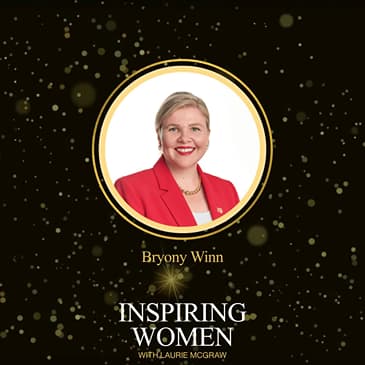
Bryony Winn graduated from Oxford just after the banks crashed, applied for 102 jobs and got one offer. Today she is CEO of BAYADA Home Health Care, a $2.2 billion organization with 44,000 employees, and the first leader from outside the founding family in its 50-year history.
In this episode of Inspiring Women, Laurie McGraw talks with Bryony about growing up in Zimbabwe, becoming a partner at McKinsey, running health plan operations at Blue Cross Blue Shield of North Carolina and Carelon Health, and why the founder of BAYADA asked her for a 50-year plan.
WHAT YOU'LL LEARN
- How growing up in Zimbabwe shaped the way she sees healthcare
- The McKinsey value she still leads by: the obligation to dissent
- Why she felt she had to know the data better than anyone else
- What consulting doesn't teach you about leading 11,000 people
- How she helped fix a claims mess after the pandemic
- Why partners matter as much as mentors
- The questions she asked before taking the BAYADA job
- Why 11,000 people a day turning 85 changes home care
- Her goal: serving one million clients a year
CHAPTERS
0:00 Introduction
0:49 Moving house with three kids
1:55 Growing up in Zimbabwe
3:47 102 job applications, one offer
5:09 The obligation to dissent
6:44 Why she over-prepared
8:00 From consulting to running operations
9:13 It takes a village: leading 11,000 people
10:11 Learning what she didn't know
12:03 Fixing claims after the pandemic
13:31 Partners, not just mentors
15:16 BAYADA's first CEO from outside the family
16:42 The 50-year plan
17:48 BAYADA today: 250,000 clients a year
20:54 11,000 people a day are turning 85
22:20 From individual care to population health
24:39 The vision: one million clients a year
25:43 What she expects of herself
ABOUT THE GUEST
Bryony Winn is the Chief Executive Officer of BAYADA Home Health Care. She was previously President of Carelon Health at Elevance Health, held senior roles at Blue Cross Blue Shield of North Carolina, and was a partner at McKinsey. She grew up in Zimbabwe and is a Rhodes Scholar.
ABOUT THE SHOW
Inspiring Women is hosted by Laurie McGraw. Each episode features women leaders in health, science and business sharing how they built their careers and what they learned along the way.
[00:00:00] [SPEAKER_00] I graduated from Oxford just after the banks crashed at the beginning of the recession, and I applied for 102 jobs and got one. And so McKinsey was literally the only company that gave me an offer. Mark Beata, the founder, said to me, I want a 50 year plan. It was such a gift. How do we shift the system for the next 50 years at a time that I truly believe is the Super Bowl for home care?
[00:00:24] [SPEAKER_01] Laurie McGraw This is Inspiring Women. I'm Laurie McGraw, and this morning I am speaking with Bryony Nguyen. She is the Chief Executive Officer of Beata Health, Home Health. It is a 50 year organization that is family founded, family run until Bryony took it over most recently as its first outside the family CEO. I want to talk about what that process is. Bryony is a many year senior executive in health plan organizations, Blue Cross Blue Shield,
[00:00:58] [SPEAKER_01] North Carolina, and the President of North Carolina. She was most recently the President of Carolyn Health from Evelyn's. And she also grew up in Zimbabwe, which is part of the reason for her mission. Bryony, thank you so much for being on Inspiring Women. Bryony Nguyen Absolutely, Laurie. It is so nice to meet you. Bryony Nguyen So nice to meet you as well. So Bryony, let's start with the most important thing. You move to a new home this weekend. It is early Monday morning. When I'm looking at it in your
[00:01:28] [SPEAKER_01] background is a completely perfectly set up home. How in the world did that happen?
[00:01:34] [SPEAKER_00] Bryony Nguyen It is a great question. I will tell you this move has tested Wynn family resilience. We spent a couple of weeks in an Airbnb before this with three little kiddos. And the deal this weekend was two set up offices and enough food for the week. And we at least managed to have that happen.
[00:01:55] [SPEAKER_01] Bryony Nguyen Okay. And you've got like, you got kids out of the home this morning and like all of those things? Bryony Nguyen We did. Bryony Nguyen We did. Bryony Nguyen Congratulations. You're already having a fantastic week. Like that's an incredible accomplishment. I have a my daughter has two young children. I'm a grandmother and just like seeing the chaos of what it takes in the morning. It's sort of like, I think I think I've forgotten what that is. So I have an appreciation of what that must mean for you. But Bryony, you
[00:02:25] [SPEAKER_01] Bryony Nguyen You grew up in Zimbabwe. You talk about that as a time that really grounded you in a mission for caring for others. Can you just bring us back to those early founding days of sort of like, you know, where you got your inspiration to pursue a career, a lifelong career, sort of leading pretty significant care organizations?
[00:02:52] [SPEAKER_00] Bryony Nguyen Yeah, absolutely. So, you know, growing up in the developing world and certainly Zimbabwe being part of that, there is so much around healthcare and particularly health should be seen end to end. That is just more to that kind of that kind of life. You know, in America, everything is so specialized. And what we call social drivers of health.
[00:03:21] [SPEAKER_00] Bryony Nguyen It's really just life in the developing world. Your GP looks at everything. Are you eating enough? What is your mental health like? Ranges of specialty conditions. And it's very obvious to you, even, you know, people at a really young age that if you don't have enough to eat or a safe place to live, of course, your schooling is going to be impacted and your economic opportunity is going to be impacted.
[00:03:45] [SPEAKER_00] Bryony Nguyen And then you counterbalance that with just feelings of such great community, of entrepreneurship, of hustle. And, you know, a lot of my American friends, when they visit Zimbabwe or Southern Africa in general, they are just inspired by this most amazing sense of togetherness. Bryony Nguyen And so it was really important for me, even from being really little, that I wanted to do something that helped individuals, but then also populations.
[00:04:16] [SPEAKER_01] Bryony Nguyen Well, you certainly brought that hustle forward. When you came to the United States, I mean, you're a Rhodes Scholar. You are very well studied. You are certainly well recognized for all of your accomplishments today. But you were also started at McKinsey.
[00:04:32] [SPEAKER_01] Bryony Nguyen And became a partner at McKinsey. And that is a pretty hard organization to stand out at. So can you just like give us a little bit of the what drove you and what did you learn at McKinsey that then brought you to your leadership opportunities at Blue Cross Blue Shield North Carolina and then Caroline?
[00:04:54] [SPEAKER_00] Bryony Nguyen Yeah, absolutely. Well, I will start with, I graduated from Oxford just after the banks crashed at the beginning of the recession. And I applied for 102 jobs and got one. Bryony Nguyen And so McKinsey was literally the only company that gave me an offer. And I applied to all the ones you would have thought of. USAID and Oxfam and all of the, you know, kinds of organizations that I thought were mission aligned.
[00:05:21] [SPEAKER_00] Bryony Nguyen And so I am incredibly grateful to McKinsey for, A, the job then, but also I was just surrounded by incredible people who really like to problem solve and work together in teams. Bryony Nguyen And so that's why I wanted to go. And so I think that's really important for that. And so I think that's how I wanted to help you. Bryony Nguyen As an organization, it also balances people who want to work in the corporate world and maybe bringing together sort of more of the social impact type of work.
[00:05:50] [SPEAKER_00] Bryony Nguyen A couple of things I learned while I was there. One that has always struck me is one of McKinsey's values is obligation to dissent. great ideas come from anywhere. And not only do you have a right to, but you are obliged to bring data insights facts in a team room, regardless of how junior you are. And I absolutely love that and have carried it on ever since. And for me, magic is when
[00:06:19] [SPEAKER_00] leaders with lots of years of experience and pattern recognition meet analysts who have data and deep understanding of this specific problem. And problem solving together is where magic happens.
[00:06:32] [SPEAKER_01] Well, talk about that descent. That's actually really interesting. And so was that a hard, I mean, so certainly like understanding the data, you know, what the data might be telling you that might be aligned or not aligned with the direction for whatever project you're working on. Was that a hard skill for you? Was that an easy skill? Was that fun? For many women, many women in
[00:06:55] [SPEAKER_01] you know, who moved to leadership, that is a core competency that eludes many women. It's a hard thing to do to not be agreeable for many. Was that hard for you? Was it easy? How did that help you in terms of the building of your own professional journey? Yeah, you know, I think the fact that
[00:07:15] [SPEAKER_00] it was such a core value made it easier. It really gave you permission to have those conversations in a way that was incredibly empowering. What I did find, and you know, to your point, this probably is true of many women, is I felt the need to be overprepared on my facts. You know, I needed to know the data better than anyone else. I needed to build the client relationships that were
[00:07:40] [SPEAKER_00] deeper than anybody else's. And I think, you know, I think that's something that many women,
[00:07:47] [SPEAKER_01] especially early in their careers, use. I know. Actually, like every successful woman that I speak to, it's like they still do it. I don't know that it ever leaves, you know, in terms of like doing like that. It's sort of like it is what it takes. And I'm sure that, you know, in the new role as CEO, there's a lot of prep there. Maybe before we go to Bayada in terms of what you're doing there,
[00:08:16] [SPEAKER_01] can we talk about the times at health plans, Blue Cross Blue Shield, the president of Carolyn, and sort of how did the McKinsey work prepare you for those pretty significant operations roles?
[00:08:29] [SPEAKER_00] Yeah, no, really good question. And it's, you know, it's not a given that people go from consulting to operating. A couple of things I think McKinsey were really good at preparing me for is the ability to think big and with multiple permutations of data and strategies and different constructs. And I could bring those together quite easily. I'd also done a lot of work on the evolving healthcare landscape. And so my time at McKinsey was really punctuated by
[00:08:59] [SPEAKER_00] health plan strategy in the time of the ACA. How do we think about a changing external environment? And then in the latter part of my life, working with states on what value-based care looks like. So Governor Kasich in Ohio had a massive value-based care program that we supported. Governor Rauner in Illinois on behavioral health and what that looks like in different payment models.
[00:09:22] [SPEAKER_00] And I became absolutely convinced that the only way to make healthcare in this country, or at least a significant way to move it forward, was to integrate the system and pay for value. And I was very excited to take that ahead on the health plan side of the world. I think on the flip side, one thing McKinsey doesn't teach you is that it takes a much bigger
[00:09:49] [SPEAKER_00] village to execute than one might think. Consulting teams are pretty small, you know, seven or so highly motivated people. My team in health solutions at Elevance Health was 11,000, including many international colleagues. It really does take quite a village.
[00:10:08] [SPEAKER_01] And so in terms of those skills that you were not prepared for, but yet you're in the role, how did you, so how did you one recognize that? Was it, you know, sort of the crisis moments or was it one just like, okay, I need to learn this? How did you prepare yourself? Because obviously you were quite successful in both the roles at Blue Cross Blue Shield, as well as Carolyn. How did,
[00:10:34] [SPEAKER_01] how did you gain those skills successfully knowing that you didn't come with them?
[00:10:39] [SPEAKER_00] Yeah. You know, Laurie, I think sort of three or so things. So one is I did all the reading, like absolutely everything from health plan leaders to women leaders, to all, you know, to all sorts of people. I had some great mentors, you know, Patrick Conway at Blue Shield, Blue Cross of North Carolina, Gail Boudreau at Elevance, just really incredible people who invested in me.
[00:11:09] [SPEAKER_00] And had seen a lot of this before. And then finally, I'm a big fan of just, if you listen to your team, they'll tell you. Like people will tell you, people closest to the work know what's going on. You just have to have the humility to listen and to create environments where they are comfortable sharing with you.
[00:11:27] [SPEAKER_01] Well, it's humility, but it's also like being nervous and not feel, so if you are a person who feels comfortable being overprepared and not having the skills and listening, how did you gain them? So you're listening, you have humility, you're learning, but then how did you apply them in a way that, you know, you were successful at it? Did you have setbacks? Was there a setback that you can
[00:11:54] [SPEAKER_01] perhaps speak about that you used as a learning opportunity that helped you get through whatever
[00:12:00] [SPEAKER_00] a difficult time? Yeah. You know, I tried to partner with the expert in any particular topic and be very comfortable saying things like, what I bring to the table is, you know, the ability to knit a whole bunch of things together end to end and a kind of relentlessness that we will get this done no matter what. Like these are my, you know, these are my spikes. What you bring is such deep
[00:12:28] [SPEAKER_00] expertise. Let's do it together. And I can tell you about a particular case on this. After the pandemic or during the pandemic, health plans just forgot how to pay claims. Like it was, it was such an industry wide mess. Huge amounts of age data, faxes sitting in offices that no one ever went into
[00:12:52] [SPEAKER_00] anymore. Unmanned mailboxes, a whole bunch of care providers and hospital systems who also forgot how to submit claims because they were busy actually working on the front lines. And it was just a mess. And we, one of my roles in health solutions was, hey, we need to fix this operationally. Um, and I partnered with Gloria McCarthy, who was a, at that time, 50 year veteran
[00:13:18] [SPEAKER_00] of Elevance Health. And if there is an inspiring woman you should talk to, I highly recommend Gloria. Um, but she had been the CAO across multiple health plans in her life. And we partnered together, um, and, uh, really fixed that for Elevance and, um, changed a huge amount going forward. You know, I think we more than halved the amount of claims submitted by fax over a pretty short period
[00:13:46] [SPEAKER_00] and really transferred this much to a more digital and, you know, data-driven ecosystem, which was very cool. But it's, you know, three steps forward, two steps back every day in that
[00:13:56] [SPEAKER_01] project. But still, but still moving forward. I actually, it's, it's, it's interesting that you, um, point out, you know, your partner in partner in accomplishing something very difficult, Gloria. Um, I think there's almost like a, you know, so many women leaders successful like you, they talk about their mentors, they talk about, you know, the people who help them, but the partners who get the work done, the people that you can count on, rely on to do the
[00:14:24] [SPEAKER_01] hard work, getting hard things done. I almost feel like that is underappreciated and just finding those people, um, because every organization, regardless of size, has complexities. People are people. AI can't fix people, I don't think. And the ones who are aligned in your, whether it's mission, drive, experience, efforts that you want to put forward, um, is so helpful. And plus somebody that you can
[00:14:51] [SPEAKER_01] absolutely count on, um, to, to work with. That's, that's amazing.
[00:14:56] [SPEAKER_00] You know, that's a really insightful point. Uh, my partners and peers have been a huge part of every single chapter of my journey. Um, at McKinsey, I partnered with some incredible women, uh, many of whom are still at McKinsey and I would love them to come partner in the office world as well. Certainly at North Carolina in value-based care, um, Rahul Rajkumar, who is now leading a
[00:15:23] [SPEAKER_00] company health and Danielle Gray, who is at United Healthcare. We really partnered together to shift North Carolina payments to value, Elevance, and then, uh, even now slightly differently when you're CEO. And it's one of the things that I have had to transition to. I have great partners here at Bayada. It is a slightly different dynamic. Well, let's move to Bayada because, uh, first of all,
[00:15:47] [SPEAKER_01] it's not only a slightly different dynamic, you are the first leader CEO who's taking on a business that is family founded and has been family run for 50 years. So first of all, what were the questions that you had that made you realize that this was going to be, um, the right fit for you? You could have gone to a lot of places, run a lot of things. You chose this one. Yes. So the first question I
[00:16:17] [SPEAKER_00] had for myself, but also for the organization is what are the values that Bayada that is, you know, based on 50 years as a family owned business with this level of success is quite spectacular in a choppy medium-sized business, U S healthcare world. Um, and so I wanted to know what drove them. And that was my first question. And, uh, Laurie, it's, it's pretty incredible. Really? This is an
[00:16:46] [SPEAKER_00] organization of people committed to helping other people. And the underlying value set is called the Bayada way. It's an incredibly special mission, um, and vision document, but really it boils down to, we are people who like to help other people. Our clients come first and our employees. And you know, this goes to the teaming are our greatest asset. And this organization lives like that every day.
[00:17:13] [SPEAKER_00] Um, the second question I asked is, okay, so where do you want to go? Because I am an ambitious human and really the ambition is driven by, uh, how much work there still is to do in the system for the richest country in the world. The U S healthcare system is such a disappointment. And I think those of us who are lucky enough to lead here have to do better. And, um, Mark Bayada, the founder,
[00:17:41] [SPEAKER_00] uh, said to me, I want a 50 year plan. Like this is the next year plan. Like where are we going to be in the next 50 at a hundred years? And, you know, from coming to, from, from coming from places who live more quarter to quarter or other things I was looking at three to five year private equity cycles, it was such a gift. How do we shift the system for the next 50 years at a time that I truly believe
[00:18:09] [SPEAKER_00] is the super bowl for home care? Um, for sure. It was just too big a gift to, uh, to turn down.
[00:18:16] [SPEAKER_01] Yeah. I mean, let's talk about the organization. So $2.2 billion, 44,000, um, employees. How many people do you serve? I mean, we have what, I think the number is now 11,000 people who are turning 65 every day. So it's gone up from 10,000. So, you know, we, and there's more and more opportunity for people. We know that when they're served in the home, they live healthier, better lives for
[00:18:44] [SPEAKER_01] whatever care that, you know, that they might need as they become more ill or have chronic conditions. So just let, let's just talk about the scope of, um, Bayada today, and then get to perhaps that 50 year vision, because I think your goals are pretty ambitious. Uh, that's definitely right.
[00:19:03] [SPEAKER_00] Yeah. So it's a pretty incredible organization. We serve about 250,000 clients a year. And really one of the things that makes Bayada unique is that we serve clients across the spectrum of their lifetime. So, um, you know, technically we're made up of eight different practices all the way from pediatrics. So think, um, really? Oh yeah. So think, uh, you know, sort of, uh, trach vent babies,
[00:19:31] [SPEAKER_00] people who need nursing care at the home all the way through to hospice. Gotcha. Um, and in between we have skilled nursing, we have a really gem of a piece of work around the IDD population and working in homes and communities. So intellectual and developmental disabilities. Um, and that work happens, you know, partly in home, but also really in communities. We have adult skilled nursing,
[00:19:59] [SPEAKER_00] think people who've had accidents, pediatric clients who grow up to more traditional home health, hip replacements, knee replacements, et cetera, all the way through to hospice. And then on the non-skilled side, home health aides, think activities of daily living. How can we help, you know, your grandparents with cooking and bathing and that type of work as well, both for a private pay population, but also
[00:20:22] [SPEAKER_00] a Medicaid population. Um, and, uh, Medicaid work and serving the underserved is, you know, a really core part of, uh, me and my, my identity. I think it's so important. I think that comes from the Zimbabwean roots. Everybody deserves great healthcare. Um, and so Bayada really is, you know, broader than
[00:20:43] [SPEAKER_01] one would think. It's quite a spectrum of work. That is an enormous spectrum of work. And I can totally appreciate how the, you know, like the Medicaid populations, how there's a, you know, uh, an affinity to serve them, but it is an entirely different conundrum to how to do it in a way that is financially sustainable. So can you just talk about perhaps, you know, some of the innovations that you're thinking
[00:21:09] [SPEAKER_01] about, it's more than just people, um, in terms of the people, uh, in terms of how you serve. So what, how do you grow beyond just becoming, you know, a many, uh, much larger people organization?
[00:21:23] [SPEAKER_00] Yeah. So let's pick up on something that you just said, which is 11,000 people age into Medicare every day at the moment. Um, I think we did a really good job at understanding that 10, 11,000 number on the health insurance side, because it was a change in insurance product. You were coming off employer sponsored insurance or the ACA and into Medicare pretty much. I actually think the delivery
[00:21:50] [SPEAKER_00] system did a less good job at that because this has been happening now for, you know, 20, 25 years. We now have 11,000 people a day aging into 85. And so these are people with a whole bunch more complex health needs than the 65 year old Medicare members. But the delivery system doesn't talk about it in the same way. I've never heard a hospital CEO talk about this highly complex specialized population that they
[00:22:16] [SPEAKER_00] now see as a by-product of this aging. Um, and so firstly, taking that macro view is something I want to do at Bayada and somebody who's done it really well, organizations that have done it really well have actually been real estate developers. You see over 55 communities and assisted livings popping up everywhere over this country. So why have we managed to do it in housing, but not in health? And honestly, the,
[00:22:44] [SPEAKER_00] the, uh, intersection of that is home health. Um, so firstly, taking that lens is something that's incredibly important to me. The second is Bayada is an absolute gem at serving individuals. I can tell you about Laurie. I can tell you about your family. I can tell you about your history and whether you were a veteran and Hey, do you like your pots and pans in the left hand drawer or the right? Like we are
[00:23:11] [SPEAKER_00] amazingly client centric. What we're less good at is talking to you about populations. Can you tell me about the last 4,500 lorries that we served and what were the implications of that? What were the outcomes? And so one of the things that I can bring this organization from my health insurance background is how do we take our hugely special individualized client care and apply it to the kinds of population level metrics and
[00:23:36] [SPEAKER_00] outcomes, uh, that people care about. Of our sort of 2.2 billion odd revenue, 90, 90 plus percent of it is fee for service. That is almost unheard of in a vet, you know, in the world that we have now. It's incredible scale. How do we start thinking about taking on more population health outcomes and then, you know, clearly the, the compensational payment models that might support that more end-to-end care?
[00:24:03] [SPEAKER_01] That is just, first of all, like there's so many fascinating things there. So 90% fee for service, like, like you understand that sort of like jump to value-based care and how to do it. And you also know it's very complex. So, so like, let's just like state that because like bright sun is like, the sun is rising here in Boulder, Colorado. I'll just tell you that. Um, but, um, but real estate
[00:24:28] [SPEAKER_01] that you're exploring other industries to learn how to apply that to what you're doing at Bayetta, that is just, um, impressive and sort of, you know, that's your McKinsey background, perhaps that's, uh, like, you know, serving you there. Bryony, I'd love to just like close out on this, um, inspiring women discussion with what is the big vision? So clearly you're going to grow and
[00:24:53] [SPEAKER_01] expand this organization in, um, significant ways, but what is that grand vision, um, that you might have that carries on both legacy as well as the opportunity to serve that you see?
[00:25:08] [SPEAKER_00] Yeah, I'll go back to Mark Bayetta's vision, which really is so special. I would like this to be the premier home health organization in a hundred years. So the next 50 years where we are serving clients with the same, uh, mission driven, incredibly authentic and personal care that we do today, but at scale. And the number I'm putting out to the organization is in the next 10 years or so,
[00:25:35] [SPEAKER_00] I'd like to serve a million clients a year. That Bayana way has a line that says we will serve millions of people worldwide. And I want to take a meaningful chunk out of that in the next decade.
[00:25:47] [SPEAKER_01] Okay. So I lied. I said, I had, that was my last question. It's not my last question. Bryony, as you add the inspiring woman that you are in terms of both the, like what you're doing, what you're learning every single day, what do you personally aspire for in your own leadership journey to both fulfill that mission as well as to live up your own expectations for yourself?
[00:26:12] [SPEAKER_00] What a great question. You know, I, um, I feel incredibly blessed to have come from the journey that I have. And so, uh, you know, in the spirit of the parable of the talents to whom a lot has been given, a lot is expected. And I just want to make sure that we use the great foundation of this organization, but also my history and experience to really deliver for the clients
[00:26:38] [SPEAKER_00] we serve. Um, and Laurie, this is in so many ways underserved American consumers or, you know, in healthcare, Bayada is also an organization of 91% women and how incredible to create livelihoods, careers, opportunities for an entire generation of women here. It's something that honestly gets
[00:27:00] [SPEAKER_01] me out of bed every day. That is incredible. And this has been a fantastic conversation. I've been speaking with Bryony Nguyen and Bryony, thank you so much. Absolutely. Thank you.