

For four months, the CDC's most senior career leader worked out of an empty office. She had cleared it out in April, during a measles outbreak, after she refused to put medications that weren't warranted on an agency toolkit, because she thought each day could be her last.
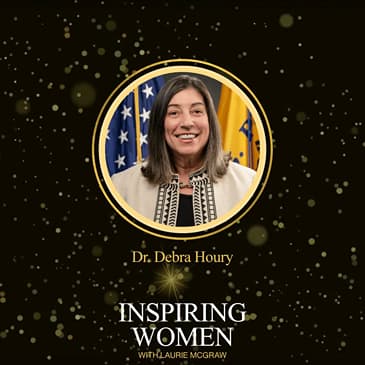
Dr. Debra Houry spent 11 years at the CDC and served as its Chief Medical Officer and Deputy Director for Program and Science. On August 27, 2025, after CDC Director Dr. Susan Monarez was fired, she resigned alongside two center directors and chose to go public. On Inspiring Women, Laurie McGraw talks with her about that decision, the state of the CDC today, and why she is still optimistic about public health.
WHAT YOU'LL LEARN
- Why she chose to resign publicly instead of leaving quietly
- "My job was actually not to protect my job, but to protect the American public and the agency"
- The pushes on hepatitis B vaccine advice, measles treatments and the COVID vaccine pages that led her to say "I can't change science"
- What it means that 30% of CDC's workforce is gone
- Why about 19 political appointees at the CDC is a big change from the usual one to three
- How she started national drug overdose, suicide and firearm violence prevention work at the CDC, across administrations
- Where to get health information now, from Dr. Google to Dr. ChatGPT
- Why she is not sure the agency will still be called CDC
- How regional state alliances, universities and medical societies are filling the gap
- Her advice for women leaders: be authentic, step up and speak up
ABOUT THE GUEST
Dr. Debra Houry is a physician executive, emergency medicine doctor and public health leader. She was the Chief Medical Officer and Deputy Director for Program and Science at the U.S. Centers for Disease Control and Prevention, and earlier ran its National Center for Injury Prevention and Control. Today she works with California's innovation institute on bringing technology and AI into public health, advises the West Coast Health Alliance, teaches part-time at Yale and advises health tech and AI companies. Her book on leading through crisis comes out next year.
ABOUT THE SHOW
Inspiring Women with Laurie McGraw features conversations with women leaders in health, technology and business.
#InspiringWomen #CDC #PublicHealth #WomenInLeadership #Leadership #Measles #Vaccines
[00:00:00] [SPEAKER_00] I knew my job was actually not to protect my job, it was to protect the American public and the agency. I actually was having issues with the secretary, we were in the middle of another measles outbreak, and he was publicly misspeaking on the vaccine and promoting unlicensed medications for measles. I can't change science. And that's when I cleared out my office in April. For four months, had an empty office except for what was on the walls, because I thought each day could be my last.
[00:00:25] [SPEAKER_00] You can't be a CDC director if you can't make decisions. She told me to see what happened, and then I saw what happened. She was fired. Do we go quietly or do we go public? We're seeing that 30% of CDC's workforce is gone. As women leaders, we really need to rise up to the occasion. We may have a different lens, a different voice. We need to use it.
[00:00:50] [SPEAKER_01] This is Inspiring Women. I'm Laurie McGraw, and what an honor. Today I am speaking with Dr. Deborah Clary, and she is a physician executive. She's a public health leader. She serves as the chief medical officer and deputy director for program and science at the United States Centers of Disease Control and Prevention. She was a leader there for 11 years. She quite famously resigned from that post on August 27, 2025.
[00:01:20] [SPEAKER_01] So just a bit over a year ago, when Dr. Susan Menares was fired by Secretary of HHS Robert Kennedy. We are a bit of a year later in this, and Dr. Howery continues to be a public leader in terms of public health and the importance of public health. And quite interestingly to me, she is optimistic about public health.
[00:01:48] [SPEAKER_01] Dr. Howery, thank you for being on Inspiring Women.
[00:01:51] [SPEAKER_00] Pleasure. Looking forward to the conversation.
[00:01:53] [SPEAKER_01] Well, let's start perhaps just with your article in Time yesterday. So you are a prolific writer. You are out there. You are reminding us of the importance of public health. Title of that article, Children Are Back in School, Measles Is Too. Can you just give us a glimpse into the state of public health today and what's happening in the world of measles?
[00:02:16] [SPEAKER_00] Yeah, despite you saying I was optimistic, certainly some things don't make me optimistic. And, you know, I'd say the state of infectious diseases in our country is really at an all time low. We've now hit thousands of measles cases. I am sure we will lose measles elimination status for the United States. And just last night, a fifth fatality was reported in Pennsylvania due to measles. And so what I did in that article is really called out the silence of CDC.
[00:02:46] [SPEAKER_00] They did a lot of back-to-school messaging on things like nutrition and physical activity, which are certainly important, but absolutely nothing on vaccines, which is a deviation from prior years. And the new CDC director also has chosen not to follow the usual process where states report information on fatalities. She's now using a different system, and she changed it mid-course, and actually they took numbers down. And so in my mind, that is not helpful for the United States as we're looking at health threats.
[00:03:15] [SPEAKER_01] So, Dr. Howery, before we get into this, that day that you resigned after over 11 years at the CDC in public service, can you just first tell us, like, how you came into public health? As a physician, you became a physician leader, but then as a public servant, you oversaw one of the most important agencies that we have for the safety net of public health.
[00:03:40] [SPEAKER_01] And so we can talk about sort of like where we are, the dismantling, but also the what's being rebuilt. But first, let's talk about you. How did you get into this, and how did you get into public service?
[00:03:52] [SPEAKER_00] Yeah, so it was one of those unintentional, I'd say, tasks that I ended up taking. When I was looking at medical schools, I ended up doing a combined MD and master's of public health at the same time, no additional training within four years. And so I was taking public health classes at the exact same time I was going through medical school. So for me, it was married together from the start, the patient to the population. And after my residency training in emergency medicine, I worked at a county hospital in Atlanta, Grady Memorial Hospital.
[00:04:21] [SPEAKER_00] And there on the front lines, a lot of the patients I saw would come in with advanced cancer or HIV or an overdose, things that I could see in my public health brain. We could really focus on preventing. So I began a research career focused on a lot of the public health prevention issues, became tenured, was enjoying what I was doing at Emory. And then an opportunity came at CDC to run a national center. And I actually came from a family of federal servants and said I was never going to go into government.
[00:04:50] [SPEAKER_00] But I applied and ended up at the CDC, you know, running the National Center for Injury Prevention and Control. And for me, it was the opportunity to take what I saw on the front lines and the research I was doing and be able to launch national programs to prevent drug overdose, prevent suicide, even firearm violence. I led some of the initial work in that at CDC. So it was really, I'd say, impactful. And we're now seeing drug overdoses coming down in our country, but to be behind a lot of that work there.
[00:05:19] [SPEAKER_01] And so we're going to get to the point of your resignation and why that moment happened. But I think it's important to note that during your time at the CDC, you worked in multiple administrations. So and you've spoken publicly about all of the progress that you were able to oversee in advance during the first Trump administration.
[00:05:42] [SPEAKER_01] Can you just talk about some of those accomplishments and why organizations like the CDC are so important and should not be politicized based on administrative whims or what the sort of politics of the day might be?
[00:05:59] [SPEAKER_00] And I think that's such an important point. I think we're seeing a lot of the politics and ideology causing issues today. But the three first administrations I worked in, some of the political leaders that I would work with changed, but the work I did didn't. And, you know, I was able to, under the first Trump administration, stand up the National Drug Overdose Prevention Program. We started suicide prevention out of CDC for the first time, as well as even preventing gun violence. That was all done under the first Trump administration.
[00:06:28] [SPEAKER_00] My budget grew significantly between the first two administrations as well, because when you look at injury and violence in the United States compared to other public health issues, it was really underfunded and a tremendous need to be able to do more in our communities around it. So across administrations, we focus on what are leading causes of death, what are taking lives prematurely, and then trying to address that with evidence and science. Sounds basic, but that's what we try to do. It's boring.
[00:06:57] [SPEAKER_01] Yes. Actually, follow the science, do the work, put out the information publicly, let the scientific community, the medical community take that information, apply policies, apply rules, you know, administer vaccines, all of that important thing, develop drug programs that can be helpful to people who are battling a disease. And again, the work can be boring, critically important.
[00:07:24] [SPEAKER_01] Let's take us to the second administration where you, in last year in August, you felt compelled so strongly that something dramatically different was happening in the CDC, so much so that you were compelled to do something pretty significant.
[00:07:56] [SPEAKER_01] And it was something I had been thinking about for quite some time.
[00:08:06] [SPEAKER_00] I was actually the transition lead for the agency, and every four years when a new administration comes in, they select a senior leader at the agency to welcome the administration and, you know, focus on priorities. And given the administrations I'd worked across before and kind of was a change agent, I was asked to do that. And I was also the senior most career leader at CDC. I was actually the only non-political in the office of the director after January. But there were many times I had concerns.
[00:08:34] [SPEAKER_00] The first doge cuts initially were going to be even more severe, and that was when I first offered a verbal resignation to my political leaders, and we were able to negotiate and actually change the outcome of several programs that were going to be completely eliminated. And that was when I knew the first time you think you might leave, that it could happen. And then in the spring, I actually was having issues with the secretary.
[00:08:56] [SPEAKER_00] We were in the middle of another measles outbreak, and he was publicly misspeaking on the vaccine and promoting unlicensed medications for measles. And so I sent corrected talking points, and I was also asked to modify a toolkit as well to put medications on it that weren't warranted. And I said no, and that's when I cleared out my office in April. I, for four months, had an empty office except for what was on the walls because I thought each day could be my last.
[00:09:23] [SPEAKER_00] I knew my job was actually not to protect my job. It was to protect the American public and the agency. And I had reached out to Susan Menares, who was going through the confirmation proceedings. I told her with a lot of the things that were going on at CDC, I didn't think I would be there when she came in August. And she said, please wait, you know, I will help you when I get there. And so I stayed. Mid-August, she got a memo saying from the department, the chief of staff,
[00:09:51] [SPEAKER_00] that she couldn't make any policy or staffing decisions without oversight from other politicals. You can't be a CDC director if you can't make decisions. And that's why I said to her, Susan, your time is limited, and you're not going to be able to be effective. I'm not going to be staying. She told me to see what happened. I saw what happened. She was fired. And so I said to two of the center directors who reported to me, our time has come. And we actually talked. Do we go quietly or do we go public?
[00:10:20] [SPEAKER_00] And the reason for us to leave was to truly use our voices. We weren't going to just leave and do something else. I actually didn't know what I was going to do that day I walked out. But it was important to say there's scientific integrity issues. There's challenges to the American public when it comes to health. And this is not acceptable.
[00:10:39] [SPEAKER_01] Can we just talk about in the space of public health, the public health infrastructure for the United States, I would argue that it has always been underfunded. And so that as a challenge in terms of protecting the public and providing what is generally a safety net for people who need to access health resources, that's always been a challenge.
[00:11:05] [SPEAKER_01] And as a leader for the CDC, protecting the public is the critical thing that you do. What is the difference between protecting the public with just funding versus protecting the public with, I might say, just misinformation or not science? Can you just describe the difference and the importance of that difference? That is so it just was the turning point for you in terms of your need to leave?
[00:11:34] [SPEAKER_00] Yeah. So there were a few things. And one was I knew the September vaccine committee meeting was coming up. And from several of the political appointees, I heard that they planned to change the hepatitis B vaccination recommendation. We had really changed the number of children who were dying from hepatitis or had long-term chronic liver disease because of those vaccinations. I knew that it was not an evidence-based recommendation that was going to go forward and that was going to have harm on the American public.
[00:12:00] [SPEAKER_00] What was happening with measles, that was going up and saying things like take steroids or antibiotics or cod liver oil was harmful as well. And I did my best at multiple points in time to actually try to intervene, even when we were asked to take pregnancy off a website around COVID vaccines because they felt it wasn't a risk factor. That's incorrect. Pregnancy has a lot of physiologic changes. And I just said, I can't change science.
[00:12:25] [SPEAKER_00] And so repeatedly it became cumulative to where I just knew I had done as much as I could inside. And if I wanted to try to do more, I had to do it from outside where I could speak more publicly to Congress and to other stakeholders.
[00:12:39] [SPEAKER_01] So I want to move to that work that you're doing now before we even get there. Can you talk about the state of the CDC today? And we have new leadership there. There continues to be the function of the CDC, but not all of the programs that the public counts on the CDC to provide. Exist. They're being cut off. There are reports that are no longer being provided in terms of public health information and statistics.
[00:13:09] [SPEAKER_01] Can you just talk about the current state of the CDC?
[00:13:13] [SPEAKER_00] Yeah, unfortunately, it is not good. It continued to worsen. And that's why I stayed as long as I did because I thought that after I left, there wouldn't be somebody that would be pushing back. We're seeing that 30% of CDC's workforce is gone. And 80% of the funding from CDC goes out to local and state communities. When there's an outbreak, like we saw a cyclospora, you want boots on the ground helping with that. So when you have less people able to respond, we're going to see more of these outbreaks in communities.
[00:13:43] [SPEAKER_00] Things like chronic disease, about half the center has been wiped out in the Office of Smoking and Health. Well, smoking is one of the most important predictors and contributors to things like high blood pressure and cancer. And to wipe that out is mind-boggling. There's been more political appointees. I think there's about 19 now. Usually there's one to three. And so that's a significant difference. And most don't have a medical, health, or even government background.
[00:14:09] [SPEAKER_00] So you look at that, and then a report came out last week, Youth Risk Factors, the Youth Risk Behavior Survey. I was glad it came out, but it's actually a pared-down report than normal. It didn't have sexual identity in there. It didn't have race. They took out violence questions and substance use questions. That's not transparent. You know, we need to be putting all the data and all the information out there and not just what the administration wants to show.
[00:14:36] [SPEAKER_01] So there's a lack of data, a lack of transparency. Let's talk a little bit about the misinformation. Because in terms of like how that is being portrayed when you have political information, not scientific information, there has been an enormous trust decrement in terms of the scientists, in terms of the medical professionals that are providing information.
[00:15:00] [SPEAKER_01] That trust that the public is losing, you know, that has all kinds of downstream impacts. So that being said, one of the things that has not happened since you left the CDC over a year ago, you certainly haven't lost your energy and your commitment to informing the public and to leaning in to public health. So, Deborah, can we just talk about what you have been doing?
[00:15:27] [SPEAKER_01] You certainly didn't spend a second on feeling sorry for yourself in this public moment.
[00:15:33] [SPEAKER_00] No, I took because for the first few weeks, I said I was probably one of the busiest unemployed people there was as I was doing nonstop media. And three weeks after I quit, I testified before the Senate around many of the issues that happened. But, you know, for me, it's about what can I do positively during this moment. So I'm working out West with California. They have an innovation institute where I'm helping bring in different technology and AI to the state to really look at how we can inform public health systems.
[00:16:02] [SPEAKER_00] And then I'm advising the West Coast Health Alliance, which is four different states out West, on how they can work together. They're just things on like lab prioritization or ensuring that their communities have access to vaccines. I'm teaching part time at Yale because I think it's important to build that next pipeline. I'm advising several health tech, AI companies and advisory boards. And then I've got a book coming out next year on leadership on how you lead during crisis.
[00:16:29] [SPEAKER_01] Well, I can't wait to read it because you're certainly the best spokesperson for something like that. So, Dr. Deborah Clary, just in terms of leadership and in terms of continuing to be a public advocate and voice, you also maintain a level of optimism.
[00:16:47] [SPEAKER_01] So for the things that you're both personally involved in, as well as what else is happening, that where the CDC is not providing what you feel is necessary for the public in terms of correct information, scientific information, serving with resources, the people that are there. There are many other things. Are they filling the void? Where should we feel optimistic? What else still needs to be done?
[00:17:15] [SPEAKER_00] Yeah. And when I say I'm optimistic, it's because I think you have to get up each day and tackle what's in front of you. I certainly think our country has been through quite a bit and the public health federal agency has pretty much been dismantled. But in my mind, that means that when we're fixing it, it's not a small tweak anymore. Now you have the opportunity to really rebuild and do things differently. So that's my positive spin. But, you know, I think we're seeing a lot of regional alliances across states and communities work together.
[00:17:43] [SPEAKER_00] And that should have been happening anyway, because I think public health happens in local communities and state and regional, not just at federal. And so that is an opportunity where a lot of different regions are stepping up and looking at their differences. You know, Northeast might have more like tick-borne diseases and out West, you know, more on like hantavirus or wildfires. And so there's different differences to where these groups can work together. And universities, I have seen step up a lot.
[00:18:09] [SPEAKER_00] Yale, you know, where I'm part-time, they have pop fives where they're putting new data systems out to where you can look at data that might be more timely than federal. They're doing a lot of work with private sector and commercialization because I think as we're looking at what's needed, public health systems can be old and archaic. So how do you bring private sector in to really modernize a lot of that?
[00:18:30] [SPEAKER_00] So and then finally, I'd say a lot of the medical societies like the American Medical Association have really stepped up right now when it's come to things like vaccine guidance. And certainly the American Academy of Pediatrics, because you can't go to the CDC, unfortunately, for evidence-based guidance. So you have to look at many of these medical organizations.
[00:18:49] [SPEAKER_01] So where should people be getting their information these days? And we're also in a really different era of how people consume information. Yes. My daughter, as an example, she has two children. I'm a grandmother, a very proud grandmother. And she gets a lot of her information from her social groups, from like, you know, what's in, you know, what's on Instagram or things of that nature. Are these reliable sources?
[00:19:11] [SPEAKER_01] How can they be reliable sources versus politicized sources or, you know, influencer status that might not be based in science?
[00:19:21] [SPEAKER_00] So I think people always turn to their friends or it used to be, I used to call it Dr. Google. Now it's like Dr. Chat GPT. And I think it's important to realize that what goes in is what comes out, you know. And so it may not always be the, you know, most scientifically rigorous studies that are being put in all the time. Some of the misinformation can also be being put in, so you have to balance it. So I would say in general, look at your local or state health department for information.
[00:19:46] [SPEAKER_00] And when it comes to things like vaccination, look at American Academy of Pediatrics or the American Medical Association. Many of the specialty societies and health departments have really filled the gap during this time. And that is why we do need a federal government, because it's helpful to have that glue and that kind of coordination. But we are not seeing that today. So in general, I would not go there.
[00:20:08] [SPEAKER_01] So, but you do have confidence in institutions. You do have confidence in scientific and rigorous organizations. Do you think that the CDC, which brings so much of that all together, do you think that that institution can recover? Do you see a world where that is possible in the near term? What do you think it will take for the CDC to be restored to a place of public confidence?
[00:20:37] [SPEAKER_00] So there's still some amazing people at CDC. The issue is there's about two levels of political layers. And that's why what we're seeing coming out can't be trusted. The people, the scientists and the staff that are there still can absolutely be trusted and they want to do great work. I think we will need a federal public health agency. See, this is going to be controversial, but I want to say I'm not sure it's going to be called CDC. I think as we've looked at all the hits to its reputation, it may truly need to be rebranded. And you can't just put pieces together.
[00:21:06] [SPEAKER_00] I think this allows us to look at how can we provide more support to local and states? How can we look at what a more nimble federal agency can do? So I think the institution or at least the concept of the institution will survive, but I think it's going to look different.
[00:21:23] [SPEAKER_01] Do you see more a future of more global organizations or more localized organizations or a combination of both?
[00:21:33] [SPEAKER_00] Well, you know, certainly global is a separate issue right now, you know, with the United States having withdrawn from the World Health Organization and with some of the funding changes to Department of State. CDC is closing many of its country offices. And so we're losing a lot of that global perspective. I think in my mind, the perfect ecosystem, you know, is from hyperlocal to federal and global because you need all components. You know, you're going to catch the first signals or respond to local community needs for something.
[00:22:03] [SPEAKER_00] That's going to be different from looking across several countries. So it really should all be part of the same continuum with different, you know, different components that are important.
[00:22:13] [SPEAKER_01] So I think that this this idea of optimism, it really sounds more like a survival technique for you in terms of just your commitment to public service, public health, and also protecting people from disease, from outbreaks, from things of that nature. Sure. So as you do the work that you're doing today, Dr. Hure, just in terms of that, what do you envision for yourself?
[00:22:39] [SPEAKER_01] You have spoken very publicly that you still identify as an ER physician. You still identify as a public health, you know, advocate, and you also identify importantly as a mom. And so just like, how do you see your work today? What is driving you and what are you looking forward to?
[00:22:59] [SPEAKER_00] Yeah, there's always been a common thread, I'd say, throughout my career. You know, if you look, it looks like it's been all over the place between academia and federal sector. And now some of the work I'm doing with corporations, but it has always been about mission and impact. Like where can you improve people's lives? Where can you scale up and have impact? So for me, the next step will be, you know, where can I have that impact today? My impact is needed. And these other groups, as we don't have reliability with a federal public health agency,
[00:23:29] [SPEAKER_00] a few years from now, hopefully when we do have much more stable federal government, I see myself leading an organization again that's really committed to health, health improvement. And I've really become a big fan of incorporating AI and technology into a lot of what we're doing to improve workflow, even patient experiences. And so I think that will be a component for me as well.
[00:23:51] [SPEAKER_01] So Dr. Harae, if we can close out this Inspiring Women interview, if you can just speak to sort of like earlier stage scientists, physicians, medical professionals, or people who do want to have a level of impact like you and also serve others. You know, it is a commitment to service that you lead with. What is your advice for them?
[00:24:14] [SPEAKER_00] Well, you probably can't see it behind me, but I always have the sign, well-behaved women rarely make history. And that is my favorite quote. And for me, it's always about, you know, be an authentic leader. You know, if you see something wrong, like with a patient case, with a program you're running or an opportunity, step up and speak up. That's, you know, what I think is so important. In the ER, I learned how important teams were. Every single person had different expertise and saw something different.
[00:24:41] [SPEAKER_00] And that's where I think as women leaders, we really need to rise up to the occasion. We may have a different lens, a different voice. We need to use it.
[00:24:50] [SPEAKER_01] Well, thank you so much for continuing to use your voice in very loud and very well-heard ways. I know that I certainly appreciate it. I can't wait for your book to come out. This has been an incredible, inspiring women conversation. I've been speaking with Dr. Deborah Howery and Dr. Howery. Thank you so much.
[00:25:09] [SPEAKER_00] My pleasure. My pleasure.