
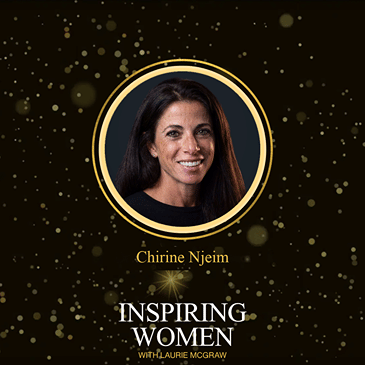

Four-time Olympian Chirine Njeim on racing for Lebanon at three Winter Olympics, qualifying for the Rio 2016 marathon, and bringing an athlete's drive to building a company. Chirine Njeim learned to ski on the slopes of Lebanon, left home for France at 13, and raced alpine skiing for Lebanon at the 2002, 2006 and 2010 Winter Olympics. After moving to Chicago she ran her first marathon, then qualified for the Rio 2016 Olympics with a 2:44 in Houston after her coach told her there was no way. She is executive assistant to Glen Tullman, founder and CEO of Transcarent. On Inspiring Women, Laurie McGraw talks with her about two knee surgeries, double pneumonia and anorexia, why positive reinforcement works better than shame, running seven marathons on seven continents in seven days, and her advice for young women. WHAT YOU'LL LEARN - How does a girl from Beirut become an Olympic skier when Lebanon is "not really known for skiing"? - What was it like to leave home for France at 13, and why did her mom always say "pack your stuff and come home"? - How do you come back from two knee surgeries, double pneumonia and anorexia? - Why does positive reinforcement work better than shame? - What did Rowmark Ski Academy and the University of Utah teach her about discipline and teams? - How did she go from her first Chicago Marathon to qualifying for the Rio 2016 Olympics with a 2:44? - What does an athlete's discipline bring to building a company like Transcarent? - Why run seven marathons on seven continents in seven days? - What is her advice for young women who want to be exceptional? CHAPTERS 0:00 Trailer 1:10 Introduction: a four-time Olympian at Transcarent 1:58 Growing up skiing in Lebanon 3:06 Leaving home for France at 13 3:55 When a passion becomes world-class 5:07 Two knee surgeries, double pneumonia and anorexia 6:32 Mental toughness before mental health coaches 7:40 Anorexia and a year to recover 8:35 Positive reinforcement, not shame 9:23 Rowmark Ski Academy and the University of Utah 10:42 Three Winter Olympics: 2002, 2006 and 2010 11:16 Carrying Lebanon's flag 12:00 Hanging up the skis 12:26 Met on a plane: from mountains to skyscrapers 13:10 Her first Chicago Marathon 14:19 Sub-three and the road to Rio 15:13 "There is no way": qualifying in Houston with a 2:4416:13 The journey was my Olympics 16:29 Bringing an athlete's drive to Transcarent 17:13 Discipline, teamwork and getting things done 18:25 Seven marathons on seven continents in seven days 21:21 Advice for young women 22:25 Closing ABOUT THE GUEST Chirine Njeim is a four-time Olympian for Lebanon. She raced alpine skiing at the 2002, 2006 and 2010 Winter Olympic Games and ran the marathon at the 2016 Olympic Games in Rio. She carried Lebanon's flag at the 2002 and 2010 opening ceremonies, trained at Rowmark Ski Academy in Salt Lake City, raced in the NCAA for the University of Utah, and has run seven marathons on seven continents in seven days. She is executive assistant to Glen Tullman, founder and CEO of Transcarent, in Chicago. ABOUT THE SHOW Inspiring Women with Laurie McGraw features conversations with women leaders in health, technology and business. #InspiringWomen #WomenInLeadership #Olympics #Marathon #Resilience
[00:00:00] [SPEAKER_01] She's a 4 time Olympian and one of the very few people in the elite class of competing in both the winter as well as the summer games. And then was it like 3 consecutive Olympics?
[00:00:13] [SPEAKER_00] So I did 2002, 2006 and 2010 Olympic Games. I actually had 2 knee surgeries. I had to deal with double pneumonia. Also I had to deal with anorexia which was back to back to back. My first injury was my ACL and honestly I thought that was the end of my career. I kept saying to myself, wait for my comeback. There's no way you can do this because back to back marathons is just impossible. My mind took over my body.
[00:00:42] [SPEAKER_00] I ran in 244 and qualified for the Olympics. Yes, I went to the 2016 Olympic Games for Lebanon but to me the journey to get there was my Olympics. So I ran 7 marathons on 7 continents in 7 days. Just give it a shot. Go for it. You know, we have that one life. Just go for it and give it a shot.
[00:01:05] [SPEAKER_02] This is Inspiring Women. I'm Laurie McGraw and today I am speaking with Shereen Zhang. And Shereen is the executive assistant to the CEO, the founder of Transcarentt, a company that we both work at. This is my second tour of duty working with you Shereen. She is more than just an executive assistant building an important company in the space of health and care.
[00:01:27] [SPEAKER_02] She's a four-time Olympian and one of the very few people in the elite class of competing in both the winter as well as the summer game. Shereen, thank you for being on Inspiring Women.
[00:01:40] [SPEAKER_00] Thank you so much for having me. I'm really excited. I've been listening to this podcast for so long and really love it. So I'm excited to be part of it.
[00:01:48] [SPEAKER_02] And I had to pull Shereen into being on this podcast. She was like, what? I'm going to show up and be on a podcast. Shereen, let's start. Let's go in the way back machine. Okay. You are an Olympic athlete from Lebanon. And so you started competing or training, I would just say, at the age of three. Can you just like bring us in the way back as to where it all started for you?
[00:02:10] [SPEAKER_00] Yeah. So I am from Lebanon, Beirut, Lebanon. And so growing up, my family, we always on the weekend went skiing. And so my dad taught me how to ski at a very young age. And that's where I just, you know, my passion and love for skiing just grew. And that's what I wanted to do. But yes, I skied on the slopes of Lebanon and started at a young age and just kind of watched it mostly on TV because Lebanon is not really known for skiing.
[00:02:38] [SPEAKER_02] No.
[00:02:38] [SPEAKER_00] So we do have mountains, which people a lot of times think it's a desert, but we do have like all four seasons. So yeah. So I just started watching on TV and I would just go on the hill and try to do exactly the same thing. And the older I got, my parents saw how passionate I was about skiing and they decided it's time to, you know, kind of help her explore more about the sport. And so they sent me to France where that's where I went to school and also was able to ski at the same time,
[00:03:08] [SPEAKER_00] which is something not really provided in Lebanon. And from there, I just, you know, trained with a coach there, lived with a coach there. It was very, very hard being so young, being away from my family. How old were you? I was about 13 years old. Okay. And so being there on my own, just, you know, it's, it was shocking. And so I would call my mom every day. I'm like, I want to come home. And she, you know, she never said, don't come home. She always said, pack your stuff and come home. Like we're here for you. We're supporting you.
[00:03:37] [SPEAKER_00] So, and then I don't know if that reverse psychology that she used kept me moving forward. And I knew I had a goal. I wanted to go to Olympics. I wanted to represent my country. And, um, so I just kept moving forward. Let's back it up a little bit, Shireen.
[00:03:52] [SPEAKER_02] Cause like, like I, I, I ski, I grew up, you know, doing a little bit of skiing. Um, to say that I am like a world-class athlete at anything. Um, I am not, there are many people who are fantastic athletes. It's a very different thing to be a world-class athlete. So, you know, at those early ages and sort of recognizing you were very passionate about something, when did it start to become something where like, oh, I could be, you know, at a world-class level. I mean, because it seems to me as somebody who is nowhere close to that, that seems to be
[00:04:22] [SPEAKER_02] like, there's like a click where it suddenly becomes more than just, I really enjoy doing this.
[00:04:27] [SPEAKER_00] Yes. It's very true. I mean, it's, I think it's a passion. It's the love of the sport. You just know, because I could have, you know, exited, I could have left at any time. But I think at the age of 13, when I started traveling all over Europe and racing and, you know, meeting other athletes and seeing how they were just, you know, proceeding in their journey, that just kind of lit more fire inside me. And I just wanted to do it more and more. And I just wanted to be better at it.
[00:04:55] [SPEAKER_00] And I think once you have that, you just know this is something for you. And to me, that's what just kept me moving forward because of that.
[00:05:03] [SPEAKER_02] Okay. But there's also like lots of reasons to sort of like hit obstacles and not push forward. Can you talk about a time that sort of like, you know, you hit some obstacles along the way and you had to, I don't know, dig in, find something. How did you get beyond and start with like, what is the obstacle? And then how did you move beyond it?
[00:05:21] [SPEAKER_00] Yeah. So, um, of course I feel like with every sports, there's always obstacles. Never like a straight line where it's just wonderful. And everybody sees that it's like the nice, easy way to get there. I know you put the pediatry page.
[00:05:33] [SPEAKER_02] It's like a straight line. It looks amazing.
[00:05:35] [SPEAKER_00] No, of course I actually, um, had two knee surgeries. I had to deal with a double pneumonia. Um, also I had to deal with anorexia, which was back to back to back. And I think all of these, like my first injury was my ACL. And honestly, I thought that was the end of my career being so young. I just didn't know what to do, but you learn from your coaches, you learn from teammates, other people talking to you and letting you know that this is just a part of, you know,
[00:06:03] [SPEAKER_00] because the sport is not just physical, it's also mental. And you need to kind of power that engine, the mental engine. So in order to be able to become the person, you know, you want to be in the future. And so to me, all these injuries, yes, they were a setback and I cried and I was very upset about it. And I thought my career was done, but they taught me mentally how to be strong and how to overcome.
[00:06:28] [SPEAKER_02] Um, how did they do it? Cause I think today with all athletes at a young age, you know, people have like, you know, mental health coaches. Like this is sort of a commonly talked about type of thing. It certainly wasn't, I mean, even like 10 and 15 years ago. Right. So like, how did you recognize it as such? And like, what did that, how did that show up as like, was it just like be tough, you know, and suck it up? I mean, you know, what was it more than that?
[00:06:52] [SPEAKER_00] Oh, it's definitely more than that. I think the support and the people that I was surrounded with are the ones that just helped me move forward and understand that this is just a part of sport. And, you know, you hear about other athletes that also have head injuries and how they overcome this injury. And it just becomes this thing where I kept saying to myself, wait for my comeback. And so that just made me even stronger as a person. And I wanted to show others what I can do, even so I was injured.
[00:07:20] [SPEAKER_00] And so all of these just kind of like builds. And I think the positive reinforcement of, you know, you have to do physical therapy. This is just a setback. This is just a challenge. Learn how to overcome it. And over and over someone saying that to you, you believe it. Yeah. And you build that confidence. And that's how kind of helped me get through my all my injuries, especially like the hardest one was the anorexia. Like, I think to me, that was more.
[00:07:45] [SPEAKER_00] I think I was very depressed being away from home, being away in a family and just having injuries. I just pushed myself to a very bad area, which is, you know, I really wanted to give my maximum. And so I thought that was the way to do it. And I quickly learned that that's not the way. And then, you know, again, it took me a year to recover from it. It wasn't easy. But how did you get help at that time? It was the same thing.
[00:08:11] [SPEAKER_00] My mom came over and so she stayed with me. And then I was just always being, you know, pushed and supported and in a positive way. It was never like, this is what you need to do. You came here for this. It was always like, you don't have to do this, but what you're doing is wrong. You know, you got to move forward. And that's what kind of helped me.
[00:08:31] [SPEAKER_02] Because it's interesting that just like, you know, it was the positive reinforcement that helped you. And so it was beyond those difficult things because oftentimes with like anorexia and other, you know, types of like, you know, pushing on sports prodigies, you know, shame is a big part of that. That type of psychology, which wasn't the thing that worked for you.
[00:08:50] [SPEAKER_00] No, I think, you know, I think in life too, like it's when you're hard on a person, it's, they just kind of push back, you know, and they don't want to move forward. But I feel like if you accept their mistakes, if you accept what they have done and you tell them why it's wrong. I think that's the way as human, we learn to just move forward. And you learn from your mistake. You say, okay, that was a bad one, but I learned and I was talked to how to fix it. So that's how to me, it was a very helpful way of just pushing forward.
[00:09:19] [SPEAKER_02] So the pushing forward drive that you have, like that stayed with you. So when did you come to the United States and when did marathon running become like the new passion?
[00:09:27] [SPEAKER_00] So at the age of 15, that's when the Olympics start to become like an idea. Like I wanted to race up to 2002 Olympic Games in Salt Lake City. And my family, my parents started looking at places in Utah where I can actually ski and train on the slopes. And we found Roamark Ski Academy. And it's part of the school where you go to class in the morning and in the afternoon, you go to the slopes and train and you do it over and over.
[00:09:55] [SPEAKER_00] And that's why I chose to go to Salt Lake City. And that was a place I stayed there, went to University of Utah, and they both were just a huge part of my life. And, you know, when I was at Roamark Ski Academy, I learned discipline. I learned resilience. I learned how to set goals. And when I moved to University of Utah, it was just a team aspect. So I learned how to work, you know, as a team because you race at NCAAs.
[00:10:22] [SPEAKER_00] And so that part was something that I learned about and supporting each other, even so you had your own goals. And at the same time, be able to support each other when things were not going as well for yourself. So all of those things just kind of shaped who I am today. When was your first Olympics?
[00:10:40] [SPEAKER_02] 2002, Salt Lake City. When you were there in 2002. Yes. Okay. And then was it like three consecutive Olympics? What happened?
[00:10:49] [SPEAKER_00] So I did 2002, 2006, and 2010 Olympic Games.
[00:10:54] [SPEAKER_02] Okay. But all skiing?
[00:10:56] [SPEAKER_00] Not all skiing. All skiing. Alpine skiing. Okay. So now you're completely focused. On skiing. On skiing. That was my only goal. I never thought I'm going to any other Olympics. That was the only thing I wanted to do. And that's what I've been training for at a very young age. So that's what I wanted.
[00:11:11] [SPEAKER_02] And describe that experience. I mean, you weren't just at the Olympics. You like carried the flag for Lebanon, you know, in the opening ceremonies. What was the experience like?
[00:11:21] [SPEAKER_00] Um, it was a dream for two weeks. Truly like how they say, you know, you, you get kind of depressed after the Olympics. It's because it's such a high in my life that going to the Olympics was kind of a blur. Yeah. But you're surrounded by athletes are just exactly like my personality, you know, they seem bold and intense, but there's something about it. And that was so special, like being there representing my country, which again, Lebanon is such a little small dot on the map.
[00:11:48] [SPEAKER_00] So it was really to me that meant the world to be able to represent my country, especially with everything that was happening. So. Yeah.
[00:11:56] [SPEAKER_02] And then, so you do these amazing Olympics. You do it three times across eight, 10 years. And, um, and then what you hang up the skis and you're never going to do anything competitive again. Well, not quite.
[00:12:09] [SPEAKER_00] Not quite. Yes. Um, well, you know, it's like when I, I got to a point in my career in skiing, what I just knew that was the end, you know, you just know, like your motivation is just not there. You're just ready for a change. And at that time I met my husband, which I met him on an airplane coming from Lebanon to Salt Lake City. And, um, and kind of, I want to say he was the change of my life, like the rotation where I literally moved from Salt Lake City. He was in Chicago. So I moved from Salt Lake City to Chicago.
[00:12:39] [SPEAKER_00] So I traded the skyscraper, the mountains to skyscrapers.
[00:12:42] [SPEAKER_02] Yeah.
[00:12:42] [SPEAKER_00] And I never thought I would live in the city. You know, I love the mountains. I love just being there. And, um, so I decided, okay, I'll move to Chicago with him. When I came here, I just wanted to be this person who just does the normal stuff, meaning like just, you know, yoga, biking and walking. But I think that competition, like that drive in me and just couldn't resist. And I saw a lot of people running and I decided, why don't I give it a shot and just run the Chicago Marathon?
[00:13:12] [SPEAKER_00] You know, I'm here and it's just one of those things to, you know, check off the box. I'm just going to run the Chicago Marathon. Yes. So I went ahead and registered my husband and I to run the 2012 Chicago Marathon.
[00:13:24] [SPEAKER_02] Yeah.
[00:13:25] [SPEAKER_00] And I honestly didn't train much for it. I just kind of went for runs and it was a, it was a hard change going from a power sport to a long distance sport. It was a lot of things that I had to learn, you know, being patient and just going out, you know, starting the race very slowly instead of just going all out. So I looked at the Chicago Marathon. I fell in love with the sport. Yeah. I'm like, this is so challenging.
[00:13:49] [SPEAKER_00] And I think also having other people around me and being so competitive as a person, I felt like I was just like chasing people around. So I love that part of it. And since then I started joining little clubs here in Chicago. And, um, I decided to just kind of like explore my running and just kind of follow that passion. So I didn't know really where it was going. And then, but the, where it went to was another Olympics. So like what happened there?
[00:14:16] [SPEAKER_00] So from there I started training and, uh, just kept doing Chicago Marathon year after year. And, um, finally I did one of the marathons, which I ran like a sub three. And that was a big step forward for me. So three hours. Yes. It takes me three hours to get out of bed and get ready.
[00:14:36] [SPEAKER_02] Okay.
[00:14:37] [SPEAKER_00] And that was getting close to the 2016 real Olympic game. So that was 2015. I did October. I ran Chicago Marathon in two 46. Then I went to Lebanon a month later, which is not recommended at all to do back to back marathons. And I did the Beirut marathon. And that was just more to be there for Lebanon and, you know, inspire the next gender younger generation. So I went to Lebanon and I ran a two 48.
[00:15:03] [SPEAKER_00] So I was only two minutes off, but I proved myself that I finally belong in those two hour. Yeah. And then on my way back from Lebanon, I emailed my coach and I said, I'm going to do the Houston marathon in January because that is my last chance to qualify for the Olympics. Okay. And I had to run a sub two 45. And he said to me, there's no way, there's no way you can do this because back to back marathons. It's just impossible. Your body is exhausted, but I just knew it.
[00:15:31] [SPEAKER_00] It's, it's almost at that point, my mind took over my body and I just had that goal in mind. And that's all I wanted to do. And honestly, the training from November to January in Chicago was terrible. Oh yeah.
[00:15:45] [SPEAKER_02] Like if you are not familiar with Chicago weather during the time, it is really cold. Yes. Really cold. Like you feel it.
[00:15:53] [SPEAKER_00] Yes. Your body hurts when you're on. I mean, everything about the training was terrible, but I just had that feeling inside me that I'm going to do it. And so we went to Houston and ran the marathon there and I ran in two 44 and qualified for the Olympics. So, and that is just incredible. And to me, yes, I went to the 2016 Olympic games for Lebanon, but to me, the journey to get there was my Olympics. Yeah.
[00:16:19] [SPEAKER_02] Yeah. Just listening to you makes me feel like I participated in some way. It's like amazing. Shereen. Thank you. Let's bring, let's bring, um, sort of like this, like incredible athletic drive, this competitiveness that you have, and let's bring it to the profession of building companies. So you, um, you know, are here at Transcarent, we get to work together again. This is a company that is growing, that is building, that's trying to like do something really disruptive. You work with Glenn Tolman, our founder and chief executive.
[00:16:49] [SPEAKER_02] And I know that he counts on you to sort of like just help propel him in sort of like, you know, his big vision for health and care. So I just like to get your perspective on like the intensity of sport and like, how do you bring that to the work of building a company?
[00:17:08] [SPEAKER_00] Yeah. So I would say, you know, in sport, you learn discipline, right? You learn how to support each other. You learn how to work with this team. And to me working for Transcarent, I bring all of that with me to, you know, working at Transcarent because first, you know, you, you're not working alone. You're working with a team and if you don't know how to manage that, you cannot move forward because one person is not going to take a whole company forward, you know? So, um, so that's one for me.
[00:17:36] [SPEAKER_00] And then I am very, I'm someone who just get things done. Yeah. You know, I've always, I set goals for myself and I set goals for work and I have, you know, a list of things to do and I get it done. Like I'm not someone who just waits for things to get done. And I find, I don't want to say joy, but almost like a, an accomplishment of getting things done, checking things off the list and saying, you know, it just feels good to me.
[00:18:02] [SPEAKER_00] And so, um, I think all of those things have helped me like in just work environment to be able to just manage my schedule that way. And I still run every day and I, you know, that's another thing that sports taught me, like to be able to manage running and work.
[00:18:20] [SPEAKER_02] And I think you're underselling it because I just like, just like getting things done on a task list is not how you show up to work. It is not how you show up to just doing things. And maybe I'll just like, you know, for people who are listening onto this conversation, I want to just talk about the building of, um, Transparent.
[00:18:41] [SPEAKER_02] And I know Shireen that you think about like just the work that you do and how to inspire others and be a team that does things that are exceptional. So I want to just like, take us back to just last year because I remember being in, I don't know what discussion, what executive meeting we were talking about. But all of a sudden I heard this crazy thing where Shireen was going to run a marathon or two in a couple of different countries.
[00:19:11] [SPEAKER_02] I'm like, okay, take a note. Like, okay, that's Shireen running. But it wasn't that it was Shireen running a marathon every day for seven days in every continent in this world. And all of a sudden I was just like, what have I done today? Like I've done nothing that's even close to that. So talk about that idea because that inspiration that you are bringing to all of us, we all followed your journey.
[00:19:40] [SPEAKER_02] We all looked at that as something like we can all do more. Where did the inspiration come from for that?
[00:19:48] [SPEAKER_00] I would say to me, it was the challenge. That's what kind of attracted me for that thing. So I ran summer marathons on seven continents in seven days. Did I think I can do it? No, but I love the challenge. The part of just giving it a shot and seeing where it's going to get me. And so I trained for it. And I trained for it even so I had a full-time job. But I managed to balance both of them. And that's another thing that you learn from sports, you know, balancing all of that.
[00:20:18] [SPEAKER_00] And it wasn't easy. You know, I just had long early mornings where I would do maybe a 20-mile run. And then in the afternoon, I just go back and run again. And it was just like the time on my feet and staying awake, you know, when I work and just trying to understand that this is what I chose to do.
[00:20:37] [SPEAKER_02] Yeah.
[00:20:37] [SPEAKER_00] And, you know, a lot of people question, like, why would you do this? You know, what's more motivating? And, again, I do it because it's challenging for me because it's something I can look back and say, I've done this. This is incredible. And I don't need a word from it, but I just know that to me that was everything. So, yes.
[00:20:57] [SPEAKER_02] Well, the thing that I get from it, and Shireen, you are an inspiration. This is Inspiring Women. But the thing that I just, you know, know from that time is your commitment to building. And what does it take to build something with excellence and with discipline and always pushing and inspiring others to bring an entire team along?
[00:21:16] [SPEAKER_02] So, Shireen, as we close out this Inspiring Women conversation, as we look to, you know, I am always trying to bring more women into leadership because I just believe that that builds a better, more just world and society. So, for younger women who are looking to be exceptional at a level of just like, you know, that you are, what is your advice for them?
[00:21:42] [SPEAKER_00] I would say, you know, everyone has their own journey. Everyone has their own path, goals. And don't let anyone or anything kind of stand in your way. And even if you might fail at doing things, a goal that you have or a dream that you have, just give it a shot. Go for it. You know, we have that one life. Just go for it and give it a shot. You know, if you fail, you fail. You learn from it. You move on. And you try something new. So, and most important, I would say surround yourself with people that really support you.
[00:22:10] [SPEAKER_00] And I think at Transcaren, I had that through my whole journey with Glenn. He's just always been very supportive of everything I've done. And that really helps a lot.
[00:22:20] [SPEAKER_02] So, you inspire all of us, Shireen. And this has been an amazing conversation. I've been speaking with Shireen Zhang. Shireen, thank you so much. Thank you so much for having me.