
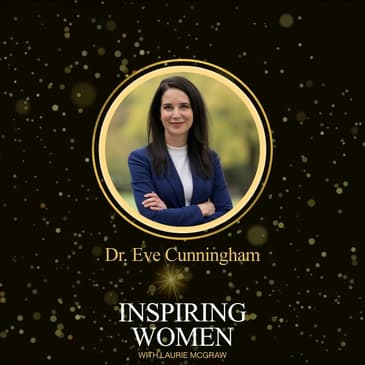
Dr. Eve Cunningham never planned to leave the delivery room. She was a practicing OBGYN — delivering babies, doing surgery, building her family — until a conversation with a Microsoft exec pulled her into virtual care leadership right as Covid forced Providence Health to move its entire clinical operation online in a single week.
That crash course became a career. Today Dr. Cunningham is Chief Medical Officer at Cadence, an AI-powered technology and care delivery company that just raised $100M and now works with 25+ health systems and over 120,000 patients. In this Inspiring Women conversation, host Laurie McGraw sits down with her to unpack how Cadence goes beyond passive monitoring — actually titrating medications, ordering labs, and triaging patients remotely on a health system's behalf.
They cover why roughly half of hypertension patients are poorly controlled, why a single office blood pressure reading is often misleading ("white coat hypertension"), and how trend-based data lets clinicians safely up- and down-titrate medications for frail, older patients. Dr. Cunningham also explains why simplicity — no apps, no passwords, no Bluetooth pairing — is the reason over 70% of Cadence's senior patients self-activate their devices without ever calling for help.
IN THIS EPISODE:
- Why 50% of hypertension patients are not in good control
- How Cadence intervenes on hypertension, diabetes, and heart failure remotely
- The "white coat hypertension" problem and why trends beat single readings
- Why 70%+ of patients self-activate devices with zero tech support
- How Covid forced Providence Health to go virtual in a week
- Building and selling a clinical decision support tool, Med Pearl
- Why remote monitoring lets PCPs manage ~100 more patients per panel
- Advice for clinicians moving into health tech leadership
ABOUT THE HOST:
Laurie McGraw is EVP at Transcarent and the host of Inspiring Women, a series spotlighting the founders, executives, and physicians reshaping health care.
Full episode on Inspiring Women. Link in comments.
#InspiringWomen #DigitalHealth #AIinHealthcare #RemotePatientMonitoring #WomenInLeadership #HealthTech #Cadence
[00:00:00] As a physician, what do you want to know about me that gives me better care than what I would otherwise need to do? We know that about 50% of patients are not in good control with their hypertension. We know that if your hypertension is not in good control, you have a higher risk of having a stroke, a heart attack, cardiac issues. It's encouraging and coaching the patients to embrace healthier lifestyle and educate them about heart healthy, educate them about their disease.
[00:00:26] We know that when they come into the office, they're coming into the office, I only get one data point. We know that there's fluctuations that happen in the blood pressures. We know that patients get nervous when they come into the doctor's office. We don't react typically to one blood pressure reading. You get a trend. And then based on the trend, you can titrate up and down those medications. This is Inspiring Women. I'm Laurie McGraw.
[00:00:54] And today I'm speaking with Dr. Evie, rhymes with Chevy, Dr. Evie Cunningham. And she is the chief medical officer at Cadence. This is an AI-powered company that works with health systems that does things like remote monitoring, remote care, and people with chronic conditions. So this is a complicated area. Dr. Cunningham is an OBGYN. And she started her career as doing just that. Still practices today.
[00:01:19] Unlikely that she became an AI expert and is leading this space of health and care. Dr. Cunningham, thank you for being on Inspiring Women. Well, thank you so much for having me. I'm excited to have this conversation. We were already chatting away before we started. So I know we're going to have lots of fun things to talk about. We were comparing our glasses and whether they, as podcasters, as fellow podcasters, if they reflect, if they're glaring. But I think we both look fantastic.
[00:01:47] Dr. Cunningham, let's start with Cadence. Let's start with where you are today. You just raised $100 million. Congratulations. Thank you. You're working with over 20 complex health systems doing complex things like remote patient monitoring. And we are now many years post-pandemic where we hopefully have worked out many of the kinks. So tell us about what you're doing right now at Cadence. Yeah.
[00:02:17] So, I mean, Cadence is unique in that we are a technology and AI company first. We're a technology company. But we also do care delivery. And we deeply intersect those areas of domain expertise together to deeply integrate with the health systems that we serve and to extend their reach and their care. Specifically, Cadence serves the remote patient monitoring.
[00:02:45] We talk about remote patient monitoring, but we actually do more than just monitoring. We also do interventions. So we don't just monitor patients. We don't just send patients home with hypertension, diabetes, or heart failure with a glucose monitor or a blood pressure cuff or a smart scale. We also take that signal in. We ingest it.
[00:03:05] And based on both the signal that we get from the biometrics from the patient and from the patient reporting any symptoms that they may have, we can actually intervene by titrating medications, ordering labs, triaging these patients. And that's really one of the big drivers of what gives us the clinical outcomes that we provide. We have been published in multiple peer-reviewed journals with our outcomes.
[00:03:32] And one of the biggest pieces and components is not just to ingest data and take signal in and make sense of some signal, but being able to escalate that to an intervention. And the reason why we believe it's really important for us to be able to provide that level of service to our patients is because health system providers, they're not sitting at home 24-7 monitoring this data coming in on their patients.
[00:03:58] They need a care team that extends for them on their behalf to be able to do those interventions on their behalf. So the hard work is that clinical integration where we need to work together with the health systems we serve, mutually agree on clinical protocols that are guideline-based that allow us and enable to act on their behalf and to take these interventions with these patients. And so we do that.
[00:04:25] Like I said, the three disease states are congestive heart failure, diabetes, and hypertension. We also do advanced primary care management and chronic care management more globally, sort of like a concierge model that wraps around the patients. We focus on America's seniors. We focus on healthy aging in the home and supporting the patients to age in the home.
[00:04:46] We integrate with not just the patient and providing them a device in their home, but also with their caregivers where we're in constant communication if the patient wants their spouse or loved one to be involved. In the care delivery model. And we have a deep integration both from a clinical perspective and from a technology perspective to sync all of that data and all that information in a meaningful way that's easy to ingest for the health system providers so they know what's going on with their patients. We don't fragment.
[00:05:16] Sounds simple, right? But you are in some of the most complex both health systems as well as rural areas as well as some of the people who have more complicated, whether it's disease states or multiple issues that you're trying to manage. And you're an OB-GYN physician.
[00:05:37] So that means that, you know, where you started your clinical career, you were working with moms and pregnant women and people trying to get pregnant. So a different age spectrum, a different narrow but super complex area clinically. So what drew you to technology? What drew you to this side of health care delivery? Can we just sort of like talk about that arc a little bit? Yeah, yeah. I mean, I was I thought I was going to I went to medical school.
[00:06:07] I became a OB-GYN doctor. I was delivering babies, doing surgery, having a good time. My husband's a surgeon, like started growing our family. And I wasn't thinking about leadership, to be completely honest. People always ask me, like, you know, how did you you know, I kind of fell into the path. I know there's a lot more purposeful sort of engagement of like putting people on that path now and tracks, like even leadership tracks in these training programs.
[00:06:37] That's not how it was for me. It was sort of like a hey, you want to be on a committee? Do you want to be a medical director? Let's do this. So started moving down that path, had a lot of great mentorship. First, I was at CHI, which is now Common Spirit for nine years, then moved over. I got recruited to Providence to lead. I was the CMO of a medical group.
[00:06:58] So I had about 350 doctors and nurse practitioners and PAs and other types of allied health professionals that rolled up to me across many different specialties. And I was managing that. COVID hit. And when COVID hit, it was a very dramatic change for everybody. I had always been a huge advocate for virtual care, care transformation, innovation. And if you look at my career, I've always advocated for many different things, whether it was technology.
[00:07:26] And before before the pandemic, it was a lot of discussion and very, very little adoption. And I mean, just it was an absolute, you know, like light switch moment. And thank goodness some of the work had started. So you were at Providence when COVID hit because Providence is one of the most forward innovation health systems out there in terms of adopters of technology.
[00:07:53] So in that moment, leading that, you know, large practice within Providence, how did that happen? Like, you know, were you immediately part of the technology adoption groups or? I mean, it was chaos. The funny part was Providence was all over the news of being innovative, but all of their telehealth had been focused around inpatient care at that time.
[00:08:15] And I was pushing for ambulatory virtual care, but there was very little. There was like an urgent care sort of model for ambulatory that was separated from the medical groups. So I stood up a virtual care pilot. This is pre-pandemic. It was the only ambulatory primary care pilot in the entire system when COVID hit. So all of a sudden overnight, we were sneezed.
[00:08:46] Okay, how do you use the Zoom thing? And like, I'm just telling you, when you turn your entire clinical operation from in-person care to virtual in a matter of like a week, it's extremely disruptive. I didn't get a lot of sleep those first couple of months. It was a lot of hand-holding, cheerleading, uncertainty. I watched so many of my peers burn out.
[00:09:14] And I think the other thing that hit me so hard during that time was that the experience, even like six months later, was still not a great experience for the clinician. And I knew technology could make it better. And we had all these partnerships. We were partnering with Microsoft. We were partnering with all these different industry players. And like, the people who were sitting at the table, like determining like the strategic plan of the things they were rolling out, didn't have anything to do with like what was actually happening on the front lines. Right.
[00:09:44] So the guy who was like in charge of the Microsoft partnership, he like, I don't know, we had a couple conversations. Long story short, I ended up convincing him, you need a doctor on your team who can like really help you think about product, think about innovation, think about like the workflows, the translation, the change management. So they created a role. I joined the corporate development team.
[00:10:11] I rolled up my sleeves and learned everything that I could possibly learn about virtual, digital. Eventually, the entire virtual care digital health portfolio rolled under me. I started incubating a product that we spun, eventually got sold by Providence in January of this year. It was a clinical decision support tool that was, so they gave me some funding to be able to do some internal innovation. And then. You're just blown by that. That's pretty incredible.
[00:10:39] MedPearl to have done that, you know, because, you know, building and innovating and founding a product that actually gets some commercial traction beyond just the health system that you incubated in, rolled it out in is incredible. Congratulations on that. You must be. It was a labor of love. I will tell you. They all are. Any, anything worth doing is a labor of love. Yes. What's best?
[00:11:05] I tell people it was a product built out of love to help reduce clinical cognition burden for my peers. Like, it really was built to, like, ease their way. And I feel like there's, like, we were talking about clinical decision support because it's a clinical decision support product. Like, no, people are like, clinical decision support. What are you talking about? Like, nobody does that. It was, like, five, six years ago. And now it's, like, everything that everybody's talking about. I'm like, yep. Yep.
[00:11:34] What's old is new again. But it's better. It's better now. So let's fast forward because that learning by fire, you know, and absolute necessity on that you did, you sort of, like, saw of what, obviously what the potential could be before there was a, you know, enormous necessity that came from the pandemic. Now you're at cadence. Yeah.
[00:11:59] You understand the complexities of these large health systems and the patients that they're trying to reach. You're specifically focused on seniors, and that's probably the hardest. I would assume it's one of the harder populations. We don't think about seniors necessarily as digital-first types of people. They're dealing with cognition problems. They're dealing with multiple conditions. So let's talk about how are you getting engagement?
[00:12:28] How is it really working? How do you, like, what does success look like for that patient, that person who is needing to engage with their health care in a different and new way? Yeah, I mean, I think one of the nice things about being at Cadence, and I didn't tell you this part of the story, but remote patient monitoring was one of my responsibilities at Providence. And so we did an RFP.
[00:12:55] We evaluated a bunch of different vendors, and Cadence was the one that we selected. So I actually sponsored Cadence, brought Cadence into Providence. I thought that their model was unique because it wasn't just technology. It was technology-enabled services, which is the differentiator. And after the company continued to grow, continued to prove the value and the clinical outcomes over a period of time, I realized, like, this company needs to—like, health care needs this company. It needs to scale. It needs to grow.
[00:13:25] They're doing it the right way. So there's that piece. But when we talk about the patient population in particular, I mean, we're all talking about the gray wave or the silver tsunami, that 10,000 patients are aging into Medicare every day. I can't tell you how many of my primary care physician friends, like, have left primary care, and they're either in concierge practice or they're just burnt out and they're not—they don't want to do it anymore. It's just not sustainable.
[00:13:50] The patients are so complicated, and they don't have a meaningful way to manage chronic disease when you're seeing a patient every three months in the office, right? So, like, they need something different. And so—and there's not enough nursing homes. We probably don't need them to build a bunch of nursing homes because 20 years from now we're not going to need all of them. So we need to find a way to use the brick and mortar of where people live so that they can age in those homes.
[00:14:15] And one of the benefits of being in a large—in a tech company is that you can very persist—like, very quickly iterate on your model. When you're in a startup, you can quickly iterate and innovate and pilot and fail fast and try something new versus in a health system where you have 18 committees before you can roll something out sometimes. So you're just unencumbered by all of the red tape.
[00:14:41] And so—and I have to give credit to the Cadence team for this, but, you know, they said we're going to focus on Medicare-age patient population. So how do we make this, like, really meaningful for them? And you don't need really complicated technology to engage seniors. They're not digital natives. Most of them have a cell phone, right, of some kind. Sometimes it's just a flip phone.
[00:15:03] They need the ability to text, have phone calls, and they don't want to mess with passwords, Bluetooth, or Wi-Fi. So our patients, we keep it very simple for them. They get a device shipped to their home. It's configured to their identity. It's cellular-enabled. They press one button. They put the thing on or they stand on the scale.
[00:15:31] First transmission of a data. They don't have to enter anything. They don't have to pair anything. That's why, like, 70% of our patients plus self-activate. We don't even get a phone call from them, right? So because they can figure it out. The instructions are really simple. And then when we talk to them, it's via phone and text message. There's no apps that they have to download.
[00:15:58] They don't have to remember a password to log into the app. But what are you doing for them? So I get a device, and I step on a scale. And what is important about that? Clinically, as a physician, what do you want to know about me that gives me better care than what I would otherwise need to do? Right. So, for example, for hypertension, we know that about 50% of patients are not in good control with their hypertension.
[00:16:26] We know that if your hypertension is not in good control, you have a higher risk of having a stroke, a heart attack, cardiac issues. Like, there's all kinds of, like, long kidney issues, long-term effects, right? So it's a multi-pronged approach to how we're trying to address this. Some of it is lifestyle. So the phone calls and the text messages and things like that, it's encouraging and coaching the patients to embrace healthier lifestyle and educate them about heart healthy, educate them about their disease, right?
[00:16:56] Yeah. So that's one piece of it. So that's one piece of it. Then we know that when they come into the office, they're coming into the office, I only get one data point. We know that there's fluctuations that happen in the blood pressures. We know that patients get nervous when they come into the doctor's office. There's a lot of what we call white coat hypertension. Is this really high blood pressure, physiologic high blood pressure? Or does this patient actually, like, not have high blood pressure? They're just anxious. So now we have patients who are checking every day or every other day or whatever.
[00:17:25] We're getting multiple data points. We don't react typically to one blood pressure reading. We don't get all excited. If somebody has a really high reading, which we have a triage team and an alert board and we'll outreach to the patient and find out if they're having symptoms. But we have learned with our data over time that, you know, you don't react necessarily to one reading. You get a trend. And then based on the trend, you can titrate up and down those medications.
[00:17:54] And a lot of the patients, you put them on a blood pressure medicine, maybe they're frail, maybe they're older, maybe they can't tolerate it as much. We don't just up titrate medications. We down titrate medications. We deprescribe medications. And you only can really get into a rhythm of being able to do that in a fluid manner, longitudinally, with a lot of precision.
[00:18:20] If you have an intervention model where you're persistently, proactively monitoring these patients over time with trends, with signal in their homes. And you're able to sort of start to tinker up and down with these meds to get them into a place where they can well tolerate the medications that they have their blood pressure in or their heart failure or whatever it is in really good control. And you're managing.
[00:18:48] And then you're also coaching them to habit-forming behaviors where they're really, like, embracing the lifestyle changes and they're being reminded of the changes and they're being reminded. I can't tell you how many patients forget to take their medications. Oh, a million. Or they get to renew them or to get the refill. And, like, you have to—we see the signal. So what you're doing—tell me if I'm getting this right.
[00:19:15] So for a health system where their resources, available physicians, you know, available clinical sources is actually getting smaller. There's just not enough of them as their patient populations are growing, you know, significantly. People are living longer. They're living less healthy as they get older. And you're not just rationing care.
[00:19:41] You're expanding care with all of this continuous monitoring done in the privacy of someone's home. And then is the—it's proactive monitoring when you find something, a signal in the noise of all this data? Yes. Yeah. So we can proactively outreach. So we have a program we call Proactive Medication Titrations. Yep. Where we are taking the signal in every three weeks or so.
[00:20:08] If, like, so, for example, if the patient's starting out at a really, really high blood pressure range, you don't want to, like, drop them down really rapidly. If they've been—like, you want to go in, like, incremental steps with titration schedules over time. And so we can proactively reach out to the patients. We also have patients that are doing fine, and then something changes, and we get signal that they're not—their blood pressure is creeping up again. Yeah.
[00:20:36] Sometimes it's like, you know, they stop taking their medication. They're having an intolerance to it. We need to switch things around. These types of things happen all of the time. They forgot. But so those are— Well, you're also just—one of the things you said earlier that really, you know, sort of hit. One of the things I find just, you know, as we study people and everyone wants to get older, healthier, everyone ages. It's just natural.
[00:21:02] And you also talked about people aren't going to need nursing homes and things of that nature. So as you think about what you're doing at Cadence, working in, you know, hypertension, diabetes, you know, and few conditions, are you expanding in terms of what else you're monitoring? How are you dealing with things like loneliness and those other types of things that really impact people's aging? Yeah. I mean, those are really great questions.
[00:21:30] And we do—so we do do the chronic care management and advanced primary care management programs, which do help with coaching, education, care coordination around multiple different chronic conditions beyond. As far as, like, the titrations of medications and doing some of the interventions, we're doing, obviously, the big three. But we're starting—we are participating in the ACCESS program, which is ECKM and CKM. So, you know, obesity.
[00:22:00] So we already prescribe GLP-1s and SGLT-2s, like GLP-1s in particular, in our diabetes program. We do it in the CH—we're going to be doing it in CHF. Seems like GLP-1 might need to be in the water someday, like fluoride. But, like, that being said, until that time, you know, with the Medicare Bridge program and things like that, there's, like, a little bit more accessibility.
[00:22:24] So we have, you know, we have other conditions that we're tackling in addition to the big three that I talked about. We now have core infrastructure in place. So we are in a place, like, where we're going through rapid growth. Yeah. We have 25 health system partners. We've got multiple in the pipeline. I mean, it's a great problem to have.
[00:22:49] It's also, like, a we need to execute and make sure that we scale and scale appropriately and meet all of our requirements of, like, delivering from a high, you know, a high-quality care delivery perspective and things like that. But we're always entertaining additional use cases with our partners. There's a couple that come, you know, that come up quite frequently where there's a strong desire.
[00:23:16] And we continue to sort of evaluate and assess, like, when the right time is. There's also some conditions, like mental health in particular, like, we're not, like—we probably, like, wouldn't home grow something like that. We probably would, you know, find a mechanism to either bring that expertise in or partner or something at some point. It's also a very crowded space. So there's a lot of expertise already in that space. So how do you start to, like, put these things together? Well, there's so much there.
[00:23:44] And I just have to say it's such an interesting space. And your historical experience, both clinically as well as the technology, what an exciting time. I mean, and I'll talk about a need in, you know, the space that we're in with people aging as they are, the number 10,000 a day, you know, moving on to Medicare.
[00:24:06] And also not enough clinical support in terms of literal clinicians to handle this crushing need of care for these people. So just, like, congratulations on how far you've come. I'm confident you're only at the beginning. Dr. Cunningham, I'd love to bring this back to you on Inspiring Women. And, you know, for all the work that you've done so far, as you think about the, you know, you fell into leadership.
[00:24:35] You were, you moved to be a technology leader. You're in the space of AI, which is changing by the hour in terms of, you know, what is possible. An exciting time of interventions in medicine. GLP-1s for all the talk. They're very exciting in terms of, like, the promise that they hold for people generally, broadly. What are you most excited about?
[00:25:00] What is the impact that you're thinking about now of what's possible that you can drive in just the next couple years, if you could? Yeah, I mean, I think that, like, as we look at our care model and how we're, we now have this delivery system. We have distribution. We've bolted into all these different health systems. We have, like, over 120,000 patients.
[00:25:27] We have this amazing data set that, like, nobody really has, right? And when I look at just, like, what we're doing from AI, like, AI transformation perspective and how we can start to take, like, people keep talking about how, like, doctors are going to be replaced by AI. And I sort of laugh because I feel like it's going to be a long time. And, like, I just saw patients last week and I, like, threw in an IUD, did an endometrial biopsy.
[00:25:54] Like, like all these procedures, I'm like, I think it's going to be a while before someone lets a robot do that to them. But, okay, if you guys want to say, like, okay, you know, maybe we should think about robots doing, like, simple tasks first. Sure. And, you know, replacing that before you say a doctor's going to be replaced, but whatever. Empty my dishwasher. Start there. There are pieces. There are pieces of the work that we do that's kind of what I call the stupid stuff.
[00:26:20] Like, where it's, like, not really high-value work. It's not really—it's administratively burdensome. It's cognitively burdensome that can help us scale our ability to provide more accessibility to care. And it was a little bit of what I was trying to do with MedPearl, like, was, like, how do I take, like, one of the core theses that I was thinking about when I built MedPearl was, like, I'm an OB-GYN who knows a ton about hormone replacement therapy.
[00:26:50] Primary care doctors were told for 20 years not to prescribe hormone replacement therapy because of the Women's Health Initiative. We have an entire generation who's, like, afraid of them. We don't have enough OB-GYNs. It's not a good use of my time as an OB-GYN to be doing hormone replacement therapy because I should be in the OR or I should be delivering babies or I should be doing procedures or things that primary care can't do.
[00:27:12] So how do I extend my expertise and expand my expertise to them and enable and empower them so that they can do more and that they can feel confident and comfortable? And that was a lot of what we were trying to do. And I think that's what we're doing also to some degree with cadence.
[00:27:32] It's, like, how do we take the primary care physician who has this amazing relationship with their patients or the nurse practitioner or whatever and cardiologist, how do we make sure that they have this amazing relationship that's sacred with their patients and their patients trust them and they have all these other things that they want to do, they need to do with their patients? And how do we act on their behalf and extend their reach to more patients?
[00:27:59] One of the studies that we did with one of our partners, we did an analysis on the panel. Like, they talk about the patient panels that primary care physicians have. The average is supposed to be 1,800 or whatever, and, like, that's the goal. Well, it's getting increasingly harder and harder for providers to handle that many patients because of the complexity of how difficult and challenging it is to manage all these patients. All their complexities, all the data that they have in their chart.
[00:28:26] Well, we did a study that showed the ones that with the biggest cadence usage versus the ones who were not using cadence, there was, like, they were able to, like, have, like, almost 100 more patients on their panel without asking them to have more. Yeah. They just did it organically. And to me, that's a testament to the fact that, like, we create almost, like, panel sustainability because we're not offloading the easy stuff.
[00:28:55] We're offloading some of the really hard stuff that's hard to manage within the constraints of a four-wall clinic where you see a patient every three months. They still have ownership of the patients, but we are empowering them to even manage their patients to a higher level.
[00:29:12] I also just like the way that you're thinking about the different sides of the model, the physician side, you know, in terms of, like, you know, what they're dealing with as a physician, as a clinician, you know, understanding the complexities of the health system where patients are being seen. And then the simplicity that's needed for that patient to use the system because it has to be easy. Things are only getting more complex.
[00:29:41] You're thinking about how to make it easy. As we close out on this Inspiring Women conversation, Dr. Cunningham, you talked about, again, just, like, how you've moved and just, like, grown in your own career, the impact that you're having. Sort of like falling into it, you know, as if it was, you know, it was done unto you. That does in no way does justice to what I believe is real.
[00:30:07] So as you think about other women leaders and you mentor many men, women, others, what advice do you give to people today at this moment in time when so much explosive innovation is happening, where it's very uncertain as to where the career growth is going to be. How are you advising others? I mean, I stay curious. You've got to ask lots of questions.
[00:30:36] You've got to try everything out. I advise, like, I have a couple of new folks that are on my team recently, and I'm like, get on Claude, get on Codex, get on Open Evidence, get on all these tools, start experimenting with them. Because this is, like, going to be, like, embedded into the way that we do our work. So figure out how you, like, be curious. Be a self-starter. Be willing to network and put yourself out there.
[00:31:06] Try to meet as many people as you can. People will connect you to other people who will connect you to other people. And so you can't be shy, and you've got to try to put yourself out there. The other thing that I do think is really important, and I feel like this is, like, we're seeing people leave so rapidly from the clinical work and from the bedside. And then they're trying to go into tech or whatever.
[00:31:31] And it's like, you don't have a lot of credibility when you've only been practicing for a year or something. And then you, like, you're not going to be seen as the expert. Like, it gives me so much credibility to continue to practice, even though I don't have to. I love it, and I love taking care of patients, and I, like, it fills my cup. But, like, you have to stay close to the work, especially if you're going to be involved in technology,
[00:31:56] because that is how you understand the pain of continuing to, like, the stupid stuff. The stuff that, like, you forget about when you're distant from the work. And so I encourage people, hold on, even if it's just a half day a week. Hold on a little bit longer, because it has a lot of relevance to informing how you translate to product, technology,
[00:32:23] to clinical leaders on the other side when you are still sort of in the game and still sort of— and do it also if you love it. Don't give it up if you love it. Yeah, I think that is such great advice. I think that the best leaders out there today have, you know, most are talking about going back to the roots of where they started their professions, their career. People are going back to school.
[00:32:52] People are learning new things. Okay, I want to actually—I want to be a coder now, even though I'm the CEO. Because of this explosive learning curve, we're all in. Nobody has the playbook figured out yet. But we all know there's a place for a lot more innovation done in a correct way, a right way, something that makes a difference, which you are clearly doing. This has been such a fun conversation.
[00:33:18] Dr. Cunningham, I have really enjoyed talking to you, learning about what you're doing. Thank you so much for pushing the boundaries. This has been Inspiring Women Conversation with Dr. Evie Cunningham. Dr. Cunningham, thank you so much. Thank you.