
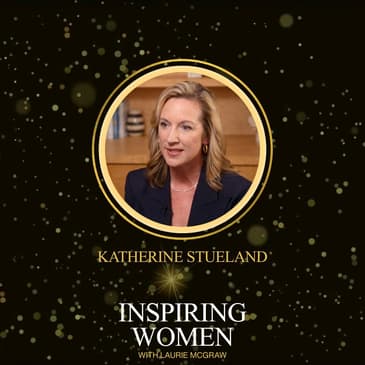

Katherine Stueland is President and CEO of GeneDx (Nasdaq: WGS), a $3 billion public company that diagnoses more children with genetic disease than any lab in the world. Since taking over in 2021, she has brought the company to profitability and launched new tests that are changing how rare disease is diagnosed. On the day of this recording, she was named a 2026 Fierce 50 honoree for Health Equity.
In this episode of Inspiring Women, Katherine talks with host Laurie McGraw about:
- Why it takes an average of 5 years to diagnose a child with a genetic disease, and how GeneDx now delivers a fully interpreted genome in 48 hours
- GeneDx's origin story at the NIH under founder Dr. Sherri Bale, whose Gaithersburg, Maryland lab took the hardest-to-diagnose cases
- How the 2013 Supreme Court ruling on gene patents opened the genomics industry
- Making exome and genome testing easier for non-geneticists to order and understand, including pediatricians, cardiologists, and parents
- Why "rare disease" is a misnomer when it affects 1 in 10 Americans, half of them children
- Why 95% of genetic diagnoses have no FDA-approved therapy, and how more data can change that
- Careful listening as a CEO skill, and balancing quick decisions with contemplation
- Using gut and lived experience alongside data and AI to make big decisions
Katherine previously served as Chief Commercial Officer at Invitae before joining GeneDx.
Inspiring Women is hosted by Laurie McGraw.
#InspiringWomen #KatherineStueland #GeneDx #RareDisease #GenomicMedicine #WomenInLeadership #HealthEquity #Fierce50
[00:00:00] Access side of things, how do we make it easier to order? But then on the other side of it, what do I do with this information now? It's our job to translate it, to make it more understandable for the non-geneticist. And by non-geneticist, we mean for a cardiologist, for a pediatrician, for a neurologist, for a parent, for one of us just to be able to read it and say, okay, now I know what to do.
[00:00:21] This is Inspiring Women. I'm Laurie McGraw, and today I'm speaking with Caroline Stokes Catherine is the president and CEO of GeneDx. This is a public company worth $3 billion. Catherine took over this company in 2021 as CEO. She's brought the company profitable, but most importantly, she's delivering brand new tests, scientific breakthroughs out in the ecosystem.
[00:00:52] We're going to talk about that in terms of what that means for rare disease and how to take an academic NIH spin-out and turn it into a market-leading company. Catherine, I understand you also were awarded just today in terms of the many accolades that you have been awarded just today. You've been named to the fierce 50 most important women in the world for health equity. I want to understand what that means in terms of your impact. Catherine, thank you for being on Inspiring Women.
[00:01:22] Thank you so much for having me. Well, let's get started. Let's get started, Catherine. So first, I want to start with you. And in terms of what you're doing right now as president and CEO of GeneDx, tell us a little bit about the company and what the most important things are that you work on.
[00:01:44] Well, you know, I think number one, our goal is to try to diagnose anyone who has a genetic disease as early as possible. The earliest point at which you can diagnose a disease, it gives you the greatest chance for improved health outcomes. It gives you the greatest number of options in terms of treatments and clinical trials and other medical interventions.
[00:02:10] And the problem is that it takes on average five years for a child to be diagnosed accurately with a genetic disease. So our entire mission is about how do we get information that resides within each one of us into our hands so that way we can diagnose disease early and help empower people to have the healthiest life possible. So we have been doing this for 26 years.
[00:02:40] So we have been doing this for 26 years. I've joined the company just over five years ago, really, to help grow and scale the company. But we were very proud of our heritage. We started at the NIH.
[00:02:52] So I'd like to think that we're kind of this picture perfect example of government funded and founded science that today, thanks to amazing, amazing researchers and clinicians and experts and now commercial and business people and technologists are able to deliver better health outcomes and run a really healthy business that allows us to keep reinvesting in our core technology.
[00:03:22] Caroline, you took over this company just a couple years ago, but you grew up in this field. You were the chief commercial officer of Invitae. You know this space very, very well.
[00:03:34] And there's something really different about leading a commercial organization with amazing science than being grounded in science. I say this having spent many years at the American Medical Association, an outstanding organization, but commercial is different. So you competed against GeneDx before you became the leader of GeneDx. How did that transition to the CEO spot happen for you?
[00:04:03] You know, when I first started in the genomics industry, which was in 2013, it was the year that the Supreme Court determined that you couldn't patent DNA and really opened up this entire field.
[00:04:17] We all had been talking about the promise of sequencing everyone at birth and empowering everyone to have the insights from their own DNA to be able to help guide healthcare decisions as early as possible. But the industry, for many reasons that made incredible sense from an industrial logic standpoint, the industry was really focused on multi-gene panels.
[00:04:46] So moving from BRCA1 and BRCA2 to, you know, there's now dozens of genes that are on a multi-gene panel. But what GeneDx was really able to do over those years is invest in the core technology, build the biggest reference set of data, genotypic data and clinical data from notes that a doctor might submit that give clinical context. And so they've been building this core technology.
[00:05:17] What we needed to do on top of that core technology is take that same industrial logic. How do we bring down the costs? How do we bring down the turnaround times? How do we bring down the test?
[00:05:39] So the work that we've done over the past five years at GeneDx is really built on a foundation of clinical excellence. It's built on a foundation of the best technology. But we've been able to bring the scale factor that ultimately benefits more and more patients and more and more families each and every day.
[00:06:02] Well, you know, being grounded and rooted in the academia, you know, the science is so, so important. But also the why, like the academia research is all about the impact. So let's just talk about that for a second because, you know, this recognition, you know, Fierce 50 for health equity.
[00:06:25] We know that these tests and the opportunity to understand disease down to the level of the gene is incredibly incredible in terms of the opportunity and the breakthrough opportunity. But you mentioned access. You mentioned affordability. And that's where the equations start to break down. Health equity is all about access, meeting people where they are.
[00:06:53] Everyone has the opportunity for great health. So tell us, you know, what you're thinking about there. Why are you being recognized in this very important way? It's speaking to some of the most important issues in this space.
[00:07:07] Well, Laurie, I think your comments about great science, you know, and our origin story, I think it's important to give a shout out to the founder of the company, Dr. Sherry Bale, who is at the NIH. And she was one of the few people, she was training fellows at the NIH.
[00:07:30] And she was the person that doctors, as patients would kind of be, as patients would move through the health care system and they would be referred out to different specialists in different hospitals. They would get to a geneticist and finally, even the geneticist couldn't answer. They would send their patients to Dr. Bale. And so the hardest to diagnose ended up in her clinic.
[00:07:56] And that really is the origin story of GeneDx. As her caseloads were growing, it opened up to this amazing opportunity in this laboratory that still exists in Gaithersburg, Maryland, where we're now seeing it's no longer a few patients. It's, you know, a few thousand, you know, every single day that are coming through our doors.
[00:08:21] So I think that it really is a story of, if we think back to the promise of the Human Genome Project, we're now actually seeing the fruits of that investment that we made as a country that is playing out, whether it's in a pediatric office or if it's in a cancer clinic.
[00:08:46] We're now all benefiting from more and more information, access to more and more information. And the totality of that, I like to think if we look at the work that's been done in the cancer space, we're diagnosing earlier. We have more cancer immunotherapies that are on the market that are helping patients live longer. And so we really are making so much progress on the cancer side of things.
[00:09:16] We want to do that same work here in, I hesitate to call it rare disease because it impacts one in 10 Americans. It's a bit of a misnomer. Half of them are children. Anytime I'm out there telling our story, I hear from so many people, well, this is impacting my family or my neighbor's family or my college roommate's family. So I like to think of it more as genetic medicine.
[00:09:43] We want to catch up to the progress that's been made on the cancer side of things. We have a lot of cleanup to do. We have a lot of, as I mentioned earlier, five years average time to diagnosis. We can deliver information from a genome in 48 hours, fully interpreted in a report to a clinician in 48 hours.
[00:10:05] So there's no reason that anyone should have to go on what we call a diagnostic odyssey any longer than, you know, a few weeks or a few days. How, though? I mean, like, you know, we're the breakdown in this area. I mean, there aren't enough clinicians. There aren't enough PhDs, you know, available to do the work. How are you able to break through?
[00:10:32] And I mean, that's an astounding, you know, in terms of what is possible. How were you able to do that? A couple of things. One, again, looking back at what we've been able to do on the cancer side of things, hereditary cancer testing is now being offered in so many different clinics. It used to only be offered in the genetic counselor's office.
[00:10:58] It then moved into the oncology clinics, then moved into OB clinics, then moved into primary care clinics. So I think there's a really good proxy out there for we've done this well. In part, it's our job to make sure it's easier to order for a non-geneticist. And so how do we design that to that way? If you have a patient coming in, how do I know if it's the right patient to order a test for?
[00:11:27] What are the symptoms? So how do we make it easier for a clinician to make that call? Aligning those with guidelines. There's really important guidelines that are out there that guide those sorts of decisions. The American Academy of Pediatrics last year updated their guidelines to say if there's a child where you suspect there may be developmental delay, you should order an exome or a genome. So the access side of things, how do we make it easier to order?
[00:11:57] But then on the other side of it, what do I do with this information now? It's our job to translate it, to make it more understandable for the non-geneticist. And by non-geneticist, we mean for a cardiologist, for a pediatrician, for a neurologist, for a parent, for one of us just to be able to read it and say, okay, now I know what to do.
[00:12:20] So this is one area where I think AI is incredibly helpful, being able to really help us translate the complexity of an entire genome into not just here's a report, but here's a care plan. Here's a very clear action plan for what you do. So that's part of what we're trying to do.
[00:12:42] We need to do a better job of educating people and empowering them to know that this is now something that's within reach. I think when people think of a genome or they hear an exome, they think it's probably very expensive. It may be a test of last resort.
[00:13:03] And really, based on the health economic data that we've been able to generate, there's so much benefit to utilizing these tests up front because the reality is we're paying for as your symptoms are developing, as your disease is developing. The healthcare system is absorbing the costs of treating the symptoms, the hospitalizations, the admission into a PICU or a NICU or the cardiac ICU.
[00:13:32] And so how do we circumvent all of those costs and eradicate the unnecessary disease progression and get answers to patients much earlier? A lot of it comes down to making sure that it's paid for and most insurance companies pay for it. But ensuring that there is understanding and access is everything that we need to continue to drive.
[00:13:58] So for just maybe to back up a little bit for our audience who, you know, might not sort of understand this space. I mean, there are obstacles every step of the process. There's not enough expert people to understand what these tests are. You're solving, making it more available to cardiologists, primary care physicians, allowing them to do it. And I'm interpreting what you're saying. So tell me if I'm getting it right.
[00:14:24] You're taking the reading of these very complex breakthrough tests. You're using AI to make that more understandable so that it can be absorbed by more people, including the patient. And then you're also going upstream and making the tests more available because people don't know. These things are breakthrough. But the average person with that child who has some problem, they don't know how to access these tests.
[00:14:53] They don't know all these complicated terms. And affordability is a real thing. So is this right? Are these all the steps that you're hitting? That's exactly right. So thank you. You nailed it. Those are all the right steps. And I would go a step further to say, by the time a parent knows the phrase whole exome sequencing, their child is already so ill.
[00:15:22] And so I remember meeting a mom who's one of the most remarkable parent and now industry advocates. And she said, you know, Catherine, I was going to children's hospitals asking for whole exome sequencing. And she was calling it WES, which I thought we just did internally. And so she was asking for this testing.
[00:15:48] And a lot of the doctors were saying, you know, I could order it for you. But most of the time, there's not going to be an FDA-approved therapy. And that's true. 95% of the time, there's not an FDA-approved therapy. And we need to change that, too. So part of what we're doing in generating more data and testing more patients, we're finding that there's far more people who have these conditions than what was originally believed to be true.
[00:16:18] And so with broader patient populations, it makes it more interesting for biopharma companies to look for drug targets. And ultimately, we want to be able to fuel that ecosystem to be able to go to the FDA and have a regulatory pathway there for more and more therapeutics and technologies like gene editing to be made available.
[00:16:45] So that way, we go from 95% of the time there's not a treatment option for them that's approved by FDA to most of the time there is one. So our role is primarily to provide a diagnosis as early as possible. But considering we test and diagnose more children with genetic disease than anyone in the world,
[00:17:10] I view our, you know, we're in a position of privilege where we can help kind of shape the rest of the rare disease ecosystem and be of service to them. Well, it's a huge area and a huge number of problems to attack. And Catherine, I want to point out to you that you're really passionate about talking about the company and what you're driving and what you're doing.
[00:17:37] And you artfully deflected my question about you. So I'm not going to allow that on inspiring women. You know, your most recent award, you have publicly talked about thinking about yourself as not the CEO type. So maybe I could just ask you, as the leader that you are, what drives you? You've had already success with the company.
[00:18:04] You've turned it profitable ahead of schedule. You have had, you've put out many more tests during your tenure. You've taken an important organization grounded in science and grown it. These are hard things to do. They take leadership skills. They take things that you have and are delivering. So tell us a little bit about you. What is it about you that is working? What are you learning? What do you even think you could do more of?
[00:18:34] And I say this for, you know, again, listeners who want to do more of it, what they need to learn from you, Catherine, so they too can have that level of impact. Well, I think first, I would say there are people in my life that would say that I inherently am the CEO type. I can be opinionated and make decisions very quickly and direct people well.
[00:19:04] But kidding aside, I think one of the things that, I remember, one of the CEOs who I respect the most was the founding CEO of Invitae. And his name is Randy Scott. Randy's a luminary in the genetic space. And I remember he said, you're one of the most careful listeners.
[00:19:29] And I do think that that is one of the skills that I have honed over the years. It could be because I'm the youngest of three. I have a brother who's 10 years old or a sister who's eight years older. So I did a lot of observing as the littlest one in the family. But I do think that being able to listen and give space to other people to inform my decisions.
[00:19:59] You know, I can certainly sit in a room and make a decision quickly. But that would be, I think, shortcutting one of the best parts of the job, which is getting to work with other people and learn from other people. And having different viewpoints at the table. I just had my executive team in town last week.
[00:20:26] I was commenting that there are about some people who have been with the company for 10 years. We had somebody who had been with the company for about 10 hours. And being able to, you know, honor the experience of 10 years at GeneDx, but also honor, you know, the insights and the learnings from somebody who's been at other companies for the past 10 years and can bring new perspectives.
[00:20:51] So I think one of my pieces of advice to other CEOs is really to make sure that you're listening. Because in our effort to make decisions and move on to the next problem, because there are so many problems to solve as we look at the world that we're operating in and the industry that we're operating in.
[00:21:20] Getting that balance right of listening and contemplating versus being immediately decisive. And then there's times when you've got to make a quick decision. But in terms of what drives me, it's always been impact. It's always been impact. And I think part of what we all experience in our personal lives, navigating the healthcare system, it is complex.
[00:21:47] And every single company, and I believe this to be true, is aiming to put the patient in the middle of decision making. And that's something that we do explicitly when we're making big decisions. What's the right thing for the patient?
[00:22:07] And we have to balance what's the right thing for the business and continually make sure that we can kind of sift through it to a place where we arrive at the decision that is both best for the patient and good for the company. So we can have a healthy business that allows us to reinvest in the patient. But as I think about the complexity of the healthcare system, there are so many problems that we have to solve.
[00:22:37] And for us, it's been kind of a relentless focus on solving this diagnosis problem. But I do think that impact for me is everything and getting people that are, you know, mission-oriented but also are really passionate about the kind of impact that we want to have. That alignment is hugely important.
[00:23:02] Yeah, the impact as the North Star is very focusing. I mean, the world and environment that you are in and leading in, there has always been inherent complexity, but there are also new headwinds. There is, you know, there is a war on science in a new way that is remarkable. Your organization is grounded in, you know, the core principles of science. Really, really important.
[00:23:32] Maybe, Catherine, as we close out, you know, on this Inspiring Woman conversation, you know, in terms of the skills you have today or that you've always relied on, I'd love to know for a leader leading through complexity with intent on impact, what are the skills that you rely on the most that you have or that you're sharpening all the time, you know, in this time of complexity with the intention for continued impact?
[00:24:01] I think one of the tricky parts for all of us right now, you know, we're constantly trying to balance patient care, growth as a company, getting paid for our services, technology that's changing very quickly, and the surround sound of AI.
[00:24:22] And AI can turn everyone into experts and problem solvers for very complex issues. And so you have every single one of your stakeholders who's consulting ChatGPT or Claude to be able to solve a problem. And so then you end up with all of these outputs that you've got to navigate through.
[00:24:50] And they're more sophisticated, very compelling perspectives on how to solve really complicated questions. And so I don't want to, we're a data-driven organization. And at the end of the day, I think some of what does drive good decision-making after listening to your various stakeholders,
[00:25:17] after doing your own research, after taking a look at all the data, there is an element of your own lived experience and gut. And so that's a really important one, both in terms of like what to do and what not to do. And I've had many moments in my career where I've just had a gut on something. And I asked the team to trust me on this one. And I hope for the best.
[00:25:45] And that has served me and the company well in many big moments. Yeah, well, AI is not taking away gut. I like to hear that. That's good. We all still need critical thinking. This has been a really terrific Inspiring Women conversation. Catherine, it has been really wonderful to learn from you. The work that you're doing is important. Thank you for doing it. Thank you for being on Inspiring Women. I really appreciate it.
[00:26:16] Thank you so much, Lori. Thanks for sharing all of these stories.